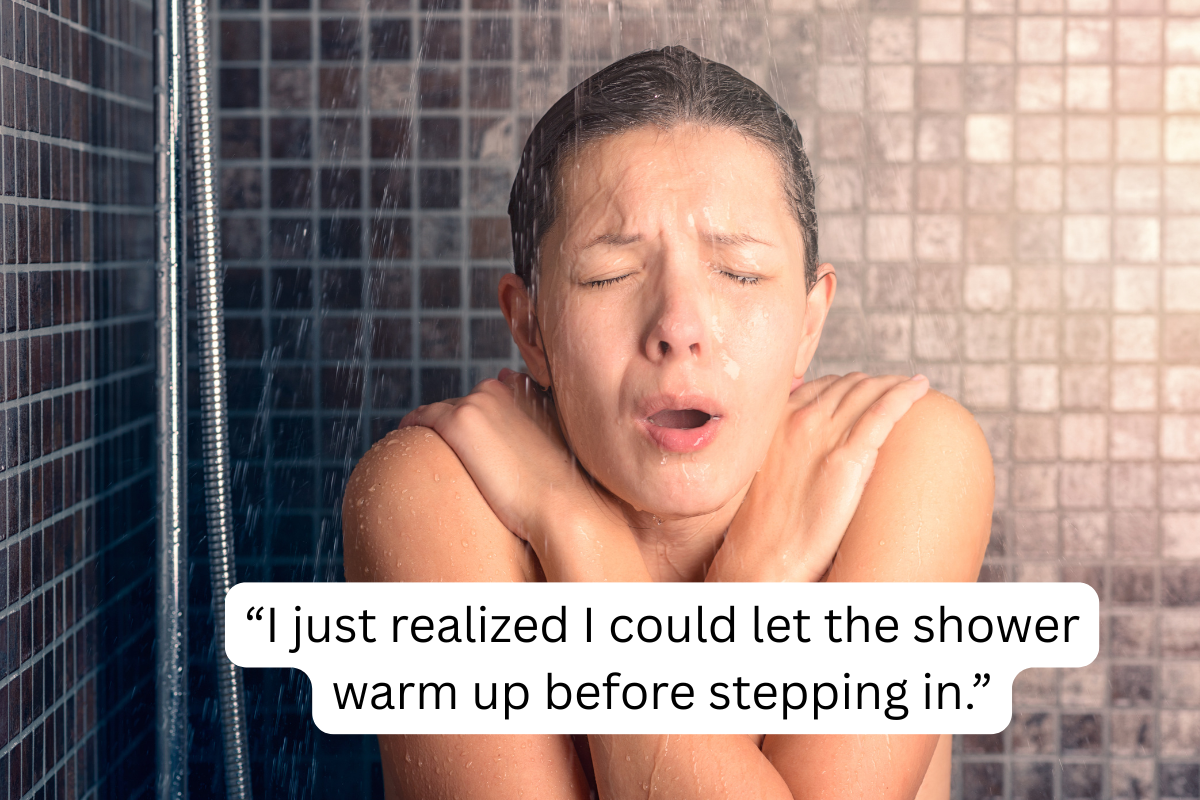
People admit their most embarrassing ‘duh’ moments that took them years to figure out

Visual illusions offer a fun behind-the-scenes glimpse at how our brains work and their limitations. For example, you might see a simple image of two faces side by side, as if about to kiss, and struggle to find any hidden symbols or messages in the picture. Once you realize the image can just as easily…

cold showers, duh moments, life hacks, obvious solutions, adulting, lightbulb moments, realizations, psychology, human behavior, funny
Photo credit: CanvaPeople are sharing mind-numbingly simple solutions to problems it took them years to figure out.

Visual illusions offer a fun behind-the-scenes glimpse at how our brains work and their limitations. For example, you might see a simple image of two faces side by side, as if about to kiss, and struggle to find any hidden symbols or messages in the picture.

Once you realize the image can just as easily be seen as the silhouette of a vase or candle, your eyes immediately find it. You simply get “locked in” to the way your brain originally perceived it, and for a while it’s difficult to see it any other way.

The classic “Rubin Vase” illusion.
Photo credit: Wikimedia Commons

This phenomenon isn’t restricted to the way our eyes and brains perceive visual images. Simple, everyday tasks or problems can have the same effect. Sometimes, a challenge seems frustrating, difficult, or even impossible when the blindingly simple solution is right in front of us the entire time.

These “duh” moments can take an embarrassingly long time—years, even—to occur to us. But we’re all equally guilty of overlooking the obvious from time to time. Thankfully, some brave souls on social media are sharing their most embarrassing “duh” moments so the rest of us don’t feel so alone.

1. You can wait for the shower to warm up before getting in

A user on Reddit bared their soul with this one:

“I didn’t realise you can warm up the shower before you get in for years. Nobody told me the proper procedure so for years I would turn it on while I’m inside already, then kinda hide in the corner while I wait for it to warm up.”

Surprisingly, they’re not the only ones. While there’s a whole subset of people who believe a few minutes of cold water does the body good, there’s another—perhaps larger—group of people who simply never realized waiting for the water to heat up was an option.

2. You’re allowed to separate bunches of bananas at the grocery store

Another poster was eternally frustrated that the store never seemed to have a bunch of bananas in quite the right size. It was always either too few or too many. It took them years to realize there was an incredibly simple solution:

“I didn’t realize until I was 25yo that you were allowed to rip apart banana bunches at the grocery store to get the amount you want. I always thought you were required to grab a bunch that had the exact amount you wanted.”

3. Turn the electric toothbrush on once it’s in your mouth

A viral post on X had everyone laughing at the thought of specks of toothpaste flying across the bathroom:

“When I was 18 I bought an electric tooth brush. I would apply paste to the bristles, turn it on and try to shove it in my mouth as fast as possible without slinging the paste everywhere. One morning, my then girlfriend looked at me and asked ‘why don’t you turn it on after you put it in your mouth?’ Top 5 dumbest feeling I’ve ever felt in my life.”

cold showers, duh moments, life hacks, obvious solutions, adulting, lightbulb moments, realizations, psychology, human behavior, funny
There’s an easier way to brush your teeth. Photo credit: Canva

4. A double scoop of ice cream can be two different flavors

One person had been living their entire life under the crushing weight of wanting to try multiple flavors of ice cream but not being able to—until it hit them:

“[Recently I learned] that if you order a double scoop of ice cream, it doesn’t have to be the same flavor for both scoops. I grew up poor and never had double scoops as an option. I learned this a few weeks ago and I’m 47.”

5. Scraping the dishes before washing them makes cleaning less disgusting

Another Redditor admitted they dreaded doing the dishes because of all the soggy chunks of food floating around in the water:

“It only recently occurred to me that I can use a dry paper towel to wipe away the bulk of the filth straight into the garbage can making doing dishes notably less disgusting. Why’d it take me so long to think of that?”

6. A dull box cutter blade can be saved

There’s nothing more annoying than digging your box cutter out of the junk drawer or toolbox and finding it dull past the point of use. If you’re like this X user and aren’t in the mood to sharpen it, you might be overlooking a far easier way to fix it: Flip it over.

“I threw away 3 box cutters before i figured out you can not only flip the blade when it gets dull but you can replace it too…..”

7. You can (usually) lift up the stove grates, or even the entire top

Cleaning the stove is a gross, annoying job. It’s made even worse when you’re unwittingly doing it on hard mode, like this person’s daughter-in-law, who must have been painstakingly scrubbing between the grates:

“I was cleaning the kitchen and had the stove top lifted up, my sons wife walked around the corner and was like ‘what the hell? I didn’t know stoves did that!! They need to teach these things in high school!’”

8. There’s an easier way to fill the coffee maker

How do you make sure you’ve added the right amount of water to the coffee maker before brewing? For some, it can be a painstaking, one-cup-at-a-time process—until they realize there’s an easier way:

“I used to always pour water into our coffee maker one glass at a time. It was such a pain … especially to fill the reservoir to the number of cups I wanted. Until I realized I could just fill the carafe with water, which has the exact same measurements, and pour the water in that way.”

“My coworker, in the first week of work, picked up the whole damn coffee maker and brought it over to the water cooler to fill it up. The whole. Coffee. Maker. He unplugged it and carried it across the office. Outstanding.”

9. Small cats can fit through big holes

Once upon a time, there was a busy man whose cats were always interrupting his work. He wanted them to be able to come and go through the door as they pleased without bothering him, so he cut two holes in it: One large hole for the mother cat, and one smaller hole for the kittens. It wasn’t until a carpenter pointed it out to him that he realized the smaller cats could just…go through the big hole.

This “duh” moment is alleged to have happened to Sir Isaac Newton, who—legend has it—went on to invent the cat flap. The story is likely apocryphal, but it’s probably based on some kernel of truth.

So, if it can happen to one of the smartest astronomers, physicists, and mathematicians who ever lived, you definitely shouldn’t feel bad the next time you realize you’ve been struggling with a problem that has a laughably obvious solution.

  • Happiness expert shares the ‘real science’ in placing a hand over your heart to lower anxiety
    Photo credit: CanvaA woman puts her hand on her heart.

    Navigating ways to address anxiety can be one of the most beneficial lessons a person can learn. Sometimes we can “trick” the very neurochemicals that send signals throughout the synapses of our brains. In doing so, we might (at least at times) help calm ourselves down when we detect danger.

    A clip of Dan Harris, the 10% Happier podcast host who is often deemed an expert on happiness, has been making the rounds where he gives a “three-step reset” for anxious feelings. During his appearance on radio host/podcaster Elvis Duran’s show, Harris shares what one can do when they begin to spiral.

    First, recognizing that the spiral is happening in the first place is essential. “Notice this is happening,” Harris says. “I’m in a moment of anxiety.”

    Hand on heart

    The second step might be rather surprising to some, especially since it’s steeped in science. “Step number two, and this is where it gets a little cheesy, is… hand on the chest. You can put your hand on your heart. You can hug yourself. A lot of data show this triggers the parasympathetic nervous system. In other words, the aspects of your nervous system that are activated when you’re resting. So it just relaxes you.”

    Talk to yourself like you would a friend

    And third is self-love, in the same way you would love a dear friend. “Say to yourself what you would say to a good friend. Using your own name. I’ll say to myself, usually, ‘Dude. I know you’re worried about losing everything and living in a flop house. But that’s irrational. You’re totally fine. And even if it did happen, you’d still have your wife and son. And all of your friends. And your purpose on earth to help other people. You’re good.’”

    Harris adds context. “Moments like that, if you’re in the car or on the way to a terrible job, or you’re leaving a domestic situation… that stinks. Again, I can’t fix all of that for you. But I can help you navigate regulating your nervous system. Deep breaths, as mentioned, and talking to yourself in a supportive way. Especially if you’re alone and there’s nobody to share your problems with. You can be your own support system.”

    He adds, of note, that simply because these tools can be helpful, doesn’t mean that one shouldn’t reach out for external assistance. “Doesn’t mean you don’t need other people—you do. But you have a lot within your own mind and heart right now that can help you.”

    Three step reset

    On Duran’s Instagram page (and posted elsewhere, as well), the three reset steps are written clearly in the comments:

    “1: Notice you’re spiraling and call it out. ⁣
    2: Put your hand on your heart (yes really!)—science shows this calms you.⁣
    3: Talk to yourself like you would your friend, using your own name.”

    Cortisol reduction

    Upworthy spoke with Dr. Anna Elton (LMFT), who relayed how helpful heart-touching can be in times that are perceived to be stressful. “Research shows that even simple self-touch can reduce cortisol and buffer stress responses by signaling safety to the nervous system. It increases body awareness, helping you feel more in touch with your body and more connected to yourself, while shifting attention away from anxious thought loops.”

    Ancient practices

    Therapist Caitlin Blair helped explain to Upworthy further how it works. “Any practice where you are bringing awareness into your body, such as placing a hand on the heart, can help bring you out of a thought spiral and feel more grounded. Many ancient practices such as yoga have used the hand over heart to feel connected to their bodies and spirits.”

    It’s not just the heart, she adds. “Other similar practices may include adding a hand on your abdomen or belly, where a lot of folks hold their stress, or focusing on their breathing. Anyone who considers themselves an over-thinker or compartmentalizer can really benefit from these body-based practices to reduce stress.”

  • People reveal how much happier they are after ditching these 7 so-called ‘required’ things
    Photo credit: Canva (Bulat Silvia)Woman sees the solution to the maze.

    There can be a lot of pressure to do what our communities and peers expect of us. Some people find absolute bliss by letting go of peer pressure. Imagine the joy in doing less of what is “required” and more of what’s right for you.

    A question was posed in a recent r/AskReddit thread: “What’s something you didn’t realize was optional in life until you saw someone simply not doing it?” Comments ranged from common-sense opinions to valuable life lessons. It’s a curious thought about what things we might be engaging in that aren’t actually serving us. Perhaps you will remove a few of these from your behavioral patterns.

    rally, opinions, behavioral change, mindset shift, emotional well-being, life improvement, self-awarenesss
    People at a demonstration rally. Photo credit:u00a0Canva

    My opinion is necessary on this

    A few quick keystrokes, and our thoughts and opinions are easily shared on a seemingly endless stream of topics. Often with little repercussions, someone might even find themselves telling a professional how to apply their field of expertise properly.

    “That you don’t actually have to have an opinion on everything. Watching someone say “I don’t know enough about that to comment” made me realize silence is an option too.”

    Here were some clever responses to that way of thinking:

    “I find such peace in not forming opinions about a lot of things.”

    “it’s cheeky but liberating for me when people ask, ‘what do you think about […]?’ and I reply, ‘I don’t’”

    “Social media has been the biggest driver of people thinking they have to have an opinion on everything & it has destroyed the fabric of society.”

    “Some things are really, really complicated and I’m not being paid to figure them out”

    social event, self-libation, invitation, friends, excuses, appointments, parties, unhealthy routines

    People at a party. Photo credit: Canva

    It’s important to attend the events to which I’m invited

    Maybe it seems like a form of rocket science to uncover the best way to excuse ourselves from something. But, perhaps it’s actually simpler to say “no thank you” than come up with an elaborate excuse.

    “Saying ‘thank you for the invitation, but I/we won’t be able to make it!’ to a social invite without providing a detailed explanation about WHY you can’t attend.

    These responses sum up the idea nicely:

    “Usually the person you’re talking to doesn’t even care that you don’t have a reason. They were just wanting to hear yes or no”

    “BECAUSE I DON’T LIKE YOU, KAREN!”

    “when I was young my mom taught me that “No.” is a complete sentence.”

    “Yes and this also applies to work if you’re using to or vacation. You earned that time, you don’t have to explain why you want to use it. Same with canceling appointments.”

    worry, problems, lifestyle cleanup, behavioral pruning, cognitive learning, social pressure, conformity bias

    A man worried on a bench. Photo credit:u00a0Canva

    Worrying about everything

    It’s easy to get wrapped up in fear and worries. But how many things do we actually have the ability to change? On top of that, how many things are actually interfering with our lives and overall happiness?

    “The world doesn’t end if you burn a pizza, or if the water spills over when boiling pasta. That guy who cut you off isn’t the worst part of your day, the staff member at the store checking your ID isn’t a bad person. You can just “not” react to those things, and life gets a whole lot easier.”

    Redditors seemed to settle into this concept rather easily:

    “I was irritated that an accident on the freeway made me late for my first day of a new job. I took a step back and realized the people involved in that accident likely wished that my issue was their problem that day.”

    “I try and teach my little niece this – ‘whoopsie daisies!’ and ‘no big deal, we’ll clean it up! are common phrases my sis and I use.”

    “Growing up my dad always said ‘don’t sweat the small stuff.’ Used to piss me off because he usually said it when I was arguing with my sister LOL. But now I think it’s actually such an important view to have.”

    “I stress myself out about trying to do the best I can, trying to fight executive disfunction, being fast and efficient and right the first time. I really need to let that go and relax more.”

    neighbors, community influence, socail modeling, herd behavior, perceived norms, normative behavior, social expectations

    Sipping coffee and not answering the door. Photo credit:u00a0Canva

    When you’re home, make yourself available

    To some, this may be a novel concept that we are not at the beck and call of people. Perhaps it’s reasonable and fair to get back to others when it’s most convenient for us.

    “Was casually speaking to my neighbor and she mentioned the neighborhood was getting hit hard by solicitors lately. I told her a few were selling internet plans, no name wireless, and pest control services, she looked at me like I had a horn between my eyes and asked me why I was opening my door to strangers. Made me really think about how programmed we are to answer the door, to anyone and everyone who may or may not be nefarious. So, I just stopped, because it IS weird I would open my door to someone I’m not expecting.”

    People responded with their own thoughts about not answering the door:

    “The doorbell and phone ringing are requests for your attention/time. You get to decide if you grant those requests”

    “And you don’t have to hide from them either! Look out your front window, realize it’s a salesperson, wave, and then ignore them til they leave.”

    “Years ago I realized that my door, much like my phone, is for MY convenience, not the world’s.”

    “My intercom is on private. I disabled my doorbell, and less than five people know my full address. I also only speak to one neighbour. Makes for a peaceful life.”

    habits, reading, books, optional norms, myth-busting, self-permission, optional norms, hidden freedoms

    Closing the book. Photo credit:u00a0Canva

    When you start something, you must see it through to the end

    Sometimes it’s hard to put things down. Just because we “started” doesn’t necessarily mean “stopping” makes us a quitter.

    “This was a revelation to me, when a friend casually mentioned that he’d started reading a particular book, but it didn’t grab him, so he stopped. I pushed back because I’d somehow got the idea that if a book didn’t interest me, that was a fault in me for not getting it/trying hard enough/being smart enough, but he was like ‘it’s the authors job to make me want to keep reading’.”

    Commenters agreed that it’s worth stopping before finishing:

    “The same goes for TV series, movies, videogames, etc. If you’re not enjoying it or you’ve had enough you can just stop.”

    “And a book can be great but still not for me. Sometimes I just can’t get into it at that point in time or ever.”

    “Just because you invested money into it doesn’t mean you need to see it through to the end. Do something else.”

    “Yes! For a long time I felt this need to finish any book I picked up and I forced myself through some that truly just did not mesh with me.”

    care instructions, ironing, convenience, dishwasher, complicated tasks, emotional resilience, stress reduction, mental expansion

    Care instructions. Photo credit:u00a0Canva

    Things have more value if they’re complicated

    There’s something to be said for having the time and patience to work through a challenge. However, filling up our lives with complicated tasks isn’t necessarily the best plan for a more enjoyable life.

    “I call myself a Darwinist about my belongings. If you can make it through the washer/dryer, or the dishwasher, then you get to survive. Saves a whole lotta hassle, and reduces expectations.”

    These were some of the opinions people had around making life less complicated:

    “I’ve got this great ironing hack called ‘Don’t buy clothes that need ironing.’”

    “For me, it’s ‘if I can’t throw it in the dishwasher, I don’t want it in my kitchen’. Gasp in horror that I don’t follow your 5-step knife care routine, but I really dgaf.”

    “Yup, I still remember the exact Sunday night years ago when I was ironing my dress shirts for work thinking to myself ‘Why am I wasting time outside of work doing work related stuff?’ That was the last time I wore clothes that needed ironing to work.”

    “I know of people who iron their sheets. It doesn’t have to be like this. We can break the cycle.”

    family matters, wellness outcomes, mindful living, best friends, bullies, poor relationships, unhealthy people, psychological thriving

    An awkward hug. Photo credit:u00a0Canva

    Stay true to your friends and family, no matter what

    This one might be a bit more complicated than most. However, everyone has the right to determine if a friend is bringing value to the relationship.

    “My closest pals through me a little party and they asked who I wanted to come and I left someone off the list that we’d normally invite. They asked and I just said: unless you guys really want her here, or if it will cause an issue, I don’t want her to come. We all know how she’ll act and I just want to have a nice time. Everyone agreed though: we’re all tired of her behaviour. So we didn’t invite her and had a wonderful time.”

    These were some thoughts by other Redditors:

    “Yep my mil has a huge problem with me not wanting to see or speak to their bigoted racist family. I want nothing to do with them.”

    “I just hope your not dropping family because of their views / ideologies / politics, but because of how they treat you.”

    “Dropping toxic friends and, most especially family, out of your life. “What do you mean you’re not inviting A**hole Uncle Frank to Thanksgiving?” “Yup!” It is soooooooo good!”

    “But who’s going to complain about the Obamacare royalties if Uncle Frank doesn’t show up????”

    Calvin and Hobbes, boy, flying, freedom, animation, spring, animated, funny, humorous

    Calvin flies with the birds. media1.giphy.com

    Experts agree that letting go of these issues can make for a happier life

    Learning how to adapt to what actually works in our lives is a valuable tool supported by science.

    A 2025 study in BioMed Central found that hanging out with peers who engage in problematic behaviors increases depression. Learning how to protect ourselves against adopting behaviors that don’t actually serve us strongly supports emotional growth and self-esteem. A 2025 study in the Wiley Online Library found that positive self-view protected individuals from engaging in harmful behaviors. Learning how to curb unproductive habits can lead to more happiness. A 2022 study in MDPI showed that treating yourself kindly and being mindful of your emotional state and personal needs contribute to overall well-being.

    This article originally appeared last year. It has been updated.

  • Woman quits 6-figure job to live on cruise ships and discovers complicated reality 2 months in
    Photo credit: abroadthattravels/InstagramA woman left her six-figure career behind to live on cruise ships full-time, but shares pros and cons.

    We’ve all thought about it. Almost every one of us has been at the beach, at a resort, or on a cruise and thought, “Wow, I really wish we could just stay forever.” The dread of going back to “real life” hits hard on that last day of vacation, and it’s hard to stop your mind from wondering what exactly it would look like to just… stay.

    Some bold folks actually do it. Cruise ships, in particular, are a popular destination for people who want to permanently live on “vacation” because they can be relatively affordable and come with built-in food, adventure, and entertainment.

    Emma, who is in her thirties, recently decided to pull the trigger and do exactly that. Earlier this year, she quit her six-figure job in order to live full-time aboard cruise ships.

    Emma’s partner of several years makes a living gambling on cruise ships as a professional poker player. Emma, who goes by A Broad That Travels, says he would be gone for weeks or months at a time sailing, and she finally had enough of all the time apart.

    “There was a point in time where we were just apart for more than half the year while he was cruising and I was doing my corporate grind, and it was really difficult,” she says. “There were some cruises and some adventures he was doing where I was like…we have to do this together.”

    So she decided to leave her six-figure career in corporate tech sales behind and join him. Though they had cruised a lot together, the couple had their first cruise as a part of their new lifestyle just two months ago, the first of a four-month stretch of non-stop cruising.

    “At the end of the day, if you’re not with the ones you love and you’re not doing something you enjoy, then what’s the point?” she says. “What’s the point of having a job that makes you a lot of money if you can’t enjoy the perks?”

    Everyone wants to know how Emma manages the finances of only working part-time and living on a cruise ship, and the answer is unique and fascinating: “The finances of the cruise actually work really well because we get free cruise offers from the casino. All we pay are port fees and taxes, which are minuscule in comparison to the standard costs of a cruise.”

    (Emma’s partner, Cael, for his part, also vlogs about the inner workings of his life as a poker player and how he’s able to get so many free cruises.)

    Living on Royal Caribbean cruises, sailing to exotic ports, partying, eating incredible food. They’re living the dream. Right?


    Except Emma says that, while living aboard cruises is fun and adventurous, the lifestyle comes with its challenges. Two months into her journey, she was hit by some of the “dark side” of full-time cruising.

    Many people who choose to live permanently on cruise ships are older and retired, or have enough savings to live off of for a while. Emma is young and still working part-time in data analytics and studying for her MBA, which poses some unique hurdles.

    “Too much of a good thing is challenging,” she says. “It’s fun and it’s really difficult.”

    Emma says the overstimulation—the constant noise, music, people, crowds—is a lot to handle. Finding a quiet space on the ship other than her tiny room to work or study has proven to be almost impossible. About four to six weeks in, she says in a video update, she found herself wanting to go home.

    “I think the biggest misconception is that people think it’s going to be just fun non-stop and that I’m on vacation the entire time,” she says. “I work and go to school, so I’m quite busy!”

    She says it’s challenging to get up every day to work, study, eat normally, and exercise when the entire cruise atmosphere is built around excess and partying.

    The lifestyle can also, surprisingly, get lonely. Emma says that it’s fun meeting people and making friends aboard the ship, but almost all of them disembark at the end of the week, never to be seen again. It’s hard to build community and lasting connections.

    “I’m definitely missing community engagement, things like that,” she says.

    On the cruise, everyone is a stranger, all the time. The other high-status cruisers Emma and her partner meet are often much older, so making friends their own age is a challenge.

    However, Emma says that they have found ways to make it work, and they’re adjusting to their new way of life.

    One thing that’s helped is making connections and friendships with the staff aboard. Those are the only other people that are doing anything close to resembling “living normal life.”

    They’ve found other ways to find community, family, and friendship as well: “We [recently] sailed with family for a 10-day cruise and had a blast! It’s really great to spend time with family after being away from home for so long.”

    She adds that the longer they stay aboard Royal Caribbean cruises, the more they start to see some of the same familiar faces.

    “We also ran into some friends on a cruise last month that we met on a cruise in the summer of 2024 going from Miami to Spain,” she says. “We ended up hanging out with them most of the cruise and catching up. We’re starting to notice a little bit of a community of frequent cruisers!”

    In the end, living permanently aboard a cruise ship (or any kind of vacation environment) seems appealing, but it’s not for everyone. The lifestyle shift can be jarring, and it can be a huge adjustment.

    “A few people have said it’s their dream to do what I’m doing and think there’s no way anyone could have any difficulty with the lifestyle,” Emma writes. “While it is fun a lot of the time, and it is an amazing experience, there are also many aspects of living on a cruise ship that are difficult for me. Travel is often glamorized and I don’t think people like when I break even a small part the illusion.”

    This article originally appeared last year. It has been updated.

  • Philosopher Socrates offered the perfect advice for anyone struggling with self-identity
    https://www.canva.com/photos/MAGycAdElhk-beautiful-woman-looking-at-herself-in-mirror-indoors/Socrates shared advice on how to find self-identity.

    Struggling to find a sense of self is part of the human condition. What makes each person unique and “themself” is a complex topic in psychology and philosophy.

    According to the American Psychological Association (APA), identity is defined by two major aspects. The first: “A set of physical, psychological, and interpersonal characteristics that is not wholly shared with any other person.”

    And the second: “A range of affiliations (e.g., ethnicity) and social roles. Identity involves a sense of continuity, or the feeling that one is the same person today that one was yesterday or last year (despite physical or other changes).”

    The APA adds that it is also “derived from one’s body sensations; one’s body image; and the feeling that one’s memories, goals, values, expectations, and beliefs belong to the self.”

    Greek philosopher Socrates addressed the human struggle with self-identity and self-knowledge—”to know thyself”—and he offered a simple sentence to help.

    Socrates’ advice on self-identity

    According to Socrates, the key to self-knowledge starts in your brain:

    “I cannot teach anybody anything. I can only make them think. To find yourself, think for yourself.”

    In the book Socrates and Self-Knowledge, author and professor of Philosophy and Classics at The Pennsylvania State University specializing in ancient Greek philosophy, Christopher Moore, theorizes that Socrates based “knowing thyself” on questioning one’s self.

    He writes, “a person can be said to have self-knowledge whenever he knows the truth of a statement in which there is reference to himself.”

    However, this does note solely require self introspection. Moore argues self-knowledge is actually best achieved with the help of others. “Socrates, at the end of his long speech in Plato’s Phaedrus, urges his friend to dedicate his life single-mindedly to ‘love accompanied by philosophical talk’,” adding that “self-knowledge comes about through conversation with others, and
    that self-knowledge is akin to knowledge of others.”

    Moore concludes: “Socratic self-knowledge means working on oneself, with others, to become the sort of person who could know himself, and thus be responsible to the world, to others, and to oneself, intellectually, morally, and practically.”

    How to tap into your inner-Socrates

    In a podcast episode with Yale psychology professor Dr. Laurie Santos, fellow Yale professor and philosopher Tamar Gendler explained how to apply Socrates’ lessons into your personal life to help better understand your self-knowledge. She explains that, according to Socrates, self-knowledge is a paradox.

    “To know ourselves is to not know ourselves,” says Gendler. “It is to know that in many ways we do not have direct access to our motivations, that we do not have direct access to what it is that we are actually responding to when we do something. And it’s an endless process of engaging in Socratic self-question.

    To tap into that inner-Socrates, she says there is an inner dialogue looks something like this:

    “Why do you think that?”

    “Is it possible that you think that for a different reason?”

    “Is it possible that even though you assume you value that, actually that’s just an old habit that you haven’t questioned?”

    “Is it possible that you think you’re responding to a person, and in fact you’re responding to a stereotype about people of that kind?”

    Dr. Santos adds that harnessing your inner-Socrates isn’t always comfortable, and involves “intentionally questioning why you think certain things, and why you take certain actions. It also involves admitting that you probably aren’t as smart as you think you are.”

  • Philosopher Plato shared two things humans should ‘never be angry at’ for a more peaceful life
    Photo credit: Canva & WikipediaAn angry woman, left, and Greek philosopher Plato.

    Americans are struggling with anger. The American Psychological Association (APA) defines anger as “an emotional state that varies in intensity from mild irritation to intense fury and rage.”

    According to a 2025 report by the APA, 45% of Americans reported feeling angry or irritable.

    Anger was an emotion that Greek philosopher Plato, who lived from 428 to 348 BCE, knew well and studied closely. He offered wisdom to those seeking answers on how to live a more peaceful life.

    Centuries later, his sage insights are still helping people today. He offered a simple, single sentence to those seeking guidance.

    Plato’s advice on anger

    According to Plato, “There are two things a person should never be angry at, what they can help, and what they cannot.”

    Plato did not shy away from discussing anger in his works on the human experience. He expanded on the Greek term thymos (also spelled thumos), describing it as an “internal psychological process of thought, emotion, volition, and motivation.”

    Plato saw anger as part of human “spiritedness” and “passion.”

    In an essay on Plato and anger, philosopher Gregory Sadler writes, “Anger arises from a perception not only that some harm has been done, some inconvenience has been imposed, some wish, desire, or intention has been frustrated — but all the more from a sense that some wrong has been committed, that someone or something is unjust.”

    Rather than deeming anger morally right or wrong, Plato’s stance is more focused on what humans do with it.

    How to deal with anger

    Plato explained that there are two ways humans can view anger when it arises: through the lens of “what they can help, and what they cannot.”

    Sadler notes, “For Plato, the goal is not total inirascability, an inability to grow angry — nor is it a godlike self-mastery that would preclude any angry responses whatsoever. There are situations in which one ought to grow angry, and act out that anger — when morally this is the right thing to do.”

    The work comes in deciphering when to act on anger and when not to. In short: reason.

    The APA notes that using logic is key to defusing anger:

    “Logic defeats anger, because anger, even when it’s justified, can quickly become irrational. So use cold hard logic on yourself. Remind yourself that the world is ‘not out to get you,’ you’re just experiencing some of the rough spots of daily life. Do this each time you feel anger getting the best of you, and it’ll help you get a more balanced perspective.”

    This is part of what the APA calls “cognitive restructuring,” explaining that it is important to focus on rationality: “For instance, instead of telling yourself, ‘oh, it’s awful, it’s terrible, everything’s ruined,’ tell yourself, ‘it’s frustrating, and it’s understandable that I’m upset about it, but it’s not the end of the world and getting angry is not going to fix it anyhow.’”

    The APA adds, “Angry people tend to demand things: fairness, appreciation, agreement, willingness to do things their way.”

    By turning these “demands” into “desires,” peace can be achieved.

    “In other words, saying, ‘I would like’ something is healthier than saying, ‘I demand’ or ‘I must have’ something,” the APA says.

    For more support, check out the APA’s resources on anger.

  • Mark Twain’s timeless advice on how to become a critical thinker is still wise over 100 years later
    Photo credit: Canva/WikipediaMark Twain shared his advice on critical thinking.

    Mark Twain is one of the most celebrated authors in American history. Throughout his long career as a writer and lecturer, he instilled his wisdom about life to others through masterpieces (such as The Adventures of Huckleberry Finn and The Adventures of Tom Sawyer) and journal entries alike.

    Twain, born Samuel Langhorne Clemens in 1835, consistently put down thoughts and ideas to paper that continue to inspire people today, decades after his death in 1910. His quotes encourage people to steep and mull ideas over in their minds, a skill necessary for critical thinking.

    Twain’s works challenged readers to become critical thinkers, and one famous Mark Twain quote on critical thinking remains particularly relevant.

    What is critical thinking?

    Merriam-Webster defines critical thinking as “the act or practice of thinking critically (as by applying reason and questioning assumptions) in order to solve problems, evaluate information, discern biases, etc.”

    It also notes an additional example from First Amendment expert Greg Lukianoff and social psychologist Jonathan Haidt: “Today, what we call the Socratic method is a way of teaching that fosters critical thinking, in part by encouraging students to question their own unexamined beliefs, as well as the received wisdom of those around them.”

    The root of critical thinking is to analyze ideas and opinions, taking nothing at face value. It’s something Twain lived out in his own life.

    “Mark Twain was not afraid to reject values he had once accepted, and he thought long and hard about how these transformations happened—or failed to happen,” said Stanford Magazine writer Shelley Fisher Fishkin in 2007.

    Mark Twain’s advice on critical thinking

    According to Twain, this is how one becomes a critical thinker:

    “Whenever you find yourself on the side of the majority, it is time to pause and reflect.”

    This quote is cited in Mark Twain’s Notebooks and Journals, Volume II: 1877-1883. According to the University of California Press, it is a conglomeration of 12 of Twain’s notebooks from 1877-1883.

    During this time, he documented three milestone trips he took that deeply impacted him: one to Bermuda, an extended tour of Europe, and his return to his roots on the Mississippi River. 

    For Twain, this quote challenges people to dig deeper about their convictions and popular opinion. While he does not convey a negative connotation towards mainstream (the majority) thinking, he encourages people to use critical thinking through quiet contemplation.

    In his essay titled “Corn-Pone Opinions,” Twain once again challenged conformity. In the essay, Twain “argues that people generally conform their opinions to those held by the majority in their community rather than thinking independently people’s opinions,” per Scribd.

    How to become a critical thinker

    Critical thinking is a practice, and Steve Pearlman, Ph.D., founder of the Critical Thinking Institute, shared his insights in a 2025 Tedx Talk on four steps to help you become a stronger critical thinker.

    “You cannot engage in problem solving at all without making a detailed observation of factors that might matter to the problem, formulating a correct and complex, insightful question about that problem, weighing out different pieces of information as they relate and impact your conclusion to that problem, and ultimately drawing a complex conclusion,” he says.

    1. Analyze and observe
    The first step of critical thinking is not an action at all, but a posture: to analyze and observe what a person sees, hears, and is presented with, according to Pearlman.

    2. Question and clarify
    Rather than making assumptions, Pearlman notes the next step is to ask questions and look for clarity. It’s important to pay attention to any biases or opinions.

    3. Evaluate and examine the evidence
    Next, take a deeper look at evidence and variables. What represented facts can be supported (or not)? Compare, examine and question evidence, notes Pearlman.

    4. Consider alternatives and draw conclusions
    Finally, come to a conclusion. But in that process, he adds that it’s key to weigh alternatives (other possible explanations or viewpoints), using reason-based judgement to come to a decision.

  • Tired of the same old tips on how to be happy? Try ‘7 Tactics to Maximize Misery’ instead.
    Photo credit: CanvaHappiness isn't just a to-do list. It's also a don't-do list.

    Generally speaking, humans want to be happy. At the very least, we want to live with a certain baseline of happiness, even knowing life comes with inevitable ups and downs. An entire self-help industry exists because of this desire, and there’s no shortage of advice on how to be happier.

    But what if the key to happiness was actually knowing how to make yourself unhappy? That’s the idea behind CGP Grey’s video explaining “7 Tactics to Maximize Misery” (an adaptation of How to Be Miserable by Dr. Randy J. Paterson).

    By detailing the habits that make us unhappy, it becomes quite clear why we might be struggling with happiness and what we might want to change. The main video includes a video footnote, in case it’s not abundantly clear that the tactics for misery are not meant to be taken as literal advice, but quite the opposite:

    “You, like me, might find the advice on happiness kind of tiresome,” Grey says. “Almost irritating. So it might be more useful to think about how to achieve the opposite, and thus, to see how the actions we might take work against us…My dear viewers, do not take the main video as literal advice.”

    Now that that’s out of the way, let’s get into the seven ways we can make ourselves miserable:

    1. Stay still

    “Remain indoors as much as possible, preferably in the same room,” Grey suggests. “Be the human equivalent of a pile of laundry…Don’t let a beautiful day tempt you for a walk. Avoid anything even vaguely exercisial.”

    He explains that stillness will keep reward chemicals out of your brain and lead to health problems, which will help you stay in the cycle of stillness and misery. And to be even more miserable, make your bedroom your “all room,” doing all of your not-doing-anything-physical in one small space.

    2. Screw with your sleep

    “A regular sleep cycle is a fragile thing and takes at least three days to establish,” says Grey. “Be sure then to vary your bedtime by several hours twice a week, at least. Even better: vary your wake time. Sleep in late, preferably very late, some but not all days. And tell yourself you are making up for sleep to feel like you’re doing something healthy, even though you feel terrible when you wake up early and when you wake up late.”

    Basically, you want to make sure you befriend irregular sleep and insomnia, never waking up or going to bed at the same time.

    3. Maximize screen time

    “Boredom could drive you to motion, so let the screen entertain you,” suggests Grey. “Tiredness can push you to sleep, so let the screen keep you awake, sort of, as long as possible. Always fall asleep with a screen in your hand and put your eyes back on it as soon as you wake.”

    Grey explains that you have allies on this front:

    “Behind the screen are teams of the smartest people and brightest bots competing to hold your attention on them as long as possible. Let them reach you to pull you back if you turn away.”

    4. Use your screen to stoke your negative emotions

    Grey suggests using your feed to fuel your “anger or anxiety about things over which you have no control or influence.”

    By focusing on the bad and only contributing in meaningless, token ways, especially about things we actually care about, we can further fuel our resentment and despair, says Grey.

    To sum up: “Be well informed while doing nothing.”

    5. Set VAPID goals

    Many of us are familiar with the concept of SMART goals—Specific, Measurable, Actionable, Responsible (or Realistic), and Time-Bounded. Grey suggests setting VAPID goals instead: Vague, Amorphous, Pie-in-the-Sky, Irrelevant, and Delayed.

    “Make the target unclear and the path unclear,” he says. “If motivation strikes, aim ridiculously high to guarantee failure. ‘I will clean the whole house today’ is much better than ‘I will do the laundry in this pile.’ Cleaning a whole house is impossible. There’s always more to do, so you will always fail.”

    Definitely focus on a goal that comes after your current goal.

    “With VAPID goals, you will turn the productive part of your brain from a dangerous source of self-improvement that rewards every small step into a consistent nag that berates you for your failure to have already accomplished your goal every step of the way,” Grey says.

    6. Pursue happiness directly

    “Imagine happiness as a place where happy people are happy all the time,” Grey says. “This turns happiness into an unreachable feeling of constant bliss that no one has.”

    Grey explains that happiness is like a bird that you can’t catch but will land on your ship if you’re not looking. So your best bet is to focus on improving your ship to get it to warmer waters, where the bird will most likely be.

    “So be sure never to do that,” he advises. “Aim toward the mirage of happiness rather than improving the ship upon which you sail.”

     7. Follow your instincts

    “Navigation deeper into the sea of sadness is quite easy, for there is a dark magnetic field that points the compass of your impulses in the right direction once you get started,” Grey says. “You will want to stay indoors, you will want to not exercise. You will want to sleep in, you will want to do what you know will make you sadder after you’ve done it.”

    Following your feelings and impulses instead of focusing on the long term is a surefire way to increase unhappiness.

    Reaction

    If you felt personally attacked by this video, you’re not alone. As one commenter wrote, “My dude literally explained my life without missing the tiniest detail.” That was the point, but not the whole point. It wasn’t meant to just be a mirror, but to help people realize that happiness isn’t just a to-do list. It’s also a don’t-do list that many of us are very much doing.

    This satirical approach to self-help may not be everyone’s cup of tea, of course. But some commenters found it much more effective than traditional “how to be happy” content:

    “This was the hardest hitting wake up call in my life. Thank you.”

    “I watch this frequently. The reverse psychology works a lot better for me than some random guy saying ‘You can do it.’”

    “I’m dealing with depression, and this video both made me laugh, and helped a lot. Sincerely, thank you.”

    “This is a perfect what-not-to-do tutorial that actually helps so much more than all the other ones telling you how to achieve happiness.”

    “Why this video is so helpful: Instead of being one of those sappy, cheesy, motivational videos, this one shows you exactly what you’re doing wrong and sends an ‘Unless you want to amplify it, do the opposite’ message.”

    “This video is just brilliant. He absconded good morals with playful satire, and once you are lured into the video expecting a laugh or two; you realize the flaw of such actions, and how easy it can be to break the cycle of misery. This video was more motivational for me than any video that puts forth a clear label of life-changing tips. I started the video laughing, and finished realizing how essential and simple it can be to take short strides towards fulfillment. Thank you so much for this, CGP Grey.”

  • ‘MIT Monk’ shares his VIBE method for choosing the perfect adult hobby
    Photo credit: Canva PhotosThe 4-part VIBE framework can help you choose the perfect adult hobby for your life.
    ,

    ‘MIT Monk’ shares his VIBE method for choosing the perfect adult hobby

    Hobbies matter more than ever. Here’s how to pick one that’s meaningful to you.

    A survey found that about 15% of adults have no hobbies to speak of. The same survey found that people overwhelmingly agree that having hobbies is important, and also, that they wish they had more time for them.

    Anecdotally, those numbers feel low. It’s rare to find someone juggling career, a household, kids, pets, family, and friends who still manages to spend time daily in the woodshop or quietly crocheting.

    “MIT Monk” says hobbies matter more than ever

    Hobbies still exist, of course, but we have less time for them. Another study found that time spent on socializing, hobbies, and offline activities has decreased over the last few decades while time spent on TV and phones has shot up.

    That’s a trend that severely needs reversing. It’s a simple calculus. Doing real things is good for your brain. Screens are not.

    “The most successful people fiercely protect their seemingly useless hobbies,” says Sandeep Swadia. “That’s their best defense against brainrot.”

    Swadia goes by “MIT Monk” on YouTube, a reference to his time spent both in Himalayan monk training and receiving his MBA from one of the world’s most prestigious Ivy Leagues. He’s also a technology executive and investor, so he meets a lot of high-performing people. His unique background makes him not only an expert in “success,” but also in inner peace and happiness.

    Swadia says all of smartest people he meets have at least one frivolous hobby that they make time for. And not just CEOS and billionaires, but Nobel Prize winners too.

    Perhaps even more importantly, hobbies are fun. They bring us joy, satisfaction, and a sense of accomplishment that’s difficult to recreate on an app or a website. Plus, they’re great for our health.

    But a lot of people simply don’t know where to start when looking to take up a new hobby, even if they’re willing to make the time and put in the effort.

    The “VIBE” framework for choosing the perfect hobby

    Swadia says you don’t have to just hope you have a passion for something. A hobby can actually be a way to improve your life in the very specific ways that it’s lacking.

    But you have to pick the right hobby for you. And Swadia says in order to pick the right hobby, you need a framework. He calls his VIBE.

    Vitality

    “Are you running on empty? Then pick a hobby that gets your heart rate up,” he says.

    It can be fitness and exercise directly, as in implementing a workout routine at the gym or taking a group fitness class. Or you can enjoy active hobbies that have a physical side effect, like hiking.

    Vitality hobbies are something fun, challenging, and non-digital to do, and they have the added benefit of improving your physical health and energy levels.

    hobbies, joy, happiness, mental health, wellness, fun, monk, MIT, expert, chess, gardening, art, color, adult hobbies
    A running club is a perfect hobby that checks multiple boxes. Photo Credit: Canva Photos

    Inquiry

    “Are you easily bored? Then pick a hobby that forces you to be a beginner again.”

    Swadia suggests learning a new language, picking up chess, or taking a formal class on just about anything. Crucially, being a beginner as an adult requires courage. It requires you to fail and face your shortcomings head on. But that’s exactly why being a beginner again is so powerful.

    “Your brain doesn’t adapt or grow when you’re comfortable,” Swadia says. “A hobby allows you to struggle, to be surprised. It forces your brain to upgrade.”

    hobbies, joy, happiness, mental health, wellness, fun, monk, MIT, expert, chess, gardening, art, color, adult hobbies
    Chess will make you feel like a humbled beginner, and that’s the point. Photo Credit: Canva Photos

    Belonging

    If you have a lot of acquaintances and distant friends, you may need to find activities that help you find deeper connections in your community.

    “Try a hobby that weaves you into a tribe,” Swadia advises.

    Anything group-centered works here: a book club, a running group, volunteering, etc. Anything that’s fun, challenging, interesting, or meaningful that you do specifically with other people will bond you to them in surprising and profound ways.

    Expression

    “Do you consume more than create? Then try a hobby that pulls something from inside of you and puts it out into the world.”

    These are the classics: creating and the arts. Woodworking, painting, photography, pottery. Even cooking can be a form of self-expression.

    You don’t need to be good at something in order to use it to express yourself. And getting better slowly over time is a huge part of the fun.

    hobbies, joy, happiness, mental health, wellness, fun, monk, MIT, expert, chess, gardening, art, color, adult hobbies
    You don’t have to be good at art to express yourself through it. Photo Credit: Canva Photos

    You don’t need one hobby per category, Swadia reminds us. Many hobbies can fill multiple needs at once. Joining a running club, for example, can improve your vitality and your sense of belonging all at once. Depending on your starting point, it can also make you feel like a total beginner (Inquiry) again.

    It’s hard to go wrong when picking a hobby

    VIBE is just one framework, and it can help you identify what’s missing from your life and figure out how a new activity can challenge you and make you feel more whole.

    Psychology Today notes, however, that hobbies don’t have to be challenging or designed to stimulate and rewire your brain. They can also be mindless and relaxing, like coloring or reading “trashy” novels.

    More important than picking the right or perfect hobby is picking one at all. Unless there are huge costs involved, you can always try something else down the road if the first one doesn’t work out. What matters is taking care of yourself in order to be at your best.

    “Our 24/7 culture tells us hobbies are selfish. They’re extra. It’s time stolen from work or the people that need you,” Swadia says. “Nothing could be further from the truth.”

Wholesome

Buffalo fans come together to sing Canadian national anthem after singer’s mic cuts out

Health

Love spicy food? Research shows it could reduce your risk of death by 25%.

Family

This mom’s controversial parenting take that her kids don’t have to ‘share’ has the Internet divided

Culture

The strange, forgotten reason so many movies have that ‘all characters are fictitious’ disclaimer