10 photos of seriously wounded vets remind us about the real costs of war.

Their wounds belong to all of us.

democracy, justice, wounded veterans, documentation, portraits
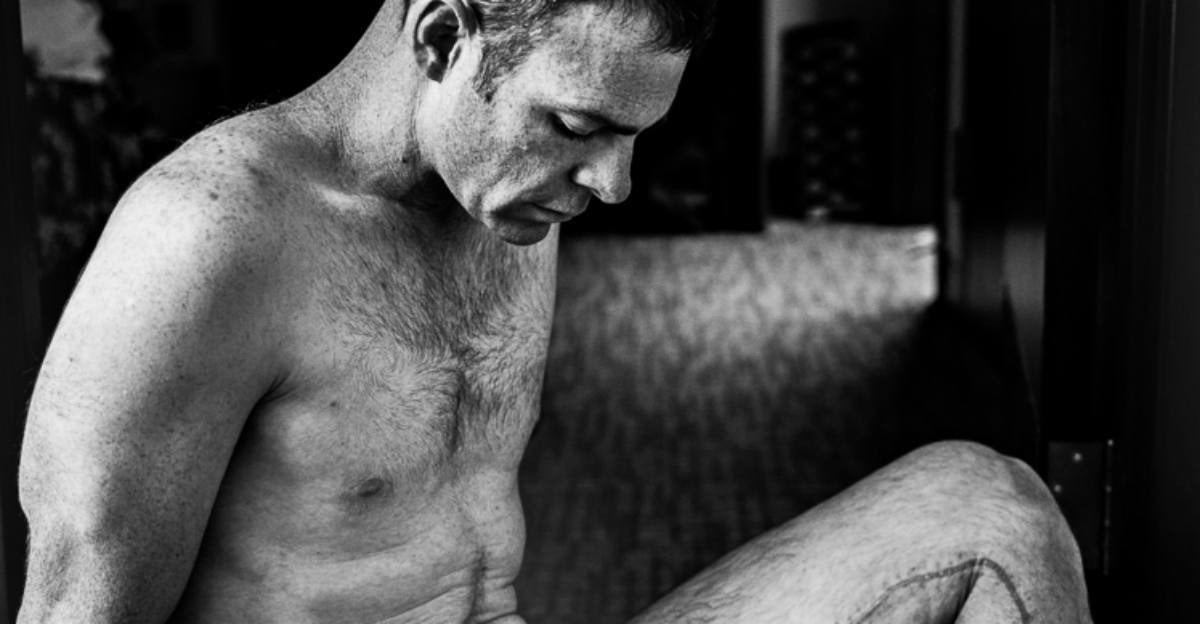
Maj, Matt Smith at Walter Reed Medical Center in Bethesda, Maryland.Photo credit: Image by David Jay/ David Jay Photography.

Photographer David Jay specializes in fashion and beauty, stuff that’s “beautiful and sexy — and completely untrue,” as he puts it. But that’s not all he photographs.

Three years ago, Jay began to take pictures of young, severely wounded soldiers returning home from the wars in Iraq and Afghanistan.

Trigger warning: These portraits don’t shy away from wounded bodies.


Be prepared. I found them shocking at first. But keep looking. The more I looked, the more beauty and humanity I found reflected here. (The photo captions are from the Jay’s Unknown Soldier Project Facebook page. All images used with permission.)
military, body image, disabilities
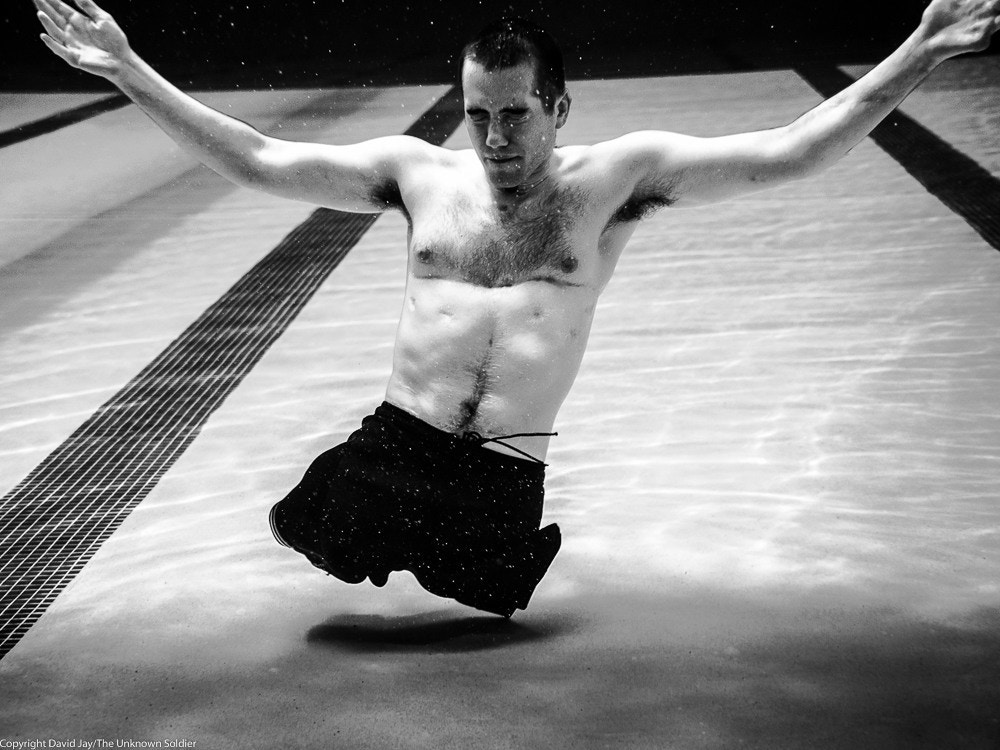
Lt. Nicholas John Vogt, U.S. Army Image by David Jay/ <a href="https://farm.upworthy.com/nuggets/5564a2bd633239000c2f0100/www.davidjayphotography.com">David Jay Photography</a>.

This is 1st Lt. Nicholas John Vogt, U.S. Army. On Nov. 12, 2011, he was severely injured by an IED while on a foot-patrol in Panjwaii, Afghanistan. We took these pictures this past weekend in the swimming pool at Walter Reed Medical Center. I asked Nicholas for his permission to post these images and this was his response: “The only thing that I want to pass on is this: Losing limbs is like losing a good friend. We wish we could still be with them, but it wasn’t ‘in the cards.’ Then we get up, remember the good times, and thank God for whatever we have left.” Image by David Jay/ David Jay Photography. All images used with permission.

In a National Public Radio interview about his project, Jay said, “You can imagine how many times each of these men and women have heard a parent tell their child, ‘Don’t look. Don’t stare at him. That’s rude.’”

“I take these pictures so that we can look; we can see what we’re not supposed to see. And we need to see them because we created them.” — David Jay
photography, mental health, veteran rights
Taking a swim. Image by David Jay/ <a href="https://farm.upworthy.com/nuggets/5564a2bd633239000c2f0100/www.davidjayphotography.com">David Jay Photography</a>.

Jay wants us to see, to become even a little familiar with the tragic loss of limbs and burned skin of wounded vets — his portraits are 4 feet wide — but he also wants us to see them as people and to think about their experiences and those of people in their lives.
health, David Jay, The Unknown Soldier
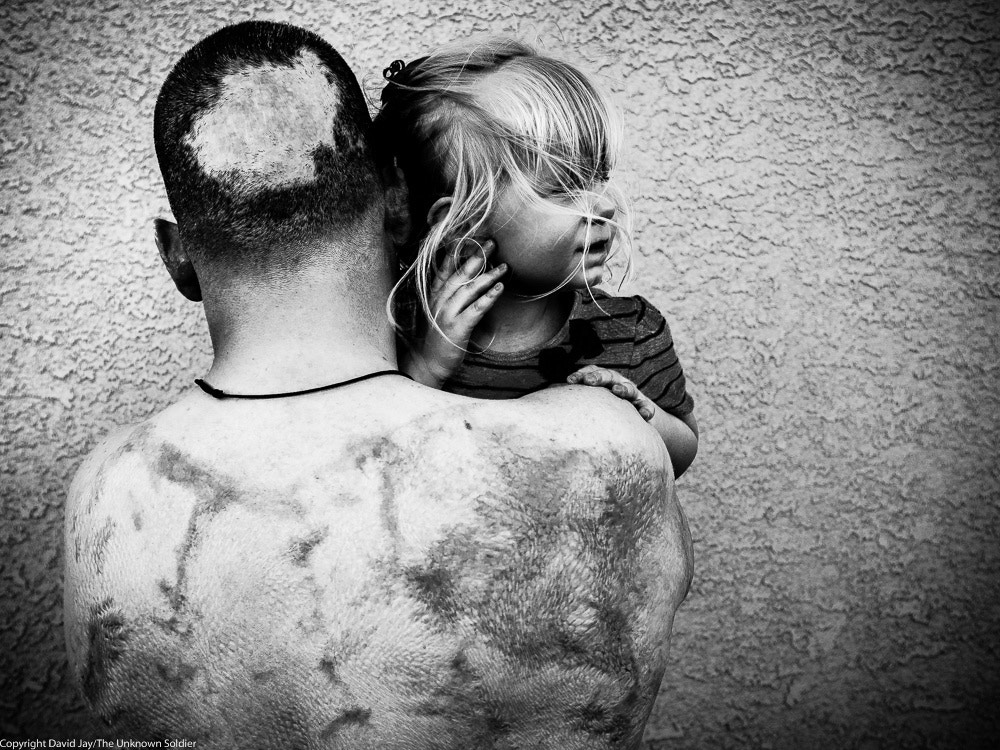
Bobby Bernier with daughter Layla. Image by David Jay/ <a href="https://farm.upworthy.com/nuggets/5564a2bd633239000c2f0100/www.davidjayphotography.com">David Jay Photography</a>.

This past week, I went to San Antonio, Texas. There I had the privilege of photographing both Daniel Burgess and Bobby Bernier. They are friends. Daniel stepped on a IED, losing one leg and destroying the other. Bobby was hit by incoming artillery, sustaining burns over 60% of his body. He is pictured here with his daughter Layla.
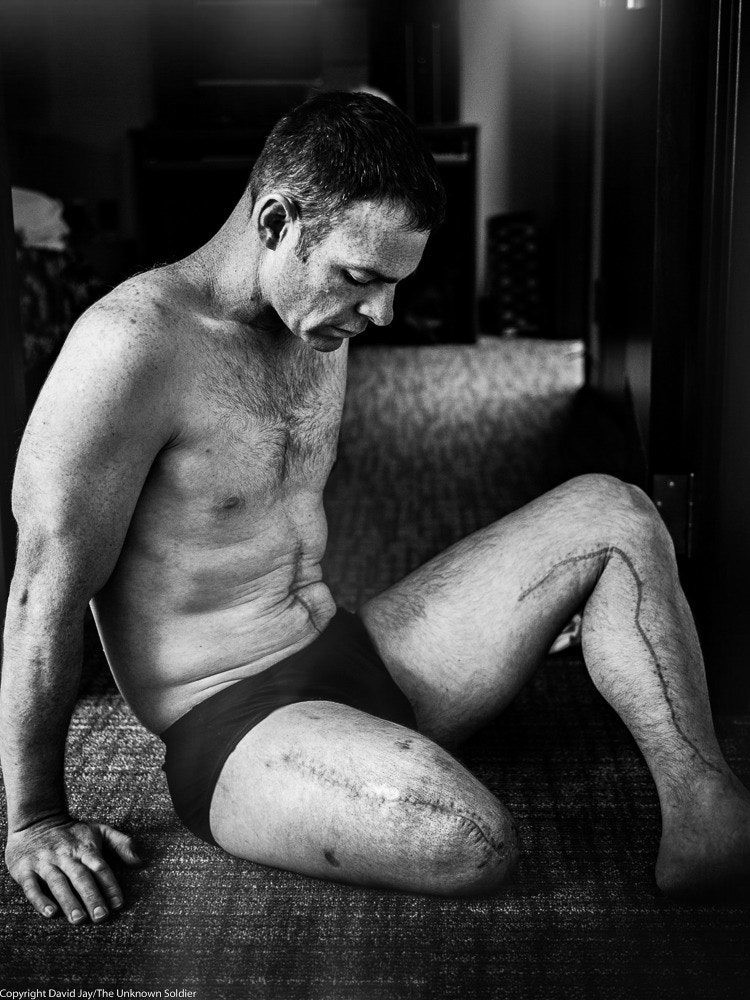
IED, Maj. Matt Smith, Afghanistan
Maj, Matt Smith at Walter Reed Medical Center in Bethesda, Maryland. Image by David Jay/ <a href="https://farm.upworthy.com/nuggets/5564a2bd633239000c2f0100/www.davidjayphotography.com">David Jay Photography</a>.

This is Maj. Matt Smith. This past week, Matt allowed me to photograph him in his room at the Walter Reed Medical Center in Bethesda, Maryland. Less than three months ago, on June 8, 2013, in Paktika province, Afghanistan, Matt was shot along with five others by a member of the Afghan National Army. The bullet severed his femoral artery, resulting in the amputation of his leg. A private and soulful man, it was an honor to photograph him. Thank you, Maj. Smith.

disabled, war, amputee
Spc. Marissa Stock injured by an IED. Image by David Jay/<a href="https://farm.upworthy.com/nuggets/5564a2bd633239000c2f0100/www.davidjayphotography.com">David Jay Photography</a>.
burn victim, roadside bomb, survivor
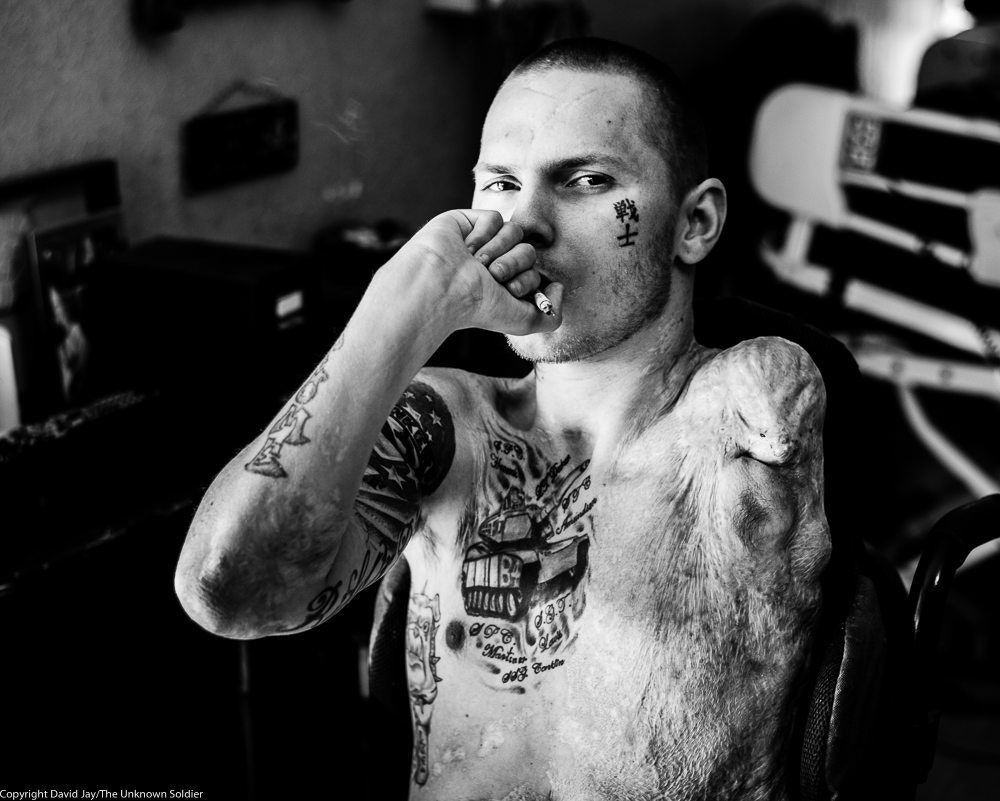
Jerral Hancock survived a roadside bomb. Image by David Jay/ <a href="https://farm.upworthy.com/nuggets/5564a2bd633239000c2f0100/www.davidjayphotography.com">David Jay Photography</a>.

This is Jerral Hancock. He was driving a tank in Iraq. A roadside bomb pierced the armor, breaching the interior. We shot these pics two weeks ago at his home in Lancaster, California, where Jarral lives with his two beautiful children. We ended up hanging out into the night, smokin’ ciggys … so I kept taking pictures.

“To the men and women of The Unknown Soldier, I can’t thank you enough for your courage and sacrifice … both on and off the battlefield. It is an honor to photograph you.” — David Jay

swimming, photography, internal injuries, Airborne Ranger
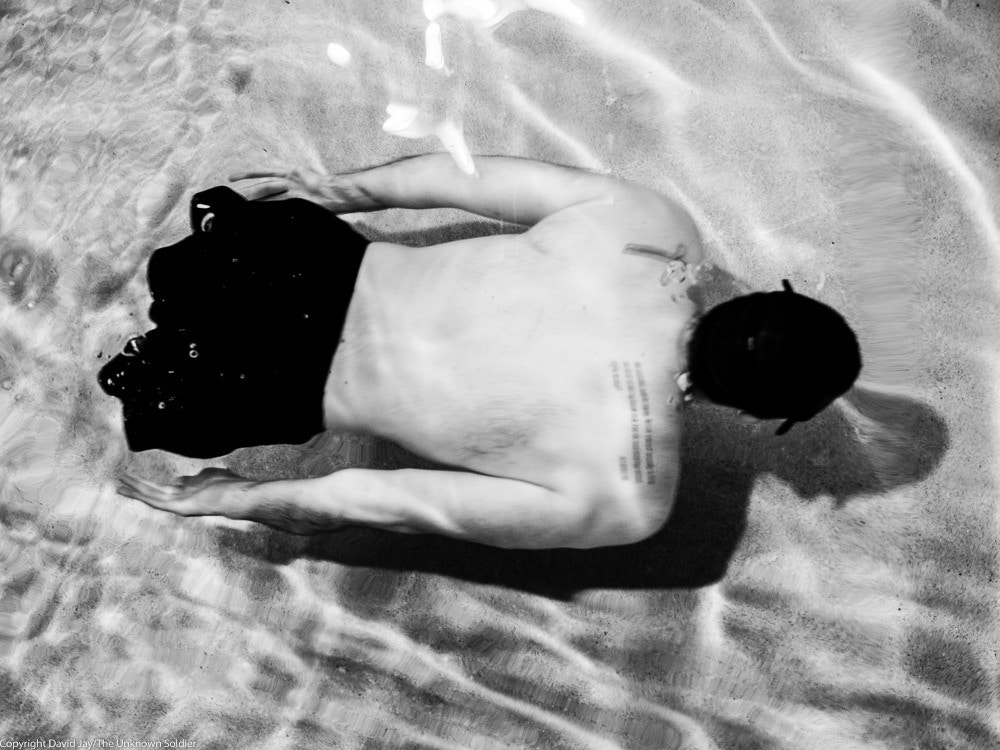
SFC Cedric King floats in the pool. Image by David Jay/<a href="https://farm.upworthy.com/nuggets/5564a2bd633239000c2f0100/www.davidjayphotography.com">David Jay Photography</a>.

On July 25, 2012, SFC Cedric King, an Airborne Ranger, was severely injured by an IED while serving his country in Afghanistan. Due to the explosion, Cedric sustained a multitude of internal and external injuries, losing both his legs. Cedric was doing his laps while I was photographing 1st Lt. Nicholas Vogt in the pool at Walter Reed Medical Center last week. Cedric kept watching, so I had to ask. Cedric said, “That man (Nicholas) doesn’t know it, but he changed my life. There was a point when I was so down that I thought I couldn’t go on. And then one day I saw him swimming … and I just thought, wow … if he can go on like that, then I can go on too.” Cedric will also change people’s lives. Already has.
Marine, foot-patrol, Afghan Army
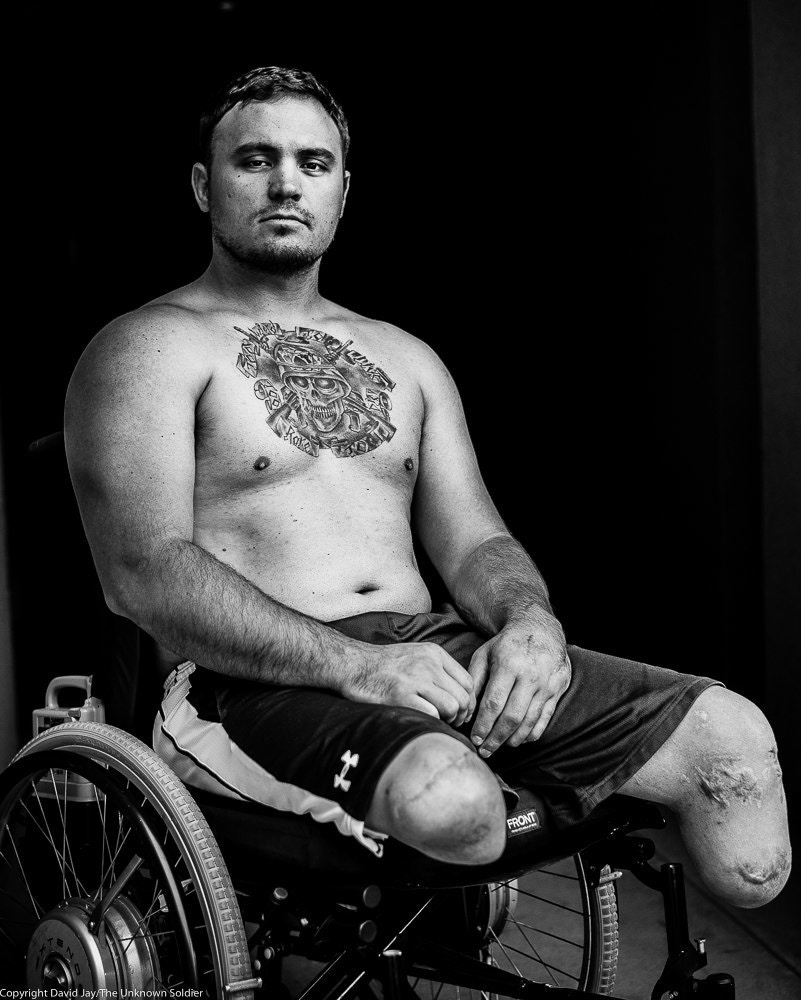
Michael Fox, 27-year-old Marine. Image by David Jay/<a href="https://farm.upworthy.com/nuggets/5564a2bd633239000c2f0100/www.davidjayphotography.com">David Jay Photography</a>.

This is Michael Fox, a 27-year-old Marine and an amazing man. On Nov. 15, 2011, Michael was on foot-patrol in the Helmand province of Afghanistan. His is the first picture of “The Unknown Soldier.”
The SCAR Project, battle-scarred, therapy
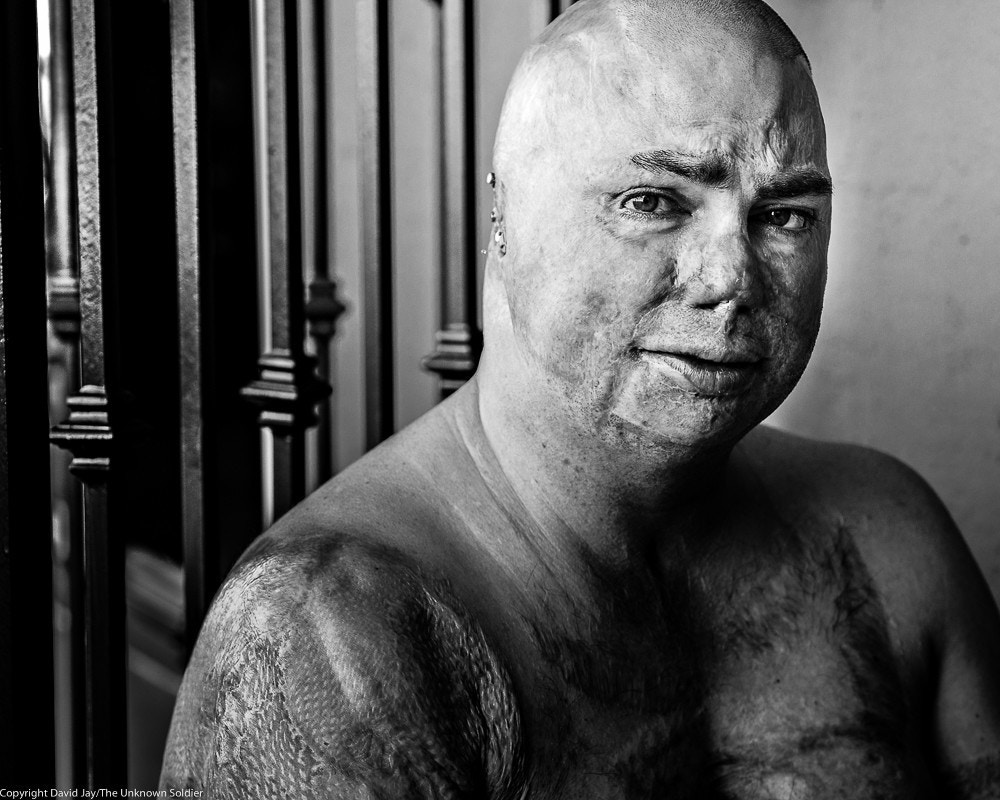
Staff Sgt. Shilo Harris in Houston, Texas. Image by David Jay/<a href="https://farm.upworthy.com/nuggets/5564a2bd633239000c2f0100/www.davidjayphotography.com">David Jay Photography</a>.

This past weekend, I photographed Staff Sgt. Shilo Harris in Houston, Texas. He came up from San Antonio to see one of my other exhibitions, The SCAR Project (www.thescarproject.org). Shilo was severely burned on Feb. 19, 2007, by a roadside bomb estimated at 700 pounds. He lost three men out of a crew of five. Only Shilo and his driver survived the blast. Shilo has a book coming out soon. He is truly an amazing man, and I am honored to call him a friend.

“The Unknown Soldier is about neither war or politics … but rather something infinitely simpler and more powerful.” — David Jay
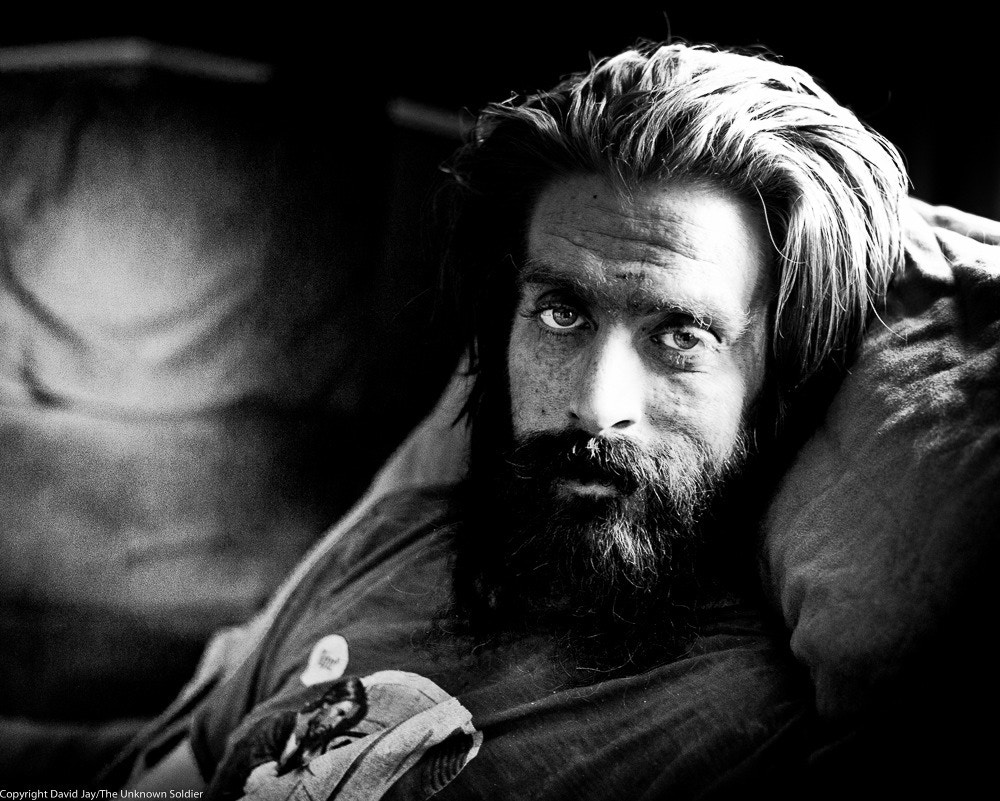
healing, medicine, remedy, hope
Thomas Young in Kansas City, MO. Image by David Jay/ <a href="https://farm.upworthy.com/nuggets/5564a2bd633239000c2f0100/www.davidjayphotography.com">David Jay Photography</a>.

The Library of Congress has acquired images from Jay’s The Unknown Soldier project as part of its documentation of the wars in Iraq and Afghanistan. This speaks to the power of these images in capturing war’s aftermath. But they are so much more than documentation.

Pictures like these help those of us who remain at home to begin to comprehend the true human cost of war.

This article originally appeared on 05.31.15

  • Toddler uses lawyer-like logic to make the case for taking candy from strangers
    A child thinking and holding his chin. Photo credit: Canva
    ,

    Toddler uses lawyer-like logic to make the case for taking candy from strangers

    His mom’s attempts to teach “stranger danger” backfired.

    Teaching children about “stranger danger” is a tough paradox. On one hand, you want your child to be comfortable and friendly around others—after all, a lot of folks we end up calling friends started out as strangers. On the other hand, they need to be careful not to interact with those who may seek to harm them.

    An easier lesson to teach is not to take candy from strangers. You can be friendly with some strangers, but never take candy from them under any circumstances.

    A young child on TikTok named Hudson, the son of pediatrician Megan Hall, is going viral for the lawyer-like way he responds when his mother tells him to stop taking candy from strangers. His logic: If you know someone’s name, they aren’t a stranger.

    @hall_fam_

    Long video but trying to teach my #toddler about taking #candy from strangers at the park. #toddlersoftiktok #fyp #funny

    ♬ original sound – Hall Fam

    It all began when Hudson took a gummy candy from a child at the park and put it in his mouth. “You can’t keep taking snacks from strangers at the park,” Hall told her son. But Hudson wanted a clearer definition of what “stranger” actually meant. “There are no strangers here,” Hudson calmly responded, adding that he knew the name of the child who gave him the candy.

    Then Hudson tried to flip the script on his mother, questioning the very nature of what it means to be a stranger. “Are you a stranger?” he asked his mom, who gave a prompt no. “But my dad tries to be a stranger to me,” Hudson said, ending the debate.

    gummy candy, gummy bears, candy, red gummy bear, yellow gummy bear
    Three gummy bears. Photo credit: Canva

    Hudson is friends with everyone when he’s at the park

    Based on what Hall told People, it looks like she’ll be having this debate for quite some time—and may need to take extra-special care at the park.

    “He has always been a really friendly and social child who genuinely believes everyone is—or should be—his friend,” she told People. “We jokingly refer to him as the mayor because he likes to talk to everyone, anywhere we go.”

    A commenter wrote, “His logic he met them, exchanged names, and played w the kids = no longer strangers.”

    “He’s about to be real confused on the rules come Halloween,” another added.

    Another loved his nonchalant nature: “The fact that he’s still tasting every ingredient in the candy while you’re warning him.”

    kids in park, kids on playground, happy kids, playing kids, children at park, kids on bridge
    Kids playing at the park. Photo credit: Canva

    How should parents discuss stranger danger with their children?

    “The phrase ‘stranger danger’ can be misleading. While it’s true that we need to teach our children to be cautious around people they don’t know, the reality is that not all strangers are harmful. Labeling all unfamiliar people as dangerous can create unnecessary fear and confusion,” Nature Therapy, a family therapy practice based in Illinois, wrote on its blog. “Statistically, most child abuse cases involve someone the child already knows. This is where the concept of ‘tricky people’ becomes more effective. It shifts the focus from fearing all strangers to identifying behaviors that are inappropriate or unsafe, regardless of whether the person is a stranger or someone familiar.”

    The debate may have been about the nuances of stranger danger, but it’s also a great example of how open-minded and kind-hearted young kids can be.

    “Children are innocent, hate is taught,” Hall said. “Children see the best in people and never think anyone would do something to harm them, and I wish this were true.”

  • ‘You better than that’: Door camera shows woman stopping package thief with tough love
    A Black woman (left) and packages on a stoop (right).Photo credit: Canva
    ,

    ‘You better than that’: Door camera shows woman stopping package thief with tough love

    She turned a tense moment into an unforgettable display of empathy.

    In a moment when most people might respond with anger and discipline, one Philadelphia woman chose instead to lead with compassion.

    On March 6, Bernadette Williams noticed a stranger across the street near a neighbor’s porch. As seen on Williams’ doorbell camera, a woman with a partial face covering appeared to reach for a delivered package. It was the kind of scene that immediately raises alarm, and Williams responded without hesitation.

    ‘What are you doing? Put that back! Put that back!’

    The woman quickly dropped the package. For a brief moment, the situation hung in the balance. It could have turned into a confrontation, a threat, or a call to the police. But then Williams made a choice that shifted the entire tone of the encounter.

    “I said, ‘She’s in trouble. How can I make a bad situation better?’ You have to be a part of the solution,” she later told WPVI

    Rather than continuing to call out the woman, Williams began speaking to her in a completely different way. As her voice softened, her message changed from warning to encouragement.

    “You better than that. Get some help. I love you. God loves you,” she told the woman.

    Then came the offer that has stayed with so many people who have heard the story. Reaching into her pocket, Williams told the stranger, “I’ll give you some money. Here’s $7, here’s $7.” It was all she had, and she gave it up willingly. 

    package thief, kindness, Philadelphia
    Close-up of hands offering money. Photo credit: Canva

    The exchange was brief, but its impact was clear

    As WPVI reported, the woman apologized and thanked her before leaving. Williams said she could see something had shifted in her expression.

    “Her eyes of ‘I’m sorry.’ That was in her heart, and that’s what I read. I hope that she will be fine, and I have faith that she will be fine.”

    For Williams, the decision was not about ignoring wrongdoing, but about recognizing what might be underneath it. Instead of seeing a thief, she saw someone who might be struggling.

    “She started realizing ‘I am somebody,’” Williams said. “She started realizing that ‘There is somebody out here that cares.’”

    package thief, kindness, Philadelphia
    A close-up of eyes. Photo credit: Canva

    That perspective comes from years of living in the same neighborhood and feeling connected to the people in it. Williams believes that communities are shaped by how people choose to respond to one another, especially in difficult moments.

    “We are a part of this community, and we can make our community better,” she told WPVI.

    The big takeaway

    There’s a common assumption that accountability must come with harshness. This story shows that it doesn’t always have to. The would-be thief is held accountable while maintaining everyone’s dignity, making a different choice in the future far more likely.

    While it’s impossible to know what happens next for the woman in the video, what remains is the example Williams set by actively choosing humanity when most would not.

  • Ethan Hawke beautifully explains why AI art can’t replace imperfect human creativity
    Ethan Hawke gets philosophical about art and creativity.Photo credit: Elena Ternovaja/Wikimedia Commons

    As AI plays an increasing role in our world, questions about its appropriate use abound. There’s no doubt that technology has the potential to improve our lives dramatically. But the way we choose to use it can also impact us in ways we may not fully appreciate.

    For instance, how might AI impact our relationship with human creativity? Ethan Hawke was asked about the idea that “AI is the future of art,” and how he would argue that human creativity matters. People are loving his thoughts.

    Ethan Hawke on AI art versus reality

    “Nature is reality,” he said. “And when you get away from reality, you get lost. Human creativity is nature manifest in us. It is happening in us.”

    Then he gave an example of why AI art will never be able to replicate a piece of art created by a human.

    “AI could make an amazing portrait of the Sundance Film Festival, and it’ll be incredible,” he said. “Or my 14-year-old could color her impression of it. And the thing about my 14-year-old’s is it’s not perfect. It’s hers. It’s unique to a moment in time and a place. And it’s inimitable because it’s coming from her, and she is beautiful. And it’s not the painting; it’s the energy behind the painting.”

    “What makes a poem great is not this collection of words,” he continued. “It’s the energy behind the poem. Dance can be…you see people who can barely dance, and you can cry at the joy happening with the music. Because they’re alive right now and they won’t be forever. And when we start making things being about perfection, you’re just belittling the experience of life. You’re just totally ceding your humanity.”

    Hawke concluded, “It makes me sad, but it also makes me excited, because I don’t want to do that. I’m not going to do that.”

    So many people resonated with his response in the comments:

    “This is so beautiful and so true ~ everything he says is so profound and I’m here for this thinking…. we’ve become a weird world of social media perfection.”

    “I love how he got 🥲 talking about the imperfections created by hand from his daughter. What a beautiful way of describing creativity.”

    “Can he just write a philosophy book already? We all know we’d read it.”

    @ethanhawke always saying what the world needs to hear. Thank you sir! Thank you for defending the magic of NATURE and defending the MAGIC of humanity. More of this ENERGY and CONSCIOUSNESS ❤️❤️❤️.”

    “This feels less like an anti-AI take and more like a pro-human one.”

    AI isn’t going anywhere, time to choose the role it plays in society

    That last comment hits the nail on the head. Whether you love it, hate it, or aren’t sure how to feel about it, AI is here. The conversations we have about it, and how we consciously choose to engage with it, matter. There’s a lot to consider on that front, ethically, educationally, environmentally, and more.

    But one thing those considerations are forcing us to do is to examine the value of human creativity. Not the dollar amounts we can assign to it, but the inherent value of the energy behind an artist’s unique expression. Generative AI will never be able to replace human creativity, no matter how “perfectly” it may replicate it. The real beauty of art is the singularity of the human spirit and the unique energy an artist brings to it.

    As Hawke said, we can choose not to cede our humanity in the age of AI—and we can be excited about that choice because the beauty of human creativity is absolutely worth celebrating.

  • Pro cleaner shares ‘trap’ method to stop dust from returning and allergies from raging
    How to dust your home the right way.Photo credit: Canva
    ,

    Pro cleaner shares ‘trap’ method to stop dust from returning and allergies from raging

    “Dust is such a massive problem for so many people simply because almost everyone cleans it the completely wrong way.”

    As spring arrives, it’s time for the annual spring cleaning ritual. From decluttering your home to cleaning up messes and washing sheets and duvet covers that feel a bit dank, it’s a great time to reset and refresh.

    A deep clean usually involves getting rid of dust that has accumulated on various surfaces. While you might reach for a duster and swipe surfaces in one fell swoop, cleaning expert Sergio of EDGE Cleaning Service says most people are dusting completely wrong.

    In an informative Instagram video, he explains why dust always seems to come back so quickly after you’ve cleaned. It all comes down to technique.

    How to dust properly

    According to Sergio, most people pick up a duster and simply swipe it across surfaces, thinking the job is done. However, he explains that this method is just pushing dust back into the air, where it will soon settle again.

    “Dust is such a massive problem for so many people simply because almost everyone cleans it the completely wrong way,” he says.

    The goal, he says, is to “trap the dust instead of just moving it around.” To properly dust, he recommends first cleaning your duster by vacuuming it, a step many people neglect, often starting with an already “dusty” duster.

    Next, he says you should adjust your dusting speed.

    “Dust surfaces slowly so the dust sticks to the duster instead of flying into the air,” he says.

    After dusting each room, he says you should vacuum your duster again to prevent trapped dust from spreading to the next room.

    Finally, you should wipe down surfaces with a slightly damp microfiber cloth. “The damp cloth helps trap dust so it doesn’t float back into the air,” he says.

    Reduce allergies by dusting

    Dust is a leading cause of allergies in homes due to dust mites, which feed on human skin flakes shed every day and on moisture in the air, according to the Asthma and Allergy Foundation of America (AAFA).

    Sergio offers an extra tip for managing dust in your home: clean and replace air filters regularly.

    “Dirty filters can push dust around your house through the vents,” he says.

    He also recommends dusting your home once a week to prevent buildup. If that’s not possible, aim for once every two weeks.

    The AAFA notes that bedrooms are a haven for dust mites, where they tend to live more than anywhere else in your home. To reduce them, it recommends washing blankets and sheets weekly in hot water (at least 130 degrees Fahrenheit) and using dust-proof mattress and pillow covers to prevent mites from penetrating them.

    Since humidity is also a factor, the AAFA notes that your home’s humidity should not exceed 50%. If it does, consider investing in a dehumidifier.

  • Pop music’s most famous phone number now connects callers to a cancer support helpline
    Jenny's number can now help cancer patients.Photo credit: TutoneJJ/YouTube & Canva

    Since the 1980s, one particular phone number has earwormed its way into pop culture’s collective memory. That number? 867-5309 (which you probably just sang in your head). Today, however, that memorable number doesn’t belong to Jenny anymore. Thanks to Tommy Tutone’s frontman, dialing it now connects cancer patients to a support group.

    Tommy Heath, the lead singer of Tommy Tutone, teamed up with the Cancer Support Community to secure the number for its free support helpline. In an exclusive interview with People, Heath shared how cancer has affected him as he’s gotten older, noting that he is dealing with “minor” skin cancer himself.

    “I have some family members who are struggling with cancer,” he told People. “I’m out on tour with a lot of bands and suddenly somebody’s not there.” 

    The song’s prank-filled past

    The song “867-5309/Jenny” reached No. 4 on the Billboard Hot 100 in 1982. However, its catchy, memorable chorus led to a wave of stories beyond music. It also sparked years of prank calls, with people asking for “Jenny” whenever they dialed the number—both during the song’s heyday in the 1980s and decades later.

    The Cancer Support Community’s hotline provides expert support from trained specialists who offer personal guidance, information, and a listening ear for cancer patients. Having such a recognizable phone number helps ensure people know exactly which number to dial for help. After learning this, Heath stepped in, wanting to give back after getting so much from the number that made him famous.

    “I need to give back to the community, the people who have supported me all these years,” he told People. “I’m going to do what I can…I’d be happy if this was an enduring legacy, and made people smile and give them hope.”

    Now, when someone dials the number using the 272 area code (or “CSC,” for “Cancer Support Community”), it connects them to a professional who can help people with cancer.

    At 78, Heath is still going strong, performing live. And yes, he still happily plays and sings “867-5309/Jenny” for the crowds that support him.

    If you need additional or specialized support in your battle against cancer, visiting the American Cancer Society’s website can help. Searching for and connecting with professionals there can provide patients with additional resources, including in-person, local support.

  • Instagram post compares Robert De Niro’s face over the years to explain why everyone’s ears change
    Actor Robert De Niro in 1988. Photo credit: Roland Godefroy

    Our bodies are miraculous, and much of the time, we don’t even know why. As we age, without any surgical help, our face shapes can change, shoulders can hunch, and teeth can shift. But one of the most obvious (and perhaps odd) differences is the size of our ears and noses.

    In a recent post from the Instagram page Historic Moments, two profile photos of actor Robert De Niro are shown. In the earlier image—likely from his role as Travis Bickle in Martin Scorsese’s 1976 film Taxi Driver—his features appear proportionate. The other photo shows a more recent De Niro, where his ear (and possibly his nose) appears noticeably larger.

    The caption reads, “Robert De Niro is living proof that our ears grow roughly 0.22 millimeters per year.” In the description, they write:

    “Recent side-by-side comparisons of Robert De Niro vividly illustrate the physiological reality that human ears continue to grow throughout our lives. While many believe this is merely sagging skin, studies confirm that ear circumference increases by roughly 0.22 millimeters per year. This phenomenon is primarily due to the continuous growth of cartilage and the relentless effects of gravity over decades. De Niro’s evolving profile is a high-profile example of this unique aspect of the human aging process.”

    The post has gone viral, suggesting that many people have wondered why this change happens. Fortunately, we have answers.

    Doctors weigh in

    Upworthy spoke with Dr. Ari Hoschander, the head plastic surgeon at the Rhinoplasty Center of Long Island, who shared:

    “There are actually two things happening at once, and people conflate them. The nose and ears do genuinely grow, but they also appear larger because the face around them is losing volume. Volume decreases in the cheeks and temples, and the fat pads that used to provide roundness to the face start to descend or just disappear altogether. Suddenly your nose looks disproportionately larger compared to the rest of your face.”

    Hoschander also discussed the cartilage issue:

    “Cartilage also doesn’t behave the way bone does as you age. While bone mostly stops changing once you’re done growing, cartilage continues to slowly deform and lose its structural resilience over your entire life. The ears and nose are mostly cartilage, so the actual structure of your nose and ears continues to change over the course of your life.”

    As for noses and ears?

    “The nasal tip is where I see it most dramatically in practice. Gravity pulls the tip down, the supporting ligaments stretch out, and the skin loses its elasticity. So the tip droops and the nose looks longer and heavier than it did a few decades earlier. For the ears, the lobes are mostly fat and skin, so they elongate just from years of gravity, sometimes accelerated by heavy earrings. The upper ear cartilage is also slowly expanding, which is why older men in particular can end up with ears that look really big.”

    A plastic surgeon explains the change

    Dr. Jeffrey Lisiecki, a board-certified plastic surgeon, also shared similar insight with Upworthy. As for noses, he said they appear to grow for a couple of reasons:

    “The cartilage of your nose essentially stops growing by adulthood, but the ligaments that hold those cartilages together can stretch with age, which can make your nose appear longer and more drooping with age. We also lose fat in our faces as we age, which makes our cheeks appear flatter and our nasolabial folds appear deeper, which can make the nose seem relatively larger.”

    And what about those ears?

    “Ears age in a similar way—the cartilage reaches its mature size before adulthood. The earlobe stretches out and becomes longer with age, which makes the ear appear larger. The earlobe also loses volume with age, and the thinning of it accelerates the process of lengthening.”

  • Grocery store’s produce section concerts give indie musicians a live venue. People want more.
    A band plays in the produce section of Fiesta Fresh Market. Photo credit: Fiesta Fresh Market/YouTube
    ,

    Grocery store’s produce section concerts give indie musicians a live venue. People want more.

    “We need this right now in the world…Real humans doing real human things.”

    On the outside, Fiesta Fresh Market looks like just another neighborhood grocery store in New Castle, Delaware. Inside the produce section, however, customers can listen to local bands perform their latest songs live and in person. These “Mercadito Sessions” have since evolved from a simple community offering into a full-fledged live music event.

    While grocery stores and live music don’t typically mix, at Fiesta Fresh Market, it’s part of the family. The Aguilar Garcia family, who run the store, have music in their roots—especially co-owner José Luis Aguilar Garcia, who works in the music industry.

    In the hope of helping Mexican American bands gain more exposure, José and his family offered their produce section as a space for Latin musicians to perform for customers. They were inspired by National Public Radio’s “Tiny Desk Concerts,” which feature artists performing live in a confined space.

    These produce section mini-concerts, dubbed “The Mercadito Sessions,” initially puzzled customers. Over time, however, shoppers came to welcome and enjoy the live music, with some even visiting just for the performances. Then, posts on the store’s social media featuring the bands began to go viral.

    “The idea is to highlight independent artists from the area,” José told CBS Philadelphia. “Because it’s getting more attention online, people are excited. They’ll ask when we’re doing the next one.”

    Commenters on the store’s Instagram celebrated the market’s concert concept:

    “This is so cool. Not everyone wants to go to bars and/or have to stay up late to hear live music. I love this so much.”

    “Honestly this is the absolute coolest thing ever.”

    “Amazing music scenes going on everywhere, love the magic being shared.”

    “We need this right now in the world…Real humans doing real human things.”

    “Such an innovative and creative idea! 🥹💫”

    @fiestafreshmarket

    Just put the bananas in the bag bro @erre6ixx

    ♬ original sound – Fiesta Fresh Market

    While the Mercadito Sessions showcase Mexican regional music, they are open to any genre. As the series gained attention online, many bands reached out to Fiesta Fresh Market to get booked. Several acts have come to perform and record as customers pick out fresh fruits and vegetables.

    Concerts for the community, by the community

    Musicians and customers alike say these concerts provide a sense of community among Latin Americans living in Delaware. They not only celebrate their culture, but also showcase it to others in New Castle.

    “It gives us a platform to portray who we really are,” musician Jesús Beltran Méndez told CBS Philadelphia. “There’s a lot of misconceptions about who we are. There are bad people. There are good people. We are just human.”

    @fiestafreshmarket

    @Los K-Bros “Ya No Me Llames” (Unreleased) live desde Fiesta Fresh Market

    ♬ original sound – Fiesta Fresh Market

    Demand for the music has grown so much that the grocery store is now hosting and promoting a full-fledged concert event. What was once a place to buy groceries has become a spotlight for the community—all by offering a small space in an aisle.

Pop Culture

Pop music’s most famous phone number now connects callers to a cancer support helpline

Making Sense of Science

Instagram post compares Robert De Niro’s face over the years to explain why everyone’s ears change

Culture

Grocery store’s produce section concerts give indie musicians a live venue. People want more.

Culture

A ‘gentleman’ reveals 4 reasons why men suddenly stopped wearing fancy hats in the ’60s