
Your refrigerator costs you a wallet-crunching $762 every year, and now scientists finally know why

Here are 10 tips for keeping your food waste to a minimum.

woman, refrigerator, organizing, food, food waste
Photo credit: CanvaA few smart organizational changes can save you money and the planet.

We need to talk about that bag of spinach sitting in your crisper drawer. Don’t be coy, you know the one. Wilting and softer than it should be, you bought it from Whole Foods with good intentions and dreams of super-powered green smoothies dancing in your head. Now, though, it’s transforming. Go ahead, check. That bag of spinach is turning into a science experiment as you read this.

Too real? You’re not alone. Most of us have felt that pang of guilt when tossing out a carton of rotten berries or a container of questionable leftovers. But that forgotten food adds up, and it’s a problem. Recent data paints a harrowing picture of American eating habits: the average person wasted $762 worth of food in 2024.

That amount of money could buy you a brand-new 55-inch 4K TV. It could cover an inflatable hot tub with 140 air jets, and then some. Without all that waste, you could even afford a two-in-one game table that switches between air hockey and table tennis. It’s a decent chunk of change.

The truth is, we don’t throw food away simply because we’re careless. According to the Environmental Protection Agency (EPA), the real culprit is far more mundane: we literally forget what’s in our fridge. However, a few smart changes to how you arrange your refrigerator can save hundreds of dollars while reducing unnecessary waste sent to landfills.

The hidden cost of our kitchen habits

The numbers reveal the scale of the problem. Research from Penn State University shows that the average household throws away about 31.9% of the groceries it buys. That’s like walking out of the supermarket with three full bags, dropping one in the parking lot, and continuing on with your day. It sounds silly when you put it that way, but it’s the reality in many homes across the country.
food, waste, america, issue, consumption
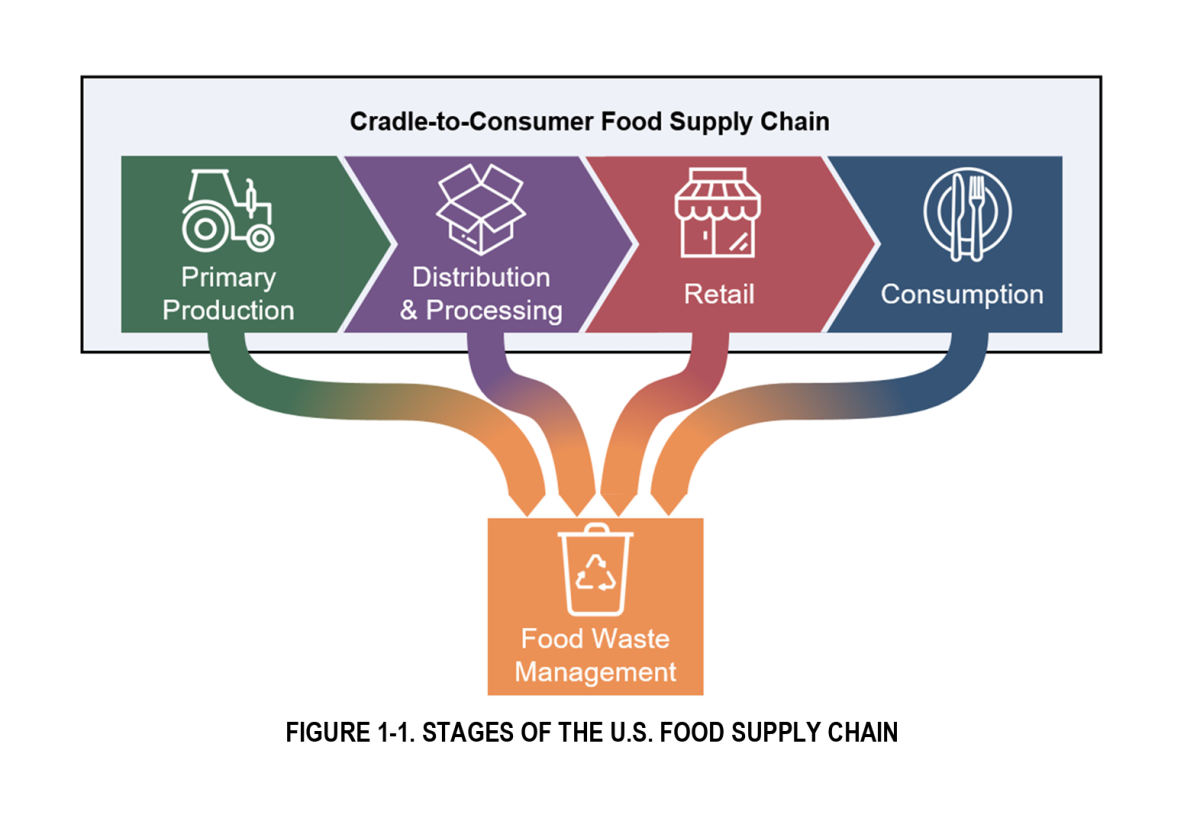
All roads lead back to food waste. Photo Credit:u00a0The U.S. Environmental Protection Agency

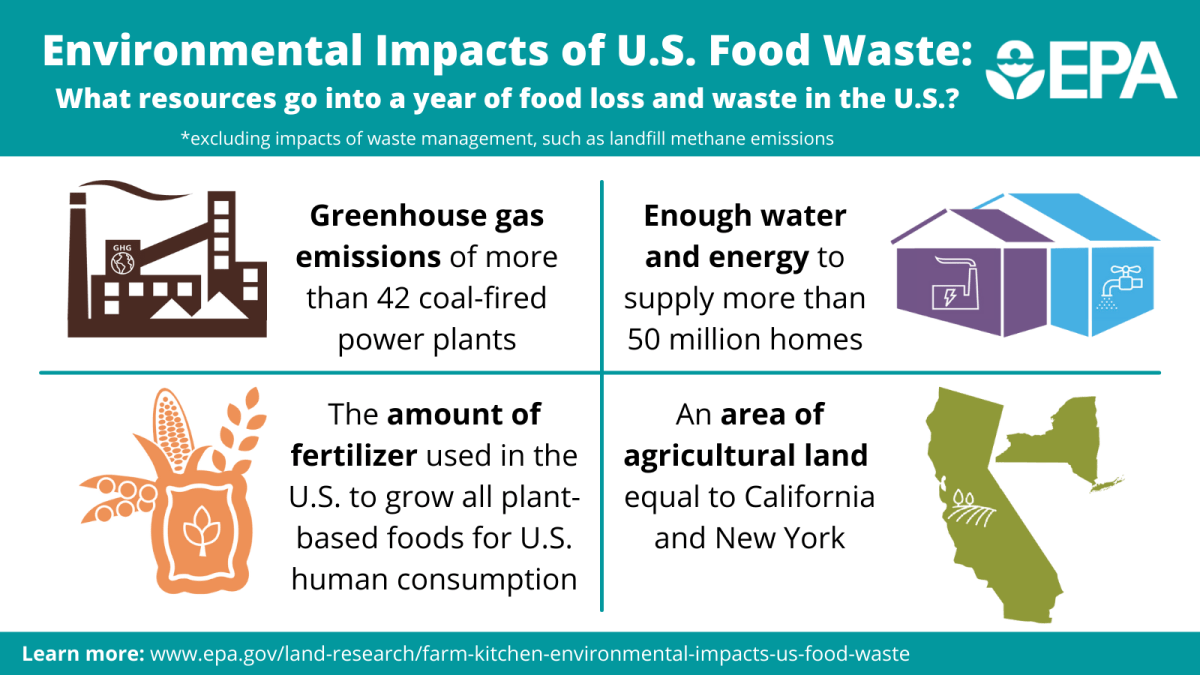
Financially, that’s bad. Environmentally, it’s even worse. In the United States, wasted food generates greenhouse gas emissions equivalent to those produced by about 50 million gas-powered cars, roughly 6% of the nation’s total emissions, according to the EPA. Those emissions come from the production, transportation, storage, and eventual disposal of food that never gets eaten. Once it ends up in landfills, that untouched food rots and releases large amounts of methane, the second most dangerous climate pollutant.

A 2021 report from the EPA titled “The Environmental Impacts of U.S. Food Waste” points out that uneaten food takes up a ton of space, roughly 140 million acres of agricultural land. That’s an area the size of California and New York combined.
food, waste, america, issue, consumption
Visual breakdown of the impact of U.S. food waste. Photo Credit: The U.S. Environmental Protection Agency

And that doesn’t even account for the immense water use, fertilizer, and energy required to produce food that ultimately rots in our refrigerators. And all this uneaten, spoiled food? It contains enough calories to feed more than 150 million people each year. Compare that to the roughly 18 million Americans who experience food insecurity, and your head begins to spin.

Why are we wasting so much food?
food, waste, america, sustainability, consumption
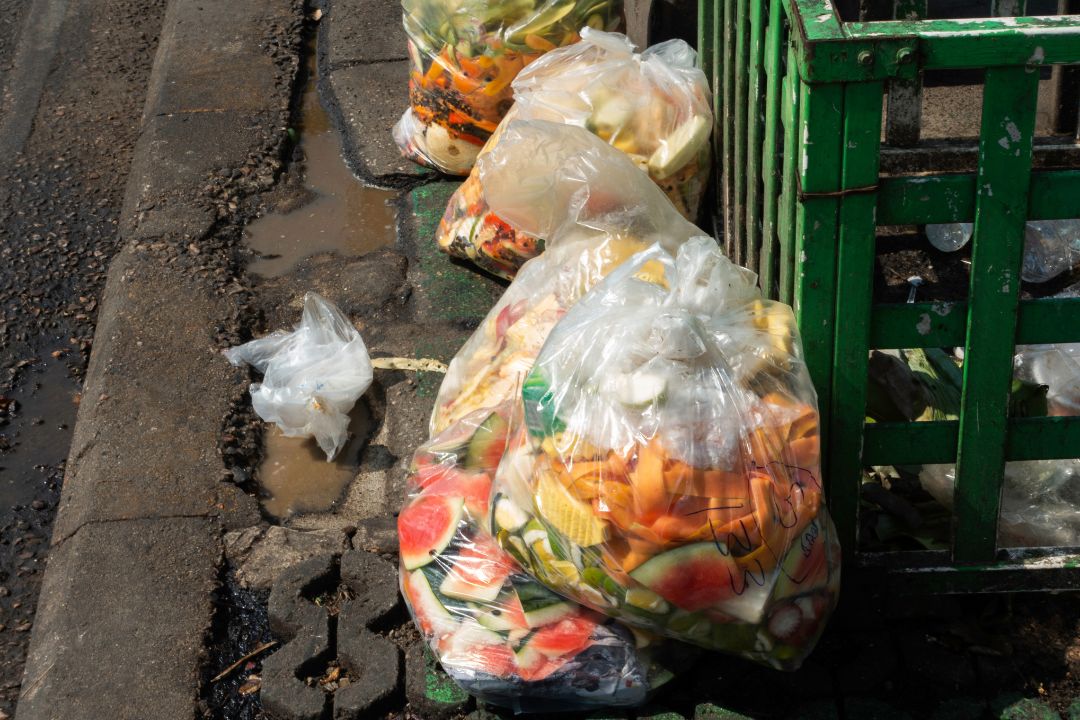
Trash bags full of food waste. Photo credit: Canva

To fix the problem, we first need to understand why it happens. Food waste in America generally boils down to three main culprits:

  1. Unused ingredients: Ingredients are often purchased for specific recipes that require only a small portion, like a bunch of fresh dill or a large round of sourdough bread. The remaining bag or container is then forgotten, left to spoil before another use comes up.
  2. Storage struggles: Cluttered fridge shelves push ingredients and leftovers into the “graveyard” at the back. And you can’t eat what you can’t see.
  3. Label confusion: “Best by,” “sell by,” and “use by” dates aren’t interchangeable and can lead consumers to throw away perfectly good food out of confusion or caution.

Ready to reclaim your kitchen? Here are 10 simple, actionable ways to organize your fridge and minimize waste.

10 easy tips for minimizing food waste

woman, refrigerator, organizing, food, food waste
A woman standing in front of her refrigerator. Photo credit: Canva

1. Plan meals and shop your fridge first

Before heading to the grocery store, take inventory of what you already have. Inspiration might just strike. Is there a half-used jar of marinara sauce or a few carrots that need to be eaten soon?

Build your meal and shopping plan around what you already have. From there, it looks like you might even have the beginnings of a great batch of chili. This simple habit prevents duplicate purchases and helps ensure you see, and eat, perishable foods before they go bad.
chart, fridge, organization, safety, food
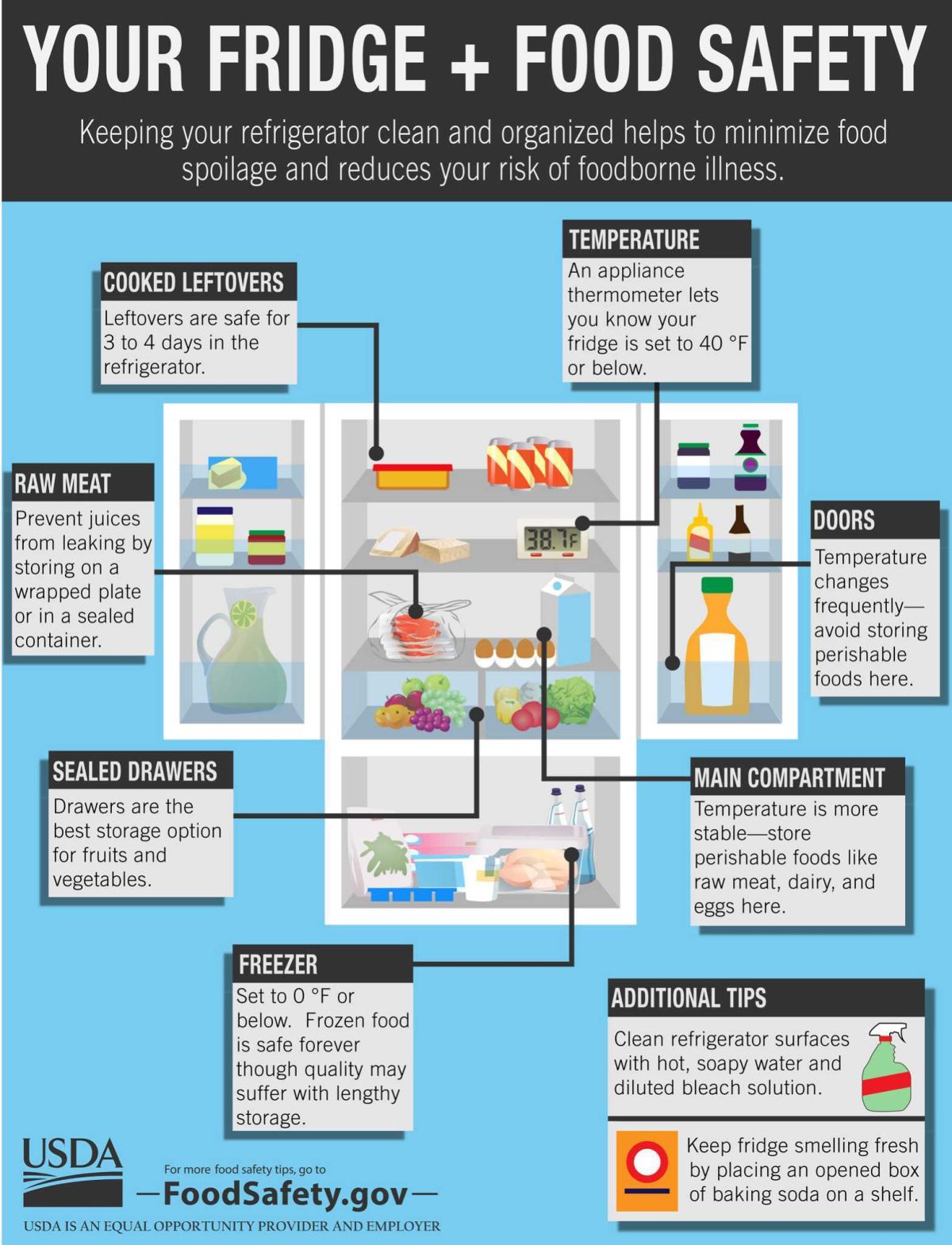
A handy chart outlining the Photo Credit: USDA

2. Store food in the right temperature zones

Your fridge is smarter than it looks. It has multiple temperature zones, and knowing how to use them can significantly extend the shelf life of your groceries.

  • The door: This is the warmest part of the fridge. Store condiments, jams, and juices here. Avoid keeping milk or eggs in this area, since the temperature changes every time the door swings open.
  • Top shelf: This area maintains a consistent temperature, making it an ideal spot for leftovers, drinks, and ready-to-eat items like hummus or deli meats.
  • Bottom shelf: This is the coldest spot in the fridge. Use it for raw meat and fish to ensure freshness and prevent cross-contamination with other foods.

3. Understand date labels

Confusion over date labels leads to a significant amount of unnecessary food waste. According to the U.S. Department of Agriculture (USDA), with the exception of infant formula, dates printed on food labels are meant to indicate best quality, not safety.

  • “Best if used by/before”: Indicates when a product will be at its best flavor or quality. It is not a safety date.
  • “Sell by”: A date intended for store inventory management. Food is usually safe to eat for several days after this date.
  • “Use by”: The last date recommended for optimal quality.

When in doubt, trust your senses. If it looks fine and smells normal, it’s likely safe to eat.

4. Master the FIFO method

Restaurants and grocery stores use the “First In, First Out” (FIFO) method to manage inventory, and it’s a wonderful tool to use at home, too. When unpacking groceries, move older items to the front of the fridge or pantry and place newer ones behind them. This simple system encourages you to finish that open container of Greek yogurt before cracking into a new one.

5. Start an “Eat Me First” bin

Consider dedicating a shelf or crafting a bin for items that need to be used immediately. Printing or hand-drawing an “Eat Me First” label can also be a fun, creative exercise.

What goes in there? This is the perfect spot for a half-used block of cheese, last night’s leftovers, or fruit that looks lonely. That way, when you’re hunting for a quick snack or ingredients for dinner, you know exactly where to check first.

6. Make the most of your freezer

It’s time to embrace your freezer, the miraculous upper unit that acts like a frosty “pause” button for food. Nearly everything can be frozen in batches, including:

  • Sliced bread
  • Avocados (mashed and placed in a small bag; add a spritz of lemon if you’re fancy)
  • Cheese
  • Nuts
  • Milk (pour into measured containers; use later in soups, baking, and smoothies)
  • Fresh herbs, like sprigs of rosemary or thyme. (For tender herbs, such as parsley, cilantro, or dill, try placing them in an ice cube tray filled with water or broth to create pre-portioned seasoning cubes.)

Didn’t finish that delicious pot of chili earlier? Freeze individual portions for easy lunches later. It’s a simple way to reduce waste and save time on busy days.

refrigerator, organizing, food, food waste, sustainability
Fridge temperatures must be carefully calibrated. Photo credit: Canva

7. Check the fridge temperature

A fridge that’s too warm can become a breeding ground for bacteria, causing food to spoil more quickly. The Food and Drug Administration (FDA) recommends setting your refrigerator to 40°F (4°C) or below and your freezer to 0°F (−18°C). This is a quick way to ensure food safety is set up for success.

8. Compost scraps

Scraps are inevitable. No one expects you to eat a banana peel or freeze used coffee grounds. But instead of sending those scraps to the landfill, try composting. Many cities offer curbside pickup or provide green bins for compostable waste. Indoor compost bins are also convenient and easy to store, and many come with charcoal filters to help eliminate odors.

Composting is a beautiful way to turn leftovers into nutrient-rich soil for your garden or houseplants.
refrigerator, organizing, food, food waste, sustainability
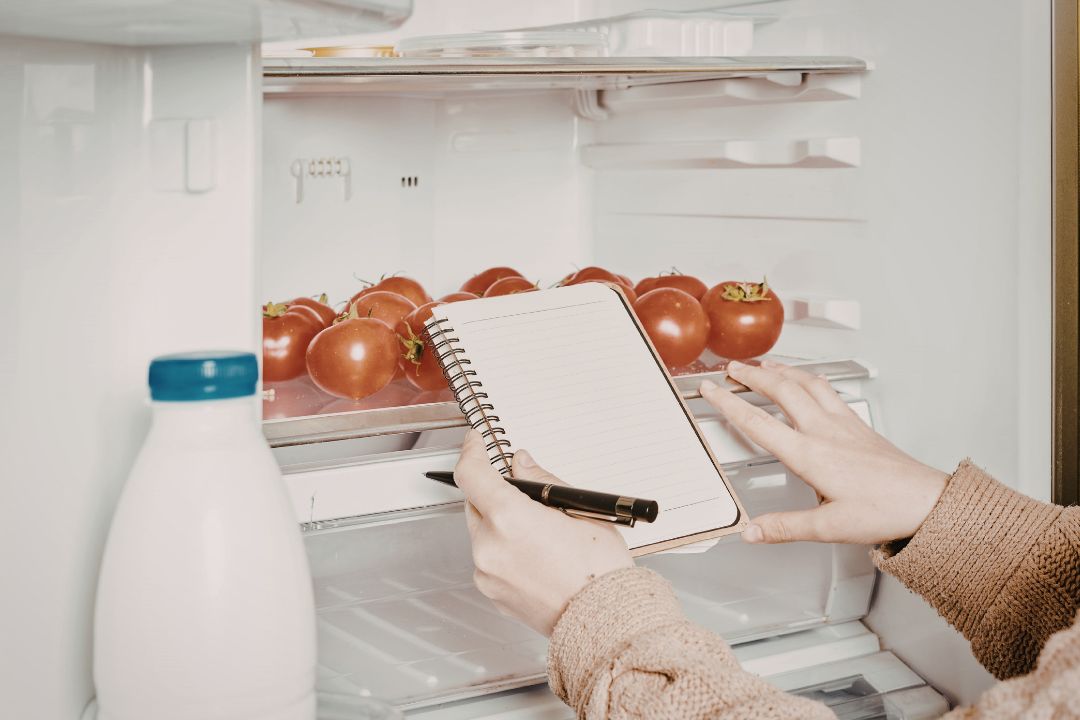
Knowing what's in your kitchen is crucial to preventing food waste. Photo credit: Canva

9. Keep a food inventory

Experiment with keeping a small whiteboard or notepad on your fridge. Putting away leftovers? Adding new produce to the mix? Jot it down. A simple visual reminder helps you remember what needs to be eaten without digging through your fridge. Plus, your next shopping list will be a breeze.

10. Embrace imperfect produce

At the grocery store, we’re drawn to flawless produce, shiny red apples, unblemished lemons, beautiful leeks. But a common misconception is at play here. Slightly bruised fruit and oddly shaped vegetables taste just as good.

Companies like Misfits Market and Hungry Harvest rescue high-quality, perfectly delicious, and sometimes funny-looking foods that might otherwise go to waste and deliver them straight to your door. Think unconventionally sized tomatoes or zucchinis that are slightly off-color.

Or go straight to the source and buy produce and ingredients directly from local farms. LocalHarvest‘s national directory lists more than 40,000 family farms and markets in all 50 states, making it easy to find farm-fresh ingredients near you.

Every small change matters

Reducing food waste is a journey, not a quick fix. There is no one-time product to buy that can get rid of your impact on wasted food. But by building simple, sustainable habits that fit your lifestyle, your efforts can make a real difference, one weirdly shaped carrot and frozen loaf of bread at a time.

Being mindful of your consumption and waste is a win-win: you save money, protect the environment, and feel more organized and in control in the kitchen.


  • Airline pilot reveals the crucial reason why there’s a tiny hole in every airplane window
    Photo credit: CanvaA woman looking out of a plane window.
    ,

    Airline pilot reveals the crucial reason why there’s a tiny hole in every airplane window

    You’ll see them on every plane no matter where you sit or which airline you’re flying.

    Have you ever been crammed into the window seat in a plane and, while gazing down at the terra firma beneath you, noticed that there was a tiny hole in the window? According to Petter Hörnfeldt, aka Mentour Pilot, a Swedish commercial airline captain, those holes could one day save your life.

    In a TikTok video, Hörnfeldt explains that there are three layers to the windows on a commercial airliner. The outside window is the strongest because it was designed “to handle any impacts as well as the pressure difference between the thin high altitude air outside of the plane and a pressurized air inside,” Hörnfeldt says.

    Then there is the middle layer, with a tiny hole, designed to protect the outer layer. The final layer is the one you can touch or press your nose up against to see what you’re flying over.

    Why do airplane windows have tiny holes?

    “So why the hole then? Well, because there is air between those layers. Differences in pressure and temperature would otherwise start causing forces to build up between the layers, trying to bend them inwards or outwards, which is something that we obviously do not want, since especially the inner two layers are not designed to take those kind of forces. So that little hole is put there to allow air to flow through slowly and relieve that potential pressure difference. Hence the name breather hole,” Hörnfeldt says.

    pane window, window hole, looking out window, aviation, commercial airliner
    The tiny hole in an airplane window. Credit: Canva

    “Now, the inner window layer, the one that’s closest to you, doesn’t really need a hole because it’s fitted in a way that allows air to flow around it. But that breather hole also serves a different job, which is to make it more difficult for moisture to become trapped between the layers and start fogging up your window, stopping you from admiring the view outside,” Hörnfeldt continues.

    In his most popular video, Hörnfeldt admitted that commercial airline pilots know when you’ve flushed the toilet on a plane.

    Do pilots know when you flush the toilet on a plane?

    According to Hörnfeldt, pilots don’t know that you’ve flushed a toilet based on an alert, security camera footage, or a sudden power surge. They know that the toilet has been flushed because of a slight change in cabin pressurization. Airplane toilets use a special vacuum flushing mechanism to suck the contents out. The vacuum system is calibrated to the cabin air pressure. “But that flushing actually does show up on our instruments as a sudden cabin climb on our cabin vertical speed indicator,” Hörnfeldt says. “So we can see it. And it kind of makes sense, if you think about it.”

    Next time you see the tiny hole in an airplane window as you gaze upon your hometown at 35,000 feet, you know that it’s not a manfcatingring mistake. It’s here to keep you safe in a cabin with a pressurized system that also knows if you used the bathroom. Aren’t airplanes just incredible?

  • Doctors kept dismissing her persistent cough. One heroic nurse refused to let it go.
    Photo credit: CanvaA nurse speaks with a doctor in the hallway.
    ,

    Doctors kept dismissing her persistent cough. One heroic nurse refused to let it go.

    “Had Alison not picked up on the fact that she was sure something else was wrong, I don’t know what would have happened.”

    Julie Silverman had been coughing for years. Not the kind of cough that goes away with some rest and cough syrup, but a persistent, worsening cough that no doctor seemed able to explain or fix. As she shared on NPR’s Hidden Brain podcast in the “My Unsung Hero” segment, the experience of being dismissed by the healthcare system over and over again was exhausting.

    “I had, at this point, gotten kind of dismissive about it because I had been dismissed by so many doctors as, ‘There’s nothing wrong, you’re not responding to our treatments, we’ll try something else,’” Silverman recalled.

    But one person refused to dismiss her: a nurse practitioner named Alison.

    nurse, saves, woman, persistent cough, misdiagnosis
    A nurse checks the vitals of a patient. Photo credit: Canva

    Alison worked at one of the clinics Silverman visited regularly, and unlike the doctors who had cycled through various unsuccessful treatments, Alison kept paying attention. She was perplexed by the cough and made it her mission to track Silverman’s condition over time.

    During one of Silverman’s weekly appointments, Alison noticed something concerning. Silverman’s symptoms had gotten worse. Her voice was hoarse, she was breathless and wheezing, and the coughing was more severe than before.

    “She was just adamant something was wrong with my airway,” Silverman said.

    Alison immediately pushed one of the physicians at the clinic to perform a scope of Silverman’s trachea. The procedure involved inserting a small camera through her nose and down the back of her throat to look for blockages.

    “I could just tell by their faces something was not right,” Silverman remembered.

    The scope revealed what years of doctor visits had missed. Silverman had idiopathic subglottic stenosis, a rare condition that affects about one in 400,000 people. Scar tissue had been building up at the top of her trachea, and her airway was 75% blocked. That’s why she’d been coughing. That’s why nothing had worked. And if it had gone untreated much longer, it would have been fatal.

    “This is a very serious condition and fatal if not treated because your airway completely closes,” Silverman explained.

    The diagnosis finally gave Silverman what she needed: the right information to find the right specialist who could actually treat her condition. She’s now doing well, spending her time volunteering at her local hospital, riding her bike, hiking, skiing, and enjoying time with friends and family.

    But she hasn’t forgotten what Alison did for her.

    “Had Alison not picked up on the fact that she was sure something else was wrong and gotten this physician to look in my throat, I don’t know what would have happened,” Silverman said. “It was her persistence and diligence and her listening to me and taking me seriously that got my diagnosis in a timely enough fashion to do something about it. So, for these reasons, Alison is my unsung hero.”

    Our healthcare system is increasingly driven by rapid diagnoses and technology, but sometimes what saves a life is just simple human attention. Someone who listens, keeps watching, and refuses to dismiss what they’re seeing even when everyone else has moved on.

  • Three lions have the most beautiful reaction to a man singing a Guns N’ Roses song to them
    Photo credit: @Plumesmusic/YouTube"November Rain" can relax darn near anybody.

    There are several stories written about music taming the savage beast, but this is no fairy tale. A video shows a small pride of lions in an enclosure hear the acoustic guitar and soothing singing of a French singer-songwriter covering Guns N’ Roses’ “November Rain.” One would think that the animals would be annoyed or ignore the music period. Instead, something heartwarming happened.

    One by one, the lions approached the musician known as Plumes as he performed. They calmly laid down and started yawn-singing to the tunes while nuzzling one another, with two lions cuddling less than a yard from where Plumes sat and played. The lions were relaxing and enjoying the concert along with their afternoon nap, showing off the gentler side of the predatory wild cats.

    People remarked upon the lion’s reaction to Plumes’ tunes:

    “Wow! That is truly an incredible interaction with them. They really enjoyed your singing to them.”

    “Omg, the way they cuddle.”

    “What a beautiful interaction to witness.”

    “Music is the universal language!”

    “That was so magical! Music speaks to the soul. Human, animal, all relate to the feelings music evokes.”

    This isn’t the only time Plumes has performed for an animal audience. In fact, his social media and YouTube channel show videos of multiple concerts for humans and creatures alike. He not only has played his guitar and sang for lions, but for tigers and bears (oh my!) among many other animals at wildlife refuges, enclosures, and zoos.

    While Plumes performs his music for a wide variety of animals today, he started at home, playing for a herd of cows in the French countryside while living with his grandmother.

    “I read somewhere that cows like music, that it’s soothing to them,” Plumes shared with AMFM Magazine. “They were super receptive. They gathered around, some even rubbed against me. It was magical.”

    Since then, Plumes had been taking the opportunity to warm up his vocal chords and provide various animals a free mini-concert throughout his tours and travels, recording video of their reactions to his music.

    “Animals inspire me to be kinder, more patient,” he added. “They remind us to reconnect with nature. Maybe we’ve lost touch with nature, and these videos help people feel that connection again.”

    Understandably, most people believe music and music appreciation are uniquely human traits, but there are studies that music isn’t exclusively for homosapiens’ enjoyment. Some studies show different species reacting positively to music in different ways. Chimpanzees sway to music, dogs tend to show calmer behaviors when listening to classical music, and sea lions synchronize their head movements to a song’s beat, just to name a few. There are veterinarians that suggest creating a music playlist for your dog to play when leaving the house so it helps reduce their separation anxiety.

    It’s interesting to see how music impacts different animals in different ways, especially if music helps them. Over time, who knows how much music will bring man and animal closer together. If a lion can enjoy Guns N’ Roses, the possibilities are nearly endless.

    This article originally appeared last year. It has been updated.

  • The reason ‘good’ people experience less joy but feel more fulfilled in life

    Photo Credit: Canva Photos

    New research finds that conscientious people take less joy in life. And yet, they're more satisfied.

    If you’re not one, you probably know one: conscientious people are never late, they’re organized, and their word is their bond. They do things the “right” way. They like things in order. And they have a strong, nearly unbreakable sense of right and wrong.

    They’re often good people. Very good. It’s hard to imagine there could be a downside to this personality type. But new research indicates there’s a little more to it than meets the eye.

    New research reveals the costs of being too “good”

    A recent study out of the University of Galway aimed to find out how personality traits affect the way we experience emotions.

    Researchers began by measuring participants using a Five-Factor Model, which breaks personality into five key dimensions: Openness to Experience, Extraversion, Agreeableness, Neuroticism, and Conscientiousness.

    Then they exposed the volunteers to several video clips which were each designed to elicit a specific emotion: anger, disgust, fear, joy, sadness, and surprise.

    Interestingly, the clip the team chose to elicit joy was none other than the famous diner scene from When Harry Met Sally: a comedy classic.

    People who scored high in conscientiousness were among the only group to react negatively to finding the scene funny or enjoyable. It did not trigger nearly as much joy in this group as it did for the others.

    The research team theorized that, with such a powerful correlation, it was relatively safe to say that extremely orderly, structured, and conscientious people may have a lower capacity for experiencing spontaneous joy.

    But there’s still a powerful upside to being conscientious

    Here’s the tradeoff: while highly conscientious people laughed less and felt less joyful during the comedy scene, they also reacted less powerfully to the scene that primarily stimulated sadness.

    What scene was that? The Lion King, of course. You know the one.

    The findings suggest that, perhaps, living a structured and highly-orderly life can protect against negative emotions—even at the cost of some of the good ones.

    Think about it. Imagine a person who never misses a deadline, forgets to pay a bill, or runs a red light. They’re never in trouble. People don’t get angry at them. They don’t wind up on probation at work or, worse, in jail.

    “How people structure their environment may be a key shield from experiencing sadness, which may represent a significant motivator for people high in orderliness if they are sensitive to this emotion,” the researchers wrote.

    If that doesn’t sound like a worthwhile tradeoff, another recent study builds on these findings and explores even more of the upside to living a conscientious life.

    “Good” people excel at finding meaning and satisfaction in their work

    Psychology Today reveals details of another recent study where, again, the Big Five personality dimensions were used to sort people into buckets.

    Researchers out of KU Leuven found that highly conscientious people were among those most likely experience a “flow state.”

    Flow is a mental state where you become completely immersed in your work, to the point that you don’t even notice the passage of time. It’s sometimes known as being “in the zone,” a state of effortless momentum, and generally people find it to be an enjoyable and deeply meaningful feeling.

    “The characteristics of Conscientious individuals are essential for maintaining focus, managing challenges, and regulating efforts toward meaningful tasks,” the study’s authors write.

    Psychology Today sums up the cutting-edge research: “Being dutiful, organized, and especially orderly may have its limitations, at least in terms of joy. However, there is the advantage of being less likely to get into the type of trouble that would trigger negative emotions. Then there is the upside of being able to bury yourself in your daily tasks to the point of not becoming bored or finding them useless.”

    One bummer for conscientious people: being structured and organized to the point that you’re less joyful and less likely to laugh at something funny might make you less likable overall. But, you probably won’t care: further research suggests conscientious people live longer and stay sharper and healthier into old age better than their peers.

    If it all seems like a moot point—after all, you’re either conscientious or you’re not—think again. Personality can, and often does change, over the course of a person’s life. It is possible to dial down your structured, risk-averse ways of thinking and open yourself up to more spontaneous joy. And it’s also possible to become more orderly and reliable, minimizing negative emotions and getting more done.

    It’s a worthwhile exercise for anyone to see the upsides of their personality, who they truly are, and to know that who they are never has to be set in stone.

  • She emailed her boss to request time off. The ‘gibberish’ she wrote saved her life.
    Photo credit: CanvaA woman checks email on her phone; a woman undergoes a CT scan.
    ,

    She emailed her boss to request time off. The ‘gibberish’ she wrote saved her life.

    “Emails I had sent to my work were gibberish, so much so that a close colleague escalated to my boss, as it frightened him.” The diagnosis that followed saved her life.

    When Becca Valle woke up with chronic headaches in 2021, she did what most people do. She went to her general practitioner, got a diagnosis (migraines, probably sinus-related), took the prescribed medication, and hoped things would get better. According to PEOPLE, the then-37-year-old tried everything to manage the pain, from different medications to morning walks, but nothing worked.

    After three weeks of worsening symptoms, Valle started vomiting from the pain one afternoon and immediately called her boyfriend to take her to the emergency room. Before heading out, she pulled up her email to let her boss know she needed the day off.

    What she typed wasn’t a day-off request. It was gibberish.

    health, cancer, medical, brain tumor, survival stories
    Woman writes an email at her computer. Photo credit: Canva

    “Emails I had sent to my work letting them know I was signing off for the day were gibberish, so much so that a close colleague escalated to my boss, as it frightened him,” Valle recalled. By the time she was in the ER, she was texting similar incomprehensible messages to her partner, who wasn’t allowed in with her due to COVID restrictions.

    The scan results showed blood in her brain. Doctors performed an emergency craniotomy, a surgery that involves removing part of the skull to access the brain. What they found required a second emergency craniotomy. Valle had glioblastoma, an aggressive type of brain cancer.

    The diagnosis finally explained the “chronic migraines” that had been plaguing her for weeks. But it also put her on a path she never expected to navigate. CBS News reported that Valle immediately told her doctors she wanted to pursue every possible trial and treatment option available to her.

    After consulting with her radiologist and oncologist, she connected with Dr. Graeme Woodworth, Chief of Neurosurgery at the University of Maryland Medical Center, whose clinical trials involved drug therapies administered by temporarily opening the blood-brain barrier using ultrasound treatment.

    Now 42, Valle describes her diagnosis journey as “interesting” and says she’s been cancer-free for four years. She rang the “cancer is clear” bell back in 2022, though her doctors have warned that glioblastoma can recur.

    Still, she’s living her life fully and has advice for anyone facing a serious medical diagnosis: “As much as you can, take control of your journey. Talk to doctors and others who have gone through the same.”

    That gibberish email, the one that scared her colleague enough to escalate it up the chain, turned out to be the alarm bell that got her into the ER in time. Sometimes the things that frighten us most are exactly what we need to pay attention to.

  • A Bolivian tribe has nearly zero dementia. Scientists say our specific lifestyle is why we don’t.
    Photo credit: CanvaAn image from the La Paz Carnival in Bolivia.
    ,

    A Bolivian tribe has nearly zero dementia. Scientists say our specific lifestyle is why we don’t.

    Only 1% of this Bolivian tribe develops dementia. They walk 17,000 steps a day, eat almost no processed food, and have never heard of a wellness trend.

    When CNN’s Dr. Sanjay Gupta traveled deep into the Bolivian Amazon to spend time with the Tsimané people, he wasn’t expecting to find a population that had essentially solved one of modern medicine’s hardest problems. But that’s close to what he found.

    The Tsimané, an indigenous group of roughly 17,000 people living in the lowland jungle near the Bolivian Amazon, have a dementia rate of approximately 1 percent. Among Americans 65 and older, that figure is around 11 percent. Researchers who have studied the Tsimané extensively through peer-reviewed work published in the journals PNAS and Alzheimer’s & Dementia say the gap isn’t genetic luck. It’s lifestyle.

    dementia, brain health, Bolivia, diet, aging
    Members of a Bolivian tribe take a break at sunset. Photo credit: Canva

    The Tsimané don’t have a wellness plan. They have a life. An average member of the community walks around 17,000 steps per day, not on a treadmill but out of necessity in order to do the fishing, farming, hunting, and foraging in the forest around them. Their diet is roughly 70 percent complex carbohydrates, primarily plantains, cassava, rice, and corn, with around 15 percent fats and 15 percent protein. Processed food, added sugars, and added salts are largely absent. Their diet is dense in fiber and micronutrients like selenium, potassium, and magnesium.

    They also practice intermittent fasting, but not as a trend but because food availability has natural limits. They sleep on a consistent schedule. They spend most of their waking hours physically active.

    “This ideal set of conditions for disease prevention prompts us to consider whether our industrialized lifestyles increase our risk of disease,” Dr. Andrei Irimia, an associate professor at the University of Southern California who led one of the major studies, told researchers.

    The contrast with American life is stark. A study published in the BMJ found that 60 percent of Americans’ daily caloric intake comes from ultra-processed foods. For children, registered dietitian Ilana Muhlstein told Fox News Digital, that figure climbs above 70 percent. The Tsimané’s cardiovascular health, separately documented in The Lancet, is similarly remarkable with some of the lowest rates of coronary artery disease ever recorded in any population.

    None of this means moving to the Bolivian jungle is the answer. The Tsimané face real hardships that come with their lifestyle, including limited access to medical care for acute conditions. But researchers are increasingly clear that the chronic disease burden plaguing industrialized nations isn’t inevitable. It’s a product of specific choices about food, movement, and how we structure daily life that we’ve collectively made and could, at least in part, collectively unmake.

    The Tsimané didn’t design a diet. They just never stopped moving, and never started eating processed food. The results, it turns out, are remarkable.

  • Richmond hospital’s 73-year-old ‘baby cuddler’ whispers these 6 words into every newborn’s ear
    Photo credit: CanvaBaby cuddling is a pretty sweet volunteer gig.
    ,

    Richmond hospital’s 73-year-old ‘baby cuddler’ whispers these 6 words into every newborn’s ear

    He calls his volunteer baby cuddler job “the best gig I’ve ever had.”

    Volunteer work is often rewarding, but few volunteer gigs are as delightfully enjoyable as baby cuddling. Maternity wards around the country train baby cuddlers who provide human comfort for newborn babies in nurseries and neonatal intensive care units (NICUs).

    One Richmond, Virginia, man shared with WTVR News why he shows up at Children’s Hospital of Richmond at VCU every Tuesday and Thursday to hold babies. Dave Whitlow, 73, has been a baby cuddler for eight years, calling it “the best gig I’ve ever had.”

    Baby cuddling involves more than just holding babies

    infant, newborn, NICU, baby cuddling
    NICU babies need specialized care. Photo credit: Canva

    Cuddling babies in the NICU is delicate work. Whitlow puts on a gown and gloves before picking up the babies, who can sometimes weigh as little as two pounds. He’s been trained to watch the monitors while cuddling them. If a baby’s oxygen saturation dips, they may need to be repositioned.

    Whitlow, a retired local government manager, also checks with the nurses to see what a baby’s specific needs are.

    “I ask the nurse, ‘Tell me. Tell me what this child is receiving. What kind of treatment? Is there anything special I need to know about it?’” the father of two and grandfather of three told WTVR.

    But perhaps the best part of Whitlow’s time with the dozen or so babies he cuddles each week is what he whispers in their ear: “Grow strong, grow smart, grow kind.”

    That’s really what he wants from people in general, he said.

    Baby cuddling is often a great way for retired people to volunteer, as it’s not too physically demanding.

    @worthfeed099

    Charity never failith ❤️ ❤️Lyn Harris, an 80yo Vietnam Veteran, spends his free time comforting babies. He’s part of the NICU Cuddler Program at St. David’s Medical Center in Austin. He’s says he’s happy to help the staff and parents. Lyn says it’s very rewarding and he’ll help the cuddles coming for as long as he can.❤️ Credit to @stdavidshealthcare/IG #children #hospital #childrenshospital #volunteer #love

    ♬ original sound – Worth feed

    How do you become a baby cuddler?

    If baby cuddling sounds like a dream volunteer opportunity, check with your local hospital to see if it has a program. Some hospitals have volunteer coordinators you can speak with or sections on their websites for volunteers.

    Though volunteer requirements differ from place to place, you can likely expect:

    • age requirement (often a minimum age of 18 to 21)
    • commitment of a certain number of hours per week over a minimum time period (such as a year)
    • personal interview
    • background check
    • health screening, including immunization verification and updated flu vaccines
    • orientation and training

    Baby cuddlers serve an important purpose in infant care

    Cuddling a baby may be beneficial for the cuddler, but it genuinely helps the infants as well. One study found that the length of stay in the NICU for newborns with Neonatal Abstinence Syndrome was six days shorter for babies who were part of a volunteer baby cuddling program. And according to Intermountain Healthcare, research shows that human touch helps a baby’s brain and body develop. Short-term and long-term benefits of positive touch for babies include increased stability in vital stats, faster weight gain, shorter hospital stays, better pain tolerance, improved sleep, stronger immune systems, and more.

    Baby cuddling truly is a win-win volunteer experience, especially when you’re someone who whispers words of strength, wisdom, and kindness in babies’ ears.

  • Hotel employee shares how to make hotel eggs, and warns ‘you might never want them again’
    Photo credit: elizabeth.emmert/TikTok (used with permission)A hotel employee shows how many hotels use pre-mixed, microwaved eggs.

    Some explainer videos fill you with a newfound sense of appreciation for little things you took for granted. This is not one of those times. 

    “Make hotel scrambled eggs with me,” Elizabeth Emmert, a hotel kitchen worker, began in a now mega-viral clip on TikTok

    However, before delving into the process, she warned, “You might never want them again.”

    What followed was a breakfast routine that seemed better suited for a spaceship—or maybe a horror movie

    Nary an egg was to be seen as Emmert grabbed a plastic bag full of sunny yellow goop (yum) and tossed it into a microwave. After the egg sack cooked for a few minutes, its yolk-like contents coagulated into a squishy, solid substance. She then cut the bag open, dumped the contents into a tray, and mashed them into small chunks.

    And voilà: hotel eggs.

    “Whelp, that’s ruined my appetite,” one viewer lamented

    “[Hotel eggs] taste like they’re made exactly like that,” quipped another. 

    Why hotels use pre-mixed eggs

    There are a few benefits hotels and other buffet-style establishments get from using pre-scrambled batches for their breakfast rushes. The first and most obvious is efficiency. Pre-mixed eggs allow for large-batch cooking in advance, without the need to crack hundreds of shells or do as much cleanup. Not to mention, you get a consistent batch virtually every time.

    eggs, hotel eggs, hotels
    Eggs cooking in a skillet. Photo credit: Canva

    Then there’s cost. Premixed eggs are significantly cheaper, at around 19 cents per ounce (according to one restaurant food supplier, at least). Compare that to anywhere from $2.50 to over $6.00 for a carton of eggs.

    However, this method does come with health concerns

    Apart from the fact that these “eggs” may not taste as good as the real thing, there are a few other issues to consider. For one thing, the longer this dish sits out, the greater the risk of salmonella and other bacteria—especially if the tray remains open and the heat source goes out.

    Plus, depending on the brand of liquid or powdered eggs the hotel is using, there may be preservatives in the mix to improve shelf life. And then, as many mentioned, there’s the potential consumption of what one viewer calls the “secret ingredient” of hotel eggs: microplastics.

    And yet, for some commenters, there simply isn’t a deterrent strong enough to decline a free breakfast 

    “I mean if it’s free with stay, I ain’t complaining.”

    “Girl move, I DON’T CARE. Give me my free hotel breakfast.”

    “Lil pepper and hot sauce and some of that nasty cheap bread toasted and I’m all set babe.”

    To each their own. But suddenly, the yogurt-and-banana option looks way more appetizing.

Culture

The real inspiration for ‘Beauty and the Beast’ is far more heartbreaking than the fairytale

Culture

Fashion expert explains why ‘survival bias’ makes it seem like 19th century Victorian gowns were much smaller than they were

Family

Dad discovers his son has pinworms and pediatrician hits him with even worse news

Culture

Millennial asks Gen Zers what they do for fun, and the answers are surprisingly different