What will Earth look like if all its land ice melts? Here's your answer.
Climate change isn't pretty.

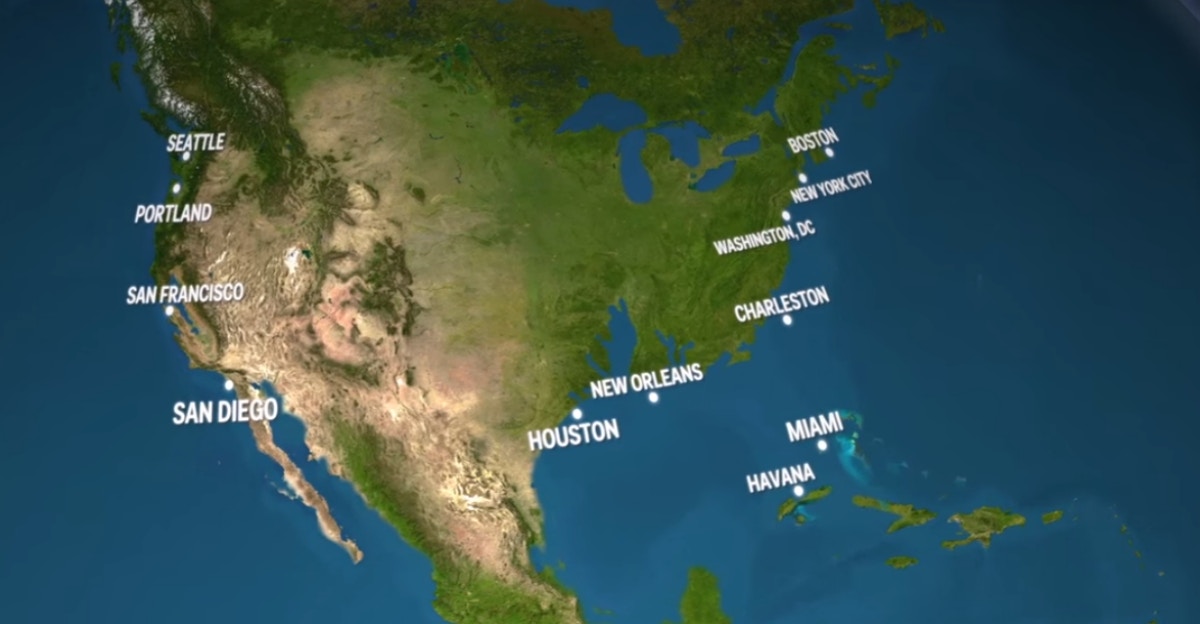
A map of the United States post land-ice melt.
Land ice: We got a lot of it. Considering the two largest ice sheets on earth — the one on Antarctica and the one on Greenland — extend more than 6 million square miles combined ... yeah, we're talkin' a lot of ice. But what if it was all just ... gone? Not like gone gone, but melted?
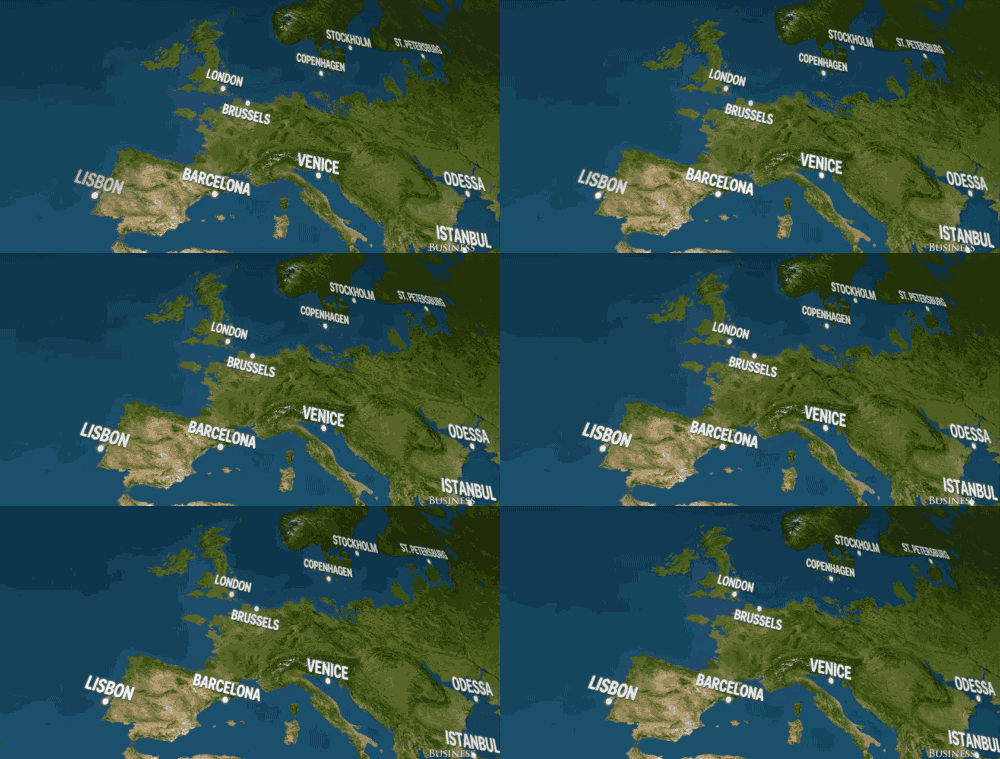
If all of earth's land ice melted, it would be nothing short of disastrous. And that's putting it lightly. This video by Business Insider Science (seen below) depicts exactly what our coastlines would look like if all the land ice melted. And spoiler alert: It isn't great. Lots of European cities like, Brussels and Venice, would be basically underwater.
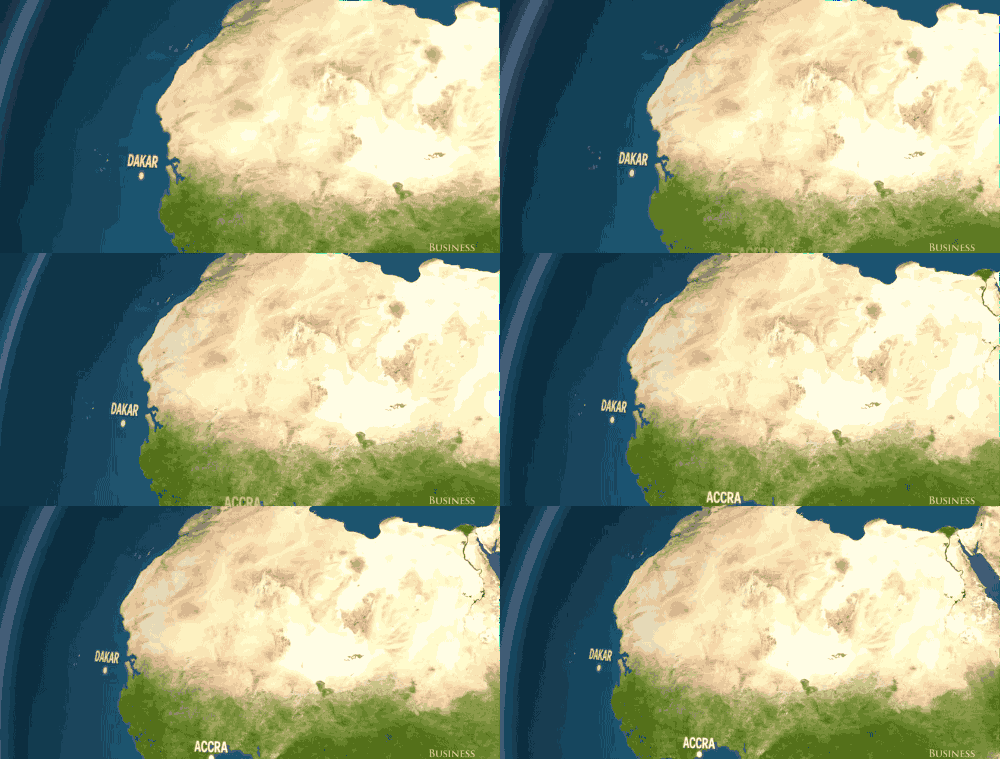
In Africa and the Middle East? Dakar, Accra, Jeddah — gone.
Millions of people in Asia, in cities like Mumbai, Beijing, and Tokyo, would be uprooted and have to move inland.

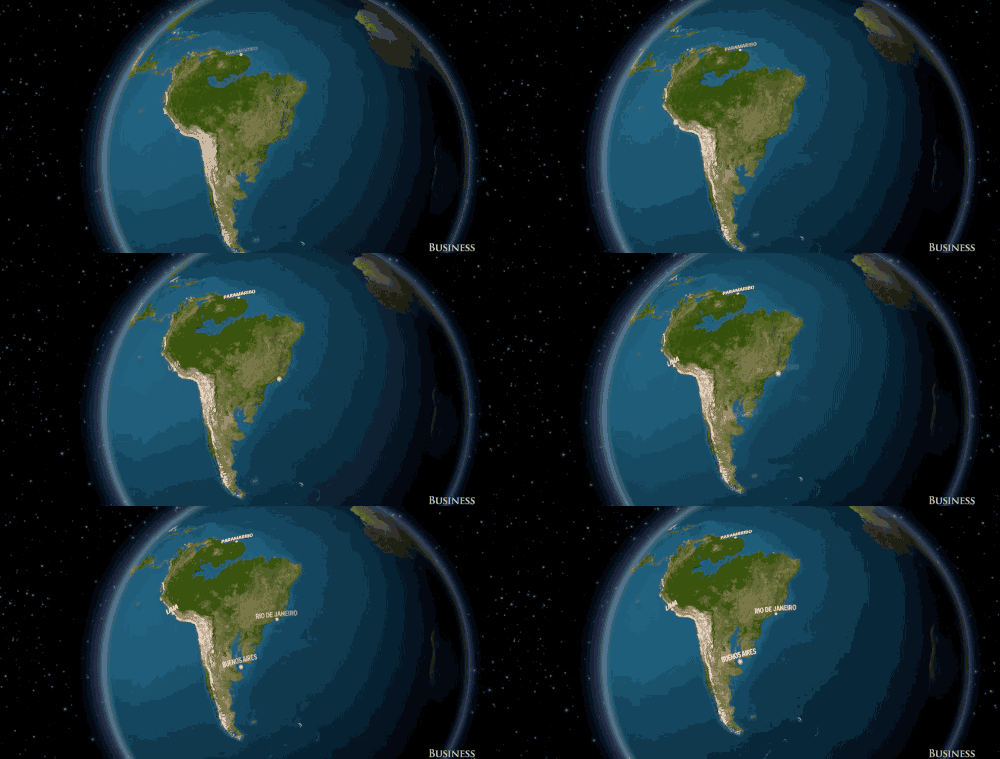
South America would say goodbye to cities like Rio de Janeiro and Buenos Aires.
And in the U.S., we'd watch places like Houston, San Francisco, and New York City — not to mention the entire state of Florida — slowly disappear into the sea.
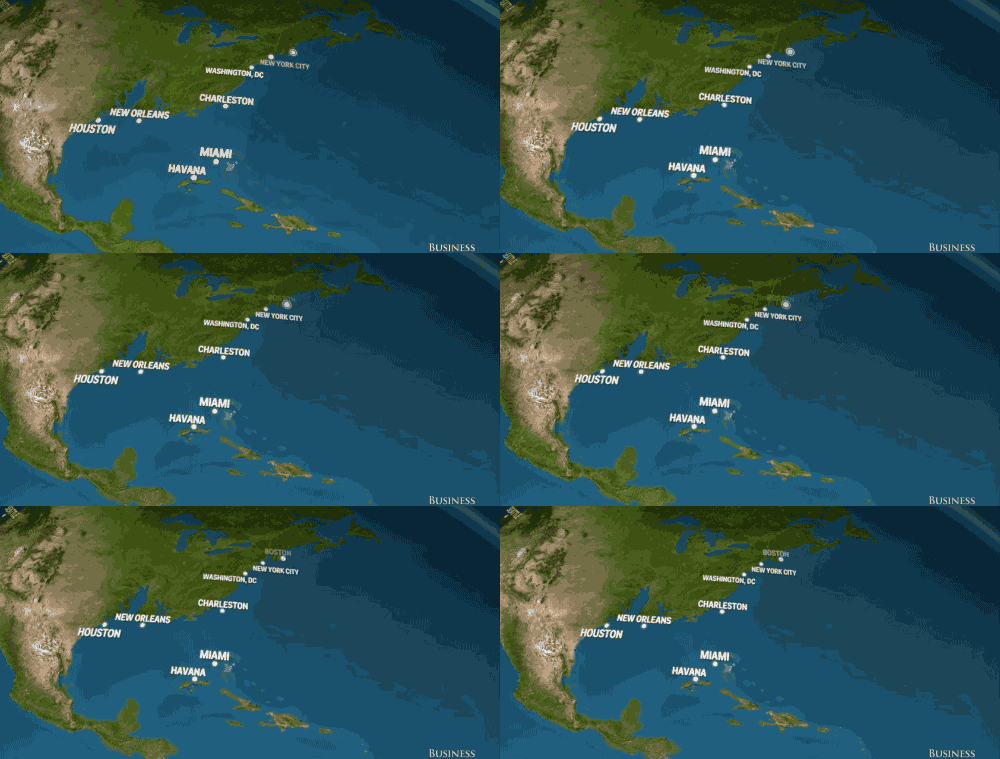
All GIFs via Business Insider Science/YouTube.
Business Insider based these visuals off National Geographic's estimation that sea levels will rise 216 feet (!) if all of earth's land ice melted into our oceans.
There's even a tool where you can take a detailed look at how your community could be affected by rising seas, for better or worse.
Although ... looking at these maps, it's hard to imagine "for better" is a likely outcome for many of us.
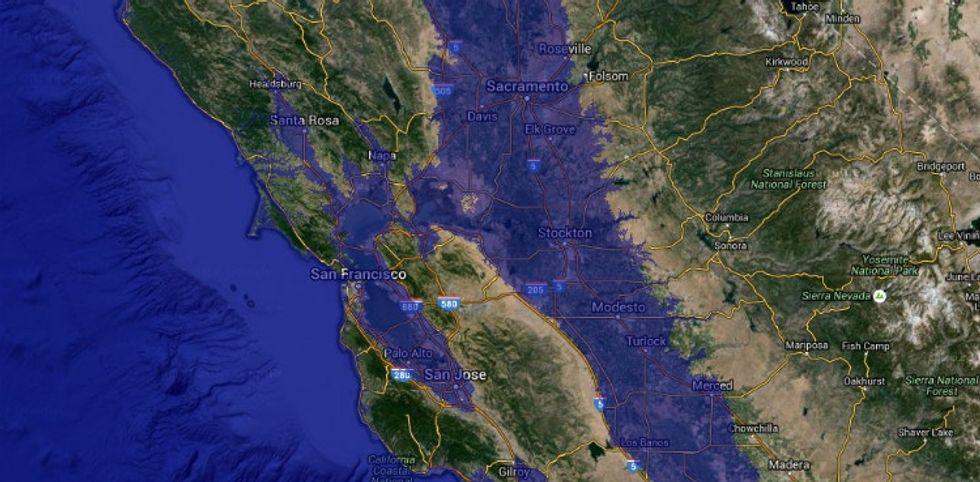
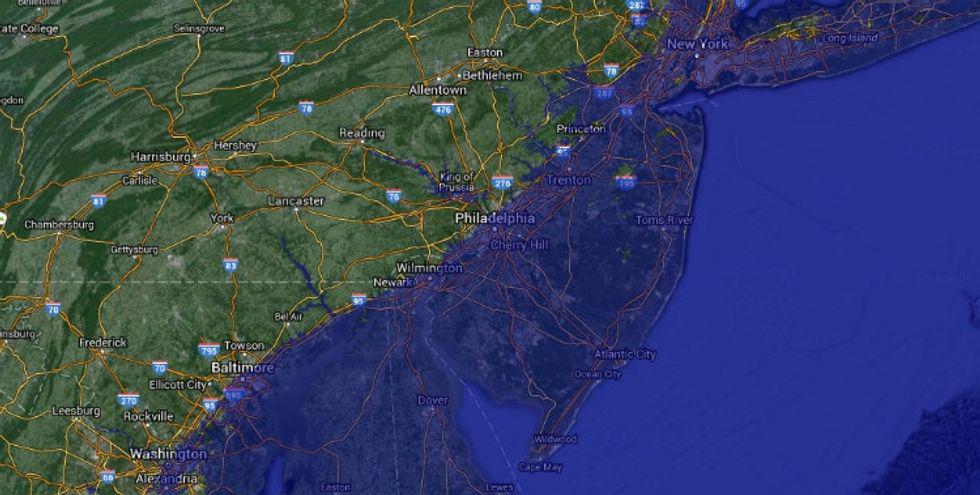
Much of America's most populated regions would be severely affected by rising sea levels, as you'll notice exploring the map, created by Alex Tingle using data provided by NASA.
Take, for instance, the West Coast. (Goodbye, San Fran!)
Or the East Coast. (See ya, Philly!)
And the Gulf Coast. (RIP, Bourbon Street!)
I bring up the topic not just for funsies, of course, but because the maps above are real possibilities.
How? Climate change.
As we continue to burn fossil fuels for energy and emit carbon into our atmosphere, the planet gets warmer and warmer. And that, ladies and gentlemen, means melted ice.
A study published this past September by researchers in the U.S., U.K., and Germany found that if we don't change our ways, there's definitely enough fossil fuel resources available for us to completely melt the Antarctic ice sheet.
Basically, the self-inflicted disaster you see above is certainly within the realm of possibility.
"This would not happen overnight, but the mind-boggling point is that our actions today are changing the face of planet Earth as we know it and will continue to do so for tens of thousands of years to come," said lead author of the study Ricarda Winkelmann, of the Potsdam Institute for Climate Impact Research.
If we want to stop this from happening," she says, "we need to keep coal, gas, and oil in the ground."
The good news? Most of our coastlines are still intact! And they can stay that way, too — if we act now.
World leaders are finally starting to treat climate change like the global crisis that it is — and you can help get the point across to them, too.
Check out Business Insider's video below:
This article originally appeared ten ago.



a man sitting at a desk with his head on his arms Photo by
Can a warm cup of tea help you sleep better? If you believe it, then yes. Photo by 
A woman is getting angry at her coworker.via
A man with tape over his mouth.via
A husband is angry with his wife. via 
Three women sit on a blanket in the park. 
Two women engaging in a pleasant conversation inside a coffee shop
Two men engaging in a peaceful disagreement.
Resurfaced video of French skier's groin incident has people giving the announcer a gold medal
"The boys took a beating on that one."
Downhill skiing is a sport rife with injuries, but not usually this kind.
A good commentator can make all the difference when watching sports, even when an event goes smoothly. But it's when something goes wrong that great announcers rise to the top. There's no better example of a great announcer in a surprise moment than when French skier Yannick Bertrand took a gate to the groin in a 2007 super-G race.
Competitive skiers fly down runs at incredible speeds, often exceeding 60 mph. Hitting something hard at that speed would definitely hurt, but hitting something hard with a particularly sensitive part of your body would be excruciating. So when Bertrand slammed right into a gate family-jewels-first, his high-pitched scream was unsurprising. What was surprising was the perfect commentary that immediately followed.
This is a clip you really just have to see and hear to fully appreciate:
- YouTube youtu.be
It's unclear who the announcer is, even after multiple Google inquiries, which is unfortunate because that gentleman deserves a medal. The commentary gets better with each repeated viewing, with highlights like:
"The gate the groin for Yannick Bertrand, and you could hear it. And if you're a man, you could feel it."
"Oh, the Frenchman. Oh-ho, monsieurrrrrr."
"The boys took a beating on that one."
"That guy needs a hug."
"Those are the moments that change your life if you're a man, I tell you what."
"When you crash through a gate, when you do it at high rate of speed, it's gonna hurt and it's going to leave a mark in most cases. And in this particular case, not the area where you want to leave a mark."
Imagine watching a man take a hit to the privates at 60 mph and having to make impromptu commentary straddling the line between professionalism and acknowledging the universal reality of what just happened. There are certain things you can't say on network television that you might feel compelled to say. There's a visceral element to this scenario that could easily be taken too far in the commentary, and the inherent humor element could be seen as insensitive and offensive if not handled just right.
The announcer nailed it. 10/10. No notes.
The clip frequently resurfaces during the Winter Olympic Games, though the incident didn't happen during an Olympic event. Yannick Bertrand was competing at the FIS World Cup super-G race in Kvitfjell, Norway in 2007, when the unfortunate accident occurred. Bertrand had competed at the Turin Olympics the year before, however, coming in 24th in the downhill and super-G events.
As painful as the gate to the groin clearly as, Bertrand did not appear to suffer any damage that kept him from the sport. In fact, he continued competing in international downhill and super-G races until 2014.
According to a 2018 study, Alpine skiing is a notoriously dangerous sport with a reported injury rate of 36.7 per 100 World Cup athletes per season. Of course, it's the knees and not the coin purse that are the most common casualty of ski racing, which we saw clearly in U.S. skier Lindsey Vonn's harrowing experiences at the 2026 Olympics. Vonn was competing with a torn ACL and ended up being helicoptered off of the mountain after an ugly crash that did additional damage to her legs, requiring multiple surgeries (though what caused the crash was reportedly unrelated to her ACL tear). Still, she says she has no regrets.
As Bertrand's return to the slopes shows, the risk of injury doesn't stop those who live for the thrill of victory, even when the agony of defeat hits them right in the rocks.