We live in a world where there is more art to consume than ever. There’s no shortage of musical mashups, digital paintings, song covers, cosplay videos, and so on and on and on and on. While having visual and audio exposure to various forms of art is lovely, when we only experience art through an online platform, we sometimes sacrifice that powerful feeling of immersion, of being able to come face to face with a creation and truly be moved by an artist’s message. There’s a subtle, yet undeniable change that happens both internally and externally when you step into something with the intention to inspire. Honestly, it’s the closest thing to real world alchemy that we’ve got.
Agnes Denes might not be a name that regularly comes up on your feed, but she’s made an entire career out of creating art that provides this kind of visceral, profound effect.
Since the late 1960s, Denes has been a pioneer for environmental activism through art, exploring our relationship to the Earth through epically large-scale creations that mimic natural splendors of nature. And what really makes her work unique, even among other similar artists, is that it’s more than a call to action—there’s actual restoration built into the process.
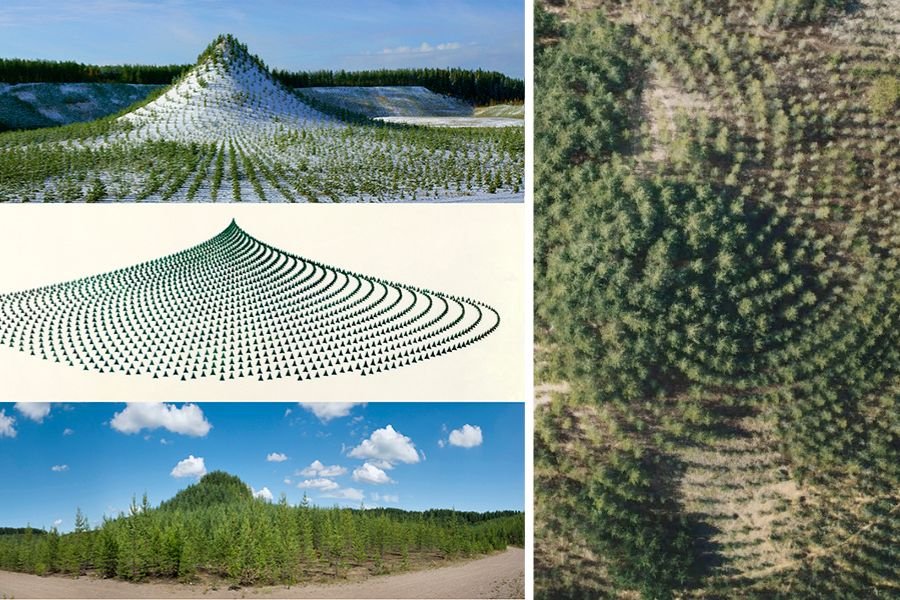
The most brilliant example of this is her grandest work of all, ”Tree Mountain,” which is both artwork and the first ever human-made virgin forest. Yep, she designed a giant, living, breathing thing. Denes doesn’t just praise Mother Nature in her creations…she channels her."Tree Mountain" from concept to actualization

<a href="https://www.agnesdenesstudio.com/img/works4/works4-2.jpg">www.agnesdenesstudio.com</a>
The work’s full title, “Tree Mountain—A Living Time Capsule—11,000 Trees, 11,000 People, 400 Years,” gives a glimpse into the huge scope and scale of the project. Built at the site of an abandoned mine in Ylöjärvi, Finland, “Tree Mountain” measures 1,378 feet long, 886 feet wide, and 125 feet tall, and is made up of thousands of trees planted in a formation reminiscent of the golden ratio.
Though Denes first came up with the concept in 1984, it wouldn’t become an official project until 1992. But once it was backed by the United Nations and the Finnish government, volunteers from around the world came together to help. Anyone who planted a tree received a certificate that not only named them as the owner of the tree they planted but bestowed ownership of the tree to that person’s descendants up to 400 years in the future.
Even granting ownership of the trees is part of the project’s message. As Denes has stated, “Anything you put into the world you become responsible for…my hope is they keep [Tree Mountain] going, for the centuries.”
Truly, at the core of all of Denes’ work is a commitment to a better future for the planet.
“The trees must outlive the present era and, by surviving, carry our concepts into an unknown time in the future. If civilization as we know it ends or changes, there will be a reminder in the form of a strange forest for our descendants to ponder. They may reflect on an undertaking that did not serve personal needs but the common good and the highest ideals of humanity and its environment while benefiting future generations.”
In a small village in Pwani, a district on Tanzania’s coast, a massive dance party is coming to a close. For the past two hours, locals have paraded through the village streets, singing and beating ngombe drums; now, in a large clearing, a woman named Sheilla motions for everyone to sit facing a large projector screen. A film premiere is about to begin.
It’s an unusual way to kick off a film about gender bias, inequality, early marriage, and other barriers that prevent girls from accessing education in Tanzania. But in Pwani and beyond, local organizations supported by Malala Fund and funded by Pura are finding creative, culturally relevant ways like this one to capture people’s interest.
The film ends and Sheilla, the Communications and Partnership Lead for Media for Development and Advocacy (MEDEA), stands in front of the crowd once again, asking the audience to reflect: What did you think about the film? How did it relate to your own experience? What can we learn?
Sheilla explains that, once the community sees the film, “It brings out conversations within themselves, reflective conversations.” The resonance and immediate action create a ripple effect of change.
MEDEA Screening Audience in Tanzania. Captured by James Roh for Pura
Across Tanzania, gender-based violence often forces adolescent girls out of the classroom. This and other barriers — including child marriage, poverty, conflict, and discrimination — prevent girls from completing their education around the world.
Sheilla and her team are using film and radio programs to address the challenges girls face in their communities. MEDEA’s ultimate goal is to affirm education as a fundamental right for everyone, and to ensure that every member of a community understands how girls’ education contributes to a stronger whole and how to be an ally for their sisters, daughters, granddaughters, friends, nieces, and girlfriends.
Sheilla’s story is one of many that inspired Heart on Fire, a new fragrance from the Pura x Malala Fund Collection that blends the warm, earthy spices of Tanzania with a playful, joyful twist. Here’s how Pura is using scent as a tool to connect the world and inspire action.
A partnership focused on local impact, on a global mission
Pura, a fragrance company that recognizes education as both freedom and a human right, has partnered with Malala Fund since 2022. In order to defend every girl’s right to access and complete 12 years of education, Malala Fund partners with local organizations in countries where the educational barriers are the greatest. They invest in locally-led solutions because they know that those who are closest to the problems are best equipped to solve and build durable solutions, like MEDEA, which works with communities to challenge discrimination against girls and change beliefs about their education.
But local initiatives can thrive and scale more powerfully with global support, which is why Pura is using their own superpower, the power of scent, to connect people around the world with the women and girls in these local communities.
The Pura x Malala Fund Collection incorporates ingredients naturally found in Tanzania, Nigeria, Pakistan, and Brazil: countries where Malala Fund operates to address systemic education barriers. Eight percent of net revenue from the Pura x Malala Fund Collection will be donated to Malala Fund directly, but beyond financial support, the Collection is also a love letter to each unique community, blending notes like lemon, jasmine, cedarwood, and clove to transport people, ignite their senses, and help them draw inspiration and hope from the global movement for girls’ education. Through scent, people can connect to the courage, joy, and tenacity of girls and local leaders, all while uniting in a shared commitment to education: the belief that supporting girls’ rights in one community benefits all of us, everywhere.
You’ve already met Sheilla. Now see how Naiara and Mama Habiba are building unique solutions to ensure every girl can learn freely and dare to dream.
Naiara Leite is reimagining what’s possible in Brazil
Julia with Odara in Brazil. Captured by Luisa Dorr for Pura
In Brazil, where pear trees and coconut plantations cover the Northeastern Coast, girls like ten-year-old Julia experience a different kind of educational barrier than girls in Tanzania. Too often, racial discrimination contributes to high dropout rates among Black, quilombola and Indigenous girls in the country.
“In the logic of Brazilian society, Black people don’t need to study,” says Naiara Leite, Executive Coordinator of Odara, a women-led organization and Malala Fund partner. Bahia, the state where Odara is based, was once one of the largest slave-receiving territories in the Americas, and because of that history, deeply-ingrained, anti-Black prejudice is still widespread. “Our role and the image constructed around us is one of manual labor,” Naiara says.
But education can change that. In 2020, with assistance from a Malala Fund grant, Odara launched its first initiative for improving school completion rates among Black, quilombola, and Indigenous girls: “Ayomidê Odara”. The young girls mentored under the program, including Julia, are known as the Ayomidês. And like the Pura x Malala Fund Collection’s Brazil: Breath of Courage scent, the Ayomidês are fierce, determined, and bursting with energy.
Ayomidês with Odara in Brazil. Captured by Luisa Dorr for Pura
Ayomidês take part in weekly educational sessions where they explore subjects like education and ethnic-racial relations. The girls are encouraged to find their own voices by producing Instagram lives, social media videos, and by participating in public panels. Already, the Ayomidês are rewriting the narrative on what’s possible for Afro-Brazilian girls to achieve. One of the earliest Ayomidês, a young woman named Debora, is now a communications intern. Another former Ayomidê, Francine, works at UNICEF, helping train the next generation of adolescent leaders. And Julia has already set her sights on becoming a math teacher or a model.
“These are generations of Black women who did not have access to a school,” Naiara says. “These are generations of Black women robbed daily of their dreams. And we’re telling them that they could be the generation in their family to write a new story.”
Mama Habiba is reframing the conversation in Nigeria
Centre for Girls' Education, Nigeria. Captured by James Roh for Pura
In Mama Habiba’s home country of Nigeria, the scents of starfruit, ylang ylang and pineapple, all incorporated into the Pura x Malala Collection’s “Nigeria: Hope for Tomorrow,” can be found throughout the vibrant markets. Like these native scents, Mama Habiba says that the Nigerian girls are also bright and passionate, but too often they are forced to leave school long before their potential fully blooms.
“Some of these schools are very far, and there is an issue of quality, too,” Mama Habiba says. “Most parents find out when their children are in school, the girls are not learning. So why allow them to continue?”
When girls drop out of secondary school, marriage is often the alternative. In Nigeria, one in three girls is married before the age of 18. When this happens, girls are unable to fulfill their potential, and their families and communities lose out on the social, health and economic benefits.
Completing secondary school delays marriage, and according to UNESCO, educated girls become women who raise healthier children, lift their families out of poverty and contribute to more peaceful, resilient communities.
Centre for Girls’ Education, Nigeria. Captured by James Roh for Pura
To encourage young girls to stay in school, the Centre for Girls’ Education, a nonprofit in Nigeria founded by Mama Habiba and supported by Malala Fund and Pura, has pioneered an initiative that’s similar to the Ayomidê workshops in Brazil: safe spaces. Here, girls meet regularly to learn literacy, numeracy, and other issues like reproductive health. These safe spaces also provide an opportunity for the girls to role-play and learn to advocate for themselves, develop their self-image, and practice conversations with others about their values, education being one of them. In safe spaces, Mama Habiba says, girls start to understand “who she is, and that she is a girl who has value. She has the right to negotiate with her parents on what she really feels or wants.”
“When girls are educated, they can unlock so many opportunities,” Mama Habiba says. “It will help the economy of the country. It will boost so many opportunities for the country. If they are given the opportunity, I think the sky is not the limit. It is the starting point for every girl.”
From parades, film screenings to safe spaces and educational programs, girls and local leaders are working hard to strengthen the quality, safety and accessibility of education and overcome systemic challenges. They are encouraging courageous behavior and reminding us all that education is freedom.
Experience the Pura x Malala Fund Collection here, and connect with the stories of real girls leading change across the globe.
An amazingretirement village is accepting guests in Shropshire, England—but instead of catering to elderly people, it’s designed for elderly cats.Shropshire Cat Rescue has been rescuing elderly cats set to be euthanized and providing them with top-notch elder care for over 21 years. Thanks to donations and sponsorship, the retirement village was built in 2009 to create comfortable homes within the rescue for senior and super senior kitties.
The owner and co-founder of the rescue, Marion Micklewright, was tired of seeing older cats get passed over for adoption and subsequently put to sleep simply because they were old. So she decided to do something about it. Shropshire was created in 1991 and moved to Micklewright and her husband Richard’s current home address in 1998. Today there are cats wandering the retirement village who are over 20 years old. One cat, lovingly named Cat, loves to hang out in the little “store” in the tiny cat town, while others lounge in cat condos.
Veterinarian Dr. Scott Miller, TV personality, resident vet onITV’sThis Morning, and owner of an elderly cat himself, visited the feline retirement community in March 2024 to film for his new YouTube Channel, Rescue Vet. He was deeply impressed with how much the retirement community had to offer the cats that call it home and dubbed it the “cutest cat retirement village” according to Shropshire Star in 2024.
Retirement Village model spreads to the U.S.
Shropshire Cat Rescue is a marvel, but it’s not the only retirement home out there for felines. A Florida couple opened a retirement home for elderly cats, too. Terry and Bruce Jenkins decided to open their home for elderly cats in their backyard, rescuing them from “hardship situations.” Affectionately called Cats Cradle, the Jenkins’ rescue doesn’t adopt the old kitties out; they let them live out their years happy and cared for cozy in their backyard (that Bruce unofficially calls “cat Disneyland”). “I found a real purpose in caring for these animals who, in many ways, were a reflection of where I was in life, too,” Terry told AARP in 2023.
What Makes Shropshire Cat Rescue Unique
Wonderfully, there are several retirement homes for cats in America, but Shropshire’s retirement village operates like a small town. It comes complete with a storefront, six “homely chalets,” and the “Moggies Mansion,” a sort of common area for all the cats to congregate.
As of 2024, Shropshire Cat Rescue houses about 19 elderly cats, but have opened the village to “younger but just as in need” cats. They offer adoptions, are open to and eagerly welcome volunteers, and even host local events.
How to Support the PURR Project and Senior Kitties
You can support Shropshire with donations to their PURR Project, a new center complete with it’s own retirement village, nursery, pet hospital, education center, and even staff and volunteer accommodations.
Check it out:
This article originally appeared last year. It has been updated.
One of the main reasons humans and dogs have gotten along so well for centuries is that we just get each other. Dogs and humans can form incredibly close emotional bonds, and we also make great partners when working together, whether on a farm or in a K-9 unit. It’s no surprise that, according to Embark Veterinary, dogs and humans share an estimated 84% of our DNA and have over 17,000 similar genes.
Further, our species have evolved together. Dogs that were better able to communicate with humans—by understanding commands, making “puppy eyes,” and showing lower levels of aggression—were more likely to be bred, reinforcing those traits across the species.
A fantastic example of the bond between humans and dogs was recently shared by Emily Freireich, 24, on her 5-year-old dog Luna’s TikTok account. In the video, Freireich shows how Luna’s pupils dilate when she talks to her.
“Ignore my annoying baby talk, but I love seeing her eyes dilate when I talk to her. It makes me feel like she loves me so much,” she captioned the video. If you look closely, as Luna locks in with Freireich, her pupils (the black part of the eyes) grow larger.
“It makes me feel like she loves me and is listening to what I’m telling her,” Freireich told Newsweek. “She is the sweetest dog ever. She’s always happy to meet people and other dogs; she’s super cuddly and such a good girl.”
Why do dogs’ pupils dilate?
Dogs’ pupils get larger, or dilate, when they’re excited; that can mean they’re afraid or incredibly happy to see you. The pupils dilate to let in more light so they can see more clearly, whether that’s a threat or the person they love most in the world.
Dog owners should be aware, though: In some cases, pupil dilation may indicate that a dog is ill. If their pupils are dilated and they aren’t aroused for any reason, it may be time to make a vet appointment. But if you get home from work and they run to greet you and their pupils enlarge, it’s a sign they’re over the moon to see you.
“When it’s dark, they widen to let in more light and help you see better. Conversely, your pupils will decrease in size and constrict when faced with additional light. Both of these occurrences allow you to adapt your vision for your environment. … When you’re attracted to someone or see something that appeals to you, your body – or more specifically your sympathetic nervous system – activates. Your brain increases production of the hormones oxytocin and dopamine, both of which can cause your pupils to dilate so you can better see the object of your desire. … Remember, attraction is hardly the only reason your pupils might dilate. Fear can also stimulate your sympathetic nervous system and release hormones so your eyes can temporarily improve its vision.”
Freireich’s video is a wonderful reminder of how much we love our dogs and how much they love us back. We live about five times longer than they do, and we should never forget that they may be only a chapter in our lives, but to them, we are the whole book. So, we should give them all the love, attention, and affection they deserve.
Dogs are considered invaluable police helpers for their tracking abilities. But performing CPR? That’s certainly not on anyone’s bingo card.
However, footage released on X by Madrid Municipal Police shows a dog named Poncho doing just that, or at least performing CPR in a training simulation.
In the clip, an officer pretends to faint, triggering Poncho to rush to the rescue. Wearing a harness fitted with a small blue light, Poncho quickly begins jumping on the officer’s chest with his forepaws, mimicking chest compressions. After every few jumps, he appears to check for a pulse or breath before continuing the drill.
By the end, the officer miraculously jumps up, and Poncho’s tail wags in gleeful triumph.
The Municipal Police of Madrid wrote that the “heroic” dog “did not hesitate for a moment to ‘save the life’ of the agent, practicing the #CPR in a masterful way.”
Adorable? Definitely. Effective? Eh, not so much.
As many were quick to point out in the comments, this “masterful” performance is certainly heartwarming, but it likely wouldn’t hold up in a real emergency.
While CPR, or cardiopulmonary resuscitation, can be performed using chest compressions alone (as Poncho was demonstrating), even that requires a level of precision that man’s best friend might find challenging.
As Jonathan Epstein, senior director of science and government relations for the American Red Cross, told The Washington Post in 2018, that technique involves pushing down about two inches into the patient’s chest at a rate of 100 to 120 compressions per minute until the patient regains consciousness or until someone else can take over to attempt traditional CPR or other revival methods.
That level of control is difficult even for humans who have not been properly trained, much less a creature without opposable thumbs.
Video goes viral
Still, it could be argued that Poncho revived millions of hearts after his video went viral, and he certainly received applause from his new fans.
“This is the cutest thing I’ve ever seen 🥺🥹”
“Lol 😂most ineffective compressions I’ve ever seen but ok cute.”
“Cutest, most ineffective bounces I’ve ever seen, but what a good way to go! lolol 😍”
Plus, dogs have proven themselves to be incredible creatures many times before, whether saving people from drowning or rescuing avalanche victims.
And for what it’s worth, the Madrid police department wasn’t trying to convince anyone that Poncho could perform CPR. They actually had much more wholesome intentions.
According to NBC News, the Municipal Police of Madrid hoped the video would inspire pet adoptions. The department also quoted American author Josh Billings in an X post, saying, “A dog is the only thing on earth that loves you more than you love yourself.”
So while Poncho might not have pulled off a medical miracle, he is undoubtedly a hero in our eyes.
Making quality dresses takes an enormous amount of skill. It’s not just about sewing and tailoring, but also about design—knowing which fabrics and colors pop and draw the eye. At their best, dresses bring art and beauty to fashion. But for a fine arts student living in Spain, making a dress incorporated all of those skills, along with a touch of nature.
Artist Amanda Meyer successfully sewed a beautiful dress from a variety of hand-picked autumn leaves in vibrant shades of orange, red, and yellow. She then soaked the leaves in glycerin to help preserve them. After drying them with an iron, the leaves became sturdier and easier to manipulate. Meyer cut and sewed the leaves together into a gorgeous patchwork mini dress.
“I wanted to see if it was possible to create a fully organic garment without using the usual materials such as cotton or linen,” Meyer told My Modern Met. “As a young person deeply committed to the environment, my practice focuses on using only recycled and natural resources. I specialize in textile art, creating sculptures and sculpt-like garments.”
Natural fibers of a different kind
It took Meyer around 100 meters of thread and 40 hours of hand sewing to create her leaf dress. While the dress remains fragile and is intended for exhibition, it is also a wearable and successful clothing experiment. However, it was never meant to last.
Screenshot
“Many people have asked me if I intend to preserve it,” said Meyer. “The answer is no, I want to see how it passes the test of time. Clothes aren’t meant to last forever.”
The environmental problem of modern fashion
The mixed-media artist draws attention to the troubling fast-fashion industry. Fast fashion offers convenience and style, but it also contributes to environmental issues. According to Boston University, the United States throws out 34 billion pounds of used textiles each year. The lion’s share of them are made from synthetic fibers, which take much longer to decompose than natural ones like cotton.
Fast fashion production also generates more carbon emissions than international flights, according to Business Insider. In the end, it contributes to piles of long-lasting clothing in landfills and increasing levels of air pollution.
Meyer’s artwork and similar movements show how the life cycles of items can be repurposed, whether for creative expression or practical use. An old garment can be transformed into crafts, toys, rugs, or even cleaning rags. If leaves can be used to create beautiful art, a discarded T-shirt can become something more, too.
Have you ever dreamed of buying an entire row of seats on an airplane so you could either enjoy the flight without being squeezed next to a stranger or lie down as if in a bed? Now, United Airlines is making that dream a reality with its new “Relax Row” seating, where your row of seats folds into a lie-flat, mattress-like space after takeoff.
If you’re flying alone, it may be a bit expensive to buy an entire row, but if you’re sharing it with a partner or traveling with kids and were planning to buy three seats anyway, it’s a more comfortable way to fly. In addition to the bed-like layout, customers receive a custom-fitted mattress pad, a specially sized plush blanket, two additional pillows, a plush toy, and a children’s travel kit for families.
For years, people who sit in first class have been able to lie down and sleep almost as they would at home. This will be the first time that bed-like seats have been available in coach on an American airline. A similar type of seating is currently available on Air New Zealand, All Nippon Airways, and Lufthansa.
“As a leading premium airline, we’re committed to delivering new, industry-leading experiences for all of our customers–and the United Relax Row is the perfect example of that,” Andrew Nocella, United’s executive vice president and chief commercial officer, said in a statement. “Customers traveling in United Economy on long-haul flights deserve an option for more space and comfort, and this is one way we can deliver that for them. United is the only North American airline offering a product like the United Relax Row and is one of the many reasons why we’re continuing to win brand loyal customers.”
Here are the actual images of United's "Relax Row," taken by a Redditor. 📸: u/CommanderDawn pic.twitter.com/6Td4RluYi2
The new seating arrangement will launch in 2027. It will be available on more than 200 Boeing 787 and Boeing 777 aircrafts by 2030, with up to 12 United Relax Row sections per plane. United Airlines currently has more than 1,000 planes in its fleet.
The airline hasn’t shared any details on how much the Relax Row will cost compared with three regular seats on a flight, saying only that it’s intended for those who “want the value of United Economy but with a little extra comfort.”
It also appears that, in the event of turbulence, passengers won’t have to pack the bed away, as they are secured by safety belts that go across their bodies.
“United Relax Row” announced by United Airlines that lets passengers combine three seats into one usable area.
Of course, there’s an added cost on top of the price for all three seats. That charge hasn’t been announced yet.
It’s becoming harder for families to sit together on commercial airlines
The new seating arrangement is perfect for families with small children, allowing them to lie down, relax, and hopefully get some sleep during a flight.
The announcement comes at a time when it’s becoming harder for families to sit together. On many budget airlines, families who book tickets aren’t guaranteed seats together unless they pay an additional fee to select them.
No one would get a dog expecting it to not bark, try to eat human food, or need daily walks. And yet people regularly get flummoxed when their just-as-loveable cat exhibits completely natural behaviors like climbing tabletops or scratching at furniture.
Cat people, who delight in adapting their lives to make them as enriching as possible for their feline family members, know the flaw in this logic. After all, most cats spend more time in the house than their human counterparts. So shouldn’t the house belong just as much to them?
If you answered yes, then this response video from a vet should have you feeling pretty vindicated. If you answered no, prepare to reconsider.
Dr. Matt McGlasson is a veterinarian and chief medical officer at Noah’s Ark Animal Clinics in Kentucky, where he oversees a four-hospital network, and also happens to be the proud dad of a special needs cat named Rupaul. As he told Newsweek, he gets several comments each week saying it’s gross to have cats on the furniture. One viewer went further and called it “disgusting.”
McGlasson’s response to that comment racked up 11.8 million views on Instagram, and with good reason.
In the clip, McGlasson holds up Rupaul, who can’t use her hind legs, and lists off everything he would do for his cat, including co-signing a loan for her, letting her do his taxes, giving her the passwords to all his accounts, going into business with her, giving her $20,000 for bringing him a dead mouse, and making her the beneficiary on his life insurance policy. He also mentioned capital punishment, which he’s not normally in favor of, but “if someone hurts Rupaul, that’s another story.” And last, but certainly not least, letting Rupaul on the furniture.
Put simply: “My cat can do whatever she wants. It’s her world. I’m just living in it.”
A cat stretches out on the couch. Photo credit: Canva
Fellow cat owners in the comments could not agree more.
“My husband picked his new chair based on the cat. The arm had to be wide enough for her to sit whenever she chooses to have quality time with him.”
“I would donate my kidneys to Square if she needed them. Yes, I mean both.”
“‘You let your cat sleep with you?’ Ma’am, I’d let him represent me in court.”
“I bought my house for my senior kitties. I wanted to get out of our apartment so they could feel grass beneath their paws again before their time was up.”
Bottom line: climbing is part of a cat’s inherent programming. If cat owners truly want their home to be a safe space for their cat, this needs to be part of the equation. The good news is there are plenty of ways to redirect those instincts without conflict, like making sure there are dedicated cat trees to climb and scratching posts to use, or opting for furniture fabrics that cats tend to avoid, like microfiber.
And as a general rule, cats respond to positive reinforcement rather than punishment. Contrary to popular belief, cats don’t “know” when they’re being bad. Scolding them just teaches them to associate their behavior with negative attention, which isn’t fun for anyone.
As McGlasson, now with nearly 800,000 TikTok followers and a book called “How to Rate a Cat,” would tell you: having a pet in your home provides so much fulfillment and connection that small compromises, or large bank loans, are well worth it.
By the way, McGlasson’s TikTok and Instagram are full of hilarious (and informative!) cat content. Here’s a small sampling:
Tiny houses are still a popular choice for people trying to downsize but tiny houses for cats are springing up in one man’s backyard.
Back in 2024, Barna thought he was doing a good deed for a stray cat that decided that he kinda liked hanging out in this human’s backyard. At first, the cat would show up but wouldn’t eat the food set out for him. That didn’t stop Barna.
The man continued to set food out for the cat. Taking note of the changing weather, Barna decided to take one of his hobbies and build the cat, now named Domino a cozy little house. Building things is a hobby for him, so he made sure to equip Domino’s tiny abode with a heating pad, light and camera.
Before too long the situation turned into a version of the famous children’s book, If You Give a Mouse a Cookie. Another cat showed up (because of course Domino had a bestie) but it didn’t stop there.
Barna built a tiny two story condo for the two cats to hang out in while still keeping Domino’s original tiny house. The backyard looks like it was made to host furry tenants in a makeshift cat community because more cats indeed showed up. Soon the tuxedo cat had several neighbors to hang out with and thanks to Barna, none of the cats looked like they were missing any meals.
“We have about four or five cats who will go in and sleep in the houses,” Barna told The Dodo. “One night one of the biggest storms of the year hit, I saw that two kittens actually took shelter in the house. That was one of the sweetest things ever.”
A stray cat looks at the camera. Photo credit: Canva
Barna had cameras set up inside and outside of the itty bitty kitty community so he can keep an eye on his feline neighbors. The cats’ landlord expressed that he feels gratification seeing his little houses be used by furry tenants. Having a group of cats around probably isn’t too terrible for keeping pests away either, so it’s a win for all involved.
Down in the comments, people applauded Barna for taking such good care of his feline friends.
“If you build it, they will come. what a kind and thoughtful gentleman to take care of these babies during the hard weather.”
“How a man treats animals reveals who the man is. This is a good man.”
“Just imagine how good the inside of those little houses feel to a kitty after he or she has been outdoors in all kinds of weather for who knows how long. They would finally be able to relax and get a good sleep. Kudos for being so kind and handy.”
“There is most definitely a special place in heaven for the animal rescuers. I love you.”
“This world NEEDS more people like this gentleman.”
Indeed, the world could definitely use a few more Barnas. Best of luck to him and his kitty companions.
Even though commercial airlines have been taking flight for 112 years, questions about etiquette still spark heated debates. Who gets the middle seat armrest? How many bags are fair to put in the overhead compartment? And one small argument continues to rage: Should the window shade be up or down, and who gets to decide?
While plenty of online discussions ping-pong the debate, the topic went viral last month after a woman documented a flight across the Arctic Ocean. Passenger Kelly Meng was flying in an economy seat from Chicago to Tokyo when, unfortunately, a fellow passenger didn’t comply with others’ wishes.
She explained in a TikTok video that the windows on this flight didn’t have “traditional shutters,” but rather dimmers that never allow them to get “100 percent opaque.” Because the flight is long (about 13 hours), many passengers wanted to sleep after dinner service, she said. But one passenger refused to dim their window beyond 75%, even after another traveler said the bright sun was blinding his eyes.
At one point, Meng said, a flight attendant gently asked the woman to dim her window, but she refused. Meng concluded, “The lack of self-awareness is insane.”
Unsurprisingly, many commenters sided with the window-seat passenger.
“Imo, whomever pays for and sits in the window seats controls the window,” wrote one commenter, who received nearly 4,000 likes.
Another person agreed: “Unpopular opinion, but bring an eye mask if it’s going to bug you. I totally see your point in this particular case, but I like to have my window open on shorter flights, especially if we’re flying over somewhere scenic.”
A few others agreed with Meng. “Idk how people are siding with the ‘window seat’ person,” one commenter noted. “It’s as if someone is playing music over speakers and telling other people to put on their own headphones if you don’t want to hear the music.”
Another commenter added, in part, that a bright window can make the cabin hot: “I don’t think people realize that having the shades open during daytime flights is not only blinding, but it also makes the cabin HOT. Especially if you’ve got the sun directly beaming on you.”
Flight attendant settles it
Upworthy spoke with a flight attendant for a major airline who preferred to go by the name Simone for this piece. She offered a definitive answer, but it’s slightly more complicated than one might think.
“The person next to the window controls the shade, and it should be down if the sun is making the cabin too bright,” Simone said. “However, most people in the window seats are nervous travelers or children. We can’t ask anyone to lower their shades during flight, we can only ‘mean mug’ them when we walk by.”
She offered this tidbit on how flight attendants sometimes get around the issue: “On the 787, the electric windows can be controlled by the flight attendants, and we aren’t supposed to set them on 5 and lock them, but we do.”
As for takeoffs and landings: “Window shades should be up for takeoff and landing so flight attendants have visibility in case of an emergency. That’s the only time we can request the position of the window shade.”
To be clear, while the airline doesn’t officially state a preference for in-flight shade position, Simone shared her own:
“For ‘blank’ sake, lower the shade and go to sleep. You can only look at the clouds for so long. One problem is the sun shines so bright in the cabin and some people can’t see their laptops while trying to do work or read on their tablets. I hate when the shades are up during the day. Nobody needs to see my large pores and runny nose while I’m serving them sodas and snacks.”