upworthy
Add Upworthy to your Google News feed.
Google News Button
Pop Culture

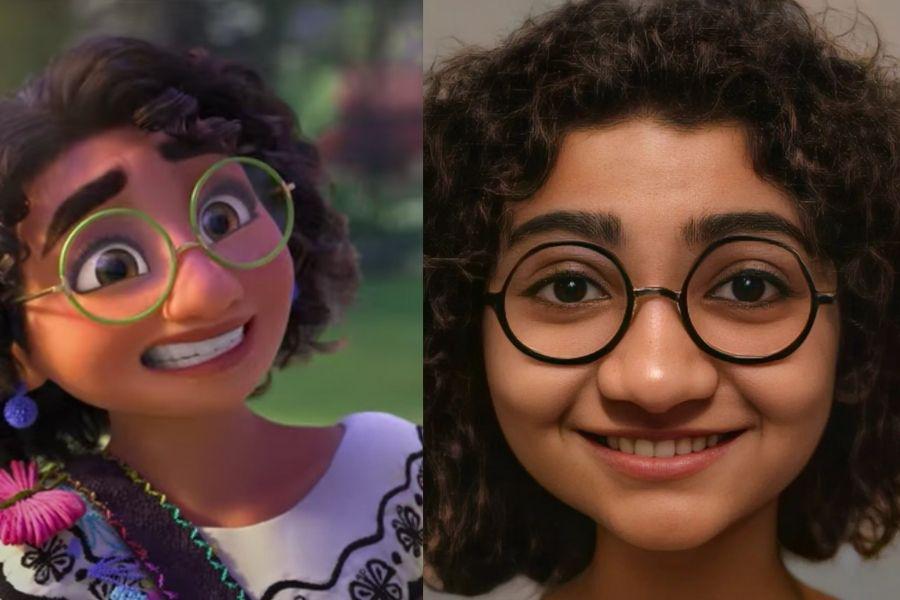
Characters from 'Encanto' get made into portraits so lifelike they look like real people

Digital portraits as magical as the Madrigal family.

encanto characters get real life portraits

Where is the live action movie already?

What do you get when you mix artificial intelligence with editing software?

Mind-blowing images, apparently.

Brazilian digital artist Hidreley Leli Dião creates ultra realistic portraits of beloved cartoon characters as well as historical figures.


The magic is in a unique blend of Photoshop, FaceApp, Gradiente and Remini, according to his contributing article on Bored Panda. Using this formula, even The Simpsons characters feel like real people you would pass on the street.

Some of Dião’s latest works include the characters of Disney’s “Encanto,” like:

Mirabel

The face shape! The hair! The smile! He nailed it.

Luisa

To no one’s surprise, Luisa was highly sought after by fans.

Bruno

I think the song will change to “Everybody Is Talking About Bruno” after seeing this picture.

Isabela

A portrait perfect enough for Miss Perfect herself.

Camilo

It’s like he could hop out of the frame and start shapeshifting in real life. Wow.

Pepa

As a fellow redhead constantly trying to keep emotions at bay, this one was my personal favorite.

Julieta

Here is Mirabel’s mother Julieta, giving off major Aunt Voula vibes from “My Big Fat Greek Wedding.”

And, of course,  Abuela Madrigal

I think it’s safe to say even if Dião doesn’t have a magic door like the Madrigal family, he’s got superpower: digital wizardry.

But of course, this is not Dião’s first Disney deep dive. Feast your eyes on some of these:

Carl Fredrickson from “Up”

Moana from “Moana”

Ariel from “The Little Mermaid”

Also Prince Eric

Pocahontas from “Pocahontas”

Joe Gardner from “Soul”

Hans From “Frozen”

Another long lost Hemsworth brother, rediscovered?

Are you more of a history buff than a Disney nerd? Never fear. Dião’s work has something for everyone.

One collection includes what certain celebrities that met an early death might look like today, such as:

Amy Winehouse

Bruce Lee

John Candy

Janis Joplin

Marilyn Monroe

Another reimagines what historical figures might have look like in modern times:

George Washington

Benjamin Franklin

Napoleon 

Leonardo da Vinci

Mozart

Beethoven

Sir Isaac Newton

William Shakespeare

Vincent Van Gogh

Marie Antoinette

Cleopatra

Alexander the Great

And just for fun, here’s what the Statue of Liberty might look like as a real person:

Thank you Hidreley for giving us some genuine wonder to peruse through on the internet. If you’d like to see more of Hidreley's work, you can follow his Instagram here.


This article originally appeared on 04.25.22

Planet

Our favorite giveaway is back. Enter to win a free, fun date! 🌊 💗

It's super easy, no purchase or donation necessary, and you help our oceans! That's what we call a win-win-win. Enter here.

Our favorite giveaway is back. Enter to win a free, fun date! 🌊 💗
True

Our love for the ocean runs deep. Does yours? Enter here!

This Valentine’s Day, we're bringing back our favorite giveaway with Ocean Wise. You have the chance to win the ultimate ocean-friendly date. Our recommendation? Celebrate love for all your people this Valentine's Day! Treat your mom friends to a relaxing spa trip, take your best friend to an incredible concert, or enjoy a beach adventure with your sibling! Whether you're savoring a romantic seafood dinner or enjoying a movie night in, your next date could be on us!

Here’s how to enter:


  • Go to upworthy.com/oceandate and complete the quick form for a chance to win - it’s as easy as that.
  • P.S. If you follow @oceanwise or donate after entering, you’ll get extra entries!

Here are the incredible dates:

1. Give mom some relaxation

She’s up before the sun and still going at bedtime. She’s the calendar keeper, the lunch packer, the one who remembers everything so no one else has to. Moms are always creating magic for us. This Valentine’s Day, we’re all in for her. Win an eco-friendly spa day near you, plus a stash of All In snack bars—because she deserves a treat that’s as real as she is. Good for her, kinder to the ocean. That’s the kind of love we can all get behind.


Special thanks to our friends at All In who are all in on helping moms!

2. Jump in the ocean, together

Grab your favorite person and get some much-needed ocean time. Did you know research on “blue spaces” suggests that being near water is linked with better mental health and well-being, including feeling calmer and less stressed? We’ll treat you to a beach adventure like a surfing or sailing class, plus ocean-friendly bags from GOT Bag and blankets from Sand Cloud so your day by the water feels good for you and a little gentler on the ocean too.

Special thanks to our friends at GOT Bag. They make saving the ocean look stylish and fun!

3. Couch potato time

Love nights in as much as you love a date night out? We’ve got you. Have friends over for a movie night or make it a cozy night in with your favorite person. You’ll get a Disney+ and Hulu subscription so you can watch Nat Geo ocean content, plus a curated list of ocean-friendly documentaries and a movie-night basket of snacks. Easy, comfy, and you’ll probably come out of it loving the ocean even more.

4. Dance all day!

Soak up the sun and catch a full weekend of live music at BeachLife Festival in Redondo Beach, May 1–3, 2026, featuring Duran Duran, The Offspring, James Taylor and His All-Star Band, The Chainsmokers, My Morning Jacket, Slightly Stoopid, and Sheryl Crow. The perfect date to bring your favorite person on!

We also love that BeachLife puts real energy into protecting the coastline it’s built on by spotlighting ocean and beach-focused nonprofit partners and hosting community events like beach cleanups.

Date includes two (2) three-day GA tickets. Does not include accommodation, travel, or flights.

5. Chef it up (at home)

Stay in and cook something delicious with someone you love. We’ll hook you up with sustainable seafood ingredients and some additional goodies for a dinner for two, so you can eat well and feel good knowing your meal supports healthier oceans and more responsible fishing.

Giveaway ends 2/15/26 at 11:59pm PT. Winners will be selected at random and contacted via email from the Upworthy. No purchase necessary. Open to residents of the U.S. and specific Canadian provinces that have reached age of majority in their state/province/territory of residence at the time. Please see terms and conditions for specific instructions. Giveaway not affiliated with Instagram. More details at upworthy.com/oceandate

Pets

Vet demonstrates 'squish the cat' method of safe cat handling in delightfully helpful video

There's a reason Dr. Burstyn's "How to pick up a cat" video has been viewed 23 million times.

cats, pets, cat handling, veterinarian, feline behavior

Handling a cat may seem like a delicate matter, but being delicate isn't actually the way to go.

If you've ever tried to make a cat do something it doesn't want to do, you've likely experienced the terror that a cat's wrath can invoke. Our cute, cuddly feline friends may be small, but the razor blades on their feet are no joke when they decide to utilize them. Even cats who love us can get spicy if we try to manhandle them, so we can imagine how things will go with cats who don't know us well. But sometimes it's necessary to handle a cat even if it's resistant to the idea.

This is where Vancouver veterinarian Dr. Uri Burstyn comes in. His "How to pick up a cat like a pro" video, in which he demonstrates a few ways of picking up and handling a cat, has been viewed over 23 million times since he shared it in 2019. Unlike many viral videos, it's not humorous and nothing outrageous happens, but the combo of Burstyn's calm demeanor and his repeated instructions to "squish that cat" has endeared him to the masses.


- YouTube www.youtube.com

The video truly is helpful; he shows the ways to pick up a cat that make them feel the most secure using his cats, one-year-old Claudia and 14-year-old Mr. Pirate. He explains that cats spook very easily and it's best to introduce yourself to them gently. Let them sniff your fingers, keeping your fingers curled in, and once they've sniffed you, you can often give them a light rub on the cheek or under the chin.

Picking them up is a different story. The reason many cats will claw or scratch you when you try to pick them up is because they feel unsupported or unsafe, so they'll scramble around trying to get some footing. Burstyn shows how he picks up Claudia with one hand under the chest and one hand under her abdomen. If he needs to carry her around, he squishes her into his body so she feels "nice and supported." He may even put a hand under her front paws.

cats, pets, cat handling, veterinarian, feline behavior Cats can be finicky about how they're held. Photo credit: Canva

Then came the best part of the video: "Squish That Cat"

"Now if we do have a cat who's trying to get away from us?" Burstyn said. "We always squish that cat. If you're trying to hold the cat down, whether it's to trim their nails or to give them a pill, or whether you just want to have a cat not run off for a moment, squish that cat. All you need to know about cat restraint is to squish that cat."

Burstyn explains that cats generally feel very secure being squished, even if they're really scared.

"Sometimes cats come to me in the clinic, and they're quite afraid," he said. "And you just gently squish them, and they'll sit there and kind of not hurt themselves, not hurt us. Just hang out and let us do our thing."

He demonstrated putting a towel over the cat, explaining, "If you have a towel handy, this is one of the best cat restraint tools around. You can just throw a towel on the catty and squish her with the towel, that way they won't get a claw into you if they are scrambling about a bit. Very safe and gentle, and generally cats are very, very happy to be squished like that."

cats, pets, cat handling, veterinarian, feline behavior Squish that cat. Photo credit: Canva

Dr. Burstyn also showed how to do a "football hold," tucking the cat under your arm with them facing backwards. "So this is kind of an emergency way if you really need to carry a cat somewhere in a hurry," he said. Scooping up Claudia, he explained, "Little head's under your arm, butt in your hand, and you squish her tight to your body. And with that little football carry, you can basically hold a cat very securely and very safely, because it's really hard for them to rake you with their hind legs."

If you're worried about over-squishing your cat, Dr. Burnstyn says don't. "You don't have to worry about hurting a cat," he said. "They're very, very tough little beasts. You know, just squishing them against your body's never going to do them any harm. In fact, they tend to feel more safe and secure when they're being held tightly."

Dr. Burnstyn also demonstrated how to pick up and set down a "shoulder cat" who insists on climbing onto people's shoulders and hanging out there, as Mr. Pirate does. It's highly entertaining, as Mr. Pirate is a big ol' chonky kitty.


@yozron

Visit TikTok to discover videos!

People in the comments loved Dr. Burnstyn's demonstration, with several dubbing him the Bob Ross of veterinary medicine. Even people who don't have cats said they watched the whole video, and many loved Claudia and Mr. Pirate as well.

"This is just proof that cats are liquid."

"12/10 cat. Excellent squishability."

"So essentially, cats love hugs? That's the most wonderful thing i've heard all day."

"This cat is so well mannered and looks educated."

"Mr Pirate is an absolute unit."

"S q u i s h . T h a t . C a t ."

"I need 'Squish that cat' shirt.

"Dang, that actually helped with my female cat. She has been through at least two owners before me and had some bad expriences which obviously resulted in trust issues. She has now been with me for two years and it had gotten loads better, but she still did not want me to hold her. Normally I simply would have let her be, but for vet visits and such it was not an ideal situation. But then I saw this video and tried to squish the cat. And she loves it! She is turning into quite the snuggly bug. Thank you!"

So there you go. When all else fails, squish that cat and see what happens.

You can follow Dr. Burstyn on YouTube at Helpful Vancouver Vet.


Joy

Wholesome moment between UPS driver and author caught on camera helps book sales skyrocket

The author was struggling to pay the bills. Then one kind encounter changed everything.

UPS driver, ups, damian lewis, self publishing, publishing on Amazon, Amazon, ring camera, new jersey, positive news
via @thecallmefirstblueprint/TikTok, used with permission

A quick exchange between a UPS driver and a budding author turned into a beautiful friendship.

Sometimes, even the simplest human interaction can turn into something miraculous and life-changing. One such interaction recently happened on a New Jersey doorstep, resulting in a launched career and an unlikely friendship.

In a video that blew up on TikTok, we see UPS driver Kyle Thurkauf inquisitively asking, “What’s the deal with all these books?” as he unloads piles of large boxes.


Little did Thurkauf know that he was delivering to Damian Lewis, a first-time author who had recently self-published a motivational guidebook for men titled Call Me First: A Man’s Blueprint to True Leadership at Home.

Upon discovering this, Thurkauf replies, “I’m happy for you, bro!” Before returning to his route, Lewis gifts Thurkauf a free copy.

@thecallmefirstblueprint Here is a clean, search friendly video description you can drop straight in. It stays real, specific, and searchable. A UPS driver noticed the constant book deliveries at my house and asked what was going on. I handed him a copy of the book I wrote, and two days later he came back saying how much it helped him and asking where he could buy it. This book is written for men who want to lead better at home, communicate with confidence, earn real respect, and become dependable husbands and fathers. It breaks down leadership, responsibility, discipline, and presence in a way most men were never taught. If you are a husband, a father, or a man trying to step up, build structure, and stop guessing your way through life, this book was written for you. Available on Amazon and TikTok Shop. Click the link below to get your copy. Optional hashtags if you want them added #mensleadership #fatherhood #husbandgoals #selfdiscipline #callmefirst ♬ Boundless Worship - Josué Novais Piano Worship

“Kyle had been dropping off boxes of my books for a while,” explained Lewis in an exclusive interview with PEOPLE. “But we had never actually met face to face. It was usually my wife grabbing the packages or he would leave them on the porch. This was the first time we really crossed paths in person.”

Lewis added that he was more than content that Thurkauf took a sincere interest in his work. But then Thurkauf returned days later…not to make a delivery, but to tell Lewis how much he enjoyed the book and ask where it could be bought.

“For him not to have a delivery for me that day, when he came back to tell me how good the book was and to ask me where to get it, it was like, I feel like I made it at that point,” Lewis shared with News 12 New Jersey.

- YouTube www.youtube.com

Pretty soon, that video garnered nearly 34 million views and helped Lewis sell 9,000 copies. This stroke of luck came at a pivotal time, as Lewis informed PEOPLE he had just quit his job in August 2025 to pursue writing full time and was certainly feeling the struggles of self-publishing.

“Things were slow. I had about six weeks of savings left and knew I might have to walk away if something didn’t change. That momentum honestly helped keep me afloat and allowed me to keep chasing the dream instead of walking away from it.”

But perhaps most endearing of all, this viral interaction has inspired a very real friendship between two entrepreneurs. Lewis told PEOPLE that, in addition to being a UPS driver, Thurkauf is also the owner of Preservation Pantry, which sells pickles and jams. Now they are both “talking nearly every day" and “supporting each other’s businesses.”

“Somehow it turned into something bigger than both of us. I’m just grateful for it,” said Lewis.

As for Thurkauf, he told News 12 New Jersey that he always tries to “provide a close, meaningful relationship” filled with “respect and kindness and gratitude” with every customer.

This lovely story is just a brief, yet oh-so meaningful glimpse into what humans can really accomplish when they extend friendship and kindness to one another.

guitar, learning a skill, neuroscience, music, exposure, passive exposure, gardening

A woman learning how to play guitar.

Learning a new skill, such as playing an instrument, gardening, or picking up a new language, takes a lot of time and practice, whether that means scale training, learning about native plants, or using flashcards to memorize new words. To improve through practice, you have to perform the task repeatedly and receive feedback so you know whether you’re doing it correctly. Is my pitch correct? Did my geraniums bloom? Is my pronunciation understandable?

However, a new study by researchers at the Institute of Neuroscience at the University of Oregon shows that you can speed up these processes by adding a third element to practice and feedback: passive exposure. The good news is that passive exposure requires minimal effort and is enjoyable.


"Active learning of a... task requires both expending effort to perform the task and having access to feedback about task performance," the study authors explained. "Passive exposure to sensory stimuli, on the other hand, is relatively effortless and does not require feedback about performance."


woman reading, woman book, young woman, studying, new skills A woman reading a book.via Canva/Photos

How to pick up new skills faster?

So, if you’re learning to play the blues on guitar, listen to plenty of Howlin’ Wolf or Robert Johnson throughout the day. If you’re learning to cook, keep the Food Network on TV in the background to absorb some great culinary advice. Learning to garden? Take the time to notice the flora and fauna in your neighborhood or make frequent trips to your local botanical garden.

If you’re learning a new language, watch plenty of TV and films in the language you are learning. The scientists add that auditory learning is especially helpful, so listen to plenty of audiobooks or podcasts on the subject you’re learning about.

But, of course, you also have to be actively learning the skill as well by practicing your guitar for the recommended hours each day or by taking a class in languages. Passive exposure won't do the work for you, but it's a fantastic way to pick up things more quickly. Further, passive exposure keeps the new skill you're learning top-of-mind, so you're probably more likely to actively practice it.

What is passive exposure?

Researchers discovered the tremendous benefits of passive exposure after studying a group of mice. They trained them to find water by using various sounds to give positive or negative feedback, like playing a game of “hot or cold.” Some mice were passively exposed to these sounds when they weren't looking for water. Those who received this additional passive exposure and those who received active training learned to find the water reward more quickly.

gardening, woman gardening, gardening shears, leaning gardening, weeds A woman tending to her garden.via Canva/Photos


“Our results suggest that, in mice and in humans, a given performance threshold can be achieved with relatively less effort by combining low-effort passive exposure with active training,” James Murray, a neuroscientist who led the study, told University of Oregon News. “This insight could be helpful for humans learning an instrument or a second language, though more work will be needed to better understand how this applies to more complex tasks and how to optimize training schedules that combine passive exposure with active training.”

The one drawback to this study was that it was conducted on mice, not humans. However, recent studies on humans have found similar results, such as in sports. If you visualize yourself excelling at the sport or mentally rehearse a practice routine, it can positively affect your actual performance. Showing, once again, that when it comes to picking up a new skill, exposure is key.

The great news about the story is that, in addition to giving people a new way to approach learning, it’s an excuse for us to enjoy the things we love even more. If you enjoy listening to blues music so much that you decided to learn for yourself, it’s another reason to make it an even more significant part of your life.

- YouTube www.youtube.com

This article originally appeared last year.

History (Education)

John Adams' 1756 diary entries are making people feel better about struggling to 'lock in' in 2026

Even without the internet, smartphones, or electricity, people still struggled to be productive back in the day.

john adams, diary, journal, u.s. presidents, productivity
Images in the public domain

John Adams' diary entries about trying to be productive feel remarkably relatable.

In a world where we are surrounded by endless distractions and digital dopamine hits, it can be hard to stay focused on what we need to do, or even what we want to do. There's a reason we see countless productivity hacks being pushed and why the phrase "lock in" has gained popularity to describe getting into a state of deep focus.

However, if you think lock-in struggles are a modern phenomenon due to the internet and smartphones, we have evidence to the contrary in former U.S. president John Adams' diary entries. An image of an excerpt from David McCullough's Pulitzer Prize-winning biography of John Adams offers a glimpse of a man determined to make a schedule and stick to it, even as he battles his tendency to while away his time.


According to the book excerpt, Adams was frustrated that he so often made resolutions he didn't keep and instead daydreamed his days away. As an example, he wrote in his diary (edited in the book) on July 21, 1756:

"I am now entering on another Year, and I am resolved not to neglect my Time as I did last Year. I am resolved to rise with the Sun and to study the Scriptures, on Thurdsday, Fryday, Saturday, and Sunday mornings, and to study some Latin author the other 3 mornings. Noons and Nights I intend to read English Authors. This is my fixt Determination, and I will set down every neglect and every compliance with this Resolution. May I blush whenever I suffer one hour to pass unimproved. I will rouse up my mind, and fix my Attention. I will stand collected within my self and think upon what I read and what I see. I will strive with all my soul to be something more than Persons who have had less Advantages than myself."

The next day, he wrote that he "Rose not till 7 o clock," adding, "This is the usual Fate of my Resolutions!"

And just over a week later, on July 30, his entire entry read, "A very rainy Day. Dreamed away the Time."

Sound familiar?

john adams, diary, journal, u.s. presidents, productivity President John Adams struggled with sticking to his resolutions. Rossiter Johnson/Wikimedia Commons (public domain)

Why so many people relate to his resolution struggles

Adams was a man who not only didn't have a smartphone or computer, but didn't even have electricity. People on X shared their thoughts on his diary entries:

"Relatable! Actually reads like my own to-do lists."

"I feel seen."

"He's literally me.”

"And the age-old reality: Dreamed away the Time."

"Man he didn't even have to worry about smart phones, social media, the internet, video games, tv, an attention-economy, etc. etc. etc. Honestly, makes me feel better lol."

"Bro was founding a nation and still couldn't focus. makes me feel better about not wanting to do laundry."

"Oh the struggle is age old so I can't blame tech?"

"Infinite scroll would've stopped the American Revolution."

"Honestly this is some serious validation for the modern man. We're not the only ones who know we can spend our time better."

The truth is, a lot of us set goals for ourselves that we end up bailing on over and over, leaving us frustrated. According to a Forbes survey, the majority of New Year's resolutions are abandoned within four months, and only 6 percent last the entire year.

Adams also struggled with anxiety, depression, and other mental health issues, with some psychologists suggesting he might have been diagnosed with Bipolar II disorder if he were alive today. Undiagnosed or untreated mental health challenges, including conditions like ADHD, can come between what we want for ourselves and what we're actually able to do.

goals, resolutations, new year's, motivation, sticking to goals How do we stick with the goals we set for ourselves?Photo credit: Canva

How to stick with your goals

Once you've ruled out or addressed mental health reasons for your "lock in" woes, there are steps you can take to make sticking to personal resolutions more likely. Psychologists from the University of Delaware suggest the following:

Don't discount timing

"New Year's resolutions sometimes lack in commitment," said Philip Gable, a professor in the Department of Psychological and Brain Sciences. "It's just this time of year when people feel like they should make a resolution, as opposed to other times in the year when it's less common but maybe more meaningful, like if you get a doctor's report and realize you need to change that aspect of your life."

Break goals down and start small

"I think a lot of times with goals, people will commit to a very big goal and not realize the smaller steps they need to take to achieve that goal," Gable said. "If we have too big of a goal, we get emotionally distressed when we can't do it, or we fail because we set too big of a goal. Or maybe we couldn't think through all of the elements required to meet that really big goal. So starting small gives us something achievable, and then that gives you a platform to go to the next thing."

Expect it to feel slow and repetitive

"In your natural setting, or even in controlled settings, habits are going to develop slowly," said Rob West, a professor in the Department of Psychological and Brain Sciences. "You don't roll out of bed and say, 'I'm going to have a new habit today.' That's not the set of cognitive mechanisms by which we develop habits. They are acquired over time through repetition."

Give yourself grace

"It happens every year — we all have good intentions and then life gets in the way," said Naomi Sadeh, an associate professor in the Department of Psychological and Brain Sciences. "So it's important to be kind to yourself when you make mistakes or have lapses in your plans. If you just go down the rabbit hole of feeling guilt and shame, that's not going to help in terms of your long-term goals. Just expect that there will be lapses and accept that and be kind to yourself in those situations."

When all else fails, remind yourself that even John Adams managed to not only be president of the United States, but also raise a U.S. president, lock-in struggles and all.

arthur c. brooks, harvard, psychology, happiness research, bucket list

Harvard researcher Arthur C. Brooks studies what leads to human happiness.

We live in a society that prizes ambition, celebrating goal-setting, and hustle culture as praiseworthy vehicles on the road to success. We also live in a society that associates successfully getting whatever our hearts desire with happiness. The formula we internalize from an early age is that desire + ambition + goal-setting + doing what it takes = a successful, happy life.

But as Harvard University happiness researcher Arthur C. Brooks has found, in his studies as well as his own experience, that happiness doesn't follow that formula. "It took me too long to figure this one out," Brooks told podcast host Tim Ferris, explaining why he uses a "reverse bucket list" to live a happier life.


bucket list, wants, desires, goals, detachment Many people make bucket lists of things they want in life. Giphy

Brooks shared that on his birthday, he would always make a list of his desires, ambitions, and things he wanted to accomplish—a bucket list. But when he was 50, he found his bucket list from when he was 40 and had an epiphany: "I looked at that list from when I was 40, and I'd checked everything off that list. And I was less happy at 50 than I was at 40."

As a social scientist, he recognized that he was doing something wrong and analyzed it.

"This is a neurophysiological problem and a psychological problem all rolled into one handy package," he said. "I was making the mistake of thinking that my satisfaction would come from having more. And the truth of the matter is that lasting and stable satisfaction, which doesn't wear off in a minute, comes when you understand that your satisfaction is your haves divided by your wants…You can increase your satisfaction temporarily and inefficiently by having more, or permanently and securely by wanting less."

Brooks concluded that he needed a "reverse bucket list" that would help him "consciously detach" from his worldly wants and desires by simply writing them down and crossing them off.

"I know that these things are going to occur to me as natural goals," Brooks said, citing human evolutionary psychology. "But I do not want to be owned by them. I want to manage them." He discussed moving those desires from the instinctual limbic system to the conscious pre-frontal cortex by examining each one and saying, "Maybe I get it, maybe I don't," but crossing them off as attachments. "And I'm free…it works," he said.

- YouTube www.youtube.com

"When I write them down, I acknowledge that I have the desire," he explained on X. "When I cross them out, I acknowledge that I will not be attached to this goal."

The idea that attachment itself causes unhappiness is a concept found in many spiritual traditions, but it is most closely associated with Buddhism. Mike Brooks, PhD, explains that humans need healthy attachments, such as an attachment to staying alive and attachments to loved ones, to avoid suffering. But many things to which we are attached are not necessarily healthy, either by degree (over-attachment) or by nature (being attached to things that are impermanent).

"We should strive for flexibility in our attachments because the objects of our attachment are inherently in flux," Brooks writes in Psychology Today. "In this way, we suffer unnecessarily when we don't accept their impermanent nature."

What Arthur C. Brooks suggests that we strive to detach ourselves from our wants and desires because the simplest way to solve the 'haves/wants = happiness' formula is to reduce the denominator. The reverse bucket list, in which you cross off desires before you fulfill them, can help free you from attachment and lead to a happier overall existence.

This article originally appeared last year.