
upworthy
Add Upworthy to your Google News feed.
Google News Button
Health

Stuck in the past or worried about the future? 6 tips for living more fully in the present.

Living in the now is both harder and easier than it sounds.

man joyfully riding a bike

Living in the present includes finding joy in small things.

One of the hallmarks of being human is that, without even leaving our own heads, we can live in three different places—the past, the present and the future. We all have memories of things that have happened in our lives, which we might reminisce on fondly or relive traumatically. And we all have our imaginings of things to come, in which we place our hopes and dreams as well as our worries and anxieties.

And then we have the now, where all of us actually live. Despite the fact that the present moment is the only place life actively happens, many of us spend much more time mentally living in the past or in the future. We might long for a time when things were better or dwell in the past where we wish things had been different. We might look forward to something that's coming next—a big life event, a change, a break from the routine—or we might find ourselves paralyzed by the fear of an uncertain future.

There's nothing wrong with looking back or looking ahead, but if we don't look at the present right before us more often, we end up missing out on life as we're living it. The past can't be changed and the future is unknown; the only time that we can truly live fully is now.

It sounds so simple, right? If it were easy to live in the present, we'd all be doing it more often. Habits of mind can be hard change, but tips for living in the now aren't complicated. It's both easier and harder than it sounds to live in the now, but these habits can help us strike a healthier balance.

"Use the good china"

We live by a lot of unwritten rules, some that are there for good reason and some that aren't. Examining the do's and don'ts we have set for ourselves—or that others have set for us—is a worthwhile endeavor, especially when they lead us to experience life more fully in the now.

How many of us have dishes for special occasions that rarely (or never) get used or special outfits we're saving for some unnamed future event? What if we used the good china more often, just because? What if we wore our fancy dress out to dinner, just because? Would the world end? No. Might we enjoy making the most of what we're holding onto for special occasions that might never come? Probably.

It's fine to have special things for special occasions, but there's no set definition of "special," and if not now, when?

"Always take the trip"

One of the best pieces of parenting advice I ever received was "always take the trip." The idea is that our kids grow quickly, and if we're ever considering not taking a family trip because the timing or cost isn't ideal, as long as it's doable, to just do it.

That advice spills over into more than just parenting. If we have opportunities to make memories with loved ones, to experience something together outside of our norm, we should take them. There will always be reasons to say no or to put things off, but that doesn't mean we should. Barring actual financial ruin or some other dire consequence, take the trip, whatever it is.

Ground yourself in your senses

This is an exercise that can help stop a panic attack, but it can be used any time you find your mind spinning in the past or future. Becoming hyper aware of your physical surroundings can bring you into the present moment in a tangible way, and it's quite simple to do. Look around and name 5 things you see, list 4 things you hear, 3 things you feel, 2 things you smell and 1 thing you taste. Then sit with those physical senses for a moment, taking them all in.

Meditate—however it works for you

I know, I know. Some of us love meditation and others find it impossible. Much of the time, people who feel like they can't meditate have a limited view of what meditation means or what it can look like. But there are a million ways to reap the proven benefits of meditation.
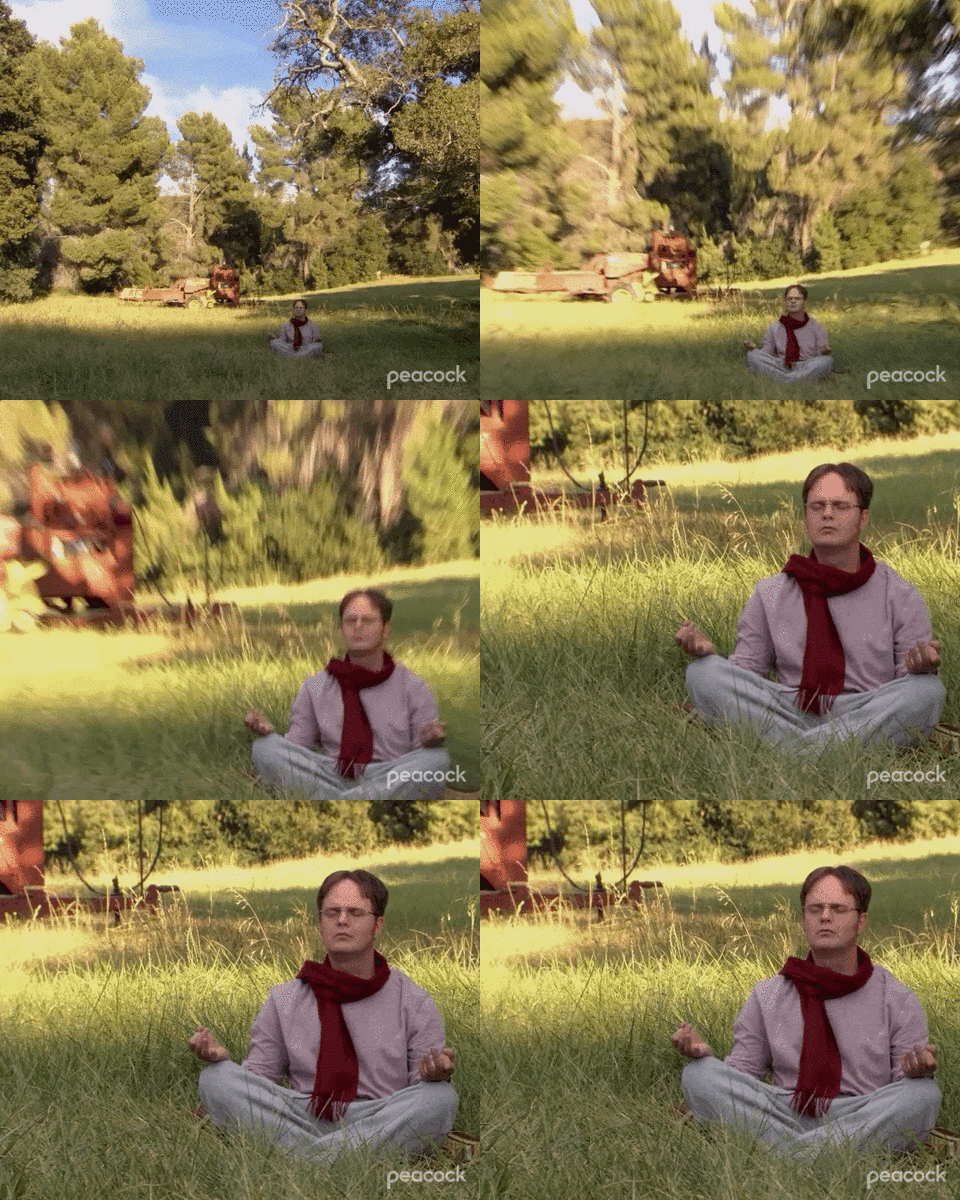
You don't have to sit cross-legged and you don't have to try to "clear your mind." You can lie down. You can walk. You can focus on your breathing or on a word or phrase or image. When your mind starts wandering or racing or otherwise doing what it normally does, intentionally direct it back to whatever you're focusing on.

That mindfulness helps bring you into the present moment. Start with a couple of minutes a day and build up. It doesn't have to be complicated. Don't overthink it. Find a comfortable position or a movement you enjoy and pick one thing to focus your attention on. That's it.

Practice gratitude

The idea of practicing gratitude has almost become a cliché at this point, but hey, it works. What are you thankful for in your life right now? Making a habit of ending each day writing down or thinking about what you're grateful for is a powerful way to appreciate the present.

If you struggle to find something you're thankful for, think beyond your own immediate circumstances. Humans created public libraries and they exist all over the world—isn't that amazing? Grateful. Sunrises and sunsets and puppies and flowers? Grateful. The fact that we live in an era with toilet paper? Grateful.

There's always something to be thankful for in the now.

Find joy in small things

Life has its big moments, but most of our daily life is made up of small things. If we only look forward or backward to big things, we miss out on a lot of the simple joys of everyday life—the first sip of coffee in the morning, the sound of a loved one's laughter, the feel of the wind in your hair.

man joyfully riding a bicycle.Enjoy the little things.Photo credit: Canva

Take a moment to look at how the light comes through a window, how cute your cat looks when she's sleeping, the beauty of your favorite decor in your home, the smell of your favorite food.

Remembering that our present is the future our past self used to look forward to can help us remember the importance of living in the moment. Reflect on the past and plan for the future, but in moderation. Life is happening in the now.

party, chatting, likable, drinks small talk, men and women

A woman speaking with two men at a party.

When we think of someone likable, we often imagine a person with a big personality who's the life of the party. We conjure up images of social butterflies and people who keep everyone at the dinner party glued to their every word when they tell a story. The funny thing is, according to research, that's not really the case.

Studies show that the easiest way to make someone like you is to show interest by asking questions during the conversation and making it clear that you like them. People also really love those who come off as genuine.


Michael Gendler, a co-founder of Ultraspeaking, a platform that helps people master the art of public speaking, recently shared three "magic" phrases that make you more likable, all of which align with what science tells us.

Three phrases that make you more likable

Phrase 1: "Here's what really scares me..."

This phrase resonates with people because it shows you're genuine by admitting your vulnerability. "Man, talk about your feats, real fears, not like 'Oh, I'm scared I'm going to be too successful.' Tell us about something that actually scares you. Don't be guarded. Be open, and other people will appreciate that," Gendler says.

Phrase 2: "You know what I really like about you?"

This phrase makes people like you because it counters a psychological phenomenon known as signal amplification bias, which suggests we tend to overestimate how clearly we express our feelings to others. This means that, many times, when we think others know we like them, they may not be so sure. So a little assurance goes a long way toward showing them the feeling is mutual. "People love being complimented as long as it is genuine," Gendler says.


Phrase 3: "Tell me more"

As Dale Carnegie wrote in How to Make Friends and Influence People, the key to interacting with others is focusing on being interested in them rather than trying to impress them by being interesting. "Be interested, not interesting," Carnegie writes.

A Harvard study supports this, showing that when you first start speaking with someone, you should follow your first question with two more. People who do this are rated as much more likable than those who, after one question, shift the conversation to themselves. "People love feeling like what they're saying is interesting. So invite them to speak more," Gendler continues.


Don't forget to be genuine

Ultraspeaking's post is a breath of fresh air for those who aren't comfortable trying to impress others at parties, on dates, or in the office. The video shows that if you make people feel important, they're much more likely to like you in return. The key is that it has to come from the heart.

"Remember, don't just use these phrases and expect them to work," Gendler says. "They have to be genuine and open. That's what makes people likable."

idioms, catchphrases, buzzwords, english language, english, office, workplace, corporate culture

Business idioms that you can totally use in your real workplace.

It seems that the higher up you ascend in your career, the more you grow to love a good business catchphrase, buzzword, or idiom. Working in an office will have you saying things like "let's kick this off," "let's circle back on this," and "let's not boil the ocean here" in no time.

Idioms, while they can get annoying when overused (especially in the workplace), do serve a helpful purpose. They're a sort of fun shorthand, conveying a lot of meaning in a few words. While idioms act as analogies or metaphors that give more context to a situation, they also come with a lot of history: when you hear one, you remember all the times you've heard it before or even used it yourself. It instantly contextualizes what's going on and quickly helps us understand what someone may be communicating.


However, run-of-the-mill workplace idioms have gotten a little stale, to the point that many of them have become meaningless cliches. We could all use some new ones, and luckily, folks on social media are chiming in with some ridiculous creations of their own.

It all started when an X user named Tomie shared what would go on to become a hugely viral post: "I've started saying nonsense phrases at work like 'that's neither cheese nor cheddar' just to see my coworkers nod seriously like they understand."

Tomie added in another post, "Like woah there, pause the pineapples."

The post received nearly 2 million views and hundreds of comments on X. Soon, it made its way to the professional crowd on LinkedIn, where people began building on Tomie's original suggestions.

Daniel Berk added a few of his own:

"Let's not microwave the lasagna on this one."

"We might be polishing the doorknob instead of opening the door."

"This feels like we're alphabetizing water."

"Let's not put racing stripes on a parked car."

"That's a lot of garnish for no entrée."

"We're measuring the shadow, not the object."


Noah Latner chimed in with:

"Let's not settle in before we buy the house."

"That lollipop isn't worth the lick."

"You've got to put the patty on the grill before it sizzles."

"This banana's got no peel to it."

"Don't juice a pickle and tell me it's matcha."

Sally Thomas writes, "One of my finest achievements was in a previous company where the manager was full of buzzwords. I got him to adopt 'It depends how you fold your napkin' as a favourite saying."

Jennifer Connelly suggested: "Let's sauce these nugs later!"

Cameron Gibbons said, "I'm not sure where it started, but one exec at Google said 'let's double click into that' and it spread like wildfire through the org."

idioms, catchphrases, buzzwords, english language, english, office, workplace, corporate culture "That banana's got no peel to it." Giphy

Liora Kern cooked up a few idioms that paid homage to different languages and cultures:

"Dutch version:
1. That's a lot of hagelslag on a very thin slice of bread.
2. It's a three bicycles beat one car type of thing.

Belgian version:
1. We're agreeing on the fries because agreeing on the sauces is harder.
2. We're arguing over the glass instead of the beer."

idioms, catchphrases, buzzwords, english language, english, office, workplace, corporate culture "We’re arguing over the glass instead of the beer." Photo by engin akyurt on Unsplash

Here are a few more from the creative minds on X:

"The last nail is the rustiest one."

"Two claps and the goat's up the hill"

"Let's toss this idea into the piranha bin."

"I'm pulling the porcupine here."

"This is all bags and boxes."

"The proof is in the parmesan."

"There's a rock behind every bush."

"There's more to being a dog than sleeping under the porch."

The funniest part about these made-up, nonsense idioms is that they kind of make sense.

Some of the idioms brainstormed by random commenters are variations of existing catchphrases, or combinations of multiple different ones ("It's not exactly rocket surgery."). But many are complete gibberish, and yet our brains still seek out and manage to find some semblance of meaning in them.

YouTube English teacher Aly says that "corporate English" is like its own language. Speaking the secret code with confidence, and pretending to understand it even when you don't, are key to success. In fact, one recent study found that more than half of employees regularly "pretend" to be working. So if you've ever felt self-conscious because you were in over your head at work or didn't know what the higher-ups were talking about, rest assured there's a good chance they were faking it, too.

- YouTube www.youtube.com

One commenter on Tomie's original post summed it up perfectly: "Office culture accepts nonsense when said confidently and calmly."

Another added, "The only way to survive corporate America is to understand its 90% make believe."

Delivering a totally made-up, nonsense business idiom with full confidence is one sure way to make people perk up and take notice of how brilliant you are.

senior citizen, elderly, karaoke, music, Barry Manilow, singing
Photo Credit: Canva

An elderly man sings karaoke. Barry Manilow poses for a headshot.

Sometimes, people just want to sing. They imagine themselves belting out their favorite tunes to whomever will listen. But for many, anxiety overtakes their fantasy. The thought of messing up or sounding bad is just too terrifying, and they end up keeping their songs to themselves.

Luckily for a 79-year-old man named Colin in Barnsley in the UK, the opportunity to turn this fantasy into a reality presented itself. Singer/songwriter Ruth Lisgo had begun recording karaoke on the street, occasionally handing out a microphone to those who wanted to join in on harmonizing or singing a verse or two.


Colin first went viral after singing "Words" by the Bee Gees. Lisgo states on an Instagram post that "over one million have now viewed that video."

@ruthlisgomusic

Replying to @Sir Nick the Naughty I absolutely agree Nick. So often when I’m busking I come across people who have so many stories to tell and often in life it just takes a few minutes to really make a difference with someone by listening ❤️ 🙏 Colin has many stories I’m sure #words #beegees #busking #takethetime

Well, Colin has returned a few times, most recently to belt out "Mandy" by Barry Manilow. An added bonus is that he dedicated his rendition to none other than his dental hygienist.

In a chyron over the clip, Lisgo explains, "This man asked if he could sing on my mic. He told me he only sang karaoke at home when he was younger, but always loved singing and music. But he was afraid of forgetting words and being on a stage. He came back today to sing this for his dental hygienist who had seen the video of him singing 'Words' by the Bee Gees, and she requested him to sing this ahead of her going to a Barry Manilow concert in 2026."

Clad in a warm coat and beanie, Colin grasps the microphone. His hands seem to shiver in the cold, but what comes out of his voice is pure warmth and perfection. He begins, "I'm standing on the edge of time. I've walked away when love was mine." For a moment, he blanks on the following lyric, "Caught up in a world of uphill climbing, the tears are in my mind and nothing is rhyming." But Lisgo steps in to help him find his way.

Now for the chorus and a key change: "Oh Mandy! Well, you came and you gave without taking, but I sent you away. Oh Mandy! Well, you kissed me and stopped me from shaking. And I need you today. Oh Mandy!"

The clip jump cuts to both Colin and Lisgo caught up in the moment. You can clearly feel the pride, smiles, and applause as Lisgo flips the camera to reveal a small crowd has formed. Lisgo asks commenters under her Instagram post to please share where they live so Colin can feel love from all over the world.

Over 5,500 people (and counting) did just that. Chiming in from Canada to Turkey to Finland to Sweden, compliments poured in by the hour. "Wonderful moment for him and for us," one Instagrammer writes.

Another addresses their comment directly to Lisgo, praising her for bringing so much joy. "I don't know you, but I actually watched your reaction to him singing and it was beautiful. I could see the heart and kindness in your face." Lisgo replies sharing how moved she was, writing, "I was brought to tears and I was feeling so much in this moment. It really was special and magic - thank you!"

Another commenter shares what so many of us believe: "Barry Manilow will be proud."

Colin sings full-version of "Mandy" by Barry Manilow. www.youtube.com, Ruth Lisgo

Sylvia Browne, Montel Williams, laughing, psychic, viral videos
Photo Credit: Canva, The Montel Williams Show

People laugh while scrolling their phone. Sylvia Browne looks concerned.

If you lived through the '90s and early aughts and happened to watch The Montel Williams Show or Larry King Live, you probably remember their "resident psychic," Sylvia Browne. With her flaxen blonde hair and very short bangs, Browne claimed to be a medium for "angels" and purported to be clairvoyant when audience members asked her questions.

Of course, it wasn't just Millennials watching. Many members of previous generations would, often secretly, enjoy her segments with abandon like a sci-fi zombie B-movie. It wasn't until we had a little hindsight that we could measure her extremely confident-sounding statements and understand that...many of them simply were not true.


Near the end of last year, people who grew up in this era began making compilations of some of Browne's most outrageous, inappropriate, and often laughably wrong predictions. The trend went so incredibly viral that it has picked up steam again, and these clips continue making the rounds.

In one montage of clips, we see person after person bravely stand up and ask Sylvia questions. Often they'll ask about someone who has gone missing. Browne's answers are curt and to the point. "He drowned" seems to be a big one. To one woman who asked about her father, Sylvia matter-of-factly states, "He's alive. He's in Florida."

A common question Montel often asked after Browne's declarations was, "Does that make sense?" Usually the answer was, "No, but thank you," as the audience member gingerly took their seat.

The best part of watching these clips continue to go viral is the communal joy it's bringing to the comment sections (not to mention the nostalgia and the jokes). One person writes that their life schedule was dependent on whether or not Browne was booked as a guest that day. "If Sylvia was on, I'd skip school."

psychic, Sylvia Browne, Montel Williams., Larry King, Mean Girls Amanda Seyfried in a scene from the movie Mean Girls. Giphy, Paramount Pictures

This person jokes after seeing the woman who was told her father has been in Florida for decades: "Her dad in Florida watching this: Darn it!"

Another acknowledges Browne's go-to answer. "Sylvia, I forgot my middle name…." "It drowned." "Okay, thank you."

And here's another spin on it: "5 years ago my father went missing while climbing Mount Everest I was wonde....." "He drowned in the Titanic." "Thank you."

Over on Threads, @Robbylernan posted quite a few Browne clips, claiming, "I went down a Sylvia Browne rabbit hole last night and I laughed my a-- off for an hour."

One person on the thread reminisces about their favorite Browne moment: "The best one was when she told that reporter that the girl in the picture was kidnapped and dead and the reporter said, 'That picture is me.' And she looked at the woman and said, 'You weren't kidnapped?' BRUHHH."

Note: Her predictions weren't all completely wrong. In fact, The Daily Mail recently shared a Browne prediction that went viral during the COVID-19 pandemic. Browne reportedly stated, "In around 2020, a severe pneumonia-like illness will spread throughout the globe, attacking the lungs and bronchial tubes and resisting all known treatments."

That said, skeptics debunked her claims for years. In a piece for TV Insider, freelance entertainment Martin Holmes reminds readers of the time "Browne told Louwanna Miller her missing daughter, Amanda Berry, was 'not alive,' explaining to the distraught mother, 'Your daughter's not the kind who wouldn't call.'" Holmes adds, "Berry was found alive in 2013 after she escaped years of captivity."

In 2010, Skeptical Inquirer Magazine noted, "Despite her repeated claims to be more than 85 percent correct," a study reported that "Browne has not even been mostly correct in a single case."

Wrong or right, it's the wrongness that seems to bring the most delight to those who are dipping into the nostalgia. Even Saturday Night Live got in on the fun.

Amy Poehler spoofs Sylvia Browne on SNL. www.youtube.com, Saturday Night Live, NBC Universal