The ‘one simple fact’ about life that gave Steve Jobs the courage to change the world

The same spark can live in all of us.

steve jobs, steve jobs advice, santa clara, apple, technology advice
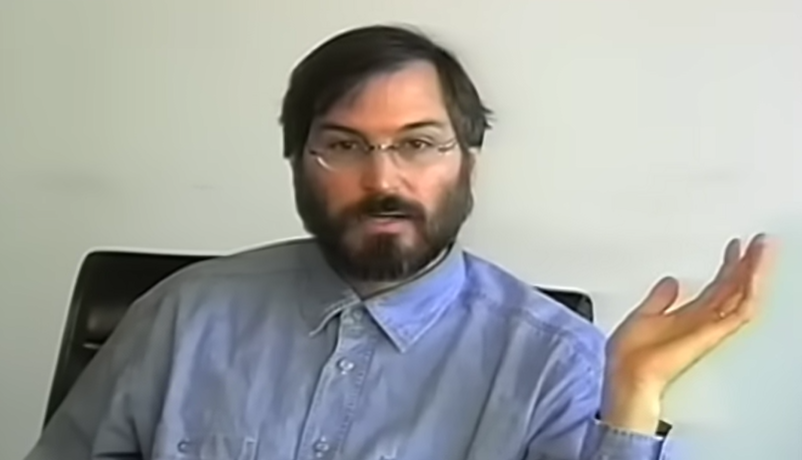
Photo credit: Photo via Santa Clara Valley Historical Association/YouTubeSteve Jobs speaks to the Santa Clara Valley Historical Association.

Steve Jobs was one of the greatest minds of our time because he could anticipate what people would love before they even knew it themselves. By blending art and technology, he helped create era-defining products like the iPhone, iPod, iPad, and Macintosh computer. He also helped guide Pixar to change how we see movies.

Jobs once described the epiphany that led him to embrace out-of-the-box thinking in a 1994 interview with the Santa Clara Valley Historical Association. The message was simple: you’re just as smart as the people who created the parameters of the modern world, so break them and see what you can create.

The realization that changed his life

In the interview, Jobs revealed:

“When you grow up, you tend to get told that the world is the way it is and your life is just to live your life inside the world, try not to bash into the walls too much, try to have a nice family, have fun, save a little money. That’s a very limited life. Life can be much broader, once you discover one simple fact, and that is that everything around you that you call life was made up by people that were no smarter than you. And you can change it, you can influence it, you can build your own things that other people can use. Once you learn that, you’ll never be the same again.”

“The minute that you understand that you can poke life and actually something will, you know if you push in, something will pop out the other side, that you can change it, you can mold it,” Jobs continued. “That’s maybe the most important thing. It’s to shake off this erroneous notion that life is there and you’re just gonna live in it, versus embrace it, change it, improve it, make your mark upon it.”

steve jobs, iphone, jobs apple, apple iphone luanch, steve jobs conference, stete jobs speech,
Steve Jobs holds anu00a0iPhone 4 at the 2010 Worldwide Developers Conference. Photou00a0via Matthew Yohe/Wikimedia Commons

His advice applies to everyone

Jobs’s realization is empowering because he argues that the people who came before us were no more special than we are today, and that we shouldn’t live our lives constrained by their limitations. Traditions from years ago may no longer serve us, and pathways to success that once worked may not be as fruitful today. Nobody knows how to live your life but you.

He added that the average person has the intelligence to make big, significant changes that can improve the lives of many. In fact, with all the information and technology available today, individuals have far more tools than those who originally created the parameters by which we live.

steve jobs, iphone, jobs apple, apple ipad luanch, steve jobs conference, stete jobs speech,
Steve Jobs introducing the iPad in San Francisco on January 27,u00a02010. Photou00a0via Matt Buchanan/Wikimedia Commons

“I think that’s very important, and however you learn that, once you learn it, you’ll want to change life and make it better, cause it’s kind of messed up, in a lot of ways,” Jobs said. “Once you learn that, you’ll never be the same again.”

The beautiful thing about this realization is that Jobs wasn’t trying to gatekeep being a changemaker but instead invited everyone to the party. His breakthrough was an admission that the world is never finished; it is only a rough draft that we can either keep perfecting or throw away and start something completely different.

Look around, what do you think we can improve that no one else has considered? That’s how you start thinking like Steve Jobs, and after we lost him in 2011, it’s clear we could use more people who see the world the way he did.

  • Astounding 2013 study found that ‘expressive writing’ can help heal physical wounds

    Photo credit: Canva Photos

    Writing about your emotions can improve your mental health and, a 2013 study finds, even help heal physical wounds.
    ,

    Astounding 2013 study found that ‘expressive writing’ can help heal physical wounds

    Remarkable things happen when you relieve your psychological stress.

    It’s not breaking news that journaling has been proven, again and again, to be good for you—mind, body, and soul.

    But not all journaling is created equal. Writing about what you did that day and your future plans has a profoundly different effect than writing about your deepest emotions, especially the upsetting ones. A growing body of research now shows that confronting your deepest traumas and experiences in order to put them on the page not only makes you feel better, but can even help heal you. One remarkable scientific study demonstrates how.

    Landmark study indicates that “expressive writing” has healing powers

    The body of research around expressive writing had been growing for years. American social psychologist James Pennebaker is considered one of the leading voices in pioneering this area of research.

    In an interview with the American Psychological Association, Pennebaker recalled wondering, “If secrets are so bad, what if we brought people in the laboratory and had them talk about them… [but] that turned out to be way too complex. How about we just had them write about it? And that was kind of the birth of expressive writing.”

    Pennebaker’s remarkable research revealed that expressive writing could improve mental health, boost the immune system, and reduce doctor visits. In 2013, a group of researchers wanted to see whether these benefits could carry over even further into the physical world.

    In the study, two groups of adults ages 64 and older underwent a simple biopsy procedure. It left a small wound on the upper arm that was uniform in size across all participants and could easily be monitored for changes in healing.

    A Band-Aid covers a wound. Photo credit: Canva

    One group was assigned to perform expressive writing for 20 minutes per day, writing about its deepest thoughts and most upsetting life experiences.

    The other group, rather than not writing at all, journaled daily about its activities but did so in an emotionally neutral register.

    Just 11 days after the biopsy, 76% of the expressive writing group had fully healed. That’s almost double the rate of the control group, of whom only 42% had healed.

    A thorough review found almost no other differences in the adults’ cognitive or physical health, which makes a powerful case that the expressive writing exercises were responsible for the improved healing.

    Why emotional writing can have a physical impact

    Pennebaker, for his part, recognized that deeply emotional journaling is not just about the physical act of writing.

    In order to write about upsetting experiences in your life, you have to turn them over and over in your mind and confront them head-on.

    “Getting people to actually sit down and confront it and to write it, you don’t have to write a lot, but you have to first of all just acknowledge it and put it into words,” Pennebaker said. “And that was really for me, the breakthrough.”

    Emotional writing eases psychological stress. Feelings like anxiety and stress can have severe negative health consequences, so it stands to reason that relieving some of that stress should have a positive payoff. Less stress on the immune system, for example, means it’s better able to do its job of warding off sickness and healing wounds.

    According to Harvard Health Publishing, “The process of writing may enable [people] to learn to better regulate their emotions. It’s also possible that writing about something fosters an intellectual process — the act of constructing a story about a traumatic event — that helps someone break free of the endless mental cycling more typical of brooding or rumination.”

    The power of “letting it out”

    A majority of scientific research agrees that learning to understand and express what’s happening inside us is a key component of mental health.

    “Labeling and expressing what’s going on inside can calm our nervous system. It also gets us in touch with our internal senses and what’s going on beneath the skin, in the heart, and in the brain,” said Alli Spotts-De Lazzer, a licensed therapist. “The connection of thoughts flowing through and out may be similar to ‘name it to tame it,’ a concept related to calming emotional distress and increasing emotional regulation.”

    It can be dance, it can be art, or it can be talking it out with a therapist or friend. The important thing is that expression, or disclosure, is necessary. The unique power of expressive writing, however, is that it forces us to address our biggest sources of pain and anxiety head-on.

    Expressive writing has its limitations, of course.

    It’s not necessarily a cure-all for people suffering from serious mental health conditions like chronic anxiety or major depression. And it can’t cure cancer or miraculously heal a broken leg.

    Some research also shows that expressive writing can temporarily make people feel worse before the mental health benefits kick in. And for people who have recently undergone trauma, it may simply be too soon to write about it. Pennebaker himself advises therapists not to assign expressive writing to patients until at least a few months after an incident.

    However, the study is fairly undeniable evidence of the mind-body connection. Science shows us that placebos can work wonders, even when people know they’re taking a placebo. And expressive writing research is beginning to show just how incredible the physical benefits of relieving psychological stress can be.

  • Researchers found that scrolling while pooping dramatically raises your chance of getting hemorrhoids
    A man looking at his phone on the toilet.

    Have you ever been scrolling through social media on your phone and then suddenly wondered where all the time went? You glance at the clock and wonder, “OMG, did I really just spend 30 minutes mindlessly scrolling on this app?” Well, after a new report published in PLOS ONE, you’ll think twice about getting lost doomscrolling while sitting on the toilet.

    A team of researchers at Beth Israel Deaconess Medical Center found that people who scroll on their phones while pooping have a much higher chance of getting hemorrhoids. Hemorrhoids are swollen veins, akin to varicose veins, that are either internal or external. They can be painful, itchy, and sometimes bleed.

    Looking at your smartphone on the toilet could cause hemorrhoids

    “Smartphone use on the toilet was associated with a 46% increased risk of hemorrhoids,” the paper found after adjusting for sex, age, fiber intake, and exercise activity. To come to this grim conclusion, the researchers interviewed 125 patients at the medical center and asked them about their toilet habits, including whether they scrolled through their phone or not.

    phone, toilet, hemorrhoids, smartphone, tiktok, social media, toilet health
    A woman looking at her phone on the toilet. via Canva/Photos

    What the researchers found was that those who bring their phone into the bathroom spend more time on the toilet; therefore, increasing the likelihood of developing hemorrhoids. “Of all respondents, 83 (66%) used smartphones while on the toilet,” the study found. “Furthermore, smartphone users spent considerably more time on the toilet compared to non-smartphone users, with many spending more than five minutes on the toilet per visit.”

    Of those who looked at the phone on the toilet, 37.3% said that they sat on the throne for six to fifteen minutes. Non-phone users sat longer than six minutes only 7.1% of the time. “The likely explanation is that prolonged sitting increases pressure in the veins around the rectum, which can contribute to hemorrhoids,” Dr. Ernesto Gonzaga, a gastroenterologist from the Hospital of the University of Pennsylvania, told ABC News.

    “When you’re sitting on an open toilet bowl, you have no pelvic floor support,” Dr. Trisha Pasricha, the study’s senior author and a gastroenterologist and director of the Gut-Brain Research Institute at Beth Israel Deaconess Medical Center, told CNN. The study said that 54% of people who use the phone while pooping are reading the news, and 44% said they were scrolling through social media.

    The study was conducted on people 45 and over

    The study was conducted on people aged 45 and older, a beneficial group to examine because some individuals in this age group don’t bring their phones to the bathroom. The study would have been much harder to conduct on younger people.

    “It was helpful to have this (45 and older) group because there were people who didn’t use their smartphones on the toilet. So we had a comparison group,” Dr. Trisha Pasricha, the study’s senior author, told CNN. “Having a third of people not bringing their smartphones to the bathroom helped us understand what a baseline could look like, especially as I imagine the situation is more profound for younger individuals.”

    So what can you actually do about it?

    If you’re afraid of developing hemorrhoids, the first step is to make sure that, if you take your phone with you to the bathroom, you stop scrolling when you’re done evacuating your bowels. You can also eat more high fiber foods, such as fruits and vegetables, and be sure to exhale while pushing and not strain. It’s also important to keep a healthy weight and to avoid sitting for too long, whether on a toilet or in your car. Hemorrhoids are a pain in the butt, and they’re not worth it, no matter how great the latest tea is on TikTok.

    This article originally appeared one year ago. It has been updated.

  • Why does a facial itch feel a lot different than one on your arm? Science just figured it out.
    Photo credit: Champja/Canva & Towfiqu barbhuiya/CanvaWhy does an itch on your face feel so different from one on your arm?

    An itch on the tip of your nose can feel different from one on your rear end—and possibly a bit more painful. Why is that? Shouldn’t your body treat an itch like an itch, no matter where it pops up?

    According to a new study from North Carolina State University, your body treats itches on your face much differently than it treats them on the rest of your body.

    The study found that your body sends itch signals from the face and the rest of the body along different routes to your brain, where they are processed. It’s as if your body has two different “itch phone lines” communicating with the brain—one from the face and another from the rest of the body.

    Itches travel to your brain differently throughout the body

    An itch on your arm starts with irritation of the skin—perhaps from dryness—then travels through the dorsal root ganglia, the spinal cord, and finally to the brain. An itch on your face goes from the spot of irritation to a different system called the trigeminal ganglia, and then to the brain.

    itch, scratch, skin irritation
    An itchy forearm. Photo credit: Canva

    Here’s the straight science:

    “You can think of itch being transmitted from the skin to the brain as a series of switches that get flipped,” Santosh Mishra, associate professor of molecular biomedical sciences at NC State, said in a statement

    “On the body, itch signals go from neuronal projections in the skin through the dorsal root ganglia (DRG) – which are clusters of sensory cells located at the root of the spinal nerves – then to the spinal cord. But on the face and head, those signals travel to the trigeminal ganglia (TG) – which are clusters of sensory cells located in a small structure below the brain where it sits atop the skull,” Mishra added.

    itch, scratch, skin irritation
    A woman scratching her arm. Photo credit: Canva

    Your body sends mixed signals to your face

    The researchers also discovered why an itch on your face may feel different from one on your torso. Studies showed that when histamine, an itch-inducing substance, was applied to the neck and cheek, the cheek itched less than the neck. Researchers initially assumed this was because there are fewer nerves in the cheek, but they were wrong: the cheek actually has far more. Instead, the face sends itch and pain signals simultaneously, and pain often overrides the sensation of itching. In the rest of the body, those signals are separated. That’s why an itch on your face feels different and may even be more painful than one on your arm.

    itch, scratch, skin irritation
    A woman scratching her neck. Photo credit: Canva

    Now that we know why an itch on your cheek feels different from one on your stomach, researchers can work on therapies that better address skin irritation on different parts of the body. One day, you may have a separate cream for a facial itch and another for one on your torso—not because of marketing, but because of real science.

    “Understanding how itch perception in the face differs from itch perception in the body could give us better molecular targets for future therapies,” Mishra said.

  • Man builds the ‘world’s smallest tiny house’ and somehow makes it work in 19 square feet
    Photo credit: Levi Kelly Tours/YouTubeLevi Kelly's tiny house.

    Levi Kelly wanted to go small. Very small. As someone who loves building and touring tiny homes, along with unique Airbnbs and cabins, he wanted to create something truly special. Though the idea of a tiny home isn’t new and certainly began picking up steam in the early 2000s, Kelly wanted to raise— or, in this case, lower—the bar and make a statement about just how efficient he could get.

    In an Instagram clip originally posted just over a year ago, but now making the rounds on social media again, Kelly shows viewers this extraordinary tiny home. Reminiscent of a tree house, its dark brown exterior and cheery windows look genuinely inviting. The most shocking part? It’s only 19.46 square feet.

    19.46 square feet

    The quick tour begins with an exterior view of the home, which is hitched to a two-wheeled trailer. Kelly explains, “I built the world’s smallest tiny house by square footage. It’s 19.46 square feet. Totally off-grid. You can see the solar panels up there. And it’s on a trailer. Take it anywhere you want to go.”

    He then pulls open the door and says, “Walking inside, let’s see how I fit everything in here.” The door opens to an extremely narrow hallway. On one side is a small sitting area with wooden drawers underneath. Straight ahead is a sink beneath a rather large window, at least relative to the size of the space.

    Kelly’s tour continues: “There is a seating area here to the left. Underneath, we have your AC and heating units, and it comes out of this little vent right there. And then on the other side is a battery bank for the solar panel. And that’s how everything in here gets plugged in.”

    Running water, too

    Blink and you’re in the kitchen, where a tiny fridge sits atop the counter. “Up here is your kitchen. We have a mini fridge up here for some drinks.” He removes a light brown cover from a square opening, almost like a jigsaw puzzle piece, revealing that the countertop also doubles as a sink. “Here’s your sink. Open this up and it unfolds.” He turns on the water. “Check that out. Running water. So we’ll shut that back up for more countertop space.”

    He opens a cabinet beneath this area. “Underneath, we have our water tanks, and you can have a little electric grill to take out and put there if you need to.” He then points to another tiny space on the counter.

    Can’t be taller than 5’10”

    Some, at this point, might wonder where someone would sleep in this house. “You’re wondering about the bed situation. Well, it’s up here.” He then points upward, where a platform is hooked to the ceiling. That is indeed the bed. He explains, “It folds down and can fit somebody that’s 5’10” or shorter.”

    As for the bathroom? Kelly has that covered. Once again, he takes the camera outside and shows a small shower head attached to the corner of the house. “You’re probably wondering about the bathroom situation. The outdoor shower is right here. Set this up and turn on the water and you’ve got yourself a little shower.”

    And what about the toilet? Off to the side, there’s an even smaller “storage area.” He explains, “You can take the lid off. The storage is stored in there, which is now right behind me.” The camera then cuts to a fresh white toilet sitting on the lawn. “You can go use the bathroom in nature anywhere you want. And it does flush.”

    Only a month and $5,000

    In a more detailed tour of the tiny home posted on YouTube, Kelly shares additional details:

    “This took over a month and $5,000. It’s a truly functioning tiny house. It has power, running water, kitchen, separate seating, separate bed, shower, flushing toilet, AC, and heating—everything a modern house has, just in the size of 19.46 square feet (1.8 square meters). The nicest tiny house of this relative size I have ever seen.”

    He also shares more details about the materials used, including the padauk wood on the window sills and the walnut kitchen countertops. He even demonstrates what it’s like to have three people sitting in the bench area at the same time. “Here’s a clip of me, Weston (his son), and my wife.”

    We also get a full look at how the “bed” works, which Kelly admits was his one slight miscalculation. There isn’t much space to climb up to the bed, but he demonstrates how to do it by stepping onto the countertop and hoisting himself into the small cubby.

    One YouTube commenter joked that if the bed doesn’t work, “you can sleep on the roof like Snoopy.”

    Another commenter was a big fan, even imagining what it could look like during the holidays: “Imagine adding tiny picture frames or minuscule paintings to the walls, and Christmas decorations outside in winter. The absolute coziest house ever conceived.”

    A few commenters were concerned about the complete lack of storage, joking that someone might have to keep their belongings in their car. But if you like the idea of the tiny house and don’t necessarily want to break any records, Kelly has other tiny homes with a bit more room. One can even be packed up and “unfolded in a single day.”

  • Google editor reveals the 3 most privately searched terms. And honestly, it’s the best of humanity.
    Photo credit: CanvaThe top Google queries are actually inspiring and helpful

    One thing many people believe is that you can truly know a person based on their Google history. Private searching is understandably on the rise, and given how negativity drives a lot of online news and social media, it can be easy to think the same way regarding our searches. However, a Google expert shared that the majority of searches on the platform are actually hopeful.

    Google Data Editor and Journalist Simon Rogers reported that, while we do Google news information, the vast majority of Google queries were positive. In fact, Rogers says Google’s publicly available data set shows a counterbalance to the negativity often seen when scrolling on our feeds. The hard fact is that our Google searches show something different than the narrative on social media.

    “The data is unfailingly honest,” Rogers wrote on CNBC’s Make It. “The way we search collectively is simply not the way we present ourselves on social media. There’s no such thing as a ‘dumb query,’ and analyzing these massive trends gives us a highly accurate reflection of our shared curiosities.”

    Here are the surprisingly refreshing top queries he found on Google:

    ‘How to [insert life skill here]’

    Rogers shares that the top searches start with “How to” and end with some form of life skill or task. “How to boil an egg”, “How to fix a door”, “How to cook spaghetti”, and so on. Google has turned to the go-to place for adults to learn many life skills.

    Some folks may be concerned that adults have to learn basic life tasks they could or should have learned as children. However, it’s mostly agreed that it is good such information is readily available through a simple online search.

    It’s also promising that the top Google searches are from people who want to independently learn their lives (and others) easier. If not a tutorial, they can also use Google as a resource to find classes or people who may properly teach them.

    ‘What’s a job that helps people?’

    The other top trend Rogers indicated was occupation-oriented. While many top searches included queries like “high-paying jobs” and the like, Rogers noticed that those didn’t get the top spots. Searches for a “job that helps people” have surpassed searches for “jobs that pay well.”

    The search for meaning at work has been on the rise since the COVID-19 pandemic. Meaningful careers included therapists, social workers, and other vocations dedicated to health, wellness, and community building.

    ‘How to help [insert person, place, or thing here]’

    Many see our current time as one of anger, tension, and incredibly high division, but Rogers says that couldn’t be further from the truth. Near the top end of Google queries in the U.S. and U.K. is some variation of “How can I help?”

    This is backed up by a 2022 Stanford University report showing that more people are willing to help more than most realize. This echoes a study found that Americans are more likely to help a stranger now than they did in the 1950s or “the good ol’ days” as many frame it. 

    There are many reasons for a person to help, and not all of them are altruistic. However, the fact that so many do such a search that it towers over all others can feel inspiring.

    These trends show and can back up the claim that people are still instinctively good. If you still don’t think so, well…just Google it.

  • Airline pilot reveals the crucial reason why there’s a tiny hole in every airplane window
    Photo credit: CanvaA woman looking out of a plane window.
    ,

    Airline pilot reveals the crucial reason why there’s a tiny hole in every airplane window

    You’ll see them on every plane no matter where you sit or which airline you’re flying.

    Have you ever been crammed into the window seat in a plane and, while gazing down at the terra firma beneath you, noticed that there was a tiny hole in the window? According to Petter Hörnfeldt, aka Mentour Pilot, a Swedish commercial airline captain, those holes could one day save your life.

    In a TikTok video, Hörnfeldt explains that there are three layers to the windows on a commercial airliner. The outside window is the strongest because it was designed “to handle any impacts as well as the pressure difference between the thin high altitude air outside of the plane and a pressurized air inside,” Hörnfeldt says.

    Then there is the middle layer, with a tiny hole, designed to protect the outer layer. The final layer is the one you can touch or press your nose up against to see what you’re flying over.

    Why do airplane windows have tiny holes?

    “So why the hole then? Well, because there is air between those layers. Differences in pressure and temperature would otherwise start causing forces to build up between the layers, trying to bend them inwards or outwards, which is something that we obviously do not want, since especially the inner two layers are not designed to take those kind of forces. So that little hole is put there to allow air to flow through slowly and relieve that potential pressure difference. Hence the name breather hole,” Hörnfeldt says.

    pane window, window hole, looking out window, aviation, commercial airliner
    The tiny hole in an airplane window. Credit: Canva

    “Now, the inner window layer, the one that’s closest to you, doesn’t really need a hole because it’s fitted in a way that allows air to flow around it. But that breather hole also serves a different job, which is to make it more difficult for moisture to become trapped between the layers and start fogging up your window, stopping you from admiring the view outside,” Hörnfeldt continues.

    In his most popular video, Hörnfeldt admitted that commercial airline pilots know when you’ve flushed the toilet on a plane.

    Do pilots know when you flush the toilet on a plane?

    According to Hörnfeldt, pilots don’t know that you’ve flushed a toilet based on an alert, security camera footage, or a sudden power surge. They know that the toilet has been flushed because of a slight change in cabin pressurization. Airplane toilets use a special vacuum flushing mechanism to suck the contents out. The vacuum system is calibrated to the cabin air pressure. “But that flushing actually does show up on our instruments as a sudden cabin climb on our cabin vertical speed indicator,” Hörnfeldt says. “So we can see it. And it kind of makes sense, if you think about it.”

    Next time you see the tiny hole in an airplane window as you gaze upon your hometown at 35,000 feet, you know that it’s not a manfcatingring mistake. It’s here to keep you safe in a cabin with a pressurized system that also knows if you used the bathroom. Aren’t airplanes just incredible?

  • Doctors kept dismissing her persistent cough. One heroic nurse refused to let it go.
    Photo credit: CanvaA nurse speaks with a doctor in the hallway.
    ,

    Doctors kept dismissing her persistent cough. One heroic nurse refused to let it go.

    “Had Alison not picked up on the fact that she was sure something else was wrong, I don’t know what would have happened.”

    Julie Silverman had been coughing for years. Not the kind of cough that goes away with some rest and cough syrup, but a persistent, worsening cough that no doctor seemed able to explain or fix. As she shared on NPR’s Hidden Brain podcast in the “My Unsung Hero” segment, the experience of being dismissed by the healthcare system over and over again was exhausting.

    “I had, at this point, gotten kind of dismissive about it because I had been dismissed by so many doctors as, ‘There’s nothing wrong, you’re not responding to our treatments, we’ll try something else,’” Silverman recalled.

    But one person refused to dismiss her: a nurse practitioner named Alison.

    nurse, saves, woman, persistent cough, misdiagnosis
    A nurse checks the vitals of a patient. Photo credit: Canva

    Alison worked at one of the clinics Silverman visited regularly, and unlike the doctors who had cycled through various unsuccessful treatments, Alison kept paying attention. She was perplexed by the cough and made it her mission to track Silverman’s condition over time.

    During one of Silverman’s weekly appointments, Alison noticed something concerning. Silverman’s symptoms had gotten worse. Her voice was hoarse, she was breathless and wheezing, and the coughing was more severe than before.

    “She was just adamant something was wrong with my airway,” Silverman said.

    Alison immediately pushed one of the physicians at the clinic to perform a scope of Silverman’s trachea. The procedure involved inserting a small camera through her nose and down the back of her throat to look for blockages.

    “I could just tell by their faces something was not right,” Silverman remembered.

    The scope revealed what years of doctor visits had missed. Silverman had idiopathic subglottic stenosis, a rare condition that affects about one in 400,000 people. Scar tissue had been building up at the top of her trachea, and her airway was 75% blocked. That’s why she’d been coughing. That’s why nothing had worked. And if it had gone untreated much longer, it would have been fatal.

    “This is a very serious condition and fatal if not treated because your airway completely closes,” Silverman explained.

    The diagnosis finally gave Silverman what she needed: the right information to find the right specialist who could actually treat her condition. She’s now doing well, spending her time volunteering at her local hospital, riding her bike, hiking, skiing, and enjoying time with friends and family.

    But she hasn’t forgotten what Alison did for her.

    “Had Alison not picked up on the fact that she was sure something else was wrong and gotten this physician to look in my throat, I don’t know what would have happened,” Silverman said. “It was her persistence and diligence and her listening to me and taking me seriously that got my diagnosis in a timely enough fashion to do something about it. So, for these reasons, Alison is my unsung hero.”

    Our healthcare system is increasingly driven by rapid diagnoses and technology, but sometimes what saves a life is just simple human attention. Someone who listens, keeps watching, and refuses to dismiss what they’re seeing even when everyone else has moved on.

  • Three lions have the most beautiful reaction to a man singing a Guns N’ Roses song to them
    Photo credit: @Plumesmusic/YouTube"November Rain" can relax darn near anybody.

    There are several stories written about music taming the savage beast, but this is no fairy tale. A video shows a small pride of lions in an enclosure hear the acoustic guitar and soothing singing of a French singer-songwriter covering Guns N’ Roses’ “November Rain.” One would think that the animals would be annoyed or ignore the music period. Instead, something heartwarming happened.

    One by one, the lions approached the musician known as Plumes as he performed. They calmly laid down and started yawn-singing to the tunes while nuzzling one another, with two lions cuddling less than a yard from where Plumes sat and played. The lions were relaxing and enjoying the concert along with their afternoon nap, showing off the gentler side of the predatory wild cats.

    People remarked upon the lion’s reaction to Plumes’ tunes:

    “Wow! That is truly an incredible interaction with them. They really enjoyed your singing to them.”

    “Omg, the way they cuddle.”

    “What a beautiful interaction to witness.”

    “Music is the universal language!”

    “That was so magical! Music speaks to the soul. Human, animal, all relate to the feelings music evokes.”

    This isn’t the only time Plumes has performed for an animal audience. In fact, his social media and YouTube channel show videos of multiple concerts for humans and creatures alike. He not only has played his guitar and sang for lions, but for tigers and bears (oh my!) among many other animals at wildlife refuges, enclosures, and zoos.

    While Plumes performs his music for a wide variety of animals today, he started at home, playing for a herd of cows in the French countryside while living with his grandmother.

    “I read somewhere that cows like music, that it’s soothing to them,” Plumes shared with AMFM Magazine. “They were super receptive. They gathered around, some even rubbed against me. It was magical.”

    Since then, Plumes had been taking the opportunity to warm up his vocal chords and provide various animals a free mini-concert throughout his tours and travels, recording video of their reactions to his music.

    “Animals inspire me to be kinder, more patient,” he added. “They remind us to reconnect with nature. Maybe we’ve lost touch with nature, and these videos help people feel that connection again.”

    Understandably, most people believe music and music appreciation are uniquely human traits, but there are studies that music isn’t exclusively for homosapiens’ enjoyment. Some studies show different species reacting positively to music in different ways. Chimpanzees sway to music, dogs tend to show calmer behaviors when listening to classical music, and sea lions synchronize their head movements to a song’s beat, just to name a few. There are veterinarians that suggest creating a music playlist for your dog to play when leaving the house so it helps reduce their separation anxiety.

    It’s interesting to see how music impacts different animals in different ways, especially if music helps them. Over time, who knows how much music will bring man and animal closer together. If a lion can enjoy Guns N’ Roses, the possibilities are nearly endless.

    This article originally appeared last year. It has been updated.

Kids

Kasai and Klarity on the rise, Emma on the outs in Social Security’s new baby-name rankings

Health

Astounding 2013 study found that ‘expressive writing’ can help heal physical wounds

Pets

Cat owners share the super-specific, wildly weird things their cats insist on as part of their routine

Pets

When does ‘rage baiting’ your cat cross the line from playful fun to torment? Experts weigh in.