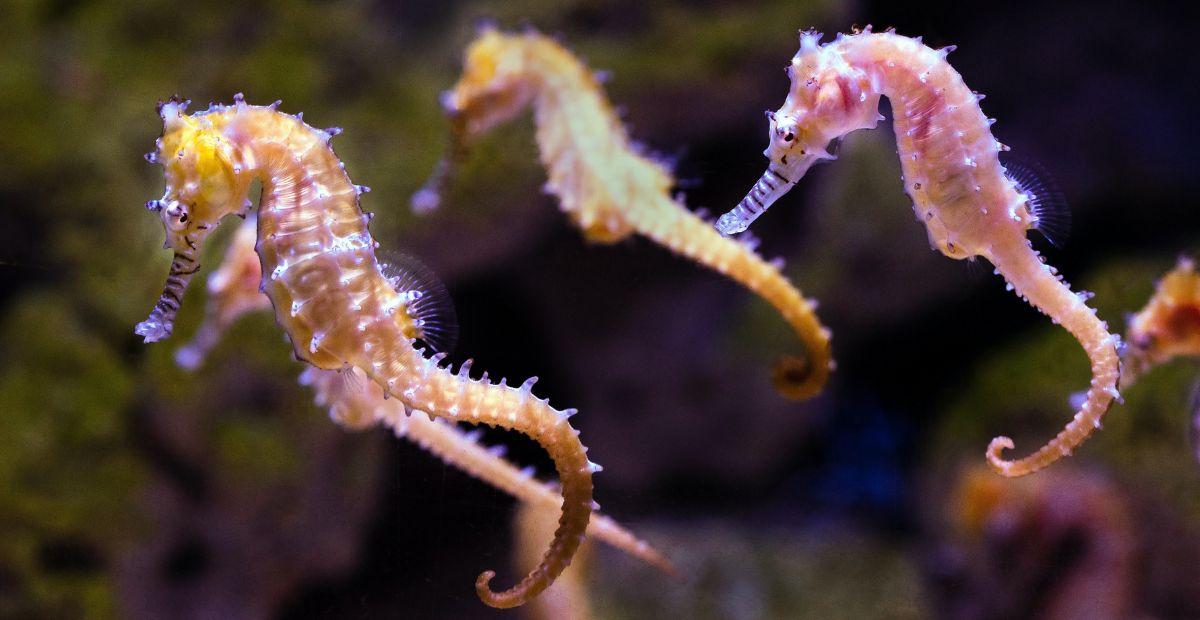
We all know that seahorses are some of the most unique and fascinating creatures that Mother Nature has to offer.
For one thing, they’re gorgeous. Who has ever looked at a seahorse, with all its vivid colors and delicate, otherworldly shapes and gone, meh? No one, I tell you.
Plus they’re basically the mascot for cool, supportive dads everywhere. Not every creature in the animal kingdom can say that.
Yet, for as much as we know about the seahorse, there are even more thrilling stories swimming around—particularly when it comes to how it got here in the first place.
A video published by PBS Eons explains that today, seahorses are found in all of the world’s oceans. And yet, they are pretty terrible swimmers. So how on Earth could they have traveled such far distances to spread across the globe?
As it turns out, the answer is possibly hiding even further below the surface.
Throughout at least the last 55 million years, the ocean floor around southeast Asia has been whirling with tectonic plate activity, with the most important shift happening at the end of the Cenozoic era.
As deep channels between continents became more shallow and surfaces were thrust upward toward the sun, more aquatic plant life was able to grow and expand. Experts think that meadows of seagrass in particular helped ancient seahorses travel away from the waters of the Indonesian region (where they likely originated) and across the world. Yep, just like land horses, seahorses wildly gallop into unknown terrain. Actually, they prefer to simply hold onto traveling seaweed and raft into unknown terrain. Still majestic though.
You can watch the full video here:
How Plate Tectonics Gave Us Seahorses
The surge in seagrass might have even caused seahorses to trade in the long, horizontal shape of most traditional fish for their signature upright posture. As the video explains, the grass beds might have supported their ambush hunting technique, allowing them to obtain a longer reach and blend in with the grass blades before striking. Ambush hunting seems OK for a seahorse, but kind of terrifying if you think of land horses doing the same thing. Thank goodness the latter are herbivores.
PBS Eons is a virtual treasure trove of lesser known evolutionary stories. Its YouTube channel covers everything from the domestication history of cats to why we have 10 toes. If you’re looking to go down the coolest educational rabbit hole ever, you can check out its videos here.

A single door can open up a world of endless possibilities. For homeowners, the front door of their house is a gateway to financial stability, job security, and better health. Yet for many, that door remains closed. Due to the rising costs of housing, 1 in 3 people around the world wake up without the security of safe, affordable housing.
Since 1976, Habitat for Humanity has made it their mission to unlock and open the door to opportunity for families everywhere, and their efforts have paid off in a big way. Through their work over the past 50 years, more than 65 million people have gained access to new or improved housing, and the movement continues to gain momentum. Since 2011 alone, Habitat for Humanity has expanded access to affordable housing by a hundredfold.
A world where everyone has access to a decent home is becoming a reality, but there’s still much to do. As they celebrate 50 years of building, Habitat for Humanity is inviting people of all backgrounds and talents to be part of what comes next through Let’s Open the Door, a global campaign that builds on this momentum and encourages people everywhere to help expand access to safe, affordable housing for those who need it most. Here’s how the foundation to a better world starts with housing, and how everyone can pitch in to make it happen.
Volunteers raise a wall for the framework of a new home during the first day of building at Habitat for Humanity’s 2025 Carter Work Project.
Globally, almost 3 billion people, including 1 in 6 U.S. families, struggle with high costs and other challenges related to housing. A crisis in itself, this also creates larger problems that affect families and communities in unexpected ways. People who lack affordable, stable housing are also more likely to experience financial hardship in other areas of their lives, since a larger share of their income often goes toward rent, utilities, and frequent moves. They are also more likely to experience health problems due to chronic stress or environmental factors, such as mold. Housing insecurity also goes hand-in-hand with unstable employment, since people may need to move further from their jobs or switch jobs altogether to offset the cost of housing.
Affordable homeownership creates a stable foundation for families to thrive, reducing stress and increasing the likelihood for good health and stable employment. Habitat for Humanity builds and repairs homes with individual families, but it also strengthens entire communities as well. The MicroBuild® Initiative, for example, strengthens communities by increasing access to loans for low-income families seeking to build or repair their homes. Habitat ReStore locations provide affordable appliances and building materials to local communities, in addition to creating job and volunteer opportunities that support neighborhood growth.
Marsha and her son pose for a photo while building their future home with Southern Crescent Habitat for Humanity in Georgia.
Everyone can play a part in the fight for housing equity and the pursuit of a better world. Over the past 50 years, Habitat for Humanity has become a leader in global housing thanks to an engaged network of volunteers—but you don’t need to be skilled with a hammer to make a meaningful impact. Building an equitable future means calling on a wide range of people and talents.
Here’s how you can get involved in the global housing movement:
Speaking up on social media about the growing housing crisis
Volunteering on a Habitat for Humanity build in your local community
Travel and build with Habitat in the U.S. or in one of 60+ countries where we work around the globe
Join the Let’s Open the Door movement and, when you donate, you can create your own personalized door
Every action, big and small, drives a global movement toward a better future. A safe home unlocks opportunity for families and communities alike, but it’s volunteers and other supporters, working together with a shared vision, who can open the door for everyone.
Many dog owners like to commemorate their fur babies’ birthdays with a party. But this doggy birthday party takes things to a whole new level.
Lady, an adorable spaniel turning five, didn’t celebrate her solar return with treats or costumes. Instead, her mom, Kat, arranged for her and her canine friends to go on a backyard “sniffari.”
The sensory adventure featured fresh chicken eggs (the crowd favorite), as well as a small herb garden, old socks and shoes, a pile of sticks, and layers of cardboard with treats hidden between each layer. And of course, participants could refuel themselves at the “pup cup station,” where they’d be served whipped cream, aka “pupaccinos.”
The TikTok video racked up over 500,000 views online, and people couldn’t help but praise Kat for her grade-A dog mom skills.
“What a unique and thoughtful birthday treat for your pup,” one viewer commented.
Another added, “You rock as a dog mom I’m done. I thought my doggo was spoiled.”
Why sniffing matters to your pup
As PetMD explains, our dogs “see” the world through scent. They use their powerful noses to understand and interact with the world around them, increasing their mental stimulation while lowering their stress levels in the process.
Lady’s sniffari in action 🐕 Thanks everyone for all the love 💕 she had the best day with her friends. I’m so happy so many of you have decided to try and recreate your own with your own dogs. Pressure is on for her 6th birthday… #dogtok#dogparty#dog#dogmum
So sniffing activities are like the upper echelon of enrichment. That’s why experts recommend owners be patient while taking their dogs on walks and even reward sniffing behavior. The olfactory fulfillment they receive from it is crucial to their well-being.
Of course, that was just the beginning of Lady’s birthday celebrations
Inspired by Lady’s celebration, pet parents can easily create their own scent-based party at home. The key is variety and curiosity. Scatter safe, dog-friendly items with different textures and smells around your yard or living space. Hide treats inside boxes, under towels, or within layers of paper so pups can “hunt” for rewards.
You can also create themed scent stations. A garden corner with herbs like rosemary or basil gives dogs new smells to explore. A “laundry pile” of worn clothing offers familiar scents that many dogs love. Even a simple cardboard maze can become an adventure when treats are tucked inside.
For an extra special touch, invite a few canine friends and let them explore together at their own pace. Keep things relaxed and supervised so each dog feels comfortable.
Truly, for birthday celebrations or otherwise, sometimes the best thing we can do for our pups is to let them experience the world as closely to how nature intended as we possibly can.
It’s commonly understood that extroverts replenish their energy by being around people, and introverts find restoration in being alone. So it’s no wonder that a tabby cat named Winston and his “alone cabinet” have grabbed the attention of introverts everywhere.
Winston lives with his sister, a black cat named Spooky, who can be a little…well, clingy. Spooky loves Winston and wants to be where he is, preferably as close as possible. Winston loves Spooky, too, but sometimes he needs some space. That’s when he surreptitiously slips away to the kitchen and takes respite in a “secret” cabinet where he can be alone for a bit.
There’s just one problem: Spooky seems to be catching on to Winston’s hiding place.
And Winston apparently doesn’t want Spooky to know when he’s retreating to his alone cabinet.
‘Winston’s introverted space cannot be compromised.’
According to their human, Spooky isn’t the brightest bulb in the bunch and doesn’t know that she can open cabinets. But still, Winston appears worried that his sister will follow him into his safe space and ruin the whole purpose of having it.
Thankfully, their human has been paying attention and can see what’s been happening. When Winston goes into the kitchen, he won’t climb into the cabinet if Spooky follows him. He just looks up with pleading eyes, as if to say, “Can you please take her away long enough for me to hop in there without her seeing, pretty please?”
And that’s exactly what their human does, taking Spooky to the bedroom for a few minutes so Winston can secretly escape into his cabinet.
“Spooky is very confused, but Winston’s introverted space cannot be compromised,” the owner shares. Introverts everywhere are feeling seen.
Introverts everywhere are seeing themselves in Winston
In the comments, people shared how they relate to Winston’s need for alone time and praised the cats’ owner for noticing and respecting it:
“I understand Winston on a molecular level. I too dislike it when people follow me into my cabinet when I’m trying to decompress and recharge. Good on you, Winston, for prioritising self-care.”
“I don’t like when people try to follow me into my cabinet either.”
“As a fellow introvert, I completely understand. Kudos to Winston for caring for Spooky’s feelings.”
“As an introvert myself, I can only say thank you for allowing Winston his refuge.”
“I feel that this is a very very VERY good thing to do. For anyone, not just cats. Letting peeps have their own space to decompress in means they’ll be happier and more able to stay social and happy.”
Cats have traditionally been viewed as solitary animals, and sometimes they are. But most of us who’ve had cats, especially more than one, know them to be social creatures as well.
Cats’ social structure is just different than humans or other social animals. Related females tend to form colonies when left alone, while males do tend to be more solitary. But as with most things “cat,” that’s not a hard and fast rule. Basically, the answer to the solitary vs. social question can be summed up in this one sentence from the Milwaukee Cat Clinic: “Cats choose with whom to be social and when.”
That’s likely why Winston’s desire for alone time in the cabinet seems so deliberate. Humans on the introvert end of the spectrum feel a similar pull to solitude when we’ve had enough socializing. Introverts aren’t altogether unsocial; they just choose with whom to be social and when, like a cat.
Winston is basically living every introvert’s dream: a cabinet of one’s own and a guardian who makes sure that no one, not even our closest loved ones, will follow us into it.
Wild horses maintain their hooves through constant, daily movement. They often travel 10 to 20+ miles across varied, abrasive terrain like rocky, sandy, or hard-packed ground. This natural lifestyle allows their hooves to wear down at roughly the same rate they grow, creating a self-trimming effect that keeps them short, thick, and tough. Their environment does the work a farrier would normally do, keeping their feet balanced and functional without the need for human intervention.
Domestic horses, on the other hand, live very different lives. Without that level of movement and terrain, their hooves continue growing without enough natural wear to keep them in check. As a result, they require trimming every six to eight weeks to stay healthy and comfortable. When that care is missed, the consequences build quickly. Overgrown hooves can crack, split, and throw off a horse’s entire posture, leading to strain on joints, ligaments, and tendons.
This was the exact dire situation that a pony named Stella found herself in.
As Julia Cesario explained to The Dodo, Stella belonged to an elderly couple who had fallen on hard times and were struggling to care for their animals. Basic upkeep became difficult, and Stella’s condition steadily worsened.
Her coat had gone unbrushed, but it was her hooves that told the most urgent story. They had grown so long they curled upward, striking her legs each time she tried to walk. Every step looked uncomfortable. She couldn’t tolerate being touched without reacting intensely, making it nearly impossible to help her in that state.
“It broke my heart completely,” shared Cesario.
She immediately set out to help. Cesario knew the process would be overwhelming for Stella, so she hired a farrier, who began by sedating her. Then came the careful, time-intensive work of removing the excess hoof. Using multiple tools, including a saw, the farrier slowly reshaped them to a manageable length.
After two hours, Stella’s hooves were finally trimmed to a comfortable size.
At first, the change was clearly a strange experience for Stella. She lifted her feet higher than necessary, as if expecting the old weight to still be there. But within minutes, she began to adjust, testing out her new range of motion, then moving with increasing confidence. Before long, she was trotting, even galloping, freely around the enclosure. Her coat was brushed, her mane neatly braided, and her presence lighter. All in all, she was a brand-new pony.
“We all cried,” Cesario told The Dodo. “When we brought her back to her friends, she did laps and laps and laps as fast as she could.”
A new chapter
Today, Stella no longer needs sedation for routine hoof care. She stands calmly during trims and even appears eager to see her regular farrier, affectionately referred to as her “nail guy.”
Her transformation has resonated with people across the Internet, inspiring an outpouring of heartfelt reactions:
“I LOVE this story! Watching her run as fast as she could afterward was so heartwarming.”
“I felt like crying when I saw her running. You could tell how happy she was. It was so beautiful to watch. Thank you for giving her a wonderful life.”
“My heart skipped a beat when I saw her register that her feet were different and free…Seeing her run around and play is priceless.”
When animals receive proper care, they thrive. Thankfully, Stella got the care she needed in time and is currently galloping into a far brighter future.
Welcoming a pet into your family can be a wonderful experience, but it’s also a consequential decision. There’s a lot to weigh as you commit to years of daily care and the lifestyle changes that come with owning an animal. Because different breeds have different traits and behaviors, those factors should be considered as well.
U.K. veterinarian Ben Simpson-Vernon (or “Ben the Vet”) is sharing some food for thought that many people may not be aware of when it comes to cat breeds. Not only are certain breeds harder for humans to care for, but some are also hard on the animals themselves. In one TikTok video, he makes the case for not buying certain cat breeds.
(He clarifies that true rescue adoptions are a different story if you have the means to care for these breeds. He’s specifically referring to not buying them as kittens from a breeder or pet store.)
5 Cat Breeds I wouldn’t get as a vet. *truly rescuing one of these cats if you have the means to care for them is different to buying a kitten I should make clear. I’ve made a similar video to this a while ago, but some of the trends are changing so I felt the need to revisit it. #learnontiktok#veterinary#benthevet#cat#catbreeds
“This is just my opinion as someone who sees a lot of cats with health problems,” he said. “It’s not intended to cast judgment over people, but sometimes you have to say it like it is.”
Sphynx cats, also known as hairless, bald, or naked cats, have gained popularity in recent years. But Simpson-Vernon says that breeding them has basically “removed the essence of being a cat.”
Sphynx cats tend to have heart problems and shorter life expectancies. Photo credit: Canva
For one, they have either no whiskers or tiny, stubby ones. “Whiskers are an integral part of being a cat,” he said. “They use them to navigate in the dark, to sense vibrations, to communicate their emotional state.”
“Also, no cat should have to wear clothes to avoid being cold,” he added.
He pointed out that Sphynx cats tend to have heart problems due to their genetics, and that their life expectancy is much lower than that of most cats—just six and a half years on average.
“Yes, they’ve got great personalities,” he said. “But why make life hard for your cat?”
2. Munchkin cat
Munchkin cats have a genetic condition that results in unusually short legs. Photo credit: Canva
Munchkin cats have extremely short legs, often compared to the cat version of a Corgi or Dachshund. The breed is relatively new, first proposed as an experimental breed in 1991. While a few associations have accepted it, most have not. Three of the largest—the Cat Fanciers’ Association (CFA), the Governing Council of the Cat Fancy (GCCF), and the Fédération Internationale Féline (FIFe)—refuse to grant Munchkins official breed status, citing the short legs that make them unique as a congenital condition.
“Please, let’s not let it become socially acceptable to deliberately breed cats with dwarfism,” Simpson-Vernon said. “A pet should not just be an object of our amusement. They’re a living, breathing animal that has the ability to sense pain and their own needs. Let’s not make life hard for them by giving them short limbs, which make it hard for them to jump and mean they suffer from arthritis at a young age.”
3. Scottish Fold cat
Scottish Fold cats may be cute, but they are all affected by a genetic condition. Photo credit: Canva
Taylor Swift’s photos and videos of her Scottish Fold cats may have influenced a surge in the breed’s popularity. But Simpson-Vernon said these cats all have the same genetic disorder, osteochondrodysplasia, which causes their folded ears.
But that disorder “also means they have defective joint cartilage in all of their joints and develop painful arthritis at a young age,” he said.
He said Scottish Folds make up 2% of all new cats, which he called “quite sad.” Given what’s known about their health issues, Simpson-Vernon said he could never get a Scottish Fold kitten. Other vets offer similar warnings:
4. Savannah cat
Savannah cats look like they belong in the wild, as they are basically a blend of a domestic cat and a serval. But that’s exactly why Simpson-Vernon said he’d never get one.
“I’ve seen a few in practice, and I have to say, I was quite scared of them,” he said. “They’re much bigger and stronger than a domestic cat, and they retain a lot more of their wild instincts. So they’re hard to cater for in a home environment. I would say near on impossible.”
He suggested buying an inanimate object for those looking for a status symbol. And for those drawn to wild animals, he suggested donating to a conservation charity.
5. Peke-faced Persian cat
Peke-faced Persian cats tend to have a lot of health problems. Photo credit: Canva
Persian cats with faces that look like they hit a wall at full speed are known as “Peke-faced” for their resemblance to a Pekinese dog.
“I feel really sad for these cats,” Simpson-Vernon said. “They can’t groom themselves properly, so they get really matted, and they get a lot of health problems. It is obviously harder for them to breathe when they have tiny nostrils, like this, but they get chronic upper respiratory infections really commonly.”
Simpson-Vernon said this breed is also prone to eye issues, dental problems, and hydrocephalus (a buildup of fluid in the brain).
He said that “if you want a happy, healthy companion,” buying a Persian kitten “is not a good choice.”
Making an informed decision
Not all cat breeds are created equal. But how can you tell if you’re choosing one without ethical concerns? The clearest way to avoid supporting questionable breeding is to adopt a rescue cat. Regardless of breed, these are cats already in need of a home.
If you want a kitten, consider alerting a local shelter to your interest and asking to be notified when kittens become available for adoption. If you want to choose a specific breed, search terms like “controversial cat breeds” or the breed you’re considering, paired with words like “controversy” or “ethical concerns,” can help you identify potential issues before making a decision. Some organizations also provide lists of traits to avoid in order to discourage breeding that may result in unnecessary health problems.
Informed decisions are the best decisions, especially when it comes to our furry friends.
Snakes are not for everyone, but those who love them enough to keep them as pets tend to know a lot about them. Most snake owners do thorough research on the type of snake they want before purchasing. So imagine one snake lover’s surprise when her Texas rat snake had a bizarre reaction to a YouTuber.
Taylor Dean recently turned to social media for help figuring out what was happening with her snake. She noticed something peculiar while watching YouTuber Markiplier (real name Mark Fischbach): Tofu, her Texas rat snake, would become visibly annoyed at the sight of his face on her computer screen.
Photo credit: Canva – Woman baffled by pet snake's 'passionate hatred' towards YouTuber Markiplier
Dean has been conducting mini experiments to determine whether her snake reacts to all YouTubers who use a corner reaction camera, or just Markiplier. Time and again, Tofu reacted aggressively only to him. Given her knowledge of snake eyesight and facial recognition, Dean grew more confused.
“The reason this was so intriguing is because snakes don’t typically have the ability to discern and recognize different faces, so I’ll forever be confused over how a hatred can be so strong that it can transcend everything I’ve ever learned about snakes,” she wrote in the caption of her Instagram Reel.
According to Animal Club, snakes don’t recognize people by sight. Instead, they rely on scent and movement. The organization also notes that rat snakes are generally easygoing—like Tofu, when he’s not forced to see Markiplier’s face.
This isn’t a passing dislike. Tofu is openly hostile toward Markiplier any time he appears, no matter where his face shows up. Luckily for the YouTuber, his real face has never been anywhere near Tofu. When the rat snake spots him, its attention shifts, its noodle-like body stiffens, and it strikes the screen.
According to Dean, rat snakes have normal eyesight, but because they aren’t known to distinguish faces, she isn’t sure what Tofu is picking up on.
In her experiment, she watched multiple other YouTubers who also use a corner reaction camera. Tofu showed no interest, slithering along and minding his own business. That is, until she switched back to Markiplier.
Tofu clearly hates the guy, and his specific reaction may actually warrant further study. While it may seem like this Texas rat snake can distinguish between faces, science suggests they aren’t supposed to be able to do that.
To confirm that Tofu was indeed reacting to Markiplier’s face, and not something in the background, Dean took the experiment IRL. She printed color photos of the YouTuber and attached them to a crafting stick. Tofu was neither fooled nor amused.
Every time his owner brought the photo close, he recoiled, nearly folding himself into a knot to get away. It seemed that if she hadn’t been holding the stick, he would have struck, just as he did at the laptop screen.
Photo credit: Canva – Woman baffled by pet snake's 'passionate hatred' towards YouTuber Markiplier
Dean assured viewers that the snake is not experiencing stress, but instead shows a “passionate hatred” toward Markiplier. In the video, she said she had seen enough to conclude that Tofu recognizes and hates the YouTuber. Tofu will be safe from any further exposure to Markiplier content.
People in the comments found Tofu’s hatred of Markiplier amusing, while others offered theories about his reaction.
“What’s most hilarious to me is this is unironically possibly rewriting what is known about snakes,” a commenter wrote.
One commenter joked that the snake might be a bit prejudiced, writing, “Imma say it again, you might need to show other Asian/wasian people to rule out racism.”
Another commenter wrote, “Markiplier’s continued silence on Tofu’s damning accusations is very telling… what did you do to Tofu, Markiplier? The people deserve the TRUTH!”
One commenter noted that snake science might never be the same, writing, “I love how Tofu’s hatred is cutting-edge snake science.”
This commenter shared a theory they came across on Tumblr:
“Saw a theory on tumblr that, long story short, Tofu has seen you respond to jumpscares in his videos and thinks Mark, Personally, is a threat to you. Like crows recognizing the faces of people that have wronged their flock. Tofu doesn’t understand that humans like to be a little scared for fun and he’s trying to protect you.”
Training a family pet can be hard, especially when you have an active breed that needs a certain level of stimulation. Some dogs are good to go after a few training sessions with a local trainer at a pet supply store, while others may require more personalized training in home. There are even some pet parents who opt to send their dogs to a sleep away training program that requires the dogs to live at a training facility for several months before coming home.
Many times these programs are expensive and used as a last resort option, when the other training programs aren’t providing the dogs with the skills they need to live safely with their family. This decision to send your fur baby off to a facility for months at a time is not an easy one to make, but with your pets’ best interest in mind, you put your faith in someone who specializes in the care your pup needs, and keep your fingers crossed that it pans out.
In 2024, one family thought they were doing what was best for their Huskies by sending them to a training facility. It’s unclear what prompted the family’s concern after dropping their four dogs off with their trainer, but after months of looking for their dogs with no luck, they contacted Anakin’s Trails Stray and Pet Recovery Team.
The dogs, which were from Ohio, where their owner Andrea lives, were entrusted to an unnamed animal training facility in Greenville County, South Carolina. It was suspected that the training facility dumped the dogs in the woods without contacting the family to retrieve their beloved pets. Thankfully, Anakin’s Trails Stray and Pet Recovery Team uses drones and other techniques to help locate lost dogs and give them an idea of where to place their traps, and they were eventually able to help recover the lost pups.
The first of the Huskies, Oakley, was found and reunited with Andrea after spending a whopping five months surviving in the wilderness. In a clip posted to TikTok, we see that poor Oakley was clearly unsure of the situation when she first spotted her human. It almost appeared that she was afraid of being in trouble. Anakin’s Trails referred to this as “lost dog syndrome.”
But after a few seconds of uncertainty, the pooch fully recognized her human mom and could not contain her excitement. Understandably—neither could Andrea.
To make things even better, just a few days after Oakley was reunited with her family, her sister Marley was also found.
Ashley Raymond, Founder and Director of Anakin’s Trails told Upworthy, “We got involved after the owners found out about them being dumped about a month and a half later [after entering the training facility]. For about a month, we hung flyers, set food stations with high quality bait with surveillance cameras, and strategically placed them where we got sightings. Before long, we began getting sightings.”
Owner reunited with second husky dog (Marley) when she was finally captured by the Anakin’s Trails Stray and Pet Recovery team after surviving in the wild for months with two of her sisters. Marley was captured days after her sister (Oakley) and reunited with her owner . As of now, there is still one sister on the run in the wild that the recovery team is adamantly trying to locate and capture . #anakinstrails#animalrescue#fyp#sc#trustthetrap#animaltrapping#lostdog#dogontherun
Things were looking up for the agency after the sightings, but then the region experienced a beast of a hurricane. Hurricane Helene was massive, hitting Florida, Georgia, South Carolina, North Carolina, Tennessee and Virginia making the rescue of these remaining two pets a bit more difficult. The animal recovery organization didn’t give up hope though.
“Then, the hurricane happened and pushed them 16 miles down the road to another town. We basically had to start from scratch in an entire town, and that’s just what we did. After about 2 weeks of that, we finally nailed down the yard where they kept coming,” Raymond shares. “This time, we set our custom made kennel trap up. After they came once to it, we set it live the very next night. Around 10:30 that evening, Marley and Oakley walked in! Oakley got trapped, Marley ran off. Two nights later, Marley came back and we trapped her. We called the owner and she came down for the reunion for both on 2 different evenings.”
As of October 2024, the third dog, Juno, Marley and Oakley’s sister, is still missing, and their dog mom, Nova Jo, had been found but has still not been reunited with her human, according to Anakin’s Trails.
“There is a fourth dog. She was dumped with the other three, but she ran up to someone days after being dumped and was picked up,” Raymond said. “SC has a 5 day stray hold unfortunately. So any dog that you find in the state of SC and no one comes forward in 5 days, it’s technically yours. So they are fighting that in court.”
The work Anakin’s Trails does isn’t easy and since it’s a nonprofit, they rely on donations, which is how they were able to help provide Andrea a hotel room when she came to be reunited with her dog. And how they are able to help many others reunite with the four-legged member of their family.
If you’d like to donate to Anakin’s Trails Stray and Pet Recovery Team so they can continue their work, you can do so here.
This article originally appeared two years ago. It has been updated.
Have you ever watched a chicken lay an egg? Think hard before you answer. Many of us may instinctively say, “Of course I have!” but then realize we’ve only seen movie scenes or cartoonsdepictinghens laying eggs. Few of us have actually witnessed a real egg come out of a real hen in real life.
Even fewer of us have seen it the way the folks at @chickenwifehappylife captured it. One of their chickens hopped onto a workbench and laid her egg right on the table in front of them. No nesting-box privacy for this lady. She wanted to show the world what she goes through to lay a single egg, and frankly, she has every right.
“Girl… I promise not to complain about the price of eggs. Please take a day off, you deserve it.”
“I’d be pissed if I had to lay an egg every day.”
“We should have a moment of silence every time we crack an egg as respect. That was some work!”
The overwhelming sentiments people shared were: (1) “Wow, I have truly never watched a hen lay an egg before,” and (2) “Wow, I will never take eggs for granted again.” Some also said, “I don’t know if I want to eat eggs anymore,” rethinking their breakfast choices.
Does it hurt a chicken to lay an egg?
Watching this hen lay her egg on the workbench had people feeling for her. It’s a bit reminiscent of giving birth, especially with her bearing down and “singing the egg song” just before it popped out.
“The reason it is hard to answer this question with complete clarity is because, of course, chickens cannot tell us for sure whether they’re experiencing pain when laying eggs. There are some signs, but we have to be careful not to misread them. For example, for a long time humans (including that first century Roman writer, Columella) believed that the sound many chickens make before laying indicated pain. However, studies found that the sound was instead an “egg song,” which could have a number of explanations, including happiness and scaring off predators. Another study found that when a hen “sings” it is more likely to be associated with contentment, while cackling aligns with danger.”
Naturally, there are things that can go wrong during the egg-laying process that can make it painful. Signs that a hen is in distress while laying include wheezing, distressed squawking, not eating or drinking, isolating, hunching over, drooping, avoiding movement or activity, and slow or awkward movements. Most of the time, however, a hen will recover immediately after laying an egg and go on with life as if nothing happened.
How often do chickens lay eggs?
Hens basically lay eggs daily, but that’s a bit oversimplified.
The University of Wisconsin–Madison notes that hens ovulate, releasing an egg yolk, every 24 to 26 hours. It then takes about 26 hours for the egg white and shell to form around the yolk. As a result, hens typically lay one egg per day, but the timing shifts later each day. Once in a while, a hen will also “skip” a day or two.
Hens did not originally lay more than 300 eggs a year, however. Through centuries of selective breeding, humans have “engineered” chickens to become more prolific egg layers.
Many people have concerns about the well-being of hens used in the industrial production of eggs. Even when we try to make ethical choices about the food we consume, the details are not always clear. Labels on egg cartons, such as “organic,” “cage-free,” and “pasture-raised,” can be confusing, but Certified Humane offers an explainer that helps demystify these terms.
Whatever egg choices we make, seeing the laying process may at least give us a newfound respect and gratitude for the hens who lay them.
Dogs are naturally driven by a sense of purpose and a need for belonging, which are all part of their instinctual pack behavior. When a dog has a job to do, it taps into its needs for structure, purpose, and the feeling of contributing to its pack, which in a domestic setting translates to its human family.
But let’s be honest: In a traditional domestic setting, dogs have fewer chores they can do as they would on a farm or as part of a rescue unit. A doggy mom in Vancouver Island, Canada had fun with her dog’s purposeful uselessness by sharing the 5 “chores” her pit bull-Lab mix does around the house.
The mom says Rhubarb has chores because “we didn’t raise a freeloader.”