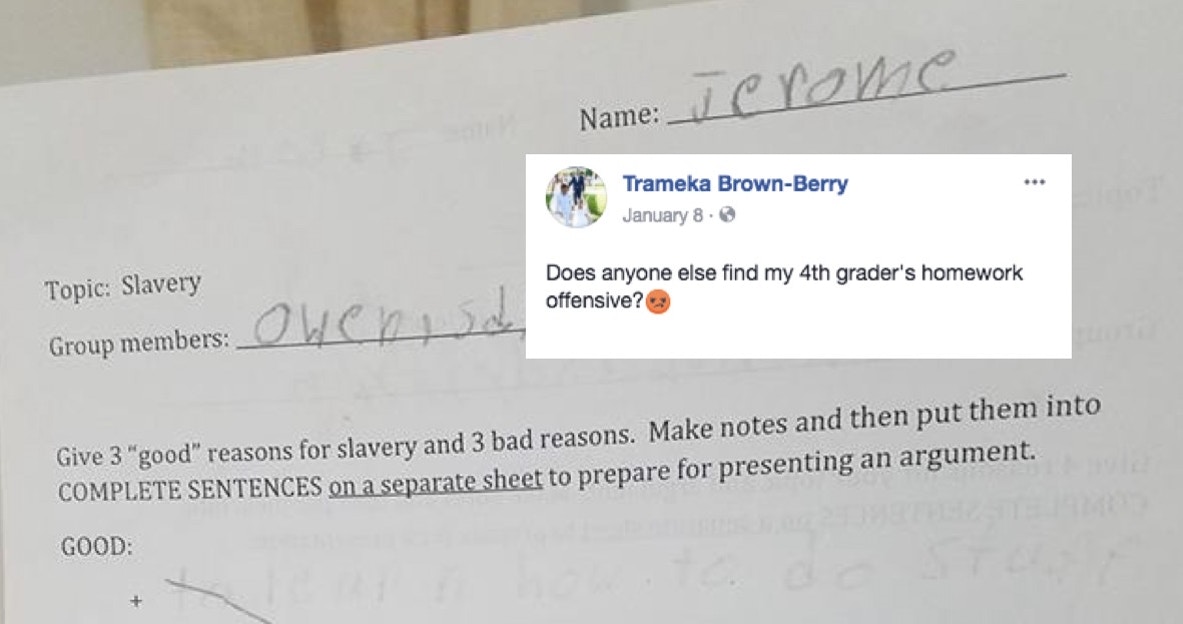
A school assignment asked for 3 benefits of slavery. This kid gave the only good answer.

The school assignment was intended to spark debate and discussion — but isn’t that part of the problem?

slavery, history, black americans
Photo credit: Trameka Brown-Berry/FacebookA school assignment asked for 3 "good" reasons for slavery.

It’s not uncommon for parents to puzzle over their kids’ homework. Sometimes, it’s just been too long since they’ve done long division for them to be of any help. Or teaching methods have just changed too dramatically since they were in school. And other times, kids bring home something truly inexplicable.

Trameka Brown-Berry was looking over her 4th-grade son Jerome’s homework when her jaw hit the floor.

“Give 3 ‘good’ reasons for slavery and 3 bad reasons,” the prompt began.

You read that right. Good reasons … FOR SLAVERY.

Lest anyone think there’s no way a school would actually give an assignment like this, Brown-Berry posted photo proof to Facebook.

In the section reserved for “good reasons,” (again, for slavery), Jerome wrote, “I feel there is no good reason for slavery thats why I did not write.”

Yep. That about covers it.

The school assignment was intended to spark debate and discussion — but isn’t that part of the problem?

The assignment was real. In the year 2018. Unbelievable.

The shockingly offensive assignment deserved to be thrown in the trash. But young Jerome dutifully filled it out anyway.

His response was pretty much perfect.

We’re a country founded on freedom of speech and debating ideas, which often leads us into situations where “both sides” are represented. But it can only go so far.

There’s no meaningful dialogue to be had about the perceived merits of stripping human beings of their basic living rights. No one is required to make an effort to “understand the other side,” when the other side is bigoted and hateful.

In a follow-up post, Brown-Berry writes that the school has since apologized for the assignment and committed to offering better diversity and sensitivity training for its teachers.

But what’s done is done, and the incident illuminates the remarkable racial inequalities that still exist in our country. After all, Brown-Berry told the Chicago Tribune, “You wouldn’t ask someone to list three good reasons for rape or three good reasons for the Holocaust.”

At the very end of the assignment, Jerome brought it home with a bang: “I am proud to be black because we are strong and brave … “

Good for Jerome for shutting down the thoughtless assignment with strength and amazing eloquence.

This article originally appeared seven years ago.
  • Why Gen Z’s ‘career minimalism’ is the future of work
    Gen Z employees.
    ,

    Why Gen Z’s ‘career minimalism’ is the future of work

    Every generation could learn from the workforce’s youngest.

    Forget the corner office. Gen Z is rewriting the rules of professional success, and their approach might save us all from burnout.

    While previous generations dutifully climbed the corporate ladder rung by rung, Gen Z is choosing to do things differently. These youngsters, born between 1997 and 2012, embrace a clear philosophy: work should fund your life, not consume it. It’s a simple dogma. This emerging trend, dubbed “career minimalism,” goes beyond the corporate buzzword, representing a fundamental shift that challenges what we thought we knew about ambition, success, and the definition of “making it” in today’s economy.


    The great corporate ladder exodus

    The statistics are striking: 68% of Gen Z workers claim that they would not pursue management roles unless they came with higher pay or a better title. This isn’t laziness. It’s a well-thought-out strategy. Generation Z watched Millennials sacrifice their twenties to corporate culture, only to face economic uncertainty, housing crises, and unprecedented stress levels.

    Gen Z is boldly saying “No thanks” to that traditional blueprint.

    Janel Abrahami, Glassdoor’s Career Pivot Strategist, puts it perfectly. “Gen Z is more willing to embrace a flex mindset than older generations,” Abrahami tells Upworthy. “While past generations often prioritized climbing the corporate ladder, Gen Z is looking for the career equivalent of a lily pad: a sustainable route where they can jump to whatever opportunity best fits their needs at the moment. That could mean taking a pay cut for more free time, accepting a lower title for a more creative role, or switching to an industry they see as more stable. Since 70% of Gen Z questions their job security as AI advances in the workplace, many are proactively moving toward sectors like skilled trades, healthcare, and education.”


    young, gen z, working, professionals, career
    Person with pink hair typing on laptop. Photo credit: Canva

    This lily pad mentality represents a profound shift in how an entire generation views professional growth. Instead of linear progression within a single company, Gen Z sees their careers as a series of strategic moves that prioritize personal fulfillment, financial stability, and most of all, time for the things that actually matter to them.

    Generation side hustle

    Despite the moniker “career minimalism,” 57% of Gen Z employees have at least one side hustle, more than any generation before them. Is it about the money? Not exactly. For Gen Z, side hustles are where their ambition thrives.

    Nearly half (49%) of Gen Z side hustlers say their primary motivation is to be their own boss, while 42% are driven by the desire to pursue their passions. These numbers tell a story about a generation that refuses to wait for opportunities. When their 9-to-5 doesn’t provide creative fulfillment or meaningful impact, they create it themselves.

    A teacher in Iowa sums it up, saying, “I always joke that I don’t dream of labor… If people were truly passionate about their job, it wouldn’t pay anything. Passion is for your 5-9 after the 9-5.”

    Similarly, a research analyst echoes this sentiment, saying, “While having a job that you’re passionate about is really cool, it’s important to have other interests that are not tied to your work life.”

    The broader statistics are even more telling: 66% of Gen Z and Millennials have started or plan to start side hustles, with 65% intending to continue their entrepreneurial ventures long-term. Meaning, this isn’t a phase, it’s a fundamental reimagining of how work fits into a fulfilling life. The pattern is clear: younger generations are diversifying their income streams and refusing to put all their professional eggs in one corporate basket.

    Work-life balance as a non-negotiable priority

    While older generations might view work-life balance as a nice idea, Gen Z regards it as essential infrastructure for a sustainable life. Thirty-two percent of Gen Z rank work-life balance as the most critical aspect of a job, compared to 28% of Millennials and 25% of Gen X. More significantly, they’re willing to prioritize this balance over higher compensation, a move that would have been unthinkable to previous generations entering the workforce.

    “Employers may be surprised by the changing attitudes of Gen Z in the workplace,” says Abrahami. “However, this doesn’t mean that Gen Z is abandoning work; instead, they are redefining ambition through career minimalism. If Gen Z feels unsupported in achieving the work-life balance they seek, they may become less motivated or start looking for opportunities that align better with their values and lifestyles.”

    young, gen z, working, professionals, career
    Young working professionals. Photo credit: Canva

    Gen Z is working smarter, not harder: Seventy-three percent of Gen Z employees want permanent flexible work alternatives, and they’re not just asking, they’re demanding. Companies that fail to adapt are losing talent rapidly. Research shows that 72% of Gen Z workers have considered leaving a job because of inflexible policies. Meanwhile, organizations offering flexible work arrangements see 78% higher retention rates among Gen Z employees. When companies listen to their employees’ preferences, everyone wins.

    Empathy is the key to Gen Z’s management style

    As Gen Z enters management roles, they make up over 10% of managers, this generation is bringing a different leadership philosophy to the table. Gone are the days of barking orders, wielding fear, and pitting direct reports against each other: Gen Z leaders prioritize emotional intelligence, collaboration, and authentic connection with their teams.

    Gen Z managers focus on:

    Seventy-seven percent of Gen Z consider organizational values when choosing an employer, and as they move into leadership roles, they ensure those values are lived, not just posted on company websites.

    The companies (already) getting it right

    Innovative organizations understand the importance of the Gen Z workforce, with many getting a head start on adapting to their preferences. The results speak for themselves. Goldman Sachs moved to a flexible dress code in 2019, General Motors eliminated its 10-page dress code in favor of a simple “dress appropriately” policy, and companies like Google offer flexible time off and comprehensive mental health support. Other companies, such as Microsoft, have introduced therapy stipends and on-demand counseling sessions to cater to Gen Z’s work values.

    Canva provides a standout example: through initiatives like “Force for Good,” the company encourages employees to contribute over 10,000 hours annually to community projects. This commitment to purpose-driven work has helped Canva achieve a 92% employee satisfaction rate.

    These changes aren’t just nice-to-haves, they’re competitive advantages. Companies that embrace Gen Z-friendly policies are seeing measurable improvements in engagement, retention, and overall performance.

    What every generation can learn from career minimalism

    Gen Z’s approach to work is not radical; it’s rational. After watching previous generations sacrifice their health, relationships, and personal fulfillment for corporate success that often proved fleeting, Gen Z chose a different path.

    These lessons are valuable for everyone, regardless of age:

    Boundaries create sustainability. Gen Z’s insistence on work-life balance is a nugget of wisdom. By setting clear boundaries, they dodge the burnout that has plagued older generations and create space for long-term productivity and creativity.

    Diversification reduces risk. While previous generations sought security in a single employer, Gen Z believes that proper security comes from multiple income streams and transferable skills. Their side hustles are money-generating insurance policies against rapidly changing industries and A.I.

    Values-driven work increases engagement. When work aligns with personal values, engagement and performance naturally increase. Gen Z’s demand for meaningful work benefits everyone by forcing companies to clarify their purpose and impact.

    Flexibility enhances productivity. The data is clear: flexible work arrangements lead to higher retention, better performance, and increased job satisfaction across all generations.

    For Abrahami, the way Gen Z operates in the workplace feels like a breath of fresh air, and she encourages managers to get to know their Gen Z direct reports. “Gen Z’s habits will continue to shape our workforce, so it’s important employers take the time to truly understand them,” Abrahami notes. “Their approach isn’t about laziness; rather, it’s a new representation of how they define success. They want sustainable careers that align with their goals, whether that means prioritizing a job that prevents burnout or one that provides security from layoffs. Older generations have much to learn from Gen Z, and we’re likely to start to see these values become more widely accepted.”

    young, gen z, working, professionals, career
    Gen Z coworkers. Photo credit: Canva

    The future of work belongs to Gen Z

    Gen Z’s philosophy in the workplace offers a compelling answer to the age-old question: “What if there’s a better way?” Their formula is refreshingly simple: stable jobs for security, side hustles for passion, and strict boundaries for sustainability.

    As workplace dynamics continue to evolve, the rise of career minimalism, fueled by Gen Z’s values, will reshape not only how we define professional success but also how we experience fulfillment. The future of work may belong not to the climbers, but to those content to hop from lily pad to lily pad with purpose and self-awareness.

    The corner office can keep its view. Gen Z has found something better: a career that actually fits their life, instead of consuming it. And honestly? The rest of us should take notes.

    This article originally appeared one year ago. It has been updated.

  • Master linguist visits town with world’s most ‘perplexing’ accent and finally meets his match
    Photo credit: CanvaA polyglot who speaks dozens of languages finally met his match: A strange version of English.

    Some languages are harder to learn than others. Many who’ve tried will say that Eastern languages like Chinese Mandarin and Japanese are extremely difficult for non-natives because of the unique sounds and intricate writing system. Others, like Hungarian or Finnish, have complex grammar rules that are challenging for beginners.

    Some people find pretty much all of them simple. Or at least, they enjoy the challenge.

    Arieh Smith, a YouTuber known as Xiaoma, is a polyglot—someone who has mastered many languages. He’s known as a linguistics master and his skill and teachings have earned him nearly a whopping seven million subscribers on social media.

    Xiaoma recently traveled to a well-known part of the world and finally met his match in the form of a dialect he just couldn’t crack: English.

    No, not regular American or British English, but a specific accent and dialect called Glaswegian; spoken in Glasgow, Scotland.

    language, linguistics, polyglot, english language, accents, travel, international, cultural differences
    Glasgow is a beautiful and fascinating city. Photo by Dorin Seremet on Unsplash

    Xiaoma says Glaswegian is known as one of the trickiest English accents in the entire world, and so he was eager to go and see—or hear—it for himself. He quickly meets up with a local guide who has agreed to show him around the city, and immediately, Xiaoma can hardly understand the man at all. When the guide tells Xiaoma that the day is going to have “tops off weather,” the YouTuber is baffled. (It’s just a clever, and cheeky way, of describing good weather.)

    “You guys speak English, but it’s different, it’s like…”

    “Swahili,” the guide finished for him. Xiaoma agrees.

    Later, Xiaoma interacts with a few randoms on the street, who all greet and welcome him warmly, even though they can’t understand each other all that well. Eventually, Xiaoma tries his hand at a few of the Glaswegian phrases he’s picked up, but he just can’t seem to match the pace and cadence of the natives—even though they’re technically speaking the same language!

    You’ve got to watch the whole series of interactions to truly appreciate this fascinating dialect:

    Reactions poured in as nearly a million people have viewed the video to date. Many were fascinated by the language, but even more viewers appreciated the cultural representation on display in the video.

    The video resonated especially with UK residents and people who had Scottish ties:

    “This might be the most authentic representation of glasgow ive seen on an international channel – no sanitised tourist pish, just normal folk on the street.”

    “Was born and raised in Glasgow for the first 9 years of my life, been back there a few times over the year but not returned in maybe 20 odd years now, this made me extremely homesick as to how friendly and willing to chat to strangers everyone is, you don’t get that South of England.”

    “The language is rich but their cheekiness is richer”

    “Glaswegians you’ll notice are very informal but very friendly. Most of the slang is crude humour jabbing at the nature of things and I wouldn’t have it any other way.”

    “Man, being a native Scot I always have a big smile on my face hearing Scottish folk talk, especially Glaswegians. Pure magic, like!”

    Glaswegian is an incredibly stubborn, resilient accent that shows no signs of going away anytime soon.

    language, linguistics, polyglot, english language, accents, travel, international, cultural differences
    Fancy a visit? Photo by Artur Kraft on Unsplash

    Many different towns and regions across the UK have their own specific dialects, but a lot of them are becoming “diluted” due to global television, social media, etc. It’s related to a concept called “global homogenization.” The more we’re able to travel both physically and digitally, and the more we all consume the same media and culture on a large scale, the more we lose some of the regional intricacies that make the world so fascinating. Languages blend together, cultures flatten on, accents disappear. For example, the Brogue—an extremely rare English dialect found in some Atlantic coast islands in the United States—is quickly fading away.

    Not Glaswegian.

    “Interestingly, what is not happening in Scotland is the dilution of accents to a more homogenised anglicised accent on the scale that we are seeing in England, and in fact the Scots accent remains very distinctive,” Professor Jane Stuart-Smith of Glasgow University told The Independent in 2015.

    While the accent is beautiful, in its own strange way, maybe its the local culture and the good-hearted nature of the people who speak it that keeps it alive. You might not be any closer to understanding or speaking Glaswegian after watching Xiaoma’s video, but with any luck, your interest in visiting Scotland will be piqued.

    This article originally appeared last year. It has been updated.

  • 1981 Afterschool Special, ‘The Wave’, still holds up with its lessons about fascism
    "The Wave" demonstrates how easy it is to pull people into fascism.

    “What are you watching?” my 13-year-old son asked.

    “An old Afterschool Special,” I responded.

    “What’s an ‘Afterschool Special’?” he asked.

    Hoo boy. Kids these days have no idea how different television was for those of us who grew up in the ’80s or how many core memories we have wrapped up in the ABC Afterschool Special.

    I briefly explained and then he sat down to watch with me. It was 2022. A discussion about fascism on X had led me to look up “The Wave,” a 1981 ABC Afterschool Special based on a real-life high school experiment in Palo Alto, California, in 1967.

    The real experiment was both fascinating and terrifying

    In the real experiment, first-year history teacher Ron Jones had students at Cubberley High School engage in a simulation of how fascism spreads as part of a lesson on World War II, with him playing the role of the dictator. His intent was to show skeptical students how the Nazis came to power by creating a social movement he dubbed the Third Wave.

    “It started out as a fun game with the most popular teacher at school,” Mark Hancock, one of the students in Jones’ history homeroom class, told Palo Alto Online in 2017. “He told us, ‘If you’re an active participant, I’ll give you an A; if you just go along with it, I’ll give you a C; if you try a revolution, I’ll give you an F, but if your revolution succeeds, I’ll give you an A.’”

    Hancock said he started off planning to get that revolution A, but it quickly grew beyond grades and turned into something real. “At the end, I was scared to death,” he shared.

    It began with Jones rallying the students around the idea of “strength through discipline” and “strength through community.” He had them engage in regimented behaviors and handed out membership cards. At first, it was just fun, but students began to enjoy feeling like part of a special community. Jones pushed the importance of following the rules. The students even formed a “secret police” to monitor other students, and if someone broke a Third Wave rule, they’d be reported and publicly “tried” by the class.

    The students got wrapped up in it to a frightening degree and even Jones found himself enjoying the way the students responded to him. “It was pretty intoxicating,” he told Palo Alto Online.

    But according to Verde Magazine, Jones felt like he’d lost control of it by the fourth day.

    The experiment ended at the end of the week with a rally. Jones told the students they were actually part of a real national Third Wave movement and that the national leader was going to speak to them at the rally. Jones turned on the televisions to white static and watched the students eagerly wait for their leader to speak. That’s when he broke the news to them that they’d fallen for a totalitarian regime. Instead of a Third Wave leader speech, he played them a video of a Nazi rally.

    According to a school newspaper at the time, most students were disillusioned. But one student said, “It was probably the most interesting unit I’ve had. It was successful in its goal to achieve the emotions of the Germans under the Nazi regime.”

    What the 1981 film gets right

    “The Wave” follows the true story quite closely and still holds valuable lessons. One chilling scene shows a kid who had been sort of an outcast prior to the “movement” saying, “For the first time, I feel like I’m a part of something great.” He was particularly crushed to find out it was all a fascist facade.

    As is the cyclical nature of history, “The Wave” and what it can teach us is especially relevant today. According to NPR, “surveys of more than 500 political scientists find that the vast majority think the United States is moving swiftly from liberal democracy toward some form of authoritarianism.” The benchmark survey, known as Bright Line Watch, had “U.S.-based professors rate the performance of American democracy from zero (dictatorship) to 100 (perfect democracy),” noted NPR. After President Trump’s election in November 2024, scholars gave American democracy a rating of 67. By April 2025, that figure had dropped to 53, and public ratings fell below 50 for the first time since Bright Line Watch began collecting data in 2018.

    Why this story feels so timely right now

    The most recent Bright Line Watch surveys from early 2026 show expert ratings have stabilized around 57, still the lowest recorded since the project began.

    John Carey, co-director of Bright Line Watch and a professor of government at Dartmouth, summed up the matter by saying, “We’re moving in the wrong direction.”

    Since President Trump’s election in November, various publications worldwide have suggested that much of Trump’s rhetoric echoes that of Nazi Germany, with some pointing out parallels between each administration’s first 100 days in office. Other publications have criticized the comparison.

    At any rate, this afterschool special is incredibly timely. If you can get past the ’80s aesthetic, it’s worth watching. Even my teen kids got into it, once they stopped making fun of the hair and film quality.

    This article originally appeared four years ago. It has been updated.

  • Former teacher gets brutally honest about the ‘denial’ some parents have about their kids’ education
    Photo credit: @bodacious.bobo/TikTokA former teacher breaks down the "denial" some parents have about their kid's academic performance
    ,

    Former teacher gets brutally honest about the ‘denial’ some parents have about their kids’ education

    “They’re more concerned about the optics…than about taking care of the child’s needs.”

    Many kids are seriously struggling in school. According to the National Center for Education Statistics, an estimated 49% of public school students started off the 2022-2023 school year behind in at least one subject. More recent data shows some improvement, with that figure dropping to 44% for the 2023-24 school year, though millions of students remain behind.

    While there are several factors contributing to this issue, including the lasting effects of the COVID-19 pandemic, underfunded schools, and a growing teacher shortage, many educators feel that one majorly overlooked factor is parental involvement, or the lack of it, in their child’s education.

    A former teacher’s blunt take on parental denial

    One former teacher bluntly stated that it was parents’ “denial” that’s to blame. Odion, who now works as a flight attendant, made her case in response to another teacher’s TikTok asking parents why they’re unaware that their children are underperforming for their grade level.

    In the original video, user @qbthedon laments that his 7th grade students still perform at a 4th grade level, and, despite his efforts, those kids still move onto the next grade even though they’re not ready. The worst part is that the parents don’t seem to be aware that their kids are extremely behind.

    One dad’s denial that stuck with her for years

    This lack of awareness and engagement dates back further than the pandemic years, says Odion, who taught Pre-K and Kindergarten in 2013.

    Case in point: parent-teacher conference nights, where virtually no parent would show up. Odion then recalled one father who did attend with his daughter, called Tia for the story, but would not believe that Tia did not know the full alphabet.

    “In kindergarten, you have to at least know, I think it was 80% of the 52 letters, as in uppercase and lowercase, and you have to be able to identify at random. So, I’m telling the dad that she barely knows 10 letters. And he’s in denial. ‘Nah, you know, she knows her letters,’” Odion says.

    @bodacious_bobo

    #stitch with @QBSkiiii if these children are our future, we should all be terrified

    ♬ original sound – Odion ✨

    She then acts out that night, using a makeshift flashcard like she did to test Tia.

    “I literally said, ‘What letter is this?’” Odion says while holding up the letter “M.” “She said something that’s not it. Put another one down. ‘What letter is this?’ She don’t know it.”

    Still, the dad insisted that Tia knew her letters. Eventually, he blamed Tia’s older brother, who, despite only being a sixth grader himself, was “supposed to teach her.”

    “It is not up to a child in elementary school, or middle school, or really any of your older kids, as someone who’s an older child… It is not up to the kids to teach younger kids,” Odion says in the clip.

    Using another example, Odion states that a fifth grader in her class was reading at a kindergarten level and could only process basic sentences like “I see you” and “I like to see.”

    In this instance, the students should be held back in order to fully learn the year’s curriculum. But Odion argues that parents fight against it “because they are more concerned about the optics of a child being held back than actually taking care of the child’s needs.”

    Why holding kids back is not a simple solution

    While the research shows that holding kids back a grade does improve their academic performance by granting them more time, there are still significant pros and cons to consider. In other words, being held back might not be the best solution for every struggling child. The biggest point Odion seems to be trying to make is that in addition to teachers and administrators, parents need to be more proactive in their child’s education.

    “Parents, y’all can’t be backseat drivers about your child’s learning. You have to help reinforce it at home. You put a kid in front of that phone or iPad whenever they come home, it better be on YouTube, and it better be learning about letters and sight words. You can’t tell me you can’t read to the kid. It takes 10 minutes to read to the kid. No one is that busy,” she concludes.

    This article originally appeared two years ago. It has been updated.

  • Teacher of the year explains why he’s leaving his district in landmark 3-minute speech
    Photo credit: Image via YouTube Former teacher of the year Lee Allen
    ,

    Teacher of the year explains why he’s leaving his district in landmark 3-minute speech

    “I’m leaving in hopes that I can regain the ability to do the job that I love.”

    For all of our disagreements in modern American life, there are at least a few things most of us can agree on. One of those is the need for reform in public education. We don’t all agree on the solutions but many of the challenges are undeniable: retaining great teachers, reducing classroom size and updating the focus of student curriculums to reflect the ever-changing needs of a globalized workforce.

    And while parents, politicians and activists debate those remedies, one voice is all-too-often ignored: that of teachers themselves. This is why a short video testimony from a teacher in the Atlanta suburb of Gwinnett County went viral. After all, it’s hard to deny the points made by someone who was just named teacher of the year and used the occasion to announce why he will be leaving the very school district that just honored him with that distinction.

    In a video carried by Fox5 Atlanta, 2022 Gwinnett County Public Schools Teacher of the Year Lee Allen breaks down what he sees as the overriding problems in the county’s school system. While his comments are specific to that of Gwinnett County, it’s virtually impossible to not see the overlap across all of America and how the problems have only grown more challenging in the years since.

    What Lee Allen said about leaving

    “At the end of this year, I will be leaving Gwinnett County Schools, leaving behind the opportunity to submit for state teacher of the year, roughly $10,000 in salary, and most importantly, the students and colleagues I’ve built strong relationships with,” Allen, a math teacher at Lawrenceville’s Archer High School, says at the beginning of his remarks. “I’m leaving in hopes that I can regain the ability to do the job that I love.”

    Normally, one might assume teacher pay is the overriding issue for educators like Allen. But he makes it clear that he is, in fact, leaving money on the table to avoid what he deems as unacceptable changes to the student body and how the district manages its teachers and the learning environment.

    Four big problems that pushed a Teacher of the Year out the door

    • “First issue at hand is student apathy and disrespect for school rules and norms. … We have an alarming number of students that simply do not care about learning and refuse to even try.”
    • “We are also experiencing incredible disrespect and refusal to follow basic school rules. There is little to no accountability or expectation for grades or behavior placed on students or parents. Rather than being asked what the student can do to improve their understanding, teachers are expected to somehow do more with less student effort.”
    • “Cell phone use. Teachers simply cannot compete with the billions of dollars tech companies pour into addicting people to their devices. Phones allow constant communication, often being the spark that fuels fights, drug use and other inappropriate meetups throughout the day. We need a comprehensive district plan with support behind it in order to combat this epidemic and protect the learning environment.”
    • “Lastly, there is a huge disconnect between administrators and teachers. The classroom in 2022 is drastically different from just three years ago. Most administrators have not been in a classroom full-time in years or even decades. Many teachers do not feel understood, valued or trusted as professionals from administrators and the decisions that they make.”

    While Allen points fingers at administrators and student behavior, he also says that the pressures put on both students and teachers alike by COVID-19 had a catastrophic impact on learning. “The pandemic has acted as a catalyst and turned a slow negative trend into an exponential crisis,” he says.

    His suggestions for fixing the problem

    But he also offers some solutions, stating, “I won’t list complaints without offering ideas for improvement.”

    • All administrators should spend at least one week in a high needs classroom, “without a suit, without people knowing your title and in the same room, all day, for an entire week.”
    • Prioritizing smaller class sizes.
    • Greater transparency from the district in terms of needs and expectations and goals.

    “We all want the same thing and we cannot accomplish this without supporting one another,” he says near the end of his remarks.

    With hundreds of thousands of views, it’s clear his remarks resonated with people well beyond his school district.

    There’s almost nothing more important than how we educate our children. And while the national political debate centers on areas of far less importance generated to gin up controversy and campaign fundraising, it’s families and local leaders who will need to do the heavy lifting of reprioritizing the fundamental principles of learning and leadership if we want an American educational system that can compete on the global stage. After all, when literal award-winning educators like Allen are walking away, it’s clear something more needs to be done.

    This article originally appeared five years ago. It has been updated.

  • Teachers share 17 wild excuses from their students that actually turned out to be true
    Photo credit: Via PexelsTeachers share the best excuses.
    ,

    Teachers share 17 wild excuses from their students that actually turned out to be true

    Every once in a while, an excuse that seems way too improbable to be believed actually is true.

    Kindergarten through 12th grade teachers and college professors have heard every excuse in the book. Whether it’s a third grader claiming their “dog ate my homework” or a college freshman claiming their grandmother died to get out of a test, they’ve heard it all a billion times.

    The top excuses teachers say they hear all the time

    A college professor once listed the top 21 excuses he’s heard from his students. Here are the top five:

    5. “It’s the last week of the semester.”

    4. “It’s St. Patrick’s Day or 4/20”

    3. “Our other teacher held us back.”

    2. “My timetable showed the class was canceled.”

    1. “I’m taking a vacation.”

    Yes, some students actually say they didn’t do their work because of a holiday predicated on drinking or getting stoned and others have the audacity to say, “Hey! I needed a vacation.” After spending week after week fielding excuses, there’s a good reason why most educators are skeptical when they hear one from their students.

    But every once in a while, an excuse that seems way too improbable to be believed actually is true.

    Reddit user u/minecraftplayer48 asked the teachers of Reddit to share the “best excuse for being late that turned out to be true” and the stories were all pretty great. But it wasn’t only teachers who chimed in; a lot of people shared stories from when they were students and had an excuse that was so crazy they didn’t think anyone would believe them.

    17 excuses that sounded fake but were completely true

    Here are 17 of the best excuses for being late that were actually true:

    1. Revenge of the torque wrench

    “My auto teacher let me practice removing and adding the tires on his vehicle. The next morning it was about 20 minutes into first period and no sign of him. He comes running into the classroom out of breath and his hair is all messed up. He points at me and says ‘YOU!!!! What is a torque wrench used for???’ I respond with “I don’t know.” He says ‘ I know you don’t know!!!” Turns out one of his tires came off while driving down the highway.” – ethnicjello

    2. Mom wanted to sleep in

    “She had to take her sister to school and drive her mom to rehab. She was always late to class because her mom just wanted to sleep in. Problem was if the mom was late or did not go she would have violated her probation and gone to prison. I never marked her late. If she missed anything important she could come in at lunch or after school to make it up.” – RM156

    3. That was you?

    “Student here, I headed into school early to get some studying done in the library before my night class. I was one exit away when I was caught in a 3 car accident. Most of the expressway afterwards was gridlock with only one lane left open. I did eventually make it into my lab class 15 minutes late, with a few scrapes and bruises. My professors reaction was simply ‘Oh that was you!”” – AlienCowAbduction

    4. School bus blew up

    “I was one of about 20 kids who were late to school. We showed up at the school office as a group and when questioned why we were late, we said ‘The school bus blew up.’ They questioned ‘So the engine blew up?’ The kids ‘No, the whole bus, in flames. It blew up.’

    “There was much conference between the teachers, all of them thinking we embellished the story. Next thing you know, one of the admin staff has the news website open, very obvious image of an entire bus on fire with a bunch of kids in our school uniform standing in front of it. Our late slip for class read ‘School bus blew up.’” – AusPB90

    5. B.U.I.

    “Told me he got pulled over by the cops for wobbly driving on his bike and they thought he was drunk. Turned out he was just dodging all the slugs on the street.” – Fortisvol

    6. Chicken of death

    “A guy in my college class missed class one day. The next day he came in with his eye covered up and medical paperwork in hand. Apparently he got pecked in the eye by a chicken.” – BrrToe

    7. Chicken 2: The chickening

    “When I was student teaching, I was late because there was bunch chickens in the middle of the road. They wouldn’t move at all. This is in the middle of a city of 200,000 people. Freaking chickens.”

    “I finally get to school and profusely apologize to my mentor teacher and I told her why I was late thinking it sounded ridiculous. She said, ‘yeah, those chickens are fucking assholes, they surrounded my car in the McDonalds parking lot last year. Don’t worry about it.” – Makenshine

    8. Cracker Barrel conference

    “Taught a group of seniors first period. It was towards the end of the year. I had a class of around 30 and only 5 were there when the bell rang. Halfway through class, the rest of them show up. They went out to Cracker Barrel for breakfast and brought me some back. All was forgiven.” – SwansonsLoveChild

    9. Beary late

    “Bear in the backyard. No access gate. Animal control had to tranq it from the roof and drag it through the house. Made the news. Got to retake the test I missed after sending her the news article.” – Vladtehwood

    10. Present the flat

    “We had an exam in my class and the teacher got a message from a student saying that he was going to be late because his car had a flat tire (the student was known to party), the teacher didn’t think it could be true, so as a joke the teacher asked him to bring the tire back. He brought the flat tire back in the middle of the exam. Needless to say, the professor didn’t expect that.” – Sapang

    11. Moo

    “A kid missed my first-period class one morning but was in school later that day. When I asked him why he hadn’t arrived in time for my course, he said his cow was birthing its calf that morning, so he’d picked being in the barn over English. Made sense to me. His essays weren’t going to win any ribbons at the county fair, but his calf could.” – Bobosbigsister

    12. Abduction

    “In high school a kid came late to history class. He was a joker so when someone asked him where he had been, he goes ‘I was kidnapped.’ Everyone laughed, until he goes ‘no really.’”

    “Turns out 2 guys kidnapped him and tossed him into the back of the minivan he was using for his morning paper route. They drove him around while they robbed something. I can’t remember what happens after. I think they just drove the van somewhere and got away.” – notinmybackyardcanad

    13. Honesty is the best excuse

    “Not a teacher, but a kid walked into my class one day and literally just said ‘Sorry I’m late, I didn’t want to be here.’ He wasn’t wrong I suppose.” – Scally59

    14. It actually was the dog

    “A little off topic but in 8th grade, a friend of mine turned in their homework late because her dog literally ate her homework. She even brought a note from her parents.” – JoeyJoey2004

    15. Is this a real excuse? Or is it fantasy?

    “‘Sorry Bohemian Rhapsody came on just as I parked.’ — My art teacher when he was about 5:55 minutes late.” – Deeberber

    16. I took a shortcut


    “This happened to me as a pupil; a very quiet, unassuming kid in our class came in to German with about five minutes of the class left. We went to a Catholic school and the teachers were all quite strict and intimidating. Classes were usually silent, especially in junior school. When this boy came into class at the end of the lesson that day, the door flew inwards with such force that the teacher gave an audible gasp.”

    “It had been raining heavily outside, his hair was plastered to his forehead. His blazer was dripping and sodden. He had mud caked into his trousers up to his knees, and he was breathing heavily. The teacher exclaimed, ‘Brendan! What happened?’ We all stared up at him in shocked silence. This quiet, unassuming little boy let out a big sigh and just said, ‘I took a shortcut.’ And went straight to his seat.”

    “That line became iconic in our school for years afterward.” – lestat85

    17. Pug lovers can attest

    “Kid was late to school and had to miss a very important football game. The reason? His fat pug fell asleep on his phone. The pug’s fat rolls muffled his alarm.” – tip52

    This article originally appeared two years ago. It has been updated.

  • Teacher reveals the ‘really obvious’ reason teens no longer read. It’s not just the phones.
    ,

    Teacher reveals the ‘really obvious’ reason teens no longer read. It’s not just the phones.

    A high school teacher’s TikTok sparked a serious conversation about screen time, low expectations, and the surprising role BookTok is playing in the literacy crisis.

    Studies show that kids are spending a lot less time reading these days. In 2020, 42% of nine-year-old students said they read for fun almost daily, down from 53% in 2012. Fourteen percent of 13-year-olds read for fun daily, down from 27% in 2012. Among 17-year-olds, 19% reported reading for fun in the last year data was collected, down from 31% in 1984.

    It’s safe to say that modern technology is a big reason why kids aren’t reading as much. A recent report found that teenagers spend an average of eight hours and thirty-nine minutes per day on screens, compared to five and a half hours for pre-teen children. So, it’s no wonder they don’t have any time left to crack open a book. In December 2024, Ms. C, a high school teacher on TikTok who goes by the name @stillateacher, brought the topic up with her class and learned they stopped reading for fun at the end of middle school.

    Why are kids stopping?

    “So, even those who are like avid readers of the Percy Jackson series in fourth and fifth grade fall off,” the teacher says. “Honestly, there are many reasons to stop reading recreationally, like increased pressure inside and outside of school, a desire to spend more time socializing, and, of course, the phones.”

    But the teacher says there’s an obvious reason “right in front of our faces”: the adults. “Adults have lowered the bar for how much you should read as a teenager so far that the bar cannot be found,” she continued. “There are many educators who have the mindset that you shouldn’t teach whole books because kids just won’t read them.”

    “I’ve taught at schools where teaching novels is actually discouraged,” she continued. “And I have conversations with teachers in other content areas who say that they themselves never read books, that they don’t think it’s important for students’ long-term success. All this said, it is not entirely surprising that high schoolers don’t wanna read.”

    How does reading benefit kids?

    kids, reading, books, literacy, reading for fun, reading for pleasure
    Kids laying down in the grass reading. Photo credit: Canva

    The significant decrease in the number of children who read for fun means that many will miss out on the incredible benefits of regularly curling up for a good book. Studies show that children who read for pleasure enjoy improved cognitive performance, language development, and academic achievement. Reading is also linked to fewer mental health problems, less screen time, and more sleep. Findings suggest that kids get the optimal benefits of reading when they do it for around 12 hours a week.

    “You forgot empathy,” one commenter added. “People who read are better at empathizing because they have been able to put themselves in the shoes of others and learn about different perspectives, people, cultures, experiences.”

    And @stillateacher has seen these incredible benefits first-hand. “But I’m telling you, the handful of kids I teach who do read are built different. Kids who read have stronger critical thinking skills, more success across all academic areas, and, honestly, just a stronger sense of self. Because reading helps you figure out who you are as a person,” the teacher said.

    The case for BookTok

    The decline in young people’s reading is a serious problem that must be addressed. So, it’s terrific that the teacher used her platform on TikTok to bring it to the public’s attention. Interestingly enough, she says that TikTok is one of the few platforms encouraging kids to read.

    “And honestly, thank goodness for BookTok because I think it is one of the only drivers of adolescent reading that still exists,” she concluded her post. “Isn’t that sad? Like, the schools aren’t doing it, TikTok’s doing it. We gotta start a movement here.”

    This article originally appeared two years ago. It has been updated.

  • A high school teacher ditched classroom rules. Now he uses 4 more effective R’s instead.
    Photo credit: Photo by Jeswin Thomas/Pexels Mr. Syrie's approach reframes classroom "rules."

    If you’ve ever been around a group of 20 or 30 kids or teens, try to imagine getting them all to pay attention and stay focused for longer than 5 minutes. There’s no doubt that wrangling a classroom of kids is a formidable feat at any age. Getting a group of learners to be engaged, attentive and reasonably courteous is the goal, but managing diverse personalities from various backgrounds and home environments and who have different standards and expectations of behavior isn’t easy.

    Some teachers take the old-school “law and order” approach to classroom management. They lay out a list of rules everyone is supposed to follow, and those who don’t fall in line face consequences of some sort. But high school Language Arts teacher Monte Syrie takes a different tack, one that sees students as valued citizens of a community instead of young people to be controlled.

    Syrie, who has been teaching for nearly three decades, says he’s always striving to make the school year better than the last one. That means regularly reflecting and reevaluating how he communicates with his students, which is how he went from standard classroom rules to reframing them as “Policies and Procedures” to tossing out the concept of “rules” altogether.

    Why he ditched the rulebook entirely

    Now he offers 4 R’s, Roles, Routines, Rights and Responsibilities, as a framework for classroom management.

    “I think teachers are framers. We frame the room. We frame the work. We frame the day. We frame the year. We frame the entire experience–whether we want to or not,” Syrie shares. “The kids look to us for the frame. What we do or don’t do decides the day. And, man oh man, is there pressure in that. But, there’s also possibility–powerful possibility.”

    Syrie explains in his book about teaching that kids respond differently when teachers frame things differently, and being greeted with classroom rules on day one evokes a specific response in kids.

    “We seem to believe if we don’t get rules in front of the kids immediately, we will never get the kids where we want them,” he writes. “I don’t believe in this anymore. I did, I suppose, at one point, but at this point, I believed there was a better way to ‘get kids.’”

    Syrie decided to reframe his classroom policies as Roles that let kids see themselves through various lenses, Routines that tell them what to expect, Rights that give them individual autonomy and Responsibilities that help them contribute to a shared community.

    What each of the four R’s means in practice

    So what does that look like?

    Roles in Syrie’s classroom include the roles of Yourself (the most important role, he says), Valued Community Member, Reader, Writer, Mistake Maker, and Reflector. He explains to the students what each of these roles entails and why it’s important for kids to take them on.

    Routines include daily and weekly activities such as starting class with a community check-in called Smiles and Frowns and ending class with Journey Journaling. Each day of the week also has a specific focus, such as writing, reading or grammar.

    Rights include things like, “I have the right to feel safe,” “I have the right to learn,” and “I have the right to ask as many questions as l want.” Syrie also gives students the right to eat and drink in class and the right to make mistakes without fear of penalty.

    teaching, classroom, students, classroom rules, education

    Monte Syrie talks to a student in one of his classes. Photo courtesy of Monte Syrie

    As for Responsibilities, students have a responsibility to get to class on time, know and honor the class routines, self-regulate use of electronic devices in the classroom, be a great listener, self-regulate leaving the room, take ownership of their learning, and be sensitive and respectful of others’ viewpoints, among other things. Students are expected to do their best to fulfill these responsibilities and to handle any breaches (such as being late to class) with courtesy and minimal disruption to the rest of the class. If they are struggling with any of these responsibilities, interventions include reminder(s), conversation(s), parent contact, and as a last and unlikely resort, office referral.

    The beauty of Syrie’s four R’s is that they demonstrate a sense of trust in students right off the bat, helping them see themselves both as responsible individuals and as valued parts of a communal whole. When people feel trusted and valued and are empowered by a clear balance of rights and responsibilities, most tend to rise to the occasion, even when they’re in high school. That’s not to say that this framing eliminates all classroom management issues, but it’s a framework that encourages character development from within the students rather than exerting control from the top down. They’ll be able to take this framing through their whole educational career and beyond.

    Why this idea goes beyond the classroom

    A fellow educator wrote on X, “Love this in so many ways! In these times, this answers ‘how can we help learners understand the principles of a democracy?’” Imagine if we all reflected more on our roles, routines, rights and responsibilities as citizens rather than just memorizing the laws we are obliged to follow. Perhaps Mr. Syrie’s rethinking and reframing of the educational experience can help us all consider a new framing for our own lives as individuals and community members as well.

    You can follow Monte Syrie on X and find his book, “better: A Teacher’s Journey: Project 180 Book One,” here.

    This article originally appeared two years ago. It has been updated.

Kids

Kasai and Klarity on the rise, Emma on the outs in Social Security’s new baby-name rankings

Health

Astounding 2013 study found that ‘expressive writing’ can help heal physical wounds

Pets

Cat owners share the super-specific, wildly weird things their cats insist on as part of their routine

Pets

When does ‘rage baiting’ your cat cross the line from playful fun to torment? Experts weigh in.