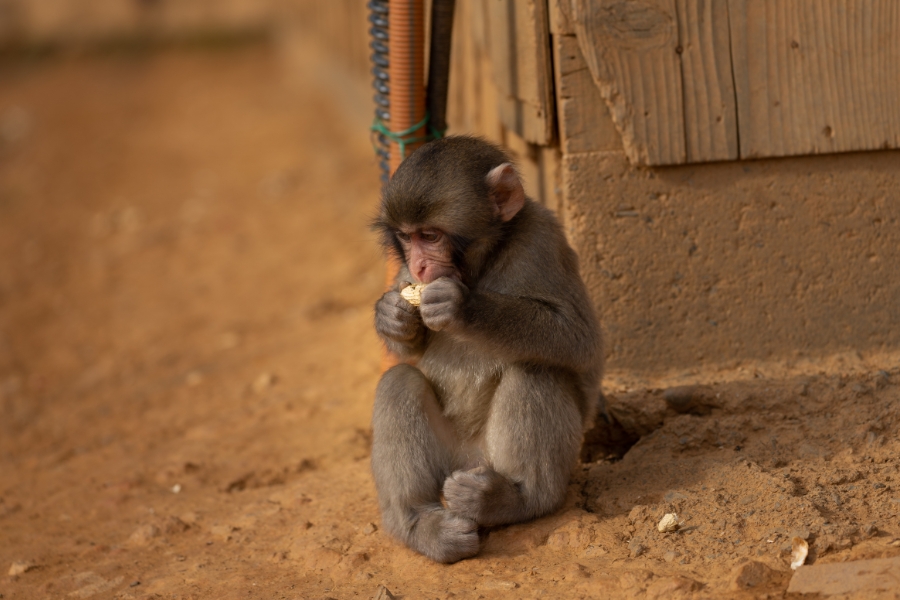
A baby monkey named Punch has captured the hearts of people around the world. The now seven-month-old Japanese macaque, who lives at Japan’s Ichikawa City Zoo and Botanical Garden, was rejected by his mother shortly after birth. Videos of him clinging to zookeepers coming into the enclosure broke people’s hearts, but that was just the beginning of the saga.
Zookeepers gave Punch a stuffed orangutan toy as a surrogate “mom” to cuddle with. Naturally, that has only increased the “Awww” factor. Punch drags the toy around with him and runs back to it for comfort when he’s scared or lonely, and he’s been scared and lonely a lot since he was introduced to the larger macaque troop in January. Videos show him being pushed away and even dragged around by older macaques, after which he runs back to cling to his stuffed mama.
People can’t take watching a baby monkey be rejected
However, things have not been quite as dire for Punch as they may appear. The zoo has reassured the public in a statement that the “bullying” Punch has endured is actually a pretty normal part of primate socialization. Being “disciplined” by other macaques will teach him appropriate behavior in the troop, even if it appears mean to our human sensibilities.
People’s reactions to Punch and his struggles to fit in have been emotional and fierce, though. It’s like Punch’s story was designed to trigger every compassionate, protective instinct we have as humans. The motherless outcast who just wants to be loved. The big, mean bullies who knock him around. The rejection when he attempts to make friends. The finding comfort wherever he can, even in an inanimate object.
Comedian Britt Migs captured the emotional investment people have in this monkey in a parody video. It may be hilariously over the top, but it’s actually not far off from how many people feel after watching Punch videos.
Comments on the videos range from sadness to empathy to rage:
“Punch needs to have his own kingdom.”
“At dawn we ride for Punch.”
“How do I apply to foster and ultimately adopt punch. He can stay with me.”
“This story has wrecked my life this week.”
“I love Punch and I’ve never met him!”
“Every video I see of punch I’m crying, He’s so cute and innocent.”
Punch is doing better than people think, thankfully
There has been good news on the Punch front, thankfully. The zoo says he “shows resilience and mental strength” even as he goes through his social pitfalls. And he has started making friends with others. Newer videos show him being carried and cuddled by at least one older macaque, playing with a peer, and even being groomed. All good signs.
Ichikawa Zoo has seen a massive influx of visitors since Punch’s story went viral and has had to make adjustments. They have asked visitors to limit their time on Monkey Mountain (where the macaques live) and observe quietly so as not to disturb them.
The zoo has been keeping people posted on how Punch is doing. A zookeeper update from February 22 reads (translated from Japanese on X): “Thanks to everyone’s good manners, it was a calm atmosphere with no fights or anything like that. Punch, around 5 PM, was meticulously groomed by two monkeys and is steadily fitting into the group.”
The reality of zoos can often give people pause and prompt concern for the well-being of the animals in human care. Dr. Tessa Wilde, executive director at For the Love of Primates, shared some insights into how macaques live in the wild and how that influences the way enclosures are designed.
There’s a rather fuzzy line between caring for animals and anthropomorphizing them to the point where we might interfere with normal behavior, such as the socialization we’ve seen Punch going through. Wilde pointed out in a previous video that early rejection and scolding are not unusual in a case like Punch’s. And we’re seeing progress as he gets integrated into the troop, so that’s promising.
It is hard to watch, though, and our feelings of compassion for a creature we think is going through a hard time certainly isn’t a bad thing. We need more compassion in the world, even if it comes through a monkey with a stuffy just trying to find a family.