Photographer James Balog and his crew were hanging out near a glacier when their camera captured something extraordinary. They were in Greenland, gathering footage from the time-lapse they’d positioned all around the Arctic Circle for the last several years.
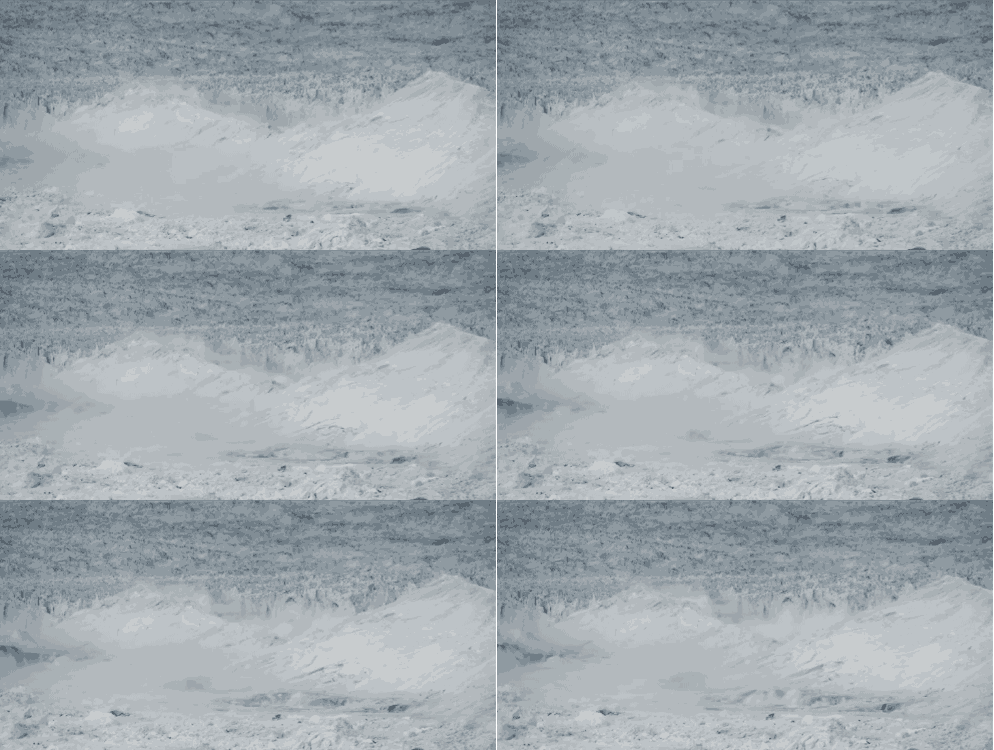
They were also there to shoot scenes for a documentary. And while they were hoping to capture some cool moments on camera, no one expected a huge chunk of a glacier to snap clean off and slide into the ocean right in front of their eyes.
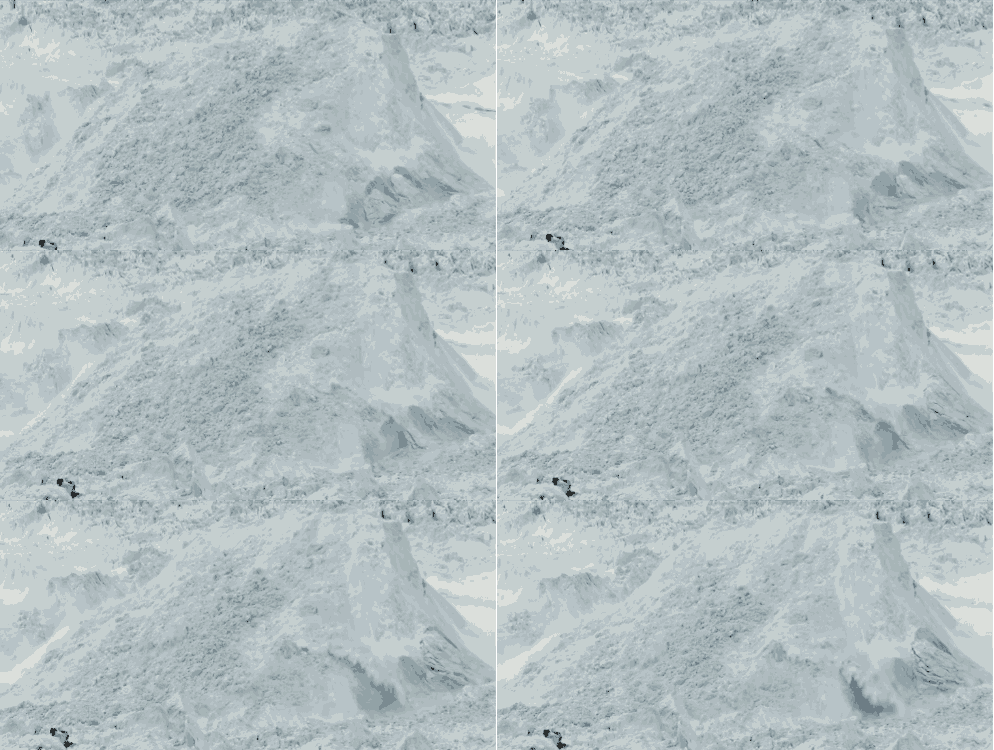
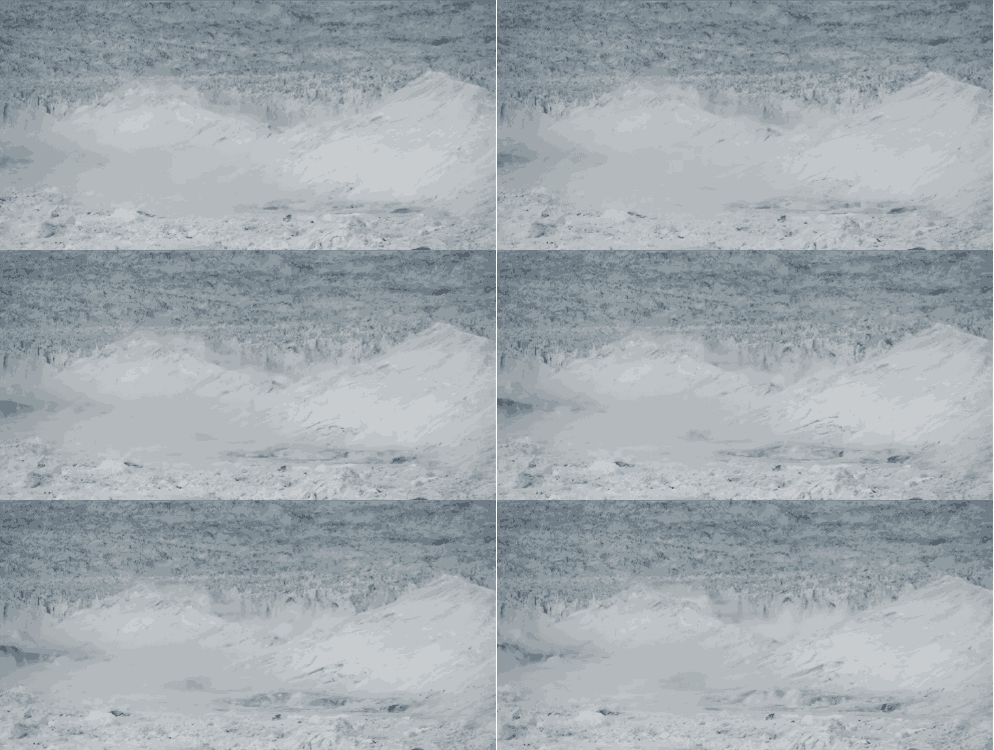
A glacier falls into the sea. <a href="https://assets.rebelmouse.io/eyJhbGciOiJIUzI1NiIsInR5cCI6IkpXVCJ9.eyJpbWFnZSI6Imh0dHBzOi8vYXNzZXRzLnJibC5tcy8xOTQ5OTk4MS9vcmlnaW4uZ2lmIiwiZXhwaXJlc19hdCI6MTY0Mzc1NTc3OH0.FAySffHTIynGNOXPuRAokuqF7bGD_M20bj7y8AC8fW0/img.gif?width=980">assets.rebelmouse.io</a>
Massive swells created by large chunks of glacier falling away. <a href="https://assets.rebelmouse.io/eyJhbGciOiJIUzI1NiIsInR5cCI6IkpXVCJ9.eyJpbWFnZSI6Imh0dHBzOi8vYXNzZXRzLnJibC5tcy8xOTQ5OTk4Mi9vcmlnaW4uZ2lmIiwiZXhwaXJlc19hdCI6MTY5MjAyNjg2Nn0.4uD3PHudZc7Wf9XMIQ8DG2nEfELR8JK4_6G14Ph2Ok8/img.gif?width=980">assets.rebelmouse.io</a>
It was the largest such event ever filmed.
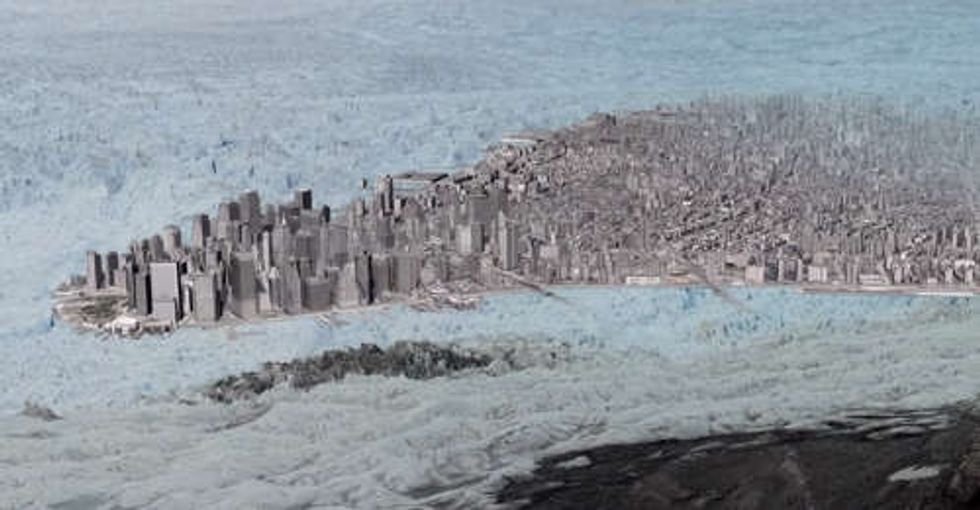
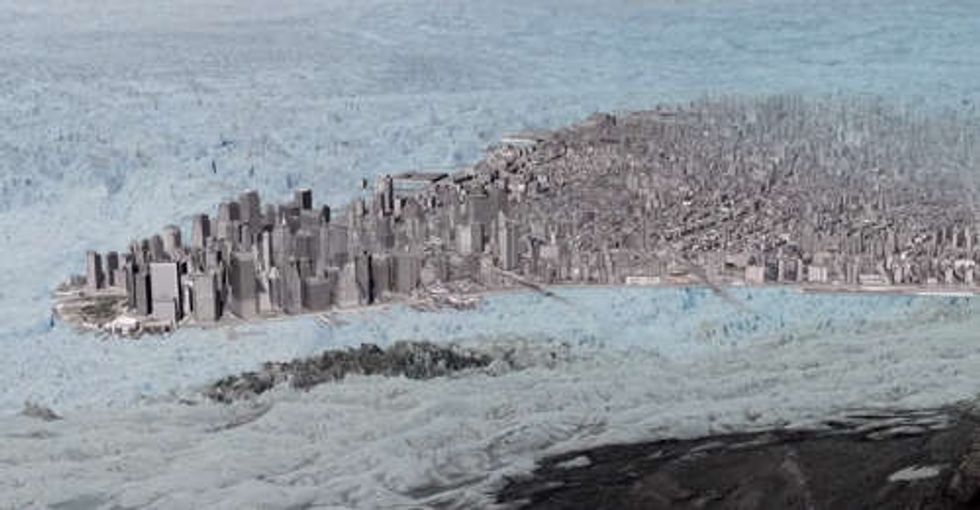
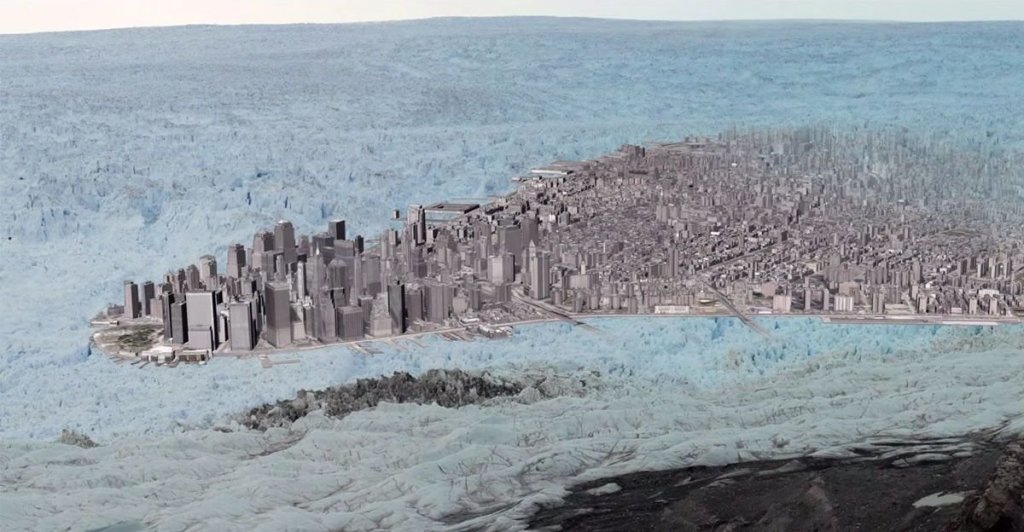
For nearly an hour and 15 minutes, Balog and his crew stood by and watched as a piece of ice the size of lower Manhattan — but with ice-equivalent buildings that were two to three times taller than that — simply melted away.A representation demonstrating the massive size of ice that broke off into the sea. <a href="https://assets.rebelmouse.io/eyJhbGciOiJIUzI1NiIsInR5cCI6IkpXVCJ9.eyJpbWFnZSI6Imh0dHBzOi8vYXNzZXRzLnJibC5tcy8xOTQ5OTk4My9vcmlnaW4uanBnIiwiZXhwaXJlc19hdCI6MTY0NTc3MDU2MH0.A3vkySOxfkoGCsFu1LKsh9_pOWJKzaXWAUUeMp4D_Og/img.jpg?width=980">assets.rebelmouse.io</a>
As far as anyone knows, this was an unprecedented geological catastrophe and they caught the entire thing on tape. It won’t be the last time something like this happens either.
But once upon a time, Balog was openly skeptical about that “global warming” thing.
Balog had a reputation since the early 1980s as a conservationist and environmental photographer. And for nearly 20 years, he’d scoffed at the climate change heralds shouting, “The sky is falling! The sky is falling!”
“I didn’t think that humans were capable of changing the basic physics and chemistry of this entire, huge planet. It didn’t seem probable, it didn’t seem possible,” he explained in the 2012 documentary film “Chasing Ice.”
There was too much margin of error in the computer simulations, too many other pressing problems to address about our beautiful planet. As far as he was concerned, these melodramatic doomsayers were distracting from the real issues.
That was then.The glacier ice continues to erode away. <a href="https://assets.rebelmouse.io/eyJhbGciOiJIUzI1NiIsInR5cCI6IkpXVCJ9.eyJpbWFnZSI6Imh0dHBzOi8vYXNzZXRzLnJibC5tcy8xOTQ5OTk4NC9vcmlnaW4uZ2lmIiwiZXhwaXJlc19hdCI6MTY1NDM4NDY1OH0.mEoIl6RYtdd5bbRS6MrKIt_ne69YC3yE9QdLD7qN6YA/img.gif?width=980">assets.rebelmouse.io</a>
In fact, it wasn’t until 2005 that Balog became a believer.
He was sent on a photo expedition of the Arctic by National Geographic, and that first northern trip was more than enough to see the damage for himself.
“It was about actual tangible physical evidence that was preserved in the ice cores of Greenland and Antarctica,” he said in a 2012 interview with ThinkProgress. “That was really the smoking gun showing how far outside normal, natural variation the world has become. And that’s when I started to really get the message that this was something consequential and serious and needed to be dealt with.”
From Pakistan to Tanzania, the most effective education solutions are community-led. Here’s how local leaders, in partnership with Malala Fund and supported by Pura, are mobilizing entire communities.
When asked to describe what Tanzania smells like, Grace Isekore closes her eyes and breathes in deep. For a moment, she’s somewhere else entirely. Tanzania is a rich tapestry of sights and scents, from the smell of sea mist that permeates the coastline to the earthy cardamom and cloves she cooks with in her kitchen. But when Grace emerges from her reverie, her answer is unexpected.
“Tanzania smells like peace,” she says, her eyes still closed. “I see a beautiful country where we are free to move, free to speak. And there is peace within the community.”
For Grace, that sense of peace isn’t just something she smells; it’s something she works toward every day. As a project coordinator with Pastoral Women’s Council (PWC), a women-led organization that empowers pastoralist communities in northern Tanzania, she has seen firsthand how girls flourish when they have the opportunity to attend school. Like scent, education not only connects girls to their own culture, but also helps broaden their horizons, realizing new possibilities for themselves and others. That transformation reshapes entire communities and ripples outward, with the potential to change countries and transform the world for the better.
Different scents, different approaches, and communities driving change
Spices in Tanzania. Captured by James Roh for Pura
For Grace and others around the world, education is freedom, as well as a pathway to a stronger community. Rooted in that shared belief, Pura, a home fragrance company, was inspired to build on their four-year partnership with Malala Fund to create something truly unique: a fragrance collection that connects people through scent to communities in Tanzania, Nigeria, Pakistan, and Brazil, where barriers to girls’ education are among the highest.
Using ingredients from each region, the new Pura x Malala Fund Collection uses scent to transport people to these regions directly. “Future in Bloom,” for example, invokes Pakistan’s lush valleys through notes of jasmine, cedarwood, and mango; while Tanzania’s fragrance, “Heart on Fire,” evokes the spirit and joyfulness of the girls who live there through cardamom, lemon, and green tea.
The new Collection honors the work Malala Fund does every day, partnering with locally-led organizations in these four countries to ensure every girl can access and complete 12 years of education. Each scent celebrates the joy, tenacity, and courage of the women and girls driving change on the ground, while also augmenting Pura’s annual grant to Malala Fund by donating eight percent of net revenue from the Pura x Malala Fund Collection to Malala Fund directly.
Just as each country’s scent is unique, so too are their needs related to education. But with support from Malala Fund and Pura, local leaders are coming up with creative ways to mobilize entire communities (parents, teachers, elders, and the students themselves, in their pursuit of solutions, understanding that educating girls helps everyone thrive. Here’s how their efforts are creating real, durable impact in Tanzania and Pakistan, and creating a ripple effect that changes the world for the better.
Parent-teacher associations help Maasai girls and their communities in Tanzania problem-solve
A girl’s school in Tanzania. Captured by James Roh for Pura
Northern Tanzania, Grace’s home, is home to pastoralist communities like the Maasai, a nomadic people who have moved with the seasons to nurture the land and care for their livestock for centuries. The nomadic nature of this lifestyle creates significant and unique barriers to girls’ education. Longstanding gender roles have enabled Maasai to survive in the harsh environment and have placed great value on both women and men. Over time, as nomadic life has been threatened by the privatization of land and stationary education models have been implemented, the reality of pastoralist livelihood has shifted and introduced new complexities. Now, the sheer distance to schools is both a practical challenge and one that often comes with danger from the landscape, predators, and potential exposure to assault along the journey. Girls shoulder the responsibility of household chores and there is often cultural pressure around early marriage – both leading to boys’ education being prioritized over girls’.
“There are very, very good [pastoralist] cultural practices, which are passed from generation to generation,” says Janet Kimori, an English teacher at Lekule Girls Secondary School in Longido, Tanzania. But when cultural practices act as educational barriers, “you have to sit down and look for where you are going to assist. As a school, as an individual, the school administration—all of us will chip in and know how we are going to deal with this problem.”
PWC works to ensure girls are able to exercise their right to an education while also preserving pastoralist culture. One successful approach, the organization found, has been the formation of Parent Teacher Associations (PTAs), created with help from Malala Fund. In PTA meetings, students, parents, teachers, elders, and government officials meet, discuss educational barriers, and come up with community-led solutions that preserve and honor their culture while advancing educational outcomes.
PTA meeting in Tanzania. Captured by James Roh for Pura
One recent PTA meeting highlights how these community-led solutions are often the most effective. At Lekule Girls Secondary School, the lack of fresh water forces girls to walk long distances to collect water for the school’s kitchen during the school day, and these long journeys not only disrupt class time but can leave girls vulnerable to sexual assault in isolated areas. Through facilitated discussion, PTA members landed on a solution: installing a borehole to pipe in fresh water to the school. Reliable access to water creates a better learning environment for the girls, but it also benefits the community at large, as local governments are then more likely to invest in health clinics and other community resources nearby.
With a solution in place, the PTA was then able to discuss ideas and map out a course of action. The women would raise money for the cost of the borehole, while the men would recruit workers to dig the hole and lay the pipe. Together, they would ask government officials to match their investment.
The benefits of PTA meetings within the pastoralist communities are undeniable. “The girls are talking and addressing issues in a confident way, and parents feel they are part of the resource team to solve challenges happening at school,” Grace says. One unexpected benefit: The larger cultural impact these PTA meetings have created. Thanks to the success of PTAs within pastoralist communities, the models are now being endorsed on a national level, and schools across Tanzania are starting to use them to solve problems in their own communities. When a community creates opportunities for girls to learn, everyone benefits.
Safe spaces in rural Pakistan help students and their parents connect, then drive change
Safe space for girls meeting in Pakistan. Captured by Insiya Syed.
A continent away in Pakistan, the country’s northernmost region of Gilgit-Baltistan seems like a land untouched by time. The region’s looming mountains, snow-capped peaks, lush valleys and crystalline lakes draw nature lovers and landscape photographers from around the world, but living among this kind of breathtaking scenery has its drawbacks. Schools in the region are few and far between, and the area’s harsh climate often makes roads inaccessible for travel. Poverty and gender-based discrimination are additional obstacles, making school even further out of reach, and girls are affected disproportionately. Going up against these barriers requires a persistent, quiet strength that’s found in the women who live there and reflected in Pakistan’s signature scent.
Saheli Circles are how local leaders in Gilgit-Baltistan are bridging the gap between girls and education. An Urdu term for “female friend,” Saheli Circles are after-school safe spaces where girls explore subjects like art and climate change, while also developing skills that help them manage emotions, set goals, and build positive relationships. Girls study in groups, visit the library, play sports, and tackle filmmaking and photography projects, all designed to develop self confidence and teach the girls how to advocate for issues that matter to them. But the work doesn’t stop there.
“What we’re trying to achieve here will only be impactful if it trickles down to the home environment and the school environment,” says Marvi Sumro, founder and program director of Innovate, Educate, and Inspire Pakistan (IEI), the local organization that developed the Saheli Circles model and partnered with Malala Fund in 2021 to make it a reality. Ever since, Saheli Circles have grown to involve teachers, elders, and parents to encourage relationship building that’s essential for young girls and adolescents. “Our spaces can give mothers and daughters an opportunity to interact a little differently—do an art activity, or have a cup of tea together, or some good conversation,” Marvi says.
The relationship building is what makes the biggest positive impact throughout the community. Recently, one Saheli Circle was able to bring together parents, teachers, and administrators to advocate for better education at their local school, and together they convinced the department of education to hire a science teacher. Another Saheli Circle organized a fund where members of the community can contribute monthly to pay for uniforms, books, and other school expenses for the girls in their village, eliminating those small, hidden costs that are often a barrier to education for many. A third Saheli Circle was able to produce a short film about how gender-based household chores can take away valuable study time from girls, leaving them at a disadvantage. “The girls put the film together and showed it to the mothers, and the response from the mothers was just beautiful,” Marvi says.
Girls smiling in Pakistan. Captured by Insiya Syed.
The education and relationship building that the girls receive in Saheli Circles connects them to larger opportunities and economic freedom that are not possible in their hometown. “For girls in Gilgit-Baltistan, education is extremely important because of the fact that we’re so far away from where the economy is, where the opportunity is. Education becomes this bridge for us, for our girls, to access all the opportunity and economy that exists in [larger cities].”
From rural Tanzania to remote Pakistan, local organizations prove every day that prioritizing girls’ education benefits everyone. Communities that lift up girls are able to secure resources like clean water and well-staffed schools, as well as build stronger relationships.
These outcomes are only possible because of the women and girls who work tirelessly in these regions to overcome barriers and drive progress. The Pura x Malala Fund Collection is a way to honor them, celebrate their achievements, and unite people the world over around a shared belief that education is freedom. Like scent, that belief can build, travel, and has the possibility to transform the world.
Experience the Pura x Malala Fund Collection here, and connect with the stories of real girls leading change across the globe.
Close your eyes and let your imagination take you to the seaside coast of the southern Chilean rainforest. Now picture a giant cypress tree—an alerce, to be exact—thought to be a relative of the giant sequoia of North America. Beneath it is where the magic happens. Researchers have unearthed a massive number—more than 300—of fungal…
Close your eyes and let your imagination take you to the seaside coast of the southern Chilean rainforest. Now picture a giant cypress tree—an alerce, to be exact—thought to be a relative of the giant sequoia of North America. Beneath it is where the magic happens.
Researchers have unearthed a massive number—more than 300—of fungal species beneath one of these trees. While scientists already knew about the symbiosis between trees and fungi, they were shocked to find so many different types of fungi in a single soil sample. What this means for the ecosystem could be groundbreaking and, at the very least, supportive of the Darwinian view that the fittest species survive.
According to writer Helen Pilcher’s article in Discover Wildlife, these trees are not only enormous, they can grow to be thousands of years old: “These slow-growing trees can grow as tall as the Arc de Triomphe, and as wide as a shipping container. Renowned for their longevity, some individuals have lived for over 3,600 years, making Alerce the second-longest-lived tree species on Earth.”
The tree that is especially exciting to researchers in this study is called Alerce Abuelo. This individual, whose soil was studied alongside that of 31 other trees by researchers in Biodiversity and Conservation, is approximately 2,400 years old.
How it works
Pilcher explains the partnership: “These mycorrhizal fungi funnel water and nutrients into the tree roots, and help the plants to fight stressors, such as drought and pathogens. In exchange, the trees feed their fungal partners with sugars, fuelling the growth of underground networks that help shunt carbon into the soil.”
On the National Park Service’s website, they also explain how mutually beneficial these relationships can be: “Mycorrhizal fungi form a mutualistic relationship with the Redwoods and other plants in the forest. A mutualistic relationship is when both organisms benefit. The fungi will combine their mycelium with the tree’s roots. As a result, the fungi make it easier for the trees to get more nutrients and moisture from the soil, and the fungi get access to sugars from the trees.”
Why it matters
At a time when many people are concerned about climate change happening at an alarming rate, this doubling of fungal species is promising. Pilcher reiterates how exciting it was that one tree had so many fungal species: “In addition, the fungal richness under Alerce Abuelo was more than two times greater than in any other sample. The study highlights the importance of protecting these older, bigger trees.”
Pilcher also cites Adriana Correlaes, field science lead at the Society for the Protection of Underground Networks (SPUN), who exclaimed, “All that diversity means resilience.”
The Nature Conservancy further explains how important it is to have thriving, healthy trees for a number of reasons: “Through photosynthesis, trees absorb carbon dioxide from the air and store it in its wood. Trees and plants will store this carbon dioxide throughout their lives, helping slow the gas’s buildup in our atmosphere that has been rapidly warming our planet.”
Land ice: We got a lot of it. Considering the two largest ice sheets on earth — the one on Antarctica and the one on Greenland — extend more than 6 million square miles combined … yeah, we’re talkin’ a lot of ice. But what if it was all just … gone? Not like gone gone, but melted?
If all of earth’s land ice melted, it would be nothing short of disastrous. And that’s putting it lightly. This video by Business Insider Science (seen below) depicts exactly what our coastlines would look like if all the land ice melted. And spoiler alert: It isn’t great. Lots of European cities like, Brussels and Venice, would be basically underwater.
I bring up the topic not just for funsies, of course, but because the maps are real possibilities.
How? Climate change.
As we continue to burn fossil fuels for energy and emit carbon into our atmosphere, the planet gets warmer and warmer. And that, ladies and gentlemen, means melted ice.
A study published this past September by researchers in the U.S., U.K., and Germany found that if we don’t change our ways, there’s definitely enough fossil fuel resources available for us to completely melt the Antarctic ice sheet.
Basically, the self-inflicted disaster you see above is certainly within the realm of possibility.
In Africa and the Middle East? Dakar, Accra, Jeddah — gone.
Millions of people in Asia, in cities like Mumbai, Beijing, and Tokyo, would be uprooted and have to move inland.
South America would say goodbye to cities like Rio de Janeiro and Buenos Aires.
And in the U.S., we’d watch places like Houston, San Francisco, and New York City — not to mention the entire state of Florida — slowly disappear into the sea.
Business Insider based these visuals off National Geographic’s estimation that sea levels will rise 216 feet (!) if all of earth’s land ice melted into our oceans.
There’s even a tool where you can take a detailed look at how your community could be affected by rising seas, for better or worse.
Although … looking at these maps, it’s hard to imagine “for better” is a likely outcome for many of us.
Much of America’s most populated regions would be severely affected by rising sea levels, as you’ll notice exploring the map, created by Alex Tingle using data provided by NASA.
Take, for instance, the West Coast. (Goodbye, San Fran!)
Or the East Coast. (See ya, Philly!)
And the Gulf Coast. (RIP, Bourbon Street!)
“This would not happen overnight, but the mind-boggling point is that our actions today are changing the face of planet Earth as we know it and will continue to do so for tens of thousands of years to come,” said lead author of the study Ricarda Winkelmann, of the Potsdam Institute for Climate Impact Research.
If we want to stop this from happening,” she says, “we need to keep coal, gas, and oil in the ground.”
The good news? Most of our coastlines are still intact! And they can stay that way, too — if we act now.