Bullying is never okay, but it’s arguable that some bullying situations are more egregious than others. So it’s no wonder that when people saw a video of a group of teens making fun of a kid with terminal cancer for wearing a police officer uniform, the reaction was swift disapproval. However, the kid himself responded with a maturity that had his bullies apologizing to him for their behavior.
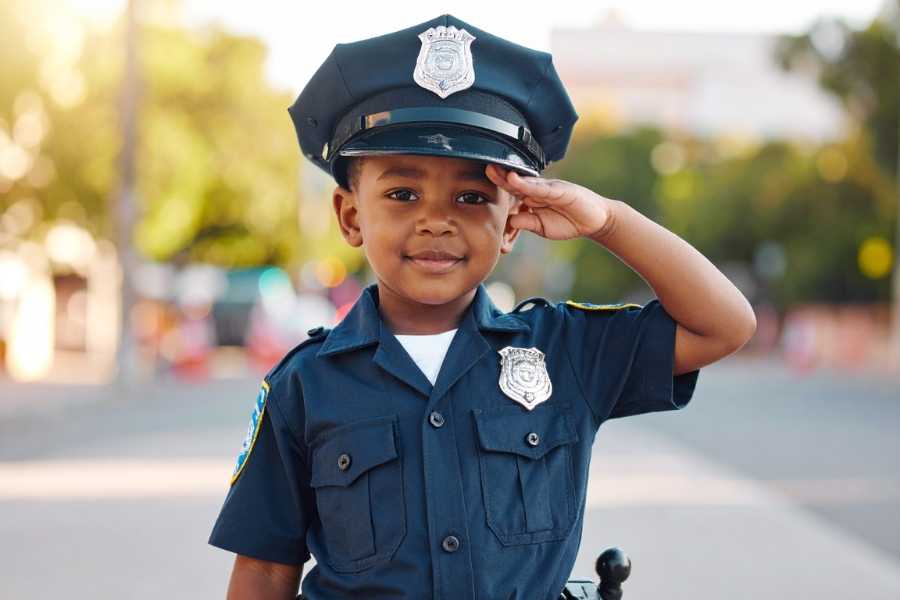
Twelve-year-old Devarjaye (DJ) Daniel (@devarjaye) is an honorary police officer with hundreds of agencies around the country and wears his uniform proudly. In a video that went viral, a group of teen girls were shown mocking him at a gas station for the way he was dressed. The footage captures the group demeaning Daniel while making mocking expressions, laughing, and making vile comments. They danced around him while he holds his face in his hands, which both DJ and his father called “disturbing,” and even yelled “Arrest us!” with complete disrespect.
DJ’s dad, Theodis, was talking to someone at the station when he saw what was going on. He stepped in to intervene, but the father and son chose a more educational response than an aggressive one.
Theodis recalled choosing not to act impulsively. “We are used to all the frantic behavior, so it wasn’t anything we aren’t accustomed to,” he told the Houston Chronicle.” Every time they see him in his uniform, he gets a lot of laughs; some of them may ridicule him and make jokes about him. A lot of times, he doesn’t want me to intervene; he’d rather just do it himself,” the dad noted.
DJ, too, chose a more mindful approach, not letting the bullying hurt his feelings. “Really and truly, I’m like a 40-year-old and I don’t have feelings like that,” he told Fox 26. In the video, he made no impulsive moves, choosing to remain calm and silent.
Instead, DJ responded by letting the teenagers learn his story. He became a cop to teach people to stand up for themselves and he did just that. DJ and his dad patiently explained to the girls DJ’s cancer diagnosis and his 13 surgeries that have caused his scars. By the time they left the gas station, the girls were treating DJ with respect and even calling him “Officer DJ.”
Theodis told the Houston Chronicle that he received a call from an unknown number after the video went viral and Houston community activist Candice Matthews shared DJ’s story on social media. The caller said they were involved in the video and wanted to apologize for their part in it.
It just goes to show how far a little kindness and education can go. Since the bullying incident, DJ has been honored by even more police precincts. He was invited to be an honorary member of the Secret Service by the president at a joint session of Congress and has been sworn in as an honorary member of other federal law enforcement agencies as well. While some have chosen to bully DJ and his father for political reasons, they father-son duo have continued to focus on DJ’s interest in police work and his ongoing cancer treatment.
As this young cancer warrior demonstrates, not letting bullies get to you and focusing on educating them instead of getting back at them can sometimes make a positive difference for everyone involved.
A single door can open up a world of endless possibilities. For homeowners, the front door of their house is a gateway to financial stability, job security, and better health. Yet for many, that door remains closed. Due to the rising costs of housing, 1 in 3 people around the world wake up without the security of safe, affordable housing.
Since 1976, Habitat for Humanity has made it their mission to unlock and open the door to opportunity for families everywhere, and their efforts have paid off in a big way. Through their work over the past 50 years, more than 65 million people have gained access to new or improved housing, and the movement continues to gain momentum. Since 2011 alone, Habitat for Humanity has expanded access to affordable housing by a hundredfold.
A world where everyone has access to a decent home is becoming a reality, but there’s still much to do. As they celebrate 50 years of building, Habitat for Humanity is inviting people of all backgrounds and talents to be part of what comes next through Let’s Open the Door, a global campaign that builds on this momentum and encourages people everywhere to help expand access to safe, affordable housing for those who need it most. Here’s how the foundation to a better world starts with housing, and how everyone can pitch in to make it happen.
Volunteers raise a wall for the framework of a new home during the first day of building at Habitat for Humanity’s 2025 Carter Work Project.
Globally, almost 3 billion people, including 1 in 6 U.S. families, struggle with high costs and other challenges related to housing. A crisis in itself, this also creates larger problems that affect families and communities in unexpected ways. People who lack affordable, stable housing are also more likely to experience financial hardship in other areas of their lives, since a larger share of their income often goes toward rent, utilities, and frequent moves. They are also more likely to experience health problems due to chronic stress or environmental factors, such as mold. Housing insecurity also goes hand-in-hand with unstable employment, since people may need to move further from their jobs or switch jobs altogether to offset the cost of housing.
Affordable homeownership creates a stable foundation for families to thrive, reducing stress and increasing the likelihood for good health and stable employment. Habitat for Humanity builds and repairs homes with individual families, but it also strengthens entire communities as well. The MicroBuild® Initiative, for example, strengthens communities by increasing access to loans for low-income families seeking to build or repair their homes. Habitat ReStore locations provide affordable appliances and building materials to local communities, in addition to creating job and volunteer opportunities that support neighborhood growth.
Marsha and her son pose for a photo while building their future home with Southern Crescent Habitat for Humanity in Georgia.
Everyone can play a part in the fight for housing equity and the pursuit of a better world. Over the past 50 years, Habitat for Humanity has become a leader in global housing thanks to an engaged network of volunteers—but you don’t need to be skilled with a hammer to make a meaningful impact. Building an equitable future means calling on a wide range of people and talents.
Here’s how you can get involved in the global housing movement:
Speaking up on social media about the growing housing crisis
Volunteering on a Habitat for Humanity build in your local community
Travel and build with Habitat in the U.S. or in one of 60+ countries where we work around the globe
Join the Let’s Open the Door movement and, when you donate, you can create your own personalized door
Every action, big and small, drives a global movement toward a better future. A safe home unlocks opportunity for families and communities alike, but it’s volunteers and other supporters, working together with a shared vision, who can open the door for everyone.
Nuns at the Convent of St. Anthony of Padua in Central Spain are on a mission beyond their spiritual calling: to save a rare breed of giant rabbit from extinction. The eleven Franciscan sisters are currently caring for 35 giant rabbits at the convent, which weigh up to 20 pounds each.
Sister Consuelo Peset Laudeña told Global Sisters Report that the rabbits hold historical significance in Spain. During the Spanish War, the rabbits were a crucial source of food for families and orphanages during food shortages.
“Many families have managed to get by thanks to this animal, and now it seems we are forgetting that part of our history,” she told the publication.
The journey to save giant rabbits
The sisters at the Convent of St. Anthony of Padua have worked to preserve the rabbits for over 30 years. But ten years ago, they learned the rabbits were going extinct.
“We contacted an association, I sent some photos, and they told me, ‘You have a spectacular animal, and it’s endangered,’” Peset explained.
Their focus shifted into helping the rabbits breed, so the sisters worked with local Spanish authorities to establish a farm. They raised $5,700 to initially invest in the farm.
Caring for the rabbits
The sisters are tasked with feeding, cleaning, and maintaining the rabbits and their quarters. The rabbits are fed a combination of barley, hay, and corn. At the end of March 2026, a total of 90 births were recorded.
“I do a visual check. I take a walk around and see which animals are listless or lethargic, and if any have died in the nests, they must be removed immediately,” Peset said.
The rabbits live in temperature-controlled cages with proper ventilation.
“Rabbits start to suffer at 26 degrees [Celsius; which is about 79 degrees Fahrenheit]; they tolerate the cold well, but not the heat,” Peset also added.
The nuns feel called to protect the rabbits thanks to a encyclical given by Pope Francis titled Laudato Si’ in 2015. In that message, he called Catholics to care for nature and the environment.
“We have to protect creation,” she said. “We are Franciscans. St. Francis is the patron saint of veterinarians, and that is the source of the love and admiration we feel for the Spanish giant rabbit.”
What are Spanish giant rabbits?
Spanish Giant Rabbits are a cross between the Flemish Giant and Spanish brown-type female rabbits. The rabbits weight up to 20 pounds, and each female rabbit can give birth to 22 pups each month.
According to Farm Show Magazine in 2014, the rabbits are comparable in size to a small lamb. They were first bred in the early 1900s.
The giant rabbits are not for sale. To further conservation efforts, the sisters have chosen to donate the rabbits to local schools, a nearby theme park, and to registered private rabbit breeders.
There are many reasons people love giving their pets goofy names. A big one is that, unlike humans, they’ll never have to put it on top of a résumé, so we’re free to call them whatever we desire. Humans also give their pets adorable names because of anthropomorphism. When we give our pets human traits, they become more relatable.
Giving our pets a truly unique name also makes us feel more attached to them. Research shows that when we give them a name we won’t hear anywhere else, they feel more personal to us, strengthening the bond. It’s the same reason why we give our loved ones nicknames.
Every year, the Nationwide pet insurance team recognizes the boldest and most unforgettable names among its roster of newly enrolled pets. This year, after over 200,000 votes were counted, the team recognized 10 cats with the wackiest names, and the winner was Cheddar Big Booty Cheeseburger from Benton, Arkansas. Cheddar Big Booty Cheeseburger is hard to beat, but the nine runner-ups have pretty amazing names, too.
2026 winner: Cheddar Big Booty Cheeseburger
“He was one of two orange kittens in a litter of a stray I took in,” said cat mom Chantalece C. “This tiny little kitten grew into a sturdy unit of a cat, so when I would grab him, it was like picking up a triple-stacked cheeseburger.”
Cheddar Cheeseburger is a wacky name in its own right, but she decided to add another quirky twist. “He really loves booty spankings too, so he deserved a big booty title,” she added. Thus, Cheddar Big Booty Cheeseburger.
Small kitties often have the biggest purr-sonalities. Sometimes, that means snuggling, funny sounds, or smiley faces. Sometimes, that means, well, destruction. “If you met this lil’ monster, you would understand,” said cat dad D. D., on naming his frisky feline Bad Kitty 5000.
“We rescued him from inside a car engine,” said cat mom Carly M. “He was small and so scared, we just kept trying to encourage him to be brave and kept telling him he was ‘such a brave little toaster.’ And it stuck. We call him B.L.T. for short!”
Looking for the right recipe for their new wacky pet, cat mom Yan L. and her boyfriend took inspiration from a rat—specifically the furry little chef from an animated classic. The result? A Michelin-star-quality pet name that’s also a little wacky. “I love the movie ‘Ratatouille,’” she said. “My cat is a grey tabby, which is a little like the rat in the movie. And he is a cat, so voila, Catatouille.”
“My girlfriend is a fan of American Dad,” said cat dad Nick R. “There’s a very niche character present in season 13—he’s only mentioned by name and never appears on screen.” Later, when a small orange kitten was discovered falling out of an engine bay, the couple knew they’d found the “embodiment of Goofus McDoof Business Horse.”
“Cats are kind of demonic, but in a fun, charming way,” said cat mom Margot. “We love a good pun and were originally planning to name one cat ‘Lucipurr’ and the other ‘Meowzebub.’ Once we brought our kittens home, it became immediately clear that this orange menace needed both names. Thus, Lucipurr Meowzebub, Lord of Cats.”
Lucipurr Meowzebub, Lord of Cats. Photo credit: Nationwide (used with permission)
Miso Tunacanopolis The First
“Miso is his original name,” said cat mom Phuong N. “The ‘Tunacanopolis’ part is just a funny name I’ve always wanted to use. ‘The First’ alludes to the fact that Miso is my first cat, but also because Miso is the best cat in my admittedly very biased eyes.”
“She was such a cute little munchkin when I got her at 3 months old, but ‘Munchkin’ was too much of a mouthful, so it quickly got reduced to Munchie,” said cat mom Morgan S. “From the moment I got her, she purred like an engine every time she snuggles up—and she does love snuggling very, very much—so, to capture her loud, reliable purr, I added McPurryToes as her last name.”
“We have always liked weird pet names,” said cat dad Steven S. “When we first got Jules, I would call him ‘Orange.’ I thought of names I could keep Orange in—it started off as Orange Julius, then evolved to Orange Julius Ceasar Salad.”
“I’m a biologist, so the term ‘significantly significant’ is used a lot, and I always thought it would be cute for a cat name,” cat mom Renee G. said. “So, when I adopted her, it was the first option on my list.”
The office potluck was a success! People went back for seconds; someone joked about licking the pan (and actually got a few laughs). And now you find yourself in the kitchen, alone with your overeager coworker, her phone already out and eyes bright with a burgeoning question.
She means it with her whole heart. She loved it and probably wants to make it for her family on Christmas Eve, or on the first cold night that feels like an excuse to stick something in the oven for hours. The warmth in her voice is so real.
And so is the tiny knot in your stomach. This recipe means something to you—it was passed down from your grandma, you got it from an esoteric cookbook online, or you invented it yourself—and right now, you don’t want to share it.
Here’s the truth: keeping a recipe to yourself isn’t rude. It’s not selfish or petty, nor is it a power move. You know how to share. But more importantly, you know when not to.
When it comes to family recipes—or any recipes, for that matter—there are countless ways to protect your peace.
Let’s get into it.
More than a recipe
Think about a specific spice: how does it smell? Where does it show up in your memory? Maybe it’s cardamom in December, folded into the sweet, enriched dough of Swedish Christmas braids, or dried chiles toasting in a pan.
That act of remembering is powerful and all-encompassing. It represents many things: a place, a person, an era of your life. Food scholars argue that this is exactly what recipes are built to do: carry culture in the body through smell, muscle memory, and repetition. Recipes live within us, not only on the page.
New York University food scholar Krishnendu Ray has observed that, for most of human history, food knowledge was traditionally passed down in close physical proximity (e.g., grandmother to grandchild). And it’s this intimacy—a shared moment between two people—that gives a recipe its meaning, just as much as its ingredients.
“Caregiving comes at a cost. Whenever there is a labor of love, there is also a labor of resentment.” – Krishnendu Ray
This is why sociologists describe family recipes as a form of cultural capital, a resource tied to identity, memory, and belonging. To hold that recipe is to hold a piece of a transmission chain: an artifact of care, repetition, and survival.
Cooking it for someone else adds another layer of complexity. The French sociologist Marcel Mauss argued that a gift is never just a gift; it creates an ongoing bond between giver and receiver. A dish cooked for others already works that way. When someone asks for the recipe on top of that, they’re asking for the gift to be extended: not just the meal, but the means to carry it forward. That’s a meaningful escalation, even when it’s asked warmly, which is exactly why your coworker’s question, however kind, however well-meant, can land as so much more than a simple request.
How to say “no” and still be kind about it
Here’s something etiquette experts agree on: the problem is almost never the “no.” A refusal delivered with warmth, gratitude, and a clear boundary is never rude. In some cases, it’s the kindest thing you can offer because it’s honest.
The following strategies offer five different ways to refuse requests for family recipes with grace.
Start with real gratitude
The ask is a compliment: someone loved what you made so much that they now want it on their own table, with their own people. That’s beautiful. Honor that.
A simple script:
“I’m so glad you liked it! That means a lot to me. But the recipe is a family tradition I keep private.”
Full stop. No nervous laugh, no extra spiral of “I’m so weird, sorry.” Warm, clear, closed.
You don’t owe anyone a backstory. But if you want to offer one, a single concrete line can make it clear that the “no” revolves around what the recipe means to you, not your opinion of the other person.
For example:
“My aunt spent years perfecting this and made us promise to keep it in the family.”
“It’s one of the few things we have left from my grandmother’s kitchen. Keeping it private helps me feel close to her.”
People can sit with disappointment and still respect a story. The key is brevity: you’re offering context, not building a legal case.
Share the “vibe,” not the blueprint
Sometimes, they don’t even want the recipe, but they are looking for cooking tips. In those cases, you can share little snippets without handing over the entire thing: a key ingredient, a basic technique, or how you approach spices.
For example:
“I don’t share the full recipe, but I can tell you the essentials. It starts with sautéed garlic, and the real magic is how low and slow you go.”
You’re not giving away the recipe. You are simply pointing in the right direction and letting them explore on their own.
Instead of sharing the recipe, forge connection in other ways. Photo credit: Canva
Offer a different kind of “yes”
If you feel comfortable, find a different way to connect. You can invite them into the process instead:
“I can’t give you the recipe, but I’d love to make it together sometime.”
“I don’t share this one, but I’ll bring it to every potluck we have. Consider me your short rib supplier.”
Those lines tend to land well because they’re both generous and specific. The boundary stays intact, and the relationship feels even warmer.
Stay gentle, even if they keep asking
Some people will circle back. Not because they’re trying to bulldoze you, but because they really want to know how to make that dish.
It’s natural to want to come up with new reasons each time, but that can sound like negotiating, which invites even more pushing.
“Still keeping that one close, I’m afraid. But truly, I appreciate you asking.”
“You’re persistent! Thank you, I’ll take it as a compliment. But the answer’s still no.”
Said with a real smile, that’s a firmly closed door.
Some things were never meant to be shared
Keeping your cherished family recipe private isn’t selfish. This is what it looks like when food, memories, and shared history travel between people who love each other.
And a quick note to the person who was told no: this was almost certainly never about you. It’s lovely that you asked, but don’t take it personally. There’s something much older than this conversation at play, something that existed long before you tried that dish and will exist long after.
What matters is that the ask was kind, and the “no” was kind. Neither of you did anything wrong. Besides, the goal was never really the recipe. It was to stay close to the person who made it.
One generation’s texting habit that baffles every generation is the Boomers‘ seemingly excessive use of ellipses. Do you have more to say, Aunt Judy, or did you just accidentally press the period key too many times? Maybe it’s for a dramatic pause or to put emphasis on a point? This is truly a mystery that leaves every generation below them confused about what is meant by the dreaded “dot dot dot.”
Texting etiquette differs with every generation. Gen X and most Millennials use fairly proper grammar and punctuation throughout a text message exchange. Every new sentence starts with a capital letter, there are strategically placed Oxford commas to ensure there’s little room for misunderstandings, and sentences end with an appropriate punctuation mark.
How each generation texts differently
When it comes to Gen Z, they find that ending text messages with proper punctuation indicates that the person they’re texting is being passive-aggressive. They also text in shorthand and emojis that can feel a bit like you need a special decoder ring to decipher the messages. But texting in an encrypted way can be chalked up to youth, though the same can’t be said when it comes to Boomers. Or can it?
Harvard linguist and author of the New York Times bestseller Algospeak, Adam Aleksic, breaks down why so many Boomers use ellipses when texting. It’s surprisingly not as complicated or dramatic as one may imagine. In a viral 2024 TikTok video, Aleksic explains his theory for the texting etiquette of Boomers.
“You know how older people tend to use the ‘Boomer ellipses’ whenever they’re texting? There’s always a random ‘dot dot dot’ in the middle of their messages?” Aleksic asks. “Well, that’s because they grew up following different rules for informal communication. Nowadays, if you want to separate an idea, you just press enter and start a new line with a new thought, but it made less sense to do that for writing postcards or letters, where you had to save space, so people back in the day learned to separate thoughts by using ellipses.”
The pay-per-text era that changed everything
Aleksic explains that this is also true for when phones first started allowing text messaging. You were charged by the message, so ellipses made it more efficient to convey all the thoughts in one message instead of multiple ones. SMS texting also had a character limit, unlike current phones, where you can essentially write a novella in a single message without your phone automatically breaking it up.
Today’s texting standards typically mean people separate their thoughts by sending multiple messages for separate thoughts, though that annoys some people. If separating thoughts means you’ll be sending no less than five texts in quick succession, it’s likely best to just space down to make the text longer, rather than bombarding an unsuspecting friend.
Why the boomer ellipsis causes so much confusion
When it comes down to it, younger generations have adapted to the new standard, embracing the unlimited text option, while Boomers haven’t. Due to this discrepancy in text etiquette, the ellipses used by Boomers throw people for a loop.
“That means the Boomer ellipses became redundant, which is why they cause confusion today. They violate what we call ‘the maximum quantity;’ they add more information than necessary, so they appear to imply something more than the intended meaning. Most of the time, that comes off to younger people as hesitation, annoyance, or passive aggressiveness because that’s how we use the ellipses,” the linguist shares.
So, no, your grandma isn’t mad at you or avoiding telling you something; according to Aleksic, she’s just trying to send you multiple messages in one. There’s no hidden emotion behind the ellipses for Boomers; it’s simply a habit left over from their younger years.
This article originally appeared one year ago. It has been updated.
America is definitely not afraid to do its own thing, even when its own thing is pretty weird. Ever stop to think how bizarre it is that the United States is one of the only countries to not use the metric system? Or how it uses the word “football” to describe a sport that, unlike fútbol, barely uses the feet at all?
What must our forefathers have been thinking as they were creating this brave new world? Wonder no further. All this and more is explored in a Saturday Night Live sketch that folks are hailing as an “instant classic.”
Why the sketch went viral
The hilarious clip takes place during the American Revolution, where George Washington rallies his troops with an impassioned speech about his future hopes for their fledgling country…all the while poking fun at America’s nonsensical measurements and language rules.
Like seriously, liters and milliliters for soda, wine and alcohol but gallons, pints, and quarts for milk and paint? And no “u” after “o” in words like “armor” and “color” but “glamour” is okay?
The inherent humor in the scene is only amplified by comedian and host Nate Bargatze’s understated, deadpan delivery of Washington. Bargatze had quite a few hits during his hosting stint, including an opening monologue that acted as a mini comedy set, but this performance takes the cake.
The fans love it
All in all, people have been applauding the sketch, noting that it harkened back to what “SNL” does best, having fun with the simple things.
“This skit is an instant classic. I think people will be referencing it as one of the all time best SNL skits for years.”
“Dear SNL, whoever wrote this sketch, PLEASE let them write many many MANY more!”
“Instantly one of my favorite SNL sketches of all time!!!”
“I’m not lying when I say I have watched this sketch about 10 times and laughed just as hard every time.”
“This may be my favorite sketch ever. This is absolutely brilliant.”
The sketch was so popular, they did another one when Nate Bargatze returned to SNL in October of 2024, and it’s every bit as hilarious as the first one. Again, the comedy focused on the idiosyncrasies of America, including our names for animal food products, the way we count grades in school, and the design of our currency.
“A real American would never want to know what’s in a hot dog, just as they will never know why our money is called the ‘dollar’…” says Bargatze as Washington. “And if you think I’m worthy, put my portrait on the front of it.”
“And what shall be on the back, sir?” asks Kenan Thompson’s character.
“Everything, all of it,” Washington replies. “Crazy stuff, squiggles, Latin words, a pyramid with a floating eye on top.”
Behind the scenes of an SNL classic
The sketches became so popular, people wanted to know more about how the idea for them came about and what the process of creating the original sketch was like. Jesse David Fox, the host of Good One: A Podcast About Jokes,sat down with Bargatze and SNL writers Mikey Day and Streeter Seidell to talk about the origins of the sketch and what it was like to co-create it in the week leading up to the live show. It’s a fascinating insight into the SNL writing process, which is largely done within that week.
According to Day and Seidell, Seidell had actually written a near-complete draft of the sketch the prior season, originally envisioned for a dramatic actor. It had been sitting unfinished on his computer until Bargatze was tapped to host. Bargatze was on board with playing Washington, but apparently, the sketch landed flat at the table read earlier in the week and was placed dead last in the dress rehearsal lineup. But Bargatze said he really liked the sketch, and once he was in costume and in front of a live audience for dress rehearsal, everything came together to make the magic of a classic SNL bit.
Bargatze has become one of the biggest names in stand-up comedy, known for his clean, family-friendly routines. He was the highest-grossing touring comedian in the world in 2024. You can catch even more of Bargatze’s “SNL” episodes here and here.
This article originally appeared three years ago. It has been updated.
Ten months after a man’s wife passed away, he finally got the courage to read a letter she left him, which contained a devastating admission. The son they had together may not be his.
“My ‘darling’ wife passed away 10 months ago,” the man wrote on Reddit’s Off My Chest forum. “She wrote a letter for me before she died, but I couldn’t bring myself to read it until now. She told me how sorry she was that she didn’t have the guts to tell me this to my face when she was alive.”
A letter that changed everything
In the letter, the wife revealed that there was a “good chance” that the son he thought was his wasn’t his biological child. A few weeks before their wedding day, the wife got drunk at her bachelorette party and had a one-night stand with another man. Soon after that night, she became pregnant but was unsure who the father was.
The man was torn whether or not to have the paternity test done. The child had only one parent in this world, and he would have to take care of him regardless. He also thought it was cowardly that his former wife would wait until she was no longer around to share the truth with him.
“So she thought she’d rather drop this bomb on my life when I could no longer confront her about it,” the man wrote. “Now that my son would only have one parent looking out for him, and she’d have no idea how I would even react. Maybe I should not have got the paternity test done. Maybe it might be better to live in ignorance. But I just had to know.”
The paternity test result
The man took the paternity test and learned he wasn’t the child’s biological father.
“I’m devastated. This doesn’t change how I feel about my son,” he wrote. “He’s my whole world and he’s innocent. But boy, does it hurt. There’s so much going on in my head right now. I haven’t stopped crying. Thank god my son is at my parents’ place for the day. I’d hate for him to see me like this.”
Facing a pain nearly too much for him to bear, the only outlet he had at the moment was reaching out to Reddit to find some solace. “I just needed to let this all out. Don’t have it in me to tell anyone in my life about this right now,” he wrote.
The commenters sent him hundreds of messages of support to get him through the shock of first learning the truth about his family.
“All your feelings are valid, a lot of people will react with some kind of toxic positivity to things like these. Your feelings are valid. Each and everyone,” – femunndsmarka
“He is going to find out the truth one day. Imagine how much more he will love you knowing you didn’t leave him, even though he wasn’t yours.” – ImNotGoodatThis6969
“As an adopted child, I just want to thank you on behalf of your son. I deeply believe it changes nothing, family is not about blood, its about who you love, want to have by your side, and care for the most. Sending hugs, strength and gratitude.” – Mariuuq
The father at the heart of this story is understandably devastated because his life was upended almost overnight. But the hope in the story is that his trials also taught him a powerful truth: his love for his son goes much deeper than blood.
This article originally appeared three years ago. It has been updated.
Photo credit: Photo by Darwin Vegher on Unsplash – With one turn of the wheel, my dad taught me a lesson about self-care in high school that I'll never forget.
When I was in high school, I woke up one morning feeling overwhelmed. I was an honors student, I was involved in various activities and clubs, and for whatever reason, I felt thoroughly unprepared for the day. I don’t recall if I had a test or a presentation or if it was just a normal school day that I couldn’t face. I just remember feeling like I’d hit a wall and couldn’t make my mental gears turn right.
I usually walked the mile and a half to school, but I was running late so my dad offered to drive me. In the car, I tried to keep it together, but halfway to school, the tears started to fall. My dad looked over and asked if I was OK.
“I don’t know,” I sobbed. “I feel like … I just … I need a day.”
He knew I wasn’t sick. He could have told me to tough it out. He could have given me a pep talk. He could have forced me to go. But he didn’t do any of those things.
With zero hesitation, and just a simple “OK,” he turned the car around and took me home.
I have no memory of what I did the rest of that day. Three decades later, the only thing that sticks out is the basic-but-profound lesson my dad instilled in me the moment he turned that steering wheel: It‘s totally OK to take care of yourself.
We talked about it briefly on the way home. As it turned out, he was also taking a “mental health day.” My dad was a social worker and, as an adult, I can totally understand why he would need to take a random day off sometimes. But it didn’t really matter what he did for a living. Most of us need an occasional mental health day: adults, teens, and kids alike.
Why more schools are officially recognizing mental health days
Some schools have begun incorporating this understanding into their school attendance policies. Utah was among the first states to allow a mental health day to count as an excused absence from school. Oregon followed in 2019, and today a total of 12 states have enacted similar laws, including Arizona, California, Colorado, Connecticut, Illinois, Kentucky, Maine, Nevada, Virginia, and Washington. Education Week and other outlets have tracked the growing list of states that allow student mental health days or have proposed bills to expand access.
“Mental health days are not only good for the practical aspect of giving young people a break,” psychologist Caroline Clauss-Ehlers, Ph.D., told Healthline, “but they also validate that the community and society are saying, ‘We understand and we’re supporting you in this way.’”
Occupational therapist Shelli Dry concurs, telling Healthline that acceptance of mental health days can help eliminate the stigma that often comes with mental illness.
“For schools to recognize that sometimes it’s better to take a mental health day than push through when you cannot seem to cope, is a tremendous support for students to feel understood and accepted, and [this, in turn, encourages] students to understand and accept themselves more,” she said.
Kids are carrying more than we realize
Sometimes we forget how hard it is being a kid. In some ways, I think it’s way harder than being an adult. Considering the fact that nearly 1 in 5 children between the ages of three and 17 have been diagnosed with a mental, emotional, or behavioral health condition, according to the CDC, we need to acknowledge that a lot of kids have days where they’re struggling. But even kids who don’t deal with mental illness sometimes need a down day. Modern life is busy and complex, no matter our age. Keeping up with daily life while handling whatever extra stuff gets thrown our way is no small thing.
Part of good parenting is teaching kids to persevere through challenges, but encouraging perseverance has to be balanced with insight and wisdom. Sometimes kids might cry wolf, but it’s important for parents to understand that kids might be dealing with more than we know. Sometimes kids need to be encouraged to dig deep for resilience. Sometimes kids have already been resilient for a long time and need a little time and space to just be.
My dad knew me. He understood that I wasn’t just being lazy or trying to get out of doing something hard. He trusted me to know what I needed, which in turn taught me to listen to my inner alarm and trust myself. As a result, I’ve spent my adult life with a good sense of when I need to push through and when I need to pause and reset. It’s a gift I’m immensely grateful for.
A word of caution for parents
All of that said, this advice does come with a caveat. As a parent of kids who are learning to manage anxiety, mental health days can be a mixed bag. There’s a difference between taking a mental health day because you really need it, which happens, and taking a mental health day to avoid facing fears, which also happens. Avoidance feels good in the moment but fuels anxiety in the long run, so parents and kids have to be aware of how the idea can be misused and unintentionally make certain mental health issues worse.
A dad walking his kid to school. Photo credit: Canva
The bottom line, however, is that kids need breaks sometimes. And when you allow them to take an occasional day here and there to breathe, to do some self-care, to reconnect with themselves and reset their mental and emotional barometer, you teach them that their well-being matters. You teach them that it’s OK to acknowledge when they’ve hit a limit and pause to recoup their strength.
It’s OK to turn the car around when you know you need to. That’s a lesson we all need to learn, and one we need to support with work and school policies in addition to internalizing individually. We’re making some good strides toward that goal, and the sooner we all get on the same page, the better everyone’s well-being will be.
To learn more about how to help kids and teens with their mental health and self-care practices, The Kids Mental Health Foundation has tons of resources for parents, caregivers, teachers, coaches, and more.
This article originally appeared four years ago. It has been updated.
“The word fact-checking itself has become politicized,” Cambridge University researcher Jon Roozenbeek said, according to the Associated Press. Further, studies show that when people have incorrect beliefs challenged by facts, it makes them cling to their false assumptions even harder. These platforms have also attempted to remove posts containing misinformation that violates their terms of service, but this form of content moderation is often seen as insufficient and is often applied inconsistently.
So what actually works against misinformation?
How do we combat dangerous misinformation online if removing false claims or debunking them hasn’t been effective enough? A 2022 study published in the journal Science Advances by a team of university researchers and Jigsaw, a division of Google, found a relatively simple solution to the problem they call “pre-bunking.”
Pre-bunking is an easy way of inoculating people against misinformation by teaching them some basic critical thinking skills. The strategy is based on inoculation theory, a communication theory that suggests one can build resistance to persuasion by exposing people to arguments against their beliefs beforehand.
With false claims, debunking is less effective than prebunking.
25 studies: rebuttals and fact checks don't do much to change minds. We're better off training people to spot flaws in logic and data.
The researchers learned that pre-bunking was effective after conducting a study on nearly 30,000 participants on YouTube.
“Across seven high-powered preregistered studies including a field experiment on YouTube, with a total of nearly 30,000 participants, we find that watching short inoculation videos improves people’s ability to identify manipulation techniques commonly used in online misinformation, both in a laboratory setting and in a real-world environment where exposure to misinformation is common,” the recently published findings note.
The researchers uploaded videos into YouTube ad slots that discussed different types of manipulative communication used to spread false information such as ad hominem attacks, false dichotomies, scapegoating and incoherence.
Here’s an example of a video about false dichotomies.
Short videos with surprisingly big results
Researchers found that after people watched the short videos, they were significantly better at distinguishing false information than they were before. the study was so successful that Jigsaw rolled out a prebunking campaign about scapegoating in Poland, the Czech Republic and Slovakia. Since that initial campaign, prebunking’s reach has only grown. These countries are all combating a significant amount of false information about Ukrainian refugees.
Before the 2024 EU Elections, a Jigsaw-supported campaign reached more than 120 million YouTube users across 12 countries, with studies confirming the approach improved viewers’ ability to spot manipulation tactics.
Many people talk about “critical thinking,” but a lot of people don’t really understand what the term means. Learning about the tropes and techniques used to spread misinformation is a vital part of developing critical thinking skills. It’s not just about thinking for yourself and determining what’s true based on what your brain tells you; it’s about recognizing when messaging is being used to manipulate your brain to tell you certain things. It’s learning about logical fallacies and how they work. It’s acknowledging that we all have biases that can be preyed upon and learning how propaganda techniques are designed to do just that.
Teaching the skill beats playing whack-a-mole
There’s an old saying, “If you give a man a fish, he’ll eat for a day. Teach that man to fish and he’ll eat forever.” Pre-bunking does something very similar. We can either play a game of whack-a-mole where social media platforms have to suss out misinformation on a minute-by-minute basis or we can improve the general public’s ability to distinguish misinformation and avoid it themselves.