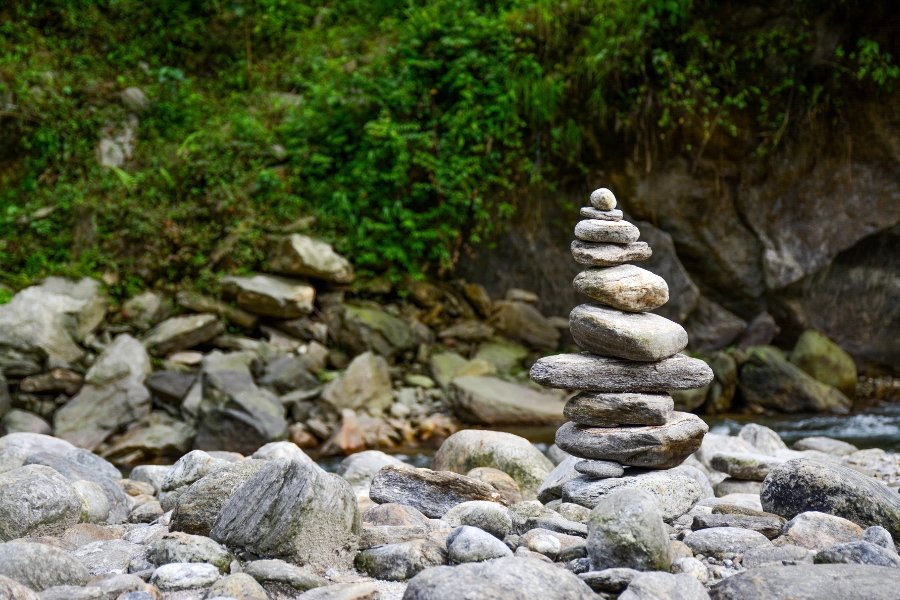
How rock cairns became a weird wilderness battleground
And why we should resist the urge to build—or topple—the ubiquitous rock towers.

Rock cairns are everywhere, but they're not as harmless as they look.
For the past several years, largely thanks to Instagram culture, rock cairns—those carefully balanced towers of rocks that look like something straight out of a Zen garden—have become ubiquitous across the natural landscape. It's not terribly surprising, really. There's something satisfyingly primitive about balancing rocks on top of one another, and the urge to create art and order out of the wildness of nature is a decidedly human instinct. Plus, they just look cool.
But according to environmental experts, that's not a good enough reason to make them.
Rock cairns have become a wilderness battleground of sorts, with people loving to make them but many places making it illegal to erect them in natural areas. Even the freedom-loving state of Texas, where you can basically build a tower of guns as high as you want, has made building rock towers illegal in its state parks.
Why? As it turns out, stacking rocks isn't as harmless as it may seem.
While no one is really worried about hurting rocks themselves, non-living as they are, there are entire ecosystems living under rocks that get disturbed when people build cairns. Rocks around waterways are particularly important for wildlife, as insects, fish, crustaeans and other animals lay eggs or make their homes under them. Even the algae that forms under and around rocks is an important part of river ecosystems, and when people pick up rocks to pile into a cairn, all of that gets disturbed or destroyed.
What about if you're stacking rocks nowhere near a river? Well, in mountainous areas, rocks also help prevent erosion. An increase in erosion can increase pollution, decrease soil fertility and lead to more runoff, which can impact waterways and ecosystems down the line.
You may be thinking, "Yeah, but there are millions of rocks. Surely moving a few to make a cool, meditative rock cairn isn't going to destroy the environment." What it really boils down to is the "leave no trace" idea of protecting our natural areas. One person's actions might have a minimal impact in the grand scheme of things, but what if everyone did it? Additionally, moving rocks from the wrong place can lead to rock and mudslides, which directly endangers humans as well.
The other problem with building rock cairns in random places is that real, official ones in specific places serve an important purpose. When built by authorities like park rangers, they are used to delineate a hiking path. Cairns, when purposefully placed by people who know the whys and hows and wheres of creating them, keep hikers safe by orienting them to official trails.
That's one reason why, despite the righteous urge to do so, people shouldn't topple cairns built by others, either. Yosemite National Park recently shared a video of a ranger knocking over a huge cairn and seemingly encouraged people to do the same, but in some places, cairns have been placed purposefully by park rangers. A cairn in the middle of a river? Not likely a trail marker. But out in the woods? Probably best to leave the toppling of those ones to the experts.
It may seem like people who rail against cairn-making are just grumpy buzzkills making a mountain out of a molehill—or a rock pile, in this case. But protecting the environment involves all of us taking actions both large and small. As the saying goes, when we know better, we do better, and experts have been asking people to refrain from moving rocks out of their natural places to protect the natural environment.
If you want to build a cairn in your own yard with landscaping rocks, go ahead and balance those stacks to your heart's content. But out in the wilderness and in protected park lands, leave the rocks where they are, knowing that you're helping keep the Earth itself in balance for all of her creatures.

- New research shows that children who grow up near nature become happier adults ›
- New study shows that allowing cats outdoors is bad for their health and the environment ›
- A resourceful nonverbal teen lost in the woods is rescued after clinking rocks together ›
- Orson Welles narrates cartoon about how racism and greed will end America - Upworthy ›


A woman is getting angry at her coworker.via
A man with tape over his mouth.via
A husband is angry with his wife. via 
a man sitting at a desk with his head on his arms Photo by
Can a warm cup of tea help you sleep better? If you believe it, then yes. Photo by 
Three women sit on a blanket in the park. 
Two women engaging in a pleasant conversation inside a coffee shop
Two men engaging in a peaceful disagreement.
Resurfaced video of French skier's groin incident has people giving the announcer a gold medal
"The boys took a beating on that one."
A good commentator can make all the difference when watching sports, even when an event goes smoothly. But it's when something goes wrong that great announcers rise to the top, and there's no better example of a great announcer in a surprise moment than when French skier Yannick Bertrand took a gate to the groin in a 2007 super-G race.
Competitive skiers fly down runs at incredible speeds, often exceeding 60 mph. Hitting something hard at that speed would definitely hurt, but hitting something hard with a particularly sensitive part of your body would be excruciating. So when Bertrand slammed right into a gate family-jewels-first, his high-pitched scream was unsurprising. What was surprising was the perfect commentary that immediately followed.
This is a clip you really just have to see and hear to fully appreciate:
- YouTube youtu.be
It's unclear who the announcer is, even after multiple Google inquiries, which is unfortunate because that gentleman deserves a medal. The commentary gets better with each repeated viewing, with highlights like:
"The gate the groin for Yannick Bertrand, and you could hear it. And if you're a man, you could feel it."
"Oh, the Frenchman. Oh-ho, monsieurrrrrr."
"The boys took a beating on that one."
"That guy needs a hug."
"Those are the moments that change your life if you're a man, I tell you what."
"When you crash through a gate, when you do it at high rate of speed, it's gonna hurt and it's going to leave a mark in most cases. And in this particular case, not the area where you want to leave a mark."
Imagine watching a man take a hit to the privates at 60 mph and having to make impromptu commentary, straddling the line between professionalism and acknowledging the universally understood reality of what just happened. There are certain things you can't say on network television that you might feel compelled to say. There's a visceral element to this scenario that could easily be taken too far in the commentary, and the inherent humor element could be seen as insenstive and offensive if not handled just right.
The announcer nailed it. 10/10. No notes.
The clip frequently resurfaces during the Winter Olympic Games, though the incident didn't happen during an Olympic event. Yannick Bertrand was competing at the FIS World Cup super-G race in Kvitfjell, Norway in 2007, when the unfortunate accident occurred. Bertrand had competed at the Turin Olympics the year before, however, coming in 24th in the downhill and super-G events.
As painful as the gate to the groin clearly as, Bertrand did not appear to suffer any damage that kept him from the sport. In fact, he continued competing in international downhill and super-G races until 2014.
Alpine skiing is a notoriously dangerous sport, with a reported injury rate of 36.7 per 100 World Cup athletes per season, according to a 2018 study. Of course, it's the knees and not the coin purse that are the most common casualty of ski racing, which we saw clearly in U.S. skiier Lindsey Vonn's harrowing experiences at the 2026 Olympics. Vonn was competing with a torn ACL and ended up being helicoptered off of the mountain after an ugly crash that did additional damage to her legs, requiring multiple surgeries (though what caused the crash was reportedly unrelated to her ACL tear). Still, she says she has no regrets.
As Bertrand's return to the slopes shows, the risk of injury doesn't stop those who live for the thrill of victory, even when the agony of defeat hits them right in the rocks.