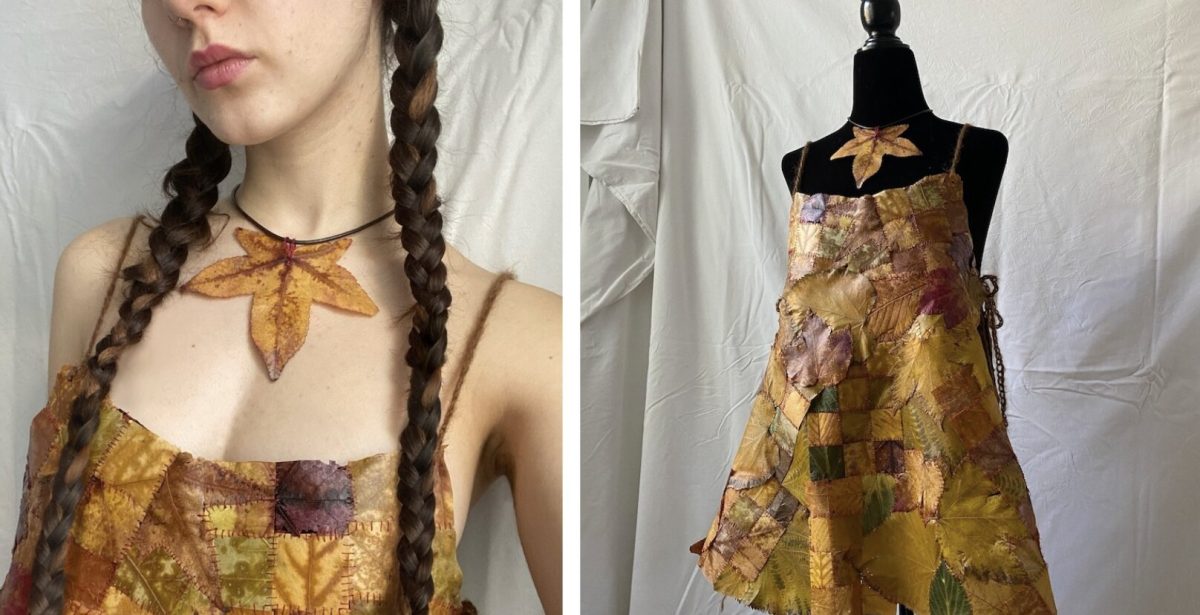
Making quality dresses takes an enormous amount of skill. It’s not just about sewing and tailoring, but also about design—knowing which fabrics and colors pop and draw the eye. At their best, dresses bring art and beauty to fashion. But for a fine arts student living in Spain, making a dress incorporated all of those skills, along with a touch of nature.
Artist Amanda Meyer successfully sewed a beautiful dress from a variety of hand-picked autumn leaves in vibrant shades of orange, red, and yellow. She then soaked the leaves in glycerin to help preserve them. After drying them with an iron, the leaves became sturdier and easier to manipulate. Meyer cut and sewed the leaves together into a gorgeous patchwork mini dress.
“I wanted to see if it was possible to create a fully organic garment without using the usual materials such as cotton or linen,” Meyer told My Modern Met. “As a young person deeply committed to the environment, my practice focuses on using only recycled and natural resources. I specialize in textile art, creating sculptures and sculpt-like garments.”
Natural fibers of a different kind
It took Meyer around 100 meters of thread and 40 hours of hand sewing to create her leaf dress. While the dress remains fragile and is intended for exhibition, it is also a wearable and successful clothing experiment. However, it was never meant to last.
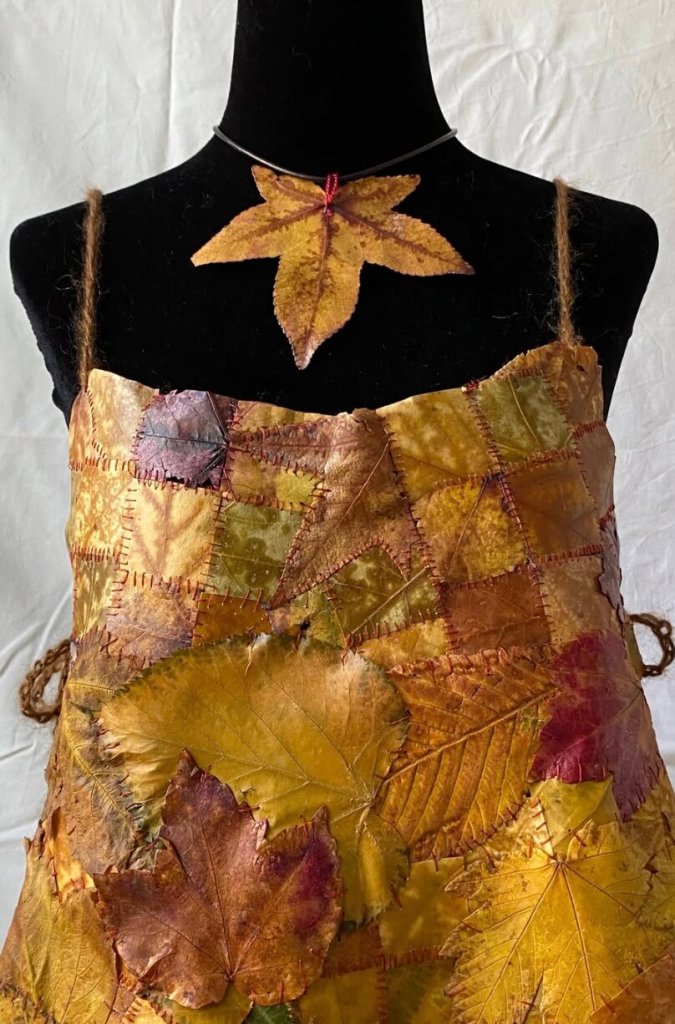
“Many people have asked me if I intend to preserve it,” said Meyer. “The answer is no, I want to see how it passes the test of time. Clothes aren’t meant to last forever.”
The environmental problem of modern fashion
The mixed-media artist draws attention to the troubling fast-fashion industry. Fast fashion offers convenience and style, but it also contributes to environmental issues. According to Boston University, the United States throws out 34 billion pounds of used textiles each year. The lion’s share of them are made from synthetic fibers, which take much longer to decompose than natural ones like cotton.
Fast fashion production also generates more carbon emissions than international flights, according to Business Insider. In the end, it contributes to piles of long-lasting clothing in landfills and increasing levels of air pollution.
Meyer’s artwork and similar movements show how the life cycles of items can be repurposed, whether for creative expression or practical use. An old garment can be transformed into crafts, toys, rugs, or even cleaning rags. If leaves can be used to create beautiful art, a discarded T-shirt can become something more, too.