upworthy
Add Upworthy to your Google News feed.
Google News Button
Pop Culture

Disney cast members shocked to see 'Walt in the park' at Disneyland 56 years after his death

There's an inspiring reason why he dresses as Uncle Walt.

walt disney, disneyland, disney cosplay

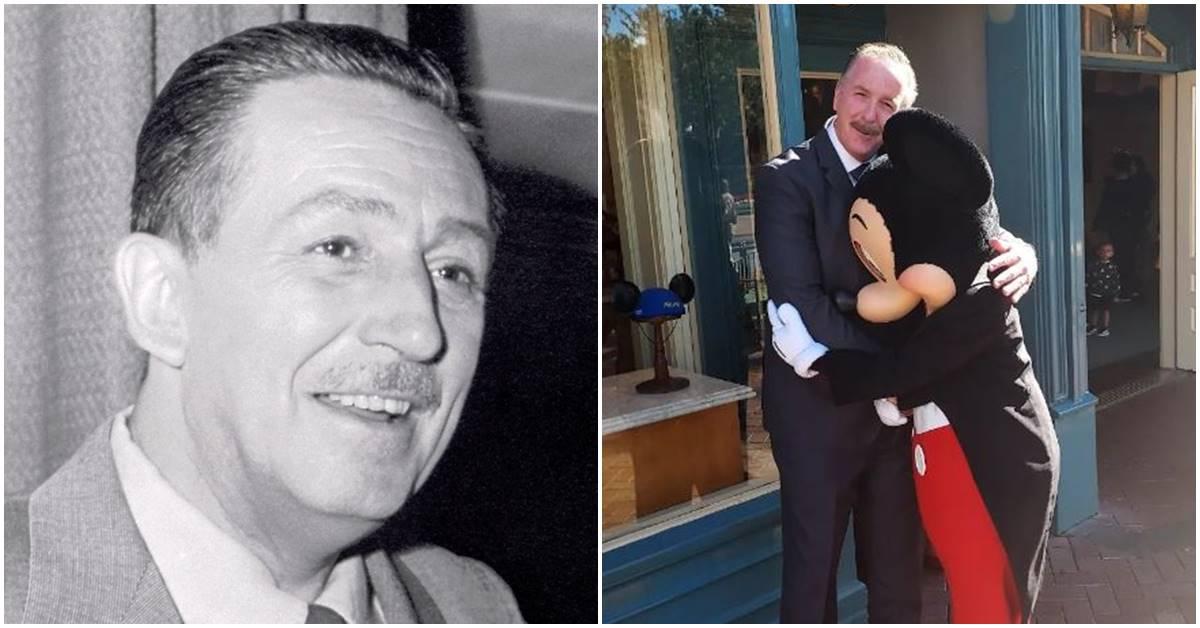
Bill Burns dressed as Walt Disney gets a hug from Mickey Mouse.

Dapper Day is an unofficial themed day at Disneyland where people come to enjoy the magic in style. The day is celebrated by park guests twice a year, once in the spring and once in the fall, by dressing up in vintage clothing reminiscent of when the park opened in 1955.

On November 6, one guest at the park’s cosplay outfit was so convincing that cast members at the park did a double-take. Bill Burns and his wife Jane dressed up as Walt and Lillian Disney and Bill looked so much like Uncle Walt that he caused a stir among park employees.

Bill later told Good Morning America that park employees were saying, “Walt is in the park” when he arrived. For many, it must have been like seeing a ghost, because Bill has an uncanny resemblance to Disney with his mustache and period-perfect suit.

A magical moment was caught on camera when Bill, as Walt, was seen interacting with a cast member dressed as Mickey Mouse. "Mickey stops and literally is staring," Bill told Good Morning America. "And then Mickey snapped out of it and you saw the hug. And that hug was a long hug as hugs go for the characters. It was extremely genuine. The cast member was stunned."


Bill’s appearance at the park is about a lot more than wowing people with his resemblance to Disney. He wants to inspire people in the same way the park’s creator has.

He got into cosplay with his wife back in 2014 but things changed after he was diagnosed with Waldenstrom macroglobulinemia, a rare form of cancer. While undergoing chemotherapy he realized he could help uplift others through his hobby.

“While I was sitting in the chair for many hours I thought ‘if I make it through this, I’m going to do everything I can with this hobby to try to influence people and inspire them’.” He went on to say, “Life does go on and you can spread that life and that joy to many other people who are suffering through this.”

Chadwick Boseman, who died of colon cancer in 2020, had a big influence on Bill's decision to inspire others. He told Good Morning America that “during the movies he was going through treatment and he kept going. He was going to inspire people and show them that even though your time is limited … you can spread inspiration. That made a huge impact on me. Because that’s what I want to do. I’m hoping I can just do a fraction of what he did.”

Seeing Walt Disney return to Disneyland for a day does conjure up feelings of magic and inspiration. The idea that the man who created Mickey Mouse and Disneyland would return to his creation, 56 years after his death, is pretty touching. Would he like how the park has changed? Would he know what “Star Wars” is about? Would he scoff at the prices?

Bill also gave us a great reminder of the power that Walt Disney has had over our imaginations and culture. He’s also a wonderful embodiment of his spirit. It’s easy to forget that among all of the other iconic Disney entertainment, it all started with one man’s vision—and that vision still inspires so much wonder and magic.
Pop Culture

All In: 5 Ways This Week

From the silly to the sentimental, there are so many ways people like to go “all in” on something. Here are our five favorite examples we found this week across the internet.

5 ways people are going "All In" this week
True

When you hear the words “all in,” what do you think? You might picture a Dancing with the Stars trend gone viral or maybe bridesmaids who fully supportive of the bride's favorite movie (and recreates an iconic scene). Whatever you picture, the idea is the same: Someone who does something with 100 percent total commitment. Going “all in” means giving your all—going completely over the top, no second guessing, no holding back. Just full-throttle enthusiasm, with some flair and creativity thrown in. And when people go “all in,” something truly special usually happens as a result.


The internet abounds with examples of people giving it their all—whatever it is. In this roundup, we’ve found the very best examples of people going “all in”—moments where passion, creativity, and commitment take center stage. Some are sentimental, some are silly, but all of them are a reminder that giving 100 percent is truly the only way to leave a mark on this world. Get ready: These folks didn’t just show up, they went all in.


1. An Iconic "snow-coaster"

One thing about going all in - it can be crazy and childish at times. That’s something that makes going all in special, connecting with that side of you that takes things less seriously in order to have some fun. Shira Goldstone and her husband took to that mindset when it started snowing in their backyard. Shira’s husband picked up planks of wood (and whatever other tools are required) and within the same night, in the falling snow, built a “snow-coaster” for the two of them to play on.

2. A Truck That's Feeding It's Community

You already know our friends at All In—they’ve got some seriously tasty snacks that are not only healthy and affordable (scroll to the bottom of this article to see how you can snag a free bar), they help fund food banks, gardens, community fridges, meal programs, and other amazing things

For Giving Tuesday, All In teamed up with Fresh Truck, a weekly mobile market that brings fresh and affordable produce to neighborhoods in the Boston area. Fresh truck hosts weekly markets, pop-up events, and an online storefront, all to help strengthen communities who need it the most. They’re going all in on local nutrition and food access, and we’re here for it.


3. All In on Madam Morrible

I’m always all in on a good TikTok trend. This week, I’m going to share with you a classic that has come out of the Wicked franchise and the incredible actress Michelle Yeoh.

Michelle, who plays Madame Morrible in the Wicked movies, is an outstanding actress. She’s known for iconic films like Everything, Everywhere, All At Once, as well as Crazy Rich Asians and Star Trek. But her legacy might be this one quote, which she’s said in interviews countless times, and now people can’t stop making videos with the phrase “Madame Morrible, M.M…flip it around, W.W. Wicked Witch!”

You might have to take a look at how people are going all in yourself, the sound has taken off with already 14.3K videos, and the variations are unstoppable...defying all odds and maybe even...defying gravity?

4. Spotify Wrapped: All in on "Coconut Mall"

TikTok · Ale

www.tiktok.com

There’s nothing better than finding a song that hits just right and gets you feeling productive. For some people, it’s lofi beats. For others, it’s orchestra music. For TikTok user @aleinmotion, it was the “coconut mall” song from the Mario Kart racing soundtrack. Ale never realized how much she listened to the song until it became #1 on her Spotify Wrapped. Sometimes you’ll be surprised by what you love most, and I’m thinking this is one of those moments for Ale.

5. A Family Prank Everyone Enjoys

This girl said her boyfriend had an ugly hat, so her family decided to go all in on supporting him instead. This is when love and humor come together, a perfect prank that actually made the boyfriends day…and taught his girlfriend that nothing is really that serious! They even got the daughter her very own hat as well, and she looked happy to wear it!

As someone who grew up with a dad who always wore floppy hats to protect him from the sun, I understand the embarrassment. Maybe it’s time I go all in and show my support with a matching hat and white long sleeve sun shirt!

Snag your free (!!) snack bar here while this deal lasts. Simply sign up with your phone number, pick up your favorite flavor of an All In bar at Sprouts, and then text a picture of your receipt through Aisle. They’ll Venmo or PayPal you back for the cost of one bar. Enjoy!

batteries, energy, sustainability, power, breakthroughs

UCI doctoral candidate Mya Le Thai has developed a nanowire-based technology that allows lithium-ion batteries to be recharged hundreds of thousands of times.

A quote widely attributed to the Roman philosopher Seneca says, "Luck happens when preparation meets opportunity." In 2016, a doctoral candidate at the University of California Irvine proved that this is indeed the truth.

Nine years ago, Mya Le Thai, PhD was playing around in the lab when she made a colossal discovery that could lead to a rechargeable battery—that could last up to 400 years. That means longer-lasting appliances, laptops, smartphones, cars and so much more, plus fewer lithium ion batteries piling up in landfills.


A team of researchers at UCI had been experimenting with nanowires for potential use in batteries, but found that, over time, the thin fragile wires would break down and crack after too many charging cycles. A charge cycle is when a battery goes from completely full to completely empty and back to full again.

charging station, battery, charging battery, charge, batteries Phone charging.Canva Photos.

But one day on a whim, Thai coated a set of gold nanowires in manganese dioxide and a Plexiglas-like electrolyte gel.

"She started to cycle these gel capacitors, and that's when we got the surprise," said Reginald Penner, chair of the university's chemistry department. "She said, 'this thing has been cycling 10,000 cycles and it's still going.' She came back a few days later and said 'it's been cycling for 30,000 cycles.' That kept going on for a month."

This discovery is mind-blowing because the average laptop battery lasts 300 to 500 charge cycles. The nanobattery developed at UCI made it though 200,000 cycles in three months. That would extend the life of the average laptop battery by about 400 years. The rest of the device would have probably gone kaput decades before the battery, but the implications for a battery that lasts hundreds of years are pretty startling.

- YouTube www.youtube.com

“Mya was playing around, and she coated this whole thing with a very thin gel layer and started to cycle it,” Penner added. “She discovered that just by using this gel, she could cycle it hundreds of thousands of times without losing any capacity.”

“That was crazy,” he added, “because these things typically die in dramatic fashion after 5,000 or 6,000 or 7,000 cycles at most. ”"The big picture is that there may be a very simple way to stabilize nanowires of the type that we studied. If this turns out to be generally true, it would be a great advance for the community."

Not bad for just fooling around in the laboratory!

science, discovery, lab, batteries, Bill Nye, gif bill nye chemistry GIF by NETFLIX Giphy

Since her discovery, Mya Le Thai earned her PhD and has gone on to a successful career as the Principal Scientist with the Enevate Corporation, a company set "to develop innovative battery technologies that accelerate adoption of electrified mobility," according to their website.

She has also filed patents for her various inventions, the most recent of which being "Cells with blocking devices for delayed heat propagation" in July 2025. Her full list of patents can be found on Justia.

This article originally appeared eight years ago. It has been updated.

doorbell, millennials, comedian, strangers, generational differences
Photo credit: Canva, Africa images (left, cropped) / Khosro (right, cropped)

Millennials bond over their doorbell anxiety.

If you’re a Millennial who reacts to a knock on the door like it's a "jump scare" from a horror flick, you’re not alone. Comedian Jake Lambert nailed that particular form of anxiety in a new Instagram video titled "how different generations react to the doorbell," in which he acts out stereotypical responses from Boomers, Gen X, Millennials, and Gen Z.

The Boomer reaction is simply asking, reasonably, "Who’s that?" and walking over to the door. For Gen X, it’s wondering, "Who’s that?" and checking the security camera. The Gen Z move is apparently ignoring the sound entirely. But only Millennials, according to Lambert, react to a doorbell with genuine fear—in this case, appearing totally stunned and sliding off the couch into a puddle on the floor. The clip is hilarious, but it also appears to have touched a nerve. A large chunk of the top comments come from that demographic, with people pointing out the video’s accuracy.


Millennials say doorbell phobia is real

Here are some highlights from the flood of responses:

"Look, Millennials were locked up in the house alone when our parents were at work, we were told under NO circumstance were we to open the door for stranger’s. 🚪#strangerdanger⚠️"

"100% accurate on millennial 😂❤️"

"Millennial here. I definitely hide immediately and try not to make any noise"

"Millennials are not home ever unless you text first and give them hours notice. Facts."

"Yep, as a millennial, I can confirm that if I'm not expecting anything or anyone, there's no way I'm answering the door. The same applies to phone calls. Leave me alone. I don't exist. You don't need my time, and I yours."

"Millennial here. I've even removed my doorbell 😂"

"Millennial running quickly to the bathroom to hide hoping I wasn’t seen. I thought it was just me 😭"

"Millennials were latch key kids who were left home alone and told to never answer the door under any circumstances. We weren’t even supposed to let anyone see we were home alone, hence staying away from windows, closing the blinds, staying silent, etc. That was a large part of our childhood."

"And we stuck to it! 😂"

"Millennials are so anxiously traumatized 😂 I love us!"

"I'm a millennial and I feel so seen, but also attacked.😂"

"That millennial was quite accurate if I could disappear completely I would😂💯"

Safe spaces for this specific Millennial anxiety

This isn’t the only online safe space where Millennials have expressed their knock/ring stress. Ethan Lapierre (@Withethanlap) spoke "for all Millennials" in a funny and fascinating video, saying, "If someone rings the doorbell, we’re basically treating it like it’s a home invasion."

What’s interesting, Lapierre says, is a perceived shift in how this generation has interacted with that particular sound: "It’s so crazy because, growing up, someone ringing the doorbell was exciting. It meant one of your friends was coming over to see if you could go play or someone was selling, like, wrapping paper or Girl Scout cookies, you know?...Now [when] someone rings the doorbell, it’s like panic and anger. It’s like, 'Who even knows where I live? Who has the audacity to ring my doorbell right now?’ You start asking yourself, 'Do I even have the capacity to have a face-to-face conversation with another human?'"

But this response, Lapierre says, is "insane" because of how many Millennials were raised: "[A]ll of us are very well-versed in small talk, in pleasantries. That’s how we grew up. But somewhere along the line, we started needing a head’s up before you came to our house. Like 'Text me, call me, send a carrier pigeon—I don’t care. Just let me know before you come over.’ Because, for some reason, that ringing of the doorbell or that knock at the door is triggering a fight-or-flight response. It’s so wild because we grew up answering landlines without hesitation, but now we treat the doorbell ring like it’s a jump scare."

"I have no desire to open the door when I don't know who it is"

This same topic even launched a thread on the /Millennials subreddit' user rethinkingfutures wrote that they don’t answer the door unless they know someone is coming over. "Do other millennials not answer the door if they don’t know who it is? Even with a peep hole?" they asked. "I have no desire to open the door when I don’t know who it is or if I’m not expecting anyone. It’s not even that I’m a single woman who lives alone; I just hate answering the door for people whose arrival I’m not anticipating."

Lambert even touched on a similar topic in a video about how different generations show up to people’s houses. "Millennials will have hoped that the plans would've been canceled," he says in the clip. "There’s no reason that a millennial will ever actually want to come to your house…They will arrive late, but they will text you to let you know they're on their way, just as they're about to get into the shower. And a millennial will never knock on your door. You'll just get a text either saying 'here' or 'outside,' and that's your cue to go and let them in."

- YouTube www.youtube.com

Science

Video of a 1949 kitchen design has people drooling over its brilliant features

Can we bring back some of these "step saving" design elements?

1949 step saving kitchen, 1950s, vintage kitchen, functional kitchen design, home economics

People are fascinated by the features in this 1949 kitchen design.

Modern kitchens are pretty epic in the historical scheme of things. We have refrigerators that dispense ice, cold water, and even hot water. We have faucets that turn on and off with a touch. We have garbage disposals, automatic trash-can lids, and pot-filling faucets over stoves—all manner of modern conveniences that might make us assume that today's kitchens are superior to every era that came before.

In some ways, they are. But a video from the National Archives demonstrating the features of a 1949 step-saving kitchen design has some of us rethinking just how much. The video was put out by the United States Department of Agriculture’s Home Economics division and it details every part of this efficient kitchen design:


- YouTube www.youtube.com

No wonder kitchens from that era feel small compared to most new homes today. Modern kitchens tend to be sprawling but far less functional. This design may be small, but it’s mighty.

The movie itself is a bit of a time capsule—not only in the cabinetry and clothing styles, but in the clear assumption that only women would be using the kitchen. On one hand, it’s great that work traditionally viewed as "women’s work" became the focus of innovation aimed at making life easier. On the other hand, it’s interesting to see how much has changed around gender roles since the 1940s.

But why did the government even make a video like this in the first place? Why would the government even care about kitchen design?

kitchen design, home design, functional kitchen, interior design, kitchens Design 3D GIF Giphy

It all began with a push for science and innovation in the late 19th and early 20th centuries.

As food historian Sarah Wassberg Johnson wrote, "This kitchen design is the culmination of several decades of work studies. During the Progressive Era, American interest in science began to increase, and scientific theories were applied to everything from factories to households. The Efficiency Movement was part of this application of scientific principles to everyday life. Led by mechanical engineer Frederick Winslow Taylor, the movement posited that everyday life, from industry to government to households, were plagued by inefficiencies, which wasted time, energy, and money."

This movement, known as "Taylorism," spilled over into the home economics movement, which eventually became of interest to the U.S. government. A USDA report published in 1948 explained the push for efficient kitchen design:

"To help homemakers reduce time and work involved in kitchen activities, the Bureau is designing and preparing construction drawings for kitchens, with different arrangements of equipment — the U, L, broken U and L, and parallel-wall types of arrangement. They are designed to reduce walking, stooping, and stretching to a minimum, in accordance with accepted principles of work simplification."

And that's how we ended up with this glorious video.

Many people cheered for the features of this nearly 80-year-old kitchen design:

"Wow! That is an amazing well thought out kitchen. And we think we are modern today. That kitchen was has way more features than our kitchen today!" – @TheCrystalLion1

"I say I want an old time kitchen all the time! Everything was so functional." –@LizSmit97381516

"Yeah, that is pretty amazing! I would be completely happy with this." – @TexasAris

"I have a garbage pail and potato drawer like this. Love it. Our kitchen is brand new tho. I requested these things. Also a full size pull out pantry, 15 inches wide and 6 ft tall. Hideaway kitchen utensils vertical pullout 6 inches wide, full size microwave drawer. Modern kitchens can be amazing or terrible." – @NativeNoticer

Some people have expressed concern about bugs in those potato and onion bins, but someone who grew up in that era noted that potatoes and onions were such daily staples that families went through them quickly:

"We kept things real clean and, no, that was never a problem - the potatoes and onions were gone through on pretty much a weekly basis. We normally figured 1/2 an onion per person per day and a potato per person. We had a small family. Grandfather, grandmother, Uncle, Mom, myself, and a kid that no one wanted - 6 people; that is 6 potatoes and 3 onions a day or a 20# bag of each a week. And they were used as hash browns, potato pancakes, baked potatoes, sautéed onions in dishes (all dishes) and of course fried potatoes and french fries. They were pretty much a staple. We also had flour bins, two types - cooking and baking, and also two different kinds of sugar. There was baked bread and a pie or cake every single day and always biscuits. And everything was from scratch. All vegetables were prepared before cooking and did not come from cans and had only when in season, same with fruits. We did can some items but not many." – @DannerFoundati1

Naturally, times change, the way we use our homes changes, and new innovations often replace the old for good reason. But there may be some things we can learn from an era when function and efficiency were prioritized over Instagrammable spaces. What good is a beautiful kitchen if it's cumbersome to use?

National Lampoon's Christmas Vacation, Mae Questel, aunt bethany, betty boop, olive oyl
Images via Reddit/corndogeveryday, Wikipedia

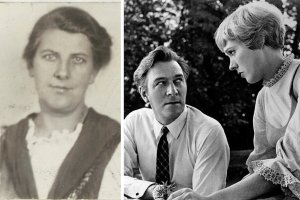
Actress Mae Questel, who played Aunt Bethany in 'National Lampoon's Christmas Vacation,' was the voice behind Betty Boop.

One of the most beloved Christmas movies is National Lampoon's Christmas Vacation, starring actor Chevy Chase as the iconic Clark Griswold. With too many quotable lines and laughs, it's a movie that's played on repeat this time of year. A new 2025 poll by PixelParade of 2,000 Americans found that National Lampoon's Christmas Vacation is the clear favorite Christmas movie, with 31% of respondents ranking it No. 1.

But people are just now discovering that actress Mae Questel, who played the hilarious Aunt Bethany, was also the voice behind iconic animated characters like Betty Boop and Olive Oyl from Popeye.

In a Reddit community discussing 1980s culture, people shared their amazement. "I had no idea until now that Aunt Bethany was the voice of Olive Oyl and Betty Boop. That's awesome," one commented. Another added, "I am today years old equating her in Christmas Vacation and Betty F**king Boop. Wow."


- YouTube www.youtube.com

Another commented, "I always loved that Christmas Vacation pulled out a roster of absolute ringers for the older relatives," while another shared, "She is an American icon."

Questel's role in National Lampoon's Christmas Vacation was her last before her death in 1998, according to her IMDB. And she had an incredible career before her role as Aunt Bethany.

@timeflowinglikeariver

#nostalgia #nationallampoonschristmasvacation #maequestel #1978

Questel was born in 1908 in the Bronx, New York. She attended the Theatre Guild school in New York before going to Columbia University, where she studied theater, according to the Voice-Over Actors Hall of Fame. After graduation, she found success as a Vaudeville performer known for her outstanding vocal imitations.

The creator of Betty Boop, Max Fleischer, hired Questel in 1931 to voice the famed character after he heard her singing the "boop-oop-a-doop" routine. According to The Washington Post, the character of Betty Boop began as Betty Coed, but transformed once Questel took on the role.

She told the publication in 1978, "There was something about me in those days, I never walked, I hopped. I was very much alive...There was this nostalgia thing, in Arizona, awhile ago, and I saw of the shorts I had made with Rudy Vallee back then, and I'd never seen them before, and well, I hate to say this, but I took a look at myself, and I was so adorable...I couldn't look at myself enough...it's too bad I can't look at myself and say that now, not because I hate myself, but because in those days...how much of me was in Betty Boop? Oh, a lot, a lot. I'm still a real idiot, but I was especially then, bouncy, bubbly, never a straight face. I love Betty Boop, everybody loved Betty Boop."

She voiced Boop until 1939 and even reprised the role decades later for the 1988 movie Who Framed Roger Rabbit.

- YouTube www.youtube.com

Questel also became the voice of Olive Oyl and Sweat Pea in the Popeye cartoons in 1933. She was the voice of the lanky character from 1931 to 1967.

Although it was her longest role, Questel didn't personally love playing her.

"Olive Oyl, I wasn't so crazy about," she told The Washington Post. "Some people really love Olive Oyl. I say, how the hell can they? So what if it's on three times a day, I don't have to love it. Betty Boop was a sexpot. Olive Oyl is a string bean, with an ugly puss, and a pair of legs that look like spaghetti."

Questel’s career also included a number of television commercials, most notably her long-running role as Aunt Bluebell for Scott Towels, among many others.

neuroscience, brain coach, emotions, success, achievement, change, evolution, the self

A woman at a laptop.

Just about all of us have something we’d like to improve in our lives. Most of us would like to be more resilient, more proactive in accomplishing our goals, break bad habits, remain open to change, and stay calm when we are emotionally triggered.

Ed Janes, a life coach who uses scientifically proven neurological research to help people improve their lives, says these changes all start in our minds, specifically with our beliefs. In a recent TikTok video, he shared the five beliefs that we should all adopt to change our lives for the better.


“I don't know who needs to hear this, but here are the five best beliefs to have, backed by neuroscience. If you have these, pat yourself on the back. And if you don't have these, start to integrate them,” he opens the video.

@rewirethemindcoaching

Have you got these? #fyp #successful #selfbelief #neuroscience #goals

Note: I have simplified Jane’s explanations so they are easier to understand for everyone.

1. “My emotions are data, not my identity”

When you are emotionally affected by something that you read on the Internet or that someone tells you face-to-face, realize that the emotions you experience are just a symptom of the situation and do not reflect who you are as a person. This belief activates the prefrontal cortex, the part of your brain associated with impulse control, and the emotional part of your brain relaxes, allowing you to think more clearly.

2. “My actions create clarity.”

Do you have a project you’d love to start but never feel it’s the right time? This belief actually trains your brain to avoid taking action, leading to predictive paralysis and overthinking. However, once you take the first steps on the task, whether it’s the perfect moment or not, your body floods with adrenaline and dopamine, which reward you with clarity to proceed with your project. “Stop waiting for the perfect moment. It's intellectualized procrastination,” Janes' says.

Jane's words echo those of Napoleon Hill, author of the 1937 mega bestseller Think and Grow Rich. In the book, he says that if you want to do something, start now. “Do not wait: the time will never be ‘just right.’ Start where you stand, and work with whatever tools you may have at your command, better tools will be found as you go along."


3. “Pain is neurofeedback, not punishment”

Reframing discomfort as feedback activates the part of the brain that helps guide you through stressful situations and increases your threshold for stress. In the long run, activating this belief when you experience physical pain will help you build a pain threshold and remain calm in stressful situations.

4. My identity drives my behaviour, not my willpower

Let’s say you have a problem with wasting your time doomscrolling. Janes says you should change your self-concept from someone who doom-scrolls to someone who isn’t interested in what’s happening on [insert your social media platform]. When you change to the new belief, the parts of your brain associated with habit formation will kick into action. “So when you change your identity, you will change your actions,” the name says.


5. “My brain can change at any age”

When you genuinely believe that your brain still has the power to change, the areas of the brain associated with learning (the hippocampus, basal ganglia, and prefrontal cortex) begin to fire up. “So when you actually give yourself this belief, it already starts making you learn faster, deal with emotions better, you regulate yourself better, and you also come back from your losses and become more resilient,” Janes says.

Janes’ video does a great job at explaining the brain science behind why we can easily get stuck with unproductive habits. It seems that our minds are afraid of pain, change, and taking action. But the good news is that when we change what we think is possible by accepting new beliefs. We can develop a mind eager to adopt new habits that make us happier, healthier, and more successful.