Dad makes kids put down their phones then captures hilarious video of them ‘playing’ outside

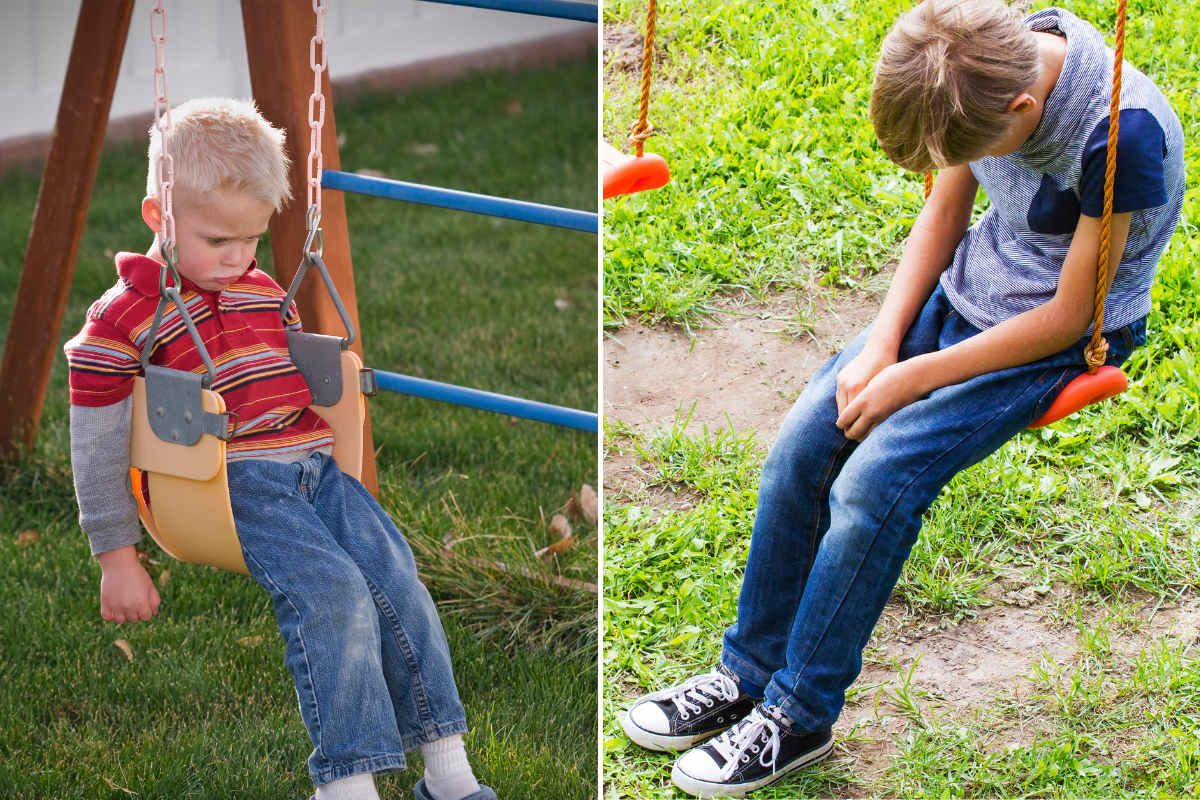
No one has ever looked so sad on a swing.

Two boys sitting on swings, with heads down, looking thoughtful.
Photo credit: Canva PhotosArray

These dang kids and their dang screens! I’m loathe to admit that I’ve had this thought a lot lately myself. When it comes to planning our kids’ summer break, a part of my brain assumes they’ll just want to play outside with their friends most of the day; making up games, riding bikes, coming inside to grab popsicles. The stuff I did at their age. But in reality it hasn’t worked out like that. Most kids in the neighborhood are either in camps, or they’re inside watching TV or playing video games.

When I try to encourage my kids to go outside more, I get a lot of grumbling and push back. Is it possible this generation has just… forgotten how to play? Are the phones and tablets to blame for this strange phenomenon? One dad recently had the brilliant idea to take his kids to the park, take away their phones, and force them to go play. The results were… not exactly what he was hoping for.


Person lying down, wearing sunglasses, taking a selfie with a phone.

“It was a nice day outside,” Charles Lavea told Newsweek. “I thought we could go get food and eat at the park. I took my daughters’ devices, phones and iPads, off them and left them at home. I wanted them to get some sun and fresh air, so we went.”

In footage shared by Laveas on TikTok, you can see what happened next. HIs two girls are shown sitting on swings, forlornly swaying back and forth, not knowing what to do with themselves. You can tell they’re just disassociating until dad’s weird little experiment is over. They would rather be anywhere else in the world. Specifically, they’d like to check in on what’s going on on their phones. It’s all over their faces and in their sad, hunched over body language.

Watch the comical video here:

@lifewithlaveas

This generation man ??? I remember growing up all we did was play at the park with the kids in the neighbourhood ? #lifewithlaveas #girldad #funnymoments #trendingsound #titanicflutefail #tiktokparent #viralvideos #fyp ♬ original sound – LifeWithLaveas

Commenters had a field day, and most agreed: Kids “these days” don’t know how to play outside.

“Bro when I was that age me and my sista be seeing who can swing the highest and jump off the swing on our feet”

“They would ratha watch other kids playing from there devices”

“Kids these days won’t know the struggles we been through since the 80s – 90s kids been through with no phones, gaming pc, iPhone, Samsung, tablets, Facebook, tiktok, YouTube & Instagram wasn’t invented. Even internet was hard to get when we use to have dial-up internet back then.”

“Honestly the kids nowadays have no idea how to play outside eh? My kids too I used to run out the door and never came back til the street lights turned on.”

The data backs it up. There’s been a shocking decline in often kids play outside in the last couple of decades. One study estimates only 6% of kids aged 9-13 regularly play outside unsupervised.

But is it so simple as to say that phones and tablets have rewired our kid’s brains and the fun of playing outside can’t keep up with the quick and easy dopamine hits found on screens? That’s part of the problem, sure. But did you know that only around 20% of kids walk or bike to school, compared to 70% of parents who did so when they were young? That’s not kids’ fault, and it’s definitely not because they’re in their room playing on their iPads. It’s because our culture has stoked so much fear in parents that our kids will be kidnapped or hit by a car that we rarely let them out of our sight anymore.

Kids have less unstructured free time than they did in the past, too. Your average kid is enrolled in more sports, clubs, and extracurriculars than ever before. Those are generally good things on their own — these activities challenge them, teach them new skills, and help them make new friends. But it doesn’t leave them a lot of time to flex their imagination and invent silly outside games with other kids, and that time is important too.

It’s easy to grumble about how kids are obsessed with their devices — and of course, genuinely laugh when dads like Lavea show that their kids barely know how to use a swingset — but change is going to have to start with us parents. The screens aren’t going anywhere. Time spent playing outside is so good for a child’s mind, body, and soul. We may just have to awkwardly force them into it a little more often, and that might mean pushing our own fears aside, or (the scariest thing of all) putting our own phones down to lead the way, too.

This article originally appeared in February

  • New Orleans is sending nurses on house calls to help new mothers
    Photo credit: CanvaA nurse feeds a newborn.
    ,

    New Orleans is sending nurses on house calls to help new mothers

    Bringing back house calls is improving the health of mothers and babies.

    According to the United Health Foundation, Louisiana is the least healthy state for women and children. For that state and many others, one major factor is the need to address the health of new mothers and their babies.

    Most parents know how overwhelming it can feel to suddenly care for a newborn without much experienced help. With that in mind, New Orleans brought back house calls, sending nurses to support new mothers.

    The program Family Connects New Orleans offers new mothers up to three in-home visits from a registered nurse for babies up to 12 weeks old. It allows nurses to check in on both the babies and their mothers to ensure they’re safe and healthy.

    The nurses are also able to spot symptoms of postpartum depression earlier, allowing mothers to receive treatment sooner. According to Rosemary Westwood of WWNO, “About 10% of moms participating in the New Orleans program were eventually diagnosed with postpartum depression, compared with 6% of moms who did not get the visits.”

    How does this work?

    The nurses visit with supplies for the baby, perform examinations (such as checking the child’s weight), and help answer any questions from the mothers.

    “We got to do some real things real differently, unless you like being number 50 all the time,” Dr. Jennifer Avegno, New Orleans’ health director, told NPR. “There is no more critical time and vulnerable time than right at birth and in the few weeks to months following birth.”

    “You go, you have your delivery, you’re in the hospital and everything is there. You go home, there’s a bit of a honeymoon period, and then, for many women, you fall off a cliff,” Avegno told The Guardian. “It’s the time in your life when your resources are generally at their lowest. We often don’t know about it until you hit one of our systems later on, whether that’s child protection, whether it’s the ER, whether it’s substance use treatment.”

    The program, which shows great potential for New Orleans, has found success in other states. When it was introduced in North Carolina, both mothers and their babies’ health significantly benefited from the home visits. In fact, a Duke University study of the program found that every dollar invested in the home visits saved $3.14 in healthcare billing before the child turned two.

    @thatheitgirl

    Sometimes supporting a friend who’s deep in postpartum life feels overwhelming because you don’t always know what she needs or how to show up. That’s why this postpartum scale is such a game changer. I put together 17 simple, practical ways to use someone’s “number” to guide you; from knowing when to send help, to when to offer company, to when to just let her rest. It takes the guesswork out of supporting each other and makes showing up feel natural instead of awkward or intrusive. And even though I created this scale with postpartum moms in mind, it’s just as powerful for anyone navigating mental illness, chronic illness, burnout, or big emotional seasons. Sometimes people don’t have the words to explain where they’re at, but they can give you a number. That number can help you understand their capacity, their needs, and how to support them without pushing too hard. It’s a tool that builds connection, reduces isolation, and reminds all of us that we don’t need to struggle alone. #PostpartumSupport #MentalHealthTools #MaternalMentalHealth #SupportYourFriends

    ♬ Soft and minimal instrumental music(1259336) – MaxRecStudio

    Where can new mothers get support?

    If you or someone you know is expecting, it may be worth seeing if a similar program is available near you. Organizations such as Welcome Baby in Los Angeles or national ones like Nurse-Family Partnership could help. The Health Resources & Services Administration has a database to find assistance near you as well.

  • Mississippi students work together to save bus driver having asthma attack
    Photo credit: Photo Credit: CanvaKids on school bus (left) Female bus driver (right)
    ,

    Mississippi students work together to save bus driver having asthma attack

    “This emergency situation could have definitely been detrimental.”

    Having your kids experience an emergency is every parent’s worst nightmare, but never underestimate their own resiliency and ability to problem-solve in times of crisis. 

    On April 22, a bus driver carrying middle school students in Hancock County School District, Mississippi, suffered an asthma attack and lost consciousness. Thankfully, several students quickly banded together to safely regain control of the vehicle. 

    While some helped steer and brake, others called 911 and notified the school district. One student, Destiny Cornelius, even helped the driver take their medication. 

    “I saw her medication in her hand, and I saw her reaching for it. I knew that’s what she needed,” Cornelius told local TV station WLOX.

    Thanks to their teamwork, the bus came to a peaceful stop, and no one was hurt. Amazingly, the heroic act was caught on camera. 

    In a statement posted to Facebook, the Hancock County School District praised the students for “staying calm and acting responsibly.”

    Hancock Middle School principal Dr. Melissa Saucier also told WLOX, “I’m not surprised to hear that our kids remained calm and acted swiftly. This emergency situation could have definitely been detrimental. And they handled it exactly how they should have. And we’re extremely proud of them.”

    Why preparation matters

    Moments like this raise important questions about how prepared students are for unexpected emergencies. These middle schoolers’ instincts were clearly spot-on, but their success also points to a broader opportunity for schools. Basic emergency response training for scenarios just like this could give more students the confidence and knowledge to act when adults are incapacitated.

    Simple lessons such as how to contact emergency services, recognize medical distress, or safely stop a moving vehicle could make a critical difference. Many schools already practice fire drills and lockdown procedures, yet situations involving transportation or medical crises receive less attention. Expanding safety education to include these scenarios could empower students without overwhelming them.

    There is also a strong case for age-appropriate first aid training. Understanding how to assist someone experiencing an asthma attack, as Cornelius did, is a skill that extends far beyond a single incident. It builds awareness, empathy, and the ability to stay focused under pressure.

    A powerful example of student leadership

    Regardless, what really stands out most is how naturally these students stepped into leadership roles. No one waited for instructions. They communicated, divided responsibilities, and acted with purpose in a matter of seconds.

    Educators often emphasize academic achievement, yet stories like this highlight the value of life skills. Problem-solving, teamwork, and emotional regulation are just as essential, especially in unpredictable situations.

    For parents, this story may spark both fear and pride: fear of what could have gone wrong, and pride in seeing young people rise to the occasion. For schools, it offers a chance to reflect on how to better equip students for the real world.

    A huge kudos to these kids for demonstrating that even in frightening circumstances, young people can take meaningful action. 

  • People are torn over whether stepdad’s ‘adult contract’ for 20-year-old stepdaughter is fair
    Photo credit: CanvaAn adult child is mad she's being charged rent.

    There’s an old saying that goes something like this: Parents should give their children enough so that they can succeed, but not so much that they don’t have to. Meaning, parents should help their adult children reach their goals because it’s hard to pull yourself up by the bootstraps when you have no boots. But they shouldn’t give them so much that they lose the desire to create something on their own.

    This is a tricky balance for parents to strike if they have the means, and, of course, every child requires something different. The problem occurs when children aren’t doing much on their own, and you may have to create real-world consequences to get them to step out on their own.

    An aunt on Reddit recently shared a contract that her sister and her husband gave to their 20-year-old niece. The contract was written so that the young woman would contribute to the home and abide by her parents’ rules. The aunt believes that the contract is too tough.

    The young woman’s aunt didn’t like the contract

    “My niece showed me this ‘contract’ her mom and stepdad are making her sign to keep living at home. She told them she isn’t signing it because she doesn’t agree with it, and they told her if she doesn’t sign it, she needs to move out,” the aunt wrote. “For context—she’s 20 but not very mature for her age. I’d say more like 15–16 emotionally. She has ADHD and depression. She does have a part-time job (which is her 1st job) that she’s had for a while and picks up shifts when she can.”

    “I’m worried this is going to do the same thing it did to me, where instead of getting support when I was struggling, I just got more pressure and criticism,” she continued. “That didn’t help me move forward at all. If anything, it kept me stuck longer than I needed to be. I’m also worried that this is going to destroy any type of relationship they have.”

    Rental contract. Photo credit: Canva

    The contract had a list of rules:

    • Pay $200 a month in rent
    • Pay $100 for her cell phone plan
    • Pay a $5 maid fee for each time she skipped her chores
    • No guests after 10 p.m. without prior approval
    • The “adult child” must also maintain employment
    • No illicit activity or underage drinking

    The contract stressed that living in the home was a “privilege, not a right” and that failure to comply would result in “termination of housing privileges.”

    Most commenters thought the contract was a fair idea

    The interesting thing was that, although the aunt passionately disagreed with the contract, most commenters thought it was a decent idea.

    “If you feel this is unreasonable, are you offering for her to live in your home without an agreement?” one commenter asked the aunt.

    “Also, ADHD is not something that incapacitates you from adhering to very simple rules,” another added. “This contract exists because the niece has been doing much of nothing for the last 2 years, and the parents need an exit ramp.”

    woman thinking, contemplation, young woman on couch,
    A woman contemplating her life. Photo credit: Canva

    A few commenters said the best thing the parents can do is save the rent money the young woman pays and give it to her when she’s ready to move out.

    “I’d love if your sister, in turn, would save all that money for her and give it to her when she’s finally out on her own. That’s the only way to make this productive,” a commenter wrote.

    What do the experts say?

    Real Property Management Pros says charging your adult child rent is a great way to help them become responsible. “Asking your child to pay rent doesn’t mean you love them less. It means you’re preparing them for real life. That said, setting clear parental boundaries is critical,” the company wrote on its blog.

    Ultimately, charging an adult child rent is a touchy subject. Still, it can become a positive experience for all parties if it’s communicated with love rather than seen as a punishment. It’s a great stepping stone for young adults to get out on their own and realize that it’s probably worth paying a bit more to a landlord than living under their parents’ rules.  

  • Dad is praised for his patient explanation of their mom’s period to his two young sons
    Photo credit: TikTok/@payalforstyle [with permission]Dad talks to his two sons about periods.
    ,

    Dad is praised for his patient explanation of their mom’s period to his two young sons

    “There’s one week a month when Mom wakes up and her body is telling her, ‘This is painful.'”

    Period education can be an awkward topic for parents to tackle, but not for Payal Desai’s husband, Hiren.

    The mom of two boys caught a sweet conversation between Hiren and their sons about menstruation as they brushed their teeth together. His understanding tone and explanation of what women experience during their periods is being celebrated by fellow moms and viewers.

    “My husband reminding our boys that there is no shame (only empathy) in periods,” she captioned the video.

    Dad explains periods to sons

    In the video, Hiren is chatting with his two sons as he begins to explain what periods are like for women.

    “I cut my finger yesterday and I needed a Band-Aid. Imagine what…Mom can’t put a Band-Aid on her vagina,” he says.

    One of the boys asks, “Isn’t that why there’s pads?”

    Hiren responds, “The pads absorb the blood, but it doesn’t make the pain go away. I’m sorry, but my little cut is not like what happens to Mom. So that’s why we have more sympathy and empathy for Mom. Like, be nice to her.”

    He then explains more about what is going on in a woman’s body during her period.

    “Mom’s hormones are impacted from her period, then the pain in the body…all kinds of things. It’s not just, ‘Oh no, some blood came out’,” he adds.

    Finally, Hiren tells the boys that it’s important to understand periods because one day they may have a partner who goes through menstruation, and that they need to be empathetic.

    “You’re gonna have a partner, and if it’s a woman, you’re gonna have to deal with that. Or you’re gonna have friends that are girls, and they’re gonna go through this,” he says. “Or classmates or teammates or partners. There’s one week a month when Mom wakes up and her body is telling her, ‘This is painful.’”

    Payal shares her thoughts

    In an interview with Upworthy, Payal explained why the talk Hiren had with their boys is important.

    “I’d want folks to know that in our home we aim to raise our boys with respect for themselves and deep empathy for others,” she says. “I wasn’t surprised to overhear my husband having this talk with them, which is part of ongoing conversations on how we can all show up for each other in times of need.”

    She also explained that she hopes it will help encourage other boy dads and moms to talk with their sons about periods.

    “On the topic of periods and menstruation, I think parents raising boys have a unique opportunity to help lift stigma that lead to misogyny and intolerance. We can raise boys to be a safe and understanding spaces for the women in their lives by being transparent—it’s biology after all!”

    Viewers respond

    Many viewers shared their support for Hiren’s chat with their sons, and shared their thoughts in the comments:

    “That man was MEANT to be a father, especially to young men! 🥰😭.”

    “This is the greenest flag of green flags that has ever flagged. You and those boys are very lucky.”

    “Imagine…. if ALL boys were parented this way. Just imagine …….”

    “THE INCLUSIVITY IN HIS LANGUAGE ♥️♥️♥️♥️”

    “This is what secure masculinity looks like.”

    “Now we all know why you married this man. No mansplaining just an actual conversation with his son. Your son’s are going to be able to feel comfortable and confident going to him for any advice without being made to feel ashamed. We need the Green flag guy.”

  • New study finds that ‘good enough’ parenting seems to be making a comeback and why that’s absolutely okay
    Photo credit: CanvaAn exhausted mother holds her baby.

    Since the beginning of time, it’s probably safe to say that many parents are simply exhausted as they navigate child-rearing. It’s a delicate dance between being a helicopter parent and being checked out. And for some, that anxiety and restlessness can linger for a good portion of their child’s life. A parenting concept from well over half a century ago might be changing that once more.

    British pediatrician and psychoanalyst D.W. Winnicott coined the phrase “good enough” parenting when he hypothesized that it was perhaps okay for parents to let their children, within healthy boundaries, learn important lessons on their own. The gist is that instead of attempting to oversee every single portion of a child’s life, a parent can step back and show up in ways that will ultimately guide them to a (hopefully) better outcome.

    Kids learn from our mistakes

    Dr. Ramani Durvasula (who simply goes by Dr. Ramani online) describes the notion succinctly in an interview clip with MedCircle. Here, she explains how vital it is for children to learn certain life lessons on their own. “We only need to be good enough. If we get it right every time… our kids learn from our mistakes. Every so often it takes us too long to soothe them. That’s when they learn to soothe themselves. We need to do ‘just enough’ mistakes so that they learn to do things by themselves.”

    In a 2016 piece for Psychology Today, author Marilyn Wedge, P.h.D. explains the idea evolves after infancy. “In discussing the mother (or other caretaker’s) adaptation to the needs of the baby, Winnicott thought that the ‘good enough mother’ starts out with an almost complete adaptation to her baby’s needs. She is entirely devoted to the baby and quickly sees to his every need. She sacrifices her own sleep and her own needs to fulfill the needs of her infant.”

    Not perfect but ‘good enough’

    She notes that this can change as the baby gets older. “As time goes by, however, the mother allows the infant to experience small amounts of frustration. She is empathetic and caring but does not immediately rush to the baby’s every cry. Of course, at first the time limit to this frustration must be very short. She may allow the baby to cry for a few minutes before her nighttime feeding, but only for a few minutes. She is not “perfect,” but she is “good enough” in that the child only feels a slight amount of frustration.”

    @herdotie

    The “good enough parent” 👏⁠ ⁠ Seán Moncrieff joins his daughter Keelin as the first guest on Mother season 3.⁠ ⁠ @kee_mon and her father discuss why letting go of parenting expectations can be one the hardest challenges faced by parents.⁠ ⁠ Other themes explored include generational differences in parenting, the epiphany of first-time parental love, his role as a father in her life, and much more.⁠ ⁠ This is one episode you won’t want to miss! Tune in wherever you get your podcasts 🎧️⁠ ⁠ #keelinmoncrieff #seanmoncrieff #parenting #mother

    ♬ original sound – Herdotie – Herdotie

    Attunement

    Fiona Yassin, family psychotherapist and founder and clinical director of The Wave Clinic, shared her view of the idea of attunement with Upworthy:

    “For parents, it can be helpful to step away from the idea of getting parenting ‘right’ or ‘wrong.’ In mental health, we often talk about ‘good enough’ parenting, which has attunement at its core. This means being present for our children, noticing their needs, and responding in a way that helps them feel seen and supported. Children don’t need flawless caregivers, but they do need caregivers who’re reliably responsive.”

    She adds how important it is that parents give themselves some grace. “It’s impossible to attune 100% of the time, but as parents we want to be looking to attune to our child’s needs for a good chunk of time. It’s also really important for parents to understand that small ruptures, missed cues, or moments of misattunement are not failures; they’re part of being human. What matters for parents here is how we repair from those moments and model to a child that relationships can stretch and recover.”

    Avoid passing down anxiety

    Alli Spotts-DeLazzer (LMFT, LPCC, CEDS-C) was excited to speak to Upworthy about the concept. “So happy ‘good enough parenting’ is in the spotlight here! I’ve been preaching this ‘good enough’ concept and the mutual growth that can come from it for years now—as a marriage and family therapist and lead author of My Child Has an Eating Disorder.

    In trying to do things perfectly, parents may unintentionally pass down more anxiety and lack of self-trust than they realize. The growth is in the ruptures, the repairs, and the role modeling of the messiness of life and how it gets handled—sometimes beautifully and other times in ways that feel poor. In a world where perfection narratives and images are pushed daily on social media, it takes courage to sit in the mess and make it meaningful. If you want to support resilience in kids, this seems like an empowering direction for parenting to move toward. Even more important, it can reduce polarization and allow more room for nuance, humanity, and growth.”

  • Millennial parents are pleading with Boomer grandparents to stop giving excessive gifts to grandkids
    Photo credit: Image via Canva/PeopleImagesBoomer grandparents are excessively gifting their grandkids, and Millennial parents have had enough.
    ,

    Millennial parents are pleading with Boomer grandparents to stop giving excessive gifts to grandkids

    “I struggle to keep on top of tidying as it is, and this is a massive added challenge.”

    Millennial parents and Boomer grandparents don’t always see eye to eye on parenting and grandparenting. Now, Millennial parents are uniting on a nightmare Boomer grandparenting trend that sees them “excessively gifting” their grandkids with tons of both new and old *unwanted* stuff during visits.

    Ohio mom Rose Grady (@nps.in.a.pod) shared her “Boomer grandparent” experience in a funny and relatable video. “Just a millennial mom watching her boomer parents bring three full loads of ‘treasures’ into her home,” she wrote in the overlay.

    One mom’s viral video hit a nerve

    Grady can be seen looking out the window of her home at her Boomer mom and dad carrying bags and boxes up her driveway after several visits. The distressed and contemplative look on Grady’s face is speaking to plenty of Millennial moms.

    @nps.in.a.pod

    Today’s “treasure” highlight was the mobile that hung in my nursery… #boomerparents #boomers #boomersbelike #millennialsoftiktok #millenialmom #motherdaughter

    ♬ Bad Reputation – Joan Jett

    Grady captioned the video, “Today’s ‘treasure’ highlight was the mobile that hung in my nursery…”

    The humorous video resonated with fellow Millennial parents. “Straight to the trash when they leave,” one viewer commented. Another added, “I always say ‘if you don’t want it in yours, we don’t want it in ours’ .”

    Even more Millennial parents have shared and discussed their situations with Boomer grandparents buying their kids too much stuff on Reddit. “Both my mother and my MIL love buying and sending toys, books, clothes, etc. I don’t want to be ungrateful but we just don’t need it and don’t have the space. I have brought this up politely in ‘we are all out of drawers for that’ but it hasn’t slowed things down,” one explained. “I think part of the issue is that the grandparents live in different cities and vacation a lot. They don’t get to see our daughter much so they buy stuff instead.”

    Another Millennial parent shared, “While the intention is very kind behind these, all the grandparents are very aware that we do not need, nor wish to receive these gifts in such an excessive volume – as it creates a daily struggle to store and accommodate in our home. I struggle to keep on top of tidying as it is, and this is a massive added challenge.”

    How to talk to Boomer grandparents about gifts

    millennial parents, millennial parent, millennial mom, kids room, organize
    Millennial mom struggles to organize her son’s room. Photo credit: Canva/fotostorm

    So, why are Boomer grandparents excessively gifting? “Boomer grandparents may be the first grandparent generation to have accumulated the substantial discretionary funds that enables them to spend money on their grandchildren,” Sari Goodman, a Certified Parent Educator and founder of Parental Edge, tells Upworthy. “These grandparents probably grew up with grandparents who didn’t have that kind of money and so they may be excited to give their grandchildren the things they didn’t get.”

    Goodman suggests that Millennial parents first discuss with them the “why” behind the gifting. “What comes before setting a boundary to limit over-the-top gift-giving is delving into the reasons grandparents are buying so much,” she explains. “Coming from a place of compassion and understanding makes it possible to come up with mutually beneficial solutions.”

    Other ways grandparents can stay connected

    She recommends that Millennial parents sit down with their Boomer parents to learn more. “Did they grow up without many toys and clothes and are fulfilling a dream? Ask them about the values they learned as children (hard work, perseverance, the power of delayed gratification) and how they can pass on these lessons to the grandchildren,” she suggests.

    She adds that another reason may be that Boomer grandparents live far away and want their grandchildren to feel a connection with them. “Set up a regular FaceTime or Zoom meeting. Rehearse with the kids so they have something to say and suggest a topic for the grandparents,” says Goodman. “Or send snail mail. Kids love getting mail. The grandparents can send postcards from where they live and explain some of the special sites.”

    boomer grandparents, boomer grandparenting, video chat, video call, grandkids
    Boomer grandparents have a video call with grandkids. Photo credit: Canva/Tima Miroshnichenko

    Finally, Goodman adds that for some grandparents, this may be the only way they know how to show their love. Millennial parents could ask if they would be open to other ideas. “Parents can set up an activity for grandparents and kids to do when they come over: a jigsaw puzzle, art activity, board game, magic tricks,” she says. “Arrange for the grandchildren to teach the grandparents something their phones can do or introduce them to an app they might like.”

    This article originally appeared one year ago. It has been updated.

  • Woman goes to great lengths to adopt baby from husband’s ex-wife to save him from foster care
    Christie Werts and her son, Levi

    Christie and Wesley Werts have taken the idea of a blended family to the next level. When the couple fell in love and married, they brought together her children, Megan and Vance, and his children, Austin and Dakota.

    The Ohio family became five children strong after officially adopting Levi in January 2023, when he was nearly 2 years old. Levi is the son of Wesley’s ex-wife, who passed away four days after the child was born. The ex-wife had the boy prematurely, at 33 weeks, and died soon after from drug addiction and complications of COVID-19.

    When Levi was born, he was a ward of the state with no first name or birth certificate.

    “When I heard about Levi, without hesitation, I said we should take him,” Christie said, according to The Daily Mail, and her reason went far beyond the fact that the child was the half-brother to two of her recently adopted children. “I myself was a foster kid and, although for the most part, I had a great experience, I did not want him going to foster care,” Christie said.

    She’d been dreaming of him before he arrived

    Before the family knew of Levi’s birth, Christie had a recurring dream about a blue-eyed, blonde-haired boy.

    “Before Levi, we had wanted to try to have a child of our own,” she told Newsweek. “I’m in my forties, so we knew that we would probably need fertility treatment, so I thought let’s just think about it and what will be will be.”

    @cjthemom5

    Replying to @Journey♥️ Yes, they will always know of her and ill be there for every emotion good or bad. But im also mom, ive been to every game, every doctors appt, sat with them if they needed an ear loved unconditional . I am mom also. #adoption #srorytime #siblings #foryou #loveislove

    ♬ Paper Birds (3 min) – Jordan Halpern Schwartz

    The problem was that Levi was in Texas, so the family sold their house and moved to the Lone Star State to go through the arduous adoption process. The situation was further complicated because Levi’s biological father had parental rights even though he had substance abuse problems. The family couldn’t move out of Texas until his rights were legally terminated.

    But after a 16-month process, in January 2023, Levi became a legal family member. Christie understands that adopting her husband’s ex-wife’s baby may seem unusual to some people. “It’s a lot to process for a lot of people, but honestly, it seems a lot crazier than it was. At the time, it just made sense,” she said.

    She had doubts, but love won anyway

    @cjthemom5

    Our adoption is official !!! after 17 months!!! #adoption #son #loveyou #ourstory#foryou #fyp

    ♬ original sound – Jenna

    Even though Christie knew in her heart that she must adopt Levi, she wasn’t without reservations. “’If I said I did not [have concerns beforehand], that would not be honest,” she told The Daily Mail. “This was different. I was going to walk into a child I never met and was worried the circumstances would hinder this instant love. But […] he stole my heart. I also felt this intense need to protect him.”

    These days, Levi fits right in with the family, and the rest of the kids are happy to be back to living an everyday life without any caseworkers or inspections.

    “He’s great, he is the king of the house! We are all very close. He won’t understand the journey right now, but someday, I will let him know we fought for him!” Christie said.

    Christie has continued to share her family’s journey on TikTok and has since published a book called Life’s Sad Story, God’s Love Story: Transforming a Child’s Adversity into a Tale of Love about her experiences as a foster child and Levi’s adoption story.

    This article originally appeared five years ago. It has been updated.

  • This mom’s controversial parenting take that her kids don’t have to ‘share’ has the Internet divided
    Photo credit: Lottie Weaver/@lottie..weaverMom of three Lottie Weaver explains why she doesn't make her kids share.

    Teaching kids to share is often part of Parenting 101. According to the Cleveland Clinic, educating kids about sharing in early childhood helps them build empathy, fosters social skills, and helps teach them emotional regulation.

    While “sharing is caring,” mom of three daughters Lottie Weaver says she’s teaching her kids that they don’t *always* have to share with others.

    Weaver explained her controversial take and more behind her ‘why.’ “I said it and I’ll say it again, I don’t make my kids share!” she captioned the video.

    @lottie..weaver

    I said it and I’ll say it again, I don’t make my kids share! #momlife #girlmom #momof3 #momsoftiktok #parenting

    ♬ original sound – ✨Lottie✨

    Why her kids don’t have to share

    Weaver starts by stating that her kids “don’t have to share their toys or their snacks or literally any of their things with your kids.”

    She goes on to explain, “If we are out and about at the park or some communal play place, if my kids have a scooter or toy or bubbles, they’re not sharing with your kids. They don’t have to. I will never ever make my kids share their stuff that they brought with another child.”

    The mom of three daughters then offers three reasons for her thinking:

    “Number one: you should’ve brought your own sh*t. Number two: that’s their toy. They don’t have to share with you. Number three: you don’t have to do something just because somebody asks,” she says.

    She elaborates more on her third reason.

    “I think especially for women, that is really important to learn. For girls growing up, just because someone says, ‘Hey can I have this’ or ‘Hey can I do this’…you don’t have to say yes. They should’ve brought their own toys,” she adds.

    @lottie..weaver

    I think you can be a mother and friend at the same time! #momsoftiktok #girlmom #momof3 #momsover30 #momlife

    ♬ original sound – random_stuff

    When to share, and when not to share

    However, Weaver notes that she does not discourage sharing.

    She says, “Now, if my kids want to share, yeah share! But as soon as they’re like, ‘Hey, they’re not giving my stuff back. I’m done sharing’, that’s when my *ss is going over there saying, ‘Cough it up [with a gesturing motion]. Cough it up. Your mommy should have brought you your own toys. We don’t have to share, okay?”

    And Weaver also adds that the venue for sharing also matters.

    “Now if you come to my house for a playdate, that’s very different, right? Because we are welcoming them into our space,” she says. “But if we are out and about, and we don’t know each other very well—even if we do know each other very well, and my kid doesn’t want to share her doll with your kid, she doesn’t have to.”

    @lottie..weaver

    Sometimes they just need a break! The mental health days are the perfect compromise! #momof3 #momsoftiktok #momsover30 #girlmom #daughter

    ♬ Carefree Days – Peaceful Reveries

    Viewers respond with mixed feelings

    Weaver’s video struck a chord with viewers. Some were supportive, while others took issue:

    “I’m so sad as a teacher this is literally the foundation of learning. Made me unfollow 🫠.”

    “Oof🥴 I tell my kids don’t bring toys if you’re not willing to share it.”

    “I disagree. My kiddo will definitely be sharing. ESPECIALLY if another kiddo doesn’t have a toy.”

    “The real flex is raising a child who is friendly, empathetic and WANTS to share.”

    “What an odd thing to say out loud and be proud of. My kids will always be expected to share. Some kids aren’t fortunate enough to have the nice extra things, and I want my kids to be remembered as the sweet ones who were KIND to others.”

    “She’s right tho and yall mad 😭😭😭.”

    “I 100% agree. I teach my kids to share, but that they don’t HAVE to share JUST because someone asks for it.”

    “Adults don’t have to share so why do kids? But … sharing is caring. And it’s always a nice thing to do.”

    “I’m a nanny and I 1,000% agree with you Lottie! We’ve gotten to the point where ppl expect the can just use your stuff at the park. It’s not your toy, they’re allowed to play with their own toy that they brought.”

    “You guys are missing the point. She isn’t saying she’s teaching them to not share… she’s saying she’s teaching them they don’t have to if THEY DONT WANT TO.”

Pop Culture

Matthew Lillard had a surprisingly humble explanation for his recent Hollywood comeback

Culture

‘Wow!’ may sound like a modern slang term, but it dates all the way back to the 1500s

Nostalgia

’90s kids rejoice as Pizza Hut’s BOOK IT! program returns for a new generation of readers

Making Sense of Science

Why some shoppers avoid self-checkout (even when it’s faster), according to psychologists