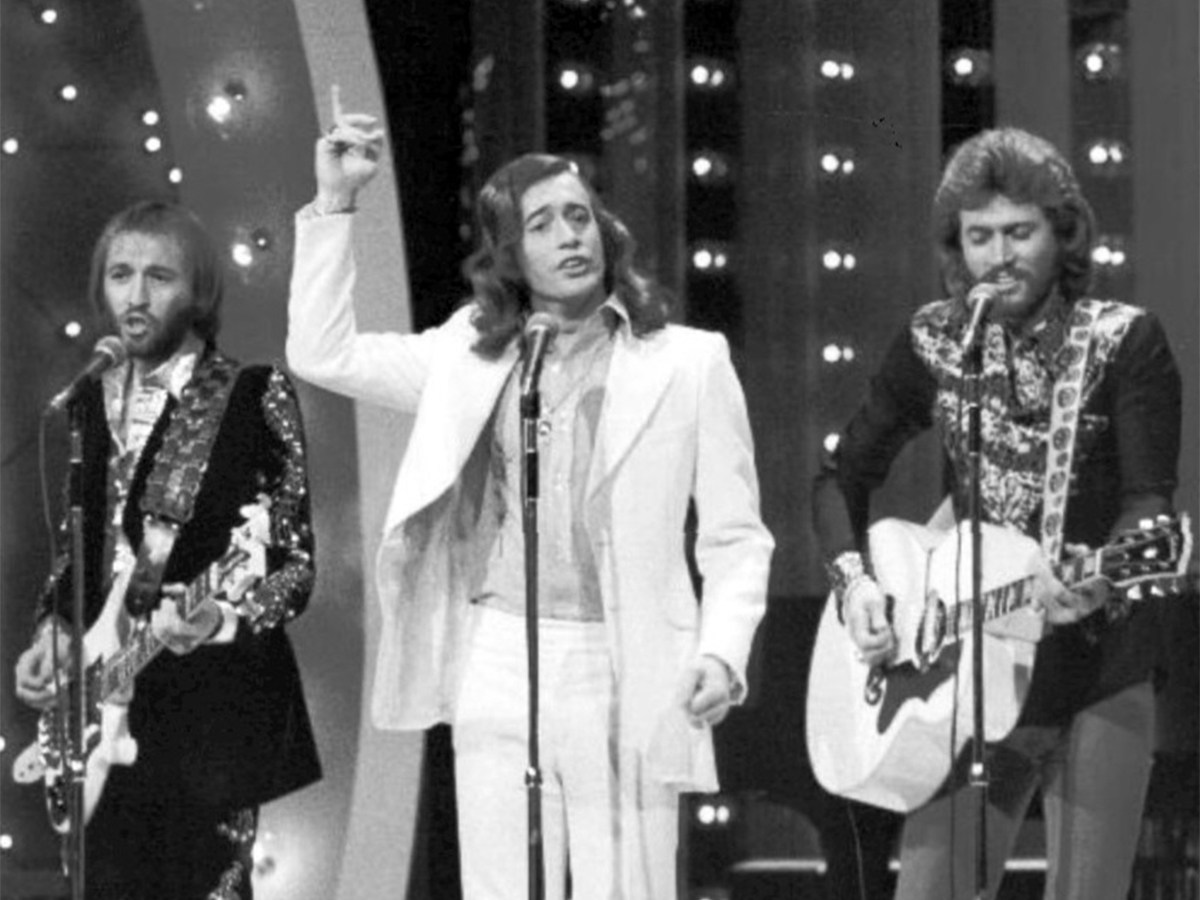
From the opening beat, the Bee Gees’ 1977 hit “Stayin’ Alive” has one of the most recognizable sounds in disco history. But the secret behind its steady rhythm lies in another of their hits, “Night Fever.” When the band’s drummer had to leave a recording session, the musicians came up with a creative solution that helped give the song its distinctive sound.
What began as a quick fix became the signature beat of “Stayin’ Alive.” And it all happened long before musicians could copy and repeat a recording on a computer.
The Bee Gees needed a drummer. They found another solution.
The Bee Gees were working on songs for the soundtrack to Saturday Night Fever, the film starring John Travolta. Recording sessions were underway at Le Château Studios, about an hour north of Paris, France, when their drummer, Dennis Bryon, had to return to England for a family matter.
The filmmakers were waiting to hear “Stayin’ Alive,” and finding a replacement drummer on short notice wasn’t easy. Recording engineer Karl Richardson described the problem in a 2000 interview with Mix.
The group first tried using an electric organ’s built-in drum machine, but the results were disappointing.
“It sounded terrible,” Richardson said.
Producer Albhy Galuten had an idea, which he described in a 2002 interview with Berklee College of Music.
“Back then, drum machines were really primitive, not even close to what they are today. I had a brainstorm and told Karl we should take a bar from ‘Night Fever,’ which we had already recorded, and make a drum loop,” said Galuten.
Two bars of music become a disco classic
Galuten and Barry Gibb listened through the drums on “Night Fever,” searching for a section with the right feel. They eventually settled on two bars of music.
“We chose a bar that felt so good,” recalled Galuten.
The next step was figuring out how to repeat those few seconds throughout the song.
Richardson copied the drum section onto a separate piece of magnetic tape and joined the ends together to make a continuous loop. The final tape was too long to fit around the recording machine alone, so he stretched it around microphone stands and other equipment in the studio.
As the tape passed through the recording machine, the same few seconds of drumming played over and over. The loop provided a steady beat without losing the natural sound of Bryon’s original performance.
By the time Bryon returned to the studio, the group liked the result too much to replace it. He added additional drum parts, but the loop remained the foundation of the song.
The mysterious drummer named Bernard Lupé
The recording technique led to a joke involving a drummer who didn’t exist.
The Bee Gees credited the drum performance to Bernard Lupé, a fictional musician whose name was a playful reference to legendary session drummer Bernard Purdie.
Of course, there was no Bernard Lupé. The performance was Dennis Bryon’s drumming, repeated over and over on a loop of magnetic tape.
The trick proved useful beyond “Stayin’ Alive.” The same drum loop was also used on the Bee Gees’ “More Than a Woman” and later on Barbra Streisand’s 1980 hit “Woman in Love.”
According to recording engineer Karl Richardson, who recalled the joke in an interview with Sound on Sound, the fictional drummer attracted inquiries from people hoping to hire him.