People share 'corporate buzzwords' they'd like to fire immediately without pay
It's time to retire 'fast-paced environment' once and for all!

Can we pivot to something else already?
OK, hive mind. Ready to do a deep dive to develop some synergy and make a lasting impact?
Yeah, corporate lingo can be kind of cringe.
Even in the age of working from home, we are still just as subject to the latest business-speak meant to inspire and motivate employees, which instead makes our brains say “kill me please.” In fact, it’s sometimes even more awkward. Who hasn’t had an “all hands” Zoom meeting where they had to “touch base,” “circle back,” then offer a “final thought?” No one. No one, I tell you.
Reddit user u/PM_ME_YOUR_MUSIC asked, “What are the most annoying corporate buzzwords or phrases you’re sick of?” and let’s just say that people “hit the ground running” with hilarious answers. No “low-hanging fruit” here. Are you triggered yet?
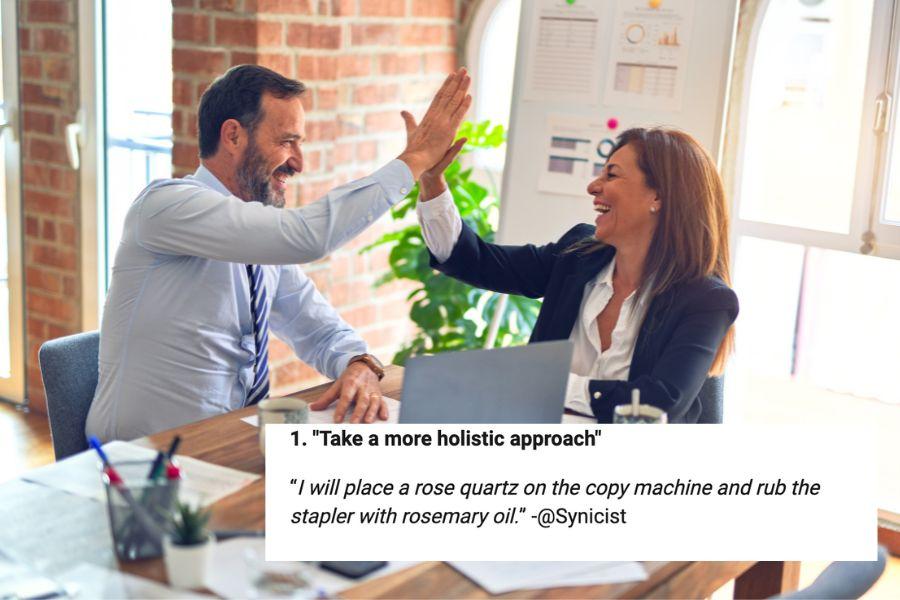
Below are 11 of the best answers that anyone in a corporate environment can relate to and giggle at. Read 'em fast, and you’ll “get five minutes of your time back”.1. "Take a more holistic approach"
“I will place a rose quartz on the copy machine and rub the stapler with rosemary oil.” – @Synicist
2. “Competitive pay”
“Yes your pay will be competing with your bills.” – @PM_ME_YOUR_MUSIC
3. "Our workers are part of our family"
“Translation: we have boundary issues.” – @shanster925
4. When someone refers to a request as an “ask”
“We had a word for this already, what was wrong with it?” – @Johanssjoberg
“Request is two syllables. Not punchy, not cool.” – @Fred2718
5. "We all wear multiple hats around here"
“I hear this everyday. It's just an excuse to not hire anyone else.” – @ChurchWineDrunk
6. "Rockstar"
“My company already changed 'rockstar' to 'jedi' in our JD 5 years ago. They changed it to 'ninja' at the beginning of this year.” – No_Imagination_4907
“I hate your company.” – @JohnCail01
7. “Win win win”
“First people said ‘win win’ for something that was good for both parties, this makes sense. One popular exec said ‘win win win’ once for something that helped us, our third party partners and the customer. That's fine as a one off and a good play on the original expression. But now every exec says it's a ‘win win win’ when something good happens. They're not even a ‘win win’, just something that's good for one party.” – @NotACockroach
8. "Willing to work in fast-paced environment"
“*ends up in cubicle*” – @Raven0uss
“Should really hire two people but only willing to pay for one.” – @Sellswordinthegrove
9. “Core values”
“A corporation is a corporation, they don't have values aside from their responsibilities to their shareholders and the law. Pretending there's some moral or ethical policy overriding any of that is insulting to the employees who are expected to parrot it.” – @Aquoad
10. "Must have excellent communication skills"
“What if they are just great communication skills, huh? I guess I'm screwed.” – @TheBladeRoden
11. "Young, dynamic and fast-growing team"
"In my experience, it usually means inexperienced people, frequent resignations and just general lack of stability.” – @longlegs25
Or maybe you prefer to steal this person's delightfully positive take on the whole thing:
"I love corporate buzzwords. You can send emails which sound intelligent without actually saying anything and just confuse everyone." – @boywithtwoarms


Student smiling in a classroom, working on a laptop.
Students focused and ready to learn in the classroom.
Fish find shelter for spawning in the nooks and crannies of wood.
Many of these streams are now unreachable by road, which is why helicopters are used.
Tribal leaders gathered by the Little Naches River for a ceremony and prayer.

Communications expert shares the perfect way to gracefully shut down rude comments
Taking the high ground never felt so good.
A woman is insulted at her job.
It came out of nowhere. A coworker made a rude comment that caught you off guard. The hair on the back of your neck stands up, and you want to put them in their place, but you have to stay tactful because you're in a professional setting. Plus, you don't want to stoop to their level.
In situations like these, it helps to have a comeback ready so you can stand up for yourself while making making sure they don't disrespect you again.
Vince Xu, who goes by Lawyer Vince on TikTok, is a personal injury attorney based in Torrance, California, where he shares the communication tips he's learned with his followers. Xu says there are three questions you can ask someone who is being rude that will put them in their place and give you the high ground:
Question 1: "Sorry, can you say that again?"
"This will either make them have to awkwardly say the disrespectful remark one more time, or it'll actually help them clarify what they said and retract their statement," Xu shares.
Question 2: "Did you mean that to be hurtful?"
The next step is to determine if they will repeat the disrespectful comment. "This calls out their disrespect and allows you to learn whether they're trying to be disrespectful or if there's a misunderstanding," Xu continues.
Question 3: "Are you okay?"
"What this does, is actually put you on higher ground, and it's showing empathy for the other person," Xu adds. "It's showing that you care about them genuinely, and this is gonna diffuse any type of disrespect or negative energy coming from them."
The interesting thing about Xu's three-step strategy is that by gracefully handling the situation, it puts you in a better position than before the insult. The rude coworker is likely to feel diminished after owning up to what they said, and you get to show them confidence and strength, as well as empathy. This will go a lot further than insulting them back and making the situation even worse.
Xu's technique is similar to that of Amy Gallo, a Harvard University communications expert. She says that you should call out what they just said, but make sure it comes out of their mouth. "You might even ask the person to simply repeat what they said, which may prompt them to think through what they meant and how their words might sound to others," she writes in the Harvard Business Review.
More of Gallo's suggested comebacks:
“Did I hear you correctly? I think you said…”
“What was your intention when you said…?”
“What specifically did you mean by that? I'm not sure I understood.”
“Could you say more about what you mean by that?”
Ultimately, Xu and Gallo's advice is invaluable because it allows you to overcome a negative comment without stooping to the other person's level. Instead, it elevates you above them without having to resort to name-calling or admitting they got on your nerves. That's the mark of someone confident and composed, even when others are trying to take them down.