Gen Z takes a lot of criticism. They’re called antisocial, emotionally immature, and phone-obsessed. They’re even called lazy.
But there’s one thing you can’t deny about Gen Z: that, as a whole, they’re done pretending they’re willing to just go along with the status quo. Young people are challenging everything, from pop culture to work culture, and nothing reflects the tide they’re working to change better than this year’s graduation ceremonies.
2026 commencement speakers totally miss the mark with young grads
First up was Gloria Caulfield, Vice President of Strategic Alliances for Tavistock Development Company. She spoke at a commencement ceremony at the University of Central Florida (UCF) and got off to a rough start when she proclaimed, “The rise of artificial intelligence is the next industrial revolution.”
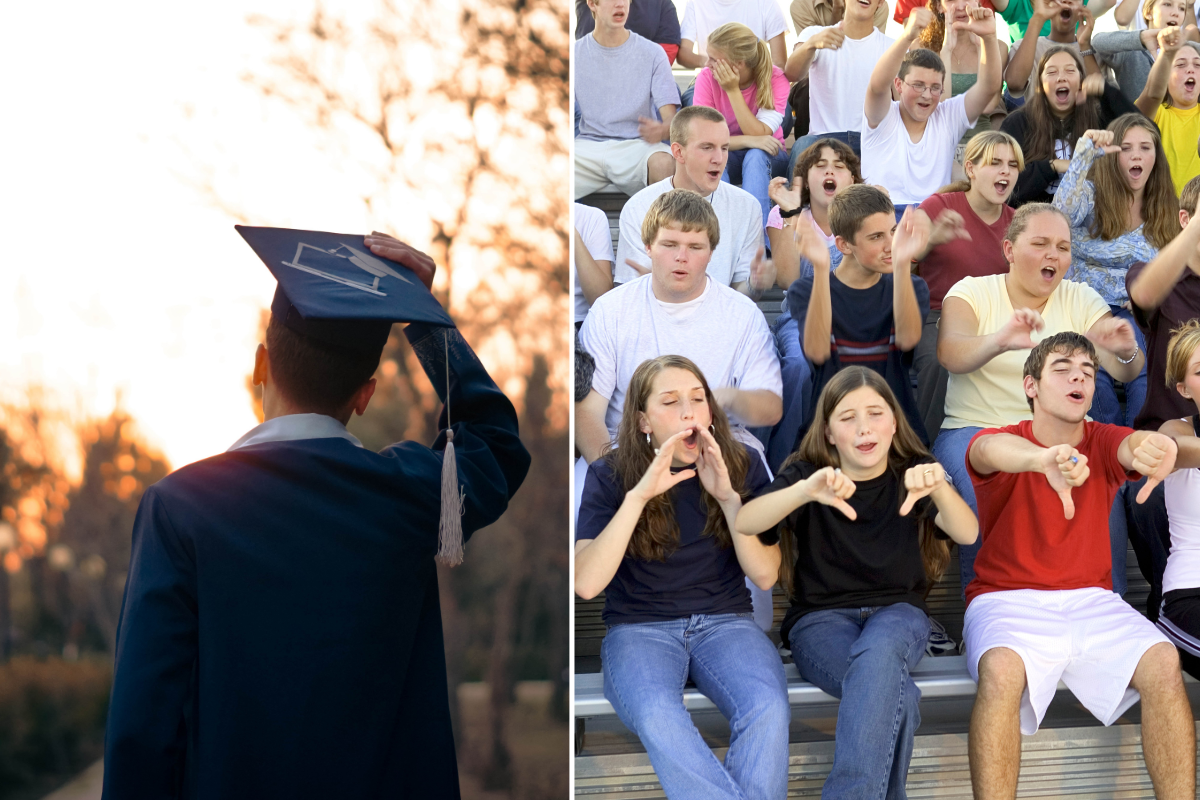
A shower of boos from graduating students began raining down on her. It took Caulfield off guard and, after a chuckle, she needed a moment to gather her thoughts. “OK, I struck a chord. May I finish?”
“Only a few years ago, AI was not a factor in our lives,” she continued. For this, the students cheered. As the speech went on, the boos only grew louder every time Caulfield mentioned the exciting capabilities of AI. She was visibly flustered by the response.
Ex-Google CEO fares even worse in controversial address
Then there was Eric Schmidt, who delivered remarks to graduates at the University of Arizona.
The 71-year-old tech billionaire, and former CEO of Google, was already in the students’ poor graces due to recent allegations of sexual abuse. When he, too, began extolling the exciting virtues of artificial intelligence, the stadium full of grads let him have it.
In part of his monologue, he said: “There is a fear in your generation that… the machines are coming, the jobs are evaporating, that the climate is breaking, that politics is fractured, and that you are inheriting a mess that you did not create.”
He then blamed social media for amplifying the fear and uncertainty, and advocated for young people to help shape artificial intelligence in order to solve these problems—to yet another chorus of boos.
Schmidt and Caulfield did not appear to get the memo that Gen Z is not thrilled with AI, overall. Though a good number of young people do admit to using it from time to time, negative sentiment among Gen Zers has risen sharply in recent years.
Many feel anxious or even flat-out angry about the advancements of artificial intelligence. To them, it’s not an exciting tool to boost the bottom line the way it is for CEOs and VPs. It’s a real threat to their futures. In that sense, the speeches from this year’s commencement speakers have been shockingly tone deaf.
Best-selling author booed for criticizing younger generations
Jonathan Haidt, the massively best-selling author behind The Anxious Generation, has been a leading voice in the movement to protect kids from phones, social media, and technology; and to give them more independence as they grow up.
He’s even gone so far as to call Gen Z coddled, soft, and fragile. Haidt has also attacked universities, claiming they insulate students from challenging ideas with ‘safe spaces and trigger warnings,’ and been vocally against diversity and inclusion initiatives.
It turns out, Gen Z graduates weren’t super excited to hear him speak at their graduation. They let him know exactly how they felt with loud boos during his address at NYU graduation.
The boos represent a fascinating shift
Multi-millionaires and billionaires used to represent the pinnacle of the American Dream. Tech CEOs and Silicon Valley bigshots have been popular choices at commencement ceremonies for years. They’re able to speak as people who “made it” and reached ultimate success.
But young people aren’t falling for it. Gen Z is not impressed with wealth. They’re acutely aware of the growing wealth gap between the older generations and themselves. They don’t face an easy path coming out of school, with huge inflation, stagnant wages, skyrocketing house prices, and growing personal debt.
AI, for whatever positive advances it has made, has largely been a main driver of layoffs that have put more money into the pockets of the 1%. It’s hard to blame young people for not wanting to listen to a billionaire lecture them on the importance of hard work, or for not wanting to cheer a technology that might make their dream job obsolete.
You also have to respect that Gen Z isn’t willing to sit there politely and clap for a man who called them coddled and emotionally fragile.
As they prepare to embark into the next phase of adulthood, Gen Z faces tough—seemingly impossible—challenges. But if these viral moments have taught us anything, it’s that the kids will go down swinging.