‘Back to the Future’ actor has a hilarious card for fans with questions about the movie

Thomas F. Wilson played one of the most recognizable villains in film history, Biff Tannen, in the “Back to the Future” series. So, understandably, he gets recognized wherever he goes for the iconic role. The attention must be nice, but it has to get exhausting answering the same questions day in and day out about…

Array
Photo credit: via KrustyKhajiit / YouTubeArray

Thomas F. Wilson played one of the most recognizable villains in film history, Biff Tannen, in the “Back to the Future” series. So, understandably, he gets recognized wherever he goes for the iconic role.

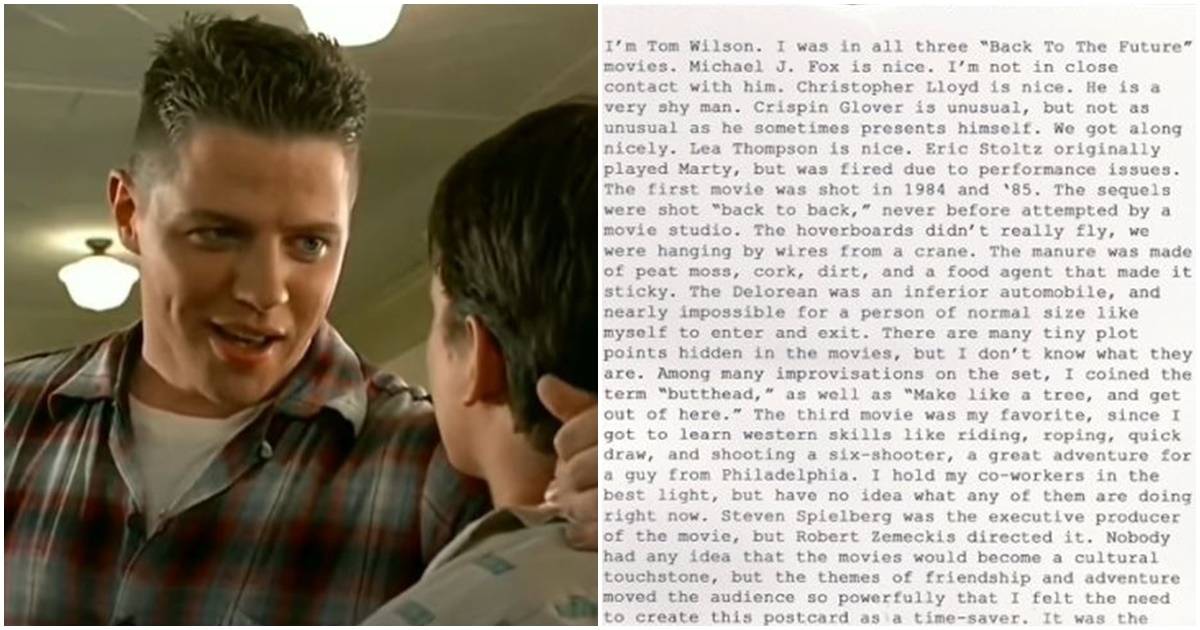
The attention must be nice, but it has to get exhausting answering the same questions day in and day out about the films. So Wilson created a card that he carries with him to hand out to people that answers all the questions he gets asked on a daily basis.


The FAQ page provides the inside scoop on hoverboards, manure, and even the word “butthead.” It also addresses Wilson’s feelings about his co-stars from the film. Evidently, Michael J. Fox and Christopher Lloyd are “nice.”
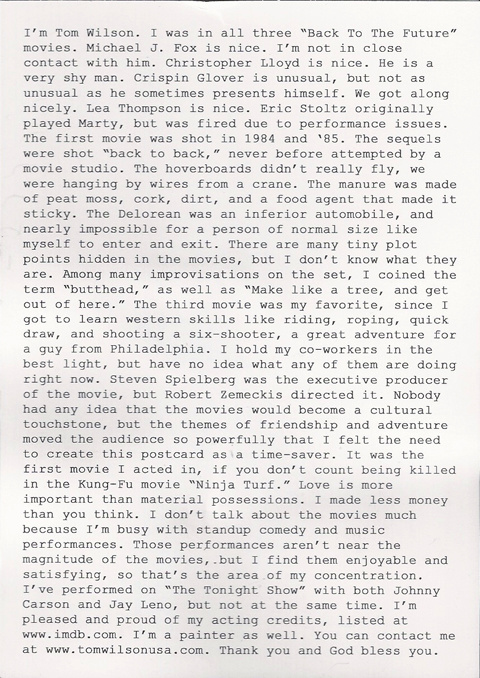
Here’s what the card says.

“I’m Tom Wilson. I was in all three ‘Back To The Future’ movies. Michael J. Fox is nice. I’m not in close contact with him. Christopher Lloyd is nice. He is a very shy man. Crispin Glover is unusual, but not as unusual as he sometimes presents himself. We got along nicely. Lea Thompson is nice. Eric Stoltz originally played Marty, but was fired due to performance issues.

The first movie was shot in 1984 and ’85. The sequels were shot ‘back to back,’ never before attempted by a movie studio. The hoverboards didn’t really fly, we were hanging by wires from a crane. The manure was made of peat moss, cork, dirt, and a food agent that made it sticky. The Delorean was an inferior automobile, and nearly impossible for a person of normal size like myself to enter and exit.

There are many tiny plot points hidden in the movies, but I don’t know what they are. Among many improvisations of the set, I coined the term ‘butthead,’ as well as ‘Make like a tree, and get out of here.’ The third movie was my favorite, since I got to learn western skills like riding, roping, quick draw, and shooting a six-shooter, a great adventure for a guy from Philadelphia.

I hold my co-workers in the best light, but have no idea what any of them are doing right now. Steven Spielberg was the executive producer of the movie, but Robert Zemeckis directed it. Nobody had any idea that the movies would become a cultural touchstone, but the themes of friendship and adventure moved the audience so powerfully that I felt the need to create this postcard as a time-saver. It was the first movie I ever acted in, if you don’t count being killed in the Kung-Fu movie ‘Ninja Turf.’

Love is more important than material possessions. I made less money than you think. I don’t talk about the movies much because I’m busy with standup comedy and music performances. Those performances aren’t near the magnitude of the movies, but I find them enjoyable and satisfying, so that’s the area of my concentration.

I’ve performed on ‘The Tonight Show’ with both Johnny Carson and Jay Leno, but not at the same time. I’m pleased and proud of my acting credits, listed at imdb.com. I’m a painter as well. You can contact me at www.tomwilsonusa.com. Thank you and God bless you.”

Wilson also wrote a hilarious song that deals with the same questions.
  • A Vietnam veteran stood on street corners handing out resumes for six years. One woman saw him and changed his life within 24 hours.
    Photo credit: CanvaAn older man rests by the side of the road.

    When a woman stopped to pump gas in Folsom, California, she noticed a 62-year-old man standing on the nearby street corner holding a sign. He wasn’t asking for money. He was handing out resumes.

    She offered him cash anyway. He declined and handed her a copy of his resume instead.

    “My heart sunk,” she later wrote. She went home and posted his story, along with his resume, to a private Facebook group called Folsom Chat. Within 24 hours, as CBS Sacramento reported, George Silvey had a job.

    Sacramento veteran’s determination pays off

    Silvey was a Vietnam veteran who had spent six years standing on street corners trying to find work the old-fashioned way. He’d had careers in maintenance, heavy equipment operation, painting, and in-home healthcare. He wasn’t looking for charity. He was looking for someone to take a chance on him.

    “I know that once I get my foot in the door, I can make a lot of money real fast,” he told reporters. “All I need is the opportunity.”

    This veteran’s job search was over

    The Facebook post did what six years of sidewalk networking hadn’t. Summer Gonzalez, co-owner of KiKi’s Chicken in Rancho Cordova, saw it and called. The next day Silvey was washing dishes and taking out trash. He showed up early.

    “How many people are really asking to earn their money when you see them out on the street?” Gonzalez said. “And how can you say no to someone that actually wants to take the initiative to take care of himself?”

    She didn’t say no. Neither did Silvey when his roommate’s phone started ringing off the hook with offers after the post went up. “It threw me for a loop because I didn’t expect this to happen so fast,” he said.

    On his first day he put on his uniform shirt and got straight to work. Gonzalez watched and said simply: “He’s a great guy.”

    The importance of community

    Silvey called it a lucky day. But the luck was mostly the woman at the gas station who saw someone doing exactly what she would have wanted someone to do — refusing to beg, asking instead to be given a shot — and decided she was going to make sure he got one.

    “Never give up, never give up hope,” Silvey said afterward. “It can happen and it will happen.”

  • She left a harsh Goodreads review of her coworker’s book. She did not expect to hear it read back to them at work.
    Photo credit: CanvaA woman reading a book.

    When a coworker emailed the whole team a link to her self-published book, the Reddit user who goes by u/Halo9_Spectra did something most people wouldn’t: they actually read it.

    They didn’t love it. The book struck them as generic, lacking originality, going through familiar motions without much of a distinct voice. So at 11 p.m., in a mood they describe as “mild annoyance,” they wrote an honest Goodreads review. Not cruel, they say, but not soft either. They assumed that was the end of it.

    The review came up in the workplace

    Two months later they were sitting in a work meeting when their coworker — the author — brought up the review. She read it aloud, verbatim. She called it “really challenging feedback.” She said it had been the most helpful thing she’d ever heard, that it had compelled her to completely rethink her approach for her next project.

    The anonymous reviewer sat there making what they hoped was an expression that read as “hm, interesting.”

    “I make a face that I hope reads as ‘hm, interesting’ and not ‘that was me,’” they wrote on Reddit.

    Since then, the coworker has cited the anonymous review four more times across different meetings, each time framing it as “brutally honest in the best way.” The reviewer continues to attend these meetings. They have not said anything. They have no intention of doing so.

    “I am never telling her,” they concluded.

    The reviewer has no plans to come forward

    The Reddit thread was predictably divided on whether the coworker’s response was genuine or strategic — some suspected she was fishing to draw out the critic, others thought the gratitude was real. One commenter suggested she might be “pretending to sus out who did it before she kills them.” Another simply said it was “an amazing compliment. Good for both of you.”

    The most interesting part of the story isn’t really the review or even the meeting — it’s the thing it accidentally illustrates about criticism. A genuinely honest negative response, delivered anonymously and without any agenda, turned out to be more useful to the author than whatever supportive replies she’d gotten from colleagues who knew her. The reviewer didn’t pull their punches because they had no reason to. And that, apparently, was exactly what she needed.

    The reviewer is still not telling her.

  • At 19, Jewel turned down a million-dollar record deal. Decades later, she says it was the best decision she ever made.
    Photo credit: Jennifer StoddartJewel performing at The Theatre in Coquitlam, British Columbia in 2008.
    ,

    At 19, Jewel turned down a million-dollar record deal. Decades later, she says it was the best decision she ever made.

    Jewel turned down a million-dollar signing bonus while living out of her car. She went to the library first to understand why she had to.

    Before Jewel sold 30 million albums and earned four Grammy nominations, she was sleeping in her car in San Diego. She hadn’t chosen the situation romantically — she’d been fired after refusing her boss’s sexual advances, lost her paycheck, and couldn’t make rent. Then the car was stolen, leaving her fully homeless. She was 19.

    It was in the middle of all of this that the music industry came looking for her.

    Jewel had found a coffee shop that was going out of business and struck a deal with the owner: she’d bring people in, and she’d keep the door money. She started playing five-hour sets of original material on Thursday nights. Four people became twelve, became twenty, became fifty. A bootleg recording ended up on the radio. Record labels started showing up.

    A bidding war broke out. The biggest offer on the table included a $1 million signing bonus.

    She said no.

    Before making that decision, she did something practical and slightly remarkable: she went to the library and read a book about the music business. What she learned changed everything. “I learned that you owe that money back,” she explained in an interview on ABC’s No Limits with Rebecca Jarvis. “If my record wasn’t successful within a year, I would have been dropped. I would have ended up homeless again. I would have had to make a record that was guaranteed to be a hit, which I didn’t know how to do. I was a folk singer at the height of grunge.”

    In other words: the million dollars wasn’t a gift. It was a loan with conditions attached, and the conditions were essentially designed for her to fail.

    She recently revisited the decision in a conversation with entrepreneur Blake Mycoskie, posted March 30. In it she described the guiding principle she had formed for herself, even without words for it at the time. “I made myself a promise that my number one job in life would be to learn. I called it being a ‘happy whole human,’ not a human full of holes.” She wanted to be an artist more than she wanted to be famous — and she’d learned enough about the industry to know those weren’t the same thing.

    “Do I want to be famous and rich, or do I want to be an artist?” she told ABC. “I used that as my road map.”

    Instead of taking the advance, she negotiated a deal structured around the back end — one that gave her room to build a fan base slowly and stay true to her music. Her debut album, Pieces of You, came out in 1995. It eventually sold more than 12 million copies in the United States alone.

    She has since become a bestselling author, a producer, and an advocate for mental health and emotional resilience. Her motto, which she’s repeated across decades of interviews: “Hardwood grows slowly.”

    “If you can emotionally connect with a human being and cause them to emotionally invest with you, you have something,” she said. “Then you just have to go about it the old-fashioned way.”

  • A teacher came back from vacation to find “concerned” emails from parents. She couldn’t stop laughing.
    Photo credit: Canva.comWoman smiles while looking at her phone

    Ms. B, a 42-year-old teacher in Minnesota, left school on a Friday for a weekend trip to Mexico. When she got back she found emails from some of her students’ parents waiting for her. She wasn’t expecting much. She posted a video reading them on her Instagram page, @tlcwithmsb, and it has since been viewed more than 2 million times.

    Minnesota teacher is not so vanilla

    The first one started warmly — “I hope you are having a great time relaxing, you deserve it” — and then pivoted to business. The parent had heard Ms. B was in Mexico and had one request: real vanilla. Not the kind you get in Minnesota. The good stuff. She offered to Venmo her for the trouble.

    Ms. B couldn’t fulfill the order. Her school district had blocked her email access during the vacation, so she didn’t see the message until she was already home.

    The second email was from a parent concerned about sunburns. She had a home remedy, she explained. She would make it herself. Ms. B just had to come pick it up. “That’s seriously so sweet… I might actually try it,” Ms. B said in her video.

    Parents made sure she wasn’t stranded

    The third came after Ms. B had posted a separate video in a mild panic. She’d accidentally booked her return flight for Monday instead of Sunday and couldn’t easily afford to rebook. A parent watched it and immediately emailed with a solution: Ms. B was welcome to stay at her second cousin’s uncle’s place.

    Ms. B said in her video that parents like these don’t get enough credit. The comment section agreed, filling up with people who said the emails were a perfect picture of what the right kind of school community actually looks like — the kind where the parents are as invested in their teacher as they are in their kids.

    The vanilla, for what it’s worth, remains undelivered.

  • 17 strong opinions the baby boomers actually got right, according to younger generations
    Photo credit: via Christian Buehner/UnsplashBaby boomers didn't get everything wrong.

    In recent years, baby boomers have often been the target of criticism from younger generations (by now you’ve definitely heard the dismissive OK, boomer catchphrase). The most common accusations are that boomers are selfish and don’t care about leaving ample resources (whether financial or environmental) to subsequent generations. They also come under fire for not being able to acknowledge that it was easier for people of their generation to come of age when things were more affordable and life was a lot less competitive.

    However, we should also understand that many of today’s problems are not the boomers’ doing, especially when it comes to the issues that stem from entitled children and technology run amok. In hindsight, there’s something to be said about the importance boomers placed on self-reliance, letting kids be kids, and having a healthy skepticism towards technology.

    In other words, the baby boomers were right! Well, about some things, anyway. In the end, each generation contributes to the tapestry of society in its unique way, whether good or bad, even baby boomers.

    This became evident after a Reddit user asked the AskReddit subforum: ‘What is something you can say ‘I’m with the boomers on this one’ about?”

    Thousands of people responded to the prompt, and the most prevalent problems mentioned by the younger generations were over-reliance on technology, the modern world’s lack of human touch, and how Gen Xers and millennials have raised their children.

    Here are 17 things that younger people are “with the boomers” about.

    1. Public filming

    Public filming has, unquestionably, become a problem. From shaming random folks in the gym to humiliating people dancing at concerts (not to mention catching cheaters), fear of being filmed without your knowledge or consent in public is a real thing people suffer from. The boomers were definitely wise to be wary of cell phone cameras!

    “Just because I’m in public doesn’t mean I want to be filmed. Yeah, I know legally you can, but common courtesy people.” – Jayne_of_Canton

    2. Customer service

    In the age of AI chatbots that are, more often than not, completely useless, I think we can all agree with this one:

    “I want to talk to a person in customer service, not a machine.” – lumpy_space_queenie

    “And also a person that actually works at the company I bought the product from, not a teenager at an outsourced call center with a script to follow and who answers calls for 15 different companies on the same day.” – Loive

    3. Turn up the dialogue

    “For the love of all that is holy, can we fix the audio in movies so that the music and sound FX aren’t drowning out the dialogue?” – Caloso

    “And the action sequences don’t burst your eardrums or the dialogue is whispers.” – Whynottry-again

    Younger generations are on board with this, too. They’re all about subtitles, all the time.

    4. Bring back buttons

    “No, I don’t need everything in my car to be electronic. Some stuff needs buttons.” – LamborghiniHEAT

    “This was the big thing for me in my last car – trying to adjust volume or change songs while driving is way more dangerous when it’s all touch screen. Thankfully my current car has physical knobs for everything.” – GeekdomCentral

    This is another one where the boomers were right all along. Car manufacturers are even listening and making a big push to bring back physical buttons.

    5. App overload

    “Every store/service does not need an app.” – BigDigger324

    “I was standing at a car rental counter at an airport (boomer here) to rent a car. My daughter’s car broke down on the way to pick me up. While standing at the counter, with a customer service rep right there and not busy, I had to log in to their site, create an account, and reserve a car. It seemed ridiculous and it took a long time, filling in my license information and all that. This was last September.” – Cleanslate

    Yep, the boomers were definitely right here. The more apps you have on your phone, the more likely some obscure security vulnerability will end up with your data getting leaked.

    6. Bring back DIY

    “Learning DIY skills is crucial. I had basically zero DIY skills when I bought my house because I had lived in apartments for so long and I’ve had to learn a lot. YouTube tutorials are absolutely clutch.” – JingleJongleBongle

    7. Turn off the speakerphone

    “I hated this when I worked at Walmart. So many of my coworkers would talk on speaker or watch TikTok at full volume. It’s just trashy imo, nobody wants to hear your media.” – WhiteGuy1x

    “I work at an emergency medical office and holy sh*t the amount of people that sit in a quiet, peaceful lobby and just have the LOUDEST conversations on their phone…. Speaker or otherwise. Not to mention the people that still watch sh*t without headphones. Like do you not see the plethora of other people around you that you’re disturbing?” – Cinderpuppins

    8. Ban QR code menus

    “I think menus should be tangible.” – Limp-Management9684

    “QR codes kill the vibe. We’re all on our phones constantly throughout the day and then when you go to spend some quality time with someone, it’s another excuse to whip out the phone and stare at it. There’s an intimacy to a physical menu. You’re looking at what the other person is reading, you’re each pointing to parts of the menu. You’re noticing the lighting of the restaurant. QR codes feel chintzy and kill the ambiance completely.” – VapeDerp420

    We get it, these are for sure a byproduct of the COVID-19 pandemic. But it’s beyond time to bring back the bulky, laminated menus we all know and love.

    9. Stop subscriptions

    “When I was your age, you only had to pay for a video game once to own it.” – CattonCruthby

    Can you imagine a world where you could just buy Microsoft Word and not get charged every year for it? Yeah, that world used to exist. Even some cars are charging drivers subscriptions to “activate” certain features. Seriously.

    10. Free the children

    “A kid should have the same freedom to exist unsupervised and move about their community independently as a boomer did growing up.” – PixelatedFish

    “The world is safer than it’s ever been and people are more scared than ever. I blame true crime and local news.” – Unhappyhippo142

    This is an idea that’s been gaining a lot of steam in popular culture, and the boomers were at the forefront. Perhaps kids aren’t too anxious to walk to school alone; they’re anxious because we don’t let them walk to school alone.

    11. Kids need to touch grass

    “Kids shouldn’t be on phones or iPads all the time. It makes them weird.” – Ubstantial_Part_952

    “The same could be said about most adults.” – DrunkOctopus

    12. Stop being so sensitive

    “People in our generation are far, far too sensitive. Don’t get it twisted; empathy is, by and large, a good thing and it takes some serious doing for me to say it’s gone too far. But collectively, we’ve become people willing to throw every last bit of energy fighting against every slight and making sure our pet cause gets top billing to the point of fighting amongst each other even if we’re in almost complete agreement otherwise. Emotional energy – like any other kind of energy – is very much a finite resource. Whereas boomers could at least generally agree to disagree and get on with things (obvious cross-wielding exceptions doth apply). Culturally, we’ve lost sight of the adage of ‘winning the battle, losing the war.’” – almighty_smiley

    Agreeing to disagree, to a certain acceptable extent, is a lost art. The way we’re all disagreeing now is completely exhausting.

    13. Stop delivery

    “Food delivery services are a complete ripoff; if you use them regularly, you’re terrible with money. Get off my lawn.” – VapeDerp420

    14. Parking meters

    “So rather than throwing a few coins in your meter, you have to now get your license plate #, get your meter number, go to the meter station, stand in line with everyone waiting to pay their meter, then you’re set. It’s an unnecessary amount of extra steps. I don’t carry cash much anymore, but I can hide a small amount of coin in my car to quickly pay a meter.” – Luke5119

    Even better is when you have to download a Parking app so you can pay the city money to park! The boomers love that one, and so do the rest of us.

    15. Kids should know their place

    “Not letting your children rule the roost. When did it become acceptable to let your kids back-talk to you, slap you, climb all over sh*t in public places? As we’ve raised ours, I’ve witnessed so many parents around us just let these behaviors slide. It’s kind of sad when I’m the one saying things like, “Did I just hear you just say that to your mom?!?!?!?! That is not ok. You go and apologize right now!!”. Then I get this stunned “deer in headlights” look back that tells me they aren’t used to someone calling them out on their behavior.” – Cobblestone-Villain

    Gentle parenting definitely has its merits and benefits, but the boomers were right to be a little bit skeptical: In the wrong hands, it can backfire tremendously.

    16. Pride in ownership

    “Seems that a lot of boomers have pride of ownership and enjoy maintaining what they have.” – Awkward_Bench123

    17. Don’t follow leaders

    “My dad (a solid boomer) has been saying that ALL politicians are crooks since he became disenchanted with politics around the Nixon era. He was starry-eyed before that, trying to make social change, yada yada. He still votes, but holds his nose. Can’t say I disagree with him.” – Thin_white_duchess

    This article originally appeared two years ago. It has been updated.

  • Investigative journalist reveals the simple way you can protect your  phone from getting hacked
    Photo credit: Daily Show/Youtube, CanvaJournalist Ronan Farrow explains how turning off your phone each night can protect you from getting hacked
    , , ,

    Investigative journalist reveals the simple way you can protect your  phone from getting hacked

    His simple tip can offer protection in a time of less-than-stellar privacy regulations.

    There are just so many ways for important information held on your phone to be swiped—from subscription based apps that secretly send private customer data to Facebook to fake accounts that get your friends to invest in some kind of fake crypto.

    And of course—this is more than a modern day inconvenience. It poses real threats to democracy and global human rights, which is why so many are calling for more regulations and safeguards. Of course, as with most regulations, change isn’t coming fast. Which isn’t good news, considering how rapidly technology evolves.

    However, Pulitzer Prize winning investigative journalist Ronan Farrow has an incredibly simple tip for preventing our phones from being hacked: Turn them off more often.

    Why Ronan Farrow says we should all be ‘freaking out’

    While appearing on the Daily Show to promote his new documentary, Surveilled, Farrow told host Desi Lydic that we as a society should be “freaking out” more about the lack of government restraints about spyware technology, saying that it could turn the country “into an Orwellian surveillance state,” affecting anyone who uses a device, essentially—not just political dissidents.

    But, as Farrow noted, turning your phone off and on every day is an easy way to protect yourself, since most current forms of spyware “will be foiled by a reboot.” And even if you aren’t, say, a journalist or a political activist (i.e. common targets for malware), you’re thwarting apps from monitoring your activity or collecting your data. And better still, you’re making it more difficult for hackers to steal information from your phone. Privacy protection aside, it’s a great way of just keeping your device healthy. Basically, it seems like the age-old solution for virtually all tech issues still holds up.

    More easy steps you can take right now

    ronan farrow, surveilled max, documentary, privacy, journalism, daily show, spyware, malware
    Remembering to turn it off…that’s a different challenge altogether. Photo credit: Canva

    There are a few other things worth turning off now and then, such as bluetooth and location devices when you’re not using them, according to the NSA. In addition, Farrow also suggested keeping devices updated, and perhaps most important of all, actually writing to your representative about the issue.

    However, when it comes to wrapping devices in tinfoil as a makeshift Faraday cage…that might not be the best use of one’s aluminum.

    “Experts vary on exactly how effective that approach is,” Farrow told Lydic, just before quipping, “we need better policies. Not just better tinfoil.”

    The documentary that started it all

    Expanding on Farrow’s 2022 New Yorker investagative exposé on the notorious spyware Pegasus, Surveilled, which is available to stream on Max, delves into the multibillion-dollar industry of commercial spyware and its potential threats, making it evidently clear that this is not an issue for the elite few, or one to ignore until the future.

    On a (slightly) brighter note, Farrow debuted another new work in 2025, this time a true crime investigative podcast, titled Not a Very Good Murderer, which he himself narrates. Find it on Audible.

    This article originally appeared two years ago. It has been updated.

  • Passenger on 274-day cruise is surprised to learn the one word you can’t say on the ship
    Photo credit: via Mattew Barra/PexelsThere's one word you can't say on a cruise ship.

    There are some things you just don’t say. You don’t yell out “bomb!” on an airplane, make jokes about carrying weapons while going through security, or, as Michael Scott from The Office knows, loudly proclaim that a boat you’re currently on is sinking.

    Those are all pretty obvious examples, but sometimes etiquette and decorum are a little more subtle. If you’re not experienced in the ways of the venue you’re in, you might not know all the unspoken rules. And you might find out the hard way. Cruise ships, for example, have their own very specific set of rules and regulations that guests should abide by.

    On December 10, 2023, Royal Caribbean’s Serenade to the Seas set sail on the Ultimate World Cruise—a 274-day global trek that visited 11 world wonders and over 60 countries.

    This incredible trip covered the Americas, Asia Pacific, Middle East, Mediterranean and Europe with a ticket price that ranged from $53,999 to $117,599 per passenger.

    With such a unique and incredible offering, it’s understandable that Royal Caribbean wanted to invite plenty of influencers to help them get the word out.

    The TikToker who accidentally broke the biggest rule at sea

    Aboard the Serenade to the Seas was TikToker Marc Sebastian, who has amassed over 2.5 million followers, documented his experience throughout the journey. In one video with over 5 million views, he revealed what he’s learned over his first few weeks aboard the ship; the biggest was the one word you’re not allowed to say.

    “So here’s [what] I’ve learned about cruising since I’ve spent 18 nights on this floating retirement home with a Cheesecake Factory attached. First, number one, you’re not supposed to talk about the Titanic,” he says in the clip.

    Titanic! It’s the ultimate taboo when you’re on a giant ship traversing the ocean. Even after all these years, it’s still too soon to make even lighthearted comparisons or jokes.

    “Who knew that? I didn’t,” Sebastian said. “I brought it up to an entire room of people having lunch that our ship is only 100 feet longer than the Titanic – when I tell you that utensils dropped. Waiters gasped. It’s dead silent.”

    The room went completely silent

    Sebastian was flabbergasted. “It wasn’t in the… handbook,” he joked. “Not that I read the handbook, clearly.”

    After the unexpected reaction, his cruise friend told him, “You’re not allowed to talk about the Titanic.” It makes sense.

    Who wants to be reminded of the tragedy that killed around 1,500 people while sinking one of the most impressive engineering feats of the era? More experienced cruisers chimed in that they were familiar with the unique piece of etiquette.

    “When I went on a cruise, my mom told me saying Titanic was equivalent to screaming ‘bomb’ at an airport,” Mikayla wrote in the comments.

    “It’s like saying Macbeth in a theatre, it’s an unspoken rule” another commenter added.

    “I’m sorry you’re telling me you had a Harry Potter like experience saying Voldemort at Hogwarts but it was the titanic on a modern day cruise I’m cryingggg” joked another.

    Later in the video covering little known cruise facts, Sebastian admits he was surprised to learn that cruise ships have godmothers and that the pools are filled with seawater.

    So, did he end up staying for all 274 days?

    In an update from June of 2024, Sebastian explains that he only stayed on the cruise for 18 nights. He was not booked to stay throughout the entire voyage, and for him, that was a relief.

    He initially jokes that he was kicked off the boat for saving a penguin that had jumped aboard. But in the end, he admits he was more than happy to deboard early.

    “I walked off that ship not a happy man,” he said, saying the ship was overstimulating and stressful. In another video, he films as the ship navigates the Drake Passage, one of the most notoriously dangerous and choppy stretches of water in the world. It looks stressful indeed, to say the least.

    Cruising isn’t for everyone, let alone for 274 days straight! But now Sebastian knows the golden rule for his next cruise.

    This article originally appeared two years ago. It has been updated.

  • ‘Wicked’ author reveals subtle clue in ‘The Wizard of Oz’ that Glinda and Elphaba were friends
    Photo credit: Public domainGregory Maguire was inspired by a line in the original 1939 film "The Wizard of Oz."
    ,

    ‘Wicked’ author reveals subtle clue in ‘The Wizard of Oz’ that Glinda and Elphaba were friends

    “I fell down onto the ground laughing at the thought that they had gone to college together.”

    Have you ever watched a movie or read a book or listened to a piece of music and wondered, “How did they come up with that idea?” The creative process is so enigmatic even artists themselves don’t always know where their ideas come from, so It’s a treat when we get to hear the genesis of a brilliant idea straight from the horse’s mouth. It’s often not what you would expect!

    If you’ve watched Wicked and wondered where the idea for the friendship between Elphaba (the Wicked Witch) and Glinda (the Good Witch) came from, the author of the book has shared the precise moment it came to him.

    The many iterations of Wicked

    The hit movie Wicked is based on the 20-year-old hit stage musical, which is based on the novel Wicked: The Life and Times of the Wicked Witch of the West written by Gregory Maguire. It says a lot about how powerful the story is that it has succeeded in so many different mediums and continued to find new audiences that connect with it.

    While the musical is a simplified version of the 1995 book, the basic storyline—the origins of the two witches from “The Wizard of Oz”—lies at the heart of both. In an interview with BBC, Maguire explained how Elphaba and Glinda’s friendship popped into his head.

    The moment of inspiration that started it all

    Maguire was visiting Beatrix Potter’s farm in Cumbria, England (Potter was an author and illustrator who created Peter Rabbit) and thinking about “The Wizard of Oz,” which he had loved as a child and thought could be an interesting basis for a story about evil.

    “I thought ‘alright, what do we know about ‘The Wizard of Oz’ from our memories,’” he said. “We have the house falling on the witch. What do we know about that witch? All we know about that witch is that she has feet. So I began to think about Glinda and the Wicked Witch of the West…

    “There is one scene in the 1939 film where Billie Burke [Glinda] comes down looking all pink and fluffy, and Margaret Hamilton [The Wicked Witch] is all crawed and crabbed and she says something like, ‘I might have known you’d be behind this, Glinda!’ This was my memory, and I thought, now why is she using Glinda’s first name? They have known each other. Maybe they’ve known each other for a long time. Maybe they went to college together. And I fell down onto the ground in the Lake District laughing at the thought that they had gone to college together.”

    Sometimes it’s the crazy idea that works the best

    Maguire must have thought the idea of Glinda and The Wicked Witch attending college together was absurd at the time. What a kooky idea! But he pursued it nonetheless and, well, the rest is history.

    In “Wicked,” Glinda and the Wicked Witch, Elphaba, meet as students at Shiz University, a school of wizardry. They get placed as roommates, loathe each other at first, but eventually become best friends. The story grows a lot more complicated from there (and the novel goes darker than the stage play), but it’s the character development of the two witches and their relationship with one another that force us to examine our ideas about good and evil.

    Watch his explanation and inspiration here:

    Why the Wicked Witch specifically?

    Maguire also shared with the Denver Center for Performing Arts what had inspired him to use the “Wizard of Oz” characters in the first place.

    “I was living in London in the early 1990’s during the start of the Gulf War. I was interested to see how my own blood temperature chilled at reading a headline in the usually cautious British newspaper, the Times of London: ‘Sadaam Hussein: The New Hitler?’ I caught myself ready to have a fully formed political opinion about the Gulf War and the necessity of action against Sadaam Hussein on the basis of how that headline made me feel. The use of the word Hitler – what a word! What it evokes! When a few months later several young schoolboys kidnapped and killed a toddler, the British press paid much attention to the nature of the crime. I became interested in the nature of evil, and whether one really could be born bad,” he said.

    “I considered briefly writing a novel about Hitler but discarded the notion due to my general discomfort with the reality of those times,” he continued. “But when I realized that nobody had ever written about the second most evil character in our collective American subconscious, the Wicked Witch of the West, I thought I had experienced a small moment of inspiration. Everybody in America knows who the Wicked Witch of the West is, but nobody really knows anything about her. There is more to her than meets the eye.”

    What the story is really about

    Authors and artists, and their ideas, help hold a mirror up to humanity for us to see and reflect on who we are, and “Wicked” is one of those stories that makes us take a hard look at what we’re seeing in that mirror. Thanks, Gregory Maguire, for launching us on a collective journey that not only entertains but has the potential to change how we see one another.

    The second Wicked film, For Good, hit theaters in November 2025 and is now streaming on Peacock.

    This article originally appeared two years ago. It has been updated.

Culture

She left a harsh Goodreads review of her coworker’s book. She did not expect to hear it read back to them at work.

Culture

At 19, Jewel turned down a million-dollar record deal. Decades later, she says it was the best decision she ever made.

Culture

A teacher came back from vacation to find “concerned” emails from parents. She couldn’t stop laughing.

Culture

17 strong opinions the baby boomers actually got right, according to younger generations