upworthy
Add Upworthy to your Google News feed.
Google News Button
Democracy

Dr. Seuss might be known for his children's books, but his political cartoons were next-level

The well known author wrote more than 400 clever and poignant cartoons during World War II.

Dr. Seuss, UC San Diego Library, archives, history, cartoonist
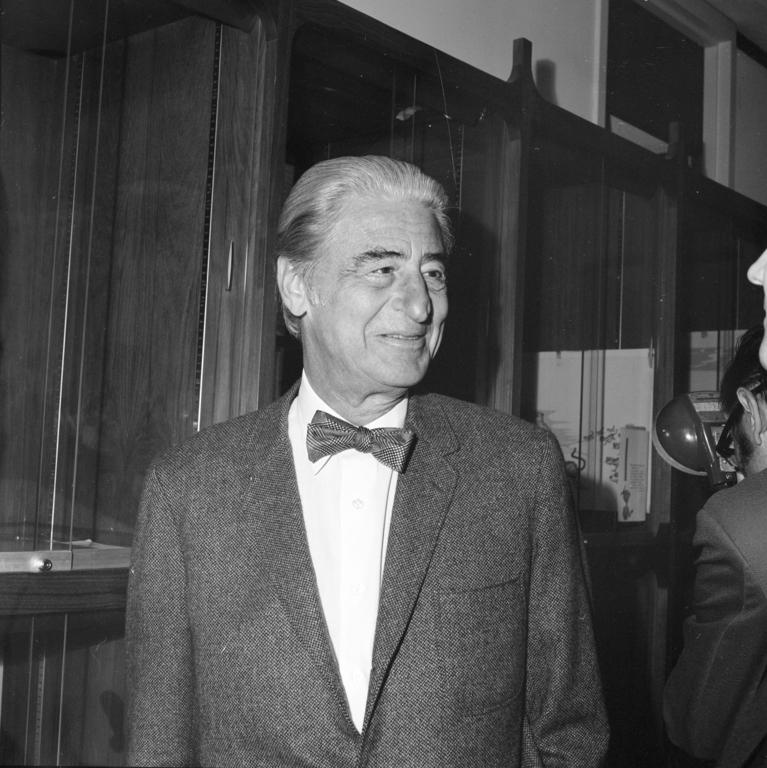
Image dated November 25, 1969, via SIO Photographic Laboratory Collection: Selections, UC San Diego Library

This photo was taken of Theodor Seuss Geisel at the UC San Diego Library.

Did you know that in addition to being a beloved author of children's books, Dr. Seuss wrote more than 400 political cartoons during World War II?

Theodor Seuss Geisel, better known as Dr. Seuss, gifted the world with stories like "The Cat in the Hat," "The Lorax," "Green Eggs and Ham," and dozens of other childhood classics until his death in 1991.

In recent years, however, it's some of his lesser known works from the 1940s that have gained attention.

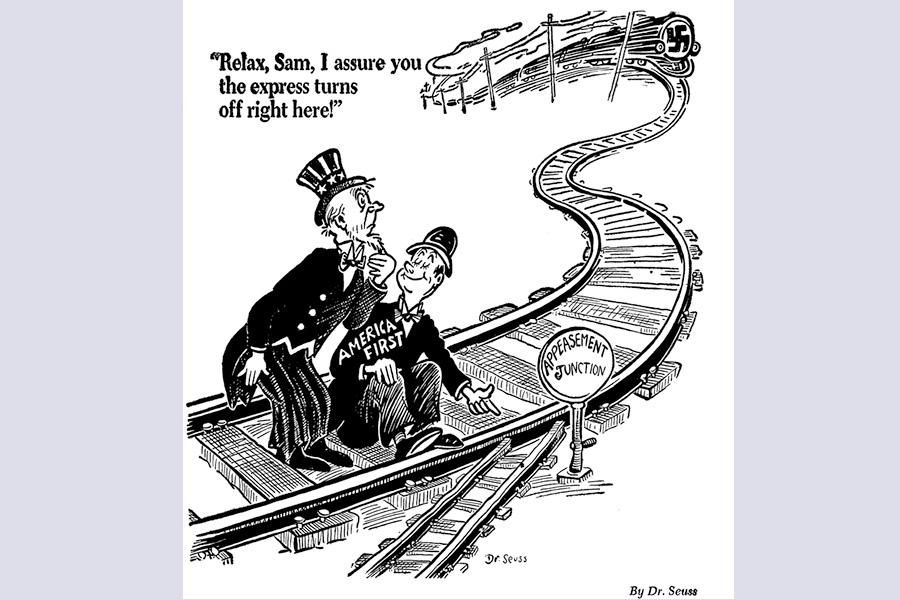
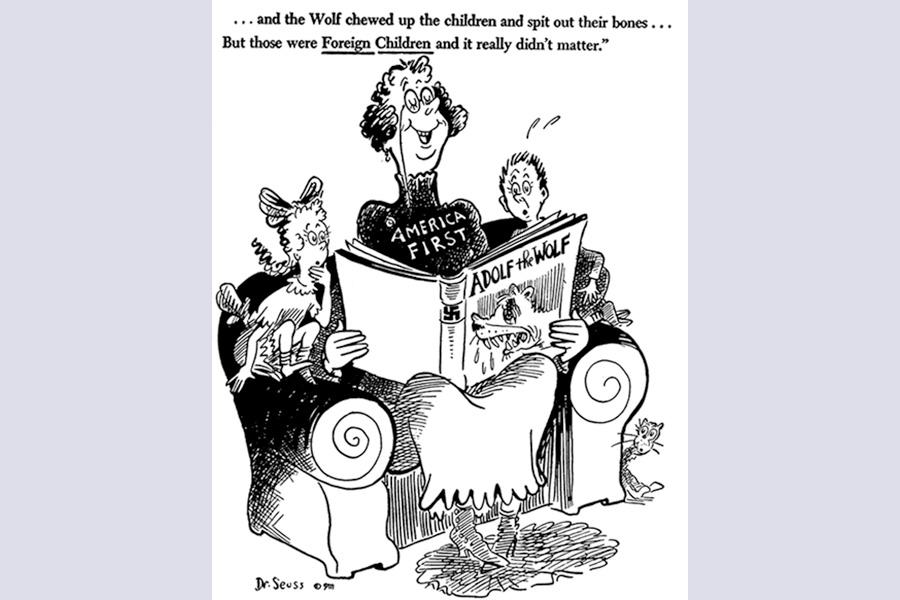
As World War II was slowly moving toward a reality, Seuss began penning cartoons for PM, a liberal publication, frequently pushing back against the "America First" mentality of U.S. isolationists opposed to U.S. involvement in the war.

So when Donald Trump adopted "Make America Great Again" as his campaign slogan, echoing cries of "America First" — the rallying call for an anti-Semitic and Nazi-appeasing segment of the wartime U.S. population — some of Seuss' cartoons began to find new relevance more than 70 years after first being published.

Like this one, which depicts a mother reading a book titled "Adolf the Wolf" to children while wearing an "America First" shirt, explaining that because the wolf's victims were foreign children, it didn't really matter that the wolf ate them — a clear parallel to the conflicting approaches to our modern refugee crisis.
Dr. Seuss, political cartoon, isolationism, refugee crisis

A Dr. Seuss political cartoon sharing thoughts on isolationism.

Image dated Oct. 1, 1941, via Dr. Seuss Political Cartoons/Special Collection and Archives, UC San Diego Library

"And the Wolf chewed up the children and spit out their bones ... but those were Foreign Children and it really didn't matter."

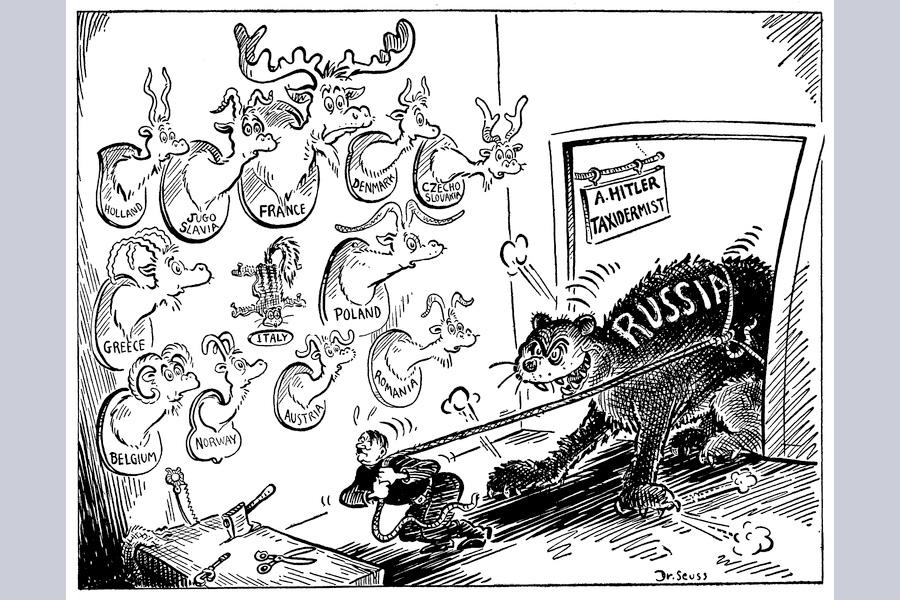
Russia, Germany, Europe, war, political cartoon

Cartoon about WWII and Hitler dragging Russia into the war.

Image dated June 25, 1941, via Dr. Seuss Political Cartoons/Special Collection and Archives, UC San Diego Library.

"A. Hitler taxidermist"

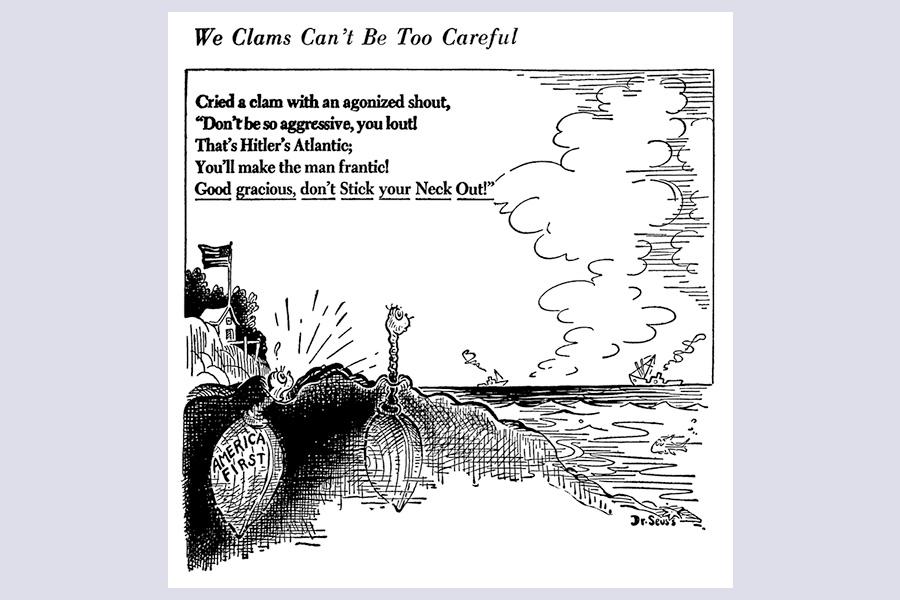
clams, frantic, Hitler, political satire, 1941

Dr. Seuss uses clams in talking about Hitler in a political cartoon from 1941.

Image dated July 17, 1941, via Dr. Seuss Political Cartoons/Special Collection and Archives, UC San Diego Library.

"We Clams Can't Be Too Careful."

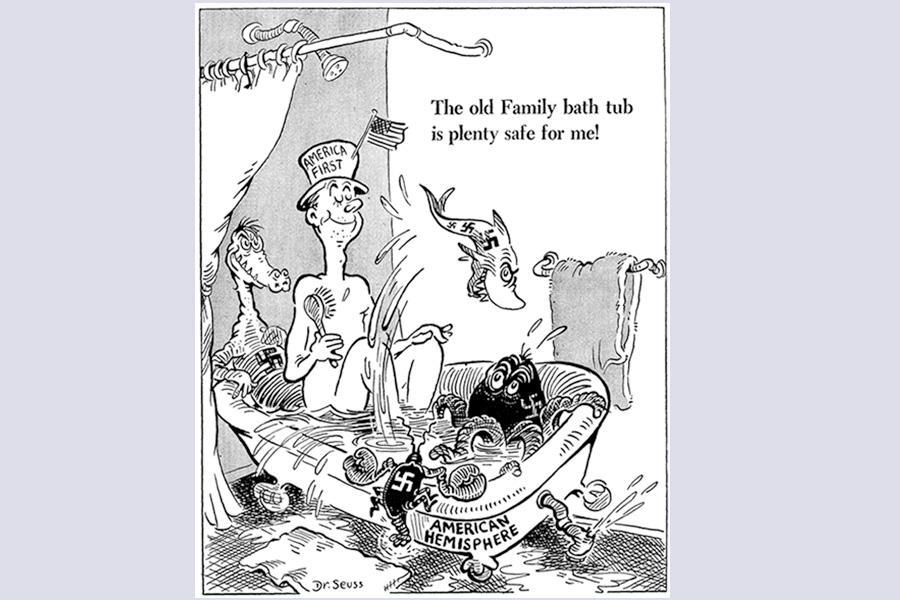
political satire, cartoon, WWII, war commentary

A political satire created by Dr. Seuss on the impending World War II.

Image dated May 27, 1941, via Dr. Seuss Political Cartoons/Special Collection and Archives, UC San Diego Library.

"The old Family bath tub is plenty safe for me!"

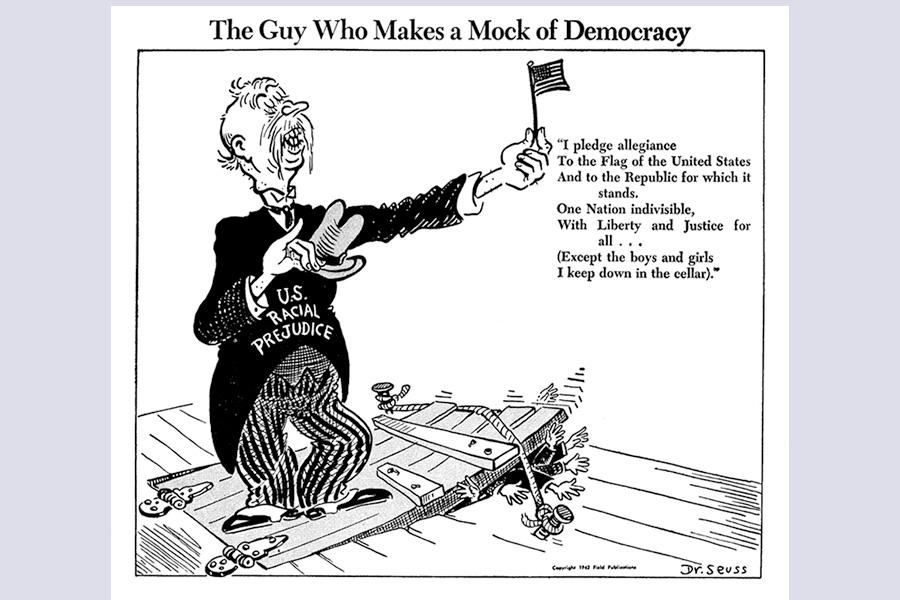
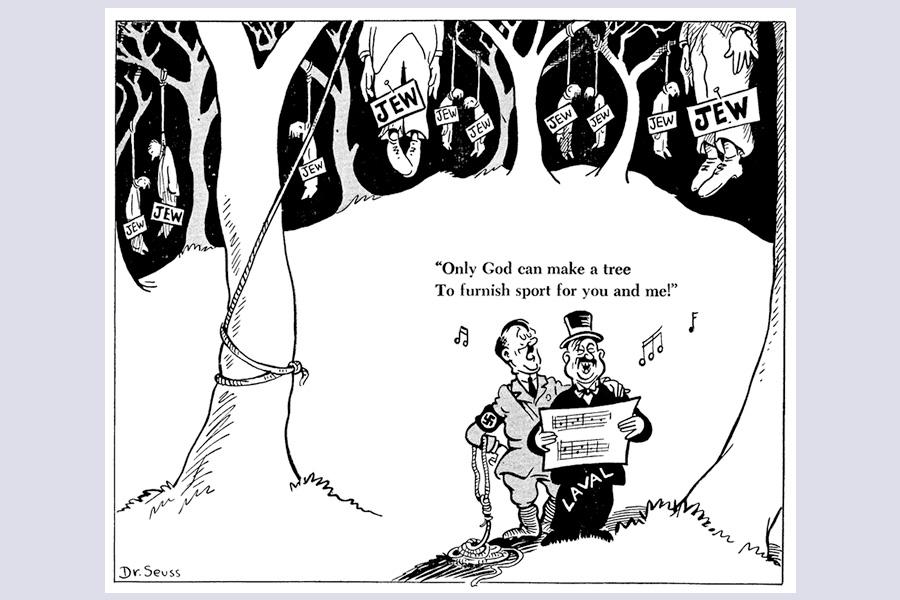
Suess's other comics took aim at overarching issues like anti-Semitism, racial inequality, and political obstructionism — all issues still relevant today.

To be sure, the comics were far from perfect and reflected some ugly stereotypes of their own. For instance, many of his cartoons amplified some pretty awful impressions of Japanese citizens and Japanese-Americans. And while it's easy to chalk that up as being simply an element of the time, that type of anti-Japanese sentiment helped fuel the racism and paranoia that eventually led to Japanese internment.
WWII, Hitler, cartoon, singing, antisemitism

A Dr. Seuss cartoon depicts Hitler singing.

Image dated July 20, 1942, via Dr. Seuss Political Cartoons/Special Collection and Archives, UC San Diego Library.

"Only God can make a tree to furnish sport for you and me!"

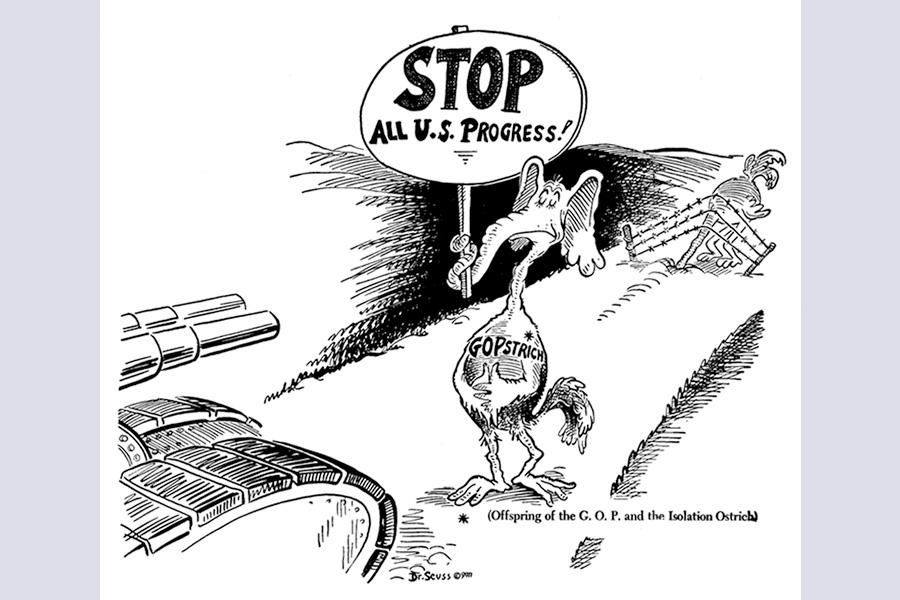
elephant, tank, satire, archives, political, Dr. Seuss

An elephant tries to stop a tank in a political cartoon.

Image dated Oct. 24, 1941, via Dr. Seuss Political Cartoons/Special Collection and Archives, UC San Diego Library.

"Stop all U.S. progress."

pledge of allegiance, flag, political cartoon, racial prejudice

Political cartoon uses 'Pledge of Allegiance' to make a point.

Image dated July 30, 1942, via Dr. Seuss Political Cartoons/Special Collection and Archives, UC San Diego Library.

"The Guy Who Makes a Mock of Democracy."

appeasement, Nazism, America first, political cartoon

Political cartoon suggests the war is coming to America.

Image dated Sept. 9, 1941, via Dr. Seuss Political Cartoons/Special Collection and Archives, UC San Diego Library.

"Relax, Sam, I assure you the express turns off right here!"

If the world of Dr. Seuss can teach us anything, it's that history is our best defense against modern tyranny.

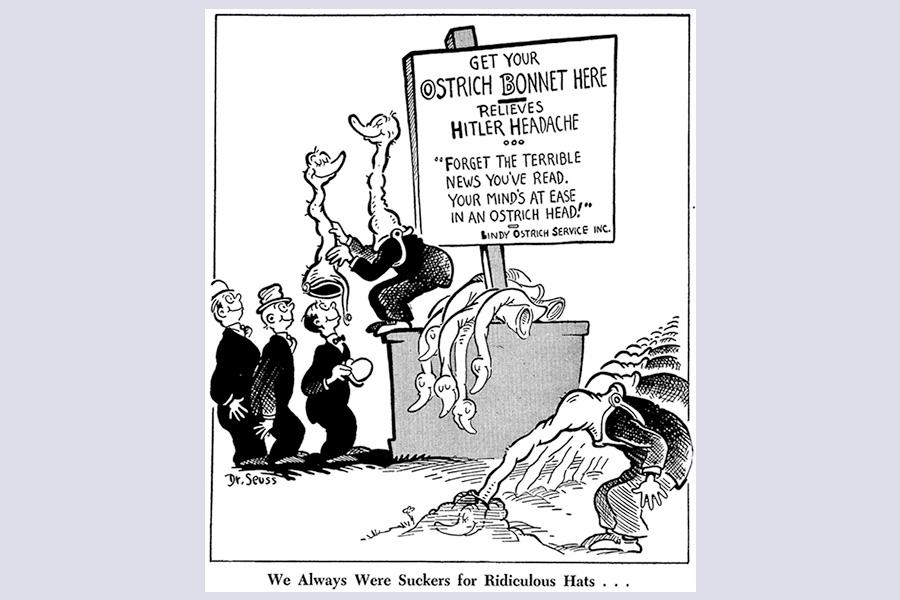
Well, that, and the fact that Americans will always love goofy hats:
satire, analogies, political satire, cartoons, 1940's

Political cartoon suggests burying your head in the sand.

Image dated April 29, 1941, via Dr. Seuss Political Cartoons/Special Collection and Archives, UC San Diego Library.

"We Always Were Suckers for Ridiculous Hats."

See more of Seuss' wartime comics at the University of California San Diego Library's website.This story originally appeared on 03.02.17

boomer grandparents, boomer grandparent, millennial parents, millennial parent, grandkids
Image via Canva/PeopleImages

Boomer grandparents are excessively gifting their grandkids, and Millennial parents have had enough.

Millennial parents and Boomer grandparents don't always see eye to eye on parenting and grandparenting. Now, Millennial parents are uniting on a nightmare Boomer grandparenting trend that sees them "excessively gifting" their grandkids with tons of both new and old *unwanted* stuff during visits.

Ohio mom Rose Grady (@nps.in.a.pod) shared her "Boomer grandparent" experience in a funny and relatable video. "Just a millennial mom watching her boomer parents bring three full loads of 'treasures' into her home," she wrote in the overlay.


Grady can be seen looking out the window of her home at her Boomer mom and dad carrying bags and boxes up her driveway after several visits. The distressed and contemplative look on Grady's is speaking to plenty of Millennial moms.

@nps.in.a.pod

Today's "treasure" highlight was the mobile that hung in my nursery... #boomerparents #boomers #boomersbelike #millennialsoftiktok #millenialmom #motherdaughter

Grady captioned the video, "Today's 'treasure' highlight was the mobile that hung in my nursery..."

The humorous video resonated with with fellow Millennial parents. "Straight to the trash when they leave," one viewer commented. Another added, "I always say 'if you don’t want it in yours, we don’t want it in ours' 😂."

Even more Millennial parents have shared and discussed their situations with Boomer grandparents buying their kids too much stuff on Reddit. "Both my mother and my MIL love buying and sending toys, books, clothes, etc. I don't want to be ungrateful but we just don't need it and don't have the space. I have brought this up politely in 'we are all out of drawers for that' but it hasn't slowed things down," one explained. "I think part of the issue is that the grandparents live in different cities and vacation a lot. They don't get to see our daughter much so they buy stuff instead."

Another Millennial parent shared, "While the intention is very kind behind these, all the grandparents are very aware that we do not need, nor wish to receive these gifts in such an excessive volume - as it creates a daily struggle to store and accommodate in our home. I struggle to keep on top of tidying as it is, and this is a massive added challenge."

millennial parents, millennial parent, millennial mom, kids room, organize Millennial mom struggles to organize her son's room.Image via Canva/fotostorm

How to talk to Boomer grandparents about gifts

So, why are Boomer grandparents excessively gifting? "Boomer grandparents may be the first grandparent generation to have accumulated the substantial discretionary funds that enables them to spend money on their grandchildren," Sari Goodman, a Certified Parent Educator and founder of Parental Edge, tells Upworthy. "These grandparents probably grew up with grandparents who didn’t have that kind of money and so they may be excited to give their grandchildren the things they didn’t get."

Goodman suggests that Millennial parents first discuss with them the "why" behind the gifting. "What comes before setting a boundary to limit over-the-top gift-giving is delving into the reasons grandparents are buying so much," she explains. "Coming from a place of compassion and understanding makes it possible to come up with mutually beneficial solutions."

- YouTube www.youtube.com

She recommends that Millennial parents sit down with their Boomer parents to learn more. "Did they grow up without many toys and clothes and are fulfilling a dream? Ask them about the values they learned as children (hard work, perseverance, the power of delayed gratification) and how they can pass on these lessons to the grandchildren," she suggests.

She adds that another reason may be that Boomer grandparents live far away and want their grandchildren to feel a connection with them. "Set up a regular FaceTime or Zoom meeting. Rehearse with the kids so they have something to say and suggest a topic for the grandparents," says Goodman. "Or send snail mail. Kids love getting mail. The grandparents can send postcards from where they live and explain some of the special sites."

boomer grandparents, boomer grandparenting, video chat, video call, grandkids Boomer grandparents have a video call with grandkids.Image via Canva/Tima Miroshnichenko

Finally, Goodman adds that for some grandparents, this may be is the only way they know how to show their love. Millennial parents could ask if they would be open to other ideas. "Parents can set up an activity for grandparents and kids to do when they come over—a jigsaw puzzle, art activity, board game, magic tricks," she says. "Arrange for the grandchildren to teach the grandparents something their phones can do or introduce them to an app they might like."

This article originally appeared last September

Fatherhood

Teen psychologist explains why kids actually love family vacations, even if they pretend not to

They may roll their eyes the whole time, but they're really enjoying themselves.

moody teen, teenager, girl wearing headphones, teen and window, iPod

A teen looking out the window.

Saturday Night Live completely nailed it last year with the sketch “Goth Kid on Vacation,” which perfectly sums up what it's like to take a grumpy teen to a tropical paradise. Even though he's staying at a beautiful beach resort in Jamaica, he'd rather sit in his hotel room reading graphic novels or playing video games than water ski, snorkel, or, God forbid, get a tan.

The sketch struck a nerve because it's hilarious to see a kid dressed all in black lounging on a deck chair in Jamaica, while also resonating with parents trying to enjoy vacations with teens they can't quite reach. However, while the goth kid appears miserable, child and teen psychologist Dr. Erika Velez says he may still be forming core memories, even when it doesn't appear that way.


Do teens like going on vacation with their families?

Velez says the main reason kids and teens love going on vacation is the time they get with their parents.

@drerikav

This might be surprsing to hear but its worth sharing! #childpsychologist #teenpsychologist #responsiveparenting #parentingtips #connectedparenting

"The things that they tend to mention, especially the younger ones, have more to do with the time that they spent with their parents, and here's what I mean: often it's that they share the room with their parents," Velez says in a TikTok video. "They tend to really enjoy that, and then having their parents' attention through meals, like there is a chance that throughout the school year they're not having breakfast, lunch, and dinner with their parents, and now they are."

Velez adds that even though teens may get moody on vacation, they're still creating core memories that will last a lifetime.


Velez says teens actually enjoy family vacations

"A recurrent theme that I hear, especially for parents of teenagers, they really wonder, like 'What's the point of bringing these kids along on this vacation, they're complaining the entire time?'" Velez continues. "You'd be surprised at some of the positive feedback that I also get. So I'd like to share that with you all that despite what's happening on the outside, on the inside, when they share these are memories and core memories that you are creating with your family."

Here are some of the comments on Velez's video:

"My 16-year-old always looks so miserable on vacation, but he also always asks when we're going on another one, so I feel like he enjoys our trips together."

"Yes, we took a disaster 2-day road trip, years later my daughter said it was the best."

"I absolutely love this! It's a reminder that making sure my son and I have a little getaway every year."

The pleasant takeaway from Velez's video is that the main thing kids and teens remember after a vacation is spending time with their parents, whether that means a long breakfast or hanging out in bed watching movies at the hotel. It's a great reminder that the destination may not be the most important part of a vacation. The real joy comes from breaking out of our routines and spending quality time with family.

- YouTube www.youtube.com

Pop Culture

In 1969, the Monkees appeared on The Johnny Cash Show and played a stunning, original country song

"Nine Times Blue" is a jaw dropping intersection of craftsmanship and pure talent.

the monkees, nume times blue, monkees live, monkees country, johnny cash show

The Monkees perform on "The Johnny Cash Show."

The great debate about The Monkees is whether they were a real band or just a group of actors thrown together for a TV show. The answer is yes. They were actors cast to play an American version of The Beatles, and many of their early songs were written by big-time professional songwriters such as Tommy Boyce, Bobby Hart, Neil Diamond, Carole King, and Gerry Goffin.

However, The Monkees would pick up their own instruments, play on the 1967 Headquarters album, and perform as a live band on sold-out tours. After a resurgence in the '80s, the band enjoyed a lucrative career as a legacy act, with various members continuing to perform as The Monkees until Michael Nesmith died in 2021. Nesmith, originally a country singer from Dallas, Texas, wrote several of The Monkees' hits, including "Mary, Mary," "Papa Gene's Blues," "The Girl I Knew Somewhere," and "Listen to the Band," and was a driving force in the group being taken seriously as musicians.


By the summer of 1969, The Monkees' TV series was off the air, and the affable Peter Tork had exited the group, citing exhaustion. The remaining three soldiered on, performing on The Johnny Cash Show to promote their latest album, Instant Replay. The band chose to perform "Nine Times Blue," a country song written by Nesmith that he had demoed at the time but wouldn't be released until he recorded it as a solo artist in 1970.

The performance is a wonderful reminder that The Monkees were great comedic actors and accomplished musicians. Davy Jones and Micky Dolenz do a fantastic job singing harmonies on the chorus, while Nesmith plays some nice fills on his Gibson acoustic.

- YouTube www.youtube.com

Later in the show, The Monkees joined Cash for a performance of his 1966 novelty song, "Everybody Loves a Nut," which perfectly suited the band's comedic sensibilities. Two weeks after the release, Cash scored one of his biggest hits with "A Boy Named Sue," recorded live at San Quentin prison.

A few months later, Nesmith left The Monkees to pursue a country-rock career, first with the seminal group The First National Band, which scored a Top 40 hit with "Joanne" from the album Magnetic South.

- YouTube www.youtube.com

Although Nesmith's country-rock albums of the '70s were moderately successful, he was still overshadowed, as a musician, by The Monkees' towering success and subsequent downfall. In the '70s, it wasn't easy for Nesmith to get the respect he was due as a country artist. But in the years leading up to his death in 2021, Nesmith's work was reappraised, and he was seen as a brilliant songwriter who anticipated the rise of alt-country.

The Monkees hold a complicated place in rock 'n' roll history. While some see them as a prefabricated band assembled to cash in on The Beatles' success, others recognize them as talented musicians brought together under bizarre circumstances who forged their own path and created something fresh and innovative, only earning proper respect years later.

Joy

Gen Xers and Millennials share 17 of the strangest things their Baby Boomer parents do

"My mom writes her emails in MS Word, then attaches the Word document to the email."

baby boomers, boomer couple, older couple, and and wife, married couple

A Baby Boomer couple.

Generational fights have raged since the dawn of time, and a recent spat between Millennials and Baby Boomers is no exception. Baby Boomers, who raised Millennials, accuse the younger generation of being entitled and irresponsible with money. At the same time, Millennials accuse Boomers of having it easier economically while making it harder for those who came after them.

Where is Gen X in the battle? Probably off in the corner somewhere, saying, "Whatever." Aside from the generational sniping, there are some things the older generation does that are just plain baffling to younger people. Whether it's outdated worldviews, a refusal to adapt to modern technology, or a lack of self-awareness, Baby Boomers can do some strange things.


To help the younger folks get over their frustrations with parents from the "Me Generation," a Redditor asked: "What is the most Boomer thing your parents still do?" The stories were pretty funny and relatable, showing that almost everyone with parents over 60 is dealing with the same thing.

Here are 17 of the "strangest" things people's Baby Boomer parents do:

1. Phones on full blast

"Play iPhone slot machine games at full volume in the doctor’s office."

"My dad pretty much exclusively has his phone on speaker, and just walks around in public talking with it at max volume (and talking really loud himself). I’m like 'Dad, the entire supermarket doesn’t want to listen to you, and Uncle Jim complains about how often you have to pee.'"

2. Still using checkbooks

"My mom balances her checkbook every week. They still have a landline."

"And she probably has way more money than you will until she dies!"

3. Email issues

"My mom writes her emails in MS Word, then attaches the Word document to the email."

"Like the email is just the virtual envelope for the digital letter."


boomer woman, older woman, woman on computer, laptop, sending email A woman in her 60s sending an email.via Canva/Photos

4. Restaurant jokes

"All those little restaurant comments.

'Wow, they'll let anyone in here!' when seeing a friend at said restaurant.
'Thanks for having us, not everyone will' to the waiter at the end of the meal.
'As you can see, it was terrible' when the staff takes away the clearly entirely eaten plate.
'You're going to have me floating away in a minute' when more water is put into their glass"

5. Always have to mention race

"Constantly mentioning the race or ethnicity of everyone she mentions. Never with any negative connotation or comment, but usually, there is no reason for it to be relevant to the conversation."

"My Jewish mother will always whisper the word 'black' in case anyone hears her: 'So the nice black man at the hardware store helped me find the right garden hose.'"

6. Googling their Google

"Typing Google on Google before they Google the thing they’re looking for."

"In the Google search bar, they type Google? Lol."

7. Getting a job is a cinch

"Believing you can walk into a business and hand in a resume. If you have a college degree in any field, they'll hire you."

"Just physically hand over your resume to HR or the hiring manager. You'll make a mark and get hired!! Call the office and ask to speak to HR/Hiring Manager."

Any Millennial who argued with their Boomer parents about how hard it is to land a good job should feel vindicated by a 2022 study, which found that most older Millennials didn't secure good jobs until their early 30s, while most Boomers did so in their 20s. "To secure a good job, young adults need to acquire more education and high-quality work experience than was necessary for previous generations," the researchers wrote.


8. Why are they together?

"Stay married forever while they behave like neither one of them can stand each other."

"I'm on the other side of that. After my mom passed, my dad now acts like their marriage was picture perfect and they were the love of each other's lives, even though they couldn't stand each other for at the very least 40 of the 54 years they were married."

9. Collectables or hoarding?

"Think their 'collectibles' are truly valuable."

"My mom insists her Hummels are going to put my kids through college!"

"Mine are the Thomas Kincade paintings. She has a Victorian glass piece that might actually be worth something, but those damn paintings are the real investment."

10. Can you grab the mail?

"Ask me to bring in the mail when they go away for more than 24 hours."

"My parents think everybody is standing at the door waiting for the mailman every day, and don’t believe me when I tell them that some people go days without checking their mail. They think everybody is waiting for the mailman every day because 'somebody might send them a check.' Like, really?"

11. Zero responsibility

"'Well, I guess I was just a bad father.' Yeah. That attitude of anti-responsibility is exactly why 3 out of 4 of your children don't talk to you."

"Ha! Have the same dad, do we?"


12. Comment on people's appearance

"Comment on EVERYBODY’s body/appearance/weight. The first thing my dad does after not seeing me for a year is poke me in the gut and tell me how fat I am."

13. Boomer panic is real

"Literally throwing their hands up in a panic when they don't understand something. Where did they learn that?"

"Or just saying 'well, I don't know', especially when that comes right after you explaining it and showing them how to do something, with them nodding along and asking relevant questions all the way through."

In a video by YourTango, editor Brian Sundholm tried to explain Boomer panic in an empathetic way: "Most of us nowadays know the importance of recognizing and feeling our emotions." Sundholm then quoted therapist Mitzi Bachman, who explained that when people struggle to express their emotions, it can result in an "unhinged" reaction.


14. Annoying Facebook posts

"Post nonsensical rants on Facebook for other boomers to like, share, and comment. Often these rants are political, but not always. Basically cringe-fest."

"Most people won't do it, but share this post if you believe in god and freedom."

"I do NOT give Facebook permission to use my photos and personal information!"

15. Dinner pushers

"While we're eating breakfast. What do you want to do for supper?"

"Can't we enjoy this meal without worrying about the next?"

16. They print everything

"My boomer in-laws print EVERYTHING! The number of times I have said, 'quit wasting ink, email it to me, or text me the link. Or just text me the schedule, don't print it out.' GPS on their phones? Nope...print a map."

"Boomers and their paper man. My dad has finally started using the internet, but he still prints everything he likes. Like he'll see a boat listing on Craigslist and print the entire page, including a massive color photo of it, and he's definitely not going to be buying it either. He's got a stack of papers that is the internet that sits by his recliner. He just sits there with Fox News on (though it's usually muted for some reason, that's a plus) and looks at his papers."

17. Flirting with servers

"My dad is 77 still flirts with the young waitresses. It's f**king weird for everyone."

"He thinks he is in cute old man territory, but he is not."

window of tolerance, therapy, coping mechanisms, tips, mental health
Photo Credit: Canva

A woman peeks through a window.

When it comes to emotional regulation, it can be hard to understand why some days feel so much easier than others. You might have moments when even the slightest mishap gets your heart racing, while at other times you can't seem to open your laptop to get the day started.

Experts call this the "Window of Tolerance" (WoT), the idea that we function best when we stay within a psychological zone that avoids both overwhelm and under-stimulation.


In an article for A Conscious Re-think, Anna Phillips-Waller explains:

"Think of your window of tolerance as your personal zone of emotional and mental stability. When you're operating within this window, you can handle life's ups and downs without losing your cool or shutting down completely. You're present, responsive, and able to think clearly even when things get challenging."

Here's how it works: our nervous system can exist in one of three zones—hyperarousal, the window of tolerance, and hypoarousal. "When you're within your window of tolerance, you're regulated," Phillips-Waller writes. "You can process information, make decisions, and respond thoughtfully rather than reactively. You feel connected to yourself and others."

According to the National Institute for Clinical Application of Behavioral Medicine (NICABM), "The window of tolerance is a concept originally developed by Dr. Dan Siegel, MD, to describe the optimal zone of 'arousal' for a person to function in everyday life."

window of tolerance, psychotherapy, therapy, coping skills, emotional regulation Information from the NICABM website regarding the "Window of Tolerance."Photo Credit: The National Institute for the Clinical Application of Behavioral Medicine

"Hyperarousal is also known as the 'fight, flight, or freeze response' and is a heightened state of activation/energy," NICABM explains. "It is when a client's nervous system suddenly kicks into high alert, even when danger might not be present."

"Hypoarousal is also known as the 'shutdown' or 'collapse' response," NICABM says. "Like hyperarousal, it can often be triggered by feeling threatened, recounting traumatic memories, or feeling emotions associated with past trauma. Even a perceived threat can be enough to send a client into shutdown or even dissociation."

The good news is there are many helpful ways to recognize which zone we're in and to learn how to "widen your window" so you can return to the space that works best.

According to an online pamphlet from the Johns Hopkins University Student Health and Wellbeing Counseling Center, you can "intentionally lower or raise your emotional arousal level one step at a time." The pamphlet recommends creating a guide to help you "identify what level you are at through behavioral, emotional, and cognitive cues." It also advises keeping "track of the skills and activities that help you incrementally shift toward the WoT."

The pamphlet suggests thinking of your functional tolerance level as a scale from 0–10, with 0–3 representing the hypoarousal zone, 4–6 the window of tolerance, and 7–10 the hyperarousal zone. You can start to notice what your body is doing and, in turn, counteract those feelings and thoughts with action. For example, if you're feeling "overwhelmed with panic or racing thoughts," you can recognize it and counter it with "grounding, calm place imagery, deep breathing, yoga, walking, music."

If you find yourself on the other end of the scale, in the hypoarousal zone, you might feel "numb, out of it, disconnected, apathetic, empty." The pamphlet recommends "exercise, connecting to positive sensations, weighted blanket, dancing, gently squeezing yourself" as ways to bump up your number, with the goal of returning to your window of tolerance.

California-based therapist and coach John Sovec shared with Upworthy:

"How we relate to our emotional experiences is part of the understanding of how to increase our tolerance of them. Rather than thinking of drowning in emotions, I encourage clients to imagine their emotional journey as the ebb and flow of the ocean. Not the ocean that crashes into the shore, all froth and foam, but instead the bigger ocean where the waves rise and fall without resistance and thus keep rolling along rather than crash and explode. This visualization can change the dynamic of how we view emotions and their influence on our daily experience."

ocean, ocean waves, window of tolerance, coping mechanisms, therapy Waves cycle in the ocean. Photo by Mnkn ada on Unsplash

Sovec offered this suggestion:

"A simple technique to assist a person in widening their window of tolerance is to encourage them to move their body when the emotions start to build up. This could involve easy movement such as shaking out the hands, doing some light stretching or yoga movement, and even the playful approach of putting on some music and having a dance party. Moving the body softens the nervous system response and allows one to be more present with their emotions rather than drown in them."

Licensed psychotherapist Alison McKleroy, author of Essential Strategies for Social Anxiety and The Self-Compassion Journal, shared this advice with Upworthy:

"A helpful practice to widen the window is orienting to safety. Take a moment to look around and notice something pleasant in your environment. This could be the color of the sky out your window, the smell of your coffee in your hand, or the way light moves across the room. Let your eyes rest there for a few breaths. This simple act sends a signal to your nervous system that there is no immediate threat, which helps bring you back into your window of tolerance."