10 things that made us smile this week

I don’t know about you, but all of this [gestures widely at the general state of things] has been getting to me a bit lately. And when that happens, I’ve learned that the best way to pull myself out of the funk is to find joy in simple things. The fleeting colors of a beautiful…

uplifting, happy, joy
From puppies riding roosters to puppy panda costumes, here are 10 reasons to smile this week.Photo credit: @StephiMireles/Twitter, @DannyDeraney/Twitter

I don’t know about you, but all of this [gestures widely at the general state of things] has been getting to me a bit lately. And when that happens, I’ve learned that the best way to pull myself out of the funk is to find joy in simple things. The fleeting colors of a beautiful sunrise. The hilarious quirkiness of my cats. The sound of my kids’ laughter.

Big happiness can be found in little things, especially when you add a bunch of them together.

So without further ado, here are 10 things that can bring us all some joy as we head into our weekend.


A puppy riding a rooster is the unexpected therapy we all need.

https://twitter.com/StephiMireles/statuses/1451525882334617636

What is even happening here? How did these puppies and roosters meet? When did they become friends? Who knew a rooster would ever do anything like this? So many questions, but honestly, who cares. It’s friggin’ adorable.

You can see the exact moment this cat says, “Oh crap,” and it’s just perfection. 

It’s the cat’s Jim Halpert stare at the camera at the 10-second mark that pushes this video over the edge. Hilarious.

Spanx founder surprised her 500 employees with two first-class plane tickets and $10,000.

After selling the majority share of her company, Sara Blakely shared the wealth with her workers in the form of two first-class plane tickets and $10,000 to spend wherever they went. An awesome example of taking care of the people who help you build success. Rock on, Sara Blakely. Read the story here.

A dad of an autistic boy shared how a U.K. football club made him feel at home.
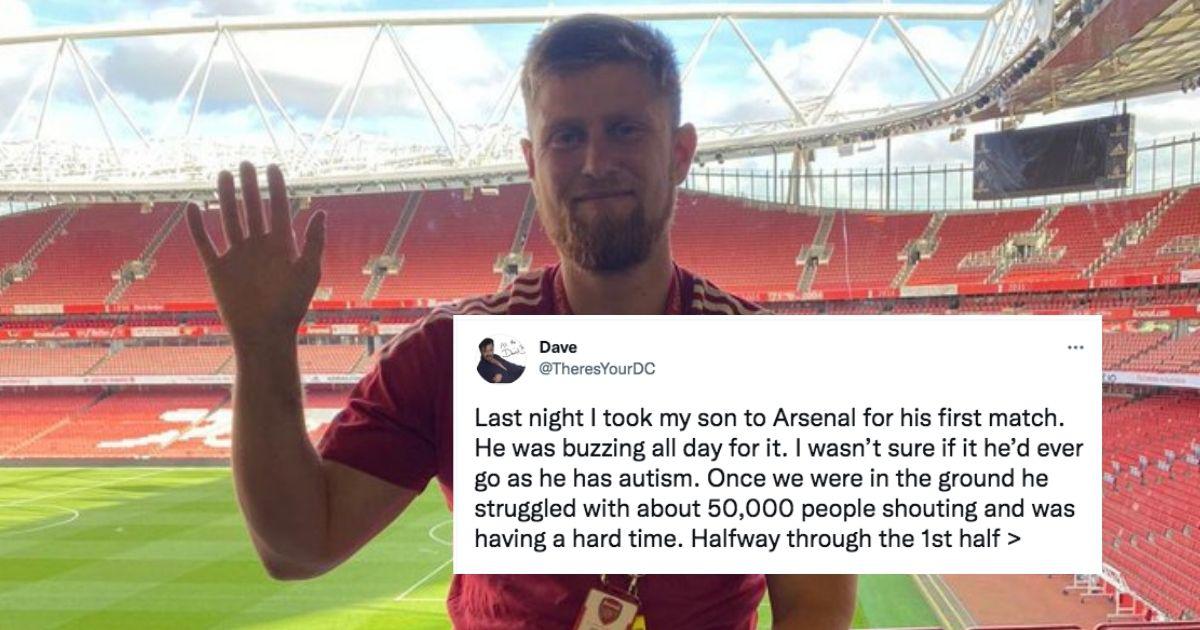
Emirates Stadium has a sensory room for autistic spectators and others with sensory sensitivities. <a href="https://twitter.com/Arsenal/status/1453349641387446281?ref_src=twsrc%5Etfw%7Ctwcamp%5Etweetembed%7Ctwterm%5E1453349641387446281%7Ctwgr%5E%7Ctwcon%5Es1_c10&ref_url=https%3A%2F%2Fwww.upworthy.com%2Fr%2Fentryeditor%2F2655412305distribution">Arsenal/Twitter</a>, <a href="https://twitter.com/TheresYourDC/status/1453266442745491464?ref_src=twsrc%5Etfw%7Ctwcamp%5Etweetembed%7Ctwterm%5E1453266442745491464%7Ctwgr%5E%7Ctwcon%5Es1_c10&ref_url=https%3A%2F%2Fwww.upworthy.com%2Fr%2Fentryeditor%2F2655412305distribution">@TheresYourDC/Twitter</a>

A dad took his autistic son to an Arsenal football game, and when he became overstimulated, he was going to take him home. But a kind employee intervened and took them to the club’s sensory room, which is set up for people who might experience sensory overload at the game. Read about this beautiful example of inclusion here.

Every parent has experienced the planking baby vs. carseat fiasco. Too familiar, and too funny. 

Seriously, when they do this it’s nearly impossible to get them to bend without feeling like you’re going to break them. It’s like a superhuman ability all babies are born with.

Awesome teacher wrote an official letter to the tooth fairy on behalf of a student who threw away their tooth.

It’s even on official school letterhead! Gotta love a grown-up dedicated to keeping magic alive for kids.

Chris Evans’ giddiness over playing Buzz Lightyear is the most delightful thing ever.

Chris Evans can't contain his delight at getting to play his dream role. <a href="https://twitter.com/ChrisEvans/status/1453349886871625733?ref_src=twsrc%5Etfw%7Ctwcamp%5Etweetembed%7Ctwterm%5E1453349886871625733%7Ctwgr%5E%7Ctwcon%5Es1_c10&ref_url=https%3A%2F%2Fwww.upworthy.com%2Fchris-evans-buzz-lightyear">Chris Evans/Twitter</a>

You’d think playing the studly superhero Captain America would be the pinnacle of an actor’s career, but Chris Evans has never gushed over that role like he has over getting to play Buzz Lightyear in Pixar’s upcoming film, “Lightyear.” Check out how he talks about playing his dream role here.

These twin toddlers giggling their way through their first Target experience are all of us.

This is the soundtrack in my head every time I get to peruse the perfectly organized aisles of Target by myself. Target is magical.

A kid wanted her “most precious” rock to be put on display at the museum. Mission accomplished.

The plaque reads, “On 23rd August 2019, Bethan visited Poole Museum. After talking with her mum about what museums do, Bethan decided she wanted to donate her ‘most precious’ rock to the museum. She asked that we put it behind glass and look after it, so that everyone could see and enjoy it.”

This is the way. Well done, Poole Museum.

Puppy pandas. I REPEAT. PUPPY. PANDAS. 

https://twitter.com/DannyDeraney/statuses/1453852006272012294

And just when you think it can’t get better, puppy lions show up. This is seriously the greatest thing I’ve ever seen.

If that last video alone didn’t make you smile, please seek help.

Hope that brought a little sunshine to your day. Come back next week for another roundup of joy and delight!

  • Wife finds an incredibly clever way to find her husband buried in an avalanche
    Michael Harris before the avalanche. Photo credit: GoFundMe
    ,

    Wife finds an incredibly clever way to find her husband buried in an avalanche

    Michael Harris was on his final run on the ski slopes at Stevens Pass in the Cascade Mountains on February 26 when tragedy struck—he was caught in an avalanche. “Because I was on skis, I got caught between two slabs,” he told FOX 13 Seattle. Harris was buried in a snow hole and remained upright.…

    Michael Harris was on his final run on the ski slopes at Stevens Pass in the Cascade Mountains on February 26 when tragedy struck—he was caught in an avalanche.

    “Because I was on skis, I got caught between two slabs,” he told FOX 13 Seattle.

    Harris was buried in a snow hole and remained upright. He tried to free himself by making a swimming motion, but he couldn’t budge. “The sensation was being encased in cement,” he said.

    He was packed so tightly that he couldn’t even grab the phone from his jacket pocket. His wife, Penny, sensed something was wrong when she hadn’t heard from him. “I started freaking out,” she told WSAW-TV. “My texts got more intense, and then I started calling.”

    Harris could feel his phone buzzing in his pocket, but there was nothing he could do. “My mind shifted very quickly to ‘does anyone know that I’m here and how am I going to survive?’” he said.

    Stevens Pass, snow, avalanche, tree, Washington, skiing
    Stevens Pass. Photo credit: Michael Greenlee/Flickr

    Penny had a brilliant solution

    Penny checked the Find My feature on her phone to see whether her husband had moved on the mountain. But his location was static—not typical for a skier. Realizing that if he wasn’t moving, something was very wrong, she contacted the ski patrol and gave them his location. “They were able to take my location and get a snapshot of it and pinpoint pretty much where he was,” she said.

    After being stuck in the snow for four hours, Harris was rescued. Ski patrol was shocked to find him still conscious. Harris’ body temperature had dropped into the 70s, and he was severely hypothermic. Throughout the harrowing experience, all he could think about was his family.

    “The thing I was hoping is that I’d get to see her [his wife] and my four kids one more time,” he said. “They were the only thing I thought about.”

    Harris was alive, but he sustained several serious injuries in the avalanche. His daughter, Lauren, posted an update on GoFundMe about his condition. “A full trauma was called,” she wrote. “After various labs and imaging, my dad only sustained a contusion of his lung, pneumonia, injuries to his kidneys, and a right tibial plateau fracture.”

    snow, avalanche, tree, Washington, skiing, hospital,
    Michael Harris in the hospital. Photo credit: GoFundMe

    The avalanche came at a terrible time for the family

    Harris is expected to make a full recovery, but his injuries couldn’t have come at a worse time. He is currently between jobs, and his recovery will delay any return to work. So, his family set up a GoFundMe page to help them through this difficult time. It has already raised over $36,000 toward a goal of $40,000.

    “I have started a GoFundMe to try and help alleviate some of the medical costs as well additional bills for my family as my dad is the sole provider, and we are unsure how long the road to recovery actually looks. Literally anything helps,” Lauren wrote. 

    When someone is caught in an avalanche and encased in freezing snow, time is of the essence. According to Safeback, about 75% of avalanche deaths occur due to suffocation, and after roughly ten minutes of being trapped in the snow, the risk of asphyxiation increases rapidly.

    Amazingly, Harris survived four hours in freezing conditions without passing out. What a blessing that his quick-thinking wife was able to locate him before he lost his life in the snow.

  • Gen Xers and Boomers recall 18 unforgettable sounds and smells from the ’80s that disappeared
    A landline telephone and a lit cigar.Photo credit: Canva
    ,

    Gen Xers and Boomers recall 18 unforgettable sounds and smells from the ’80s that disappeared

    There are certain sounds and smells that exist across generations, at least so far. The pitter-patter of gentle rain. The musical notes of a bluebird. The scent of sea life in a vast ocean. The fragrant waft of a honeysuckle flower. But many sensory experiences fade with time. A guy on Threads was curious about…

    There are certain sounds and smells that exist across generations, at least so far. The pitter-patter of gentle rain. The musical notes of a bluebird. The scent of sea life in a vast ocean. The fragrant waft of a honeysuckle flower. But many sensory experiences fade with time.

    A guy on Threads was curious about the idea that certain sounds and smells might be specific to different generations. He asked, “What is a sound or smell that doesn’t exist anymore, but 40 years ago was so common it was considered background noise?” Generation Xers and Baby Boomers were ready to answer, offering nearly 4,000 replies.

    Sounds

    “Television static or the sound between radio stations.”

    Here’s a fun fact: In a recent article on WION, journalist Anamica Singh explains that TV and radio static contain remnants of the Big Bang:

    “The static hiss contained at least 1 percent of cosmic microwave background (CMB), a remnant of the birth of the universe 13.8 billion years ago. Not only on TV, but the same noise was also heard on radios. Everyone alive at the time these analogue televisions existed inadvertently time-traveled, in the sense that they witnessed the Big Bang, the universe’s past.”

    “The sound of coins falling into a payphone.”

    “The dial tone when the phone was left off the hook.”

    “The thump of plopping a phone book on the table, followed by the whispery sound of flipping its onion-skin paper pages, and finally the whir-click of dialing a rotary phone.”

    “Typewriter bells.”

    “The sound it made when you push a VHS tape into the VCR.”

    “The sound of the book-charging machine at the library that the librarian would insert the card into to date your books. Made the most satisfying cha-chunk sound.”

    “An analog radio with an extendable antenna sitting in the window ledge, playing a crackly country song by Hank Jr., and the hum of static on TV because somebody touched the dial.”

    Smells

    “The faint but pervasive smell of cigarettes everywhere all the time.”

    A no smoking sign in a restaurant. Photo credit: Canva

    Notably, cities began passing comprehensive laws regulating tobacco use in public spaces. In the mid-1970s, Minnesota enacted one of the first laws requiring restaurants to designate a “smoking area.” By the late 1980s, many other cities and states had followed suit.

    “The hot, dusty aroma of slide projectors and filmstrip machines projecting weird 1960s/70s educational films, floating through the classroom while you were passing notes under desks”

    “The smell of freshly printed dittos.”

    What these commenters are referring to are “ditto” copy machines, often used in schools and churches in the late 20th century.

    “The sound and smell of a disposable flash.”

    “Scratch ‘n’ sniff stickers!”

    “Drakkar Noir”

    This intense scent, a particularly popular men’s cologne in the ’80s, was mentioned a few times.

    Another commenter shared a very specific memory:

    “A Norman Rockwell calendar secured by a pearl-topped push-pin next to a ringing rotary phone, and the calendar smells like bacon grease and fried chicken.”

  • A dad who lost his young son to cancer shared a note on male grief that has gone massively viral
    A father and his young son hold hands while walking.Photo credit: Representative image via Canva
    ,

    A dad who lost his young son to cancer shared a note on male grief that has gone massively viral

    Grief is an unfortunately universal and often inescapable feeling. Yet, due to certain societal norms, it can be harder for some people to embrace or fully work through than for others. In a Reddit post titled “100% Really Sucks,” a man wrote: “About ten years ago, our at the time 9-year-old son died of cancer.…

    Grief is an unfortunately universal and often inescapable feeling. Yet, due to certain societal norms, it can be harder for some people to embrace or fully work through than for others.

    In a Reddit post titled “100% Really Sucks,” a man wrote:

    “About ten years ago, our at the time 9-year-old son died of cancer. Hundreds of people asked my wife how she was doing, offered her support, etc. Lots of people asked me how she was doing, how the kids were doing, and how I had to be strong for her and our two remaining kids. Only a few close male friends asked how I was doing. Not one of my female friends did. Not even my mother. It never occurred to them.

    That really sucked. Not because I don’t think my wife deserved support. Of course she did – but so did I.”

    Reddit post. Photo credit: StreetKindly3614/Reddit

    The good news is that the OP bravely began a difficult discussion that seemed to resonate deeply with many people. The post received over 90,000 upvotes and 2.6 thousand comments. Clearly, people seem ready to talk about it.

    One Redditor noted that they shared a similar experience: “My wife and I divorced – after our marriage she chose drugs and alcohol and I chose to be a dad. People still ask me all the time how she’s doing through everything. She still gets invited to parent/kid meet ups even though the kids live with me 7 days a week. It’s unfair.”

    Another commenter added the importance of including men when an entire family needs support, writing, “It absolutely is unfair. I hope future generations will learn to be more supportive after seeing more great dads in action!”

    What was even more encouraging was that the Reddit community came together not only to commiserate but also to offer hopeful suggestions.

    Another commenter pointed out a similar situation, sharing, “We had a house fire. Lost everything. People in the community donated so many clothes and toiletries for my wife and kids. But nothing for me. One year later and I’m still struggling with wardrobe choices.”

    This Redditor was ready to help, writing, “What size do you wear bro? I have some nice clothes that I never wear I’d be happy to have dry cleaned and sent your way.”

    Not everyone, thankfully, had the same experience, though the post helped some feel a sense of gratitude:

    “My word, reading these comments just makes me appreciate my wife and my mom all the more. They actually support me when I let them know I am hurting or depressed.

    I do have to vocalize that I want the support in the moment because my wife will pick up on the fact that I’m down almost immediately and I’ll tell her I’m just having a down day. I don’t really deal with very bad depression but I do have days where it gets bad and she’s always there for me.

    When I was growing up, my mom never dismissed my feelings, never told me to ‘act like a man’.

    I’m so sorry to hear all of your stories of your struggles. I wish the best for all of you out there dealing with this type of stuff.”

    Society needs to encourage men to open up

    In the article “The Problem of Male Grief” for Psychology Today, Nick Norman, LICSW, discusses what he refers to as a “silent epidemic” among men.

    “According to the CDC, 1 in 10 men experiences anxiety or depression, but less than half reach out for help,” Norman wrote. “They are less likely to seek help for mental or emotional difficulties overall.”

    Norman seems to hit the nail right on the head when it comes to the Reddit post:

    “While there are common ways that men respond to grief, that does not mean that they are actually processing their emotions or coming to a healthy resolution. The real issue is not that men have some other means or manner of grieving. It is that the Western cultural expectation of men discourages grieving altogether.”

    He offered suggestions for men to create healthy spaces for one another:

    “The unspoken rules of oppressive masculinity often lead men to shame those who dare step outside of the limited emotional box we’re given. In this way, we become enemies of our brothers and create more pain when what we need is support. Although we may struggle with our own discomfort, we need to stop shaming other men for weeping and feeling authentically. We have enough challenges in this work. We owe it to one another to buoy each other up, or at least grant each other silent respect.”

    Mindfulness can help

    Jeanette Lorandini, LCSW, founder of Suffolk DBT in New York, spoke to Upworthy about the issue:

    “From a DBT [Dialectical Behavior Therapy] perspective, many boys grow up in environments where their emotions are invalidated. They are often taught very early that showing sadness or vulnerability is a sign of weakness and that they should ‘be strong.’ Over time, this can lead men to learn how to hide their emotions rather than understand or process them. They may become skilled at making their feelings invisible to others, but that does not mean those feelings are not there.”

    To counter this, Lorandini suggested men practice mindfulness to help process their emotions:

    “Mindfulness, a core component of DBT, encourages people to slow down, notice their emotional experience, and give themselves permission to feel sadness rather than push it away. We call that mindfulness of current emotion. When someone does not give themselves these important moments to grieve, they develop what we call inhibitive grief. It doesn’t go away but remains in a ‘holding cell.’ While it may not be a literal prison, it won’t go away until it is experienced. It often will show up in ways such as anger, substance use, working excessively, heavy screen time, or other maladaptive behaviors.”

    She added, “Grief does not require someone to fall apart, but it does require space to be felt. Learning to experience sadness in manageable moments, while continuing to move forward at a balanced pace, can help men process loss in a way that honors both their emotional needs and their role within their family.”

  • Tech strategist shares why algorithms killed ‘taste’ and where to find it now
    A woman at the bookstore and another on her phone.Photo credit: Canva
    ,

    Tech strategist shares why algorithms killed ‘taste’ and where to find it now

    There has been a cultural shift over the past year or so: being at the forefront of social media and Internet culture—or being “chronically online”—is now frowned upon. It’s similar to the ’90s, when bragging about how much TV you watched could get you accused of lacking personality or having lowbrow taste. These days, bragging…

    There has been a cultural shift over the past year or so: being at the forefront of social media and Internet culture—or being “chronically online”—is now frowned upon. It’s similar to the ’90s, when bragging about how much TV you watched could get you accused of lacking personality or having lowbrow taste. These days, bragging about bed-rotting and doomscrolling is akin to being a proud couch potato.

    Why are the chronically online backing away from their iPhones and calling TikTok trend followers tacky? It all comes down to the delivery system.

    In a viral Instagram post, Carmen Vicente, a social strategist in tech, says the shift began when the Internet changed from a place where savvy people pursued their interests on their own to one where culture was spoon-fed through algorithms. There’s a huge difference between sitting at the cultural trough and waiting to be fed by Meta and going out to discover what you authentically enjoy.

    The point is simple: You will never cultivate authentic taste in culture, art, movies, music, fashion, or food if your appetite is curated algorithmically.

    “Fifteen years ago, it required effort and curiosity to discover cool stuff on the Internet,” Vicente says. “But now, and since the advent of algorithms that hinge on economic metrics of success, looking away or elsewhere is the thing that requires effort and curiosity.”

    Vicente continues:

    “Personally speaking, I think taste is the result of your cultural inputs. And to develop good taste, we need to consume a diversity of inputs beyond just the confines of our modern suggestion engines. Simply put, the algorithms are controlled by the institutions. The institutions need to maximize shareholder value. And the more time you spend drinking the Kool-Aid from these fire hoses, the looser your grasp becomes on what is truly interesting, substantive, or moving.”

    A woman scrolling in bed. Photo credit: Canva

    There are myriad definitions of taste, but it’s generally seen as the ability to appreciate things that are culturally and aesthetically valuable.

    In his essay “Of the Standard of Taste,” philosopher David Hume argues that taste is a byproduct of a life rich in experience: “Strong sense, united to delicate sentiment, improved by practice, perfected by comparison, and cleared of all prejudice, can alone entitle critics to this valuable character.”

    Therefore, true taste can’t be developed without real-world experience and cultural inputs that go far beyond what’s delivered via smartphone.

    taste, books, culture, scrolling, algorithms, internet
    A woman at an exercise class. Photo credit: Canva

    The lesson here isn’t hard to figure out: it’s about a life lived shopping in brick-and-mortar stores, spending time outdoors, practicing hobbies that don’t involve screens, and reading books while in the dentist’s waiting room. There are so many incredible cultural treasures we can experience only by being in physical places with real people—where you can stumble upon life-changing culture by accident.

    Taste is a touchy subject, hard to separate from social status, because it often requires resources and connections to access many aspects of culture. However, that’s not an excuse to judge those who strive for an expansive, more refined sense of taste—or who hope others will join them on that journey—as merely performative.

  • A woman in the Philippines filmed herself kissing her knee. The reaction was universal.
    Do you ever kiss your own knee?Photo credit: Canva
    ,

    A woman in the Philippines filmed herself kissing her knee. The reaction was universal.

    Humanity is delightfully diverse, yet we’re also wonderfully the same. For all our differences, many of our fundamental needs, desires, and impulses are universal. One of those impulses? Kissing our own knees, apparently. A six-second TikTok video shared by a young woman in the Philippines demonstrating the phenomenon went wildly viral, racking up more than…

    Humanity is delightfully diverse, yet we’re also wonderfully the same. For all our differences, many of our fundamental needs, desires, and impulses are universal.

    One of those impulses? Kissing our own knees, apparently. A six-second TikTok video shared by a young woman in the Philippines demonstrating the phenomenon went wildly viral, racking up more than 18 million views and 2.7 million likes.

    Rasta G. simply sits on a chair with one foot up on the seat. She suddenly looks down, notices her knee, then gently kisses it. People all around the world said, “Wait, I’m not the only one who does this?”

    Who knew kissing your own knee was such a universal impulse?

    Comment after comment revealed that people do this but had no idea others did, too:

    “So I’m not a weirdo?”

    “I THOUGHT I WAS THE ONLY ONE.”

    “TikTok slowly make me realize I’m not the only weird one. We ALL weird. 😂”

    “HAHAHAHA why you exposing us.”

    “I knew before you did it.”

    “I’m never alone in my weird experiences. 😭”

    “Not a single unique experience 😭.”

    “More proof that nothing I do is unique and I’m not weird. Thank you. 🙏🙏”

    “So in conclusion we’re all the same just in different fonts.”

    “Kissing knees is universal.”

    “I’m cracking up omg we are all connected.”

    Indeed, others have publicly shared the impulse as well:

    Why, though? What is it about having our knee in our face that makes us want to kiss it? People weighed in on that, too:

    “I have a theory: I think it’s because we don’t see him often so as soon as we see him, we kiss him to show our affection.”

    “I don’t see her often, might as well.”

    “‘Oh haven‘t seen you in a while. 😙’”

    “Its like a long distance relationship.”

    “A lil kiss for encouragement, cause they don’t work very well but they’re doing their best 😅”

    “I mean they help you walk ,so a little thank you😌.”

    “I feel so maternal about my knees.”

    “It’s like kissing your baby’s head.”

    @itsabbywenzel

    why is it every time i sit like this i want to kiss my knee???🫠

    ♬ original sound – user

    Many people said they do the same thing with their shoulders:

    “I do this to my shoulders too 🥹”

    “I’m like that with my bare shoulder hahah – feels comfortable.”

    “I do this 😩. Like I love seeing my shoulder all shiny and smooth. Deserves a kiss fr.”

    Theories about why we kiss our own knees (and shoulders)

    Of course, not everyone does this. But apparently, a whole lot of us do. And the reason why isn’t entirely clear. There are no studies on the subject, and there don’t appear to be masses of people asking their therapists about this habit. It’s just something we do, and people pointed to several potential reasons why:

    • The roundness of our knee looks like a baby’s head. Shoulders do, too—kind of. Perhaps seeing it so close to our face evokes the same urge we get to kiss babies on the top of the head. It could simply be a biological urge being triggered.
    A woman kisses a baby on the top of the head
    Baby heads are irresistibly kissable. Photo credit: Canva
    • It’s a self-soothing behavior. When we were little, our moms, dads, or other caregivers may have kissed our boo-boos, and kids get a lot of boo-boos on their knees. So some of us may automatically associate gentle kisses on the knee with comfort.
    • It’s a way to show our bodies love and gratitude. A lot of the sentiment in the comments is that we don’t really see our knees very often, which is true. So when one is close to our face, we may be reminded of what they do for us. Ask someone with knee problems how important our knees are. It’s a good reminder to give them a little thank-you for their hard work.
    • We’re weird, but no weirder than anyone else. Maybe we’re all just quirky little humans who do random things for no good reason whatsoever. But at least now we know we’re not alone on that front.
  • Anthony Hopkins composed a waltz at age 26. It took nearly 50 years for him to hear it played.
    Anthony Hopkins had his waltz premiered by the Johann Strauss Orchestra, led by André Rieu.Photo credit: gdcgraphics (left), Bert Knottenbeld (right)
    ,

    Anthony Hopkins composed a waltz at age 26. It took nearly 50 years for him to hear it played.

    People know Sir Anthony Hopkins best for his film performances, and for good reason. With two Oscars and multiple other awards, the 88-year-old Welsh actor has earned his accolades for his work on screen. But Hopkins’ first artistic love was not acting—it was music. And that first love received a moving moment of recognition in…

    People know Sir Anthony Hopkins best for his film performances, and for good reason. With two Oscars and multiple other awards, the 88-year-old Welsh actor has earned his accolades for his work on screen.

    But Hopkins’ first artistic love was not acting—it was music. And that first love received a moving moment of recognition in 2011, when the Johann Strauss Orchestra premiered a waltz Hopkins composed in 1964 at age 26.

    “I have been writing music and composing for many years, but I never did anything with it,” Hopkins told The Independent in late 2012. “I’d wanted to be a musician when I was younger, but I wasn’t a good student as a kid, so I just dabbled around and wrote this piece, ‘And the Waltz Goes On,’ in 1964.”

    Years later, Hopkins and his wife were watching a concert by Dutch violinist and conductor André Rieu on TV. Hopkins mentioned that he’d love to have his waltz played in Vienna.

    “Some time later, I got a call from André and he said, ‘I got your waltz,’” said Hopkins. “I said, ‘What?’ He said, ‘I’ve just performed it with my orchestra in rehearsal.’ I didn’t know it, but my wife had sent him the score.”

    Rieu was surprised to receive Hopkins’ composition.

    A violin lying on top of sheet music
    A violin lying atop sheet music. Photo credit: Canva

    “A lot of people send me their waltzes – every week, in fact,” Rieu told The Independent. “But when I got a call from my office early last year, I was surprised when they said Sir Anthony Hopkins was sending me one, as I didn’t know he had a musical side. But I figured a man like him wouldn’t send me a bad waltz. I can imagine it must have been a struggle for him thinking, ‘Shall I give it to the world?’”

    Hopkins and Rieu had never met, but Hopkins flew to Rieu’s studio in Maastricht, Netherlands, in April 2011 to hear the piece rehearsed live.

    “Everyone was so excited–and nervous,” said Rieu. “But he was so gentle and kind; he embraced everyone and gave them all autographs, too. After we played it to him live, he was like, ‘I love it, I love it, and I have tears in my eyes!’”

    Naturally, anyone would be moved to hear a composition they wrote nearly 50 years earlier performed by top-tier musicians. After all, just a few years before, Hopkins told Gramophone magazine, “Music was my first desire, my first wish.”

    Close up photo of people playing the cello in an orchestra
    A musician playing the cello. Photo credit: Canva

    Vienna has been home to many famous composers, including Joseph Haydn, Wolfgang Amadeus Mozart, Ludwig van Beethoven, Franz Schubert, Johannes Brahms, Gustav Mahler, and the Strauss family. So the fact that Rieu premiered Hopkins’ piece there made the moment especially meaningful.

    What a gift it must have been to hear his waltz performed live in one of the world’s most iconic venues by the largest private orchestra in the world, led by one of its most renowned conductors.

    “Playing his waltz for the first time in one of the most beautiful halls in Vienna was like a dream for both of us,” Rieu said.

    Rieu toured with the piece, which is how we have this full performance of Hopkins’ waltz from André Rieu – Under the Stars: Live in Maastricht 5:

    Hopkins has made a name for himself far more successfully as an actor than as a musician, but people loved his waltz nonetheless. Some commenters on the video also noted how sad it would have been if the composition had remained unplayed:

    “There’s drama, passion, love and anger, sadness and boldness, a perfect waltz. And imagine, if Lady Hopkins never convinced Sir Hopkins to release this, we wouldn’t have this amazing masterpiece. Utmost respect for the two of them.”

    “Never asked anyone to play it, and yet it’s absolutely hauntingly beautiful. How much magnificent art is out there that never sees the light of day?”

    “This guy didn’t produce this waltz earlier in his life because he was afraid that nobody would like it. And you hear how beautiful this waltz is. Imagine how many artists have been too afraid to share their work. Imagine the wonderful pieces of music we could have if we would just lighten up a bit.”

    It’s a good reminder for all of us to share the talents we have.


  • The science behind ‘soft socializing’: Why Gen Z is ditching bars
    For younger generations, socializing does not need to be the main event. Photo credit: Canva
    ,

    The science behind ‘soft socializing’: Why Gen Z is ditching bars

    Imagine a puzzle competition held at a friend’s house, jigsaw pieces flying in a flurry. Or a beautiful Saturday morning flower-arranging class, the air fragrant with seasonal blooms, with no pressure to make small talk. What about a nature walk through local woods, where chatting with new people can happen naturally—or not? These enticing options…

    Imagine a puzzle competition held at a friend’s house, jigsaw pieces flying in a flurry. Or a beautiful Saturday morning flower-arranging class, the air fragrant with seasonal blooms, with no pressure to make small talk. What about a nature walk through local woods, where chatting with new people can happen naturally—or not?

    These enticing options are part of a growing trend: “soft socializing.” It represents a significant cultural shift in how we connect, prioritizing shared activities over forced conversation and social performance.

    @eventbrite

    Small talk is out. Shared hobbies are in. From reading hours to coffee tastings, we’re building rituals around what we love. It’s not introversion, it’s intentional gathering! How are you soft socializing this year? #intentional #rituals #hobbies #community

    ♬ original sound – Eventbrite

    Eventbrite’s 2026 Social Study surveyed 4,051 adults in the United States and the United Kingdom. It found that for today’s younger generation, socializing isn’t the main event: 58% call it “somewhat important, but don’t want it to be the focus.” Another 45% prefer control over when and how they interact, and 41% want the option to observe without small talk. Past generations might have labeled this “antisocial,” but Eventbrite calls it a redefinition of what it means to be social today.

    What soft socializing actually means

    Soft socializing means low-pressure, activity-based events where connection happens as a secondary outcome, not the main goal. The idea draws from parallel play, where children play side by side, absorbed in their own activities and comforted by others’ presence. Adults apparently feel the same way.

    soft, socializing, tea, ceremony, generations
    Soft socializing provides a comfortable, neutral environment for activities. Photo credit: Canva

    Parallel play, as researchers describe it, provides “a comforting middle ground where participants can enjoy the presence of others without the demands of conversation, leading to reduced stress and anxiety.”

    In tea-tasting ceremonies or silent book clubs—popular, low-key socializing activities—participants share space and experience without the need for ongoing conversation. The activity itself serves as the anchor for connection. Conversation may unfold naturally, or it may not—both are absolutely welcome.

    That relaxed structure is key. Traditional socializing pressures people to perform: be charming, interesting, engaged, and instantly happy. Low-pressure socializing shifts the focus from individuals to the activity.

    The numbers behind the shift

    Data from Eventbrite’s survey paints a striking picture of where people are showing up. Over the last two years, low-pressure events have seen remarkable growth:

    • Flower-arranging events saw a 282% increase in attendance.
    • Puzzle competitions grew by 151% in the U.S.
    • Music bingo attendance increased by 149%.
    • Caffeine tastings (like coffee, tea, and matcha) became more popular, with an 80% increase in events and a 49% rise in attendance.
    • Silent events, such as silent discos and book clubs, saw a 14% increase in attendance.

    These numbers show a desire for creative, low-pressure events that connect people with less effort.

    The psychology of being present together

    There’s solid science behind why soft socializing works so well.

    A 2024 study in the journal Motivation and Emotion found that “intrinsically motivated silence” promotes greater closeness and satisfaction. It suggests that, in the right context, quiet that comes from emotional connection—not social obligation—can connect people more effectively than conversation.

    oxytocin, hiking, soft, socializing, conversation
    Shared activities increase oxytocin in the brain. Photo credit: Canva

    Similarly, research shows that shared activities increase oxytocin, a hormone linked to trust, empathy, and bonding. Stanford University researchers have found that oxytocin plays a significant role in social interactions, including everyday ones. Soft socializing activities—walking, crafting, or cooking—involve people moving and creating together, an effective way to build connections.

    For those with mental health challenges, soft socializing can be vital. Nearly two-thirds (65%) of Gen Z reported expe­ri­enc­ing at least one men­tal health prob­lem in the past two years—especially with social anxiety—making the rise of soft socializing particularly important. When the activity takes center stage, social pressure drops.

    Soft socializing and the loneliness epidemic

    This discussion takes place against the backdrop of a loneliness crisis that the former U.S. Surgeon General has declared a national epidemic. In a 2023 advisory, Dr. Vivek Murthy warned that a lack of social connection carries health risks comparable to smoking up to 15 cigarettes a day. Those risks include a 29% increased chance of heart disease, a 32% increased risk of stroke, and a 50% greater likelihood of developing dementia among socially isolated older adults.

    Loneliness statistics are startling. In a 2025 survey, about half of American adults reported feeling lonely. A 2024 poll found that among those aged 18–34, 30% said they feel lonely daily or several times a week. According to Murthy’s advisory, between 2003 and 2020 average monthly time spent alone increased by 24 hours, while time spent with friends dropped by 20 hours.

    But here’s a startling twist: despite these feelings of disconnection, a 2026 Eventbrite study found that 79% of adults aged 18–35 want to attend more live events. As Eventbrite CEO Julia Hartz put it, “The most social generation in history is redefining what it means to be truly present.”

    This signals a shift: people aren’t withdrawing—they’re craving meaningful bonds and growing disenchanted with traditional ways of forming them.

    How to plan a soft socializing hang

    Are you willing to give it a try? Here’s what you need to plan a successful soft socializing hang:

    • Lead with activity

    The key rule? Build the event around a shared activity, not conversation. Think craft nights, puzzle competitions, guided hikes, silent book clubs, board games, or cooking classes. Any format that gives people something to engage with—besides each other—works. The activity itself takes the conversational pressure off attendees.

    flower, arrangement, soft, socializing, conversation
    Flower arrangement classes can be a great soft socializing option. Photo credit: Canva
    • Choose the right venue

    The right setting sets the mood before the event even begins. Think neighborhood cafés, local breweries, bookshops, and parks—venues with a naturally relaxed atmosphere.

    • Interaction should be optional

    Plan activities for small groups of three to five people. Try arranging seats side by side instead of face to face to ease the pressure of direct conversation. You can offer conversation starters, but don’t make them mandatory. Let people arrive and settle in at their own pace.

    • On the day of the event, make your welcome warm but brief

    Have materials ready so attendees can start immediately, avoiding awkward waits. Keep background music low and ambient. Close with a natural social moment—such as a snack or a group photo—for those who want to linger.

    Rebuilding connection on your terms

    As one 31-year-old told Business Insider, “We have to retrain ourselves to be social again.” Let soft socializing help. It lowers the stakes, removes social pressure, and allows connections to develop organically. Say goodbye to forced icebreakers.

    The former surgeon general urges us to prioritize social connection as we would any major public health issue. While soft socializing is not a complete solution to loneliness, it marks a vital first step—shifting our approach from forced interaction to genuine, low-pressure connection through shared activities.

  • Woman shares amazing 5-year singing transformation and obliterates the concept of ‘I can’t sing’
    A woman singing. Photo credit: Canva
    ,

    Woman shares amazing 5-year singing transformation and obliterates the concept of ‘I can’t sing’

    Some people can sing, and some people can’t. A beautiful voice is a gift and you either have one or you don’t. At least, that’s always been the prevailing wisdom. However, like many pieces of prevailing wisdom, it may not be correct. According to NBC News, an estimated 10–30% of people believe they “can’t sing”…

    Some people can sing, and some people can’t. A beautiful voice is a gift and you either have one or you don’t. At least, that’s always been the prevailing wisdom. However, like many pieces of prevailing wisdom, it may not be correct.

    According to NBC News, an estimated 10–30% of people believe they “can’t sing” because they have difficulty carrying a tune. However, further research cited by CNET shows that only a minuscule 2% of the population physically lacks the skills needed to perform a song well. These individuals may not have the required control over their vocal cords, or may have difficulty hearing pitch accurately. Everyone else simply lacks the training and practice.

    Learn how to sing

    A woman who goes by Jeska fm on social media recently took to YouTube to show her own proof that it’s possible to learn how to sing.

    singing, singing transformation, vocalist, progress, motivation, inspiration, music, artists, youtube
    Becoming even a half-decent singer can take years of practice. Photo credit: Canva

    In a video titled “MY SINGING TRANSFORMATION: no autotune or reverb, just real progress,” Jeska begins with a few words of inspiration:

    “I just wanted to start this off by saying that I’m only making this video because I wish I had seen something like this when I was a little girl who wanted to sing. It might have changed the entire course of my life. If you’re someone who dreams of being able to sing but just doesn’t think it’s possible for you, this video is for you.”

    Jeska explains that she did choir in high school and learned a few fundamentals. But while she never thought she was a bad singer per se, she didn’t believe she had the talent to sing the way she wanted to as a songwriter.

    “There were things about my voice that I hated,” Jeska says.

    However, the one thing she had going for her was a refusal to give up. She begins the transformation video by showing clips of her early attempts dating back to 2016. Even in 2021, when she was just beginning to train and practice her vocals intentionally, her singing is flat and lacks power and consistency. Her voice strains to produce volume and hit high notes, and it regularly cracks during attempts at vocal runs.

    Jeska explains how she spent years working with teachers, doing self-instruction and exercises, and practicing and performing. The final clip of her performing five years later is almost unrecognizable. The power, accuracy, and clarity are all improved several times over. All Jeska’s hard work had paid off, and she was far better positioned to perform her own music and pursue singing in other ways.

    The full transformation has to be heard to be appreciated:

    So many kids grow up dreaming of becoming singers or musicians

    However, we as humans tend to drastically underestimate how much time and work it takes to succeed.

    The “planning fallacy” is a psychological concept that suggests people often have an overly optimistic view of what it will take to complete a task. In practice, it’s one thing to pick up a guitar and realize just how difficult it is to maneuver your fingers with the accuracy and speed required. But when it comes to the original instrument—our voice—many people assume that if they have talent, it will present itself naturally.

    “Singing’s actually very different, as everyone can produce a sound,” researcher Sean Hutchins tells The Guardian. “Even if people don’t learn the technique behind how to sing, you use your voice for the purpose of speech so everyone’s reasonably adept at controlling it. The key thing which separates good singers from bad isn’t so much natural talent but getting the training to use it in the right way.”

    He also adds that the limiting belief people develop when their first attempts aren’t magically perfect—“I can’t sing”—causes many to give up on their dream. Hutchins says the worst singers he’s studied are often the ones least likely to practice.

    “My main takeaway from this whole singing journey is that it’s never too late to pursue your interests,” Jeska says at the end of her video. “You never know how far you’ll go.”

    She’s also brutally honest about how much work it really takes to perfect your vocal control. For most people, it takes years. The idea that someone can become a brilliant professional singer overnight with no training and little practice is mostly false. But so is the idea that none of us is capable of honing at least a karaoke-worthy voice, and maybe far more than that.

Wholesome

A woman in the Philippines filmed herself kissing her knee. The reaction was universal.

Pop Culture

Anthony Hopkins composed a waltz at age 26. It took nearly 50 years for him to hear it played.

Culture

The science behind ‘soft socializing’: Why Gen Z is ditching bars

Wholesome

Woman shares amazing 5-year singing transformation and obliterates the concept of ‘I can’t sing’