upworthy
Add Upworthy to your Google News feed.
Google News Button
Health

Why time seems to accelerate as we get older and what we can do to slow it down

How time works is totally trippy, but there are some "tricks" to change how our brains process it.

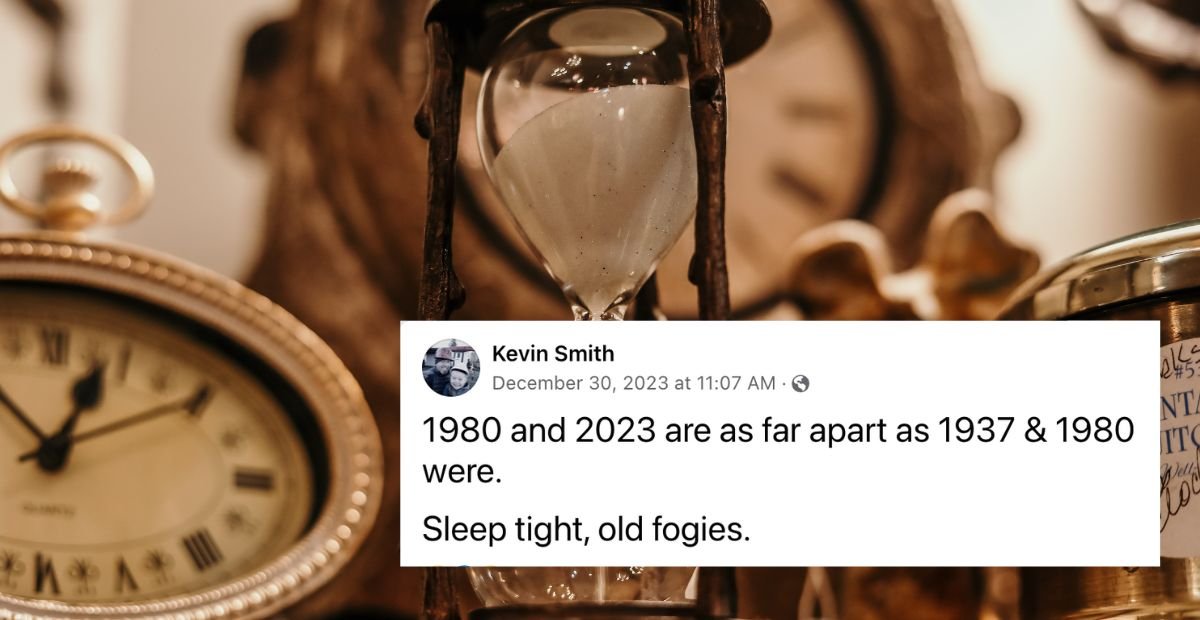
hourglass and clocks with screenshot of post saying 1980 and 2023 are as far apart as 1937 and 1980
Jordan Benton/Canva

Time is weird.

You're going along, minding your own business on the internet, when suddenly this little gem comes across your timeline:
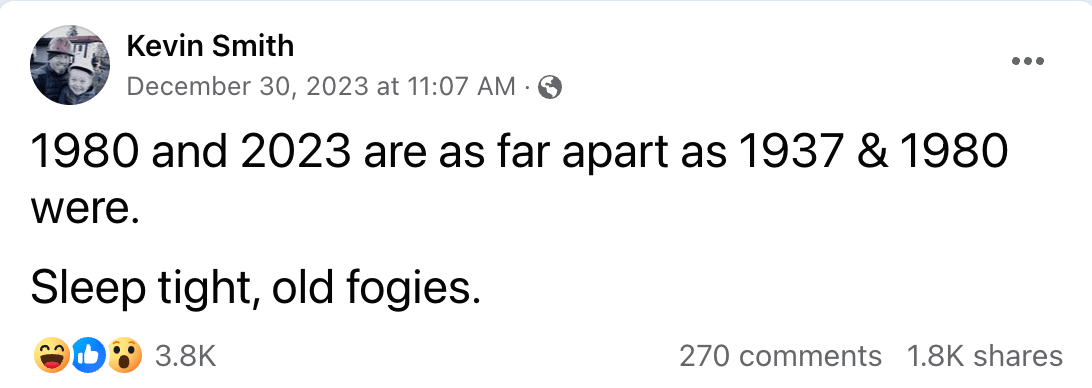
screenshot that reads "1980 and 2023 are as far apart as 1937 and 1980 were. Sleep tight, odl fogies"1980 to 2023 = 1937 to 1980. How can that math be right? Kevin Smith/GenX Only Facebook Group

Your first reaction is, "Nuh-uh, no way," so you pull out the calculator to do the math yourself—several times because you're sure you must've missed a number somewhere. You remember how long ago 1937 seemed in 1980, and there's no possible way that much time has passed between 1980 and now. Then, as the warped reality of time washes over you, you sit and stare in stunned silence, contemplating the existential crisis.

Why does time work this way? Why does it seem to get faster and faster and condense to make decades seem shorter and shorter as we age? And perhaps more importantly, how the heck do we stop time from feeling like a runaway freight train?

Here are a few theories about what creates the freight train phenomenon.

Time perception is relative—and kids perceive it differently

"Time flies when you're having fun" is a saying for a reason. Time also drags when you're doing drudgery work and feels like it stands still in moments of significance. And yet the ticking of seconds as they go by doesn't change tempo. We measure it with steady, unchanging beats, but how it feels changes constantly.

This relativity exists in every passing moment, but it also exists in the bigger picture as well. The years felt like they passed by much more slowly when we were children, and by middle age, they feel like they pass in the blink of an eye. The pandemic gave us an even greater sense of this relativity as disruptions to our normal routines and the stress associated with the COVID-19 years messed with our sense of time. (On an odd side note, surveys show that our time perception during the pandemic varied a lot from place to place—people in some parts of the world felt that time moved more slowly, while others felt time moved more quickly.)

According to a 2023 Hungarian study published in Nature Scientific Reports, very young children perceive time differently than older children and adults. Researchers split 138 people into three age groups—pre-kindergarten, school-age and adults 18 and over—and showed them two videos of the same duration, one that was "eventful" and one that was "uneventful." Interestingly, the pre-K group perceived the eventful video to be longer, while the older children and adults saw the uneventful video as longer.

The way the study participants described the length of the videos in gestures was also telling. Young children were much more likely to use vertical hand gestures, connoting volume or magnitude, to indicate a length of time than the other two age groups. School-aged kids and adults tended to use horizontal gestures, indicating time as linear, increasing with age.

Our neural processing slows down as we age

Professor Adrian Bejan has a theory based on how neurons process signals. As we age, our neural networks increase in size and complexity, and as a result, process visual information at a slower rate. That slower processing means we create fewer mental images each second than we did when we were younger, thereby making time seem to slow down.

“People are often amazed at how much they remember from days that seemed to last forever in their youth, Bejan shared with Harvard University. "It’s not that their experiences were much deeper or more meaningful; it’s just that they were being processed in rapid fire.”

In other words, processing the same number of mental images we did in our youth takes longer now, somewhat counterintuitively making time seem to pass more quickly. So goes the theory, anyway.

It might simply be about time-to-life ratios

Another popular theory about why time feels different as a child than it does as an adult is the ratio of any given day, week or year to the amount of time we've been alive. To a 5-year-old, a year is 20% of their entire life. For a 50-year-old, a year only is 0.2% of their life, so it feels like it went by much more quickly.

It's also a matter of how much change has happened in that year. A year in the life of a 5-year-old is full of rapid growth and change and learning and development. A year in the life of a 50-year-old probably isn't a whole lot different than when they were 48 or 49. Even if there are major life changes, the middle-aged brain isn't evolving at nearly the same rate as a child. A 50-year-old looking back at the past year will have a lot fewer changes to process than a 5-year-old, therefore the year will seems like it went by a lot faster.

“Our perception of days, weeks, years and that kind of time seems to be especially influenced by our perspective: Are we in the moment experiencing it, or are we looking backward on time?” psychology professor Cindy Lustig told the University of Michigan.

The key to slowing it all down? Be mindful of the present moment.

Lustig has a point. When we are in the moment, our perception of time is much different than when we look back. So, being fully conscious in the present moment can help us rein in the freight train effect.

One way to do that is to be mindful of your physical existence in this moment. Feel your heart beating. Feel your breath going in and out. Cornell University psychology professor Adam Anderson, Ph.D., conducted a study that found our perception of time may be linked with the length of our heartbeats. (Study participants were fitted with electrocardiograms and asked to listen to a brief audio tone. They perceived the tone as longer after a longer heartbeat and shorter after a shorter one.) He suggests starting a stopwatch, closing your eyes and focusing on your breathing for what you think feels like a minute. Then, check your time to see how accurate your estimation was.

“This can give you a sense of how much your experience of your body is related to your experience of time,” Anderson told WebMD. “It will help teach you to enjoy the pure experience of time.”

You can also use focused breathing to purposely slow down your heart rate, and thus slow down your time perception. “We show that slow heart rates—that is, a longer duration between heartbeats—dilates time, slowing it down," Anderson said.

Finally, try to take in the world the way you did as a small child. Take note of life's wonders. Engage fully in whatever you're doing. Notice details and take mental pictures as much as you can. Time goes by fast when we're distracted, so training our attention on the here and now can help. Ultimately, we can strive to perceive time more like we did when we were little, in its full depth and magnitude instead of a narrow, straight line.


This article originally appeared last year.

the great depression; Florence Thompson; Mona Lisa of the Great Depression; Mona Lisa; the depression; depression era
Photo by Dorothea Lange via Library of Congress
The woman from the famous Great Depression photo didn't know about her fame for 40 years.

It's one of the most iconic and haunting photos of all time, up there with the likes of Hindenburg, The Falling Soldier, Burning Monk, Napalm Girl, and many others. It's called simply Migrant Mother, and it paints a better picture of the time in which it was taken than any book or interview possibly could.

Nearly everyone across the globe knows Florence Owens Thompson's face from newspapers, magazines, and history books. The young, destitute mother was the face of The Great Depression, her worried, suntanned face looking absolutely defeated as several of her children took comfort by resting on her thin frame. Thompson put a human face and emotion behind the very real struggle of the era, but she wasn't even aware of her role in helping to bring awareness to the effects of the Great Depression on families.


It turns out that Dorothea Lange, the photographer responsible for capturing the worry-stricken mother in the now-famous photo, told Thompson that the photos wouldn't be published.

Of course, they subsequently were published in the San Francisco News. At the time the photo was taken, Thompson was supposedly only taking respite at the migrant campsite with her seven children after the family car broke down near the campsite. The photo was taken in March 1936 in Nipomo, California when Lange was concluding a month's long photography excursion documenting migrant farm labor.

the great depression; Florence Thompson; Mona Lisa of the Great Depression; Mona Lisa; the depression; depression era Worried mother and children during the Great Depression era. Photo by Dorthea Lange via Library of Congress

"Migrant worker" was a term that meant something quite different than it does today. It was primarily used in the 30s to describe poverty-stricken Americans who moved from town to town harvesting the crops for farmers.

The pay was abysmal and not enough to sustain a family, but harvesting was what Thompson knew as she was born and raised in "Indian Territory," (now Oklahoma) on a farm. Her father was Choctaw and her mother was white. After the death of her husband, Thompson supported her children the best way she knew how: working long hours in the field.

"I'd hit that cotton field before daylight and stay out there until it got so dark I couldn't see," Thompson told NBC in 1979 a few years before her death.

the great depression; Florence Thompson; Mona Lisa of the Great Depression; Mona Lisa; the depression; depression era A mother reflects with her children during the Great Depression. Photo by Dorthea Lange via Library of Congress

When talking about meeting Thompson, Lange wrote in her article titled "The Assignment I'll Never Forget: Migrant Mother," which appeared in Popular Photography, Feb. 1960, "I saw and approached the hungry and desperate mother, as if drawn by a magnet. I do not remember how I explained my presence or my camera to her, but I do remember she asked me no questions. I made five exposures, working closer and closer from the same direction. I did not ask her name or her history. She told me her age, that she was thirty-two. She said that they had been living on frozen vegetables from the surrounding fields, and birds that the children killed."

Lange goes on to surmise that Thompson cooperated because on some level she knew the photos would help, though from Thompson's account she had no idea the photos would make it to print. Without her knowledge, Thompson became known as "The Dustbowl Mona Lisa," which didn't translate into money in the poor family's pocket.

In fact, according to a history buff who goes by @baewatch86 on TikTok, Thompson didn't find out she was famous until 40 years later after a journalist tracked her down in 1978 to ask how she felt about being a famous face of the depression.

@baewatch86

Florence Thompson, American Motherhood. #fyppppppppppppppppppppppp #historytok #americanhistory #migrantmother #thegreatdepression #dorthealange #womenshistory

It turns out Thompson wished her photo had never been taken since she never received any funds for her likeness being used. Baewatch explains, "because Dorothea Lange's work was funded by the federal government this photo was considered public domain and therefore Mrs. Florence and her family are not entitled to the royalties."

While the photo didn't provide direct financial compensation for Thompson, the "virality" of it helped to feed migrant farm workers. "When these photos were published, it immediately caught people's attention. The federal government sent food and other resources to those migrant camps to help the people that were there that were starving, they needed resources and this is the catalyst. This photo was the catalyst to the government intercepting and providing aid to people," Baewatch shares.

- YouTube www.youtube.com

As for Lange, Migrant Mother was not her only influential photograph of the Great Depression. She captured many moving images of farmers who had been devastated by the Dust Bowl and were forced into a migrant lifestyle.

"Broke, baby sick, and car trouble!" is just one of her many incredible photos from the same year, 1937.

She also did tremendous work covering Japanese internment in the 1940s, and was eventually inducted into the International Photography Hall of Fame and Museum and the National Women's Hall of Fame.

the great depression; Florence Thompson; Mona Lisa of the Great Depression; Mona Lisa; the depression; depression era Families on the move suffered enormous hardships during The Great Depression.Photo by Dorthea Lange via Library of Congress

Thompson did find some semblance of financial comfort later in life when she married a man named George Thompson, who would be her third husband. In total, she had 10 children. When Thompson's health declined with age, people rallied around to help pay her medical bills citing the importance of the 1936 photo in their own lives. The "Migrant Mother" passed away in 1983, just over a week after her 80th birthday. She was buried in California.

"Florence Leona Thompson, Migrant Mother. A legend of the strength of American motherhood," her gravestone reads.

millennials, baby boomers, economics, american dream, cost of living, generations, generational differences, money
via Canva

Millennial man says "luxuries" aren't the reason young people can't afford to live.

Being a human being has really gotten expensive. Millennials constantly lament the high cost of living and the fact that the so-called "American dream" is out of reach for many of them. Housing prices have skyrocketed, as has the cost of a college education. Eating out has gotten drastically more expensive, and making food at home with fresh groceries is hardly any cheaper. It's just so hard, they say, to get a foothold in the modern economy.

One of the big talking points in the great American Millennials versus baby boomers debate is that, yes, things are more expensive, but has the younger generation knee-capped itself by its lavish spending habits that have prevented them from owning homes? If Millennials stopped buying $14 avocado toast and $1,000 iPhones, would they be able to save enough for a down payment on a modest house?


Why older generations don't understand Millennial finances

Freddie Smith, 36, of Orlando, Florida, recently went viral on TikTok for a video in which he challenged the boomer argument with statistics from the Bureau of Labor, Federal Reserve, and the U.S. Census Bureau.

Smith argues that older generations misunderstand Millennials' finances because their concept of luxury is based on 1980s economic conditions. That's when most boomers were coming of age and buying their own family homes, and their ideas of saving up for a down payment and affording a monthly mortgage are heavily outdated.

Smith says that for baby boomers, essentials such as rent and child care were much more affordable, but items considered luxuries (TVs, CD players, computers) were much more expensive.


How is the economy different for Millennials than it was for baby boomers?

"The main shift is that core essentials—housing, education, healthcare, and even food—have become more expensive," Smith said. "Housing and rent, for instance, now outpace wage growth, making homeownership feel unattainable for many. The cost of childcare has also skyrocketed, and food prices have increased.”

The home price-to-income ratio is currently at an all-time high. The Joint Center for Housing Studies of Harvard University writes, "In 2022, the median sale price for a single-family home in the US was 5.6 times higher than the median household income, higher than at any point on record dating back to the early 1970s." That ratio was closer to 2.5 in 1980.

Even transportation has skyrocketed. Buying a new car now costs about as much as the median yearly salary, with entry-level vehicles disappearing rapidly and being replaced with high-tech, fuel-efficient offerings.

"As a result, I think older generations have a different perspective on luxury versus necessity,” Smith continued. “They grew up in a time when hard work typically led to financial stability, whereas today, even with hard work, many people struggle with the high costs of housing, rent, and medical expenses. Basic survival used to be far more affordable, allowing people more financial room to build a stable life."


Smith’s numbers don’t lie. For a person in the '80s to own three TVs, a CD player, a cellphone, a microwave, and a computer, it would cost them 3.5 years of rent or a 20% downpayment on the average home. So, it was irresponsible for someone in that period to purcahse the luxuries of their day.

However, for Millennials, these "fancy toys" are a lot more affordable compared to the big-ticket items of housing, childcare, and college education. Skimping out on them won't make a meaningful difference in saving the massive amount of cash required for a down payment on a modern home.

"But if you skip that daily $6 Starbucks drink, you’ll have enough for the downpayment in 29.22 years," Yokahana joked in the comments.

"I hate that housing and transportation have become luxuries," Molly added.

"Imagine spending 3x your rent on a microwave," Donutdisaster wrote.

Older people may see Millennials with multiple TVs in their homes, along with iPhones and tablets, and think that money could be better saved toward the "American dream." But the truth is those savings won't really help, and worse, they'll make life pretty unenjoyable in the meantime.

Why are luxury goods more affordable now than they were in the '80s?

The price of manufactured goods has steadily fallen over the last few decades due to technological improvements and trade policies that have enabled the U.S. to import goods from countries with lower labor costs.

"International, global competition lowers prices directly from lower-cost imported goods, and indirectly by forcing U.S. manufacturers to behave more competitively, with lower prices, higher quality, better service, et cetera," Sociologist Joseph Cohen of Queens University said, according to Providence Journal. Although they may begin to creep up again after recent tariff policies have dramatically raised the taxes American companies pay to import foreign-made goods.

Even as recently as the early 2000s, a high-quality TV was likely to cost over $1,000. Nowadays, you can get an equivalent, or better, television set for just a few hundred bucks.

Why are housing prices so high?

Housing prices in the US have soared due to the low inventory caused by the Great Recession, mortgage rates, and zoning laws that make building more challenging. Rents have increased considerably since the pandemic due to low inventory, inflation, barriers to home ownership, and the fact that more people want to live alone than with a roommate or romantic partner.

In recent years, there has been an abundance agenda in America encouraging public policies that make housing more affordable by stripping costly regulations, opening up zoning laws, and making it easier to build taller apartment buildings. Increasing the housing supply would help lower prices.

Smith’s breakdown of economic changes over the past two generations makes a strong case that Millennial financial troubles stem more from systemic problems than from spending habits. The boomers got a bad deal regarding luxury items, and the Millennials with necessities. Wouldn’t it be great to live in an era when both were affordable?

This article originally appeared last year. It has been updated.

Pop Culture

In an iconic 1975 clip, a teenage Michael Jackson stuns Cher during hypnotic robot dance duet

The clip marks a turning point in Michael Jackson's iconic public persona.

jacksons, michael jackson, robot dance, Cher, 1970s TV

Cher and The Jackson 5 doing the robot dance.

One of the most distinctive aspects of Michael Jackson's mega-stardom was that he grew up almost entirely in the public eye. He began performing with his brothers at age five and remained a significant figure in American pop culture until he died in 2009.

He burst onto the scene as a child with an incredibly soulful voice. He became an electrifying performer as a teen before rocketing to superstardom at 20 with the release of his first solo album, 1979's Off the Wall. One of the pivotal moments when the public witnessed this transformation came in 1975, when 16-year-old Michael performed with his brothers, The Jackson 5, on The Cher Show.


The Jackson 5 and Cher performed a medley of the band's biggest hits, including "I Want You Back," "I'll Be There," and "Never Can Say Goodbye." But the most memorable moment came when Michael and his brothers broke into the robot dance during "Dancing Machine," and Cher did her best to keep up.

The Jackson 5 and Cher do the robot dance

It's fun watching Cher try to fall in line with the Jacksons, while Michael absolutely kills it, gyrating like an animatronic on hyperdrive during his solo.

- YouTube www.youtube.com

The Jackson 5 may have helped bring the robot dance into the public consciousness by incorporating it into performances of their 1973 hit "Dancing Machine." But it traces back to mechanical "mannequin" dances from the early days of film. In the 1960s, Robin Shields, a popular mime, performed as a robot on late-night talk shows. By the 1970s, dancers had set those moves to music on shows such as Soul Train.

- YouTube www.youtube.com

In a 2003 interview, Cher said she had to learn the moves on the fly from the Jacksons.

"Think of how hard it was for me to learn to do that, and the guys just knew how to do it. I've been working all day, and they just came on and said, 'Okay, sure, this is how you do it,'" Cher recalled. "I had a lot of fun on that show. It was a lot of work, but I had a lot of fun. You know, and I got to work with some great people."

What's also notable about the performance is that Michael's voice had changed, and he sang in a deeper register than he had as a child a few years earlier.

Things changed for Cher and the Jacksons in 1976

By the following year, things had changed for both The Jackson 5 and Cher. Cher reunited with her ex-husband, Sonny Bono, for The Sonny and Cher Show, which ran until 1977. In 1976, The Jackson 5 left Motown Records for Epic Records and changed their name to The Jacksons. Jermaine Jackson temporarily left the group to pursue a solo career, and he was replaced by his brother, Randy.

Here's The Jackson 5's complete performance on The Cher Show from March 16, 1975:

- YouTube www.youtube.com

classic baby names, old people baby name trend, baby names, terrible baby names, baby name trends
@mannybuckley/TikTok, Photo credit: Canva

Someone finally said what we're all thinking.

Baby name trends come and go. What was once a hip and cool name will eventually be seen as passé (this coming from someone with a name that is now obsolete, apparently), and names once thought of as old-fashioned will absolutely become cool again. It’s part of the circle of life, like the tides, the seasons, the rising and setting of the sun…accept it.

In fact, this comeback is already happening. According to the Social Security Administration, vintage names like Theodore, Henry, William, Charlotte, Evelyn, and Emma are among the top ten most popular baby names of the moment. Jimmy Fallon’s daughters are named Winnie and Frances, for crying out loud.


However, just because there’s been an uptick in names that harken you back to a time when “Good show, old sport” was a common phrase, not everyone is on board. In early 2025, content creator Manny Buckley hilariously put into words what many of us think of these WWII-era names.

old fashion, old-fashioned, names, world war II, baby names, old Classic Film GIF Giphy

In a clip posted to his TikTok, Buckley first savagely said, “Y’all went from naming all y’all’s kids Jayden, Cayden, and Aiden, Madison, Addison, and Addylyn to giving them all old people names.” He then recounted being on a train and hearing a mother call after her toddler, whose name was George.

“Ma’am. George is a mechanic in his 60s and he can’t work on your car this week because his sugars is running high.” Where’s the lie?

@mannybuckley

What is this cycle of naming kids!? #names #naming #name

He didn’t stop there, going on a lighthearted rant about the types of images certain now-popular names actually evoke, like Agnes (a “Florida retiree in her 70s who cannot leave the retirement home”), Ira (an “80 year old Jewish man”), Belinda (a “registered nurse who has been working in the field for 50 years”), and Clifford (a 85-year-old navy vet who needs “all y'all to be quiet”). Nary a youthful name in sight, if you ask him.

Although the video was clearly just a lighthearted jab, a few adults commented to defend the use of vintage names.

“We aren’t naming babies. We’re naming people,” one top comment wrote, while another seconded, “Exactly! Some people don’t realize this. They are kids for a very short period of time, then they are adults.”

Still, another quipped, “yeah, but they aren’t senior citizens forever either!” Another wrote “I’m Martha…I’ve been 80 since the first grade.”

A few others, particularly teachers, chimed in with their own equally funny experience of kids having old fashioned names:

"I am a kindergarten teacher. I have Marjorie and Brenda. It’s like a 1950’s secretarial pool."

"I have kindergarteners named Edyth, Arthur, and Iris. They’re going to form a knitting club at recess.”

“My nephew is Charles lmao and he may only be 2.5, but he is the school maintenance and everyone call uncle.”

“We have Matilda and Cordelia, 4 and 2, shelling beans on the porch. Their nicknames are just as old as Tilly and Della. I love them, though.”

kids, young people, children, youth, names Oh nothing, just Edyth, Arthur, and Iris hanging out at the park.Canva Photos

Some of the names that Manny called out may sound humorous, but the trend of using old-fashioned names is real. The Social Security Administration recently announced a list of old-fashioned names that have been making a comeback in the last year. Some of the biggest climbers were Rocky, Marjorie, Heath, Abner, Lettie, Benny, Micah, Salome, and Carlo.

And there you have it, folks. We have indeed come full circle. But is it any weirder than the thought of someone calling their Grandma Brittany? I think not.

This article originally appeared last year.

golden retriever, vet, vet visits, dog at vet, golden retriever videos, dog videos, funny dog videos
@cosmo_andtheoddparents/TikTok
Nobody loves their doctor as much as this guy.

Your average dog does not enjoy going to the vet. It's a place of strange smells and sometimes painful injections or other procedures. You can't blame them for not being stoked about their regular check-ups. But some dogs do bond with the doctors themselves, who are animal lovers through and through.

Not every dog might jump with joy after seeing their vet out in public, but for Cosmo the Golden Retriever, it was practically Christmas all over again when he spotted his own vet, Dr. Jones, at a brewery.


In an adorable clip posted to TikTok, we see Cosmo in pure, unadulterated bliss as he snuggles with an equally happy Dr. Jones, who, considering he’s still in his scrubs, might have just gotten out of work and decided to stop for a quick pint.

Watch the wholesome interaction here:

@cosmo_andtheoddparents

When you run into your vet in public #goldenretrieversoftiktok #vetlife #animallovers #petparents #goldenretriever #goldenretrievers #doglife #dogmom #dailyfluff #charlestondogs #doglover #charlestondog #brewerydog

The cuteness is too much to handle! People in the comments could barely contain their secondhand joy.

“He looked over like, 'Mom, do you see who this is?' one person wrote, while another said, “What in the Hallmark movie? Adorable!!”

One person even joked, “Did we all check the vet’s hand for a wedding ring? (Said as a married woman. Looking out for you all, or something.)”

Others wished they were as luck as Cosmo's owners. "My dog knows the vet tech by name but hates him so we’re not allowed to use the j name in our house."

golden retriever, vet, vet visits, dog at vet, golden retriever videos, dog videos, funny dog videos It helps that Golden Retrievers are notoriously friendly. Photo by Anthony Persegol on Unsplash

According to Hannah Dweikat, Cosmo’s owner, the two actually share quite a history.

She tells Upworthy that when Cosmo was but a wee pup, he “gave a scare” after eating a Sago Palm seed, which are highly toxic to dogs, from a plant in their backyard, which of course resulted in him being rushed to the animal hospital and staying there over the weekend.

While that’s every pet owner’s worst nightmare, and certainly a scary situation for the poor fur baby, Dweikat says that “the calm and patient demeanor” of Dr. Jones and his staff put Cosmo at ease. And because of this, “Cosmo has always loved going to see his friends—especially because they give him lots of treats and snuggles.”

Cosmo and Dr. Jones’ buddyship has also blossomed thanks to proximity, as Dweikat only lives down the street from the clinic. “Which means we get to see Dr. Jones and his staff out in public at times and Cosmo takes every chance he can get to say hi,” she explains. This time, however, she was able to capture it all on video. Yay for us!

A few months later, Cosmo's owners documented another such chance meeting, this time at a coffee shop:

@cosmo_andtheoddparents

When you run into your vet in public Part 2 @portsidevet_ For Part 1 see the pinned post on our profile. Cosmo loves coming out with us and seeing familiar faces, but it’s even better when he gets scritches from Dr. Jones! 🐾🐶 #goldenretrieversoftiktok #goldenretriever #veterinarian #thelifeofashowgirl #cutedog

What makes a good vet?

While not every vet, however gifted, will be able to elicit this type of reaction from their patients, having a calming presence like Dr. Jones is certainly a good sign for pet owners to be on the lookout for when shopping around for their own vet. But that’s not the only quality a good vet needs. According to Saint Matthews University, a vet also needs to have high stamina (both physically and mentally), as well as an ability to tolerate unpleasant situations (you can’t faint at the sight of blood or vomit), a high level of emotional intelligence (maybe all doctors should possess this skill, but especially those who work with animals), adaptability, a sense of enthusiasm, and finally, excellent communication skills.

Being a vet is really tough. Surveys show it's one of the more mentally taxing and draining careers out there, in fact, so good vets who are able to stick out the ups and downs are worth their weight in gold.

Dr. Jones seems to have these attributes in spades, and his patients clearly love him for it. None so much as Cosmo, obviously. Though Cosmo, it seems, shares a fondness for many things, like toys, fishing, and paw days.

@cosmo_andtheoddparents

Wanna see how many toys I can fit in my mouth?! #goldenretrieversoftiktok #boombap #kendrick #kendricklamar #chubbybunny #goldenretriever #goldenretrievers #doglife #dogmom #dailyfluff #charlestondogs #doglover #charlestondog #sillydog

If you’re in need of even more content featuring this precious pup, you can follow Cosmo on both TikTok and Instagram.

This article originally appeared in February. It has been updated.