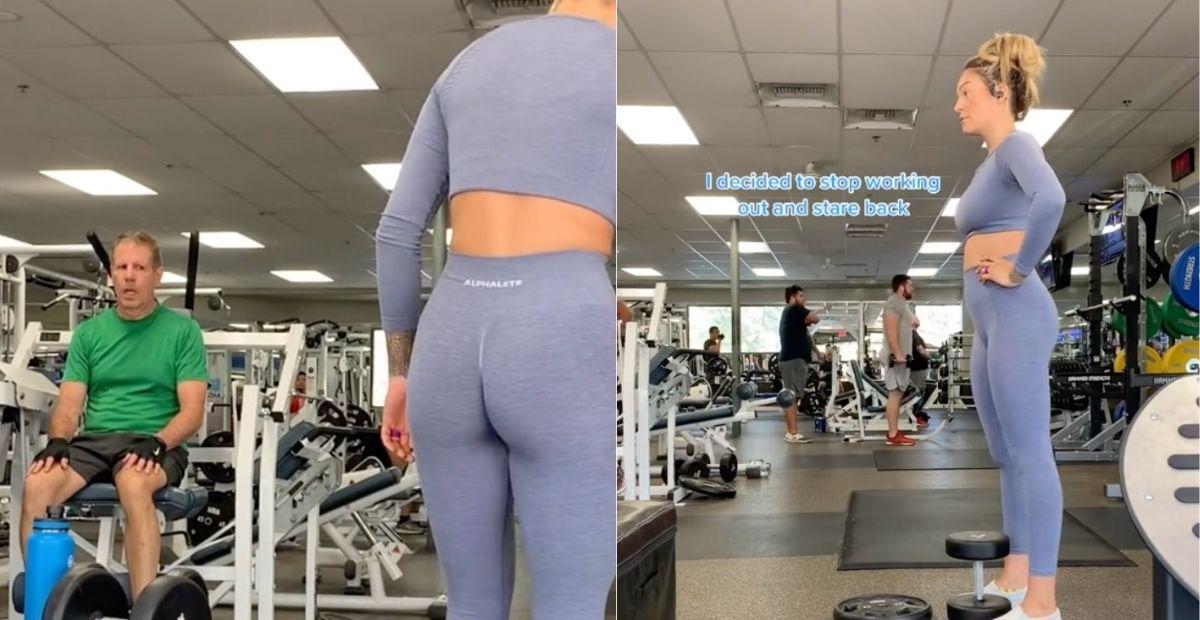
This ‘creepy’ guy wouldn’t stop staring at her at the gym. She knew exactly what to do next.

“He shut up real quick.”

viral tiktok creepy man stares at workout, gym harassment, gym etiquette
Heidi staring back at her harasser on TikTok.Photo credit: TikTok

When lifting weights at the gym, the discomfort you feel should be coming from the workout. Not from other people with no concept of boundaries. However, this is an all-too-common occurrence for women.

Personal trainer Heidi Aragon (@fit_with_heidi) is used to sharing her fitness journey on social media. Her video, which has now garnered more than 8 million views on TikTok, didn’t go viral because of the workout. Instead, people are responding to how she confronted a man who not only wouldn’t stop staring at her, but denied the fact that he was. Until Heidi beat him at his own game.

Heidi explains in the text video “This creepy old guy at the gym kept coming over and staring at me.” Sure enough, the video shows a man in a green shirt, eyes undeniably fixated on Heidi. Uncomfortable, Heidi tries to get her husband to stand between her and the man, hopefully laying down a not-so-subtle cue to back off. But subtlety is clearly not this guy’s language.

So what does Heidi do? She stares back. The strategy seemed to work, at least for a while, but eventually Heidi had to go over and confront the guy directly.

Her video text read: “I told him if he’s going to work out in this corner he needed to stop staring and making me uncomfortable. His response was, ‘I’m just looking around.’ I then told him I record my workouts and I have him on film. He shut up real quick.”

@fit_with_heidi Don’t sit there and tell me you’re not doing something when I have proof. ? #gymtok #fittok #influencer #viral #trending #tiktok #fitness #gym #gymgirl #fyp #fypシ #foryou #foryoupage #gymcreeps ♬ Real As It Gets – Lil Baby

I know what you’re thinking: “Wait, didn’t we just hear a story about this?” Why yes, you’re right. Our very own Tod Perry covered another woman who had to deal with a guy at the gym who couldn’t take a hint.

Yes, almost back-to-back stories of women who have had enough from fellow male gym-goers. And still, there is victim blaming. In the video’s comment section, one user wrote, “Wear pants like that and expected something different??” How many videos have to go viral before we stop blaming a woman’s choice of clothing (which were really quite normal gym attire, by the way) for a man’s obviously intrusive behavior?

Others also seemed to assess that because Heidi was a fitness influencer, she more or less signed up for this kind of attention, invited or not. Which completely negates this woman having any choice in the matter. However, Heidi did post a tongue-in-cheek follow-up video thanking those who posted negative comments, as it gave her more followers and likes. So I guess there’s some small victory.

Though we may never have a consensus on proper gym etiquette, a good rule of thumb is keep to yourself. Getting the gumption to go workout is hard enough; don’t make staying there a hardship as well.

This article originally appeared four years ago.
  • A woman in the Philippines filmed herself kissing her knee. The reaction was universal.
    Do you ever kiss your own knee?Photo credit: Canva
    ,

    A woman in the Philippines filmed herself kissing her knee. The reaction was universal.

    Humanity is delightfully diverse, yet we’re also wonderfully the same. For all our differences, many of our fundamental needs, desires, and impulses are universal. One of those impulses? Kissing our own knees, apparently. A six-second TikTok video shared by a young woman in the Philippines demonstrating the phenomenon went wildly viral, racking up more than…

    Humanity is delightfully diverse, yet we’re also wonderfully the same. For all our differences, many of our fundamental needs, desires, and impulses are universal.

    One of those impulses? Kissing our own knees, apparently. A six-second TikTok video shared by a young woman in the Philippines demonstrating the phenomenon went wildly viral, racking up more than 18 million views and 2.7 million likes.

    Rasta G. simply sits on a chair with one foot up on the seat. She suddenly looks down, notices her knee, then gently kisses it. People all around the world said, “Wait, I’m not the only one who does this?”

    Who knew kissing your own knee was such a universal impulse?

    Comment after comment revealed that people do this but had no idea others did, too:

    “So I’m not a weirdo?”

    “I THOUGHT I WAS THE ONLY ONE.”

    “TikTok slowly make me realize I’m not the only weird one. We ALL weird. 😂”

    “HAHAHAHA why you exposing us.”

    “I knew before you did it.”

    “I’m never alone in my weird experiences. 😭”

    “Not a single unique experience 😭.”

    “More proof that nothing I do is unique and I’m not weird. Thank you. 🙏🙏”

    “So in conclusion we’re all the same just in different fonts.”

    “Kissing knees is universal.”

    “I’m cracking up omg we are all connected.”

    Indeed, others have publicly shared the impulse as well:

    Why, though? What is it about having our knee in our face that makes us want to kiss it? People weighed in on that, too:

    “I have a theory: I think it’s because we don’t see him often so as soon as we see him, we kiss him to show our affection.”

    “I don’t see her often, might as well.”

    “‘Oh haven‘t seen you in a while. 😙’”

    “Its like a long distance relationship.”

    “A lil kiss for encouragement, cause they don’t work very well but they’re doing their best 😅”

    “I mean they help you walk ,so a little thank you😌.”

    “I feel so maternal about my knees.”

    “It’s like kissing your baby’s head.”

    @itsabbywenzel

    why is it every time i sit like this i want to kiss my knee???🫠

    ♬ original sound – user

    Many people said they do the same thing with their shoulders:

    “I do this to my shoulders too 🥹”

    “I’m like that with my bare shoulder hahah – feels comfortable.”

    “I do this 😩. Like I love seeing my shoulder all shiny and smooth. Deserves a kiss fr.”

    Theories about why we kiss our own knees (and shoulders)

    Of course, not everyone does this. But apparently, a whole lot of us do. And the reason why isn’t entirely clear. There are no studies on the subject, and there don’t appear to be masses of people asking their therapists about this habit. It’s just something we do, and people pointed to several potential reasons why:

    • The roundness of our knee looks like a baby’s head. Shoulders do, too—kind of. Perhaps seeing it so close to our face evokes the same urge we get to kiss babies on the top of the head. It could simply be a biological urge being triggered.
    A woman kisses a baby on the top of the head
    Baby heads are irresistibly kissable. Photo credit: Canva
    • It’s a self-soothing behavior. When we were little, our moms, dads, or other caregivers may have kissed our boo-boos, and kids get a lot of boo-boos on their knees. So some of us may automatically associate gentle kisses on the knee with comfort.
    • It’s a way to show our bodies love and gratitude. A lot of the sentiment in the comments is that we don’t really see our knees very often, which is true. So when one is close to our face, we may be reminded of what they do for us. Ask someone with knee problems how important our knees are. It’s a good reminder to give them a little thank-you for their hard work.
    • We’re weird, but no weirder than anyone else. Maybe we’re all just quirky little humans who do random things for no good reason whatsoever. But at least now we know we’re not alone on that front.
  • Anthony Hopkins composed a waltz at age 26. It took nearly 50 years for him to hear it played.
    Anthony Hopkins had his waltz premiered by the Johann Strauss Orchestra, led by André Rieu.Photo credit: gdcgraphics (left), Bert Knottenbeld (right)
    ,

    Anthony Hopkins composed a waltz at age 26. It took nearly 50 years for him to hear it played.

    People know Sir Anthony Hopkins best for his film performances, and for good reason. With two Oscars and multiple other awards, the 88-year-old Welsh actor has earned his accolades for his work on screen. But Hopkins’ first artistic love was not acting—it was music. And that first love received a moving moment of recognition in…

    People know Sir Anthony Hopkins best for his film performances, and for good reason. With two Oscars and multiple other awards, the 88-year-old Welsh actor has earned his accolades for his work on screen.

    But Hopkins’ first artistic love was not acting—it was music. And that first love received a moving moment of recognition in 2011, when the Johann Strauss Orchestra premiered a waltz Hopkins composed in 1964 at age 26.

    “I have been writing music and composing for many years, but I never did anything with it,” Hopkins told The Independent in late 2012. “I’d wanted to be a musician when I was younger, but I wasn’t a good student as a kid, so I just dabbled around and wrote this piece, ‘And the Waltz Goes On,’ in 1964.”

    Years later, Hopkins and his wife were watching a concert by Dutch violinist and conductor André Rieu on TV. Hopkins mentioned that he’d love to have his waltz played in Vienna.

    “Some time later, I got a call from André and he said, ‘I got your waltz,’” said Hopkins. “I said, ‘What?’ He said, ‘I’ve just performed it with my orchestra in rehearsal.’ I didn’t know it, but my wife had sent him the score.”

    Rieu was surprised to receive Hopkins’ composition.

    A violin lying on top of sheet music
    A violin lying atop sheet music. Photo credit: Canva

    “A lot of people send me their waltzes – every week, in fact,” Rieu told The Independent. “But when I got a call from my office early last year, I was surprised when they said Sir Anthony Hopkins was sending me one, as I didn’t know he had a musical side. But I figured a man like him wouldn’t send me a bad waltz. I can imagine it must have been a struggle for him thinking, ‘Shall I give it to the world?’”

    Hopkins and Rieu had never met, but Hopkins flew to Rieu’s studio in Maastricht, Netherlands, in April 2011 to hear the piece rehearsed live.

    “Everyone was so excited–and nervous,” said Rieu. “But he was so gentle and kind; he embraced everyone and gave them all autographs, too. After we played it to him live, he was like, ‘I love it, I love it, and I have tears in my eyes!’”

    Naturally, anyone would be moved to hear a composition they wrote nearly 50 years earlier performed by top-tier musicians. After all, just a few years before, Hopkins told Gramophone magazine, “Music was my first desire, my first wish.”

    Close up photo of people playing the cello in an orchestra
    A musician playing the cello. Photo credit: Canva

    Vienna has been home to many famous composers, including Joseph Haydn, Wolfgang Amadeus Mozart, Ludwig van Beethoven, Franz Schubert, Johannes Brahms, Gustav Mahler, and the Strauss family. So the fact that Rieu premiered Hopkins’ piece there made the moment especially meaningful.

    What a gift it must have been to hear his waltz performed live in one of the world’s most iconic venues by the largest private orchestra in the world, led by one of its most renowned conductors.

    “Playing his waltz for the first time in one of the most beautiful halls in Vienna was like a dream for both of us,” Rieu said.

    Rieu toured with the piece, which is how we have this full performance of Hopkins’ waltz from André Rieu – Under the Stars: Live in Maastricht 5:

    Hopkins has made a name for himself far more successfully as an actor than as a musician, but people loved his waltz nonetheless. Some commenters on the video also noted how sad it would have been if the composition had remained unplayed:

    “There’s drama, passion, love and anger, sadness and boldness, a perfect waltz. And imagine, if Lady Hopkins never convinced Sir Hopkins to release this, we wouldn’t have this amazing masterpiece. Utmost respect for the two of them.”

    “Never asked anyone to play it, and yet it’s absolutely hauntingly beautiful. How much magnificent art is out there that never sees the light of day?”

    “This guy didn’t produce this waltz earlier in his life because he was afraid that nobody would like it. And you hear how beautiful this waltz is. Imagine how many artists have been too afraid to share their work. Imagine the wonderful pieces of music we could have if we would just lighten up a bit.”

    It’s a good reminder for all of us to share the talents we have.


  • The science behind ‘soft socializing’: Why Gen Z is ditching bars
    For younger generations, socializing does not need to be the main event. Photo credit: Canva
    ,

    The science behind ‘soft socializing’: Why Gen Z is ditching bars

    Imagine a puzzle competition held at a friend’s house, jigsaw pieces flying in a flurry. Or a beautiful Saturday morning flower-arranging class, the air fragrant with seasonal blooms, with no pressure to make small talk. What about a nature walk through local woods, where chatting with new people can happen naturally—or not? These enticing options…

    Imagine a puzzle competition held at a friend’s house, jigsaw pieces flying in a flurry. Or a beautiful Saturday morning flower-arranging class, the air fragrant with seasonal blooms, with no pressure to make small talk. What about a nature walk through local woods, where chatting with new people can happen naturally—or not?

    These enticing options are part of a growing trend: “soft socializing.” It represents a significant cultural shift in how we connect, prioritizing shared activities over forced conversation and social performance.

    @eventbrite

    Small talk is out. Shared hobbies are in. From reading hours to coffee tastings, we’re building rituals around what we love. It’s not introversion, it’s intentional gathering! How are you soft socializing this year? #intentional #rituals #hobbies #community

    ♬ original sound – Eventbrite

    Eventbrite’s 2026 Social Study surveyed 4,051 adults in the United States and the United Kingdom. It found that for today’s younger generation, socializing isn’t the main event: 58% call it “somewhat important, but don’t want it to be the focus.” Another 45% prefer control over when and how they interact, and 41% want the option to observe without small talk. Past generations might have labeled this “antisocial,” but Eventbrite calls it a redefinition of what it means to be social today.

    What soft socializing actually means

    Soft socializing means low-pressure, activity-based events where connection happens as a secondary outcome, not the main goal. The idea draws from parallel play, where children play side by side, absorbed in their own activities and comforted by others’ presence. Adults apparently feel the same way.

    soft, socializing, tea, ceremony, generations
    Soft socializing provides a comfortable, neutral environment for activities. Photo credit: Canva

    Parallel play, as researchers describe it, provides “a comforting middle ground where participants can enjoy the presence of others without the demands of conversation, leading to reduced stress and anxiety.”

    In tea-tasting ceremonies or silent book clubs—popular, low-key socializing activities—participants share space and experience without the need for ongoing conversation. The activity itself serves as the anchor for connection. Conversation may unfold naturally, or it may not—both are absolutely welcome.

    That relaxed structure is key. Traditional socializing pressures people to perform: be charming, interesting, engaged, and instantly happy. Low-pressure socializing shifts the focus from individuals to the activity.

    The numbers behind the shift

    Data from Eventbrite’s survey paints a striking picture of where people are showing up. Over the last two years, low-pressure events have seen remarkable growth:

    • Flower-arranging events saw a 282% increase in attendance.
    • Puzzle competitions grew by 151% in the U.S.
    • Music bingo attendance increased by 149%.
    • Caffeine tastings (like coffee, tea, and matcha) became more popular, with an 80% increase in events and a 49% rise in attendance.
    • Silent events, such as silent discos and book clubs, saw a 14% increase in attendance.

    These numbers show a desire for creative, low-pressure events that connect people with less effort.

    The psychology of being present together

    There’s solid science behind why soft socializing works so well.

    A 2024 study in the journal Motivation and Emotion found that “intrinsically motivated silence” promotes greater closeness and satisfaction. It suggests that, in the right context, quiet that comes from emotional connection—not social obligation—can connect people more effectively than conversation.

    oxytocin, hiking, soft, socializing, conversation
    Shared activities increase oxytocin in the brain. Photo credit: Canva

    Similarly, research shows that shared activities increase oxytocin, a hormone linked to trust, empathy, and bonding. Stanford University researchers have found that oxytocin plays a significant role in social interactions, including everyday ones. Soft socializing activities—walking, crafting, or cooking—involve people moving and creating together, an effective way to build connections.

    For those with mental health challenges, soft socializing can be vital. Nearly two-thirds (65%) of Gen Z reported expe­ri­enc­ing at least one men­tal health prob­lem in the past two years—especially with social anxiety—making the rise of soft socializing particularly important. When the activity takes center stage, social pressure drops.

    Soft socializing and the loneliness epidemic

    This discussion takes place against the backdrop of a loneliness crisis that the former U.S. Surgeon General has declared a national epidemic. In a 2023 advisory, Dr. Vivek Murthy warned that a lack of social connection carries health risks comparable to smoking up to 15 cigarettes a day. Those risks include a 29% increased chance of heart disease, a 32% increased risk of stroke, and a 50% greater likelihood of developing dementia among socially isolated older adults.

    Loneliness statistics are startling. In a 2025 survey, about half of American adults reported feeling lonely. A 2024 poll found that among those aged 18–34, 30% said they feel lonely daily or several times a week. According to Murthy’s advisory, between 2003 and 2020 average monthly time spent alone increased by 24 hours, while time spent with friends dropped by 20 hours.

    But here’s a startling twist: despite these feelings of disconnection, a 2026 Eventbrite study found that 79% of adults aged 18–35 want to attend more live events. As Eventbrite CEO Julia Hartz put it, “The most social generation in history is redefining what it means to be truly present.”

    This signals a shift: people aren’t withdrawing—they’re craving meaningful bonds and growing disenchanted with traditional ways of forming them.

    How to plan a soft socializing hang

    Are you willing to give it a try? Here’s what you need to plan a successful soft socializing hang:

    • Lead with activity

    The key rule? Build the event around a shared activity, not conversation. Think craft nights, puzzle competitions, guided hikes, silent book clubs, board games, or cooking classes. Any format that gives people something to engage with—besides each other—works. The activity itself takes the conversational pressure off attendees.

    flower, arrangement, soft, socializing, conversation
    Flower arrangement classes can be a great soft socializing option. Photo credit: Canva
    • Choose the right venue

    The right setting sets the mood before the event even begins. Think neighborhood cafés, local breweries, bookshops, and parks—venues with a naturally relaxed atmosphere.

    • Interaction should be optional

    Plan activities for small groups of three to five people. Try arranging seats side by side instead of face to face to ease the pressure of direct conversation. You can offer conversation starters, but don’t make them mandatory. Let people arrive and settle in at their own pace.

    • On the day of the event, make your welcome warm but brief

    Have materials ready so attendees can start immediately, avoiding awkward waits. Keep background music low and ambient. Close with a natural social moment—such as a snack or a group photo—for those who want to linger.

    Rebuilding connection on your terms

    As one 31-year-old told Business Insider, “We have to retrain ourselves to be social again.” Let soft socializing help. It lowers the stakes, removes social pressure, and allows connections to develop organically. Say goodbye to forced icebreakers.

    The former surgeon general urges us to prioritize social connection as we would any major public health issue. While soft socializing is not a complete solution to loneliness, it marks a vital first step—shifting our approach from forced interaction to genuine, low-pressure connection through shared activities.

  • Woman shares amazing 5-year singing transformation and obliterates the concept of ‘I can’t sing’
    A woman singing. Photo credit: Canva
    ,

    Woman shares amazing 5-year singing transformation and obliterates the concept of ‘I can’t sing’

    Some people can sing, and some people can’t. A beautiful voice is a gift and you either have one or you don’t. At least, that’s always been the prevailing wisdom. However, like many pieces of prevailing wisdom, it may not be correct. According to NBC News, an estimated 10–30% of people believe they “can’t sing”…

    Some people can sing, and some people can’t. A beautiful voice is a gift and you either have one or you don’t. At least, that’s always been the prevailing wisdom. However, like many pieces of prevailing wisdom, it may not be correct.

    According to NBC News, an estimated 10–30% of people believe they “can’t sing” because they have difficulty carrying a tune. However, further research cited by CNET shows that only a minuscule 2% of the population physically lacks the skills needed to perform a song well. These individuals may not have the required control over their vocal cords, or may have difficulty hearing pitch accurately. Everyone else simply lacks the training and practice.

    Learn how to sing

    A woman who goes by Jeska fm on social media recently took to YouTube to show her own proof that it’s possible to learn how to sing.

    singing, singing transformation, vocalist, progress, motivation, inspiration, music, artists, youtube
    Becoming even a half-decent singer can take years of practice. Photo credit: Canva

    In a video titled “MY SINGING TRANSFORMATION: no autotune or reverb, just real progress,” Jeska begins with a few words of inspiration:

    “I just wanted to start this off by saying that I’m only making this video because I wish I had seen something like this when I was a little girl who wanted to sing. It might have changed the entire course of my life. If you’re someone who dreams of being able to sing but just doesn’t think it’s possible for you, this video is for you.”

    Jeska explains that she did choir in high school and learned a few fundamentals. But while she never thought she was a bad singer per se, she didn’t believe she had the talent to sing the way she wanted to as a songwriter.

    “There were things about my voice that I hated,” Jeska says.

    However, the one thing she had going for her was a refusal to give up. She begins the transformation video by showing clips of her early attempts dating back to 2016. Even in 2021, when she was just beginning to train and practice her vocals intentionally, her singing is flat and lacks power and consistency. Her voice strains to produce volume and hit high notes, and it regularly cracks during attempts at vocal runs.

    Jeska explains how she spent years working with teachers, doing self-instruction and exercises, and practicing and performing. The final clip of her performing five years later is almost unrecognizable. The power, accuracy, and clarity are all improved several times over. All Jeska’s hard work had paid off, and she was far better positioned to perform her own music and pursue singing in other ways.

    The full transformation has to be heard to be appreciated:

    So many kids grow up dreaming of becoming singers or musicians

    However, we as humans tend to drastically underestimate how much time and work it takes to succeed.

    The “planning fallacy” is a psychological concept that suggests people often have an overly optimistic view of what it will take to complete a task. In practice, it’s one thing to pick up a guitar and realize just how difficult it is to maneuver your fingers with the accuracy and speed required. But when it comes to the original instrument—our voice—many people assume that if they have talent, it will present itself naturally.

    “Singing’s actually very different, as everyone can produce a sound,” researcher Sean Hutchins tells The Guardian. “Even if people don’t learn the technique behind how to sing, you use your voice for the purpose of speech so everyone’s reasonably adept at controlling it. The key thing which separates good singers from bad isn’t so much natural talent but getting the training to use it in the right way.”

    He also adds that the limiting belief people develop when their first attempts aren’t magically perfect—“I can’t sing”—causes many to give up on their dream. Hutchins says the worst singers he’s studied are often the ones least likely to practice.

    “My main takeaway from this whole singing journey is that it’s never too late to pursue your interests,” Jeska says at the end of her video. “You never know how far you’ll go.”

    She’s also brutally honest about how much work it really takes to perfect your vocal control. For most people, it takes years. The idea that someone can become a brilliant professional singer overnight with no training and little practice is mostly false. But so is the idea that none of us is capable of honing at least a karaoke-worthy voice, and maybe far more than that.

  • Gen Xers and Boomers share what air travel was like in the ’80s and ’90s. The differences are wild.
    Flying has changed a lot over the decades.Photo credit: Canva
    ,

    Gen Xers and Boomers share what air travel was like in the ’80s and ’90s. The differences are wild.

    From smoking sections on planes to saying goodbye at the gate, so much has changed.

    Airline travel has always been an evolving business, from the first commercial flight in 1914 to the thousands of passenger flights in the air at any given moment in 2026. Those of us who lived through 9/11 as adults remember a very different time in air travel.

    On Reddit, someone asked Gen Xers and Baby Boomers what airline travel was like in the ’80s and ’90s, with specific questions like: “What was security like? What was the actual process of getting plane tickets before the internet? Was it hard to arrange rides with pay phones only? Did people smoke on planes? Did you use pay phones to call your loved ones back home and let them know you landed safe?”

    The folks on the r/AskOldPeople subreddit delivered answers, and it’s a trip down memory lane for those who lived it.

    Buying flights was a whole process before the Internet

    Today, we hop on Google Flights to compare ticket prices and book flights on airline websites right from the comfort of our couches in a matter of minutes. Back in the day, we didn’t have that luxury. Booking a flight meant making a long phone call or hoofing it to an office or kiosk, then receiving a paper ticket you had to keep track of.

    “You could either call and buy a ticket over the phone or buy it at the airport.”

    “Got a paper ticket. Mailed or picked up at airport or airline kiosks/offices at various locations (shopping malls, etc).”

    “Tickets were really precious things and you had to take care of them. They were hand-written even.”

    “Tickets were purchased directly from the airline or through a travel agent. Prior to the internet, it was much harder to research and book trips, so you hired an agency to help you.”

    “We would use travel agents in our town. You would tell them where and when and they would give you your options.  You. Would pick up your tickets at their office. They could set up your hotel and car rental.”

    Airport security was much less of a process

    It’s hard to imagine a time when you didn’t even have to show your ID to hop on a plane, but it happened. Many security measures were implemented after 9/11, though they had already been increasing incrementally before then.

    “Airport security was just a metal detector that you walked through that anyone could walk through and go to the gate to send off or greet the departing/arriving passengers. No need to be a ticked passenger, no ID check, or anything.”

    “I travelled a lot for work from about 1993 onwards. I remember flying Sydney to Chicago with a full tool case as hand luggage, a Gerber pocket knife in my pocket, no scanners hardly any security, just turn up and get on the plane.”

    “Security was easy. Just toss your stuff in a basket and go through a metal detector. I used to fly with a swiss army knife and it was no problem at all.”

    “Security was basic and relaxed. You really could run madly through the airport to catch a flight and nobody cared. You passed through a metal detector arch that was tuned way down to avoid false positives. It wouldn’t notice car keys, pens, or even small pocket knives (I once realized I had accidentally tested that).”

    “In about 1988, I bought a round trip airline ticket from NY to San Francisco off of Craigslist from a Chinese guy with a very Chinese name. Now I am as white as Wonder Bread, but I used that ticket and no one batted an eye. No ID. No questions. Nothing.”

    Smoking on airplanes was allowed through the ’80s

    Kids today can’t fathom how ubiquitous smoking was before the mid-’90s. Smoking wasn’t banned on domestic flights until 1990, and it wasn’t banned on international flights until 2000. Before that, planes had “smoking sections” with nothing separating them from the rest of the cabin. Ridiculous in hindsight, but that’s how it was.

    “Yes you could smoke on a plane…there was smoking and non smoking sections.”

    “The first time I went on a plane (mid 80s) was with my mom to go visit family, I don’t remember how old I was, but I distinctly remember there were still ashtrays in the arm rests.”

    “They used to put a complimentary four-pack of cigarettes on every meal tray. My father had at some point allowed me a puff of his cigarette through my bubble pipe, which I did not enjoy at all. So shortly after my meal tray arrived, my 4-year-old self yelled, ‘Stewardess, you can take these cigarettes away, because I quit smoking three weeks ago!’”

    “First international flight in 1997 I smoked all the way over. Pity the poor non-smokers, because even with a smoking section the smoke was all through the plane.”

    No luggage fees (but no luggage wheels, either)

    Ah, the good old days of free checked luggage. (Paying for checked luggage is actually pretty new. All airlines let you have one free checked bag prior to 2008.) But luggage was also a whole different animal. We used to have to carry suitcases. And people didn’t generally carry on suitcases with clothing in them because they’d end up smelling like smoke by the end of the flight.

    A stack of vintage suitcases from before luggage had wheels
    Suitcase wheels are a relatively new invention. Photo credit: Canva

    “Nobody was dragging their carry-on baggage throughout the terminal – checking bags was always free and everybody checked their bags. But the downside of no baggage security checks was that stuff sometimes got stolen from your bags by baggage handlers – so you always locked your bags. that is why those hard-sided Samsonite suitcases with the combination lock latches were popular.”

    “Luggage didn’t even have wheels back then!”

    “I remember the early wheeled suitcases were so awkward and top-heavy like an elephant riding on the top of a London bus. They had wheels on the bottom and a ‘leash’ attached to the top front. It was better than carrying, but if you went anything other than perfectly straight, it would topple over.”

    People dressed up to fly

    It’s not at all unusual to see people boarding flights in sweats or other uber-casual attire. On a redeye, you’ll see people basically in their pajamas. Comfort has definitely overridden traditional airplane-attire etiquette, which some people love and some people hate.

    “People dressed well, not fancy but nice. I once flew ‘standby’ (my sweet Dad was an aircraft mechanic) and I had to wear my ‘nicest’ dress just in case I got bumped to first class! And I did! It was very nice. One way, the other way i was in coach, but everyone was still dressed nicely, including me. :)”

    “Can confirm. I flew to Germany as a kid in the 80’s and my parents made me wear my ‘Church clothes’ on the plane.”

    “Night and day. It was a privilege to fly, people got dressed nice to fly, now flying like taking a bus. It’s a zoo in the air and people crazy.”

    Pick-up and drop-off happened right at the gate

    Gen Xers and Boomers who flew remember saying goodbye right before boarding the plane and greeting loved ones just after exiting the jetway. That can’t happen now. Security increases after 9/11 meant that only ticketed passengers could fully enter the terminal. At least it makes terminals less crowded?

    A woman waves goodby in an airport before heading into airport security
    Goodbyes now take place before going through security. Photo credit: Canva

    “Everyone could go to the gate and hang out. We used to go to the airport and watch the planes taking off and landing.”

    “Some time in the late 90s, I went to pick up my mother from the airport, and I brought a friend with me. They let us both go wait at the gate with no issues. We probably had to go through a metal detector but it was pretty easy.”

    “Pick up and drop off was a ton easier. Whoever was coming to get you parked somewhere and came to the gate to wait for you. For drop offs they either pulled right up to the terminal and let you out where there was a porter waiting to take your bags (hopefully to the correct flight), or you parked in the airport short term lot and walked in together —all the way to the gate if the goodbye was a difficult one.”

    “I’m glad this isn’t allowed anymore. Anytime I’ve flown, the gates have been full and I end up standing off in the walkway waiting to board. I can’t even imagine adding ‘hey, let’s all hang out with Grandma before she leaves’ into the mix.

    Another thing I remember about this was trying to get OFF the plane. People would crowd around the gate to greet their arriving family just like they do around the baggage carousel. And of course when grandma walked out the door, they’d run up and do their hugs and handshakes right there with everyone else trying to get around them. It was maddening, especially at the holidays.”

    You had to use a pay phone if you needed to call someone

    These days, nearly all airlines allow you to text for free even when you’re up in the air. The first thing many people do when the wheels touch down is text someone to let them know they’ve landed. Gone are the days of having to find a wall of pay phones or waiting until you got to your hotel to call someone.

    A wall of payphones
    Airports had walls of pay phones like this. Photo credit: Canva

    “Airports used to have huge banks of payphones all over, but I think most people would call from their hotel phone when they got checked in.”

    “There were plenty of pay phones to call people, and plenty of shops that would make change for you if you needed.”

    “Airports would have large banks of payphones, but they would also have kiosks with courtesy phones, that were basically hotline phones with no keypad that automatically dialed, this could be the shuttle bus operation, a taxi service, or your hotel that may operate their own shuttle service. Picture a kiosk near luggage pickup with a sign for Holiday Inn Airport and a phone with no number pad that directly connects you to the front desk at the nearby Holiday Inn so they could dispatch the shuttle van driver to pick you up.”

    “You didn’t call anyone when you landed, people met you at the airport. You arranged in advance. If the flight was delayed, they waited. Nobody was paying for parking at airports.”

    Other than the secondhand smoke, flying was more comfortable

    Before 1978, the government set flight prices. Since airlines couldn’t compete on price, they competed on service and passenger experience. That focus spilled over into the ’80s, but as price competition grew, so did a desire for cheaper flights. Now we pay less, but we also get less.

    “The planes were more comfortable. The seats and legroom were better in economy/coach and you got an included meal and in-flight movie on longer flights.”

    “In the ’80’s it was much nicer. Larger planes, more room, bigger seats, better food, more luggage allowed. Plus few carry on restrictions. In the 90’s airlines had begun tightening up a bit but you could still expect at least a non-alcoholic drink and a snack on anything longer than a puddle jumper flight even in economy or business. Anything longer than that and you could count on a meal.”

    “The planes were less full and seats had enough legroom even economy.”

    “Seats had more leg room because they weren’t cramming in as many as possible on discount flights.”

    Some changes in air travel have been good, and others not so great. But flying definitely isn’t what it used to be.

  • Woman ticketed for driving with phone in her ‘right hand’ has a huge surprise for police officer
    A woman hands her license to a police officer. Photo credit: Canva

    Distracted driving is a dangerous issue that police officers are taking more seriously. But when Katie, who runs the social media page Slightly Off Balance, was pulled over for the offense, she had questions. The officer writing the citation insisted that she was driving with her phone in her right hand. That didn’t make sense to her.

    The woman uploaded a clip of the interaction in which she asks the officer for clarification. According to the officer, he witnessed Katie committing the driving infraction. Katie asked for clarification several more times because it would be impossible for her to hold a phone in her right hand. Why? She doesn’t have one.

    police, traffic ticket, traffic stop, pulled over, amputee, distracted driving
    Police car seen through the rearview mirror. Photo credit: Canva

    In the video, which has been viewed nearly eight million times, Katie pokes fun at the situation. “Turns out you can still get a ticket for driving with a device in your right hand, even if you don’t have a right hand,” she says, holding up her arm. Clearly, the entire lower part of her right arm is missing.

    After cutting to the bizarre interaction between herself and the officer, Katie shows herself attempting to hold a phone with her nonexistent hand. Spoiler alert—it doesn’t work. In the video, the officer can be heard saying, “If you want to take it to court, option five on the back of the ticket. That’s how you take it to court.”

    police, traffic ticket, traffic stop, pulled over, amputee, distracted driving
    A police officer stops a driver. Photo credit: Canva

    Taking it to court is exactly what she plans to do. In a follow-up video, she shares that her court date is scheduled for mid-April. Commenters are not only gobsmacked that she could be cited for this particular infraction, but they’re also completely invested in her court case.

    @slightlyoff.balance

    Low key thought I had two hands for a minute 🤦🏻‍♀️ #palmbeach #cops #PBSO #floridaman #pulledover

    ♬ original sound – slightlyoff.balance

    One person begs, “Please take us to court with you, I want to hear the judge.”

    Another writes, “I’m glad you recorded him saying it was the right hand otherwise I guarantee he would have lied later on and claim he never said that.”

    “Ok but how would you ve able to drive with a phone in ur LEFT hand anyway,” someone questions.

    “Oh I wanna see a part 2. I know it sucks tho, cause you shouldn’t have to take time off work/life just to prove a cop wrong,” a person laments.

    One commenter shares a cheeky way Katie could have handled the situation, writing, “I would have said ‘ok I’ll see you in court’ and waved with your right hand to get his reaction. And then still gone to court to let the judge know he was lying.”

    police, traffic ticket, traffic stop, pulled over, amputee, distracted driving
    A woman being pulled over. Photo credit: Canva

    Some people wonder why she didn’t inform the officer on the spot that she didn’t have a right hand. But others argue that the officer had already proven to be untrustworthy and would likely change his story. Katie didn’t respond to those questions, but the officer could likely see that she didn’t have a hand while looking directly into her window.

    Katie appears to have a sense of humor about missing a hand, liking several comments that joke about her limb difference.

    “I would have held my right hand out for the ticket. So glad you got that admission recorded,” someone writes.

    “Cutting your hand off to get out of a traffic ticket is wild,” another jokes.

  • People were asked to share their culture’s most delicious ‘filling wrapped in dough’ snacks and they didn’t disappoint
    One thing brings all people together: a filling wrapped in dough.Photo credit: Canva

    When reading the words “filling wrapped in dough,” what pops into mind? Dumplings? Empanadas? Hostess Fruit Pies? An Instagram post has people discussing the near-universality of cultures around the world having their own version of a tasty filling encased in delicious dough.

    No matter where a person comes from, it seems like there is some form of “filling wrapped in dough” food in every country. Folks from different nations flocked to Reddit to discuss their favorites:

    “Sambousek. We make it filled with minced meat, onion, and pine nuts all mixed together with some pomegranate molasses.” (from Lebanon)

    “Cornish pasties. Or maybe sausage rolls. Then again, beef wellington is basically ‘filling wrapped in dough.’” (from the United Kingdom)

    “Pastel. Very thin and crispy dough, deep fried. National favorites include heart of palm, and cheese & ham. My favorite is shrimp.” (from Brazil)

    “Calzone.” (from Italy)

    “My French-Canadian grandma makes tourtiere in a hand pie format every Christmas and they’re incredible. I look forward to them every year.” (from Canada)

    “Here’s a curry goat patty.” (from Jamaica)

    “Pierogi, my beloved.” (from Poland)

    “Pitepalt. A potato and barley dumpling the size of a tennis ball. It is filled with salt pork and served swimming in butter and lingonberry jam.” (from Sweden)

    “Irish sausage rolls… Not to be confused with a sausage in a roll.” (from Ireland)

    “I have a steak and cheese pie for breakfast most mornings.” (from New Zealand)

    “Give me one of them handheld dessert pies from the gas station and I’ll be all over them.” (from the United States)

    Pro chefs share their favorite “filling wrapped in dough” foods and recipes

    Many professional chefs and food experts who spoke to Upworthy shared their favorite versions of dough-wrapped foods and the stories behind them.

    “I’ve rarely met a dough stuffed with filling that I didn’t like, and I also think it’s fun to reimagine popular foods and let their worlds collide,” said award-winning pastry chef Katherine Sprung. “I was a winner of the show Chopped Sweets, where our challenge was to create mash-up desserts. For my first round I made a cheesecake egg roll, made a raspberry cheesecake mixture, enclosed in an egg roll wrapper, and fried, which, luckily, the judges really loved!”

    Sprung also said that making those cheesecake egg rolls on TV inspired her to create another simple recipe: cashew butter and jelly rolls.

    “Spinach fatayer are portable and are perfect for picnics, potlucks, and special occasions,” said cookbook author Luay Ghafari. “My grandmother used to prepare them on the weekends so they would be ready to go into our school lunchboxes come Monday.”

    If you want to try this savory hand pie, Ghafari kindly provided a recipe. Ghafari said that fatayer can also be made for meat or cheese lovers.

    Spinach fatayer. Photo credit: Luay Ghafari

    A “filling in wrapped dough” started a career

    These filling-wrapped-in-dough foods aren’t just favorites springing from a chef’s imagination or family roots. In some cases, they can even inspire lifelong vocations.

    “My favorite ‘filling in wrapped dough’ food is the Himalayan momo,” said Jessica Randhawa, chef and recipe developer at The Forked Spoon. “I never knew what a momo was until my boyfriend, now husband, and I traveled to Asia for six months in 2011. Those travels are what initially got me into cooking classes and schools abroad and writing about them.”

    Jessica Randhawa and a classmate learning to make momos in Kathmandu.
    Photo credit: Jessica Randhawa

    “When I got back to Kathmandu, I had to take a cooking class to learn how to make them, which was one of my first experiences learning to cook from professionals,” she added. “So, momos are really special to me because learning about them and how to make them 15 years ago inadvertently kicked off a long and winding road that led to growing one of the largest recipe websites in the world.”

    Wrapped in dough, wrapped with love

    Celebrity chef Mariko Amekodommo told Upworthy that her upbringing and her travels while training to be a chef were filled with dough-wrapped delights.

    She recalled learning how to make handmade ravioli by watching her mom and grandma as a child. Among many other foods, she said she learned to cook and eat tamales, bánh cuốn, samosas, and ovocné knedlíky while living in Los Angeles, Vietnam, India, and the Czech Republic. While all of those dishes use different ingredients, Amekodommo saw many similarities.

    “What strikes me, having lived and cooked professionally across multiple countries, is that these aren’t really different dishes,” said Amekodommo. “They’re the same dish built from whatever the land provided—wheat in Europe and North India, corn in Latin America, rice in Southeast Asia.”

    “The form is universal because it solves the same problems everywhere: stretch protein with starch, make it portable, feed a lot of people from not very much,” she added. “And they became holiday food everywhere for the same reason—you can’t really make them alone. They require hands, time, and people around a table. That part never changes.”

    It seems that “filling wrapped in dough” brings people together, whether worldwide or within your own household.

  • Woman makes a country song out of her dad’s voice texts, and it’s an accidental hit
    A dad's failed voice-to-text attempts strike musical comedy gold.Photo credit: Canva
    ,

    Woman makes a country song out of her dad’s voice texts, and it’s an accidental hit

    “Cowboy Gary has stolen the hearts and brought tears of laughter to MILLIONS.”

    Anyone who’s ever used voice-to-text has felt the frustration of a phone hearing things very, very wrong. This is especially true for those among us with thick accents.

    However, this frustration can apparently make for musical comedy gold.

    Just ask Bri Hill, who used failed voice-to-text attempts from her father, affectionately known as “Cowboy Gary,” and turned them into a country song that’s not only hilarious but also kinda slaps.

    “This is my greatest creative achievement to date,” bragged Hill.

    And honestly, despite the fact that she’s an art teacher, she ain’t wrong. Gary’s twangy voice really lends itself to the genre. Even something as mundane as asking his sister if she’s coming to the family reunion (“Harold and Wanda will be there. Oh, and Lindsey!”) magically feels perfect.

    And of course, there’s a bit of an, ahem, misunderstanding when the phone tries to transcribe Gary talking about the BULLS on his farm. Three guesses as to what word the device thinks he’s saying.

    Watch:

    “Never know what the phone’s gonna print when I’m talkin’ to it,” Gary laments in the tune. We know your pain, Gary! He then brings it all home by saying, “I will talk to ya later when I have time to talk on the phone instead of talk to the damn phone!”

    TikTok reacts

    Without a doubt, it was an instant hit online. People praised Hill for writing a bona fide honky-tonk bop and empathized with Gary’s exasperation—so everybody found something to love.

    “You, ma’am, have written the perfect country song. David Allen Coe would be proud!”

    “Can I find this on Spotify? 🤘🏻 🎶 🤠”

    “This is a hidden gold mine.”

    “I love this! My phone constantly voice texts ridiculous things, and I say all the time, ‘Siri doesn’t speak Texan.’ I always thought I didn’t have an accent until I attempted voice texting.”

    “It sounds like text conversations with my dad! Love it!!!! my siblings, and I do a monthly recap of our text messages with our father.”

    “​​I have tears rolling down my face from laughing.”

    “As someone who voice texts, this is a very accurate conversation.”

    “Submit this to the waffle house juke box 🤣”

    “This why I don’t use voice to text. 🤣”

    As Hill put it in her caption, Cowboy Gary has stolen the hearts and brought tears of laughter to MILLIONS.”

    Getting your phone to understand your accent

    According to a survey conducted by Guide2Fluency, Southern and Texan dialects are two of the five U.S. regional accents most commonly misunderstood by AI, ranking first and fourth, respectively. Joining them are New York, New Jersey, and Boston accents. And that’s without even going into the challenges that ethnic and cultural dialects and accents face when it comes to errors.

    That said, there are ways to reduce some of these mistakes, even if they don’t disappear entirely. One is to change the specific regional dialect (e.g., British English vs. American English) in your settings. Another is to update your system’s voice recognition software to ensure better accuracy.

    Or, you could just use it to make a song. Whatever floats your boat. 

Health

A relatively unknown eating disorder is on the rise as Millennials warn about ‘2000s skinny’

Moms

18 moms share their most intense and strange pregnancy cravings

Generations

Gen Xers and Boomers share what air travel was like in the ’80s and ’90s. The differences are wild.

Culture

Woman ticketed for driving with phone in her ‘right hand’ has a huge surprise for police officer