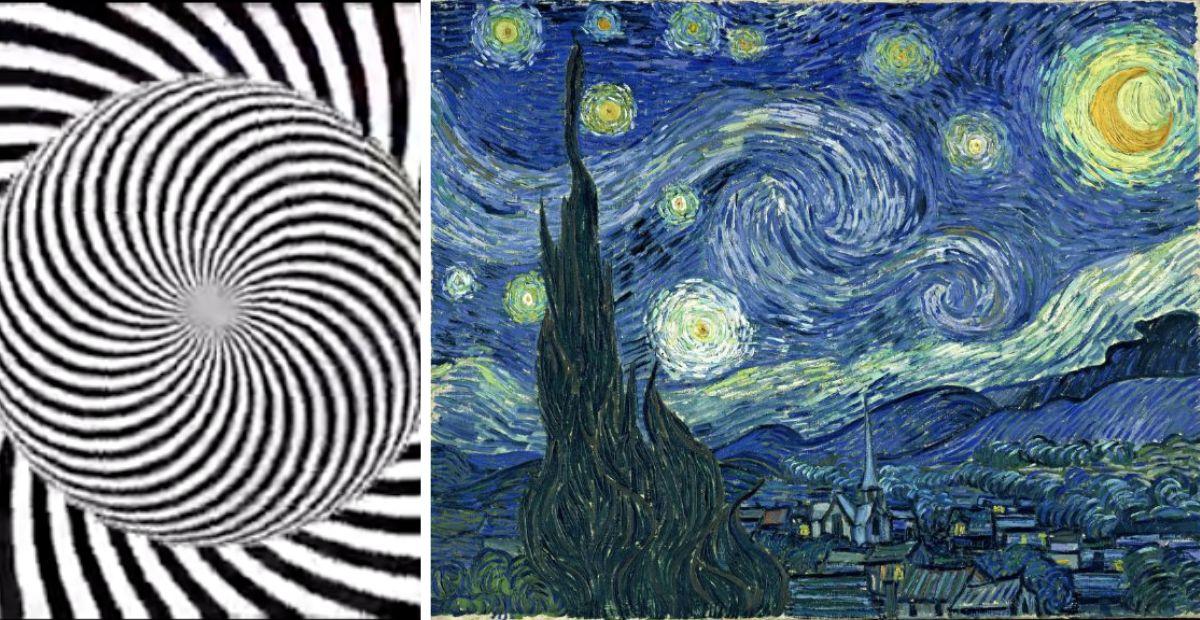
Optical illusion makes looking at Van Gogh’s ‘Starry Night’ a truly ‘moving’ experience

This is so trippy.

optical illusion starry night
Photo credit: @Alex_Verbeek/Twitter,Van Gogh’s Starry Night” by Christopher S. Penn is licensed under CC BY 2.0.Watch "The Starry Night" come to life with this optical illusion.

Vincent Van Gogh‘s “The Starry Night” is one of the most recognizable and beloved paintings in the world. It was completed in 1889 and has been part of the permanent collection of the Museum of Modern Art in New York City since 1941. It is not up for sale, but if it were to go to auction there is a chance it could fetch as much as billion dollars.

Such a priceless work of art is perhaps a strange object for a parlor trick, but trust me when I tell you this one is worth it. Whether they are oases in the desert created by heat shimmer, an elephant with an indeterminate number of legs or straight lines that look crooked, optical illusions can throw our brains for a loop. They can also be super fun, and an optical illusion that makes the “Starry Night” painting turn into a moving picture is most definitely fun.

The illusion, shared by Alex Verbeek on Twitter, involves two steps. First, you stare at the center of a spinning spiral image for 20 seconds, then you look at the painting. Staring at the spinning spiral isn’t as easy as it sounds—it makes your eyes buggy and your brain hurt a little—but even if you don’t do the full 20 seconds, you can probably get the effect.

Aim for staring at the center of the spiral for at least 10 seconds, then watch “The Starry Night” come to life before your eyes. (You have to click “play” first, by the way. The spirals need to be swirling.)

Want a larger version of the painting to try it out on? Here you go:
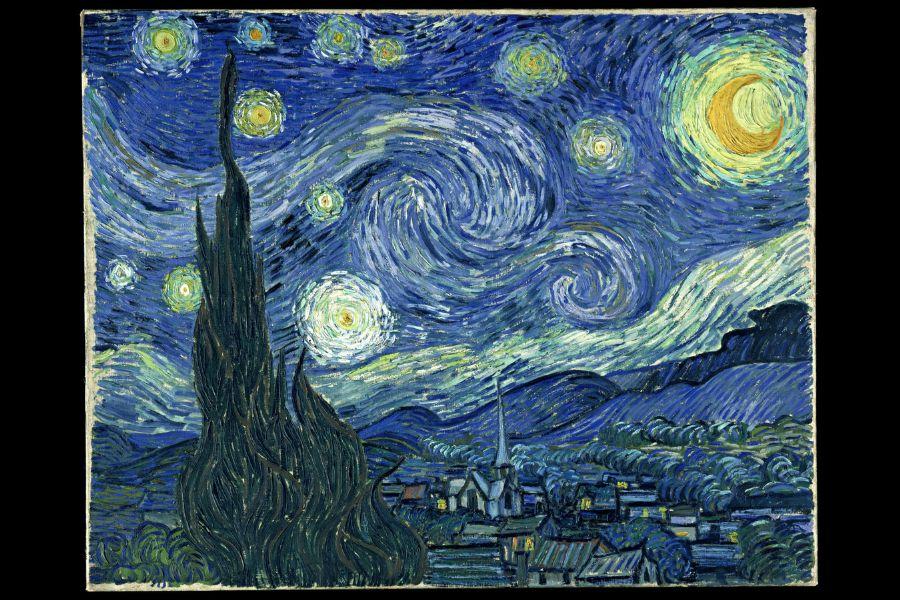
Van Gogh Starry Night
Vincent Van Gogh's "The Starry Night" (1889) "<a href="https://www.flickr.com/photos/72143877@N00/3956763480">Van Gogh's Starry Night</a>" by <a href="https://www.flickr.com/photos/72143877@N00">Christopher S. Penn</a> is licensed under <a href="https://creativecommons.org/licenses/by/2.0/?ref=openverse">CC BY 2.0</a>.

The effect doesn’t last long, but phew. Our brains are so bizarre.

According to a 2009 study by Japanese researchers, motion in optical illusions is still processed in the brain the same way real motion is. So don’t be surprised if the moving painting makes you feel a bit woozy, if you’re prone to motion sickness.

It’s hard to believe that Van Gogh’s “Starry Night” could be improved upon, but here we are. Definitely a “moving” experience to share with your friends.


This article originally appeared two years ago.

  • 8 small, simple acts of kindness you use to brighten someone’s day
    Small everyday actions can make the world a better place.

    Acts of kindness: we know they’re important not only for others, but for ourselves. They can contribute to a more positive community and help us feel more connected, happier even. But in our incessantly busy and hectic lives, performing good deeds can feel like an unattainable goal. Or perhaps we equate generosity with monetary contribution, which can feel like an impossible task depending on a person’s financial situation.

    Have you ever felt guilty because you don’t spend enough time volunteering? Or maybe because you can’t or don’t give much money to charity? It’s not a good feeling, and you can sometimes feel stuck not knowing what to do about it. But being kind and generous to others doesn’t have to be hard, or take much time, or cost anything at all.

    One social media user posed the question: “what’s a small act of kindness that literally anyone can do/practice everyday?” and people gave some brilliantly simple ideas.

    Eight small acts that actually make a difference

    Here are eight easy-to-accomplish crowdsourced answers that might bring us one step closer to a more peaceful world:

    1. Be aware of your surroundings

     “Either move with the flow of traffic or get to the side if you have to situate yourself.” – @JoeMorgue

    Americans, in particular, seem to get obsessed with the idea of “winning.” Walk around and/or faster than the next person, or refusing to give way. It’s a really kind and considerate move to make space for other people to exist comfortably.

    2. Use headphones when taking public transport

    “If you don’t have them – you can go 20 minutes without making excessive noise while sharing a small space with other people.” – @cynthiayeo

    Often there’s no law or rule in place that “forces” you to do the polite thing, like minding how much noise you make on an airplane or public transport. But it’s a simple thing to do that goes a long way for the people around you.

    3. Give compliments

    “If you have a charitable thought about someone, even a stranger, say it out loud to their face. It is free, it is easy, and it might be the best thing that has happened to that person all week. Nothing creepy or overtly sexual or flirty, just kind words. ‘That shirt is really your color! Your haircut is beautiful. I appreciate your help, you were a real lifesaver!’ It doesn’t cost you anything and it means the world to the people you are talking to.” – @Comments_Wyoming

    Everyone loves receiving genuine, no-strings-attached compliments! In fact, we often think about them all day, or even for longer. Don’t withhold praise. Give it freely and openly, when you really mean it.

    4. Hold doors open for people

    “Makes a big difference in one’s day.” – @sconnie64

    Holding doors isn’t just for gentlemen out on a date. Hold doors for everyone equally; it’s a really sweet and polite gesture.

    5. Don’t act on road rage

     “After several years of commuting I came to the realization that with a few exceptional days, I always got home at the same time. Regardless of how many people ‘cut me off’ or drove too slowly and whatever. I started to just ‘go with the flow’ and always let people in when needed, always give extra room, and just enjoy my music/podcast. Life changing.” – @CPCOpposesAbortion

    Who knows what it is about being in a car that just gets our blood boiling. Maybe it’s the slight anonymity, a little like being in an internet comment section? In any case, don’t indulge. If someone cuts you off, give them the benefit of the doubt and just move on. It was probably an accident anyway.

    6. Have patience

    “You never know what someone else is going through. Could be a breakup, their dog just died, granny finally made it to heaven, or maybe mom just broke the news that she’s got end stage cervical cancer and has weeks left to live. You never know, so be patient. After all, wouldn’t you want someone to be patient with you?” – @mamalion12

    Assuming the best in people is a really good start when it comes to kindness. Most people aren’t out to be difficult or rude. Give them a little grace and there’s no telling how much they’ll appreciate it.

    7. Thank the people you live with for taking care of things around the house

    “It doesn’t have to be over the top, but everyone feels better about doing chores when it is noticed and appreciated. ‘Thanks for folding my laundry’ or ‘thanks for always keeping track of our bills, you’re awesome at managing money!’” – @Mrshaydee

    This goes for kids, too! When they remember to pick up after themselves, reinforce the behavior with praise. Make time to appreciate your partner and family members, too, no matter how small their contributions.

    8. Leave a place you visit just a little bit nicer than when you found it

    “Pick up a piece of litter at the park. Give that mat with a pucker ready to trip someone a little tug to get it to lay flat in the business you’re at. Let an employee know when you spot a leaky dairy product on the shelves so they can deal with it. Return someone else’s grocery cart.” – @BlueberryPiano

    Don’t be the “Someone else will deal with it,” person when you can be the someone else! It doesn’t take any effort at all most of the time to grab a piece of litter. And don’t even get me started on returning the grocery cart. It’s a basic test of human kindness that too many people fail. It’s the easiest thing in the world and saves both employees and the next customer time.

    So why aren’t we doing this already?

    Perhaps surprisingly, the main reason people don’t offer more acts of kindness is the fear of being misunderstood. That is, at least, according to The Kindness Test: an online questionnaire about being nice to others that more than 60,000 people from 144 countries completed. It does make sense having your good intentions be viewed as an awkward source of discomfort is not exactly fun for either party. You can imagine that complimenting a stranger could easily be interpreted the wrong way, for example.

    However, the results of The Kindness Test also indicated those fears were perhaps unfounded. The most common words people used were “happy,” “grateful,” “loved,” “relieved” and “pleased” to describe their feelings after receiving kindness. Less than 1% of people said they felt embarrassed, according to the BBC.

    So, maybe with kindness, we need to put our social anxieties away and act without overthinking (to a certain point, of course). Perhaps it’s best to find the simplest actions we can commit to on a daily basis, rather than formulating some grandiose gesture.

    This article originally appeared four years ago. It has been updated.

  • Winston Churchill battled his depression by staying busy, laying ‘200 bricks’ every day
    Photo credit: Wikipedia/YouTube/British MovietoneWinston Churchill turned to bricklaying to combat depression.
    ,

    Winston Churchill battled his depression by staying busy, laying ‘200 bricks’ every day

    “…200 bricks and 2000 words a day,” Churchill wrote about his antidote to depression.

    Winston Churchill, former prime minister of the United Kingdom, referred to his depression and dark moods as the “Black Dog.” He never hid his struggle, and those close to him knew about it.

    In a personal letter to his wife, Clementine, Churchill wrote:

    “Alice [Guest] interested me a great deal in her talk about her doctor in Germany, who completely cured her depression. I think this man might be useful to me—if my Black Dog returns. He seems quite away from me now. It is such a relief. All the colours came back into the picture. Brightest of all your dear face—my Darling.”

    Churchill turned to physical activity to help subdue the “Black Dog,” including painting. Another pursuit that helped him was bricklaying.

    Churchill becomes a bricklayer

    His passion for bricklaying took center stage at his family’s estate, Chartwell, where he constructed many new additions. His daughter, Mary, wrote:

    “While my father was constructing the red-brick walls which now surround the garden, he had the delightful idea of building a little one-roomed cottage in the line of the wall for Sarah and me: it was meant for us both, but Sarah, who had started at boarding school in 1927, outgrew its pleasures fairly soon, and this charming dwelling became known as the Marycot.”

    Churchill became such a prolific bricklayer that he officially joined the Amalgamated Union of Building Trades Workers in 1928 while serving as Chancellor of the Exchequer, according to The New York Times.

    Churchill also wrote in September 1928 about his bricklaying at Chartwell: “I have had a delightful month building a cottage and dictating a book: 200 bricks and 2000 words a day.”

    He continued bricklaying through the 1950s, according to the International Churchill Society.

    Churchill’s mental health theory

    In December 1921, Churchill wrote an essay for The Strand Magazine titled “Painting as a Pastime.” Churchill also used painting as a way to cope with depression, and he created more than 570 paintings during his lifetime.

    He fully explained his theory on restoring the mind through activity in this excerpt:

    “Many remedies are suggested for the avoidance of worry and mental overstrain by persons who, over prolonged periods, have to bear exceptional responsibilities and discharge duties upon a very large scale. Some advise exercise, and others, repose. Some counsel travel, and others, retreat. Some praise solitude, and others, gaiety. No doubt all these may play their part according to the individual temperament. But the element which is constant and common in all of them is Change. Change is the master key. A man can wear out a particular part of his mind by continually using it and tiring it, just in the same way as he can wear out the elbows of his coat. There is, however, this difference between the living cells of the brain and inanimate articles: one cannot mend the frayed elbows of a coat by rubbing the sleeves or shoulders; but the tired parts of the mind can be rested and strengthened, not merely by rest, but by using other parts.”

    The modern-day phrase “depression hates a moving target” was certainly something Churchill would have subscribed to.

  • Sally Field recalls Robin Williams trying (and failing) to make her laugh on ‘Mrs. Doubtfire’
    Photo credit: YoutubeSally Field and Robin Williams in Mrs. Doubtfire.

    Robin Williams was notorious for making his scene partners crack up and break character with his off-the-cuff antics. However, one costar remained eternally stone-faced: Sally Field. 

    In an interview with Stephen Colbert, Field recalls working with Williams on the set of Mrs. Doubtfire, where he would constantly try, and fail, to elicit even a polite giggle from her. 

    Much to his disappointment, “I would never laugh, ever,” quipped Field, even when “ everybody else was laughing and carrying on.”

    One might assume that a consummate professional like Field perhaps felt the constant jokes were inappropriate or overly distracting. But no. They just weren’t her cup of tea. 

    “It wasn’t funny. It just wasn’t funny,” she told Colbert while chuckling. “Robin was always trying something different to make me laugh. It was so unfunny. I can’t begin to tell you.”

    The one joke that actually made Sally Field break

    Field remained Williams’ white whale throughout the entire production, which “drove him mad.” And to really add insult to injury, Pierce Brosnan successfully made her lose it with a simple fart gag. 

    “We were sitting at a table at the restaurant, and [Brosnan] made a fart noise on his arm. And I was gone. That was it. I laughed so hard they had to redo my makeup.”

    Why their chemistry in Mrs. Doubtfire still feels so real

    Knowing their behind-the-scenes dynamic adds a whole new layer of authenticity to Mrs. Doubtfire, doesn’t it?

    In the movie, Field and Williams are a divorced couple. Miranda, portrayed by Field, constantly feels like she is having to bear all the responsibility of raising their three children while Daniel, played by Williams, seemingly never takes anything seriously. 

    That said, Williams and Field still seemed to have a genuine friendship. 

    In 2024, she told Vanity Fair that her father had passed away during filming. 

    sally field, robin williams, mrs. doubtfire
    The Mrs. Doubtfire movie poster IMDB

    “I was of course beside myself,” Field shared. “I came on the set trying with all my might to act. I wasn’t crying. Being extremely “sensitive and intuitive,” Williams picked up that something was wrong, and even made arrangements for Field to leave filming to make arrangements. 

    “Robin came over, pulled me out of the set, and asked, ‘Are you OK?’” she told Vanity Fair. When Field answered, Williams replied, “Oh my God, we need to get you out of here right now. And he made it happen—they shot around me the rest of the day.”

    So, while Williams might have never made Field chuckle, it feels safe to say that he nevertheless won her respect and admiration. 

    Field stars in the upcoming film adaptation of Remarkably Bright Creatures. While she hailed her costar Lewis Pullman as “one of the best leading men” she’s ever worked with, she didn’t say anything about him making her laugh either. Regardless, her warmth, humor, and emotional depth are just as magnetic today as they were during her unforgettable run alongside Williams.

    Watch the full interview below: 

  • Student tells teacher her ‘secret good news’ and it’s delightfully unexpected
    Photo credit: Image credit: @mrs.jamiesonskinders/TikTok (used with permission)Mrs. Jamieson's reaction to her student's "secret good news" was so pure.

    It’s no secret that teaching is tough, and educators deserve all the dollars we can throw at them. But that doesn’t mean the job doesn’t have its perks. Working with kids means witnessing all the wild, weird, and wonderful ways their brains work, which can result in some moments worth memorializing.

    Case in point: this video from kindergarten teacher Mrs. Jamieson, in which a student told her she had some “secret good news” to share with her.

    If you’ve spent much time with children, you might hold your breath waiting to hear what comes next. A phrase like “secret good news” could go in literally any direction, but no one expected the way this one would go.

    “Tell me your ‘secret good news,’ please,” Mrs. Jamieson said, undoubtedly bracing herself for whatever this little angel was about to say.

    “I’ve never told you I was an African-American,” the girl said, her smile obvious even though we can’t see her.

    Mrs. Jamieson, to her credit, made an incredulous face and said, “What?!”

    “I was an African-American this whole time!” the student said, giggling. Oh, what a darling. And wow, what a “secret” for a teacher to respond to.

    “Baby, I knew!” said Mrs. Jamieson. She asked the student if she had just found out she was African-American, and she said yes, her sister had told her. But the girl seemed utterly shocked that her teacher already knew.

    “Yeah,” Mrs. Jamieson said. “You’ve been African-American the whole time! Beautiful! So beautiful. I knew. And I knew you were beautiful.”

    teaching, teacher, kindergarten, students, children
    Kudos to kindergarten teachers everywhere. Photo credit: Canva

    The student giggled, then came around the desk for two big hugs. As the girl embraced her teacher, we can see her hands, which had some commenters cracking up. It was definitely no suprise to her teacher that she is African-American.

    The delight in the video isn’t just this child’s innocence, though. It was the way Mrs. Jamieson filled this little girl up with so much love.

    “I love you,” she said. “You bring so much joy to me. You fill my bucket, do you know that?”

    A teacher’s words hold a lot of power, for better and for worse. What a prime example of using that power in the best way.

    Kindergarten, teacher, kids, classroom
    Kindergartners say the darnedest things. Photo credit: Canva

    “I started recording when she first told me she had ‘secret’ good news because I didn’t know what was going to come out of her mouth, and I’m so glad I did!” Jamieson tells Upworthy. “This year has been a tough one, but in teaching, there’s always the ‘why’ moments. The moments that remind you why you do what you do, and the fact that I caught one on camera was amazing. When I watched it back, it brought me so much joy I couldn’t keep it to myself! The outpouring of love has been incredible.”

    So many commenters praised Mrs. Jamieson for the way she handled the totally unexpected revelation:

    “I was nowhere near prepared for that to be the secret. Your reaction was EVERYTHING though.”

    “Small children are the best 😭😭😩 Thank you for telling her you seen her the entire time and that she’s beautiful. 🩷👏🏾”

    “Thank you for not pretending like you didn’t know and ‘don’t see color.’ Thank you for pouring into her by saying hey, I already knew that AND, I already knew you were BEAUTIFUL. As a darker skinned black woman who has been in these spaces, I would have killed to have a teacher pour into me this way at such a young age. I am also a former long time educator and have so much respect for how you loved on her, including the hug(s). Way to go!”

    “Can I say I love that she called it ‘good news.’ When I was her age I was teased for being black and teased for my hair that for a while I wanted to be anything other than black. I love how proud she is and you affirming her.”

    Little kids and excellent teachers really are the best of us, aren’t they?

    You can follow Mrs. Jamieson on TikTok.

  • Letter from Hemingway to F. Scott Fitzgerald holds the tough love on imposter syndrome we all need

    Photo Credit: Lloyd Arnold/Wikimedia Commons and Studio Photographer/Wikimedia Commons

    A letter from Ernest Hemingway in 1934 is the perfect antidote to imposter syndrome.
    ,

    Letter from Hemingway to F. Scott Fitzgerald holds the tough love on imposter syndrome we all need

    “All you need to do is write truly and not care about what the fate of it is.”

    People have been struggling with imposter syndrome, or the deep fear that others will discover you’re a fraud, forever. The fear says that despite all the evidence to the contrary, you are a failure and are faking competence at all times.

    Though the term wasn’t coined until the 1970s, even one of the greatest American novelists of all time suffered from severe self-doubt: F. Scott Fitzgerald.

    It took Fitzgerald nine years after the release of The Great Gatsby to publish another book, and even still, he wasn’t confident in it. So, he wrote to a friend for advice: None other than Ernest Hemingway.

    If you’re looking for advice on how to defeat self-doubt and imposter syndrome, look no further than the words of wisdom written between two of the greatest literary minds of the 20th century.

    Hemingway gives Fitzgerald some much-needed tough love

    ernest hemingway, f scott fitzgerald, authors, famous writers, life advice, life tips, imposter syndrome, psychology, motivation, famous letters
    Ernest Hemingway in 1950. Photo Credit: Wikimedia Commons

    The Great Gatsby, today, is considered one of the great American novels. However, when it was published in 1925, the reception was lukewarm.

    “Fitzgerald’s Latest A Dud,” one newspaper headline read.

    Partially as a result, he fitzed and fussed over his next novel for years. He also struggled with mental health, his marriage, and alcoholism during that time. Finally, though, he followed up Gatsby with Tender Is the Night in 1934.

    By all accounts, Fitzgerald was not happy with the book, even though he had wanted it to become the best American novel of all time—an awful lot of pressure for anyone to put on themselves. He worried he’d never write anything as good as Gatsby again. He asked Hemingway for his opinion, which Hemingway gladly delivered in a way that only he could:

    “I liked it and I didn’t,” Hemingway writes, bluntly. He goes on for paragraphs about all the ways the book is lacking before softening. “It’s a lot better than I say. But it’s not as good as you can do.”

    Hemingway’s advice to F. Scott Fitzgerald on how to ignore the critics, including himself

    Though Hemingway chastised Fitzgerald for taking too many liberties with the story, “cheating,” and stuffing the novel with “good stuff… that it didn’t need,” he ultimately writes to console his friend.

    Or, as some would say, his “frenemy.”

    “For Christ sake write and don’t worry about what the boys will say nor whether it will be a masterpiece nor what. I write one page of masterpiece to ninety one pages of shit. I try to put the shit in the wastebasket. You feel you have to publish crap to make money to live and let live.”

    It’s brilliant advice. One way of conquering imposter syndrome is positive thinking and affirmations: “I do belong.”

    Another is to realize that everyone else around you is just making it up as they go, too. And that’s the point Hemingway is getting at. Even he, who had written The Sun Also Rises and A Farewell to Arms by this point, admits that most of what he writes is trash.

    A wonderful, if harsh, pep talk. But Hemingway isn’t finished:

    “Scott, good writers always come back. Always. You are twice as good now as you were at the time you think you were so marvellous. You know I never thought so much of Gatsby at the time. You can write twice as well now as you ever could. All you need to do is write truly and not care about what the fate of it is. … Go on and write.”

    ernest hemingway, f scott fitzgerald, authors, famous writers, life advice, life tips, imposter syndrome, psychology, motivation, famous letters
    A young F. Scott Fitzgerald. Photo Credit: Wikimedia Commons

    Modern psychologists’ advice has plenty of overlap with Hemingway

    In parts of his letter, Hemingway urged Fitzgerald to stop feeling bad for himself and to channel his pain into his best work.

    “Forget your personal tragedy. We are all bitched from the start and you especially have to hurt like hell before you can write seriously. But when you get the damned hurt use it.”

    One evidence-based strategy for overcoming imposter syndrome is coming up with what psychologists call a “post-mistake compassion plan.” It’s a strategy for moving forward with confidence after screwing up. That’s what Hemingway was trying to help Fitzgerald do; recognize that Tender Is the Night was perhaps not his best work, but that he was more than talented enough to get off the mat and come back stronger.

    No one is perfect, and falling down doesn’t mean you don’t belong.

    In the end, it’s hard to say if things did get better for Fitzgerald. LitHub writes, “he ended his too-short life doing Hollywood hack work to make ends meet before dying, largely forgotten, his final novel left unfinished. His life has long been viewed as a classic tragedy—glamorous rise, brutal fall.”

    But the result was not for a lack of his friends, like Hemingway, trying to help.

    “[I] was always trying to get him to work and tell the truth at least to himself,” Hemingway wrote. “Well, the hell with all of it.”

    We should all be so lucky as to have someone in our lives who will, harshly if need be, insist on reminding us of our own talent and worth.

  • Strangers have donated more than $125,000 to best friends who shared their heartfelt breast cancer story
    Photo credit: Images courtesy of Candace Eng and Diana PrinceDiana Prince and Candace Eng have been best friends for 50 years.
    ,

    Strangers have donated more than $125,000 to best friends who shared their heartfelt breast cancer story

    “I want to pass on to others in need just how much total strangers have buoyed my spirits,” Candace Eng tells Upworthy.

    When Candace Eng and Diana Prince met in college 50 years ago, they had no idea they would become besties. It’s a friendship that has been both life-changing and life-saving for them.

    The friends were recently walking in New York City when they were asked whether they were best friends by Seth Clayton of Besties NYC. Candace revealed her breast cancer diagnosis and the support Diana has given her throughout it in the now-viral video. The emotional clip reached millions of people, inspiring many to donate to Candace’s cancer treatment.

    “We have been overwhelmed with the outpouring of support and kind comments,” the friends tell Upworthy. “Total strangers come up to us saying how much they have been touched by our genuine friendship. It’s amazing how many people just hug [us].”

    The story of Candace and Diana’s friendship

    “We met in September 1976 at Manhattan Community College, in an English class,” they tell Upworthy.

    They sat next to each other and exchanged numbers to keep in touch. Food brought them together after Candace and her mom invited Diana to lunch, where she was introduced to Chinese food for the first time. From there, their friendship grew.

    Candace began modeling and introduced Diana to the process. With shared modeling experiences, the two decided to start a tradition of spending holidays together. They both eventually married, and Diana moved to Connecticut. Candace had her son in 1989, with Diana following with her first son in 1992. Although their lives were busy, they still saw each other for the holidays.

    Diana and Candace at Candace’s baby shower. Photo credit: Image courtesy of Candace Eng and Diana Prince

    “As the boys aged, we started to get together more often and were always on the phone,” they share.

    Candace’s breast cancer diagnosis

    When Candace learned she had breast cancer, she immediately called Diana. Diana’s mom had cancer and suggested Candace get a second opinion. She learned her cancer was worse than the original diagnosis, but it was still in an early stage.

    “We went to all appointments together,” they share. 

    After Candace’s mastectomy, she spent her time recovering at Diana’s apartment. Her treatments have included chemotherapy, radiation, and immunotherapy, and Diana has been by her side every step of the way.

    “I know that if the tables were turned, Candace would be there in a heartbeat. Her love and friendship are totally unconditional,” Diana says. “Candace is a very giving person, to a fault, never thinking of herself.”

    Diana supports Candace during a cancer treatment. Photo credit: GoFundMe

    Strangers raise money for Candace

    Many people were touched by Candace and Diana’s friendship, and a GoFundMe was started by Diana’s husband, Kevin, to help cover Candace’s care and treatments.

    “She is facing all of this from public housing, on government assistance, food stamps, and Medicare,” he wrote in the GoFundMe. “She has spent her life on the bottom rung, and now she’s fighting the hardest battle of that life with almost nothing in her pockets.”

    Thousands of generous people donated, raising more than $125,000 to help support her.

    “I want to pass on to others in need just how much total strangers have buoyed my spirits,” says Candace. “I am a changed person who has gained self-confidence and believes in herself now.  If we can change people’s lives, we will be happy.  The experience of strangers wanting to have or give us a hug is amazing. We both realize how important touch is and how healing a simple hug or touch on the arm is to all of us.”

  • C.S. Lewis perfectly articulated how losing a friend affects your other friendships
    Photo credit: CanvaEach of our friends brings out a different part of us.
    ,

    C.S. Lewis perfectly articulated how losing a friend affects your other friendships

    “In each of my friends, there is something that only some other friend can fully bring out…”

    When a friend dies, it can feel like a part of you died with them. And in some sense, it’s true. The parts of you that a friend brings out may not come out the same way with anyone else. Each of our relationships has its own unique dynamic, and every friendship taps into different parts of us.

    Author C.S. Lewis wrote about this truth in his book, The Four Loves. But he took it a step further to explain how losing one friend in a group changes our friendships with others who knew them, too.

    It may look like a math story problem at first, but stick with it: “If, of three friends (A, B, and C), A should die, then B loses not only A, but ‘A’s part in C,’ while C loses not only A but ‘A’s part in B.’”

    “In each of my friends, there is something that only some other friend can fully bring out,” he explains. “By myself I am not large enough to call the whole man into activity; I want other lights than my own to show all his facets.”

    Then he gives an example to illustrate. (The word Caroline might be confusing—it’s a formal adjective meaning “Charles-like.”):

    “Now that Charles is dead, I shall never again see Ronald’s reaction to a specifically Caroline joke. Far from having more of Ronald, having him ‘to myself’ now that Charles is away, I have less of Ronald.”

    Group friendships can sometimes suffer from perceptions of favoritism or jealousy, but Lewis tosses that idea on its head.

    “Hence true Friendship is the least jealous of loves,” Lewis wrote. “Two friends delight to be joined by a third, and three by a fourth, if only the newcomer is qualified to become a real friend. They can then say, as the blessed souls say in Dante, ‘Here comes one who will augment our loves.’ For in this love ‘to divide is not to take away.’”

    Is C.S. Lewis right about friendships and jealousy?

    The idea that different friends bring out different parts of us and the effect of friend loss on a friend group’s individual relationships feels pretty spot on. But what about friendship being the “least jealous of loves” part? Is that true?

    We’ve likely all seen or experienced the reality of group friendships, which can sometimes involve some feelings of jealousy. Maybe two friends hang out more with each other than they do with others in the group. Perhaps one friend makes a new connection with someone outside the friend group and starts pulling away. Jealousy can creep in when friendships shift.

    In an ideal world, Lewis is right that to divide love doesn’t take anything away, but that doesn’t mean jealousy never happens. And though it can pose problems, jealousy in friendship isn’t always a bad thing.

    In fact, a study from Arizona State University, Oklahoma State University, and Hamilton College found that feelings of jealousy can actually be a useful tool in maintaining friendships. 

    “Getting jealous can sometimes be a signal that a friendship is threatened, and this signal can help us jump into action to invest in a friendship that we might have been neglecting,” said Athena Aktipis, assistant professor of psychology at ASU and author on the paper. 

    Friendships are good for us, even if we don’t technically need them

    Lewis also wrote in The Four Loves, “Friendship is unnecessary, like philosophy, like art…. It has no survival value; rather it is one of those things which give value to survival.”

    C.S. Lewis, college, friendships
    C.S. Lewis (top right, standing) with his University College classmates in 1917. (Photo credit: unknown/public domain

    Modern science agrees. Greek researchers conducted a meta-study of adult friendships and well-being, analyzing 38 research articles published from 2000 to 2019, and found:

    “Although individuals could reap the benefits of friendship from other social sources as well, it became evident that friendship is a special type of relationship, with a unique contribution to wellbeing. As a result, friendships have survived through the years and, in our days, are considered as vital to psychological flourishing.”

    Here’s to the friends who bring out the parts of us we might otherwise never see and who contribute to our psychological flourishing.

  • Sally Field shares her favorite memory working with Robin Williams on ‘Mrs. Doubtfire’: Playing ‘Zelda’
    Photo credit: Rhododendrites/Nintendo/Dave or Atox/Eva Rinaldi via WikiMedia CommonsSally Field and Robin Williams played "The Legend of Zelda" together while filming "Mrs. Doubtfire."

    Mrs. Doubtfire has been a comedy favorite for Millennials and many other generations since 1993. The movie starred Robin Williams and Sally Field as divorced parents, with Williams dressing in drag as the older Mrs. Doubtfire to work as a nanny and spend time with his children.

    Given the wacky hijinks of the film, many fans have wondered what it must have been like for the stars when the cameras were off. It turns out they fired up a Nintendo to play The Legend of Zelda between takes.

    Field was interviewed to promote the film Remarkably Bright Creatures alongside her co-star Lewis Pullman. The interviewer, Jake Hamilton, asked Field about her favorite memory working on the set of Mrs. Doubtfire with Williams. Field answered that one of her favorite memories was Williams coming to her rented apartment to play The Legend of Zelda together.

    Playing games, making movie memories

    Williams was known to be a Zelda enthusiast. What wasn’t widely known is that Field became just as big a fan. In fact, she currently has a Nintendo Switch 2 to keep playing the games.

    “We’d play the early games of Zelda together. Zelda, the computer game, that I still play with my grandsons,” said Field. “Even when my grandsons aren’t there, I pretend they are there. I play them.”

    Field then asked her younger co-star Pullman whether he played the games. She playfully chastised him when he admitted he was missing out.

    “What the hell is the matter with you?! It’s so fun,” she said with a laugh.

    Williams’ connection to The Legend of Zelda

    The Legend of Zelda is a Nintendo video game franchise that has released 21 games in the main series. Most of the games focus on the young warrior Link as he battles monsters and solves puzzles to rescue Princess Zelda. The series has continued to produce new entries since its debut in 1986.

    Williams became a fan of the original game when it was released in North America in 1987. He enjoyed it so much that he named his daughter after the titular character. When the developers of The Legend of Zelda: Ocarina of Time released the game for the Nintendo 3DS, Nintendo had both Robin and Zelda Williams star in heartfelt commercials for the game together.

    After his death, fans of the games found a possible reference to Williams in the The Legend of Zelda: Breath of the Wild and The Legend of Zelda: Tears of the Kingdom games. While it hasn’t been confirmed by Nintendo, gaming fans believe that the non-playable character Dayto is a tribute to him because of the facial and vocal resemblance between the two.

    Video games are a medium for all ages

    Field’s connection to the The Legend of Zelda franchise reinforces how video game fandom is becoming increasingly cross-generational, with many older people picking up a controller to play with their families and on their own. In the end, you can never know what a person is into based on appearances. As many gamers just discovered with Field, you don’t know what you might have in common with someone unless you ask.

Family

Florida teacher says she’s quitting her job because of school’s ‘course recovery’ shortcut

Innovation

Man builds the ‘world’s smallest tiny house’ and somehow makes it work in 19 square feet

Identity

Winston Churchill battled his depression by staying busy, laying ‘200 bricks’ every day

Pets

8 things dog people need to know about cats before interacting with them