Someone predicted that cults will make a ‘huge comeback’ in 2022, sparking a funny debate

Things have definitely taken a turn for the weird in America over the past few years. So much so that I’ve had many a morning where I wake up with the John Lennon song, “Nobody Told Me” stuck in my head. “Strange days, indeed. Most peculiar, mamma,” Lennon sang on his posthumous hit. There’s been…

cults, caleb hearon, 2022 predictions
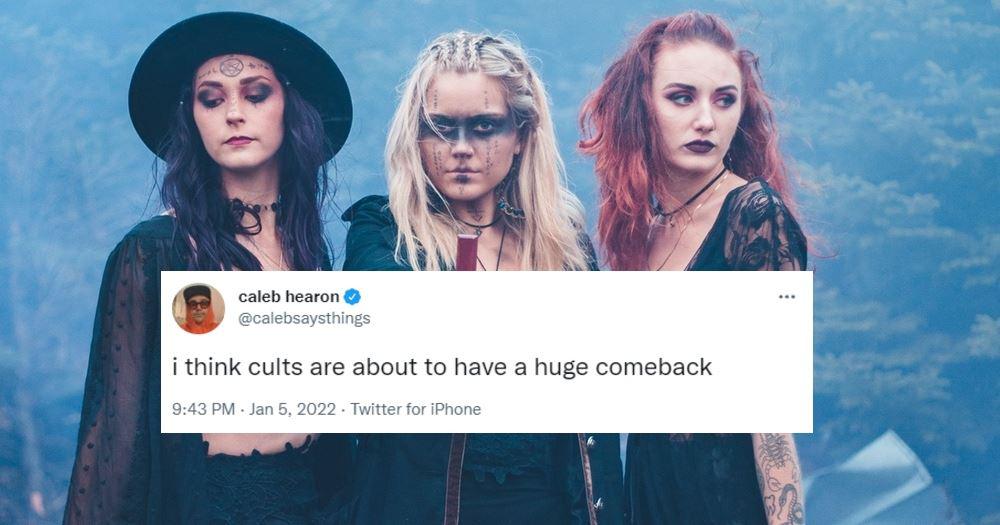
Are cults making a comeback?Photo credit: via Pexels and Caleb Hearon/Twitter

Things have definitely taken a turn for the weird in America over the past few years. So much so that I’ve had many a morning where I wake up with the John Lennon song, “Nobody Told Me” stuck in my head.

“Strange days, indeed. Most peculiar, mamma,” Lennon sang on his posthumous hit.

There’s been political unrest, ecological disasters, that weird monolith that popped up in the Utah desert and super credible-looking UFO videos.

Oh yeah, there’s also that pandemic thing that’s still going on.

The sheer absurdity of it all prompted comedian Caleb Hearon to tweet “i think cults are about to have a huge comeback” on Wednesday and a lot of people agreed with him.


https://twitter.com/calebsaysthings/statuses/1478965438876766209

It’s been said that people often join cults to soothe their fears and anxieties. If that’s the case, then Hearon may be right. A recent study found that there was a 26% increase in anxiety worldwide in 2021 due to the pandemic.

To make things even more interesting, there are many who feel anxiety about the pandemic ending because they don’t want to go back to normal.

Hearon’s tweet kicked off a great discussion on Twitter on whether or not we’re already in the midst of a cult renaissance.

We’ve already got the clothes down.

Is the internet already a cult?

Is it happening already?

Some folks are down already.

What cults are we talking about?

Let’s do this.

After reading the responses it looks like Hearon wasn’t far from the truth. A lot of people raised their hands and said “I’m in” after thinking about the potential benefits that come with being in a cult.

While others claimed there are plenty of cults happening right now, it’s just that people don’t know they’re in them.

Steven Hassan, author of “Combating Cult Mind Control: The Guide to Protection, Rescue and Recovery from Destructive Cults” and a former member of the Moonies, no less, says that there are essentially four types of cults: behavior control, information control, thought control and emotional control.

He also says that just about anyone is susceptible to being the victim of a cult.

“If you think it could never happen to you, then you’re the most vulnerable. Because nobody’s impervious,” he says.

If Hearon is right, there may be some super culty stuff happening all around us in the coming months. If you’re not down for the cult lifestyle, then it’s best to keep your eyes wide open for suspicious groups gathering in unlikely places.


  • People are shocked to learn the real meaning behind The Lion King’s ‘Circle of Life’ song
    The meaning of the Zulu chant in "The Lion King" song "Circle of Life."Photo credit: Wikipedia/ Walt Disney Feature Animation

    The Disney movie The Lion King was released in 1994, and it had a soundtrack full of bangers. Produced by Hans Zimmer with assists from Elton John, there are so many songs that remain classics—including “Circle of Life.”

    The song begins with the iconic Zulu chant by singer and composer Lebo M at the start of the Disney film, as the sun rises and baby Simba is lifted into the sky by Rafiki: Nants ingonyama bagithi Baba Sithi uhm ingonyama

    And more than 30 years later, people are finally learning what it translates to. On the One54 Africa podcast, Zimbabwean comedian Learnmore Jonasi shared with hosts Akbar Gbajabiamila and Godfrey Daneschmah (and the rest of the world) the meaning of the Disney tune’s chant—and it’s hilariously underwhelming.

    “I’ve seen The Lion King 100 times,” Gbajabiamila says, before giving his own soulful rendition of the chant. “What did I say?”

    Jonasi tells him he said “nothing,” adding that it’s Zulu, a language from South Africa, and that it translates to: “Look! There is a lion. Oh my God.”

    The three burst into guttural laughter. Gbajabiamila and Daneschmah react in disbelief, saying, “You are joking! That is not what that means!”

    Jonasi assures him that’s exactly what it means, and they can’t contain their laughter.

    “This whole time I thought it was like this beautiful, majestic [thing],” Gbajabiamila howls.

    People react to Zulu chant meaning

    On Reddit, people did not hold back their shock and hilarious disappointment about the song’s iconic opening:

    “And here I thought it was some majestic phrase about life 😂.”

    “It does. It does mean that. I found this out and had the same reaction. I f**king howled. ‘Oh look, here comes a lion, father a lion’ or something was how I was told it was. I was amused and somehow disappointed. But like… it’s accurate.

    “I mean it works in the song too since all the animals look at the lions at this part.”

    “You know what… I’m okay with this.”

    “See? This simpleton answer actually fits. Try and think about the sheer amount of people who’ve run around shouting this phrase in public looking like idiots (myself included), and then match their idiocy with the simplicity of this answer!!!”

    “Okay so quite mundane and hilariously so.”

    How “The Circle of Life” was made

    The film’s composer, Hans Zimmer, “tapped Lebo M, a then-exiled South African composer living in the U.S., to help with the music,” according to Rotten Tomatoes.

    Zimmer and Lebo M “riffed” together to come up with the film’s opener, along with Elton John and lyricist Tim Rice, but struggled to nail down an idea until inspiration came to Lebo.

    “Then, suddenly, Lebo cried out ‘Nants ingonyama bagithi Baba,’ and all present agreed—instantly—that the chant would open the film,” the publication noted.

    “Circle of Life” was nominated for an Oscar for Best Original Song at the 1995 Academy Awards but lost to another of the film’s iconic songs, “Can You Feel the Love Tonight?”

  • In 1973, the Bee Gees sang an unplugged medley tribute to the Beatles. It’s gorgeous.
    The Bee gees playing a medley of Beatles hits in 1973.Photo credit: via Midnight Special/YouTube

    By 1973, the Bee Gees’ career had hit a low. After a series of hits in the late 1960s and early 1970s, including “To Love Somebody,” “How Can You Mend a Broken Heart,” and “I Started a Joke,” the band was in a rut. Their latest album, Life in a Tin Can, and single “Saw a New Morning” sold poorly, and the band’s popularity declined.

    On April 6, 1973, the Gibb brothers (Barry, Robin, and Maurice) appeared on The Midnight Special, a late-night TV show that aired on Saturday mornings at 1 a.m. after The Tonight Show with Johnny Carson. Given the lukewarm reception to their recent releases, the Bee Gees decided to change things up and play a medley of hits from their idols, The Beatles, who had broken up three years before.

    the beatles, bee gees, 1960s
    The Beatles were the biggest band on Earth in their heyday. Giphy

    The performance, which featured five of the Fab Four’s early hits, including “If I Fell,” “I Need You,” “I’ll Be Back,” “This Boy,” and “She Loves You,” was a stripped-down, acoustic performance that highlighted the Bee Gees’ trademark harmonies.

    “When you got brothers singing, it’s like an instrument that no one else can buy. You can’t go buy that sound in a shop. You can’t sing like The Bee Gees because when you got family members singing together, it’s unique,” Noel Gallagher, who sang with his brother Liam in Oasis, said according to Far Out.

    A year later, the Bee Gees performed in small clubs, and it looked like their career had hit a dead end. Then, at the urging of their management, the band began to move in a new direction, incorporating soul, rhythm and blues, and a new, underground musical style called disco into their repertoire. Barry also adopted a falsetto singing style popularized by Black singers such as Curtis Mayfield and Marvin Gaye.

    This unlikely change for the folksy vocal group catapulted them into the stratosphere and they became the white-satin-clad kings of disco.

    john travolta disco GIF by uDiscoverMusic Giphy

    In the late ‘70s, the band had massive hits, including songs featured on the 40-million-selling Saturday Night Fever soundtrack: “Stayin’ Alive,” How Deep is Your Love,” More Than a Woman,” Jive Talkin’,” and “Night Fever.”

    In 1978, the band made a significant misstep, starring in a musical based on The Beatles’ music called Sgt. Pepper’s Lonely Hearts Club Band, produced by Robert Stigwood, the man behind Saturday Night Fever and Grease. The film was a colossal bomb, although the soundtrack sold well.

    The Beatles’ George Harrison thought the Bee Gees film was about what happens when you become successful and greedy.

    “I just feel sorry for Robert Stigwood, the Bee Gees, and Pete Frampton for doing it because they had established themselves in their own right as decent artists,” Harrison said. “And suddenly… it’s like the classic thing of greed. The more you make the more you want to make, until you become so greedy that ultimately you put a foot wrong.”

    Even though the Bee Gees’ Beatle-themed musical was a flop, former Beatle John Lennon remained a fan of the group. He sang their praises after the public’s growing distaste of disco resulted in a significant backlash.

    john lennon, the beatles
    John Lennon was a fan of the Bee Gees. Giphy

    “Try to tell the kids in the seventies who were screaming to the Bee Gees that their music was just the Beatles redone,” he told Playboy magazine in 1980. “There is nothing wrong with the Bee Gees. They do a damn good job. There was nothing else going on then.”

    The Bee Gees historic career ended when Maurice passed away in 2003 at 53. Robin would follow in 2009 at 62. Barry is the final surviving member of the band.

    This article originally appeared last year.


  • Wish you could belt out Broadway tunes at the top of your lungs in public? There’s a nightclub for you.
    Imagine singing along to your favorite Broadway show tunes at a club.Photo credit: Canva

    Broadway Rave is every theater kid’s dream come true.

    When you’re a fan of Broadway musicals, the world is your stage. Or at least, you wish it was. The urge to break out in song always bubbles under the surface, but other than annoying your friends at karaoke or singing into your spatula while you make dinner, there aren’t a lot of opportunities to indulge the impulse.

    Singing by yourself in your kitchen can be fun, but sometimes you want to experience the energy of joining a full chorus. What if there was a place where it’s not only okay to sing show tunes at the top of your lungs, but where everyone else will sing along with you?

    Singing in your kitchen is fine, but not the same as a full chorus. Photo credit: Canva

    Enter Broadway Rave, the nightclub experience for theater kids, Broadway fans, and anyone who prefers an alternative to the traditional clubbing experience. Broadway Raves take place in dance clubs, but instead of house music, you get Hamilton, Heathers, and Hairspray.

    Imagine walking into a club and hearing the sound of your people:

    Is it a rave in technical terms? That’s up for debate. But it certainly is a chance for people who want the energy of a communal social experience without all the stuff that goes along with clubbing. If a Broadway singalong appeals to you more than navigating a dance floor, it might be worth checking out.

    Not that there isn’t dancing. It just might be more The Greatest Showman than “In Da Club.”

    I mean, few Hamilton fans wouldn’t appreciate an opportunity to sing some of those iconic tunes with wild abandon, especially in a group that fully appreciates it.

    Billed as a “musical theatre dance party celebrating the best of Broadway,” Broadway Rave takes place in various cities at different times. You can check their website for upcoming shows. If you don’t find one near you, you can submit a request for a rave to come to your city. They have shows around the United States as well as in Canada and the United Kingdom.

    What musicals do they play songs from? That may depend on the DJ. Here’s what one person shared about their experience:

    “The last time I went I stayed from 9:30 until about midnight. Went and looked up my post from that night.

    They played songs from a bunch of shows, including Hamilton, Heathers, Rent, Dear Evan Hansen, Sweeney Todd, Cats, Six, Mamma Mia, Hairspray, Phantom, Les Miz, Grease, High School Musical, Hercules, Frozen, Waitress, Legally Blonde, Greatest Showman, Book of Mormon, Chess and I’m sure I’m forgetting some.

    It was so much fun.”

    Who would pass up a chance to join in on a group version of Wicked‘s “Defying Gravity”?

    Most reviews of Broadway Rave have been positive, though some people have said the DJ really makes a difference. Shows last around 2.5 hours, and age restrictions vary by venue. Generally, they are either 18+ or 21+, which is a bummer for the high school drama club kids.

    What a great idea, though, to give those of us who don’t really fit the typical nightlife mold a space to let our drama geek flag fly freely and proudly.

    You can find more on Broadway Rave’s website or follow them on Instagram or TikTok.

  • Kobe Bryant explains why failure ‘doesn’t exist’ and to stop fearing it
    Kobe Bryant talks about failure.Photo credit: MykChiz/YouTube

    NBA legend Kobe Bryant was one of the greatest competitors of his generation, and his work ethic was distilled into a single phrase: Mamba Mentality.

    “You wake up every single day to get better today than you were yesterday,” Bryant said in an interview posted on Twitter (X) in 2020. “Doesn’t matter what you are—basketball player, hockey player, golf player, painter, writer… doesn’t matter.”

    It was about dedication to the process, not just the results, and about obsessively preparing and outworking everyone else in the building.

    Bryant described one way he placed process above everything else in a 2015 interview with Jemele Hill during BET’s Genius Talks. She asked Bryant, “How did you become one of those people who doesn’t seem to be afraid of failing?” Bryant flipped the question on its head.

    Bryant didn’t believe in failure

    “Seriously, what does failure mean? It doesn’t exist. It’s a figment of your imagination. What does it mean? I’m serious. I’m trying to think. How can I explain it?” he responded.

    He tried to explain the concept of failure through the opposite idea—perpetual success—which he also didn’t believe exists:

    “So let’s use happy endings then we can relate this to failure, why it’s not existent. Everybody talks about how everybody wants a happy ending, right? Now, let’s go through the reality of it. Let’s look at a fairy tale story. It’s like Snow White. She gets a happy ending. She finds a prince or whatever, she goes along, she lives happily ever after. Well, I call bulls**t on that because two months later, the fact is they had an argument and he’s sleeping on the couch. Right? So the point is, the story continues. … So if you fail on Monday, the only way it’s a failure on Monday is if you decide to not progress from that, right?”

    kobe bryant, bryant 24, mamba mentality, basketball, lakers
    Kobe Bryant. Photo credit: Keith Allison/WikimediaCommons

    Bryant added, “So to me, that’s why failure’s not existent. Because, you know, if I fail today, okay, I’m going to learn something from that failure, and I’m going to try again on Tuesday. I’m going to try again on Wednesday.”

    Later in the interview, he extended this belief across disciplines, noting that even if he never achieved his ultimate dreams on the basketball court, he would take the lessons he learned there and apply them to his next endeavor—for example, business.

    Kobe Bryant at a charity event. Photo credit: Neon Tommy/Wikimedia Commons

    “But, if I don’t take that stuff and apply that someplace else, then that’s failing, which to me is the worst possible thing you could ever have is to stop and to not learn,” Bryant said. 

    The Mamba Mentality has a life of its own

    Bryant’s thoughts on success and failure mirror the oft-repeated wisdom that it’s not the destination but the journey that truly matters. Sure, you’re going to win some games and lose others, but the most important thing is constant improvement, no matter the arena. That’s the Mamba Mentality. Although Bryant may have left us, his drive lives on in everyone he inspired to be their absolute best.

  • Robin Williams landed his breakout ‘Happy Days’ role after literally flipping the audition on its head
    Robin Williams as Mork on "Happy Days." Photo credit: METV/YouTube

    George Lucas’ Star Wars: Episode IV — A New Hope hit theaters in 1977, capturing the imaginations of people across the globe and launching a renewed interest in science fiction. Gary Marshall, producer of the hit show Happy Days, was looking to keep the series fresh in its fifth season, so he listened to his son—a huge Star Wars fan—who asked if there could be an alien on the show.

    The show’s cast wasn’t too excited about the bizarre episode, which centered on an alien, Mork from the planet Ork, who landed on Earth in an attempt to bring Richie Cunningham back to his home planet. “It really wasn’t a very good script. It was the worst script we ever had,” Anson Williams, who played Potsie Weber on the show, later recalled.

    The actor originally cast as Mork quit just two days before filming, leaving the crew scrambling to find another alien. Al Molinaro, who played diner owner Al Delvecchio on the show, suggested Robin Williams, an actor from his improv class. Williams was brought in to read for the role, and his surprising take on the alien would launch him into superstardom.

    Williams made an incredibly unexpected choice during the audition—one that could have jeopardized his chances of securing the role. When Marshall asked Williams to take a seat, he turned upside down, with his head in the chair and his butt in the air.

    “He did the whole audition standing on his head,” Marshall said, according to Parade. “He was a whole different, fresh view of a guy doing an outer-space alien.” The producer gave Williams the role, explaining that “he was the only alien to audition.”

    “When Robin Williams came on as a Martian, he was all over the place and was improvising some, and they gave him room,” Marshall recalled. “At the end of the episode, 300 people in the audience stood up and applauded, which is not usually done. It didn’t take a genius to know he could do his own show, and we made one for him, Mork & Mindy.”

    During rehearsals, the rest of the cast gave Williams room to improvise, and he quickly created the unique Mork character with his “Na-Nu-Na-Nu” greeting and Star Trek-esque handshake.

    The episode, “My Favorite Orkan,” which originally aired on Feb. 28, 1978, would go on to become one of the most memorable in the series. “It was one of the best shows in the history of the series,” Anson Williams recalled.

    Robin Williams’ performance as the character was so memorable that Paramount rushed an entire show based on the alien, Mork & Mindy, which debuted on Sept. 14, 1978. The Mork character was also invited back on Happy Days the following year for a follow-up episode, “Mork Returns.”

    Mork & Mindy initially surpassed Happy Days in the ratings before experiencing a sharp decline over the next three seasons. In the final season, Mork and Mindy had an Orkan baby, played by Jonathan Winters, who aged backward. By the final episodes in 1982, Williams had become a bona fide movie star, having starred in Popeye and The World According to Garp.

    Williams was such an incredible talent that one audition—where he stood on his head—probably wasn’t the sole reason for his incredible success. But it is a great example of how extraordinary talent expresses itself in ways most people can’t fathom. Kudos to Gary Marshall and the producers of Happy Days for embracing his lunacy instead of laughing Williams out of the studio, and for giving him the space to explode into America’s living rooms.

  • The voice of Woody from ‘Toy Story’ is often the younger, lookalike brother of Tom Hanks
    Jim Hanks plays Woody in much of the "Toy Story" franchise. Photo credit: Jace Diehl/YouTube

    There’s a snake in my boot!” may be one of the most recognizable lines in children’s films across multiple generations. Voiced by the iconic Tom Hanks, Toy Story‘s trusty cowboy toy hero, Woody, has been a beloved character for over 30 years.

    But what people may not realize is that when you hear Woody’s voice anywhere but the films, you’re likely not hearing Tom Hanks. You’re hearing his brother, Jim Hanks. Didn’t know Tom Hanks had a voice actor brother? You’re not alone. An interview with Jim explaining how he’s voiced Woody for three decades is blowing people’s minds.

    Jim Hanks has played Woody more often than Tom Hanks

    When Toy Story came out in 1995, it made history as the first full-length, 3D computer-animated film. Since then, the film franchise has become one of the most successful in history. We not only have four (going on five) movies, but also toys, merch, and themed experiences.

    We know the voice in the film is Tom Hanks. But the voice in Woody toys? That’s Jim. Computer and video games? That’s Jim. Theme park rides? Also Jim. Disney on Ice shows? Jim.

    “I think I went in and did the first toy in ’94 before the first movie came out,” Jim told Jace Diehl. He said he voiced Woody for a short film that came out after the fourth movie, in addition to the various other places Woody can be found.

    People thought it was a myth that Tom Hanks’ brother voices Woody

    “I never really knew that my voice was as similar to Tom’s,” Jim shared. “I have since then seen videos of myself…where I watch myself and go ‘Oh my God, yeah, I do sound like him, even if I’m not trying.”

    Watching the interview, it’s quite remarkable how much Tom and Jim look and sound alike. Tom Hanks has also talked about Jim’s Woody work in interviews, including this one in which Graham Norton thought it was an urban myth:

    Commenters on the Jim Hanks interview video were blown away to find out this bit of Toy Story trivia:

    “I can’t be the only one who didn’t know Tom Hanks had a brother, where the hell have I been.”

    “I feel like I just got Mandela effected.”

    “I’m not entirely convinced that’s not just Tom Hanks with a shaved head.”

    “They should make a docudrama about Jim Hanks played by Tom Hanks.”

    “Seeing Jim talk casually is surreal, because he looks and sounds just about as much Like Tom Hanks as a person possibly can. But at the same time, he has a totally different personality and way of carrying himself.”

    “This is breaking my brain right now. I’m 33, grew up on Toy Story, and I was today years old when I learned that collectively, Jim Hanks has more of a right to the title ‘the voice of Woody’ than Tom Hanks does. Such a talented family.”

    Voicing Woody is a Hanks family affair

    Jim said he thinks of his Woody voice as an impression of Tom yelling at his kid, which makes sense. Even though they are brothers, their voices aren’t identical, so Jim has to work to find Tom’s voice. The way he describes pushing on his diaphragm while having the voice up in his nose, but also deep at the same time, makes it clear he’s a skilled voice actor. He may have a clear genetic advantage, but he has to work to play Woody.

    And if you’re wondering whether the brothers’ work ever comes into their family life, the answer is yes.

    “One time, Tom and I were up visiting my mother, and we called my other brother,” Jim shared. “We were just blabbing  away, and my brother Larry finally says, ‘I just got to say, this is like listening to dueling Woodys.’”

    Countless kids and adults have a lot to thank the Hanks family for, especially knowing that Woody has been a family affair from the beginning.

  • Harrison Ford brings viewers to tears in surprisingly emotional speech
    Harrison Ford has been acting in film and television for over 50 years.Photo credit: Gage Skidmore/Wikimedia Commons
    ,

    Harrison Ford brings viewers to tears in surprisingly emotional speech

    Ford’s Life Achievement Award brought out his heart, humor, and humility.

    Han Solo. Indiana Jones. Rick Deckard. Richard Kimble. Harrison Ford has played characters so iconic they’ve made him a household name for generations. And he’s still acting, playing a lovably cantankerous therapist in Apple TV’s Shrinking. So it’s no surprise that Ford is being recognized by his peers with the 2026 SAG-AFTRA Life Achievement Award.

    What was surprising was seeing Ford deliver a moving, heartfelt speech at the March 1 Actor Awards ceremony—one that lacked any hint of the gruff persona so often associated with him. With humor, humility, and heart, he spoke not only to his fellow actors but to anyone who genuinely loves what they do.

    He began his speech with characteristically dry wit, joking about being there to “receive a prize for being alive.”

    “That said, it is a little weird to be receiving a lifetime achievement award at the half point of my career,” said the 83-year-old. “It’s a little early isn’t it? I’m still a working actor!”

    Ford shared that he had not been an overnight success. He spent 15 years going back and forth between acting and carpentry before finally landing a role in a wildly successful film.

    “None of this happened on my own,” Ford said.

    He thanked Star Wars creator George Lucas and Indiana Jones director Steven Spielberg. He also thanked film producer and casting director Fred Roos, as well as his manager of 30 years, Pat McQueeney, for getting him through hard times in the business.

    “They were both incredibly persistent in their support of me at a time when I really needed it,” Ford said. “I would not be here without them. They are no longer with us, but it feels important that I thank them now.”

    Ford shared that he was “a little lost” in his third year of college.

    “I was failing at school. I felt isolated and alone,” he said. “And then I found a company of people putting on plays. Storytellers. People I once thought were misfits and geeks turned out to be my people. I found a calling. A life in storytelling. An identity in pretending to be other people.”

    Then he spoke about what that life has meant to him, becoming clearly emotional.

    “The work I do with other actors is one of the great joys of my life,” he said. “My career is built on their work, as well as the work of writers, directors, and every single cast member and every crew member I’ve ever been on a set with.”

    He spoke of the “honor” and “privilege” of doing collaborative, creative work for audiences.

    “And because of that privilege, I have come to know myself,” he said. “Ours is a tough business to get into. In my case, it’s been a tough business to get out of, thank God. Because I love what I do.”

    “As actors, we get to live many lives,” he continued. “We get to explore ideas that affirm and elevate our shared experience. The stories we tell have a unique capacity to create moments of emotional connection. They bring us together.”

    Ford said that no matter what stage of their careers actors are in, they share “something fundamental.”

    “We share the privilege of working in the world of ideas, of empathy, of imagination,” he said. “Sometimes we make entertainment. Sometimes we make art. Sometimes, if we’re lucky, we make both at the same time. And if we’re really fortunate, we also get to make a living doing it.”

    And he spoke of the importance of lifting others up.

    “Success in this business brings a certain freedom that comes with responsiblity,” he said. “To support each other. To lift others up when we can. To keep the door open for the next kid, the next lost boy who’s looking for a place to belong.”

    Finally, he spoke with gratitude about his good fortune.

    “I am indeed a lucky guy,” he said. “Lucky to have found my people. Lucky to have work that challenges me. Lucky to still be doing it. And I don’t take that for granted. I want to say thank you, truly, from the bottom of my heart. To my peers, to my extraordinary, beautiful wife, Calista. And my family, who have given me love and courage through all of it. And thank you to SAG-AFTRA for honoring me with this prize. This is very encouraging.”

    Ford was speaking to his fellow Hollywood actors, of course, but his speech carried a powerful, universal message that resonated widely. Many people on X found themselves brought to tears by his sincere, heartfelt words:

    “Harrison Ford, known for his rugged dignity, just gave one of the most touching acceptance speeches I’ve ever heard. Just a man, reflecting on the incredible blessing it is to be able to do what you love and find your place in the world. I cried.” – @PettyLupone

    “Tears welled up in my eyes because he said it from the bottom of his heart… How wonderful it is to have opportunities that help you grow personally and professionally… Beautiful speech.” – @8MilaMila8

    “Beautiful speech. Very moving. He is a national treasure and a cultural icon indeed.” – @beingpt

    “Sobbing my eyes out. Harrison Ford is the first actor I ever became a fan of before I even understood what that meant. His body of work is one thing, but in moments like this, it’s his character that speaks, and we are so lucky to live in a world where he’s on our screens.” – @GissaneSophia

    “There’s something powerful about seeing a legend get raw like that. Harrison Ford has played smugglers, archaeologists, presidents, and heroes, but that speech strips it all back to a craftsman talking about work, gratitude, and responsibility. The line about entertainment versus art hits because it’s honest, most projects are just jobs, but every so often something transcends. And the part about keeping the door open for the next ‘lost boy’ is the real legacy move. Success isn’t just freedom, it’s stewardship. When someone who’s been at the top that long still says ‘I’m lucky,’ that’s humility forged by decades, not PR polish. That’s why it landed.” – @Dan_Brisbois

    Well said. Thanks for over five decades of entertainment and art, Harrison Ford.

  • The West Philly club teaching boys to be gentlemen
    The Distinguished Young Gentleman club teaches boys important life skills. Photo credit: Distinguished Young Gentleman/YouTube
    ,

    The West Philly club teaching boys to be gentlemen

    Meet Dwayne Frazier, the man behind the Distinguished Young Gentlemen club—where suits, etiquette, and big dreams are the lesson plan.

    Every other week, more than two dozen boys walk into Lewis C. Cassidy Academics Plus School in West Philadelphia wearing suits, neckties, and dress shoes. They shake hands with firm grips and maintain eye contact while speaking. They are gentlemen carrying themselves with a confidence that turns heads.

    For many of them, this is their first time wearing a suit.

    @6abcmatteo

    West Philadelphia teacher Dwayne Frazier started an afterschool club where students suit up and learn how to become ‘Distinguished Young Gentlemen.’ #philly #goodnews

    ♬ original sound – 6abcmatteo

    One student puts it plainly: “The first time I ever wore a suit was when I joined the Distinguished Young Gentlemen. It feels good. I think I look handsome in it.”

    At the heart of all this is Dwayne Eric Frazier—a teacher, retired firefighter, and ordained reverend. He built the Distinguished Young Gentleman club (DYG) from scratch, transforming it from an after-school initiative into a registered 501(c)(3) nonprofit dedicated to impacting lives well beyond the classroom.

    Meet the man behind the mission

    Growing up in North Philadelphia, Frazier’s father taught him how to tie a necktie, polish his shoes, and look people in the eye while speaking. Those lessons stuck, following him through military service—three years of active duty in the U.S. Army and six years in the Air National Guard—and through a 26-year career with the Philadelphia Fire Department.

    After retiring from the fire department in December 2019, Frazier returned to school for his master’s in early childhood education at Lincoln University. In 2020, he began teaching elementary classes, building on his B.A. in African American studies from Temple University and an M.A. in religion from Cairn University.

    DYG’s roots go back to 1996, when Frazier coached a youth basketball team called the “Distinguished Gentlemen” and used the sport to foster etiquette among Philadelphia children. The idea stayed with him, and in 2021, with support from volunteer Gordon Stewart Harrison, he formalized it as an after-school club at Cassidy Elementary.

    Philadelphia, distinguished, young, gentlemen, mentorship
    A mentor teaches a young boy how to iron a dress shirt. Photo credit: Distinguished Young Gentleman

    He also credits Sleman Clark, a Temple University student who ran a mentorship camp in the neighborhood where he grew up in the 1970s, as his inspiration. That early experience of being seen and guided by an older person planted a seed that took decades to bloom.

    More than a suit

    The dress code matters at DYG, but the curriculum goes much deeper.

    The club meets weekly after school, with students required to wear suits, neckties, and dress shoes every other week. Frazier models this daily, viewing disciplined dress as a silent statement: “When you dress right, you don’t have to say a word—it speaks for you.”

    Weekly lessons at DYG cover a wide range of practical life skills:

    • Professional etiquette: firm handshakes, strong eye contact, punctuality, how to carry a wallet, and how to dress for job interviews.
    • Respect and character: how to treat women, emotional regulation, and self-discipline.
    • Appearance and presentation: necktie-tying, shoe-polishing, and what it means to show up prepared.
    • Career awareness: exposure to professions beyond the ones visible to kids in their neighborhood.

    Emotional intelligence is central. As Frazier says: “It’s about manners, appearances, and self-respect. Learn how to think before they speak, not react with emotions.”

    He describes the program’s core values as “respect, responsibility, reading, and resilience.”

    Impact beyond the classroom

    Field trips are where Frazier’s vision comes into full focus.

    DYG has taken students to the White House and United States Congress for civic education. In February 2024, they toured the 6abc Philadelphia newsroom, where they met the station’s general manager and on-air talent. They also visited the WDAS radio station and spoke with on-air personality Patty Jackson, who discussed what a career in broadcasting can look like.

    The most ambitious trip happened in October 2025: a multi-day journey to Atlanta. DYG spent months planning and fundraising for the trip. In July, Frazier reached out to the public on Classix 107.9 FM to explain why he chose Morehouse College as the destination:

    “I always wanted to go to Morehouse College. It’s an HBCU—it’s the only Black male college in the country—and it promotes positivity. I wanted to take the boys to see that.”

    From October 9 to 13, the group visited Morehouse College, Clark Atlanta University, the Martin Luther King Jr. Center, Tyler Perry Studios, and The Coca-Cola Company headquarters—driven by the idea: “If you can see it, you can believe it.”

    Philadelphia, distinguished, young, gentlemen, mentorship
    Dwayne Frazier is showing young men that the future is bright for them. Photo credit: Distinguished Young Gentleman

    Showing West Philadelphia elementary school students the campus of a prestigious HBCU gave them a tangible, lived sense that higher education is a path available to them.

    After returning, one student said he wanted to become a lawyer. Another added, “I act like a gentleman, I think like a gentleman, and I look like a gentleman.”

    Breaking the cycle

    Cassidy Elementary serves a community in which 99% of students qualify for free or reduced-price lunch, and 86% are Black or African American. DYG’s focus is breaking cycles of poverty and inequality by equipping boys with social and interpersonal skills. The goal is clear: to help every participant succeed in life, no matter the environment.

    Frazier clearly distinguishes between the cultural influences working against young boys and what DYG aims to build.

    “When we look at society today, and what the culture is doing to our young boys, we get to reel them back in and give them the basics,” he said in a 2025 feature for 6abc Philadelphia. “Basic things like coming on time. When you see a person, look them in the eye, shake their hand.”

    For 8th grader Safiy Salley, the program is “a very big blessing to actually be involved in something that could really change my life.” His classmate Lance Epps, reflecting on the visit to 6abc Philadelphia, said, “It shows you’re more than you’re presented in your regular clothes. I think to myself, ‘Should I wear a suit every day?’”

    That question—and the fact that a middle schooler in West Philadelphia is asking it—speaks volumes about what DYG truly represents.

    A community that shows up

    DYG relies on donations and volunteers. The organization is officially registered as Distinguished Young Gentlemen of America Inc. and holds 501(c)(3) nonprofit status. Contributions help fund field trips, provide students with suits, and sustain the program week after week. If this story moved you, visit DYG’s website to donate or learn more.

    DYG shows that with one person’s vision—and a suit—lasting change is possible.

Pop Culture

In 1973, the Bee Gees sang an unplugged medley tribute to the Beatles. It’s gorgeous.

Family

5 ‘core’ childhood memories your kid will cherish forever, according to a psychologist

Education

6th-grade teacher quits rather than remove harmless sign from her classroom

People Skills

The 13 signs that someone is ‘dangerously good’ at reading people