Scientists in Kenya team up with mealworms to help solve the plastic problem in Africa
An insect solution for pollution?

Plastic pollution is a huge global issue.
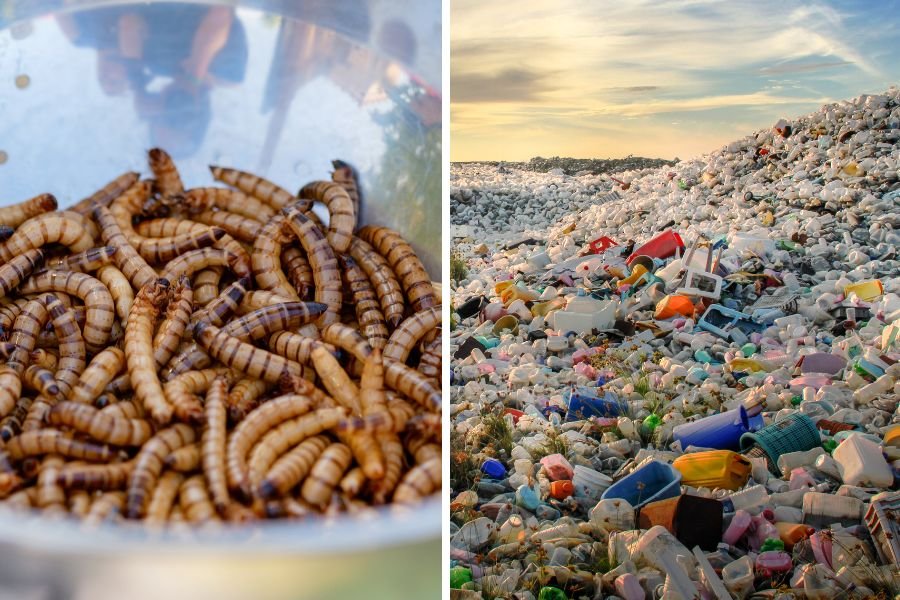
A scientific discovery could potentially be a breakthrough for Africa’s landfills. Scientists have discovered that a Kenyan mealworm species has the ability to eat and digest polystyrene—better known to most of us as styrofoam.
Researchers at the International Centre of Insect Physiology and Ecology conducted a month-long study that found that the stomach bacteria within the larvae of Alphitobius darkling beetles can adapt their enzymes to break down styrofoam. These mealworms not only can digest it, but seem to grow an appetite for the plastic, too. While they cannot get their fullest nutrition on styrofoam alone, the mealworms were able to ingest hydrogen and carbon from it through digestion. These mealworms are commonly found as pests in chicken coops and poultry production facilities, so there’s no worry of a worm shortage.
Styrofoam is widely used for food containers, shipping materials, insulation, electronics, and many other products. While it is incredibly useful, it’s also piling up in our landfills since there is no way for it to degrade or decompose naturally like organic garbage and other material. Properly recycling styrofoam also has its drawbacks, as it is expensive to process and produces other pollutants.
While these plastics are a problem globally, they’re especially an issue in Africa. The region is predicted to amass 116 million tonnes of plastic waste by 2060. According to the charity Tearfund, enough plastic waste to cover a soccer field is tossed or burned in sub-Saharan Africa every minute. It’s theorized that this Kenyan mealworm’s adaptation was due to the amount of styrofoam that has invaded their local environments. The hope is that this discovery can help its native continent first then possibly expand application worldwide.
Now before you think that the solution is to just have millions of these mealworms unleashed into landfills to feast on our trash, the scientists involved are continuing their research. One of the next steps is to study the bacteria in the hope to obtain, recreate, and distribute the bacteria and enzymes on their own. They also plan on trying to see if these mealworms could digest other plastics and, if so, if they can remain healthy. Should the positive momentum continue, this wouldn’t just help the environment in Africa but could provide global applications in how we dispose of our plastic trash.
Science is a funny thing. We like to champion it yet underestimate it at the same time. Federal funding for scientific research is at historic lows and the average American seems skeptical towards scientific studies in general. Understandably, many everyday people would think less about studying bugs since there’s no apparent human benefit or application towards larger issues compared to those studying how to make various rockets, vehicles, or other technology. Yet now it seems like studying something very small and insignificant like a mealworm could help preserve our planet in the long term.
It’s the perfect example of how investment, patience, and study could lead to surprising solutions that never would’ve been considered otherwise, even if it seems unimportant on the surface. On top of that, it shows how every living thing plays a role in our Earth’s preservation. Even tiny, squiggly mealworms.
- A grocery store added climate impact to its receipts and it changed how its customers shop ›
- A giant garbage patch floating in the ocean has become home to hundreds of sea creatures ›
- We haven't just paved paradise—we've plastered it in plastic ›
- 'Forgotten' water harvesting method changes desert to farmland - Upworthy ›


A Generation Jones teenager poses in her room.Image via Wikmedia Commons
An office kitchen.via
An angry man eating spaghetti.via 


An Irish woman went to the doctor for a routine eye exam. She left with bright neon green eyes.
It's not easy seeing green.
Did she get superpowers?
Going to the eye doctor can be a hassle and a pain. It's not just the routine issues and inconveniences that come along when making a doctor appointment, but sometimes the various devices being used to check your eyes' health feel invasive and uncomfortable. But at least at the end of the appointment, most of us don't look like we're turning into The Incredible Hulk. That wasn't the case for one Irish woman.
Photographer Margerita B. Wargola was just going in for a routine eye exam at the hospital but ended up leaving with her eyes a shocking, bright neon green.
At the doctor's office, the nurse practitioner was prepping Wargola for a test with a machine that Wargola had experienced before. Before the test started, Wargola presumed the nurse had dropped some saline into her eyes, as they were feeling dry. After she blinked, everything went yellow.
Wargola and the nurse initially panicked. Neither knew what was going on as Wargola suddenly had yellow vision and radioactive-looking green eyes. After the initial shock, both realized the issue: the nurse forgot to ask Wargola to remove her contact lenses before putting contrast drops in her eyes for the exam. Wargola and the nurse quickly removed the lenses from her eyes and washed them thoroughly with saline. Fortunately, Wargola's eyes were unharmed. Unfortunately, her contacts were permanently stained and she didn't bring a spare pair.
- YouTube youtube.com
Since she has poor vision, Wargola was forced to drive herself home after the eye exam wearing the neon-green contact lenses that make her look like a member of the Green Lantern Corps. She couldn't help but laugh at her predicament and recorded a video explaining it all on social media. Since then, her video has sparked a couple Reddit threads and collected a bunch of comments on Instagram:
“But the REAL question is: do you now have X-Ray vision?”
“You can just say you're a superhero.”
“I would make a few stops on the way home just to freak some people out!”
“I would have lived it up! Grab a coffee, do grocery shopping, walk around a shopping center.”
“This one would pair well with that girl who ate something with turmeric with her invisalign on and walked around Paris smiling at people with seemingly BRIGHT YELLOW TEETH.”
“I would save those for fancy special occasions! WOW!”
“Every time I'd stop I'd turn slowly and stare at the person in the car next to me.”
“Keep them. Tell people what to do. They’ll do your bidding.”
In a follow-up Instagram video, Wargola showed her followers that she was safe at home with normal eyes, showing that the damaged contact lenses were so stained that they turned the saline solution in her contacts case into a bright Gatorade yellow. She wasn't mad at the nurse and, in fact, plans on keeping the lenses to wear on St. Patrick's Day or some other special occasion.
While no harm was done and a good laugh was had, it's still best for doctors, nurses, and patients alike to double-check and ask or tell if contact lenses are being worn before each eye test. If not, there might be more than ultra-green eyes to worry about.