upworthy
Add Upworthy to your Google News feed.
Google News Button
Humor

People share their most ridiculous 'I paid for it, not letting it go to waste' moments

The things we do save a buck.

ask reddit thread, waste

Worth it?

The saying “waste not, want not” can be very valuable. However, as with most idioms of wisdom, it can be taken too far. Especially if it means putting up with severely unpleasant experiences simply to save a buck or two.

A person on Reddit by the username @Bull56Dozer recently asked the online community to share their own “well I paid for it, not letting it go to waste” moments and their question received a ton of responses. As it turns out, many, many humans would prefer to endure the uncomfortable (even consume the questionable) rather than potentially waste money.

A lot of the anecdotes were, perhaps unsurprisingly, food related. Considering that food inflation is at nearly 10% as of April 2022, it makes sense that people might want to milk every penny, even if that means drinking milk past the expiration date.

Plus, we do have a huge food waste issue. According to the World Food Programme, nearly one-third of all food currently produced globally is wasted each year … enough to feed 2 billion people. With those alarming statistics, I find myself choking down cereal that’s flavor is … interesting at best.

Of course, money fears could also be at play. Finances is a major source of stress for many people, if not manifesting into a full-blown phobia. Even those who are currently secure could still have been affected by growing up in poverty. As Leah Brookner, MA, MSW, Ph.D., a professor in the School of Social Work at Portland State University, explained in an article for Health, the trauma of childhood poverty—even when experienced well into young adulthood—can negatively shape the way we think. Luckily, she adds that with awareness, this is a challenge that can be overcome.

Maybe by making light of some of the measures we go through in the name of frugality, we can bring in some of this awareness, while still keeping our spirits lifted. After all, when given an optimistic spin, these moments can make for some funny stories. And time spent laughing is never wasted, right?

Without further ado, here are 14 of the best responses:

1. How could Oprah lead them astray?

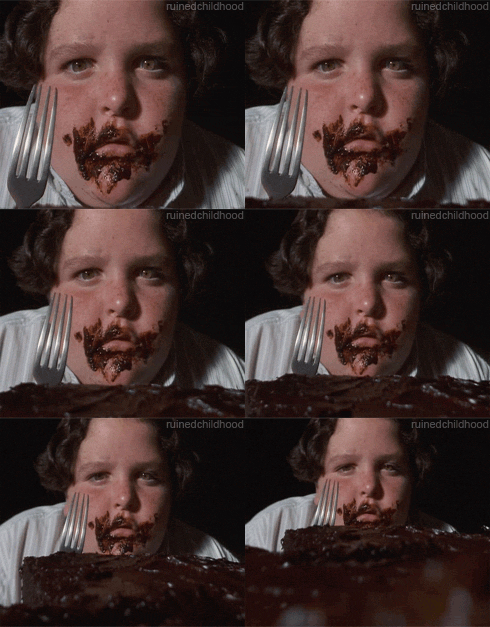
“The worst cake I ever had was $30 for two slices…It was my mom’s birthday and she wanted to go to this gourmet cake place that was every girl’s tea party fantasy on the inside. The cakes were even Oprah recommended which was the reason my mom knew about it. We go to eat it, and the cake is…..awful. And it’s not just, oh it’s not my taste, like the cakes just tasted bad...."

things we do to not waste money

When you have your gross cake and have to eat it too

Giphy

"...We still ate them because they were $30 but I had to buy my own frosting to get through it.” – @signaturefox2013

2. When cheapness leads to closure

“Planned a weekend away with the guy I was dating, it was for his birthday. We would go to a theme park and stay in a hotel. But in the meantime we decided to break up. We still got on that trip, cause we already booked. At first I thought it was going to be a bit awkward, but it turned out to be really fun and a nice way to close things off.” – @vonne_F

3. ...and all they got was this lousy T-shirt

“Ran a marathon where I hit the wall at 25k. The remaining 17k I was just repeating to myself that I had paid for this and I was going to get my finisher T-shirt no matter what. Absolutely miserable 2 hours.” – @donut-or-do-not

4. Did somebody order a free feline piercing?

My cat was pissed at me (I may have been egging him on) and bit my ear. In fact, he pierced my ear. My daughter cleaned it up for me and added a nice diamond-stud earring…I’m not a guy for earrings, but as long as I had a piercing, I’ll wear an earring for a little while at least…the hard part was done.” – @Southern_Snowshoe

viral ask reddit thread

Lucky it was his ear

Giphy
5. In dad's defense … should the turkey die for nothing?

“My dad burnt the thanksgiving turkey to the point were if he had left it 5 more minutes he would’ve burnt the whole house down… still forced us to eat it tho… worst thanksgiving to this day…” – @MemeVY

6. When the term "cheap date" becomes a little too literal

“Went on a date for Valentine’s Day and they offered to buy me a coffee beer at the restaurant. Horrible. I’m pretty sure they just made it with half black coffee, half stout and mixed it together in the glass. If I had purchased it myself, I would have noped out, but I managed to choke it down.” – @CONFETA

7. Mom never has to know

I decided to try making a big batch of slow-cooked shredded pork tenderloin with smashed potatoes because my parents had this huge tenderloin in their freezer that they weren't going to use. I had never cooked pork before, I'd never thawed meat before, I'd never used a slow cooker before…. What could possibly go wrong?

I severely messed it up …the pork came out tough and way, way over-seasoned with pepper, to the point that was its only flavor, and the worst part was that there was enough meat for ten work lunches, most of which I had to freeze so they wouldn't go bad. I kept forgetting to thaw them in advance, which often resulted in the potatoes still being cold in the middle after reheating because I didn't want to hold up the microwave at work.

So for two whole weeks, I had over-seasoned, tough shredded pork and cold, under-seasoned potatoes for lunch at work. Why did I not stop this chain of events at any point or throw the food out, you may ask? Because I knew my mom would lecture me about it…and I've always been too cheap to pay for delivery.” – @RinTheLost

8. When you're a bookworm on a budget

“When I was younger not only would I compulsively finish any book I started, but I would also finish any series it was a part of.” – @tehKrakken55

However, this person did have a one-time caveat:

"I read Twilight to see what the fuss was about, and got a third of the way into whatever the hell the third book is before I looked at myself in the mirror and said 'You do not have to finish books you don't like.'"
9. Sticking to the bitter, bitter end

“I try to be very careful with my money. So I usually only get coffee from Dunkin or Starbucks as a treat to myself lol. I order the same thing every time. French vanilla cold brew with cream and no cold foam. Today for some reason, it was so bitter and terrible I could barely stand it. No cream, no French vanilla and even a bit of the coffee grounds were still floating around in there. I paid 3.50 for it …so I drank it. Lol.” – @ItchyInvestigator174

10. Yay?

Current college course. 7 and a half grand in debt for almost the rest of my life and I’m just there for the experience.” – @_Frog_Enthusiast_
11. When thriftiness leaves you feeling salty

“Overly salty peanut butter chocolate cake…..I can still feel the salt burns on my tongue after just the first slice. No amount of milk, whipped cream or fruit helped but that salt. Ate every last crumb of that cake. Took me only two weeks. It was a 6” cake.” – @GeneticExperiment626

12. Because those pants WILL come back in style!

"Most of the items of clothes in my closet unfortunately. I don’t like them so I don’t wear them but I can’t bring myself to throw them out because, well, I paid for them.” – @agentPheasant

funny things we do to save money

Hmm..what will I not be wearing today?

Giphy
13. When it affects you're health, there's a problem

Medication for my ADHD. On paper, should’ve been a great fit, but it turned me into a zombie. And I don’t say that lightly, I couldn’t tell you what happened those few months…At the time i also had undiagnosed Generalized Anxiety, which can be severely exasperated by high doses of many ADHD meds. I was taking a 35 mg does which is pretty high for ADHD meds. So when I wasn’t a zombie, I was having serve panicking attacks. The anxiety and zombification was so bad it counteracted the benefits of the medicine. Yet, I kept with it for FOUR MONTHS because they were expensive. Stupidest thing I've done. Four months I'm never getting back. Btw I got a better much lower and effective does now.” – @Agitated-Salad-894

14. Saved the happiest ending for last

My mom bought me a 1 year gym membership ( I was 16 ) I didn't want to go to the gym at all . But she told me try it out once and see what happens , I was angry at the time but I figured 'well I cant cancel it and the money's already been paid, I'll see what happens.' Here I am talking to you, 100 pounds lighter. I love my mom.” – @Mission-Pickle-2846


This article originally appeared two years ago.

the great depression; Florence Thompson; Mona Lisa of the Great Depression; Mona Lisa; the depression; depression era
Photo by Dorothea Lange via Library of Congress
The woman from the famous Great Depression photo didn't know about her fame for 40 years.

It's one of the most iconic and haunting photos of all time, up there with the likes of Hindenburg, The Falling Soldier, Burning Monk, Napalm Girl, and many others. It's called simply Migrant Mother, and it paints a better picture of the time in which it was taken than any book or interview possibly could.

Nearly everyone across the globe knows Florence Owens Thompson's face from newspapers, magazines, and history books. The young, destitute mother was the face of The Great Depression, her worried, suntanned face looking absolutely defeated as several of her children took comfort by resting on her thin frame. Thompson put a human face and emotion behind the very real struggle of the era, but she wasn't even aware of her role in helping to bring awareness to the effects of the Great Depression on families.


It turns out that Dorothea Lange, the photographer responsible for capturing the worry-stricken mother in the now-famous photo, told Thompson that the photos wouldn't be published.

Of course, they subsequently were published in the San Francisco News. At the time the photo was taken, Thompson was supposedly only taking respite at the migrant campsite with her seven children after the family car broke down near the campsite. The photo was taken in March 1936 in Nipomo, California when Lange was concluding a month's long photography excursion documenting migrant farm labor.

the great depression; Florence Thompson; Mona Lisa of the Great Depression; Mona Lisa; the depression; depression era Worried mother and children during the Great Depression era. Photo by Dorthea Lange via Library of Congress

"Migrant worker" was a term that meant something quite different than it does today. It was primarily used in the 30s to describe poverty-stricken Americans who moved from town to town harvesting the crops for farmers.

The pay was abysmal and not enough to sustain a family, but harvesting was what Thompson knew as she was born and raised in "Indian Territory," (now Oklahoma) on a farm. Her father was Choctaw and her mother was white. After the death of her husband, Thompson supported her children the best way she knew how: working long hours in the field.

"I'd hit that cotton field before daylight and stay out there until it got so dark I couldn't see," Thompson told NBC in 1979 a few years before her death.

the great depression; Florence Thompson; Mona Lisa of the Great Depression; Mona Lisa; the depression; depression era A mother reflects with her children during the Great Depression. Photo by Dorthea Lange via Library of Congress

When talking about meeting Thompson, Lange wrote in her article titled "The Assignment I'll Never Forget: Migrant Mother," which appeared in Popular Photography, Feb. 1960, "I saw and approached the hungry and desperate mother, as if drawn by a magnet. I do not remember how I explained my presence or my camera to her, but I do remember she asked me no questions. I made five exposures, working closer and closer from the same direction. I did not ask her name or her history. She told me her age, that she was thirty-two. She said that they had been living on frozen vegetables from the surrounding fields, and birds that the children killed."

Lange goes on to surmise that Thompson cooperated because on some level she knew the photos would help, though from Thompson's account she had no idea the photos would make it to print. Without her knowledge, Thompson became known as "The Dustbowl Mona Lisa," which didn't translate into money in the poor family's pocket.

In fact, according to a history buff who goes by @baewatch86 on TikTok, Thompson didn't find out she was famous until 40 years later after a journalist tracked her down in 1978 to ask how she felt about being a famous face of the depression.

@baewatch86

Florence Thompson, American Motherhood. #fyppppppppppppppppppppppp #historytok #americanhistory #migrantmother #thegreatdepression #dorthealange #womenshistory

It turns out Thompson wished her photo had never been taken since she never received any funds for her likeness being used. Baewatch explains, "because Dorothea Lange's work was funded by the federal government this photo was considered public domain and therefore Mrs. Florence and her family are not entitled to the royalties."

While the photo didn't provide direct financial compensation for Thompson, the "virality" of it helped to feed migrant farm workers. "When these photos were published, it immediately caught people's attention. The federal government sent food and other resources to those migrant camps to help the people that were there that were starving, they needed resources and this is the catalyst. This photo was the catalyst to the government intercepting and providing aid to people," Baewatch shares.

- YouTube www.youtube.com

As for Lange, Migrant Mother was not her only influential photograph of the Great Depression. She captured many moving images of farmers who had been devastated by the Dust Bowl and were forced into a migrant lifestyle.

"Broke, baby sick, and car trouble!" is just one of her many incredible photos from the same year, 1937.

She also did tremendous work covering Japanese internment in the 1940s, and was eventually inducted into the International Photography Hall of Fame and Museum and the National Women's Hall of Fame.

the great depression; Florence Thompson; Mona Lisa of the Great Depression; Mona Lisa; the depression; depression era Families on the move suffered enormous hardships during The Great Depression.Photo by Dorthea Lange via Library of Congress

Thompson did find some semblance of financial comfort later in life when she married a man named George Thompson, who would be her third husband. In total, she had 10 children. When Thompson's health declined with age, people rallied around to help pay her medical bills citing the importance of the 1936 photo in their own lives. The "Migrant Mother" passed away in 1983, just over a week after her 80th birthday. She was buried in California.

"Florence Leona Thompson, Migrant Mother. A legend of the strength of American motherhood," her gravestone reads.

Pop Culture

Communication expert shares 3 simple 'power moves' to not take criticism personally

“If I hear something that’s offensive, I’ll be like ‘okay, that’s trash.’ In my mind, I grab it with my right hand…and throw it.”

jefferson fisher, conversation, conversation tips, communications expert, podcast, jefferson fisher podcast, winning an argument

Standing your ground in a peaceful way is possible.

Even the most skilled small talkers among us might struggle when receiving negative feedback that feels like a personal attack. The temptation to fight back or stonewall is understandably strong. Our darker emotions become ignited, which sets off rejection stories in our mind before any clear thinking can take place.

The result: we dish out the same energy we’re given. Or, we shut down completely. Either way, we don’t get a lot accomplished.


But personal injury attorney and communications expert Jefferson Fisher, who shares all kinds of simple conversation tips, argues that keeping your cool in these heated moments all comes down to three “power moves.”

During a clip of his Jefferson Fisher podcast, the conversation guru first offered up a handy visualization: during moments of facing criticism, he imagines a giant trash can next to him, which collects all the negative feedback. He then “sifts” through the words, separating any snark as “trash” to get to what’s actually worth responding to.

“If I hear something that’s offensive, I’ll be like ‘okay, that’s trash.’ In my mind, I grab it with my right hand…and throw it.”

That concept alone might be enough to avoid getting your feathers ruffled in many sticky situations. But below are the three easy strategies that can go a little further when someone is being offensive.

Power Move #1: Silence

Not saying anything after getting a snarky comment gives the other person the chance to take in their word choice, which Fisher argues often prompts them to apologize on their own.

“You’ve just exposed instead of covering it up…If you just let that silence sit there, oftentimes they go ‘sorry I shouldn’t have said that.’”

Power Move # 2: Acknowledge that the feedback could be true, rather than that it is

In these instances, Fisher encourages saying “Maybe you’re right,” which embraces humility without being a doormat.

Power Move #3: Holding off on the timing

In other words, this means not responding when you are angry and triggered.

To initiate a later time, Fisher suggests saying something like, “Let’s have this out…I don’t really have my thoughts together on that. Why don’t we talk about that at noon tomorrow?”

- YouTube www.youtube.com

Fisher added the caveat that context about who this person is in your life will determine which of these steps you might take. Overall, the main goal stays the same: asserting your value while steering the conversation towards what’s actually productive to discuss. No fighting back required.

You can find more cool tips just like this one on Fisher’s YouTube, Instagram, and TikTok.

Pop Culture

In an iconic 1975 clip, a teenage Michael Jackson stuns Cher during hypnotic robot dance duet

The clip marks a turning point in Michael Jackson's iconic public persona.

jacksons, michael jackson, robot dance, Cher, 1970s TV

Cher and The Jackson 5 doing the robot dance.

One of the most distinctive aspects of Michael Jackson's mega-stardom was that he grew up almost entirely in the public eye. He began performing with his brothers at age five and remained a significant figure in American pop culture until he died in 2009.

He burst onto the scene as a child with an incredibly soulful voice. He became an electrifying performer as a teen before rocketing to superstardom at 20 with the release of his first solo album, 1979's Off the Wall. One of the pivotal moments when the public witnessed this transformation came in 1975, when 16-year-old Michael performed with his brothers, The Jackson 5, on The Cher Show.


The Jackson 5 and Cher performed a medley of the band's biggest hits, including "I Want You Back," "I'll Be There," and "Never Can Say Goodbye." But the most memorable moment came when Michael and his brothers broke into the robot dance during "Dancing Machine," and Cher did her best to keep up.

The Jackson 5 and Cher do the robot dance

It's fun watching Cher try to fall in line with the Jacksons, while Michael absolutely kills it, gyrating like an animatronic on hyperdrive during his solo.

- YouTube www.youtube.com

The Jackson 5 may have helped bring the robot dance into the public consciousness by incorporating it into performances of their 1973 hit "Dancing Machine." But it traces back to mechanical "mannequin" dances from the early days of film. In the 1960s, Robin Shields, a popular mime, performed as a robot on late-night talk shows. By the 1970s, dancers had set those moves to music on shows such as Soul Train.

- YouTube www.youtube.com

In a 2003 interview, Cher said she had to learn the moves on the fly from the Jacksons.

"Think of how hard it was for me to learn to do that, and the guys just knew how to do it. I've been working all day, and they just came on and said, 'Okay, sure, this is how you do it,'" Cher recalled. "I had a lot of fun on that show. It was a lot of work, but I had a lot of fun. You know, and I got to work with some great people."

What's also notable about the performance is that Michael's voice had changed, and he sang in a deeper register than he had as a child a few years earlier.

Things changed for Cher and the Jacksons in 1976

By the following year, things had changed for both The Jackson 5 and Cher. Cher reunited with her ex-husband, Sonny Bono, for The Sonny and Cher Show, which ran until 1977. In 1976, The Jackson 5 left Motown Records for Epic Records and changed their name to The Jacksons. Jermaine Jackson temporarily left the group to pursue a solo career, and he was replaced by his brother, Randy.

Here's The Jackson 5's complete performance on The Cher Show from March 16, 1975:

- YouTube www.youtube.com

Joy

The two ways people who may not be naturally funny can show they have a great sense of humor

A great sense of humor is one of the most likable traits a person can have.

man luaghing, woman laughing, laughing on date, wine, happy couple

A man and woman laughing on a date.

A sense of humor is often ranked among the most desirable traits in a romantic partner, with women rating it higher than men. Studies show that, in heterosexual relationships, the more times a man tries to be funny and the more a woman laughs, the greater the chance that the woman is interested. If a couple laughs together, the greater the chance of true love.

Why is a sense of humor so attractive? It makes people more enjoyable to be around, helps people bond, and makes awkward or even painful moments more bearable. On a deeper level, humor is a great way to determine whether someone is a creative thinker with a novel approach to solving problems.


But what about people who aren't comfortable cracking jokes and don’t have their brains constantly tuned to the “be witty” channel? Vanessa Van Edwards, a communications expert and author of Captivate: The Science of Succeeding with People, says there are two ways to show they still have a great sense of humor.

@vvanedwards

Is Humor More Attractive Than Looks? | @The Diary Of A CEO

Van Edwards shared her thoughts on an episode of the Diary of a CEO podcast. During the podcast, she noted that there are two roles people can play in a conversation: a driver and a passenger. The driver is the person steering the conversation, while the passenger is along for the ride.

How do people who aren’t great at cracking jokes show they have a sense of humor?

1. Be a great laugher

"So, you are going to be the best passenger ever. You're going to laugh at the joke. You're going to bang on the table. I love table bangers. You know, I have people in my life who are not very funny, but they love to bang on the table when I tell a funny joke, and that makes me feel so good. They don't need to be funny. I'm happy to try. Right? So, if you're not funny, just be very good at hyping up other funny people."


2. Be a great curator of humor

"You also could be a curator of funny. You find the best funny gifts. You find the best funny clips. You share the best funny posts. Like, you don't have to be funny to be a curator of funny. Like, I have a friend who's not that funny, but he has the best clips and memes that he sends me. And so I think of him as funny even though he's never told a joke."

Watch the entire segment here.

- YouTube www.youtube.com

Van Edwards added that if people genuinely want to improve their sense of humor, they can take an improv class to learn how to be funny in the moment. “A lot of humor is just trying things and seeing if they land. So if you're not funny and you want to be and like something good to work on, take an improv class and work on being funny on stage.”

Van Edwards' advice is excellent for those who thought they would never be seen as funny. Her words are a great reminder that even though many great communicators seem to have talent that comes naturally, it's a skill set, and like anything else, there are always ways to learn and improve.

Animals & Wildlife

Fascinating 'Dark-fly' experiment has finally allowed scientists to measure evolution in real time

The long-running experiment has tracked changes in over 1,500 generations of fruit flies since 1954.

science, scientists, evolution, adaptation, mutation, genes, DNA, fruit flies, humans, health, futurology

An experiment running since 1954 has taught scientists valuable information about how evolution really works.

Evolution usually occurs so slowly that it's imperceptible to the naked eye. Simple adaptations can take thousands of years to take hold, far too long for any of us to notice. But just because it's slow doesn't mean it's not happening. Humans, for example, aren't growing wings or gills (as far as any of us can tell), but we are evolving "faster than ever before," mostly in subtle ways such as food tolerance, disease resistance, and brain size.

One fascinating project that was started decades ago has allowed scientists to track and measure evolutionary changes in real time by speed-running evolutionary adaption in a heavily controlled lab setting.


In 1954, Japanese ecologist Syuiti Mori launched what would become one of the longest-running active experiments in the world. He enclosed a colony of fruit flies in glass bottles, covered them with cloth, and placed them in complete darkness.

They would remain there for the next 72 years and counting.


science, scientists, evolution, adaptation, mutation, genes, DNA, fruit flies, humans, health, futurology Dark flies and wild fruit flies look almost identical, but have significant genetic differences. Photo by Luke Peterson on Unsplash

Fruit flies are often used in this type of research because they reproduce incredibly quickly. Eggs typically hatch into maggots within a day or two. Within two weeks, they mature into sexually active adults that begin mating and laying eggs. New generations can cycle rapidly, which makes fruit flies the perfect candidate for tracking genetic changes over time.

Perhaps more surprisingly, fruit flies actually share quite a bit of DNA with humans. Researcher Stephanie Mohr tells Harvard Health that fruit fly genes are about 60% similar to human genes, with even greater overlap in disease-related markers. That makes them a surprisingly effective model for studying human genetics at a simplified level.

Mori's flies bred in complete darkness, rapidly producing generations that had never seen the light of day. Today, the experiment continues under successive generations of leading researchers, during which the colony has produced more than 1,500 generations.

Researchers access, feed, and study the flies using a weak red light that the flies cannot detect. For decades, they've been able to perfectly control the conditions from generation to generation. The Genetics Society of America writes: "The stock of flies has now spent more than 1,500 generations without light. In human terms, that would be like sequestering generations of our ancestors in the dark for 30,000 years."

Adaptation is slow, but that is more than enough time to measure changes, if any occur.


science, scientists, evolution, adaptation, mutation, genes, DNA, fruit flies, humans, health, futurology The project has been passed down from researcher to researcher for 70 years. Photo by CDC on Unsplash

The research team quickly discovered that after several generations, the new variety they had created, fittingly called "Dark-fly," performed better in darkness than wild flies.

The two subspecies look nearly identical, but the Dark-fly has longer head bristles used for sensory perception, a stronger sense of smell, and a tendency to lay more eggs in dark conditions.

Researchers even created mixed colonies of wild flies and dark flies, allowing them to interbreed in darkness, and found that Dark-fly DNA was more likely to be passed on to future generations.

In 2012, the full genome of the Dark-fly was sequenced by Naoyuki Fuse, who had taken over the project a few years earlier.

According to Bioedonline.org, "Fuse and his colleagues sequenced the dark-fly genome, identifying 220,000 single-letter differences in its DNA and several thousand larger DNA insertions or deletions, compared with a normal fruit-fly strain."

The team was able to pinpoint which genes changed over time and how, offering rare insight into how evolution works.

Scientists are quick to note that living in darkness does not directly cause changes in the flies' DNA. Instead, natural selection favors mutations and traits that help the flies thrive, making them more likely to be passed on to future generations. Some differences may simply be due to random chance, or genetic drift.


- YouTube www.youtube.com

Adaptations in extreme environments have been observed before. Some insects, including bedbugs, are becoming resistant to pesticides. The Mexican tetra, also known as the blind cave fish, has lost functional eyesight after generations of living in pitch-black caves. And a number of animals have adapted to rapidly warming climates.

But recording and measuring these changes in a controlled laboratory environment is extremely rare. Outside the Dark-fly experiment, other long-running studies have tracked colonies of E. coli and yeast under various conditions. But there's something incredibly exciting about observing a living, breathing species as it rapidly adapts to thrive in unnatural conditions.

One day, studies like this one could help scientists rewire human brains and genetics to protect against disease, among other amazing applications.