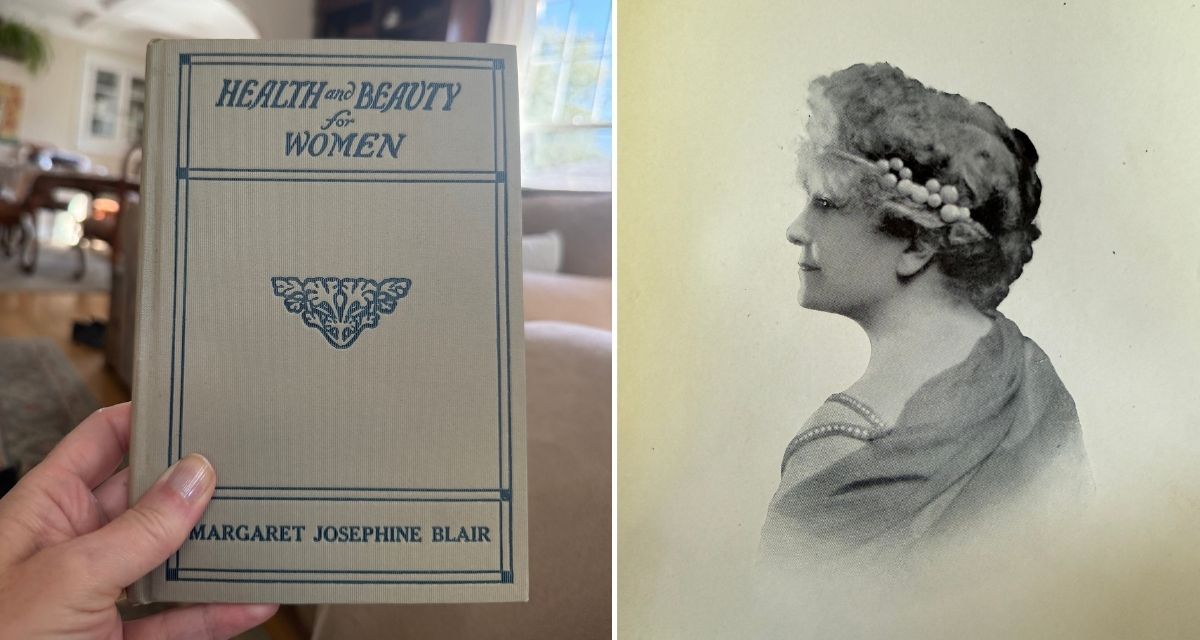
I was walking out of my 80-year-old mother’s house the other day when she stopped me. “Wait, I found something I want to show you,” she said. She disappeared for a few seconds and emerged with a small, old book: Health and Beauty for Women by Margaret Josephine Blair. I opened it to the title page and saw “COPYRIGHT 1923.”
“Oh my,” I said, eyebrows raised. I’ve seen enough horrible examples of the advice women received a century ago to assume the worst. My mom laughed knowingly but then said the book surprisingly had some solid stuff in it. “Just take a look,” she said.
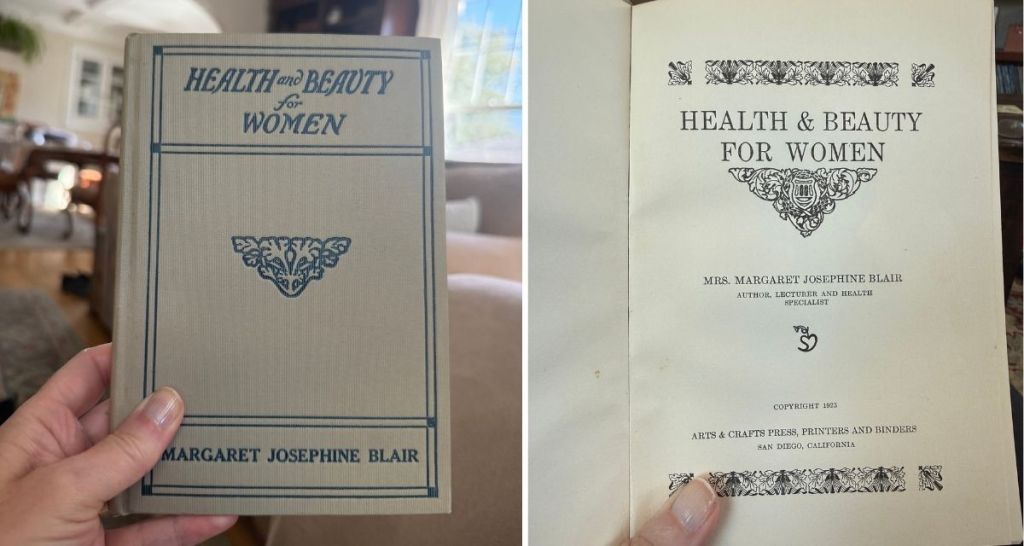
So I took the book home and read it in one sitting. She was right. A lot of the advice in it could have been given by a modern health influencer.
The mind-body connection, in so many words
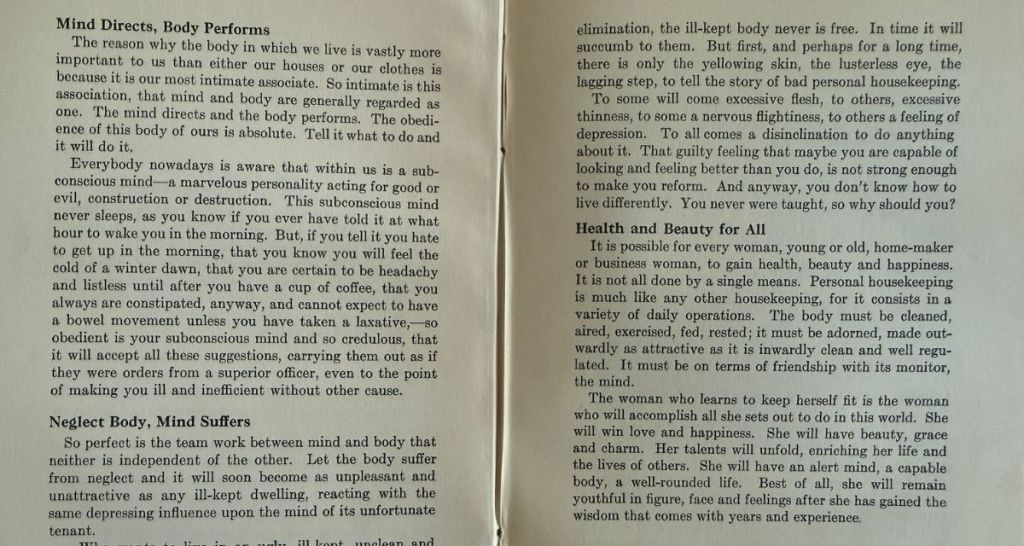
Throughout the book, Blair pointed out that the mind and body are connected and that each affects the other. “So perfect is the team work between mind and body that neither is independent of the other,” she wrote.
She claimed that if you tell yourself you hate to get up in the morning or that you can’t have a normal bowel movement without a laxative, the body will respond accordingly. She also said that neglecting the body would have “a depressing influence upon the mind of its unfortunate tenant.”
Blair suggested enlisting the help of the imagination and subconscious in achieving optimal health.
“My own way of enlisting the help of the subconscious is to sit or stand quietly alone,” she wrote. “I drop my hands at my sides and relax, breathing deeply. Sometimes, to rid my mind of strain and worry, I hum mentally an old melody.” She suggested readers “take a few minutes several times a day or at night for this communion with your higher self.”
She was basically describing the “mind-body connection” and using meditation as a health tool.
‘Breathwork’ circa 1923
There’s a lot of flashy wellness marketing around “breathwork” these days. Specific breathing techniques are marketed as helping with all sorts of ailments, but conscious breathing is hardly a new trend. We can trace breathwork back centuries, if not millennia.
Blair dedicated many pages to describing how most women don’t breathe deeply enough to “keep the vital organs in good condition.” And, she pointed out, this was the case in 1923, despite corsets being loose enough to no longer inhibit their breathing.
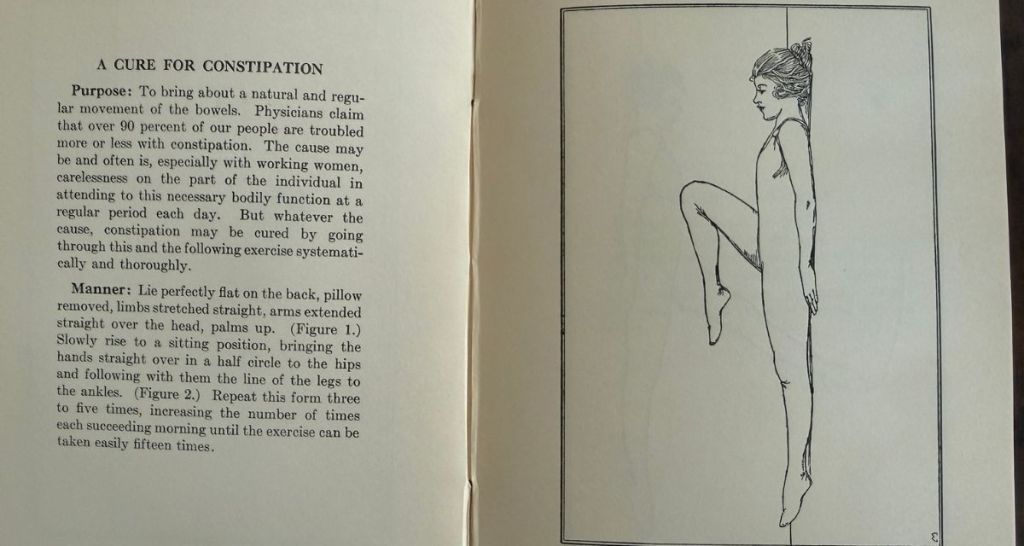
Blair advocated for abdominal breathing using the diaphragm (known as “diaphragmatic breathing” in modern wellness speak). She suggested starting the day lying in bed on your back and taking long, deep breaths. “All the viscera in the abdomen—the organs of digestion, elimination, procreation, are pulled up and down every time you take a breath by this method,” she wrote.
She also said you should practice this “muscular breathing” when you walk, using both the diaphragm and abdominal muscles.
Supporting your core while you walk, in other words. And speaking of walking…
10,000 steps a day, but in miles
Blair had lots to say about exercise, too. About half the pages in the book are devoted to exercises for strengthening various parts of the body. But in addition to doing those exercises morning and evening, she also insisted women needed to walk more.
“Two miles is hardly enough out-of-doors exercise for the normal woman in a day, but it will do for a beginning,” she wrote. “When you are able to do four miles and feel fresh at the end, in addition to the exercises prescribed for morning and night, you may regard yourself as a woman of force and power. No woman can walk four miles every day, and walk them right, without developing physical and mental qualities that will make her a force to be reckoned with.”
What does it mean to walk right? She said you should “lead with your chest” and “walk as if you liked it.”
“As you walk, hold yourself proudly,” she wrote. “Do not let yourself sag. See that your bosom and your shoulders are sustained, your abdomen receiving muscular support and your leg muscles in tense and active use. Let your head be lifted proudly from the shoulders, and your entire body move through the friendly air as if you were exercising some profoundly valuable privilege, as indeed you are.”
Four miles is pretty darn close to 10,000 steps. And if you add in the other exercises, a woman following Blair’s advice in 1923 would have stayed quite fit.
Her ‘diet sensibly’ advice was pretty solid
Blair shared that she had struggled with her own weight for a time, so she spoke from personal experience about eating in moderation. It’s just surprising to see how genuinely sensible her eating advice was:
- It is not necessary to avoid all sweets, but rich pastries will get you.
- Focus on foods you can eat rather than what you can’t (feelings of deprivation fill us with longing for what’s forbidden).
- Eat lots of fruits and vegetables and don’t overcook your veggies.
- For meat, eat mostly chicken and fish, limiting red meat.
- Avoid fried foods; eat eggs poached or boiled.
- Whole grains are better than white bread.
- Eat spinach, beans, lentils, and peas for their iron and vitamin content.
- Eat nuts and raisins, as they are of “great nutritive value.”
- Drink lots of water: “A gallon of water is not too much to drink in a day.”
She also said that spasmodic dieting was “worthless.” The only times she missed the mark were when she called chocolate “very fattening” and criticized drinking tea and coffee “due to continual irritation of the nerves.”
But I’m pretty sure Blair could’ve been a TikTok wellness influencer if she’d lived a century later.
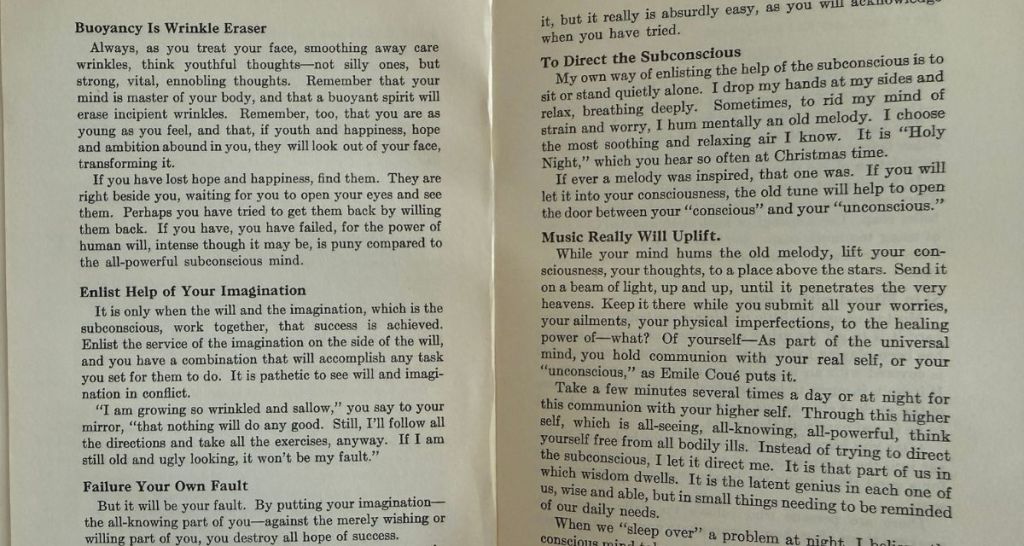
Photo credit: Annie Reneau
Of course, there was some cringeworthy advice as well
There was more in the book that modern health gurus would support than condemn, and a lot of the beauty advice about skincare, hair care, and cosmetics holds up. But it would be surprising if there were no questionable claims or admonitions in a book from 1923.
The “Yikes, that didn’t age well” bits in the book include:
- Her skin advice is quite clearly geared toward white women, advocating for bleaching creams that whiten the skin. She even suggested using those creams on the hands, noting “how white and clean it makes them.”
- She said that wrinkles aren’t necessary. “The haggard cheek and deep wrinkles can be avoided and even cured,” she wrote. “They are not necessary at any age or under the most arduous conditions.” Her contention was that wrinkles are mostly caused by our thoughts. (Oh, and it’s our own fault if we get them.)
- There’s a decent amount of fat-shaming language that feels incredibly outdated at best. “There is really no beautiful costume for the stout woman,” Blair wrote. “Blink the truth as we may, and drape her vertically or aslant, still she is fat, and the costume is a concession to her defective figure.” I mean, ouch.
- She said, “bobbed hair is not for women,” claiming it’s “pretty and becoming” to young girls but “it is apt to rob the heads of the college girl and young woman of much of their feminine charm and unfolding character” because “always the glory of woman has been in her long hair.” Okay, Marge.
- Her chapter for businesswomen is empowering in many parts but also has snippets like this: “You, of all women, must be good to look upon. Do not make the mistake of thinking that cleverness, efficiency, or even conspicuous talent can take the place of smartness in dress, hair that is becomingly arranged, nicely kept hands, and a face and figure that attract rather than repel.” I mean, she may not be wrong, but ew.
- The ableism is pretty stark. Some of it is a reaction to the previous generation, when “semi-invalidism in women” was in fashion. Blair references the “Flora McFlimsys” of the 19th century before saying, “The woman who counts, today, is the woman who is equally strong in every part of her body, who has no prolapsed organs, because she exercises her abdomen twice a day, who has good digestion for a similar reason.” And while she says that husbands and wives should give each other happiness and be kind to one another, she also says the success or failure of marriage lies largely with women. “Above all, she [the wife] should keep her body in perfect condition,” she wrote. “Physical weakness in woman wrecks innumerable marriages.” Yikes.
The bottom line: We’ve come full circle in some ways
There’s a lot more in the book, including advice on dental care, sluggish bowels, makeup, and more. But overall, the ratio of solid advice to eyebrow-raising statements is about 80/20, which is higher than I would have expected for a 103-year-old book for women about health and beauty. A lot of what Blair wrote is right along the lines of today’s health advice, which is wild when you consider all the diet and exercise trends over the past century.
Fun find, Mom. No idea why you had it in your book stash, but I’m certainly glad you did.