Kara Cartwright had always been fiercely protective of her online privacy. The writer used a pen name, carefully concealed her face and identity, and maintained her anonymity even in tight-knit writing groups where many of the women knew one another in real life.
She had certainly never announced her birthday on social media.
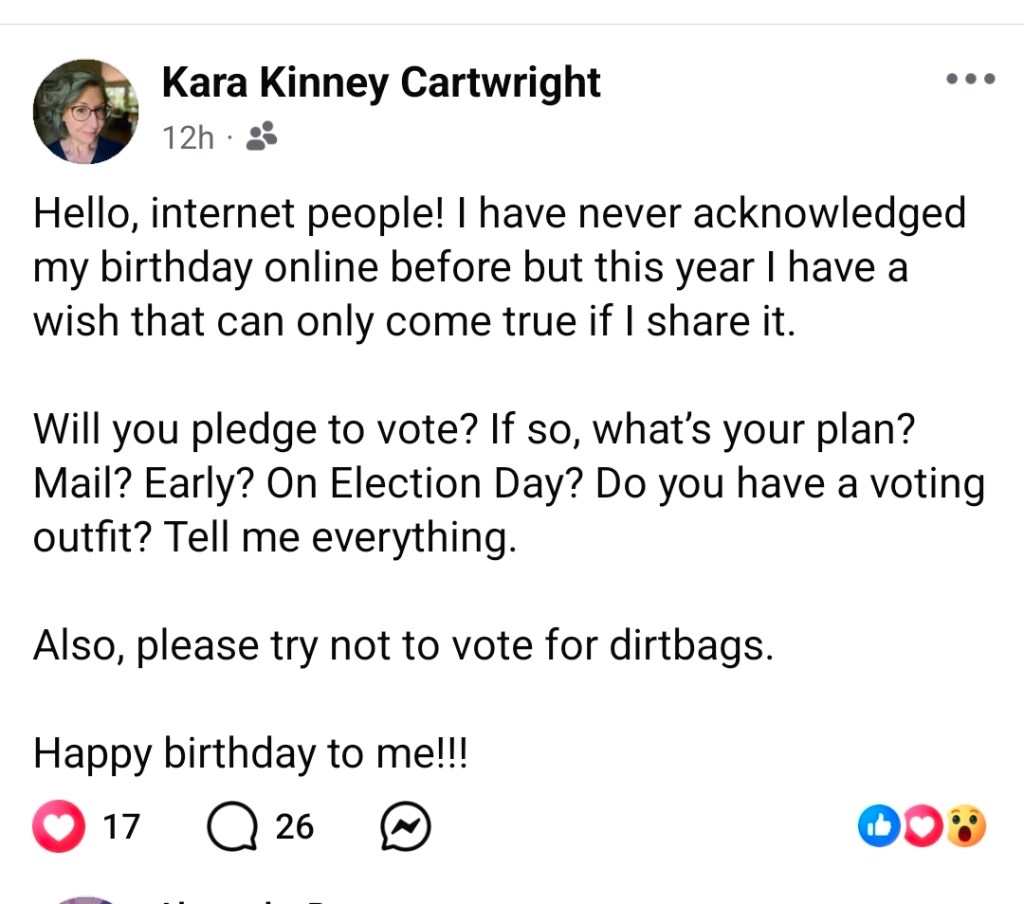
But with the November 2026 election approaching, Cartwright decided to make an exception. For the first time, she publicly acknowledged her birthday—not because she wanted attention, gifts, or well wishes, but because she had a request.
“Will you pledge to vote?” she asked her followers. “If so, what’s your plan? Mail? Early? On Election Day? Do you have a voting outfit? Tell me everything.”
Then, in keeping with her trademark humor, she added one final request.
“Also, please try not to vote for dirtbags. Happy birthday to me!!!”
For Cartwright, breaking her own rules about privacy was worth it if she could convince even a few people to show up at the polls.
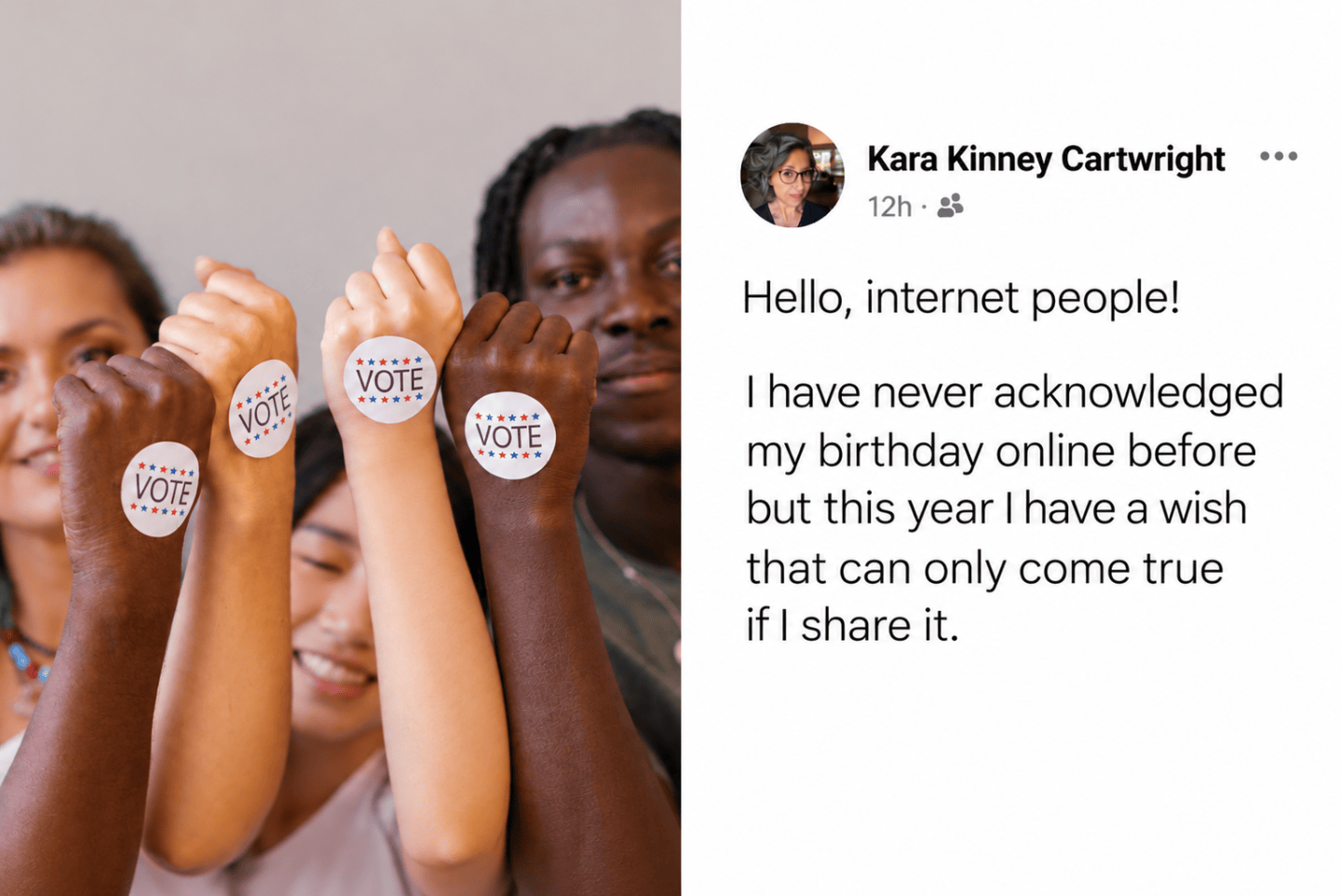
Exercising the right to vote sounds like a simple request, but getting Americans to follow through is another matter entirely. According to the Environmental Voter Project, an estimated 11.2 million registered Americans identified as environmentalists did not cast a ballot in the 2024 presidential election.
That’s 11.2 million people—a number bigger than the entire population of Michigan—whose concern for the environment didn’t translate into a vote.
The staggering voting gap inspired outdoor apparel company Patagonia’s 11.2 Million Vote Project, an initiative aimed at closing the divide between caring about the environment and participating in the democratic process.
And Patagonia was willing to put its money where its mouth was.
The company committed $11.2 million to the project, offering participants a $100 Patagonia shopping credit for helping three friends or family members make a plan to vote. Participants could also choose to have Patagonia donate $100 to the League of Conservation Voters instead. The response was so overwhelming that Patagonia’s website briefly crashed, leaving the company scrambling to keep up with demand. Within four days, the entire $11.2 million incentive budget was exhausted, but the platform remains open.
Participants sign up, identify three friends or family members who could use a nudge to get to the polls, and send them personalized links with everything they need to make a voting plan—from where to cast their ballot to when early voting begins.
It’s a modern take on an old-fashioned concept: Sometimes all it takes is a little encouragement from someone you trust. If the response is any indication, Patagonia may be onto something.
“We’re excited and quite frankly shocked at how quickly our community responded to our midterms initiative,” said Corley Kenna, Patagonia’s chief communications and impact officer in an Oct. 1 press release. “Our community understands the connection between a healthy democracy and a healthy planet, and in just four days, they helped almost half a million people make a plan to vote.”
Although the $100 incentives are no longer available, Patagonia is keeping the Rally platform open through Election Day, encouraging people to continue reaching out to friends and family to help them make voting plans. After all, the project’s central idea doesn’t require a financial incentive to work, because it was never about the money. It was about the power of personal relationships.
Cartwright didn’t need sophisticated technology or a multimillion-dollar campaign to ask her friends to make a plan to vote. All she needed was a birthday wish and a social media account. What followed were 26 enthusiastic comments from friends and family, sharing their voting plans and encouraging others to do the same.
Patagonia is betting that the same kind of personal encouragement, multiplied across thousands of relationships, can make a difference.
And Cartwright’s birthday wish is a reminder that sometimes, getting people to show up starts with something as simple as asking.