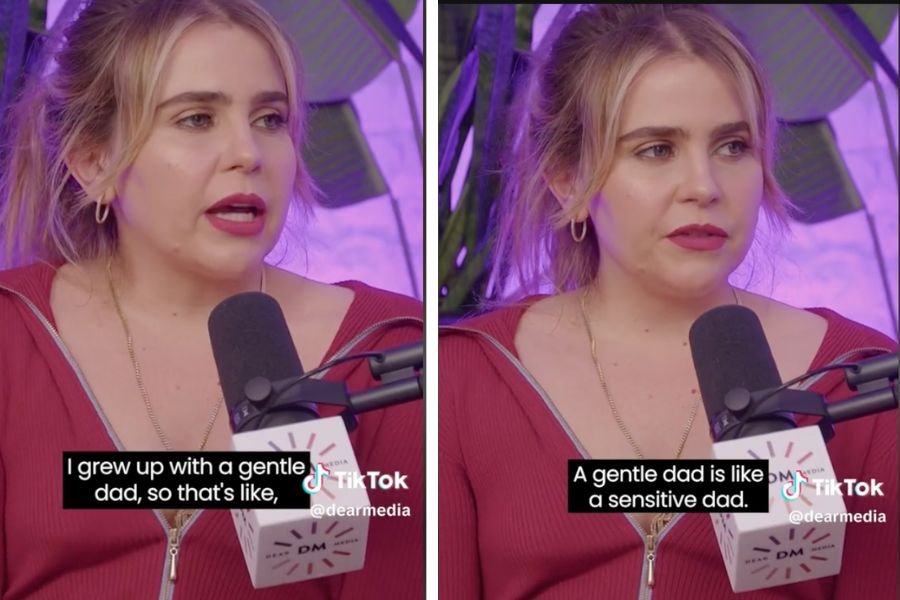
Actress Mae Whitman credits being able to navigate childhood stardom to her 'gentle dad'
“If everyone had a gentle dad, the world would be a better place,” one commenter wrote.

Mae Whitman credits her healthy childhood to her "gentle dad."
Hollywood stardom is all too often a dangerous landscape for child actors. Many celebrities who got famous early have come out with their own personal accounts of being exploited and abused by the industry or by their own parents.
Mae Whitman, however, is not one of those actors.
At the age of 6, Whitman starred as Meg Ryan’s daughter in “When a Man Loves a Woman,” and since then has gone on to roles in notable shows like “Arrested Development,” "Parenthood" and “Good Girls.” Now, at age 34, she is starring in a musical comedy on Hulu called “Up Here.”
During a podcast interview with “Dear Media,” Whitman was asked how she managed to navigate early success while dodging those all-too-common pitfalls that many young stars fall victim to.“I hate to give them all the credit, but it’s my parents,” she quipped. “They ruled. They were so cautious and they were so meticulous about prioritizing and walking me through what was important in life. What not to take personally. Our family was so communication-based.”
She then praised her dad in particular for being a healthy male presence.
@dearmedia #maewhitman is the way she is all thanks to her parents. Shoutout to the #gentledads 🥹 #notskinnybutnotfat #familygoals #podcastclips ♬ Storytelling - Adriel
“I grew up with a gentle dad—it’s a term I’ve coined with people,” she said. “A gentle dad is like a sensitive dad. There was no teasing in my house. There was no meanness. There was no ‘You need to make us proud.’ It was an open source of communication and sensitivity and consideration.”
She then gave a sweet story as an example, explaining that as a kid, she could never get into sleepovers and always wanted to go home (relatable for any introvert, to be sure). In order to avoid any embarrassment, Whitman and her father developed a code phrase that signaled it was time to pick her up.
@dearmedia Calling your parents to pick you up at sleepovers > Yes or no? ⬇️ #sleepovers #sleepoverstory #parentpickup #maewhitman #notskinnybutnotfat #podcastclips ♬ Graduate - BLVKSHP
“I would call my dad, completely casual,” she recalled, “and be like, ‘It’s awesome I’m having the best time I’ve ever had. But quick question: Did you feed the turtle?’”
Without fail, Whitman’s dad would come and get her. That is Gentle Dad-ing 101.
The interview struck a chord with viewers, many of whom had their own gentle dad to give credit to.
“My dad was a gentle dad and I miss him everyday,” one person wrote.
Another added, “I grew up with a gentle dad, and married a man who is a gentle dad. It’s the biggest flex a man can have.”
And those who didn’t grow up with that kind of support shared how much they yearned for it.
“Ooof to not have Dad issues would absolutely rule,” commented one person.
“Where was the signup sheet? Cuz I missed it,” another echoed.
Regardless, people were unanimously on board with the idea. As one person put it, “If everyone had a gentle dad, the world would be a better place.”
Just another example of how gentle parenting can work wonders for developing some high-functioning, healthy kids, whether they’re thrust into stardom or not.


Student smiling in a classroom, working on a laptop.
Students focused and ready to learn in the classroom.
Fish find shelter for spawning in the nooks and crannies of wood.
Many of these streams are now unreachable by road, which is why helicopters are used.
Tribal leaders gathered by the Little Naches River for a ceremony and prayer.

Communications expert shares the perfect way to gracefully shut down rude comments
Taking the high ground never felt so good.
A woman is insulted at her job.
It came out of nowhere. A coworker made a rude comment that caught you off guard. The hair on the back of your neck stands up, and you want to put them in their place, but you have to stay tactful because you're in a professional setting. Plus, you don't want to stoop to their level.
In situations like these, it helps to have a comeback ready so you can stand up for yourself while making making sure they don't disrespect you again.
Vince Xu, who goes by Lawyer Vince on TikTok, is a personal injury attorney based in Torrance, California, where he shares the communication tips he's learned with his followers. Xu says there are three questions you can ask someone who is being rude that will put them in their place and give you the high ground:
Question 1: "Sorry, can you say that again?"
"This will either make them have to awkwardly say the disrespectful remark one more time, or it'll actually help them clarify what they said and retract their statement," Xu shares.
Question 2: "Did you mean that to be hurtful?"
The next step is to determine if they will repeat the disrespectful comment. "This calls out their disrespect and allows you to learn whether they're trying to be disrespectful or if there's a misunderstanding," Xu continues.
Question 3: "Are you okay?"
"What this does, is actually put you on higher ground, and it's showing empathy for the other person," Xu adds. "It's showing that you care about them genuinely, and this is gonna diffuse any type of disrespect or negative energy coming from them."
The interesting thing about Xu's three-step strategy is that by gracefully handling the situation, it puts you in a better position than before the insult. The rude coworker is likely to feel diminished after owning up to what they said, and you get to show them confidence and strength, as well as empathy. This will go a lot further than insulting them back and making the situation even worse.
Xu's technique is similar to that of Amy Gallo, a Harvard University communications expert. She says that you should call out what they just said, but make sure it comes out of their mouth. "You might even ask the person to simply repeat what they said, which may prompt them to think through what they meant and how their words might sound to others," she writes in the Harvard Business Review.
More of Gallo's suggested comebacks:
“Did I hear you correctly? I think you said…”
“What was your intention when you said…?”
“What specifically did you mean by that? I'm not sure I understood.”
“Could you say more about what you mean by that?”
Ultimately, Xu and Gallo's advice is invaluable because it allows you to overcome a negative comment without stooping to the other person's level. Instead, it elevates you above them without having to resort to name-calling or admitting they got on your nerves. That's the mark of someone confident and composed, even when others are trying to take them down.