Incredible ‘bird feeder’ photos give a whole new perspective on our feathered friends

It’s amazing the magic we can find in our own yards.

wildlife photos, new york wildlife, carla rhodes
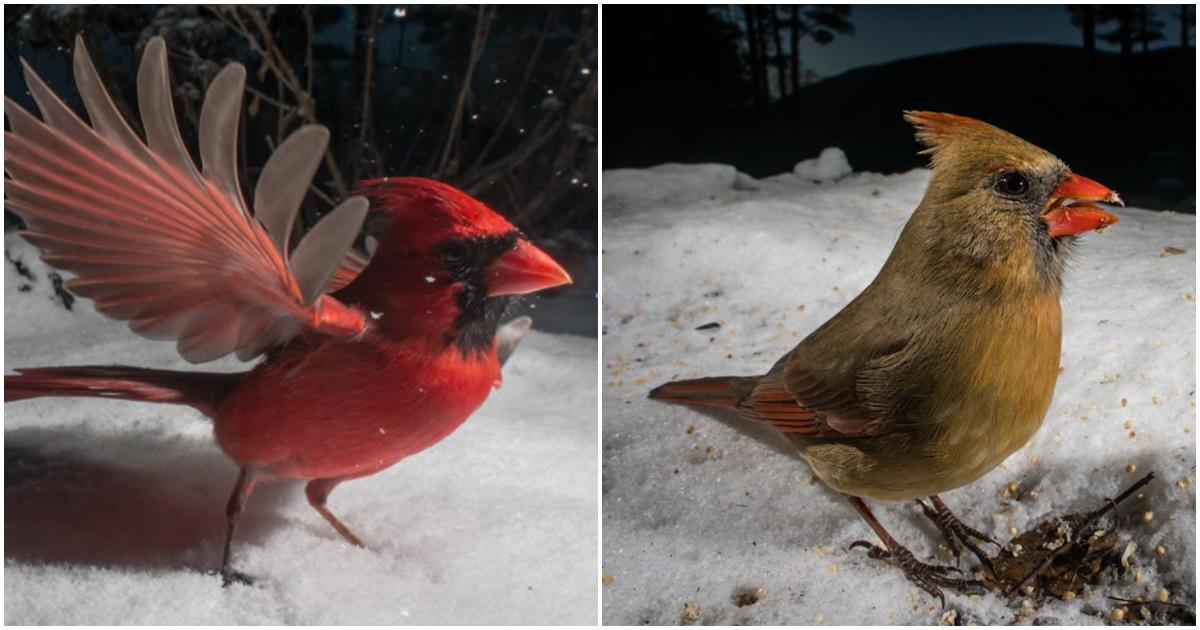
Two northern cardinals captured on Carla Rhodes' bird-feeder camera. Photo credit: via Carla Rhodes

The pandemic has caused many people to reevaluate their surroundings. When you’re stuck at home more often than you’d like, you start to pay a lot more attention to what goes on in your own backyard.

This type of introspection inspired wildlife photographer Carla Rhodes to get a closer look at the furry friends that live near her home in the Catskill mountains of New York.

What she found was magical.

“The winter of 2020-2021 was particularly brutal to humankind. After months of enduring the Covid-19 pandemic, we were now collectively slogging through winter. As a result of being stuck at home, I focused on my immediate surroundings like never before,” Rhodes said in a statement.


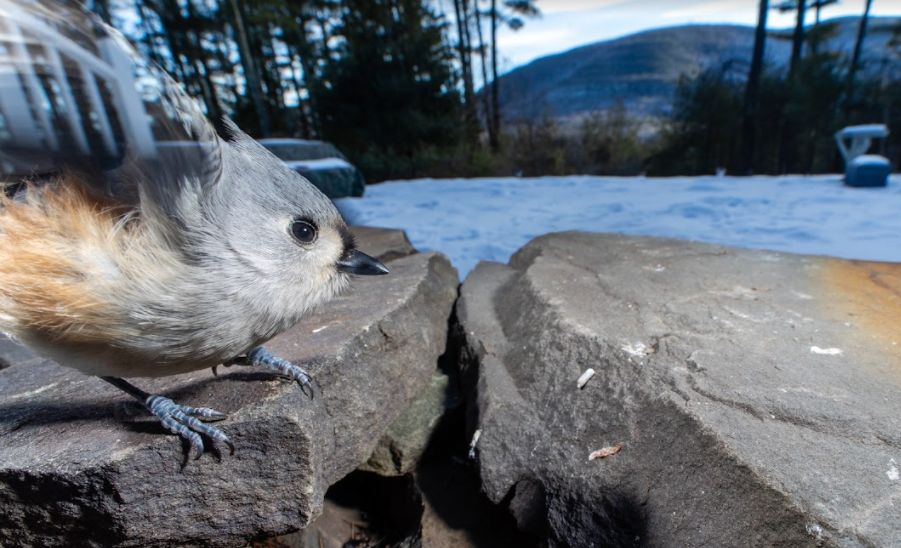
Rhodes positioned a DSLR camera trap beneath her bird feeder to get an up-close glimpse of the wildlife that came to sample her delicious seeds.

The results are an incredible series of photos of birds and other woodland creatures from a vantage point most people never see. Rhodes calls her project, “Beneath the Bird Feeder.”

The birdfeeder photos also gave a new glimpse into the behavior of several species of birds and rodents that call the Catskills home.

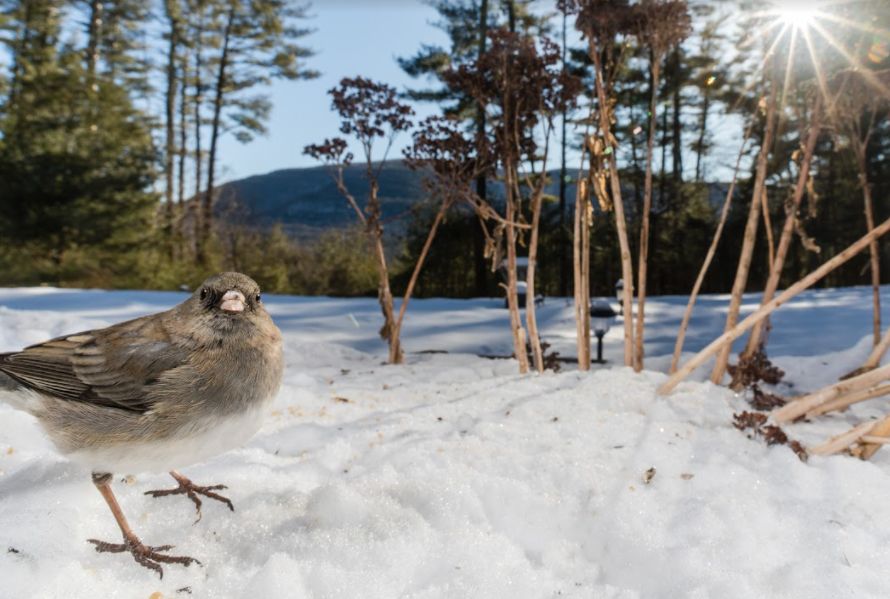
“As I got deeper into the project, intriguing observations emerged,” Rhodes says. “I noticed distinct repeat visitors such as a Dark-Eyed Junco with an overgrown beak, a deer mouse with a notched ear, and an irruption of Red-Breasted Nuthatches. Dark-Eyed Juncos always showed up at the crack of dawn and Northern Cardinals would always be the last visitor of the day as dusk turned into evening.”

Here are 15 of the most captivating photos that Rhodes captured from beneath her bird feeder.

1. Dark-eyed junco
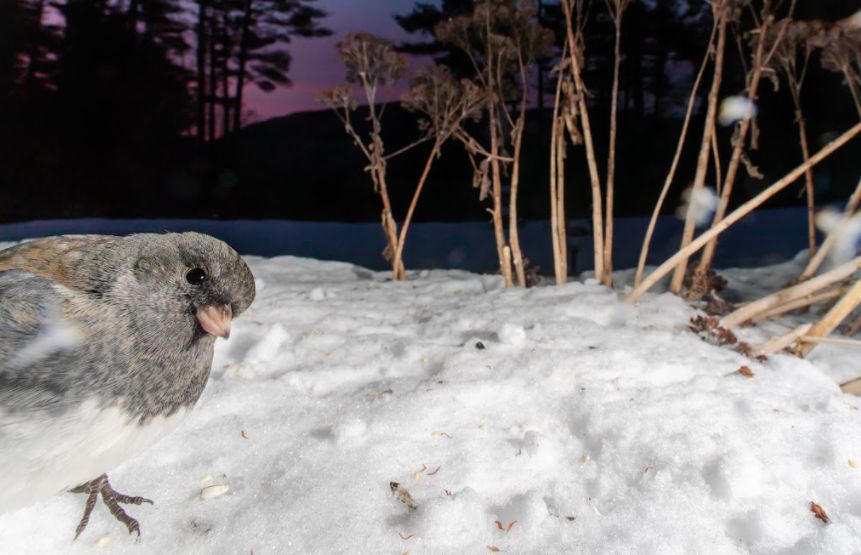
“Often overlooked and considered drab ground-feeding birds, Dark-Eyed Juncos hold a special place in my heart due to their funny and curious behaviors. Every day they were first to arrive beneath the bird feeder,” Rhodes says. “Dark-Eyed Juncos were one of the most frequent and curious subjects beneath the bird feeder.”

2. Dark-eyed junco
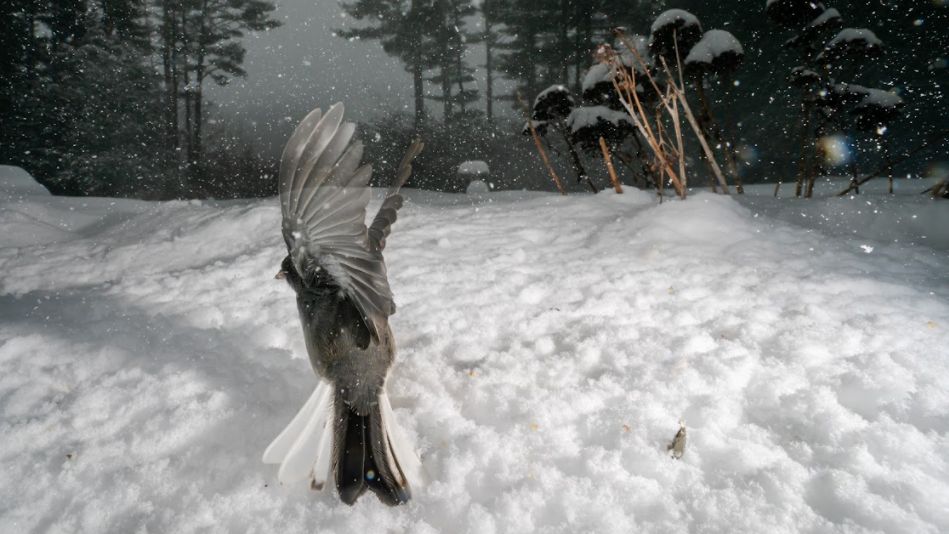
3. Dark-eyed junco
4. Tufted titmouse
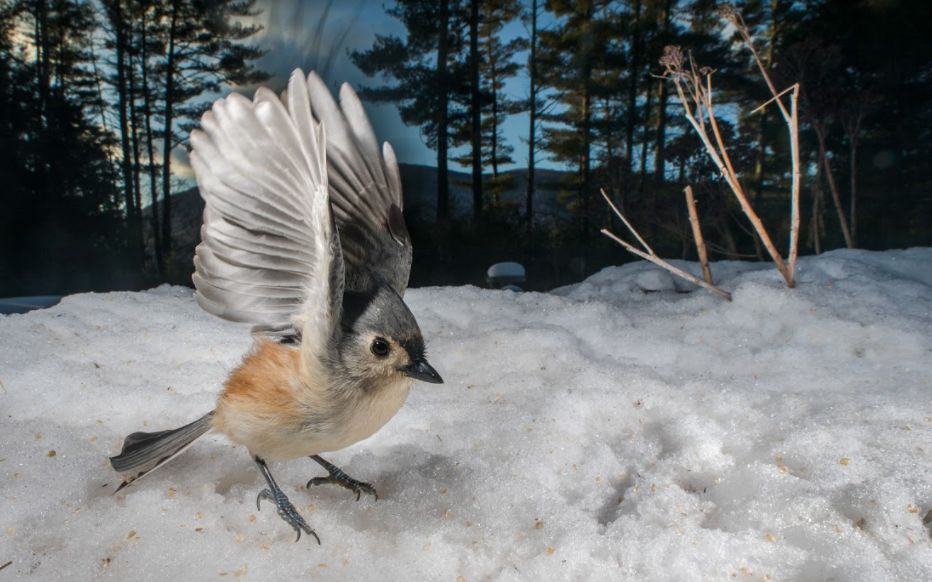
According to All About Birds, the tufted titmouse is “common in eastern deciduous forests and a frequent visitor to feeders.”

5. Mourning dove
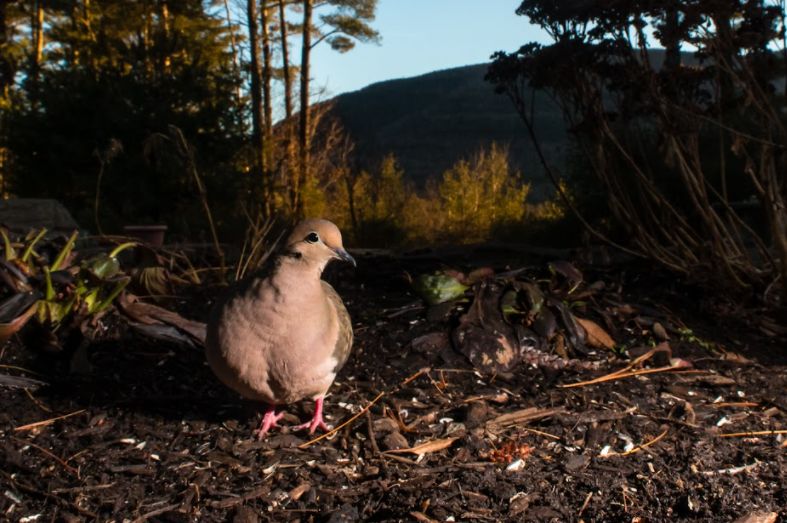
​”Observing Mourning Doves was a daily pleasure, especially when they gathered to form a clean-up crew beneath the bird feeder. Mourning doves are monogamous and possibly mate for life,” Rhodes writes. 

6. Mourning dove 
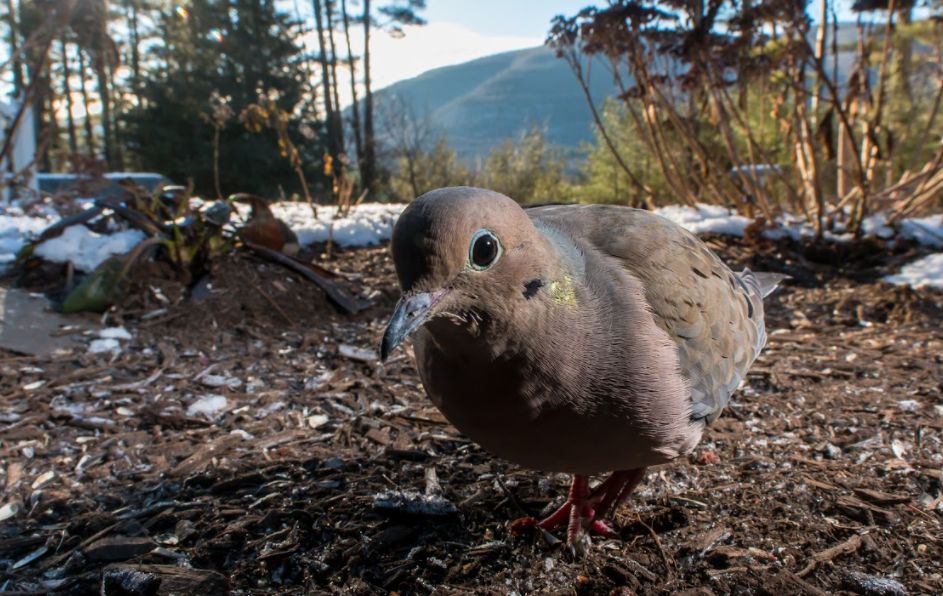
7.  Mourning doves
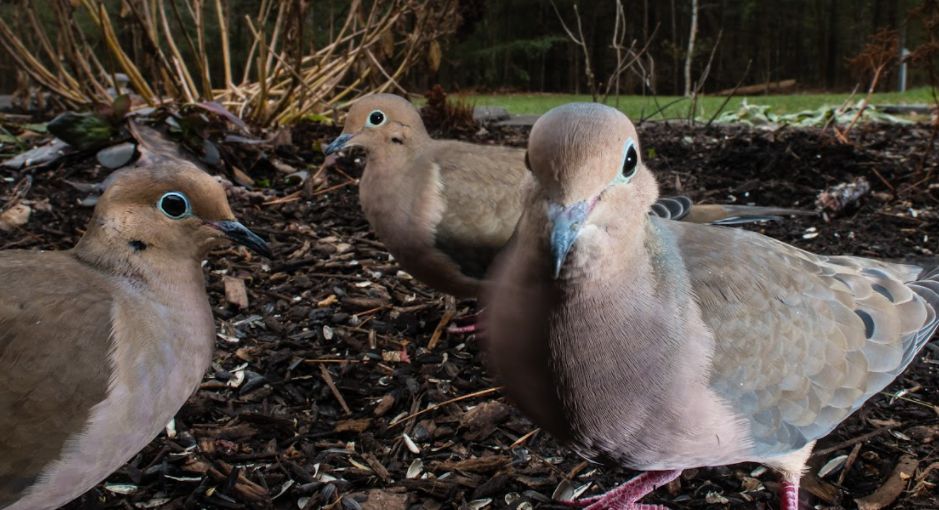
8. Blue jay
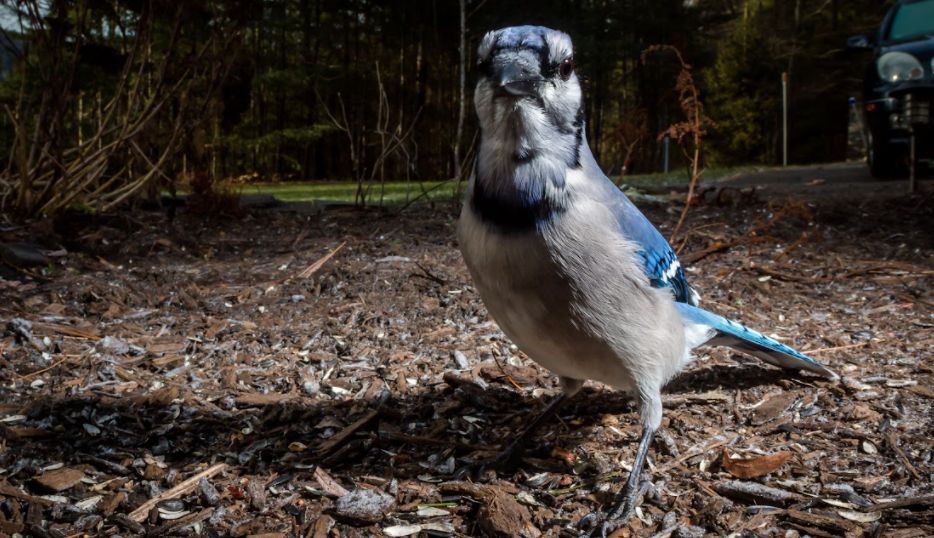
“Blue Jays are known for their intelligence and complex social systems with tight family bonds,” All About Birds says. “Their fondness for acorns is credited with helping spread oak trees after the last glacial period.”

9. Northern cardinal
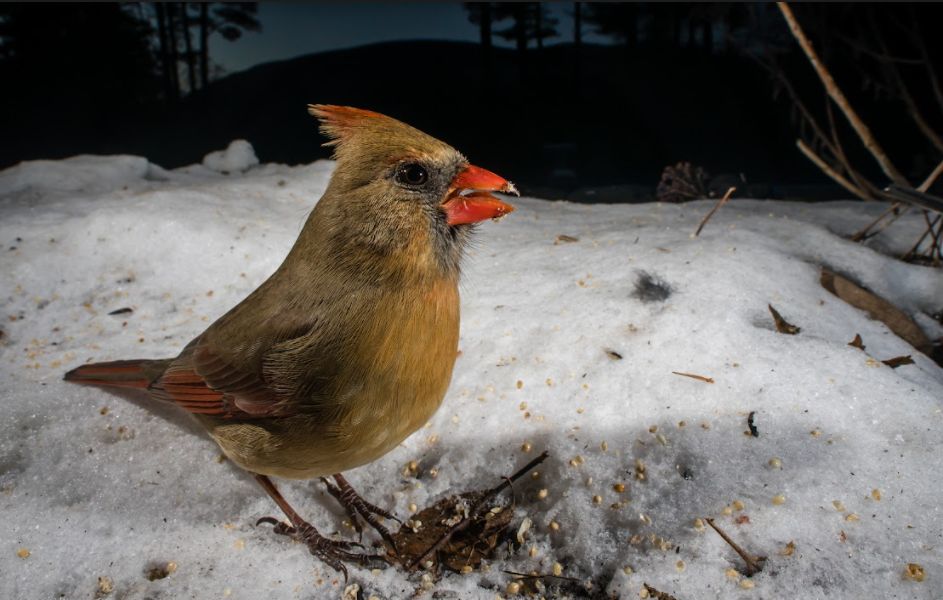
“Northern Cardinals were always the last to show up beneath the bird feeder, shortly after dusk every evening,” Rhodes writes.

10. Black-capped chickadee
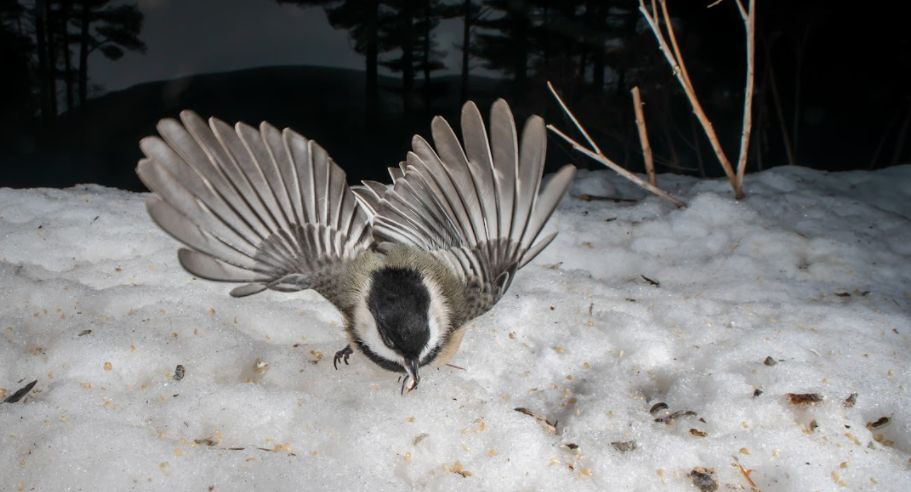
“Little flocks of Black-capped Chickadees enliven the winter woods with their active behavior and their cheery-sounding chick-a-dee callnotes as they fly from tree to tree, often accompanied by an assortment of nuthatches, creepers, kinglets, and other birds,” the Audubon field guide to North American birds says.

11. Black-capped chickadee
12. Eastern gray squirrel
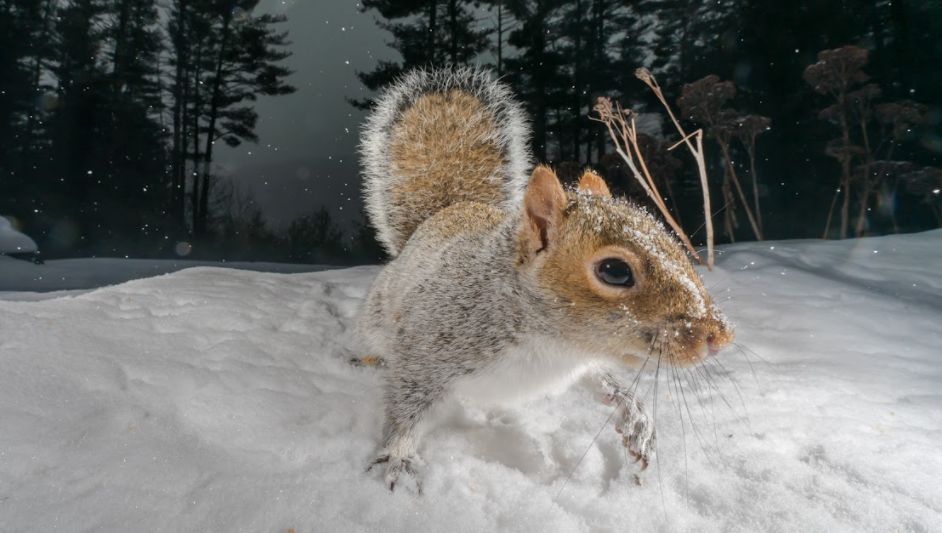
Eastern gray squirrels are important members of forest ecosystems as they play a vital role in dispersing seeds.

 13. American red squirrel
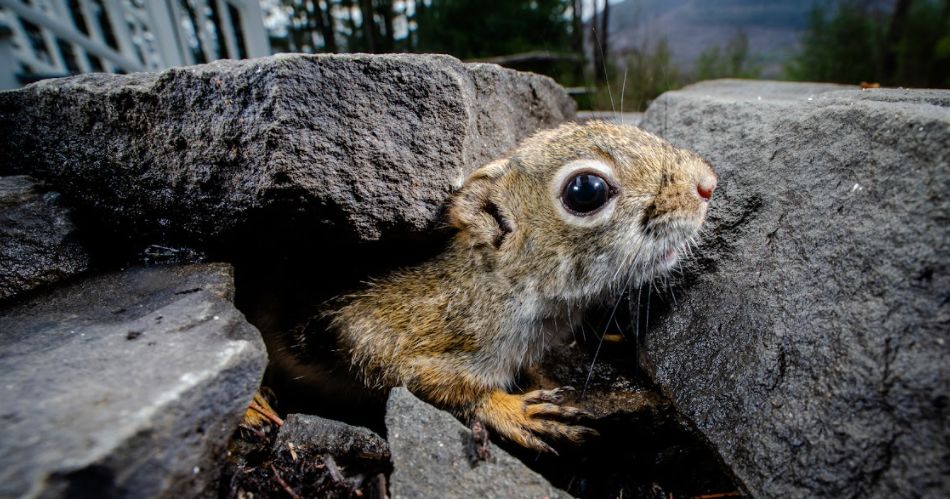
The American red squirrel is known for its distinct bushy and dark red tail with hints of a white outline.

14. American red squirrel
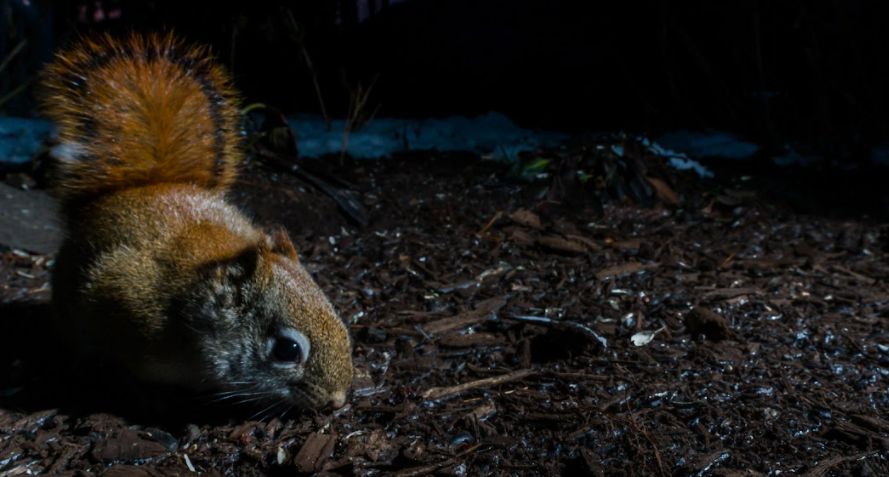
15. Northern short-tailed shrew
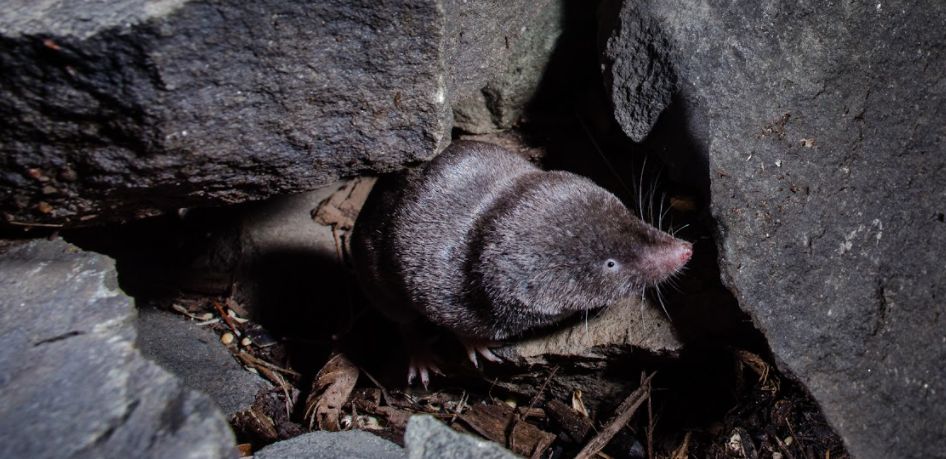
If you see a northern short-tailed shrew, be careful. It’s venomous and paralyzes its victims with poisonous saliva. In humans, a bite can cause swelling and intense pain.


This article originally appeared on 01.03.22

  • From the Sequoias to ‘huge’ hardware stores, here are 14 U.S. places foreigners dream of visiting
    A forest (left) and a man in a hardware store (right).Photo credit: Canva
    ,

    From the Sequoias to ‘huge’ hardware stores, here are 14 U.S. places foreigners dream of visiting

    “I’d love to go to a Renaissance fair or at least a Medieval Times dinner show.”

    You probably couldn’t pay a Parisian enough money to visit the Eiffel Tower, or an Italian to swing by the Vatican, even though both landmarks are objectively extraordinary. It’s a fact of life that people take for granted what they see every day, no matter how naturally splendid or meticulously crafted it may be. But sometimes an outsider’s appreciation can help you marvel once again at the wonderful things in your own backyard. 

    Recently, non-Americans on Reddit offered this gift by sharing some quintessentially American things they’d like to witness or experience for themselves. At a time when political division is making many Americans feel disillusioned, the conversation offers some timely comfort—and maybe even a renewed sense of hope for the good things the country still has to offer.

    It’s also interesting to see how much American pop culture shapes what visitors find intriguing. Many people suggested fairly mundane things simply because they’ve seen them again and again in American movies and TV shows. For instance, one person mentioned the allure of Chinese takeout because of the iconic white cartons that appear a bajillion American films and television shows.

    Keep scrolling for American things people from outside the country are eager to experience, or grateful to have experienced in their lifetime.

    1. Sequoia National Park and the Grand Canyon 

    America, reddit, culture, travel
    The Grand Canyon at dusk. Photo credit: Canva

    Even Americans agree that these two spots are must-sees.

    “I promise, standing at the base of a giant tree is an experience that cannot be replicated…If you have a chance, learn about the ecology and also about fire history.”

    “As I’m American I always brushed off the Grand Canyon and never planned to see it. I got a random chance on a return trip from Vegas. Do it. See it. I’ve traveled a fair bit around the US and Europe and it remains the most amazing, breathtaking thing I’ve ever seen or experienced.”

    “I’m also an American, and pretty well traveled. The Grand Canyon brought me to tears. It’s one of only two placed I’ve ever gone to twice in the same year because it’s just THAT good. (The second was the Cliffs of Moher in Ireland.)”

    2. The rainforests of the Pacific Northwest

    “I bet they smell AMAZING!!”

    3. The French Quarter in New Orleans

    “Nothing else like it. And you cannot get bad food there unless you just want to eat at McDonalds………”

    4. Savannah, Georgia

    “Savannah is great!! I stayed a couple nights there and always wanted to go back. Do a ghost tour! And a horse carriage tour!”

    5. New England

    America, reddit, culture, travel
    New England trees in autumn. Photo credit: Canva

    “I reallllyyy wanted to go to New England for the longest time lol. Such pretty leaves.”

    6. Sedona, Arizona 

    “A friend said it was stunning but disconcerting because at times she felt things were off kilter. I like weird places and the geographic nature appeals, all those red rocks!!”

    7. San Francisco

    “I’m 30, an American and just landed in San Francisco this morning. It’s my first time here and I’m in love. Such a cool place. I’m actually moving here soon. Doesn’t feel real at all!”

    8. Tornado areas

    america, reddit, culture, travel
    A tornado in an open field. Photo credit: Canva

    “I lived in Mexico and Central America for many years, and one thing people kept asking me about was tornadoes…They thought it was an American thing, and a very common occurrence. Maybe because of Wizard or Oz. I had to sadly tell them I’ve never seen a tornado in my life. I’m from the west coast. They were definitely very disappointed. I also realized they don’t understand how dangerous they are. They thought it was more like lightning. Just happening in the background while people got on with their day.”

    9. Gigantic stores

    “Honestly just want to hit up some of those huge pc hardware stores…we don’t have anything like that scale here.”

    “I wanna visit a Walmart. The closest thing to a giant store like that are some larger supermarket chains in Germany … In the Netherlands we don’t really have large stores where you can find EVERYTHING you wish for.”

    10. Chinese takeout

    “I have a good friend from Switzerland and the first thing she wanted to experience was getting to-go Chinese food and eating it out of those white cartons with chopsticks…I guess the whole Chinese food take-out in those particular cartons is pretty American, kinda like fortune cookies.”

    11. Fast food restaurants

    “I’m American, but my Irish colleague was so excited to try a Baconator from Wendy’s when he visited.”

    “When my German friend visited she begged to visit In-N-Out because it looked ‘so fancy.’ She loved it. I surprised her by buying her a tshirt from there too.”

    12. Items/places made famous by movies and TV

    “Australian here, and I’ve always wanted to see a big yellow school bus, after being terrified of them in the opening scene of A Nightmare on Elm Street 2”

    “I just wanna walk into a 24/7 diner at 3am and get a giant milkshake. No reason, just movie vibes.”

    “My friend from England visited New York for business and thought it was wild that to-go coffee was served in the same blue and white cups she had seen on Law & Order.”

    13. Halloween festivities

    “I absolutely love American culture for Halloween, all those decorations, costumes and just the whole vibe about this holiday is something I would like to experience.”

    “One thing that I really love about American culture is Halloween haunted houses. There’s haunted houses…There’s haunted hayrides, some where zombies attack you, and you have to try to get them with paintball guns.There’s haunted 5k runs, kids haunted houses (Not scary, just silly), even haunted car washes.”

    14. Events that celebrate olden times

    “I’d love to go to a Renaissance fair or at least a Medieval Times dinner show.”

    Finally, people seem really eager to try rhubarb pie. Honestly, who can blame them?

  • An adorable compilation of cats interrupting serious news reports is pure joy
    A cat takes a stretch break on a desk.Photo credit: Canva
    ,

    An adorable compilation of cats interrupting serious news reports is pure joy

    Even the most stoic broadcaster can’t compete with the antics of a cat.

    Cats have an interesting way of showing up when you least expect them. Sometimes their mere presence at the oddest of times provides the perfect break from serious moments. This is especially apparent when they appear on news segments.

    On the @Explaining Instagram page, they share a montage of adorable cats appearing on news broadcasts, often without their owners realizing it. In the comments, the page explains that this usually happens because cats like to see and be seen: “Cats have a funny habit of interrupting video calls, and it is mostly because they are naturally curious and attention seeking.”

    In the clip, we see different breeds of cats yawning, stretching, and yes, jumping into the middle of news shots. Often they stand frozen, their mysterious eyes widened by the lights. Other times, they are oblivious to their surroundings.

    One interrupts a man doing the weather, while another jumps on a reporter doing a “man on the street” interview. The account adds that cats often think they’re the main event:

    “When they see their owner staring at a screen and talking, they often assume it is something important and want to be part of it. That curiosity can lead them to walk across keyboards, sit in front of the camera, or stare directly into the lens.”

    Cats have their reasons

    But surprisingly, there’s another reason a cat might hop into frame. The page explains: “Cats are drawn to warmth and elevated spots. Laptops give off heat, and desks are often one of the highest places in a room, making them the perfect place for a cat to settle down right in the middle of a meeting.”

    This fact is corroborated by veterinary experts. In a Catster article, Editor-in-Chief Christian Adams (reviewed and fact-checked by veterinarian Dr. Luqman Javed) notes that cats prefer elevated spaces.

    “Most times, laptops rest on an elevated surface, like a table, desk, or bed,” Adams writes. “The laptop offers a defined place to take a load off and a strategic vantage point. They can see who’s coming or going, peek out a window, or knock some pens on the floor—just for kicks.”

    Cats are also drawn to warmth.

    “For some cats, this might involve sitting near a window. Others might get more creative,” Adams writes. “Considering how warm laptops can get, most cats will gladly situate themselves right on the keyboard any chance they get. For cats, finding a warm laptop to lie on is like finding that perfect sleeping situation at night—cuddled up in your fluffy duvet, with the cool side of the pillow.”

    And of course, cats simply (usually) love their humans.

    “With that affection, comes the desire to be the center of our world—even at the most inconvenient times,” Adams adds.

    Cat adoration

    The Instagram clip already has over 164,000 likes and tons of comments. One person marvels at how fortunate we are to even be in the presence of these majestic beings, writing, “We’re so lucky that we get to live in a world where cats exist.”

    Another cat lover notes that cat people know who’s really in charge, writing, “I love how none of them try to stop or move their cat, we’ve accepted that they are really in charge here.”

    This person sums up the response quite nicely: “I believe if you wanna find good humans, drop a cat in front of them and see how they respond. I love every laugh and bit of joy these cats brought these news anchors and reporters.”

  • Researchers dug beneath a 2,400-year-old tree and were shocked by the treasures they found
    Giant, ancient trees glisten in the sunlight.Photo credit: Canva
    ,

    Researchers dug beneath a 2,400-year-old tree and were shocked by the treasures they found

    Close your eyes and let your imagination take you to the seaside coast of the southern Chilean rainforest. Now picture a giant cypress tree—an alerce, to be exact—thought to be a relative of the giant sequoia of North America. Beneath it is where the magic happens. Researchers have unearthed a massive number—more than 300—of fungal…

    Close your eyes and let your imagination take you to the seaside coast of the southern Chilean rainforest. Now picture a giant cypress tree—an alerce, to be exact—thought to be a relative of the giant sequoia of North America. Beneath it is where the magic happens.

    Researchers have unearthed a massive number—more than 300—of fungal species beneath one of these trees. While scientists already knew about the symbiosis between trees and fungi, they were shocked to find so many different types of fungi in a single soil sample. What this means for the ecosystem could be groundbreaking and, at the very least, supportive of the Darwinian view that the fittest species survive.

    The alerce tree

    According to writer Helen Pilcher’s article in Discover Wildlife, these trees are not only enormous, they can grow to be thousands of years old: “These slow-growing trees can grow as tall as the Arc de Triomphe, and as wide as a shipping container. Renowned for their longevity, some individuals have lived for over 3,600 years, making Alerce the second-longest-lived tree species on Earth.”

    The tree that is especially exciting to researchers in this study is called Alerce Abuelo. This individual, whose soil was studied alongside that of 31 other trees by researchers in Biodiversity and Conservation, is approximately 2,400 years old.

    How it works

    Pilcher explains the partnership: “These mycorrhizal fungi funnel water and nutrients into the tree roots, and help the plants to fight stressors, such as drought and pathogens. In exchange, the trees feed their fungal partners with sugars, fuelling the growth of underground networks that help shunt carbon into the soil.”

    On the National Park Service’s website, they also explain how mutually beneficial these relationships can be: “Mycorrhizal fungi form a mutualistic relationship with the Redwoods and other plants in the forest. A mutualistic relationship is when both organisms benefit. The fungi will combine their mycelium with the tree’s roots. As a result, the fungi make it easier for the trees to get more nutrients and moisture from the soil, and the fungi get access to sugars from the trees.”

    Why it matters

    At a time when many people are concerned about climate change happening at an alarming rate, this doubling of fungal species is promising. Pilcher reiterates how exciting it was that one tree had so many fungal species: “In addition, the fungal richness under Alerce Abuelo was more than two times greater than in any other sample. The study highlights the importance of protecting these older, bigger trees.”

    Pilcher also cites Adriana Correlaes, field science lead at the Society for the Protection of Underground Networks (SPUN), who exclaimed, “All that diversity means resilience.”

    The Nature Conservancy further explains how important it is to have thriving, healthy trees for a number of reasons: “Through photosynthesis, trees absorb carbon dioxide from the air and store it in its wood. Trees and plants will store this carbon dioxide throughout their lives, helping slow the gas’s buildup in our atmosphere that has been rapidly warming our planet.”

  • Scientists left cinderblocks in a barren part of the sea. 3 months later they were ecstatic.
    Scientists are turning simple concrete into the building blocks for a healthier ocean.Photo credit: Natural Parks Gallery & Canva Photos
    ,

    Scientists left cinderblocks in a barren part of the sea. 3 months later they were ecstatic.

    A viral video has been making the rounds lately that shows a giant (and extremely bizarre) ship opening up at its middle and dropping a metric buttload—that’s the official term—of cinderblocks directly into the ocean. The video is fascinating, so much so that I was certain it was AI-generated at first. After all, what kind…

    A viral video has been making the rounds lately that shows a giant (and extremely bizarre) ship opening up at its middle and dropping a metric buttload—that’s the official term—of cinderblocks directly into the ocean. The video is fascinating, so much so that I was certain it was AI-generated at first. After all, what kind of ship can part down the middle like that?

    Turns out, the video is real! The ship is called a split hopper barge and is often used to transport and deliver dredged soil. Dumping concrete like this looks like the world’s worst case of littering, but in actuality, the concrete blocks serve an important purpose that benefits sea life of all varieties.

    But how?

    For answers, look no further than the GARP — that’s the Grenada Artificial Reef Project (also known as the Grand Anse Artificial Reef Project or GAARP).

    With coral reefs under threat and disappearing all over the world, the team behind the project came up with an interesting solution they wanted to test out.

    In 2013, the scientists placed four concrete pyramids (basically, cinderblocks stacked together into something of a tower structure) in a barren part of the Caribbean Sea. The location was just off the coastal beaches of Grenada.

    In just 3 months, the pyramids had attracted tons of marine life.

    The block pyramids gave shelter to the animals who otherwise had nowhere to hide, nest, or feed in this part of the water. “An initial growth of algae and colourful encrusting sponge was soon followed by a varied range of invertebrates. These included feather duster worms, lobster, crab, and urchins. Excitement developed as we started to see a range of juvenile fish including squirrel fish, goat fish, grunts and scorpionfish,” says the official website.

    After a year, word must have spread among the fish, because the simple concrete blocks transformed into “buzzing diverse communit[ies] of marine life.”

    At around 18 months, things started to get really exciting. Stony and brain corals, described as the “building blocks of coral” began to appear on the pyramids.

    Over the following 10 years, the project has exploded with more and more coral growing on the blocks and more fish and other sea life moving in. “Each subsequent year more pyramids have been added to increase biomass. GARP is becoming a balanced ecosystem, home to over 30 species of fish, 14 different kinds of corals and many of the invertebrates and algae you would find on a naturally occurring reef.”

    Today, there are upwards of 100 pyramid blocks in the location. Other, similar projects are taking place in waterways all over the globe.

    GARP/GAARP isn’t the first or only project of its kind. Concrete has been shown again and again to make an excellent shelter for marine life and a perfect launching pad for new coral growth.

    People have tried other materials before, to varied results. One such project off the coast of Florida in the 1970s utilized millions (!) of old tires in an effort to create new fish habitats. Called the Osborne Reef, the effort is now considered a major ecological disaster as storms and sea currents have tossed many of the tires around, washing them ashore and even damaging otherwise healthy natural reefs nearby. Talk about a backfire. Major clean up initiatives to undo the damage are still underway.

    Specialized concrete structures are heavy enough to stay put in rough conditions and are one of the few things that can withstand years and years of being battered by rough, salty seawater without degrading.

    Coral reefs are disappearing around the globe at an alarming rate. Physical damage, both natural and manmade, along with pollution, coral harvesting, global warming, and bleaching wreaks havoc on natural ecosystems under the sea.

    Coral reefs aren’t just there to look pretty. They dampen waves and currents before they hit land, reducing erosion and protecting people who live on the coast. Reefs are home to a huge variety of marine life who use it for shelter and finding food. And, finally, they’re amazing destinations for scientific discovery—new species and even medical treatments are being discovered on reefs all the time!

    All that and the very existence of coral reefs may be in jeopardy, according to the EPA.

    There’s no easy fix to this grave problem. Natural coral reefs take thousands of years to grow and mature. So, even with all the cinderblocks in the world acting as growth platforms, it would be impossible for us to replace all the coral we’ve already killed or destroyed. Saving our oceans must be a multi-faceted effort, with initiatives that combat pollution and rising sea temperatures in addition to creating artificial reefs.

    But projects like GARP/GAARP are an awesome start. They may not save the planet all on their own, but if you ask me, those fish look pretty darn grateful for their new home.

    This article originally appeared last year. It has been updated.

  • A new law in Sweden requires its citizens to check on their cats at least twice a day
    A woman and her cat. Photo credit: Canva
    ,

    A new law in Sweden requires its citizens to check on their cats at least twice a day

    Cat owners can attest to how their furry friends enrich their lives, and how important it is to support their well-being in return. This isn’t just about feeding them and giving them shelter, but also providing social interaction. It’s considered so important to a cat’s well-being that Sweden passed a requirement for cat owners. The…

    Cat owners can attest to how their furry friends enrich their lives, and how important it is to support their well-being in return. This isn’t just about feeding them and giving them shelter, but also providing social interaction. It’s considered so important to a cat’s well-being that Sweden passed a requirement for cat owners. The rule? Check in on your cats or expect a fine.

    The Swedish Board of Agriculture set rules requiring cat owners in the country to check on their cats at least twice a day. Simply setting out food and water doesn’t count. The purpose of the rule is to ensure owners pay attention to their cat’s behavior and health. If a cat isn’t acting like itself, it could indicate illness, injury, or stress that might lead to more serious problems if left untreated.

    This rule applies to both indoor and outdoor cats. That means even if a cat is the prototypical barnyard cat, the owner still has to check on it to ensure it’s in good health. The rule also encourages more frequent check-ins if a cat is sick, pregnant, or injured.

    What’s the penalty for neglecting your cat in Sweden?

    The Swedish Board of Agriculture issues a harsh punishment if a cat owner neglects their pet:

    “If [the county administrative board] discovers that you have not followed the rules, they can demand that you correct the deficiencies. This requirement can be combined with a fine if you do not correct the deficiencies. You can also be sentenced to a fine or imprisonment for a maximum of two years if you are convicted by a court of violating animal welfare legislation.”

    Are cats actually social?

    This brings up a common misconception about cats. While they’re often considered solitary creatures, cats aren’t antisocial. They actually benefit from social interaction with humans; they just socialize differently than dogs. Although they aren’t pack animals and can be territorial, house cats do form strong bonds with their humans.

    House cats tend to see the humans they live with as peers. This is why domesticated cats lick, groom, and nuzzle their humans, much as they would other cats. It also explains why they sometimes present dead animals to their owners, since they consider you part of their safe “core territory” after a hunt. Another sign that a cat has bonded with you is when it gives you a “slow blink,” a gesture that indicates trust.

    Whether you already own a cat or are thinking about getting one, it’s best to interact with them regularly, regardless of whether there’s a rule requiring it. It’s a great way to make sure your kitty is safe while also providing social time that both of you can benefit from.

  • People are trying the Dutch practice of ‘dusking’ to reduce anxiety and spark creativity
    A person watches the sky as night falls.Photo credit: Canva
    ,

    People are trying the Dutch practice of ‘dusking’ to reduce anxiety and spark creativity

    The simple ritual of going outside to welcome nightfall can be extremely relaxing. Of course, this has been done since the dawn of time. However, the practice of “dusking” has recently regained popularity and has become a trend for people looking to boost their mental well-being. The Dutch have been doing this for ages. In…

    The simple ritual of going outside to welcome nightfall can be extremely relaxing. Of course, this has been done since the dawn of time. However, the practice of “dusking” has recently regained popularity and has become a trend for people looking to boost their mental well-being.

    The Dutch have been doing this for ages. In the Netherlands, dusking is referred to as “schemeren,” which translates to “be dusky, to be in twilight.” It’s the idea of letting the lights turn off while the starry night envelops the day. Watching the color of the sky subtly fade can do wonders for a busy mind.

    The sky at dusk. Photo credit: Canva

    In a piece for The Guardian, writer Rachel Dixon describes her time at the Dark Skies “dusking event” in the United Kingdom in February 2026. “The darkening sky is faintly illuminated by a sharp sliver of crescent moon and the first stars. Bats are swooping in search of supper, an owl is softly hooting, and the dark outline of a ruined castle looms beyond the walls.”

    She explains how this ritual has resurged, writing, “The custom had all but died out until it was revived by Dutch poet and author Marjolijn van Heemstra a few years ago. Now she is encouraging other countries to adopt dusking, running events in Ireland, Germany, and here in Yorkshire.”

    Dixon shares that van Heemstra also spoke at the event she attended. “Dusking is about looking at one point and seeing it fade. Don’t look around too much; focus. Trees are very good – they rise up for a moment and then fade away,” van Heemstra eloquently said.

    Not only is the concept beautiful, but it can also do wonders for anxiety and spark the imagination.

    In Country & Townhouse, Digital Editor Ellie Smith notes that dusking intentionally forces a pause, writing, “In today’s non-stop hustle culture, it’s rare that we sit and do nothing. But intentional moments of pause can offer many benefits for our mental wellbeing—studies show mindfulness can reduce stress and anxiety, boost sleep quality, and develop better self-acceptance.”

    She also shares the concept of choosing nothing at all. “The Dutch are well-versed in the art of doing nothing: niksen, which translates as ‘doing nothing without purpose,’ is another wellness concept entrenched in their culture which went viral in 2019 as a way to combat burnout.”

    Smith cites van Heemstra once more while describing someone who says they read their interior magazines at night. “When she can’t see the images sharply, she told me, her imagination takes over and populates the interiors with strange shapes and presences. In a blurred sketch, you invent your own boundaries, and there is dialogue between inner and outer worlds.”

    On a Facebook post about the North York Moors dusking event, many commenters were eager to share their thoughts. One explains, “Dusking is a ritual and modern practice that involves consciously observing the transition from day to night. It is seen as a form of ‘slow living’ or resistance to the 24-hour economy, where one consciously stops working and waits to turn on the lights until it is truly dark.”

    Another admits they already loved the concept without knowing it had a name, writing, “Love dusking. Although I didn’t know it had a name!”

  • A clip of a golden retriever seemingly befriending a tiny mouse has given people the most unexpected joy
    A mouse and a golden retriever. Photo credit: Canva

    Beau, a golden retriever, is a very big deal. Like many dogs in the modern age, he has his own social media accounts. But one particular Instagram post went so viral that he’s gaining followers by the minute—and for good reason.

    His “person” happened to be filming him being his adorably goofy self one day in a parking lot. That’s when he spotted a tiny gray mouse. Some were concerned it wouldn’t end well. But Beau, tail wagging and fur shedding, immediately circled around it and lay down as though he’d known the mouse his entire life. His mom asked, “What are you doing? Did you find a mouse? Is that your friend?” Beau’s tail continued to wag as he occasionally side-eyed the little critter.

    In less than a week, the clip had 1.6 million likes and over 9,000 comments from new fans around the world. Both Beau and his new, unassuming pal seem to have become a symbol of hope—or at the very least, a gentle distraction.

    His bio is written in the first person on another Instagram post. While we can’t confirm or deny that Beau actually wrote it, it states:

    “Hello to all my new friends 🥰 I’m Beau 👋🏻🐾

    I was born in Utah and spent a year on the farm with my golden family, before my parents found me in March 2025 and moved me to Denver 😍

    I love tennis balls, morning cuddles, fresh snow, frozen cucumbers, and spending time in Minnesota with my cousin @cocobabydoodle ❤️

    My superpower is giving hugs. I learned it from my grand-doggy 🫶🏼

    During the week, I go to mom’s office and shed my hair all over her coworkers 💁🏽‍♀️

    My parents spoil me with toys, but my favorite is my Simba. He goes where I go 🥺

    I recently went viral for making friends with a mouse. I’m not sure why because I make friends with everyone, but I appreciate all the love ❤️”

    His new fans seem overjoyed. One person notes, “This is the most Golden Retriever behavior I’ve ever seen.”

    A few jokingly point out that if that mouse—or any mouse—crossed paths with THEIR breed of canine, it might not fare as well: “Our dachshund would have swallowed it whole. Ask me how I know.”

    Others seem to resonate with how wholesome the short clip is: “This needs to be a Disney movie.”

    Some animal experts might argue that Beau was “resource guarding” rather than becoming actual besties with the cute rodent. In a Los Angeles Times article, Kevin Spencer explains:

    “Resource guarding in dogs is a common canine behavior that does not always initially manifest as something dramatic. Sometimes resource guarding refers to a subtle head turn when a dog guards a food bowl. Other times, the same guarding behavior escalates into something far more obvious and unsettling. At its core, resource guarding describes a dog’s attempt to protect a valuable resource it finds important. This may be food, toys, bones, a dog bed, or other items dogs steal and stash. It might even be a favorite human.”

    It seems Beau has lots of cute quirks. Other photos on his Instagram page show him loving car rides, park days, and chasing balls. In one photo, Beau snuggles onto the couch with a leaf in his mouth. The caption reads, “Beau has been really into eating leaves lately.”

    While Upworthy wasn’t able to confirm with Beau (or his family) that the tiny mouse wound up having the best day ever, it seemed the dog’s owner did her best to keep him safe. All in all, Beau’s wagging tail was a delight to see—so much so that another commenter suggested maybe Beau needs his own pet buddy, writing, “Buy him a puppy!” Someone seemingly in the family replied, “We’re working on it!”

  • Video demonstrates that Mercury is the closest planet to every other planet in the solar system
    How can Mercury be closest to all other planets? Photo credit: Canva

    Pretty much every elementary school student on Earth learns the names and order of the planets in our solar system. They label worksheets, color activity sheets, and build models. We teach them songs and mnemonic devices to help them remember the order of the planets by their distance from the Sun.

    But when we see the planets neatly lined up, we don’t get a clear picture of the distances between them. And as a CGP Grey video illustrates, one of the most interesting things about the distances between planets isn’t how far apart they are from each other, but how close they all are to Mercury.

    Or at least, how close they are to Mercury most of the time. The distances between the planets vary due to the speed and shape of their orbits. But as Grey’s You Learned the Solar System Wrong” video illustrates, the planet that is closest to every other planet most often is Mercury.

    Yep, every single planet in our solar system. It feels counterintuitive, but the math checks out.

    Mercury, the “mostest closest” planet

    “Planets are not humans queuing for coffee but rather spheroids scattered in space, always in motion,” says CGP Grey. “Not in simple circles, either, but ellipses at untidy angles.”

    He explains that because of differences in their orbits, there’s no clear answer to the question of which planet is closest to another, because it changes all the time. The better question is, “Which planet is closest most often?”

    The planets of our solar system lined up in order of distance from the sun
    Planets don’t actually line up like this. Photo credit: Canva

    Mercury. It’s always Mercury. And it comes down to its small orbit.

    “Mercury’s small orbit means he never goes as far away as the other planets with their bigger orbits,” CGP Grey says. “The orbital math that shows Mercury is the mostest closest to Jupiter is the same for all the planets and everything that orbits the Sun.”

    Mercury is the social butterfly of planets

    People were delighted to learn this fun fact and shared some clever comments:

    “Mercury must be a really good friend, he’s got so many friends but he makes time for them all.”

    “This is why Mercury was the messenger, he was able to reach every God.”

    “Mercury is that one kid who has ties with the seniors.”

    “All other planets are in some toxic relationship: constantly shifting between being super intimate and escaping as far as they can from each other. And Mercury is that one guy who’s not very close, but always within reach, if you ever need him.”

    “Mercury is like that kid in school who knows EVERYone.”

    The sun with the planets clustered near it
    It’s impossible to fit all the planets into one image with their proper distances. Photo credit: Canva

    “Mercury is just the little brother that everyone loves.”

    “This is so delightfully appropriate for the planet named after the messenger of the gods. Who else can pass notes between them better but the mostest closest?”

    “Mercury is that hot (literally) playboy who steals everybody’s heart, from girls to guys, young to old.”

    Mercury does seem to get around, doesn’t it? It’s even the closest to Pluto, the poor, no-longer-a-planet outcast of our solar system.

    Mercury the planet
    Mercury is special.Photo credit: Image credit: Canva

    More fun facts about Mercury

    • It is rather wee. When Pluto was downgraded, Mercury claimed the title of smallest planet. It’s approximately one-third the size of Earth.
    • It is extreme. Daytime temperatures can reach 800 degrees Fahrenheit (430 degrees Celsius), and nighttime temperatures can drop to negative 290 degrees Fahrenheit (minus 180 degrees Celsius). A 1,000-degree swing is wild.
    • It has major magnetic tornadoes. According to NASA, “Though Mercury’s magnetic field at the surface has just 1% the strength of Earth’s, it interacts with the magnetic field of the solar wind to sometimes create intense magnetic tornadoes that funnel the fast, hot solar wind plasma down to the surface of the planet.”
    • It’s so metal. Mercury has a metallic core that takes up about 85% of its radius.
    • It is moonless. Mercury and Venus have no moons. Every other planet in our solar system has at least one.

    Mercury, the “mostest closest” of all the planets, truly is special.

    Follow CGP Grey on YouTube for more fun educational videos.

Pop Culture

A woman found the Oscars red carpet in a dumpster and knew just what to do with it

Culture

She had three packs of meat left and no money for groceries. Her landlord’s response has been shared half a million times.

People Skills

Behavioral expert reveals the number one question to instantly read someone

People Skills

Psychologists reveal the positive personality trait that childfree people share