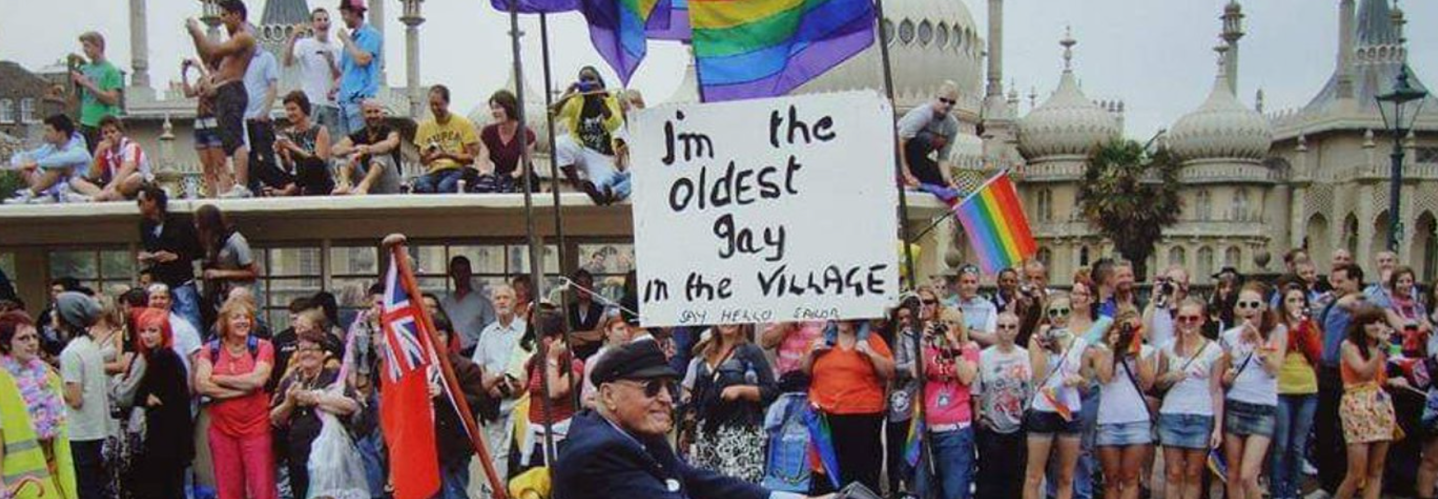
People celebrate the life of George Montague aka ‘the oldest gay in the village’ after his passing

Even at 98 years old, George Montague never shied away from the spotlight. His rainbow mobility scooter had become a yearly staple of Brighton, England’s Pride Parade. He proudly waved a banner declaring “I’m the oldest gay in the village.” More than just a festive presence, Montague was also a tireless campaigner for gay rights,…

george montague death
ArrayPhoto credit: Twitter

Even at 98 years old, George Montague never shied away from the spotlight. His rainbow mobility scooter had become a yearly staple of Brighton, England’s Pride Parade. He proudly waved a banner declaring “I’m the oldest gay in the village.”

More than just a festive presence, Montague was also a tireless campaigner for gay rights, after his conviction for “gross indecency with a man” in 1974.


When the U.K. government issued the Alan Turing law, which pardoned any gay or bisexual man previously convicted under outdated antigay laws, Montague challenged for a full apology, arguing that a pardon admits guilt.

Thousands signed his petition, and 43 years after the incident, Montague received his apology.


The formal letter that Montague read aloud for BBC News, stated: “Understand that we offer this full apology. Their treatment was entirely unfair. What happened to these men is a matter of the greatest regret and it should be so to all of us.”

“It really made my day, I was over the moon,” he told the BBC after his victory. He was thrilled to watch a more accepting society emerge and evolve throughout his lifetime, a change he actively worked to inspire.

Montague passed away peacefully in his sleep on March 18, with his beloved husband Somchai Phukkhlai by his side. He had fought for a better world, and he won.

Shortly before he died, a sweet statement on Montague’s Twitter read:

“Dear friends and supporters, George is wishing to say goodbye. He thanks everyone who have been supporting his campaign [and hopes] that he might have helped a little for us to live in a better world. Everyone please continue your good works for good causes. I shall rest now.”

The tweet received an outpouring of love from his community, people who were touched by Montague’s passing. Some he had known, others were merely strangers.


Brighton’s parade might be a little less colorful without Montague’s decked-out scooter and waving banner, but the impact he has made on his community is eternal. 

LGBTQ groups still face discrimination, especially younger student-aged members facing Florida’s “Don’t Say Gay” bill and Texas’ anti-trans “child abuse” directive. While it can be disheartening, Montague’s story also reminds us that progress has happened and can continue to happen. It is possible to openly love, when it was a crime not very long ago. We still have major strides to go, but there are victories worth celebrating.

May we all be able to live a life as full of love and courage as George Montague.

  • A man at a bar bought a rude stranger a drink and used it as a brilliant lesson about consent
    An uncomfortable woman is approached by a man at a barPhoto credit: Canva

    The situation was familiar enough to be exhausting. A man at a bar had bought a woman a drink. She didn’t want to go home with him. He apparently felt those two things were in conflict.

    “You are not going to come home with me?” he said, audibly frustrated. When she said no, he pushed back: “But I bought you a drink.” She got up and walked away.

    A TikTok user who goes by @tripptokk10 was standing nearby when this happened, already at the bar ordering his own drink. He watched the woman leave, looked at the man still standing there working through his grievance, and made a decision. He ordered two shots.

    “I slide it over to him,” he explained in his TikTok video, posted December 20, 2025. They took the shots together. Then he leaned in and made his point: “So are you going to come home with me or what?”

    The logic was the same. The conclusion was absurd. That was exactly the point.

    In the video, filmed casually at home in a robe and bonnet, he explained what he was responding to: “This one’s for the boys who think buying a woman a drink at the bar means that she should go home with you. No, it doesn’t. She doesn’t know you.”

    A man stares at a woman at a bar.
    A man stares at a woman at a bar. Photo Credit: Canva

    The same creator posted a second video about another night, different bar, same basic dynamic. This time a man had approached one of his female friends, put his hands on her shoulders without asking, and kept going despite her visibly trying to shrug him off. When she tried to walk away, he reached for her hand. The TikTok user stepped in and told him to back off.

    What happened next is the part that stayed with people. The man started apologizing, directing the apology not at the woman he’d been grabbing, but at the guy who’d intervened. “You didn’t do anything to me,” the creator told him. “You were harassing her.”

    The man’s response: “I respect you so much.”

    He described how confused and frustrated he felt in that moment. “Go apologize to her and change your behavior,” he said in the video, “because an apology without changed behavior is just a manipulation tactic.”

    That line hit harder than the shot glass moment for a lot of viewers. The dynamic he was describing, where a man harms a woman and then seeks absolution from another man rather than the person he actually hurt, is one that gets talked about in academic gender studies literature but rarely gets explained so plainly in a 60-second video in a bathrobe.

    Neither incident is complicated. Nobody got arrested, nobody threw a punch, nobody did anything that required a news alert. What spread was simpler than that: one person noticed something wrong, said something proportionate, and kept his head on straight when the whole thing got weird. Apparently that’s still worth talking about.

    This article originally appeared earlier this year.

  • How to live more productively by understanding your distinct ‘time personality’
    A person planning with a calendar (left) and a person running late (right).Photo credit: Canva

    It’s true that we all have the same 24 hours in a day. But it’s our own personal relationship to those 24 hours that greatly determines what that day looks like.

    Time is one of those things that is both a constant in our collective reality, and yet highly subjective to the individual. It’s why one person hears “We need to be there 6:30” and translates that to “We need to be out the door in fifteen minutes,” and another person translates it as “Oh, I have plenty of time to change my clothes, walk the dogs, listen to a podcast, and clean out that junk drawer!” And of course, these two individuals will be spouses. It is universal law. 

    It would seem that—much like how knowing whether you’re an introvert, extrovert, or somewhere in between can help you navigate social settings—knowing your MO when it comes to time management can really help make your day flow a lot smoother. 

    That’s where the four “time personalities” come in. 

    In an article for Verywell Mind, experts Kristin Anderson, LCSW, and Dr. Ryan Sultan, explained that most of us fall somewhere on a spectrum between “very rigid” and “very flexible.” There are, of course, various factors that dictate why we might fall into a certain spot—including neurodiversity, age, and other aspects of our overall personality. But regardless, knowing the gifts and challenges of our go-to time management settings can greatly affect how we “function.”

    See which one below seems to resonate the most. 

    The 4 Time Personalities

    1. The Time Optimist

      The never-ending mantra, or perhaps the “famous last words,” of this personality is “I’ve got plenty of time!” regardless of what the clock says.

      Because of this, Sultan says time optimists “don’t really feel pressure under a time crunch.” They truly believe they can fit multiple tasks into a short amount of time and don’t easily account for potential delays, which leads to chronic tardiness. 

      “They’re ones who leave for a dinner reservation with just enough time to get there, as long as there’s no traffic and they hit every green light,” said Sultan. 

      Folks who consider themselves time optimists might benefit from exploring the “double it rule,” which has you automatically double the amount of time you think it’ll take to get somewhere or complete a task. 

      2. Time Anxious

      Unlike time optimists, “time anxious” personalities feel an enormous amount of pressure, assuming “everything that can go wrong, will go wrong (e.g., traffic, delays, getting lost on the way).” Therefore, they attempt to ease this tension by showing up to things incredibly early. 

      Dealing with time anxiety involves many of the same tools to handle everyday anxiety, such as grounding techniques (5-4-3-2-1 technique, deep breathing), cognitive restructuring (challenging perfectionism, setting realistic goals), and structured planning (using calendars/apps, setting “worry time”). These strategies help shift focus from the future to the present, reducing the fear of wasted time. And maybe, just maybe, the time anxious can experiment with being fashionably late to low-pressure situations. 

      3. Time Bender

      For time benders, the whole concept of time is merely subjective. Where time optimists overestimate what they can accomplish within a certain amount of time, time benders create entirely different time rules for themselves. “Being 10 minutes late basically counts as on time,” Anderson uses as an example. 

      These are the curious, creative souls who thrive under pressure and easily lose track of time when they reach a flow state, or bounce from inspiring task to inspiring task.

      To help curb time-bending tendencies, a good option could be the “Pomodoro Technique,” which has you working in focused, 25-minute bursts followed by short breaks to maintain high energy and concentration. 

      “Time blindness” might sound very close to “time optimism” and “time bending,” but the former is associated with an actual inability to perceive the passage of time. That’s why Anderson and Sultan explained that this category is frequently found in those with ADHD or executive function issues.  

      4. Time Blind

      “It’s not that these folks don’t care about being late or making other people wait,” said Anderson. “Without external reminders or cues, it’s easy for them to lose track of how long things take, which makes sticking to a schedule more challenging.”

      Sultan added, “Their brains actually have a difficult time registering and processing temporal information, causing impairments in working memory, executive functioning, and temporal discounting.” 

      Though time blindness might be more deeply ingrained than the other three personalities, there are several proven tools that can help—from simple, tried-and-true methods like visual/audio timers (think hourglasses and analog clocks) to apps designed to help strengthen time estimation. And of course, these tools aren’t exclusively beneficial to those with bona fide time blindness. Optimists and benders can try them out as well. 

      Once you better understand how you uniquely navigate time, you’re better able to (a) incorporate strategies that help you work within your limitations and (b) give yourself a little grace. Perhaps that last part is most important.

    1. Man shares how not getting a wedding invite made him end a 10-year friendship, and it struck a chord
      A man shared how not getting an wedding invite made him end an 10-year friendship. Photo credit: @yonosoyasi5/TikTok
      ,

      Man shares how not getting a wedding invite made him end a 10-year friendship, and it struck a chord

      “I went through so much with this person that I thought I had made the cut.”

      As many are in the habit of doing, a man recently took to TikTok to “vent.” His “story time” was about his choice to end a 10-year friendship after not getting invited to said friend’s wedding. It soon became undeniably clear that he wasn’t alone in having an experience like this. 

      In the now-viral clip, the creator, @yonosoyasi5, explained that he understood that weddings are special, expensive moments, and therefore “not everyone can go.” 

      However, he admitted that “I went through so much with this person that I thought I had made the cut.”

      This blow ultimately caused @yonosoyasi5 to accept that the friendship as he knew it had come to a close. There was no animosity, but there wasn’t any effort, either. 

       “I wish him the best. I never wish him ill. But to say that I wanna be a part of his life now, it would be very fake. I just don’t care anymore,” he said. 

      Even when confronted by a member of that shared friend group, @yonosoyasi5 was upfront about his stance, saying, “What am I gonna hang out with him for? What’s the objective of me putting energy into this friendship?”

      TikTok reacts

      The video soon got an onslaught of comments from people who had similarly heartbreaking experiences—and developed similar mindsets. 

      “One of my BEST guy friends for 8+ years did not invite me to his wedding. I introduced him to his wife. They went out because of me. I have never been more hurt in my life. I cut off the relationship …and they always try to pull me back closer…I can never pull the knife out of my back.”

      “It’s not actually the wedding invite, it’s finding out the person doesn’t see you as a close friend.”

      “Once you exclude me from important moments, I will exclude you from my entire life.”

      “I think at our age we want to get back what we put into friendships/relationships. You love with your whole heart, so to not have it reciprocated is hurtful. I feel ya.”

      “Crazy…this happened to me…20 years of growing up down the drain.” 

      Lastly, one person even said, “friendship breakups are WORSE than romantic breakups.” 

      woman, alone, grief, breakup, friendship
      Woman sitting alone on a bench overlooking the water.Photo credit: Canva Photos

      Many experts seem to agree with this notion. Or, at the very least, that friendship loss triggers what’s known as “ambiguous grief,” which is the feeling of anguish that comes from losing someone physically while they are psychologically present (e.g., missing person, mental illness, divorce). Our stress responses are triggered, our feel-good chemicals get depleted, our sleep gets disrupted—which is all a science-based way of saying it hurts. Really bad.

      This level of ambiguous grief really depends on what the friendship personally meant to a person. In @yonosoyasi5’s case, it meant a great deal. Thankfully, there are ways to navigate these difficult transitions. 

      Coping strategies for friendship loss
      1. Allow yourself to grieve

      Even once you’ve reached acceptance and found other meaningful relationships, waves of yearning for what’s past may still creep up. Allow space for those feelings. They will pass. 

      2. Use it as a learning opportunity

      Without assigning blame, you can get curious about what might have caused the relationship to end. This way, you can set clear friendship intentions moving forward. 

      3. Engage in self-care

      Journal, meditate, reclaim old passions, exercise, and get outdoors. These things tend to help with grief of all kinds. 

      4. Appreciate the support systems you still have

      Taking stock of the good friends that remain in your life can help offset any feelings of loneliness and reinforce a sense of belonging, experts say. 

      Bottom line: cutting someone out of our lives hurts, but that pain might truly be the lesser evil in the long run. May we all have the foresight to know the difference and seek out those who do give us such grace. 

    2. Woman on a mission to bring back lost Black American recipes has people gasping at vinegar pie
      Woman on a mission to bring back lost recipes has people gasping at vinegar pie.Photo credit: Canva
      ,

      Woman on a mission to bring back lost Black American recipes has people gasping at vinegar pie

      Most of the recipes were created out of poverty to provide families with a sweet treat.

      People get very creative when it comes to cooking with limited ingredients and no budget. This combination is something people who lived through the Great Depression were very familiar with. It’s also something Black Americans experienced frequently in the 1800s, but time has stolen many of the ingenious recipes. Until now.

      One woman is on a mission to dig up these lost recipes for Black History Month. All February, Sonja Norwood, who runs the social media page for Wick’d Confections and owns Sonja Norwood Custom Cookies, has been baking up long-lost Black American recipes. Though the ingredients have folks scratching their heads, her videos clear things up by sharing each dish’s history.

      @wickdconfections

      Peanuts became a major Southern crop after the Civil War, and at Tuskegee Institute, George Washington Carver helped popularize peanuts as an affordable, soil-restoring crop with hundreds of uses. In Black Southern kitchens, that peanut power turned into breads, cookies, cakes, candy… and survival baking. During the Great Depression and WWII rationing, butter, eggs, and milk were often scarce. Peanut butter became the substitute for fat and protein, and peanut butter bread became a school-lunch staple and family recipe passed down through generations. Serve warm with a nostalgic molasses glaze and you’ll understand why this deserves a comeback 🤎 🥜 Peanut Butter Bread (One-bowl, no eggs, no butter) Ingredients 1 ¾ cups all-purpose flour (220 g) ½ cup granulated sugar (100 g) ¼ cup brown sugar (50 g) 1 tbsp baking powder ½ tsp salt 1 cup milk (240 ml) ¾ cup creamy peanut butter (190 g) 1 tsp vanilla extract Optional topping: 2 tbsp sugar Instructions 1️⃣ Preheat oven to 350°F / 175°C. Grease a 9×5 loaf pan. 2️⃣ Whisk flour, sugars, baking powder, salt. 3️⃣ Add milk, peanut butter, vanilla. Mix until just combined. 4️⃣ Spread into pan, sprinkle sugar if using. 5️⃣ Bake 50–60 min until toothpick comes out clean. 6️⃣ Cool 15 min, remove, slice. ✨ Molasses Glaze 2 tbsp butter (28 g) 3 tbsp molasses (45 ml) 2 tbsp milk (30 ml) 1 cup powdered sugar (120 g) ¼ tsp vanilla + pinch salt Optional: pinch cinnamon or ginger Melt butter, whisk in molasses + milk until warm. Remove from heat and whisk in powdered sugar until smooth. Stir in vanilla and salt. #BlackHistory BlackHistoryn#TikTokLearningCampaignFoodHistorye#VintageRecipes

      ♬ original sound – Wick’d Confections

      One particular recipe caused the former Food Network contestant to give a disclaimer before tasting it, saying, “Before I try this, we understand that there’s a reason this pie exists, right? It’s genius. Very creative. That does not mean I have to like it.”

      A unique recipe

      Norwood tried her hand at vinegar pie, and just like viewers of the video, the baker was unsure how the dessert would turn out:

      “Vinegar pie, also known as desperation pie, is classified as a pantry or make-do pie. As you can tell, this pie was born out of necessity, when fruit or citrus lemons were hard to come by. Home cooks used what they had on hand. Simple pantry staples to make something sweet, like sugar, eggs, butter, flour, and salt. A lot of people associate vinegar pie with the Great Depression, when fresh fruit was super expensive and scarce, but recipes go back much further. As early as 1855.”

      @wickdconfections

      Navy Bean Pie 🥧✨ A true heritage dessert with deep roots in Black American food culture. This traditional navy bean pie has a smooth, firm custard texture — rich, lightly spiced, and beautifully sliceable without hours of chilling. Simple ingredients, timeless flavor, and a recipe shaped by community and history. 🥧 Classic Navy Bean Pie (9-inch) Texture: traditional • smooth • firm custard • faster set Crust
• 1 (9-inch) pie crust (homemade or store-bought) Filling
• 1½ cups cooked navy beans (300 g) OR 1 (15-oz) can, drained & rinsed
• ¾ cup unsalted butter, melted (170 g)
• 1 cup evaporated milk (240 ml)
• 4 large eggs
• 1 cup granulated sugar (200 g)
• 2 tbsp all-purpose flour (15 g)
• 1 tbsp cornstarch (8 g)
• 1 tbsp vanilla extract
• 1 tsp cinnamon
• ½ tsp nutmeg
• ½ tsp salt ⭐ If using canned beans (flavor boost)
• Rinse well
• Simmer in fresh water 5–10 minutes
• Drain completely Instructions
1️⃣ Preheat oven to 350°F / 175°C
2️⃣ Blend beans until completely smooth and creamy
3️⃣ Whisk butter, sugar, eggs, milk, vanilla, spices, flour, and cornstarch
4️⃣ Stir in blended beans until smooth
5️⃣ Pour into crust and smooth top
6️⃣ Bake 45–55 minutes (edges set, center barely jiggles)
7️⃣ Cool 1 hour at room temp, chill 1 hour for clean slices Slice, serve, and enjoy ✨ BlackHiBlackHistorynLearnOnTikTokeBeanPiesFoodHistoryalCooking

      ♬ original sound – Wick’d Confections

      For the recipe, the custom cookie maker used vanilla, honey, and apple cider vinegar in the runny mixture. At first glance, it’s hard to see how this could turn into a pie meant to be cut and eaten with a fork, as it has the consistency of French toast batter. But once it’s poured into a pie pan and popped into the oven, it begins to look like a pie.

      “Black cooks in the South and the Midwest adapted pantry-based dishes like this into their family food culture,” Norwood shares while mixing ingredients. “So you were going to see this pie at Sunday dinner and on special occasions, and it doesn’t taste the way you think a vinegar pie would taste. The acidity cuts through the sweetness and mimics lemon pie without the fruit.”

      @wickdconfections

      Lost Black American Recipes: Vinegar Pie 🥧 To kick off Black History Month, I’m starting a series honoring lost and forgotten Black American recipes—beginning with vinegar pie. Also known as desperation pie or pantry pie, this dessert was born from necessity. When fruit and citrus were scarce, home cooks used simple pantry staples to create something sweet, comforting, and joyful. Made with sugar, eggs, butter, and a splash of apple cider vinegar, vinegar pie has a flaky crust and a rich custard filling. The vinegar doesn’t make it sour—it adds brightness, mimicking the tang of fruit and balancing the sweetness. It’s a reminder of how Black foodways transform struggle into creativity and care. 🖤 Vinegar Pie Recipe (9-inch pie): 4 eggs ½ cup sugar ½ cup brown sugar ½ tsp vanilla 6 tbsp butter, melted 2 tbsp apple cider vinegar 2 tbsp honey 2 tbsp flour ¾ tsp salt Unbaked 9-inch pie crust Blind bake crust at 350°F (175°C). Whisk remaining ingredients until smooth, pour into crust, and bake 35–45 minutes. The center should still wobble slightly when gently shaken. Cool completely and dust with powdered sugar. Follow along as we honor Black history through food—one lost recipe at a time. #BlackHistoryMonth #BlackAmericanFood #LostRecipes #BlackFoodHistory #FoodReels

      ♬ original sound – Wick’d Confections

      Viewers were shocked at how good the pie looked when it was done. Some even plan to give the Black American recipe a try. One person writes, “I[t] looks good and it was way less vinegar than my mind thought lol.”

      Another says, “This looks so good! My grandma is 93 born & raised in Georgia and she swears by this pie & buttermilk pie. She watched this & just kept saying ‘yup, yup’ so I know it’s good.”

      This person appreciates the history: “I appreciated acknowledging that it came out of necessity and that you don’t have to like it. Sometimes people have to make due with what they have and it’s not always what you necessarily want.”

      @wickdconfections

      Lost Black American Recipes: Blackberries & Dumplings 🍇🥟 Blackberries and dumplings is a sweet summertime dish rooted in Black American food culture. When sugar and money were scarce, the land provided. Black families relied on foraging, gathering blackberries that grew freely along fence lines, woods, and roadsides across the South. What began as necessity became tradition — turning simple ingredients into a communal, nourishing meal. Passed down orally and cooked intuitively, this dish was rarely written into cookbooks. Flour stretched what little was available, dumplings absorbed the berry juices, and one pot could feed many for very little. Though we still see cobblers today, blackberries and dumplings remain a largely forgotten seasonal treat — one deeply connected to land, resilience, and care. Blackberries & Dumplings Recipe Blackberry Syrup: 4 cups blackberries 1 cup sugar 2 cups water 1 tbsp lemon juice Lemon zest Dumplings: 2 cups flour ¼ cup sugar 1½ tsp baking powder ½ tsp salt ¼ tsp nutmeg ¾ cup milk 1 egg 1 tsp vanilla Simmer blackberries with sugar, water, lemon juice, and zest until juicy. Mix dumpling dough until it feels right. Drop spoonfuls into simmering berries, don’t stir, cover and cook 15 minutes. Uncover and simmer 5 more minutes. Serve warm with plenty of syrup. Follow along as I honor Black history through lost recipes — one pot at a time. #BlackHistory #TikTokLearningCampaign #BlackAmericanFood #LostRecipes #FoodHistory

      ♬ original sound – Wick’d Confections

      “This is brilliantly done,” someone else writes. “Showing the ingenuity and innovation of Black folks is beautiful! This video is information and funny! I’m glad you actually liked the pie. Def going to ask my 90 year old granny about this recipe. Thanks for posting this.”

      Vinegar Pie Recipe (9-inch pie):

      4 eggs
      ½ cup sugar
      ½ cup brown sugar
      ½ tsp vanilla
      6 tbsp butter, melted
      2 tbsp apple cider vinegar
      2 tbsp honey
      2 tbsp flour
      ¾ tsp salt
      Unbaked 9-inch pie crust

      Blind bake crust at 350°F (175°C). Whisk remaining ingredients until smooth, pour into crust, and bake 35–45 minutes. The center should still wobble slightly when gently shaken. Cool completely and dust with powdered sugar.

    3. 22 common Southern phrases that leave people scratching their heads, laughing, or both
      22 common Southern phrases that leave people scratching their headsPhoto credit: Canva
      , , , ,

      22 common Southern phrases that leave people scratching their heads, laughing, or both

      The accent isn’t the only thing different below the Mason-Dixon line.

      Visiting different states within America can sometimes feel like traveling to a completely different country, given the significant cultural differences and accents. Visiting parts of Louisiana may make you feel like you require a translator to navigate your vacation, as people often speak Creole or Cajun—both of which have very thick, unique accents. Southern Mississippi also has a mishmash of accents that range from Cajun to a non-distinct regional accent.

      But one thing North Carolina has in common with states like Texas, Mississippi, and Louisiana is that they all have a range of southern colloquialisms that translate fine between southern states. It’s when those creative southern phrases make their way above the Mason-Dixon Line that causes some confusion. Many southerners who travel north for work, pleasure, or relocation adapt quickly to not using uniquely southern phrases after experiencing looks of bewildered confusion.

      southern sayings; funny sayings; speaking southern; funny; silly; southern phrases
      Welcome to North Carolina State Line! Photo credit: Canva

      Oftentimes, southerners don’t even know where their beloved and well-used phrases originated or why. As far as a Google search pulls up, there’s never been a child born in the world who has ever been small enough to be “knee high to a grasshopper,” but that’s not going to stop PawPaw from saying it. People who are used to hearing the sometimes outrageous phrases simply interpret them themselves and add them to their own lexicon for future use.

      General Southern expressions to keep in your pocket

      1. “You don’t believe fat meat is greasy.”

      This is an expression often used when someone is intent on not listening to advice. It essentially means they won’t believe it until they see or experience it themselves. We all know someone who has to learn lessons the hard way, and this is the saying that conveys that message without sounding harsh.

      southern sayings; funny sayings; speaking southern; funny; silly; southern phrases

      Smiling together: Photo credit: Canva

      2. “The Lord willing and the creek don’t rise.”

      A phrase like this is used a lot by elders. It just adds a little dramatic flair when they’re making plans. In a conversation, it would go like this: “So, I’ll see you next Sunday at the potluck, right?” There may be a pause for emphasis along with a fist perched on their hip before responding, “The Lord willing and the creek don’t rise.” Just know they’ll be there as long as they wake up in the morning and there’s no natural disaster preventing them from getting there.

      3. “There’s more than one way to skin a cat.”

      This particular one is a phrase my husband uses often. It is often said by men doing manual labor, whether it’s at work or around the house. If someone is trying something that isn’t working, they have to come up with a better idea of how to make it work. If the original person pushes back on trying it a different way, that’s when you’ll hear, “There’s more than one way to skin a cat.” To date, no one has skinned a cat to prove a point, that I’m aware of, but there’s debate on its origin. It’s believed to come from a phrase used in the mid-1600s in England, “There’s more than one way to kill a dog than hanging.”

      southern sayings; funny sayings; speaking southern; funny; silly; southern phrases

      Surprised cat faces an idiom shock! Photo credit: Canva

      Eventually, it got changed to the cat idiom southerners say today, though some suggest the phrase came from when women’s coats were made from cat fur…(that’s information you can’t unlearn). Either way, as someone who has lived in the south for more than 20 years, you can rest assured that the only people skinning cats down here are taxidermists with the pet owner’s permission. Just know they’re saying there’s more than one way to get the job done.

      4. “Don’t pee on my leg and tell me it’s raining.”

      This is just a fancy way of telling someone not to lie to you.

      5. “Well, you look rode hard and put up wet.”

      Honestly, if someone says this to you, you’re looking mighty bad. This means not only do you look exhausted, but you also look disheveled, and maybe even ill. When people say this, it’s not meant to be rude. They’re typically genuinely concerned about your well-being, whether it be that you appear to need a break or you need to rest and get some soup in your belly.

      southern sayings; funny sayings; speaking southern; funny; silly; southern phrases

      Feeling under the weather with a warm cup in hand. Photo credit: Canva

      6. “P*ss or get off the pot” and “Fish or cut bait.”

      These two phrases mean the exact same thing. They’re calling out someone’s lack of progress and can be applied to all sorts of situations. It means to do what you’re supposed to be doing or get out of the way so someone else can do the job you won’t. By the time someone says this, they’re a little annoyed, so it’s best to go ahead and “pee or get off the pot” before they move you over and do it themselves.

      7. “Well, butter my butt and call me a biscuit.”

      You can stick this in the same category as, “Well, I’ll be a monkey’s uncle.” It’s meant to convey genuine surprise and delight in information they’ve just received or upon seeing someone they haven’t seen in a while and weren’t expecting. It’s a fun one to say, even outside of the South, due to the humorous element.

      southern sayings; funny sayings; speaking southern; funny; silly; southern phrases

      8. “I’ve got a hitch in my giddy-up”

      You’ve got a limp due to hurting yourself somehow, or you’re feeling under the weather in some way that’s slowing you down.

      9. “Why, bless your little pea-pickin’ heart.”

      Ouch! You’ve just been insulted, and they wanted to make sure you knew. “Bless your heart” on its own can be said in a condescending way or a genuine, “I’m so sorry you’re going through this” way. Using tone and context clues can help you decipher the difference. But when they add “little pea-pickin” right in the middle of the phrase, go grab some ointment because that was meant to sting.

      10. “I’m going to snatch her baldheaded.”

      Whoever is the target of that comment should probably avoid being around the person making it. See also, “I’m going to jerk a knot in her tail.” When it’s an adult directing the comment at another adult, it could simply mean they’re going to have a verbal confrontation. But, depending on the person, it could also mean physical confrontation because that is not off the table in Southern culture. If it’s a parent directing the expression towards their child, then it usually means that the child is going to get into trouble.

      southern sayings; funny sayings; speaking southern; funny; silly; southern phrases

      Two women in a park having a tense conversation. Photo credit: Canva

      Southern expressions about looks and intelligence

      11. “Pull your dress down, everyone can see Christmas.”

      This feels self-explanatory, but it’s something you might hear a friend say to another friend to address a wardrobe malfunction. You may also hear a parent telling their young daughter a version of this as they’re learning how to properly sit in a dress. Also see, “Pull down that skirt! We can see clear to the promised land.”

      12. “They fell out of the ugly tree and hit every branch on the way down.”

      Also in the vein of calling someone unattractive, one might say, “He’s so ugly he could make paint peel.”

      southern sayings; funny sayings; speaking southern; funny; silly; southern phrases

      13. “Pants are so tight you can see his thoughts.”

      Those are some really tight pants.

      14. “She’s just as loony as a Betsy Bug.”

      Until today, I had no idea what a Betsy Bug was, but apparently it’s a type of beetle that eats decomposing wood. There doesn’t seem to be an explanation for what makes the beetle loony, though.

      15. “Well, aren’t you as bright as a box of black crayons.”

      Have you ever seen a bright black crayon? If southerners are good at one thing, it’s insults.

      southern sayings; funny sayings; speaking southern; funny; silly; southern phrases

      16. “That boy’s so dumb he’d throw himself on the ground and miss.”

      See also: “He ain’t got the good sense God gave a mule,” and, “If he had an idea, it would die of loneliness.”

      Bonus sayings you don’t want to miss

      Clearly, southerners have a way with words, but there are a few more that can be fun to pull out for a party trick. A favorite is, “That really burns my biscuits,” but a close second is, “I’m fuller than a tick on a dog’s behind.” If you want to get around the ears of nosey children while having a chat about an adult encounter, some people in the south will say, “He took me to church,” “I was singing opera,” or “We stayed in and played the piano.”

      Whenever you decide to pull out any of these phrases, just make sure it’s not one that’ll make someone “madder than a wet hen,” and you’ll be golden.

    4. This plus size figure skater is uplifting girls everywhere with her astonishing moves
      Figure skater Laine Dubin doesn't fit the stereotypical mold, and that's why young skaters love her.Photo credit: Canva Photos

      The winter Olympic viewership numbers don’t lie: Figure skating is one of the most beloved sports in the world. Honestly, is there anything more beautiful and graceful? It’s got the gorgeous aesthetics of gymnastics and dance combined with an almost other-worldliness as the skaters glide and fly around the ice. There’s a reason people can’t seem to look away from the rink when the Olympics roll around every couple of years.

      However, the sport of ice skating comes with certain expectations or even stereotypes of what the skaters body should look like. For women, most high level skaters are almost always extremely petite and slight. It stands to reason that this body type must be a requirement to perform at a high level, right?

      Wrong. Laine Dubin is one skater who’s out to prove that there’s no “right way” for an athlete to look.

      figure skating, skater, ice skating, plus size, inspiration, girls
      There's no one right way for an athlete to look. Photo by Kelli McClintock on Unsplash

      Dubin, most recently a student at Quinnipiac University where she was a standout on the skating team, began posting videos of her routines online in 2018. Believe it or not, she didn’t set out to start a body-positive revolution—she just wanted to document her progress and free up some space on her phone.

      But almost instantly, she began to develop a following. No one had ever seen anyone like her pulling off the moves that she could, all with so much personality and showmanship that sucked people in. Not only that, but Dubin displays outstanding power and grace on the ice. If you’ve only ever watched the “prototypical” Olympic skaters perform, what Dubin does almost looks impossible. It’s really amazing to behold.

      One clip in particular recently went mega viral to the tune of over 30 million views:

      Dubin has undoubtedly found her people on social media. The responses to her videos could bring tears to your eyes. Not only are viewers in awe of her skill on the ice, they find so much hope and inspiration in what Dubin is doing:

      “Ok but as a bigger Asian girl who has always dreamed of ice skating this made me tear up so proud of you”

      “I NEVER see plus sized rep in figure skating, YOU ARE INCREDIBLE THIS IS SO COOL!!”

      “the fact no one knows how absolutely impressive this is especially with girls our size I love ice skating I’ve been a fan forever the power and strength you need to pull your up and spin like that”

      “wait! someone with my body type figure skating?!!! like a GODDESS may I add, this makes me feel so seen, and like, maybe I could do this with some practice as well!!!!!???”

      “As a plus sized girl who had the idea of figure skating shot down, thank you for making the lil girl in me happy and I’m so damn proud of you. You’re awesome.”

      Comments just like these roll in on Dubin’s videos every single day. But that doesn’t mean that general attitudes across the sport are ready to change.

      Women skaters, especially, are mercilessly mocked, fat-shamed, and picked apart by viewers, coaches, and even judges of the sport. Five-time Olympic medalist Tessa Virtue has dealt with people nitpicking her body her entire career, calling her either too fat or too muscular. Bronze medalist and two-time US National Champion Gracie Gold had to take a hiatus from the sport to get help with an eating disorder. One of the most promising young figure skaters in recent memory, Yulia Lipnitskaya, was forced to retire at just 19 due to anorexia along with injuries.

      There are a lot of factors that contribute to this major problem. The norm is for female skaters in competition to wear incredibly skimpy dresses and outfits that accentuate their form and technique, which would make anyone self-conscious about their body. Canadian skater Kaetlyn Osmond adds that less body mass also helps them achieve sky-high jumps on the ice.

      Dubin is living proof, though, that a plus-sized body can be athletic, graceful, and beautiful. It means so much to all the kids who think they shouldn’t bother pursuing their love of the sport because their own body type will never allow them to fit in.

      “It’s just people seeing representation in the media of themselves being represented first,” Dubin told US Figure Skating in 2023. “That’s what will make people feel validated and that’s what will lead to change with body inclusivity in the skating space.”

      The way she’s racking up millions and millions of views, it’s fair to say she—along with other plus-sized skaters—could have a real, tangible impact on the next generation of skating athletes. The official Olympics Facebook page even shared one of her clips, exposing her moves and her message to a new, massive audience. She was also interviewed on Behind the Skates on YouTube:

      Keep up with Dubin and watch her progress, play, and fashion on TikTok and Instagram and visit her Linktree for even more.

      This article originally appeared in April. It has been updated.

    5. Woman who lost her ‘pretty privilege’ reveals how it changed her perspective on life
      A smiling blonde woman.Photo credit: via Canva/Photos
      , ,

      Woman who lost her ‘pretty privilege’ reveals how it changed her perspective on life

      ” I instantly felt sad and horrified, because of the cosmic unfairness of life.”

      There is something extremely unfair about people born with great genetics who are extremely attractive. Sure, folks can improve their looks after putting in some work at the gym or learning how to present themselves. But many people we consider conventionally good-looking hit the jackpot by simply being born that way.

      With little effort, these people have an incredible social advantage in life. They are seen as morally virtuous, receive random favors, are always the center of attention, and are more likely to get raises and promotions at work. The funny thing is that many people with pretty privilege don’t realize the incredible advantage they have until it’s gone.

      People with pretty privilege get the social advantage that comes with a lot of people wanting to date them. They also have the advantage of the “halo effect,” where people take one trait, their attractiveness, and use that to make blanket positive assumptions about their intelligence, kindness, and integrity without much evidence.

      What happens when people lose their pretty privilege?

      In a since-deleted post, a woman on Reddit shared how she realized the power that comes with pretty privilege when she gained a lot of weight, and the world immediately began treating her differently.

      “Whether we want to admit it or not, pretty privilege is a thing. And it’s something that I now realize I had for the majority of my life,” the woman wrote in a viral post. “People were usually very nice to me. I got offered perks like drinks at bars and extra attention when I went out. And I was stared at a lot.”

      smiling, woman, pretty, privilege, looks, attraction, beauty
      An attractive woman at a bar. via Canva/Photos

      Things changed for the woman after she had a health condition that required her to take a medication that slowed her metabolism, which resulted in rapid weight gain.

      “The fatter I got, the less attention was paid to me,” the woman continued. “I didn’t notice it at first, but I began to have to ask for customer service at places instead of being offered, and I started to feel invisible, because no one looked at me. No one. People would walk right by and not even acknowledge my existence. It was strange at first, then incredibly humbling. I thought, well, this is the new normal.”

      The power of thin privilege

      It’s important to note that being a certain weight doesn’t automatically make you good-looking. People can look good at any weight. However, it would be naive to believe that thin people don’t have an advantage in this world.

      thin, fitness, measuting tape, waist, thin woman,
      A woman measring her waist. via Canva/Photos

      The drastic fluctuation in the woman’s weight made her conscious of what other people who don’t have the privilege of being pretty or thin go through in life. It allowed her to have greater compassion for people, regardless of how they look.

      “My personality started to change a little,” she wrote. “I began being thankful for any small interaction someone had with me, and responded to any small act of kindness with gratefulness. I noticed other not conventionally pretty people, and other overweight people, and made an effort to talk to them and treat them like they mattered. I became a better person. Not that I wasn’t a good person before, but I was now more aware and empathetic to those around me.”

      The woman soon went off the medication and, just like that, she lost weight, and people began to treat her as they had before.

      Realizing the inequity of pretty privilege

      “The first time I noticed it was when I was in a store looking for something, and a handsome male worker came up to me and asked if I needed help. He looked me in the eyes. I felt like I mattered again,” she continued. “Then I instantly felt sad and horrified, because of the cosmic unfairness of life, that how we look really does determine how people treat us, even though it shouldn’t.”

      smailing man, ahppy man, good-looking man, man in sweater, man holding chin
      A good-looking man holding his chin. via Canva/Photos

      After the woman lost her privilege, she better understood what other people go through. On one hand, she probably enjoys the privilege, but on the other, she feels that the world is much less fair than she once imagined. At least, in the end, it’s taught her to be more empathetic to everyone she meets.

      “And also, when someone looks at me and smiles, no matter who they are, I give them a huge smile back,” she finished her post.

      This article originally appeared last year. It has been updated.

    6. Inside a Dutch ‘dementia village,’ where the whole neighborhood is designed for memory loss
      In a dementia village, people get to choose where they go. Photo credit: Array

      No matter how much caregivers may want to keep a loved one with dementia in their home, it’s not always feasible. Living with dementia is not easy, nor is living with someone who has dementia. But moving a loved one with dementia into a traditional care facility isn’t always ideal, either. It can be difficult to find a suitable living situation that ticks all the boxes for what a family and their loved one would want.

      That’s where a “dementia village” comes in as an alternative. Instead of trying to fit a person with dementia into a living situation that either isn’t designed for them or is overly focused on their limitations, a dementia village is an environment designed specifically to help people with severe dementia feel safe and free and live as normal a life as possible.

      The Hogeweyk was the world’s first dementia village, founded in 2009. Since then, the idea has been replicated in dozens of locations all over the world. The concept is quite simple: A full, self-contained neighborhood where people with dementia can walk around freely without fear of getting lost, where everyone from shopkeepers to restaurant servers to salon workers are trained in dementia care, and where people who are losing their memory to dementia diseases are treated as people who still have aspirations.

      Eloy van Hal, one of the founders of the Hogeweyk, explained to Vox how the guiding principle of the village is “normalcy.” Traditional nursing homes keep all residents under one roof, and they are subject to do whatever program the institution provides for them. In the Hogeweyk, people live in small groups of six or seven in apartments with furnishings like they’d have at home. Distinct landmarks in the public space help residents know where they are, and putting a theater, grocery store, barber shop, etc. in separate buildings encourage movement through the neighborhood.

      “It’s about choice, choice, choice, where you want to be during the whole day and with whom,” said van Hal. The idea is to balance safe design with controlled risk, allowing for as much of a normal life as possible.

      dementia, dementia village, elder care, memory care, alzheimer's disease
      Every worker in a dementia village is trained in dementia care. Photo credit: Canva

      The one downside to the village concept, of course, is cost. Without adequate funding assistance from governments, living in a dementia village can be prohibitively expensive.

      Does it really make a difference for residents, though? Has it been proven that outcomes are better than traditional care models? With dozens of villages now being used around the world, research is ongoing, but the data from the Hogeweyk is promising. People in the comments of Vox’s by Design video shared how such facilities have been life-changing for their loved ones and how traditional care doesn’t always meet the needs of people with dementia.

      “My grandmother had dementia and when her caretaker who was my grandfather (her husband) passed unexpectedly we had to scramble to get her into a memory care facility in the US. The first place she was in temporarily was so sad, I could see her spirit drain but after about a year we were able to get her into a “village” and the quality of life difference is nothing short of ASTOUNDING! She could function in a way that was familiar and comfortable to her and not be in a foreign hospital setting. The abrupt change from a home where they are familiar, to a clinical setting must be very disorienting and upsetting to these people. That side of my family had mental health issues and memory loss starts early, so I know it will happen to me to some extent and I only hope I can have people take care of me as well as in this Hogeweyk.”

      “I’ve worked in a nursing home through high school and college. While I can’t say it was the worst place for dementia patients, it certainly did not work well for all of them. One patient once tried to wedge herself through the door begging to go outside with me and I even had patients confide in me that they hated being institutionalized, they missed being able to live a normal life, being part of a real community, and being able to come and go as they pleased. This concept is probably the closest thing possible to a normal life a dementia patient could ever have.”

      dementia, dementia village, elder care, memory care, alzheimer's disease
      In a dementia village, residents can live somewhat Photo credit: Canva

      “A relative of mine used to get aggressive, violent and angry when she would encounter a locked door in the institution she was in. She couldn’t understand why there would be a locked room in what she understood to be ‘her home’, this would take a lot of calming down and management, only for her to discover another locked door, and kick off again. I love these village based models as they allow autonomy for residents, and have an individual experience. Just because someone has a brain disease doesn’t mean they aren’t entitled to the very best care. I hope the govt spends far more on these establishments in the future.”

      “As he said at the end, people with dementia are still people—even if there is proven to be no benefits to this model over a care home, I would much prefer to have dignity in my final days than live in a clinical trap. Love all the incredible ideas the Netherlands come up with.”

      dementia, dementia village, elder care, memory care, alzheimer's disease
      A dementia village is a self-contained neighborhood with shops and places for people to go like a normal neighborhood. Photo credit: Canva

      Dementia care is something Americans are going to have to look at closely. According to The Alzheimer’s Association, the number of people living with Alzheimer’s is set to nearly double from seven million to 13 million by the year 2050. As more of our elders require full-time care, the more we’ll have to consider prioritizing putting resources into things like dementia villages.

      Everyone deserves safety and a good quality of life. The Hogeweyk is a great example of what it looks like to view people with dementia as people first and to care for them accordingly.

      This article originally appeared last year. It has been updated.

    Science

    Philosophy expert shares the 300-year-old rule to tell if someone is a good or bad person

    Finance

    Frugal people share exactly how much money they saved on their best thrifty lifestyle changes

    Culture

    A man at a bar bought a rude stranger a drink and used it as a brilliant lesson about consent

    Culture

    Why the iconic Boston accent is disappearing as the pronunciation of ‘R’ makes a comeback