Teachers, parents, and educators of all kinds want the same thing: the best for our kids. But figuring out what the “best” really means when it comes to curriculum, grading, and teaching methods isn’t as simple as it seems.
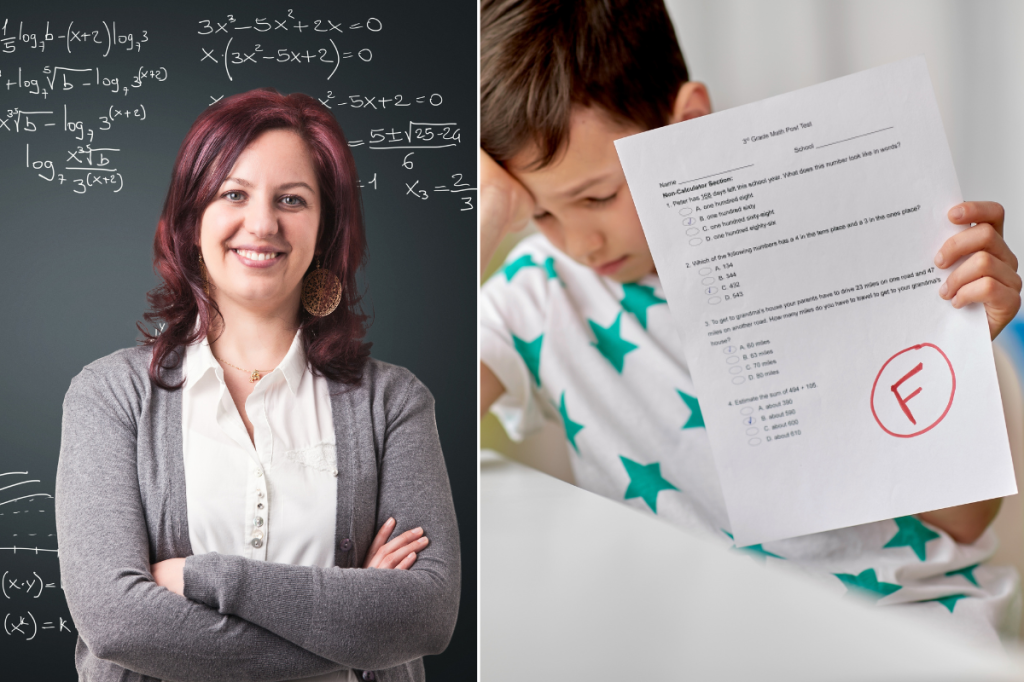
One teacher recently went viral for explaining her hotly-debated policy: She “refuses” to give her students a grade below 50%.
Jen Manly says she’s taught middle school, high school, and college students, and in a TikTok video, she announced that she “refuses to give less than a 50%. Assuming they’ve turned something in, of course.”
When she breaks down her reasoning, it makes total sense:
“On a 0-100 grading scale, there is a 10-point window for A’s, B’s, C’s, and D’s,” she says. “However, there’s 60 points that are equivalent to an F.”
That means, she explains, that if a student does extremely poorly on a couple of assignments (say, earning an 18% or a 30%), “it’s going to take multiple A or B grades to help them recover from that low grade.” That can make their grade artificially low, she says, because of one or two bad performances. In other words, their grade won’t truly reflect their mastery of the content and their ability to meet the learning standards.
“What we’re doing when we set the minimum grade at 50% is we’re making sure that all grades have about the same impact on their overall grade.”
Some teachers and policies go so far as to give 50% as the minimum even if a kid doesn’t turn in an assignment at all. It’s an idea that’s hard to stomach for people with a more old-fashioned mindset, but the reasoning remains the same. If a student with C-level mastery of the material misses an assignment, he or she will be fighting all semester long to claw their way back up to a barely passable grade.
You can see why that would be demoralizing to a kid who’s already having trouble in school, and you run the risk of that student checking out completely and giving up on the course altogether.
This is a concept called “equitable grading,” and it’s growing in popularity in many school districts across the United States and beyond.
Equitable grading aims to level the playing field by eliminating circumstances that might hold a student back, like a challenging home life or learning and behavioral difficulties. It’s the same kind of idea that led a lot of schools to ditch “Perfect Attendance” awards.
“Policies like ‘no zeros,’ eliminating late penalties, and allowing unlimited retakes aim to make grading fairer for disadvantaged students,” writes the Fordham Institute.
One teacher on TikTok named Lauren explains how, with equitable grading practices, a student could get all the answers wrong on a math test and still receive a passing grade. If they show that they understand the steps and methods, but make a few mistakes or computational errors, their grade will only get a minor ding. That’s just one example of these more modern grading practices in action.
This approach has strong critics and opponents that argue grades should also reflect effort and quality of work, not just mastery of the material.
In fact, the Fordham Institute finds in a survey that most teachers don’t like these policies overall. They feel pressured to give higher grades and believe it ultimately harms student learning
In 2019, a Florida teacher was fired after violating her school’s “No Zeroes” policy, to great public outrage. Giving a minimum of 50% even if a student doesn’t turn an assignment in is one of the more divisive components of equitable grading that’s sometimes practiced around the country.
Justin Baeder, PhD, says on TikTok, “I don’t think grades should reflect mastery. Grades are reflecting a combination of learning and effort and work quality. If a student comes in knowing everything they need to know in a course, you don’t automatically give them an A without doing any of the assignments.”
Similarly, he argues, you shouldn’t give failing grades to kids who don’t meet the learning standards provided they’ve put in full effort.
Teacher Mr. Trayon argues that giving students too much grace for poor effort, poor performance, or missed assignments does them a disservice. It doesn’t prepare them for college or the “real world” where they won’t be given so much leeway.
Traditional grading systems are problematic in many ways, and equitable grading also has its drawbacks. However, there are other solutions.
Jen Manly says many schools have moved to a 1-4 grading scale instead of adopting 50% as the minimum grade. So giving a student a 1 as the worst possible evaluation of their work won’t drag their grade down nearly as far as a 20% on the traditional 0-100.
Baeder, for his part, has argued for a 20-point grading scale for similar reasons. He believes that there should be other interventions for students who are missing assignments, like detentions or losing participation privileges. Many teachers allow students to turn in late work for partial credit to avoid the zero, for example.
In Australian schools, missed, late, or incomplete work is often scored with something called a “notional zero,” which is a grade that essentially lies just below the lowest score achieved by any other student in the class for that assignment. It’s a unique and novel approach.
In the end, it comes down to what we want grades to measure and what we want our kids to get out of school. Do we want them to come out of a math class having really mastered the material? Or do we want them to have learned the importance of hard work and effort? Most of us would agree that a bit of both would be ideal, but it’s harder than it seems to measure that goal in a fair and equitable way.