Here’s why you shouldn’t post your negative COVID test results on social media

Look, we get it. That suspiciously stuffy nose is giving you anxiety. Have you really lost your sense of smell? Maybe it’s just congestion? You start kicking yourself. Was the grocery store trip to get Haagen Dazs really worth it? To ease the worry, you do the next responsible thing: you get tested. Hooray! It’s…

covid test, fake covid results
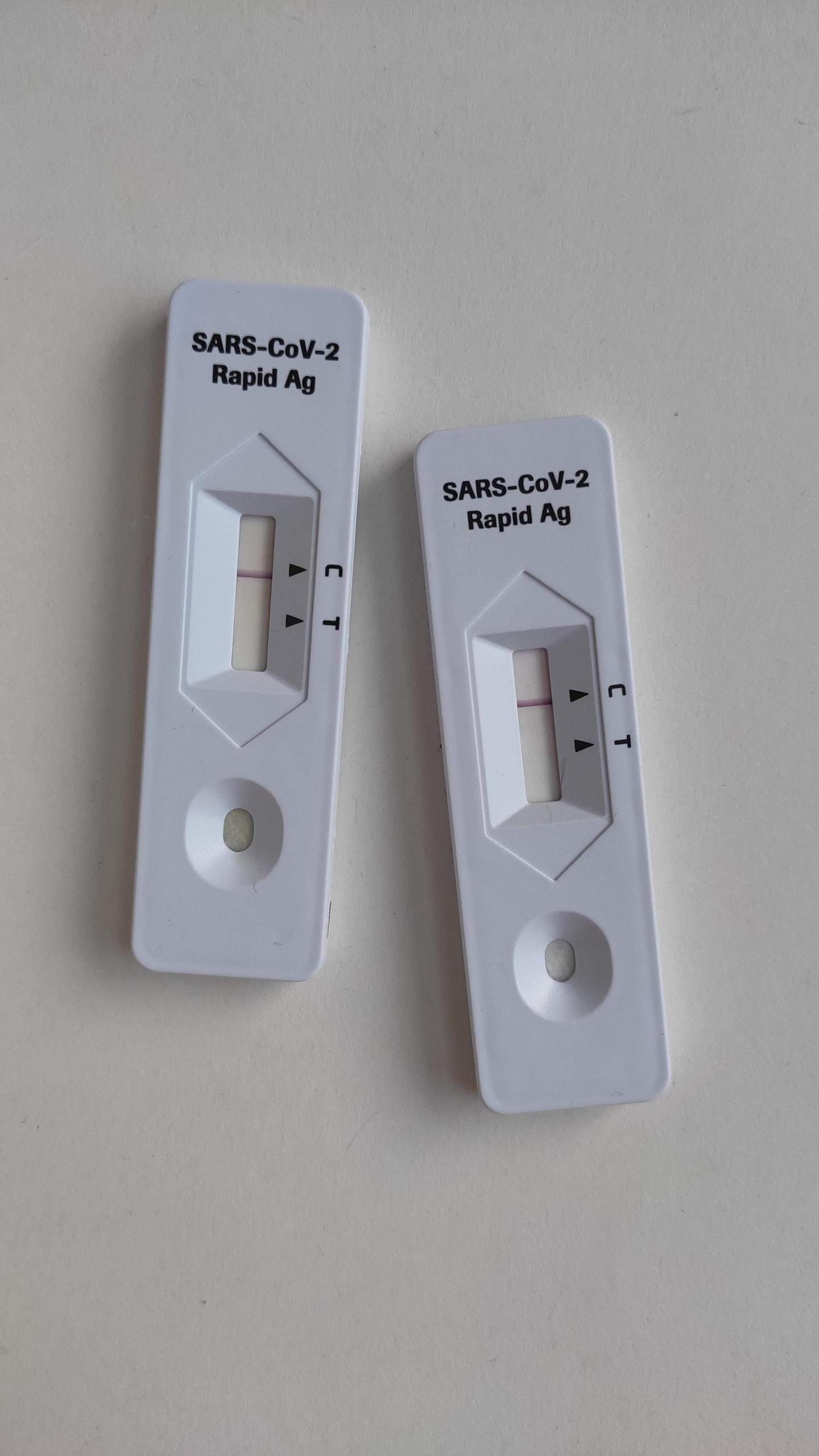
Photo credit: Photo by Steve Nomax on UnsplashFake COVID-19 test result certificates are springing up, thanks to social media oversharing.

Look, we get it. That suspiciously stuffy nose is giving you anxiety. Have you really lost your sense of smell? Maybe it’s just congestion? You start kicking yourself. Was the grocery store trip to get Haagen Dazs really worth it?

To ease the worry, you do the next responsible thing: you get tested. Hooray! It’s negative! Your instinct to announce the good news to the world is both urgent and insistent.

However, that negative test result you post to social media might have some less-than-positive outcomes.

A warning has been issued that negative test results posted online are being used to supply fake COVID-19 passes. And doctoring them is quite easy.


One man reported to a local British newspaper (the Lancashire Telegraph) that he was given a negative test by a friend, and then it was only a matter of changing the name and birthdate before that COVID-19 test passed as his own. Even the date can be edited to better reflect the required time limit.

“People are doing this as you can’t get a Covid test if you have to travel to Pakistan in case of an emergency. It is difficult to get one unless you are a key worker,” he told the Telegraph.

For some, this is an attempt to avoid the exorbitant prices being charged for legitimate tests through private clinics.

Shabaz Ilyas, who paid to have an authentic PCR test, told the Telegraph:

“This is in addition to the extortionate prices the airlines are already charging…As usual, a mini industry has been created to exploit people. This is just another example of discriminating against the poor, who are already facing financial problems.

These counterfeit tests have become the new fake IDs — sold for somewhere around £50 (about $68) in the U.K. — and can be used to enter venues and, as mentioned, travel. Which, of course, defeats the purpose of getting tested in the first place and risks the safety of those in close proximity to the person using the black market results.
fake id, covid travel requirements
bart simpson episode 20 GIF <a href="https://giphy.com/gifs/season-7-the-simpsons-7×20-xT5LMv7a1uHTeS0Ims">Giphy</a>

Shahzad Ali, CEO of security training platform Get Licensed, marked the use of fake COVID-19 passes as “inevitable” according to Wales Online, saying that “there is obviously going to be a market…because there will be people who want to go about their life like normal and not have to take Covid tests for things they didn’t have to before.”

And it’s not like similar situations haven’t been happening already. Stories of fake vaccination cards made from social media posts have been making headlines since early 2021. Though it’s a disappointing aspect of humanity, this is certainly nothing new.

“Whilst grossly unethical and potentially very dangerous, it is also illegal to use/supply/distribute fake Covid passes and could see you rack up a fine of £10,000 should you be caught,” he added.

In order to avoid this “new complication,” Ali’s advice is, of course, to avoid posting on social media. Not as cathartic, perhaps. But infinitely safer.

Forbes also shared that another travel solution in the near future might be using an app called CommonPass, which gives users a secure digital health pass, including a private COVID-19 test status.

Forbes writes:

“After downloading the app, a traveler can get a Covid-19 test at a participating lab and pull the results right into the app. The traveler can also complete any additional screening questionnaires required by the destination country. Finally, CommonPass confirms that the traveler is compliant with all entry requirements and generates a QR code which can be scanned by airline staff and border officials.

As always, social media can be a force for good and for ill. As this pandemic continues, so too does the motto, “stay safe.” That includes online.

  • Why a common World War II experience made Americans choose toilet paper over bidets
    Photo credit: PhotosNormandie/Wikimedia Commons & CanvaAmerican soldiers in World War II and a bidet.
    ,

    Why a common World War II experience made Americans choose toilet paper over bidets

    We’ll probably switch to the metric system before bidets.

    The bidet dates back to 18th-century France and, by all accounts, is more hygienic than toilet paper and better for the environment. But, much like the metric system, Americans aren’t adapting to them anytime soon.

    In fact, a 2022 poll found that only 12% of Americans “know a lot about” bidets. Americans make up 4% of the world’s population but use 20% of its toilet paper, while 70% of the world doesn’t use toilet paper at all.

    When you look at the numbers, bidets are a much better option for the environment and for one’s pocketbook than toilet paper. According to The Process, Americans cut down 31 million trees each year for toilet paper, and it takes 37 gallons of water to produce a single roll, while each use of a bidet requires only one-eighth of a gallon.

    Bidets also do a better job of cleaning your rear end than a square of toilet paper.

    “The direct application of water for post-toilet cleansing removes residual fecal matter more effectively than toilet paper alone,” Dr. Farhan Malik, a health and wellness expert, told KTVX-TV. “This can help prevent skin irritation and inflammation in the genital area. The gentle, targeted spray of water also reduces excessive wiping and tugging, which can lead to discomfort.”

    Why haven’t Americans adopted the bidet?

    When Americans were stationed in France during World War II, many visited bordellos, a fact they probably didn’t want people back home to know. In the bordellos, sex workers and their clients used bidets to clean up before and after their encounters, so Americans came to associate bidets with naughtiness and illicit behavior. 

    toilet, bidet, bathroom
    A bidet beside a toilet. Photo credit: Mura.Ts/Unsplash

    “GIs visiting bordellos would often see bidets in the bathrooms, so they began to associate these basins with sex work,” Maria Teresa Hart writes in The Atlantic. “Given America’s puritanical past, it makes sense that, once back home, servicemen would feel squeamish about presenting these fixtures to their homeland.”

    Even before World War II, bidets were associated with contraception and abortion. “The presence of a bidet is regarded as almost a symbol of sin,” Norman Haire, a pioneering gynecologist and sexologist, said in 1936.

    Bidets make economic sense

    What’s interesting is that, even though Americans rejected bidets on moral grounds, that resistance hasn’t been overridden by economic common sense. Americans spend $11 billion on toilet paper every year, and the average person in the U.S. uses 141 rolls annually. A single bidet attachment can cost as little as a one-time fee of $35.

    toilet paper, toilet paper stash, bathroom
    A whole lot of toilet paper. Photo credit: Erik Mclean/Unsplash

    Bidets have been found to be better for your health, the environment, and your wallet, but Americans still won’t switch from paper to a little spritz of water. If the runs on TP during the COVID-19 pandemic didn’t inspire Americans to change their ways, maybe nothing will. 

    “Toilet paper is not a necessity. It is a cultural habit wearing the costume of a necessity. Seventy percent of the human population proves that every single day,” The Process reports. “A product most of the world has never needed became the first thing Americans panic-bought when crisis arrived. Not medicine. Not food. Toilet paper. That tells you something, not about cleanliness, but about how habits take root. They do not grow from logic. They grow from one small misunderstood moment, repeated across a generation, then another, until the habit feels like instinct.”

  • How women in fake beards made one of the most iconic scenes in ‘Lord of the Rings’ history
    Photo credit: Flomuk/YoutubeWomen getting made-up in fake beards to become LOTR warriors.
    ,

    How women in fake beards made one of the most iconic scenes in ‘Lord of the Rings’ history

    The beloved fantasy franchise features more females than you might think.

    The Lord of the Rings: The Two Towers is widely regarded as the most action-packed installment of the Lord of the Rings trilogy. The Battle of Helm’s Deep alone was a juggernaut of a fight scene, wherein thousands of Riders of Rohan (the good guys) go up against the forces of Saruman’s infantry of Uruk-hai, Orcs, and Dunlendings (the bad guys). 

    And of course, valiantly fighting in disguise as a Rider of Rohan, or the Rohirrim, in the third and final installment of Lord of the Rings (i.e. Return of the King) is Eowyn (played by Miranda Otto), one of the only three female leads in the trilogy. Funny to think that Eowyn wasn’t, in fact, the only cross-dressing female in this iconic movie moment…not by a long shot. 

    The real riders behind the army

    To capture the full size and scope of the battle, Peter Jackson needed extras. Lots of them. Extras who could not only ride a horse well (they’re not called riders for no reason), but who would also, ideally, own their own horse. That significantly narrowed the availability of viable performers. Surprisingly, an overwhelmingly larger number of women fit that bill than men. So, Jackson and his team created a bit of movie magic. They gave these female riders fake beards, and voila: an army of horseback riding men. 

    A BTS story that stuck

    Major LOTR nerds might remember this story being shared in the extensive behind-the-scenes footage that came with the DVD. In it, we see the female extras getting fit (one even jokes, “I am a girl! See?!”), as well as Viggo Mortensen, aka Aragorn, coyly admitting that he may or may not have had a crush on one with a strawberry blonde beard. 

    While this kind of bonus content is, in some ways, a thing of pop culture past, this story lives on online as part of LOTR lore, occasionally resurfacing from time to time to either shock those who were unaware, or give aficionados reason to brag, “Yeah, I already knew that.” Either way, it’s always an opportunity to find newfound appreciation. It also highlights how the best kind of filmmaking often relies on practical solutions that subtly reshape what audiences think they are seeing. 

    Expanding women’s presence in Middle-earth

    In subsequent adaptations of Tolkien’s work, there have been a few measures taken, for better or worse, to add more female representation to the mix. The Hobbit franchise, for example, invented Elven warrior Tauriel, played by Evangeline Lilly. Similarly, Rings of Power centers on a young Galadriel (Morfydd Clark), and also features dwarf royalty Princess Disa, played by Sophia Nomvete. 

    Both the Lord of the Rings books and movie series are highly regarded for the way they portray masculinity and male relationships. But as we see, both in obvious and not-so-obvious ways, the women in LOTR brought to life some of the story’s most defining moments. 

    And really, even more than that, this story speaks to the collaborative nature of filmmaking. As a new rendition of Lord of the Rings is currently being created—in a time when so many vitally human aspects of filmmaking seem to be at risk—one can only hope this element stays within its DNA. 

  • ‘Wheel of Fortune’ fan conducts wild 6-year study and finds bizarre pattern with male contestants
    Photo credit: Tom Sloan/WikipediaVanna White and Pat Sajak, circa 1982

    Sure, there are several hacks Wheel of Fortune players might use to increase their odds of success—calling out common letters, using “Express Wedges,” etc. But when it comes to keeping a marriage alive post-show, there’s really only one winning strategy: compliments.

    A very specific (and very committed) investigation

    Who’s to say what prompted a man named Joey to devote six years to watching “nearly 2,000 episodes” of the hit game show to see how many of its married male contestants were “kicked to the curb” after competing. But regardless, his findings were…surprising, to say the least.

    After examining episodes that aired between 2010 and 2019, Joey discovered that male game players who didn’t use “complimentary adjectives” (think “gorgeous,” “amazing,”  “fantastic”) to describe their wives during their introductions were far more likely—3x more likely, in fact—to get divorced within five years than their honey-tongued counterparts. 

    marriage, wheel of fortune, divorce
    Image of divorce papers Photo credit: Canva

    Apparently, 15% of the hubbies who forgot to attribute some kind of heavenly descriptor to their spouse got the boot, while only 5% of the complimentary group suffered the same fate. 

    Joey saw more or less the same gap among the 185 Wheel of Fortune winners who were married men. Seven percent of the praising fellas eventually got divorced, while 17% of the tightlipped ones saw their relationship disintegrate.

    The Internet reacts: “Peak use of free will”

    It wasn’t long before this wild study went viral online. People were shocked, yes, but mostly incredibly impressed by Joey’s “investigative journalism.” 

    “Peak use of free will. It’s people like this that got us out of caves and into the future.”

    “I can appreciate weird obsessive behaviors. Love this.”

    Fellow data nerds were particularly enamored. 

    “This is a data analyst with hyperfixation. So niche, and now will giggle when i listen to the men introductions. No one will get when i say, ‘divorced 5 years!’ and if they ask.. i’ll come back to this comment!”

    “As a data analytics student i’m obsessed with this and this just opened a whole world of opportunity for me and my spare time tysm.”

    One Wheel of Fortune insider even shared, “This is wild because the WoF casting people go out of their way to prep you to say something complimentary about your spouse. I remember trying to come up with something really unique to say about my husband, but the takeaway is that I knew I HAD to use some kind of complimentary adjective. So, not doing this means you actively worked against the coaching.”

    As for Wheel of Fortune itself, the show’s verified TikTok account could only muster, “Bruh” in the comments section, along with a “mind-blown” emoji. 

    Why compliments actually matter in relationships

    marriage, wheel of fortune, divorce
    A happy, smiling older couple Photo credit: Canva

    These findings, however seemingly niche, do reflect a larger bit of general relationship wisdom. According to renowned marriage specialist John Gottman, publicly complimenting your spouse is a powerful tool to build a “culture of appreciation”, which strengthens the relationship’s emotional foundation. It demonstrates fondness, admiration, and pride in your partner, contributing to the crucial 5:1 positive-to-negative interaction ratio needed for a healthy marriage.

    In other words, it might not guarantee a jackpot, but a few kind words can go a surprisingly long way. And unlike solving a puzzle on national TV, this move can be practiced every day.

  • Harvard linguist explains perfectly logical reason Boomers insist on using ellipses in texts
    Photo credit: CanvaAn older woman uses a tablet computer.
    ,

    Harvard linguist explains perfectly logical reason Boomers insist on using ellipses in texts

    If you’ve ever gotten a text from your mom or grandma full of “…” and had no idea what it meant, you’re not alone.

    One generation’s texting habit that baffles every generation is the Boomers‘ seemingly excessive use of ellipses. Do you have more to say, Aunt Judy, or did you just accidentally press the period key too many times? Maybe it’s for a dramatic pause or to put emphasis on a point? This is truly a mystery that leaves every generation below them confused about what is meant by the dreaded “dot dot dot.”

    Texting etiquette differs with every generation. Gen X and most Millennials use fairly proper grammar and punctuation throughout a text message exchange. Every new sentence starts with a capital letter, there are strategically placed Oxford commas to ensure there’s little room for misunderstandings, and sentences end with an appropriate punctuation mark.

    How each generation texts differently

    When it comes to Gen Z, they find that ending text messages with proper punctuation indicates that the person they’re texting is being passive-aggressive. They also text in shorthand and emojis that can feel a bit like you need a special decoder ring to decipher the messages. But texting in an encrypted way can be chalked up to youth, though the same can’t be said when it comes to Boomers. Or can it?

    Harvard linguist and author of the New York Times bestseller Algospeak, Adam Aleksic, breaks down why so many Boomers use ellipses when texting. It’s surprisingly not as complicated or dramatic as one may imagine. In a viral 2024 TikTok video, Aleksic explains his theory for the texting etiquette of Boomers.

    linguist; boomers; gen x; millennials; gen z; text etiquette; boomer texting; gen z slang

    Two generations connecting through their smartphones. Photo credit: Canva

    “You know how older people tend to use the ‘Boomer ellipses’ whenever they’re texting? There’s always a random ‘dot dot dot’ in the middle of their messages?” Aleksic asks. “Well, that’s because they grew up following different rules for informal communication. Nowadays, if you want to separate an idea, you just press enter and start a new line with a new thought, but it made less sense to do that for writing postcards or letters, where you had to save space, so people back in the day learned to separate thoughts by using ellipses.”

    The pay-per-text era that changed everything

    Aleksic explains that this is also true for when phones first started allowing text messaging. You were charged by the message, so ellipses made it more efficient to convey all the thoughts in one message instead of multiple ones. SMS texting also had a character limit, unlike current phones, where you can essentially write a novella in a single message without your phone automatically breaking it up.

    Today’s texting standards typically mean people separate their thoughts by sending multiple messages for separate thoughts, though that annoys some people. If separating thoughts means you’ll be sending no less than five texts in quick succession, it’s likely best to just space down to make the text longer, rather than bombarding an unsuspecting friend.

    Why the boomer ellipsis causes so much confusion

    When it comes down to it, younger generations have adapted to the new standard, embracing the unlimited text option, while Boomers haven’t. Due to this discrepancy in text etiquette, the ellipses used by Boomers throw people for a loop.

    “That means the Boomer ellipses became redundant, which is why they cause confusion today. They violate what we call ‘the maximum quantity;’ they add more information than necessary, so they appear to imply something more than the intended meaning. Most of the time, that comes off to younger people as hesitation, annoyance, or passive aggressiveness because that’s how we use the ellipses,” the linguist shares.

    So, no, your grandma isn’t mad at you or avoiding telling you something; according to Aleksic, she’s just trying to send you multiple messages in one. There’s no hidden emotion behind the ellipses for Boomers; it’s simply a habit left over from their younger years.

    This article originally appeared one year ago. It has been updated.

  • Nate Bargatze reveals the true story behind his legendary George Washington SNL sketch
    Photo credit: SNL/NBCNate Bergatze as George Washington on Saturday Night Live
    ,

    Nate Bargatze reveals the true story behind his legendary George Washington SNL sketch

    Nate Bargatze’s George Washington SNL sketch has become an instant classic.

    America is definitely not afraid to do its own thing, even when its own thing is pretty weird. Ever stop to think how bizarre it is that the United States is one of the only countries to not use the metric system? Or how it uses the word “football” to describe a sport that, unlike fútbol, barely uses the feet at all?

    What must our forefathers have been thinking as they were creating this brave new world? Wonder no further. All this and more is explored in a Saturday Night Live sketch that folks are hailing as an “instant classic.”

    Why the sketch went viral

    The hilarious clip takes place during the American Revolution, where George Washington rallies his troops with an impassioned speech about his future hopes for their fledgling country…all the while poking fun at America’s nonsensical measurements and language rules.

    george washington, george washington's dream, snl sketch, nate bargatze

    Like seriously, liters and milliliters for soda, wine and alcohol but gallons, pints, and quarts for milk and paint? And no “u” after “o” in words like “armor” and “color” but “glamour” is okay?

    The inherent humor in the scene is only amplified by comedian and host Nate Bargatze’s understated, deadpan delivery of Washington. Bargatze had quite a few hits during his hosting stint, including an opening monologue that acted as a mini comedy set, but this performance takes the cake.

    The fans love it

    All in all, people have been applauding the sketch, noting that it harkened back to what “SNL” does best, having fun with the simple things.

    “This skit is an instant classic. I think people will be referencing it as one of the all time best SNL skits for years.”

    “Dear SNL, whoever wrote this sketch, PLEASE let them write many many MANY more!”

    “Instantly one of my favorite SNL sketches of all time!!!”

    “I’m not lying when I say I have watched this sketch about 10 times and laughed just as hard every time.”

    “This may be my favorite sketch ever. This is absolutely brilliant.”

    The sketch was so popular, they did another one when Nate Bargatze returned to SNL in October of 2024, and it’s every bit as hilarious as the first one. Again, the comedy focused on the idiosyncrasies of America, including our names for animal food products, the way we count grades in school, and the design of our currency.

    “A real American would never want to know what’s in a hot dog, just as they will never know why our money is called the ‘dollar’…” says Bargatze as Washington. “And if you think I’m worthy, put my portrait on the front of it.”

    “And what shall be on the back, sir?” asks Kenan Thompson’s character.

    “Everything, all of it,” Washington replies. “Crazy stuff, squiggles, Latin words, a pyramid with a floating eye on top.” 

    Behind the scenes of an SNL classic

    The sketches became so popular, people wanted to know more about how the idea for them came about and what the process of creating the original sketch was like. Jesse David Fox, the host of Good One: A Podcast About Jokes, sat down with Bargatze and SNL writers Mikey Day and Streeter Seidell to talk about the origins of the sketch and what it was like to co-create it in the week leading up to the live show. It’s a fascinating insight into the SNL writing process, which is largely done within that week.

    According to Day and Seidell, Seidell had actually written a near-complete draft of the sketch the prior season, originally envisioned for a dramatic actor. It had been sitting unfinished on his computer until Bargatze was tapped to host. Bargatze was on board with playing Washington, but apparently, the sketch landed flat at the table read earlier in the week and was placed dead last in the dress rehearsal lineup. But Bargatze said he really liked the sketch, and once he was in costume and in front of a live audience for dress rehearsal, everything came together to make the magic of a classic SNL bit.

    Bargatze has become one of the biggest names in stand-up comedy, known for his clean, family-friendly routines. He was the highest-grossing touring comedian in the world in 2024. You can catch even more of Bargatze’s “SNL” episodes here and here.

    This article originally appeared three years ago. It has been updated.

  • Debunking doesn’t stop misinformation online. But researchers found ‘pre-bunking’ can.
    Photo credit: CanvaSome helpful information to fight misinformation.

    The rise of misinformation on social media has been a monumental stress test for the world’s critical thinking skills. Misinformation has had a huge influence on elections, public health and the treatment of immigrants and refugees across the world. Social media platforms have tried to combat false claims over the years by employing fact-checkers, but they haven’t been terribly effective because those who are most susceptible to misinformation don’t trust fact-checkers.

    “The word fact-checking itself has become politicized,” Cambridge University researcher Jon Roozenbeek said, according to the Associated Press. Further, studies show that when people have incorrect beliefs challenged by facts, it makes them cling to their false assumptions even harder. These platforms have also attempted to remove posts containing misinformation that violates their terms of service, but this form of content moderation is often seen as insufficient and is often applied inconsistently.

    So what actually works against misinformation?

    How do we combat dangerous misinformation online if removing false claims or debunking them hasn’t been effective enough? A 2022 study published in the journal Science Advances by a team of university researchers and Jigsaw, a division of Google, found a relatively simple solution to the problem they call “pre-bunking.”

    Pre-bunking is an easy way of inoculating people against misinformation by teaching them some basic critical thinking skills. The strategy is based on inoculation theory, a communication theory that suggests one can build resistance to persuasion by exposing people to arguments against their beliefs beforehand.

    The researchers learned that pre-bunking was effective after conducting a study on nearly 30,000 participants on YouTube.

    “Across seven high-powered preregistered studies including a field experiment on YouTube, with a total of nearly 30,000 participants, we find that watching short inoculation videos improves people’s ability to identify manipulation techniques commonly used in online misinformation, both in a laboratory setting and in a real-world environment where exposure to misinformation is common,” the recently published findings note.

    The researchers uploaded videos into YouTube ad slots that discussed different types of manipulative communication used to spread false information such as ad hominem attacks, false dichotomies, scapegoating and incoherence.

    Here’s an example of a video about false dichotomies.

    Short videos with surprisingly big results

    Researchers found that after people watched the short videos, they were significantly better at distinguishing false information than they were before. the study was so successful that Jigsaw rolled out a prebunking campaign about scapegoating in Poland, the Czech Republic and Slovakia. Since that initial campaign, prebunking’s reach has only grown. These countries are all combating a significant amount of false information about Ukrainian refugees.

    Before the 2024 EU Elections, a Jigsaw-supported campaign reached more than 120 million YouTube users across 12 countries, with studies confirming the approach improved viewers’ ability to spot manipulation tactics.

    Many people talk about “critical thinking,” but a lot of people don’t really understand what the term means. Learning about the tropes and techniques used to spread misinformation is a vital part of developing critical thinking skills. It’s not just about thinking for yourself and determining what’s true based on what your brain tells you; it’s about recognizing when messaging is being used to manipulate your brain to tell you certain things. It’s learning about logical fallacies and how they work. It’s acknowledging that we all have biases that can be preyed upon and learning how propaganda techniques are designed to do just that.

    Teaching the skill beats playing whack-a-mole

    There’s an old saying, “If you give a man a fish, he’ll eat for a day. Teach that man to fish and he’ll eat forever.” Pre-bunking does something very similar. We can either play a game of whack-a-mole where social media platforms have to suss out misinformation on a minute-by-minute basis or we can improve the general public’s ability to distinguish misinformation and avoid it themselves.

    Further, teaching people to make their own correct decisions about misinformation will be a lot more effective than pulling down content and employing fact-checks. These tactics only drive vulnerable, incredulous people toward misinformation.

    This article originally appeared four years ago. It has been updated.

  • If you struggle with small talk, a simple acronym can make it a lot less painful
    Photo credit: via Gary Barnes/PexelsSmall talk can be painful, but the FORD method can help.

    Some people enjoy small talk and are naturally good at it. For others, it feels like mental and emotional torture. There are many reasons why people are nervous about entering social situations where they have to make small talk, such as a work event, a party where they don’t know many people, or at school. Some people don’t enjoy small talk because they get frustrated talking about seemingly unimportant topics.

    At the same time, others are shy and afraid they’ll say the wrong thing or run out of topics of conversation. Psychologists suggest those who are uncomfortable knowing what to say should use the FORD method of conversation starters. It’s an acronym that’s an easy way to remember four different topics of conversation that work with just about anyone.

    According to Nicole Arzt, M.S., L.M.F.T at Social Self, the FORD acronym stands for Family, Occupation, Recreation and Dreams. Here are some examples of questions that fall under each category.

    Family

    Just about everyone has a family, so it’s a great way to ask someone to share some information about their personal lives without being too forward. Arzt suggests the following questions when making small talk:

    family, small talk, ford method
    You can ask people about their parents, kids, siblings, grandparents, cousins, aunts and uncles, or just family in general. Photo credit: Canva

    Do you have any siblings?

    How did you two meet? (if you are meeting a couple for the first time)

    How old is your child?

    How is your____ (sister, brother, mother, etc.) doing since ____ (event that happened?)

    Occupation

    Just like a family, almost everyone has a job. Or, if they do not, that can be an interesting topic as well. Here are some starter questions you can ask someone about their job.

    jobs, occupations, ford method, small talke
    You can take questions about someone’s occupation beyond simply, Photo credit: Canva

    What do you do for a living?

    How do you like working at _____?

    What’s your favorite part of your job?

    What made you interested in becoming a _____?

    Recreation

    You can learn a lot about a person after knowing how they spend their free time. It’s also an excellent way to determine if someone is like-minded and shares the same interests. Here are some questions to get the ball rolling.

    It is fun to talk about, well…fun. Photo credit: Canva

    What do you like to do for fun?

    Have you watched (or read) ______(popular show/book)?

    What are you up to this weekend?

    Dreams

    Learning someone’s hope for the future can tell you much about who they are on a deeper level. They may have just told you about their current job or how they spend their time. But, ultimately, what do they wish to do with their lives? Here’s how to ask someone about their dreams.

    Everyone has hopes and dreams. Photo credit: Canva

    Where do you hope to be working in the next few years?

    Where would you like to travel?

    What’s something you’d like to try in the future?

    Would you ever consider trying _____ (particular hobby or activity)?

    Don’t just ask questions, share your own answers

    Arzt also notes that you shouldn’t just be an interviewer. You have to talk about yourself, too. In other words, you need a mutual give-and-take. “Pay attention to someone else’s answers and think about how you can draw from your own experience to connect,” she wrote. When you’re feeling socially anxious, it can be hard to listen to the other person while also thinking about your own responses, so thinking of the FORD acronym for yourself and having something to share in each category ahead of time can be a way to avoid the dreaded awkward silence that sometimes happens during small talk.

    It can also be tricky to know how much you should be talking vs. how much you should be listening. If you’re not sure how much to say during a conversation, follow the 43:57 rule. A numbers guy at Gong.io analyzed over 25,000 sales calls with AI and found the perfect speaking-to-listening ratio. Sales soared when the salesperson talked 43% of the time and listened for 57%.

    Even though this insight is from business calls, it applies to everyday social interactions. It’s really about listening and making the other person feel special. After all, who doesn’t love feeling heard and appreciated?

    Small talk doesn’t have to be torturous, even if it’s something you don’t look forward to. With a little preparation and some genuine curiosity, it might even become enjoyable as you make new connections with people.

    This article originally appeared three years ago. It has been updated.

  • Fox News viewers were paid to watch CNN and it actually changed their views
    Photo credit: via Wikimedia CommonsFox viewers changed their minds after watching CNN

    The prevailing logic in today’s political world is that polarization is worsening because people live in media echo chambers where they are only exposed to outlets that mirror their views. People who live in echo chambers come to distrust any opinions outside their bubbles, especially when they’re not exposed to conflicting information. This creates a scenario where the person becomes increasingly entrenched in their worldview.

    One would assume that after a person becomes fully entrenched in an echo chamber, they have little chance of changing their views. However, a new working paper by researchers at UC Berkley and Yale universities has found that when people are removed from their bubbles, there’s a chance they’ll change their minds.

    What happened when Fox News viewers watched CNN for a month

    David Broockman of UC Berkeley and Joshua Kalla of Yale conducted a study in fall 2020, publishing their findings in 2022, in which they paid regular Fox News viewers $15 an hour to watch CNN for around seven hours a week for a month. The researchers then surveyed them about their political beliefs and knowledge of current events.

    The study is titled “The manifold effects of partisan media on viewers’ beliefs and attitudes: A field experiment with Fox News viewers.” It was conducted in fall 2020, during the height of the COVID-19 pandemic and the lead-up to the presidential election.

    When the participants were polled, researchers found that they were five percentage points more likely to believe that people suffer from long COVID, 6 points more likely to think that other countries did a better job of controlling the virus, and 7 points more likely to support voting by mail.

    anderson cooper, cnn, cable news, cooper live, newscasters, news programming, liberals, conservatives
    Anderson Cooper and David Axelrod speaking in the spin room following the CNN Republican Presidential Debate at the Olmsted Center at Drake University in Des Moines, Iowa. via Gage Skidmore/Wikimedia Commons

    “CNN provided extensive coverage of COVID-19, which included information about the severity of the COVID-19 crisis and poor aspects of Trump’s performance handling COVID-19. Fox News covered COVID-19 much less,” said the study.

    How their views on Trump and police changed

    After Fox viewers switched to CNN, their opinions on the social justice protests happening at the time changed. The switchers were 10 points less likely to think that Biden supporters were happy when police got shot and 13 points less likely to believe that if Biden gets elected, “we’ll see many more police get shot by Black Lives Matter activists.”

    Many of the participants also realized that when it came to Trump, they weren’t getting the whole story. After switching to a steady diet of CNN they were less likely to agree that “if Donald Trump did something bad, Fox News would discuss it.”

    “Despite regular Fox viewers being largely strong partisans, we found manifold effects of changing the slant of their media diets on their factual beliefs, attitudes, perceptions of issues’ importance, and overall political views,” the authors of the study said.

    sean hannity, fox news, red state, news bias, political polarization.
    A Fox News van in New York City via Wikimedia Commons

    What the study means for political polarization in America

    The study shows that Fox News isn’t just a media outlet that affirms its viewers’ worldviews; it also feeds them a distorted version of reality that pushes them toward more extreme opinions. The good news is that some of these people can be changed when exposed to better information. It should also be noted that Fox News viewers aren’t the only ones living in information bubbles and that there are plenty of ideological traps that ensnare people on the left as well.

    “Partisan media aren’t just putting a thumb on the scale for their side,” Broockman said. “They’re also hiding information that voters need to hold politicians accountable. That’s not just good for their side and bad for the other side — it’s bad for democracy, and for all of us.”

    Two months after the study, it was found that the Fox News viewers reverted to their opinions before their exposure to CNN. Still, Broockman believes that the study offers some hope in a time of deep political polarization. “Even among the most orthodox partisans and partisan media viewers,” he said, according to Berkeley, “those who receive a sustained diet of information that helps them see the bigger picture actually are open-minded enough to understand that their side isn’t doing a perfect job, either.”

    The study should give everyone hope that all is not lost and that America’s political divide may not be impossible to bridge.

    This article originally appeared four years ago. It has been updated.

Nature

Spanish nuns are fighting to preserve a giant rabbit breed in danger of extinction

Animals

Cheddar Big Booty Cheeseburger wins Wackiest Cat Name contest, but these 9 runner-ups are clever, too

Family

Is it rude not to share a family recipe? Here’s how to decline the right way.

Culture

Harvard linguist explains perfectly logical reason Boomers insist on using ellipses in texts