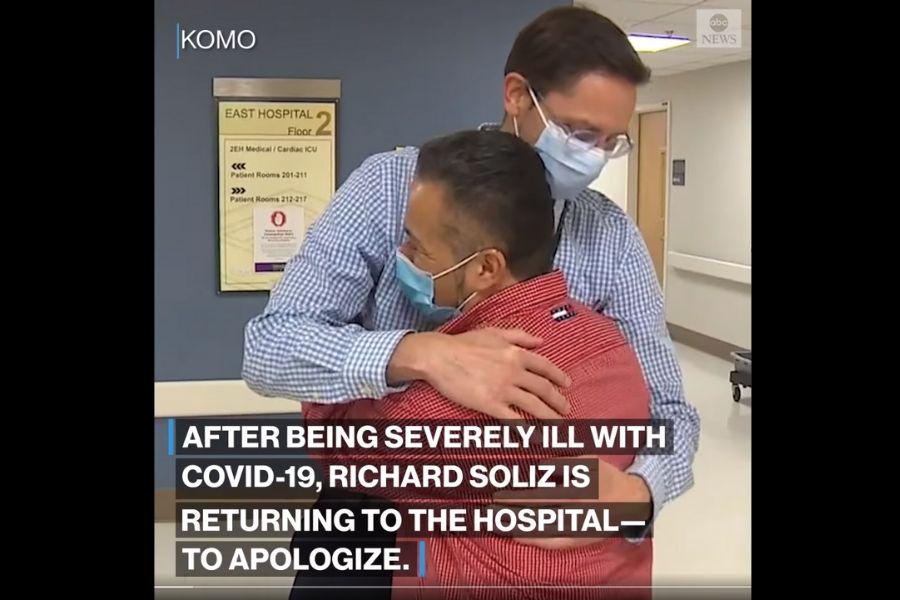
Man returns to the ICU where he almost died of COVID-19 to apologize to healthcare workers

Richard Soliz spent 28 days at Harborview Medical Center and nearly died of COVID-19.
Throughout the pandemic, we've seen countless stories of patients in the ICU, terribly sick with COVID-19, still insisting that the virus isn't real. Such stories of denial are frustrating, especially for healthcare workers who are doing their best to save people's lives.
That's why this story of a COVID patient returning to the hospital to thank—and apologize to—the medical staff who helped him offers a ray of hope that not all who are in denial will stay that way.
According to KOMO News, Richard Soliz hadn't known anyone who had gotten sick from the coronavirus. He had also fallen prey to misinformation on social media about the vaccine, so had chosen not to get vaccinated. Then he fell ill in late August, spiked a fever and found it difficult to breathe.
"That's when I really knew I was in a bad situation," Soliz said. "That's when I knew, hey, this is COVID. Man. I contracted the virus."
Soliz told KOMO he was embarrassed when staff at Seattle's Harborview Medical Center asked him if he was vaccinated. Pulmonologist and director of the ICU Dr. James Town told CNN that when Soliz was admitted, about 99 out of 100 COVID-19 patients at Harborview had not been vaccinated
Soliz ended up spending 28 days in the hospital. He was put on a ventilator and a heart monitor in the ICU and nearly didn't make it.
"I am certain that there is truth to this virus, and not being vaccinated leaves you vulnerable to the extent of possibly really taking a person's life," Soliz said. "I personally know that, because I was not vaccinated. I did not act, I wasn't certain, and I nearly lost my life."
Soliz did make it, though. Then he did something that few unvaccinated COVID-19 survivors do. He went back to the hospital to thank the medical team that treated him—and apologize for not getting vaccinated.
"I was literally on my deathbed and hanging from a string, and [doctors and nurses] tended to me as perfect strangers," Soliz told CNN. "I just had to say something."
Soliz thanked Dr. Town and told him he deeply regretted not getting the vaccine.
"No one blames you or judges you," Town responded. "Everyone is just happy that you are willing to share the story, I think. And happy that you're better."
Healthcare workers are heroes. Seriously.
"It's emotional for us to see someone do well," Town told KOMO News. "Particularly when things are so dark."
Other staff members were moved by Soliz's apology and gratitude.
"We do put so much of our own heart into the care and worry," nurse Kimmy Siebens said. "We never really get to see people get that much better. And so it's amazing. It makes it feel like it's definitely all worth it, you know?"
Soliz has a message he wants everyone to hear:
"Please go get vaccinated because this virus is real. Real enough to take someone's life (or) put you in the ICU."
Though a majority of American adults have gotten vaccinated, misinformation about the vaccines has resulted in millions of people choosing to reject the COVID-19 vaccines. Public health experts have tried every which way to convey to the public that the No. 1 thing people can do to mitigate the effects of the pandemic and safely get back to normal is to get vaccinated. Vaccines make viral infection and transmission less likely, and drastically reduce the chances of hospitalization and death. It's unfortunate that it may take more stories like Soliz's to convince some people, but here we are.
Thank you, Richard Soliz, for acknowledging you made a mistake and for serving as a good example of humility and gratitude after your hospitalization.

- Dr. reveals the regrets of dying, unvaccinated covid-19 victims ... ›
- Man who has 'recovered' from COVID-19 explains how its impact ... ›
- An anonymous VFX artist created a chilling visual of the American ... ›


A woman is getting angry at her coworker.via
A man with tape over his mouth.via
A husband is angry with his wife. via 
a man sitting at a desk with his head on his arms Photo by
Can a warm cup of tea help you sleep better? If you believe it, then yes. Photo by 
Three women sit on a blanket in the park. 
Two women engaging in a pleasant conversation inside a coffee shop
Two men engaging in a peaceful disagreement.
Resurfaced video of French skier's groin incident has people giving the announcer a gold medal
"The boys took a beating on that one."
Downhill skiing is a sport rife with injuries, but not usually this kind.
A good commentator can make all the difference when watching sports, even when an event goes smoothly. But it's when something goes wrong that great announcers rise to the top. There's no better example of a great announcer in a surprise moment than when French skier Yannick Bertrand took a gate to the groin in a 2007 super-G race.
Competitive skiers fly down runs at incredible speeds, often exceeding 60 mph. Hitting something hard at that speed would definitely hurt, but hitting something hard with a particularly sensitive part of your body would be excruciating. So when Bertrand slammed right into a gate family-jewels-first, his high-pitched scream was unsurprising. What was surprising was the perfect commentary that immediately followed.
This is a clip you really just have to see and hear to fully appreciate:
- YouTube youtu.be
It's unclear who the announcer is, even after multiple Google inquiries, which is unfortunate because that gentleman deserves a medal. The commentary gets better with each repeated viewing, with highlights like:
"The gate the groin for Yannick Bertrand, and you could hear it. And if you're a man, you could feel it."
"Oh, the Frenchman. Oh-ho, monsieurrrrrr."
"The boys took a beating on that one."
"That guy needs a hug."
"Those are the moments that change your life if you're a man, I tell you what."
"When you crash through a gate, when you do it at high rate of speed, it's gonna hurt and it's going to leave a mark in most cases. And in this particular case, not the area where you want to leave a mark."
Imagine watching a man take a hit to the privates at 60 mph and having to make impromptu commentary straddling the line between professionalism and acknowledging the universal reality of what just happened. There are certain things you can't say on network television that you might feel compelled to say. There's a visceral element to this scenario that could easily be taken too far in the commentary, and the inherent humor element could be seen as insensitive and offensive if not handled just right.
The announcer nailed it. 10/10. No notes.
The clip frequently resurfaces during the Winter Olympic Games, though the incident didn't happen during an Olympic event. Yannick Bertrand was competing at the FIS World Cup super-G race in Kvitfjell, Norway in 2007, when the unfortunate accident occurred. Bertrand had competed at the Turin Olympics the year before, however, coming in 24th in the downhill and super-G events.
As painful as the gate to the groin clearly as, Bertrand did not appear to suffer any damage that kept him from the sport. In fact, he continued competing in international downhill and super-G races until 2014.
According to a 2018 study, Alpine skiing is a notoriously dangerous sport with a reported injury rate of 36.7 per 100 World Cup athletes per season. Of course, it's the knees and not the coin purse that are the most common casualty of ski racing, which we saw clearly in U.S. skier Lindsey Vonn's harrowing experiences at the 2026 Olympics. Vonn was competing with a torn ACL and ended up being helicoptered off of the mountain after an ugly crash that did additional damage to her legs, requiring multiple surgeries (though what caused the crash was reportedly unrelated to her ACL tear). Still, she says she has no regrets.
As Bertrand's return to the slopes shows, the risk of injury doesn't stop those who live for the thrill of victory, even when the agony of defeat hits them right in the rocks.