upworthy
Add Upworthy to your Google News feed.
Google News Button
Pop Culture

Coldplay surprises couple by letting their wedding be the world premiere of a new song

The couple reached out on Twitter just two days before their big day—and it paid off big time.

coldplay, new coldpl;ay album, coldplay moon magic, moon magic, wedding songs
Raph_PH/Wikipedia, @coldplay/X

They made this couple's dream come true.

Imagine being able to tell everyone that your wedding also happened to be the world premiere of a song from an intentionally beloved band. Talk about an awesome flex.

These bragging rights belong to Paul and Céline Delcloy—all because they asked nicely, by the way.

Here’s what went down.

On Sept 2, Chris Martin, rockstar frontman for Coldplay, played a sneak preview of "All My Love,” a track which will be featured on the band's upcoming new album, “Moon Music, set to be released on Oct. 4.


Coldplay then shared the clip onto X, along with the caption "All My Love. Last song of the summer ❤️,” as this would be the last live concert before “Moon Music” would debut.

Paul and Céline, both huge Coldplay fans, went out on a limb and reached out to Coldplay's manager and “fifth member”, Phil Harvey, on X on Sept. 5, asking if "All My Love" could be the first dance at their wedding, coming up in only two days time.

"We’re getting married in 2 days, please Phil do your magic and let us dance [to] All My Love 😭😭😭,” read the tweet.

In addition, the couple also re-shared a photo previously posted on X about a month ago, where they’re holding a sign that reads, "Would you come and play 'All Our Love' [for] our wedding first dance?"


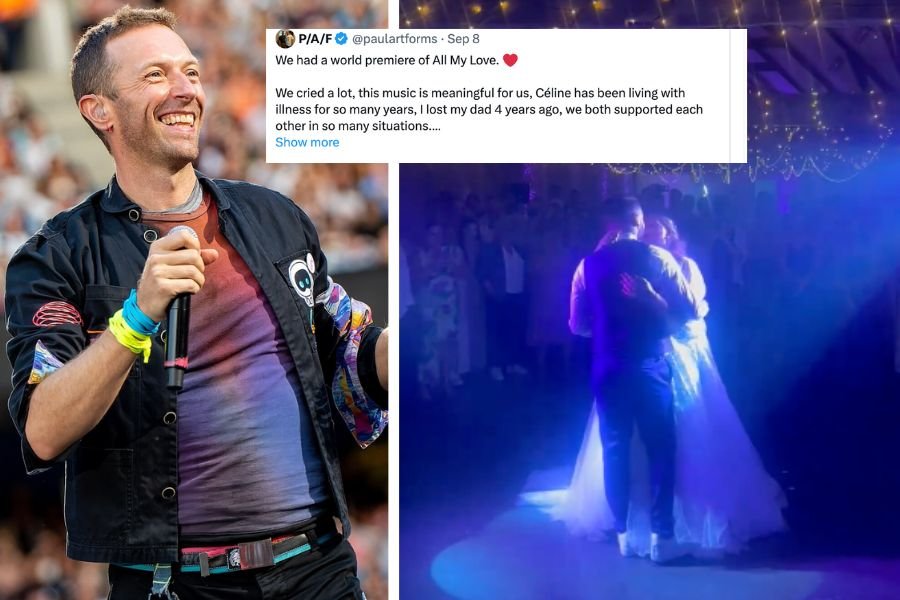
As fate would have it, Harvey not only saw the tweet, but replied, “Congratulations Paul! Let me see what I can do.” And next thing you know, Paul and Céline share another video—this time from their wedding, sharing their first dance to the sought after track.

In gratitude, Paul wrote:

“We had a world premiere of All My Love. We cried a lot, this music is meaningful for us, Céline has been living with illness for so many years, I lost my dad 4 years ago, we both supported each other in so many situations. Thank you @coldplay, We are so proud and fulfilled that you have accepted this.”

Coldplay would later share the Delcloys' dance video on their own X account, saying, "Congratulations, Céline and Paul 💕 💕. We wish you a lifetime of love, laughter and happiness." The message was signed with "Love c, g, w, j & p," representing band members Martin, Guy Berryman, Will Champion and Jonny Buckland, along with Harvey.

In an exclusive interview with People, the newlyweds shared why having a Coldplay track for their wedding dance felt so important, as their music held deep meaning in their relationship.

They reminisced about attending their first Coldplay concert together seven years ago, which “sparked a journey that took us across Europe to see the band seven times during the Music of the Spheres world tour.”

“All My Love,” is particularly meaningful, as the “lyrics echo the hardships we endured but also the power of love between us, making the song deeply meaningful to us." After hearing it in Athens, the track became the couple’s “anthem” as they dealt with challenges like Céline's Crohn's disease and the loss of Paul’s father.

Why people love Coldplay

Of course, the Delcloys aren’t the only folks who hold a special place in their heart for Coldplay. Fans appreciate the band’s musicianship, emotional lyrics, and the way their music bring people together, particularly at live concerts.

But not only that, they practice being kind humans—from working with KultureCity to make their shows accessible to deaf, hard-of-hearing or visually impaired fans, to offering $20 concert tickets to those who can’t pay the normal prices, to acknowledge Indigenous land, to employing more 40 women in areas from carpentry to personal security for their 2024 tour.

Plus, Coldplay are touted as sustainability pioneers, with their unprecedented “environmentally conscious touring” initiative and plan to offer their “Moon Music” album in multiple formats, including vinyl made from recycled plastic bottles.

Even if you aren’t the biggest Coldplay fan like Paul and Céline, you gotta appreciate what they're doing to make a real positive impact. Both in their fans’ lives, and around the world.

Education

How embracing the 'Empty Boat Theory' can help you keep anger and anxiety in check

The classic Taoist parable has found new life on TikTok, but its core message stays the same.

empty boat theory, taoism, buddhism, psychology, mindset, anger, anxiety, self help, mindfulness

Ancient wisdom for the modern day.

We all have moments where it feels like the world is against us. When we assume people are thinking negatively about us, we act accordingly by becoming angry or anxious. Once that mindset latches on, it can be tough to let go.

But one simple Taoist parable-turned-viral-TikTok-hack offers a gentle yet powerful reminder that we are not the main character in everyone’s story.


What is the “Empty Boat Theory”?

@sean.of.the.living The “empty boat” theory has me brain spinning lately. This is a brain hack to staying in a happier mindset. #advice #emptyboat #lifehack ♬ original sound - sean.of.the.living

Think of it as a thought experiment. Imagine yourself on a boat in the middle of a lake, as another boat drifts towards you, threatening to knock right into you. The closer this incoming vessel gets, the angrier you become.

Then, at the last second, you steer your boat out from the path of collision, only to notice that the other boat is empty. What this really puts into perspective, as TikToker @sean.of.the.living put it, is “There was never anybody to be angry with in the first place.”

“That’s life, isn’t it?” he said. “We assume everything’s about us. ‘They’re just doing that to screw me, to piss me off.’”

“Most of the time, nobody’s thinking about you.”

The Empty Boat Parable

@aliabdaal The Empty Boat: A Lesson in Letting Go A man gets furious when another boat crashes into him, shouting and ready to fight. But when the fog clears, he sees the boat is empty. No one was steering, no harm was intended. His anger disappears. Most frustrations in life are just empty boats. People are dealing with their own struggles, not trying to hurt you. Next time you feel anger rising, ask yourself – am I just reacting to an empty boat?
♬ original sound - Ali Abdaal

However, long before it was a viral brain hack on TikTok, this story taught how much self-inflicted suffering comes simply from the stories we tell ourselves about other people's attitudes towards us.

As the parable goes, a young monk (or simply a young man, depending on which version you read) hops onto a boat in hopes of finding a quiet spot to meditate. Suddenly, he is bumped by another boat. Furious, the monk opens his eyes and lashes out at the person responsible for disrupting his flow. There is, however, no one to blame. The boat is empty. Knowing there's now no one to be mad at, truly, the man's anger instantly dissipates.

The core message is that sometimes a bump is just a bump. We need not assume malicious intent, and would be better equipped to handle life’s collision with grace if we didn’t.

The Spotlight Effect

Bringing it into therapy-speak, the Empty Boat Theory/Parable also relates to the spotlight effect, which is the tendency to wrongly believe that others are mentally scrutinizing us when, in fact, they are likely not thinking about us at all.

This bias is a symptom of egocentrism. You don’t have to be a full-blown narcissist to be egocentric. We all, from time to time, consider ourselves to be the center of the universe in some way. It’s part of being an individual! But without mindfulness, we can let our egos overestimate how many eyes are actually on us at any given time, which only leads to a lot of unnecessary anxiety.

Whether you wanna call it a brain hack, ancient wisdom, or a psychological principle, we could all benefit from reminding ourselves to really pick our battles. Easier said than done in today’s world, but vital nonetheless. Here's to hoping that being aware of all the empty boats out there will lead to smoother sailing for everyone.

And if you're wondering just who’s to blame for letting that rogue boat out to wreak havoc on the water…? Well, that’s a different conversation.

This article originally appeared last year.

Joy

A 'social experiment' lets people from Texas and San Francisco randomly connect on a payphone

"People don't want to be seen as stereotypes. People look to connect on human stuff."

Matter Neuroscience,  payphone experiment, Texas, California, Abilene, San Francisco, humanity
Photo Credit: Canva, Matter Neuroscience, Instagram

Two payphones set up in Abilene, Texas and San Francisco, California let complete strangers chat.

Imagine you're walking by a payphone in Abilene, Texas, when it unexpectedly rings. You pick up, only to hear that a total stranger over 1500 miles away in San Francisco is on the other end of the line. Do you argue, as so many social media algorithms would have people do? Or do you dig into your primal human instinct, the one that makes evolution possible, and find yourself connecting?

The biotech company Matter Neuroscience had this thought. What if they chose one of the most conservative and most liberal cities in the U.S. and installed free payphone-looking devices in each one? The idea is to bridge the gap between the great divide many are currently experiencing. Whether due to politics, religion, or different lifestyles, many are seemingly forgetting that we're all just human beings searching for contentment.


On their Instagram page, Matter Neuroscience (@Matterneuroscience) explains that it's about people connecting from all walks of life. "The goal of this project is to create space for friendly, human-to-human conversations. We believe that a few different opinions (even on important political topics) should not block us from having a truly positive, maybe even fun conversation with other humans."

How it works

As explained on the initial Instagram Reel, "When one phone is picked up, it automatically calls the other." In a video, we see one of the Matter Neuroscience teammates, Logan Ivey, setting up an old payphone that was bought on Facebook Marketplace for $300.00. Ivey jimmies it open to put a modem inside, with a Verizon SIM card inserted. In essence, it's a cell phone inside of a payphone.

On the side, the words "The Party Line" are painted to entice people walking by to give it a shot. At the top of the "payphone" in San Francisco, they've written "Call a Republican." (In Texas, it says "Call a Democrat.") There's an extra plaque at the top that says, "This payphone is a social experiment. Right now you're in San Francisco, the most liberal city in America. When you pick up this phone, it will automatically connect you to another payphone in Abilene, Texas, the most conservative city in America."

They continue their mission statement, writing, "The goal for this project is to have people from different places have meaningful conversations. Because hostile political discourse increases our brain's cortisol levels and suppresses our happiness. But positive conversations do the opposite. We are recording the conversations so that we can highlight positive ones on our social media account, though any personal names shared will be bleeped out, as we treasure your anonymity. Have fun and enjoy!"

The results

People are already taking the "have fun" part to heart. In one conversation, the phone rings in Texas and a young woman answers. After some giggly pleasantries, they each establish the cities they're in and the current weather. The adorably pure laughter continues as they realize what a cool thing they're taking part in. The Texan shares, "I've been to San Francisco before. You have those cool little streets and stuff."

The Californian is, unfortunately, late for a meeting, but noted, "I was like I had to pick up." The Texan is glad she did, gushing, "Oh my goodness. We picked up at the same time. I'll probably never see you again. But Jesus loves you and I hope you have a good life."

The Californian agrees. "Oh yeah, you too. Sending you all the best. All the blessings."

Another conversation has a Texas woman and a California guy connecting nearly immediately. He admits, "I was running down the street and I heard the phone ring. Wait a second, I know that phone!"

They laugh and once again pleasantly discuss the weather. He then asks, "What else do you want to talk about?"

She answers honestly, saying, "I don't know! We just wanted to call and make some friends." He replies, "Oh fantastic! Well, I'm going to meet a bunch of friends out. We're a group called Moto Chug. It's not really a group, but it's the group text name. And we're all friends who ride motorcycles together." He tells her a bit about their group, to which she replies in earnest, "You are so cool. I hope that you know that. And I hope that you go and tell your friends that this random college kid from Abilene, Texas thinks that you guys are so cool."

He sweetly responds, "Awww, awesome! Right on! Well, it's great to talk to Texas, man. Hang in there. I've got good family in Texas and they're all great people. Hella love going from San Francisco to Abilene, Texas right now."

They then exchange names before he tells her, "We need to make more connections to make this a better place."

The comment section is delighted. One writes, "I'm grinning from ear to ear — just pure joy on what's going on here! Can't wait for the next call."

Another adds, in part, "The type of discourse we really need in this country."

Matter Neuroscience and their mission

Matter Neuroscience has been searching for the definitive formula for happiness since they were founded in 2019. Alongside the Happiness Research Institute, Maastricht University, and the Icahn School of Medicine at Mount Sinai, they (according to their website) sought "to find a universal biomarker for happiness to guide all of us to long, happier, healthier lives." But what they've found is that the answer is far more complex than some doctors or even philosophers might suggest.

Upworthy had the chance to chat with Ben Goldhirsh, who co-founded Matter Neuroscience, alongside neuroscientist Axel Bouchon. (Small world! Goldhirsh incidentally was also one of the co-founders of GOOD Worldwide, the umbrella company of Upworthy.) He explained that in all of his research, he has found that if people only understood how the brain worked, it could make a real difference. "It's interesting how culture sort of focuses you on certain areas. The reality is that your biology requires this rainbow of activity."

He also notes that everyone should benefit from happiness research, not just depression and anxiety patients. Their team decided, "We should create something that is useful to everyone. So, we basically opened up the 'Emotional Fitness Club' (an app.) Everyone should understand the science of happiness. We all have this incredible organ, and we're trying every day to teach people about this stuff."

The payphone experiment wanted to test how people, when stripped to just two voices across the country, would react to one another. "One of the topics that a lot of people in our community were talking about is how stressful things feel right now. And so cortisol is this fascinating and super valuable chemical in the brain that is popped out when we experience conflict or a fight-or-flight response."

The question posed was: "Are we in a state of fight or flight actually? Or are we actually just misconstruing things and feeling like we're in conflict? If we put a phone booth in the most liberal city and the most conservative city based on voting blocks, will people choose conflict? Because in a way, that's what the media would make you think people would choose. Or will people choose to connect and find common ground, which releases all these positive emotions, or chemicals, in the brain? Will they choose cortisol and conflict? Or will people choose cannabinoids and finding common ground?"

Turns out, at least so far, that 100 percent of the people in these conversations have chosen common ground. "I get to listen to all of this. It's this amazing break from the funny mirror that we're constantly looking in."

Additionally, Goldhirsh shares that people are just looking to connect. "People don't want to be seen as stereotypes. People look to connect on human stuff. Like 'Oh, I'm on a date.' Or 'Gosh, this sandwich is so expensive.' Humans are awesome, and if given the chance to connect, it brings out our humanity. And it's really nice to see how we biologically evolved to connect with each other directly. And when we have those opportunities, it turns out the best parts of us."

arthur c. brooks, harvard, psychology, happiness research, bucket list

Harvard researcher Arthur C. Brooks studies what leads to human happiness.

We live in a society that prizes ambition, celebrating goal-setting, and hustle culture as praiseworthy vehicles on the road to success. We also live in a society that associates successfully getting whatever our hearts desire with happiness. The formula we internalize from an early age is that desire + ambition + goal-setting + doing what it takes = a successful, happy life.

But as Harvard University happiness researcher Arthur C. Brooks has found, in his studies as well as his own experience, that happiness doesn't follow that formula. "It took me too long to figure this one out," Brooks told podcast host Tim Ferris, explaining why he uses a "reverse bucket list" to live a happier life.


bucket list, wants, desires, goals, detachment Many people make bucket lists of things they want in life. Giphy

Brooks shared that on his birthday, he would always make a list of his desires, ambitions, and things he wanted to accomplish—a bucket list. But when he was 50, he found his bucket list from when he was 40 and had an epiphany: "I looked at that list from when I was 40, and I'd checked everything off that list. And I was less happy at 50 than I was at 40."

As a social scientist, he recognized that he was doing something wrong and analyzed it.

"This is a neurophysiological problem and a psychological problem all rolled into one handy package," he said. "I was making the mistake of thinking that my satisfaction would come from having more. And the truth of the matter is that lasting and stable satisfaction, which doesn't wear off in a minute, comes when you understand that your satisfaction is your haves divided by your wants…You can increase your satisfaction temporarily and inefficiently by having more, or permanently and securely by wanting less."

Brooks concluded that he needed a "reverse bucket list" that would help him "consciously detach" from his worldly wants and desires by simply writing them down and crossing them off.

"I know that these things are going to occur to me as natural goals," Brooks said, citing human evolutionary psychology. "But I do not want to be owned by them. I want to manage them." He discussed moving those desires from the instinctual limbic system to the conscious pre-frontal cortex by examining each one and saying, "Maybe I get it, maybe I don't," but crossing them off as attachments. "And I'm free…it works," he said.

- YouTube www.youtube.com

"When I write them down, I acknowledge that I have the desire," he explained on X. "When I cross them out, I acknowledge that I will not be attached to this goal."

The idea that attachment itself causes unhappiness is a concept found in many spiritual traditions, but it is most closely associated with Buddhism. Mike Brooks, PhD, explains that humans need healthy attachments, such as an attachment to staying alive and attachments to loved ones, to avoid suffering. But many things to which we are attached are not necessarily healthy, either by degree (over-attachment) or by nature (being attached to things that are impermanent).

"We should strive for flexibility in our attachments because the objects of our attachment are inherently in flux," Brooks writes in Psychology Today. "In this way, we suffer unnecessarily when we don't accept their impermanent nature."

What Arthur C. Brooks suggests that we strive to detach ourselves from our wants and desires because the simplest way to solve the 'haves/wants = happiness' formula is to reduce the denominator. The reverse bucket list, in which you cross off desires before you fulfill them, can help free you from attachment and lead to a happier overall existence.

This article originally appeared last year.

Pop Culture

People rally behind an older woman who refused to train her 25-year-old replacement

"They expected me to teach her the job they said I wasn't good enough for."

ageism, workplace ageism, workplace violations, hr, negotiating severance package, exit strategy, hiring, jobs

An older employee refused two train her replacement who was "fresh out of grad school."

When an older employee was asked to train a 25-year-old to do the same job she'd been doing for as long as the young recruit had been alive, she had some choice words. And it became a vital lesson in not getting exploited.

The TikTok creator, who goes by The Unobsolete (@theunobsolete) centers her content around helping people “fight age bias” in the workplace. She explained how she had been “passed over” for a promotion that she had rightfully earned over the past two-and-a-half decades and was instead expected to train someone “fresh out of grad school” who presumably would then do the job for a fraction of the price.


“They expected me to teach her the job they said I wasn’t good enough for.”

The Unobsolete didn’t entertain pleasantries as she flat-out said “no.”

@theunobsolete watched 25-year-old get my promotion then ask me to train her. I said no. Not sorry. Not maybe. Just no. She shocked. Manager furious. HR email about team player. Don’t care. They passed me over for promotion I earned. Gave it to someone with zero experience. Expected me to teach her job they said I wasn’t good enough for. Train my replacement? Pay me. Want 25 years knowledge? Triple salary consulting rates. Want me to smile while you humiliate me? Wrong person. Not your free training program. Not making cheap hire look competent. Not handing over everything so you can pay her half. They said unprofessional. I said appropriately compensated or not sharing. They said not supporting team. I said team didn’t support me. Silence. Second you stop being useful they stop caring. Stop pretending you owe them anything.#promotions #over50 #notateamplayer #genx #isaidno ♬ original sound - The Unobsolete

"I'm not your free training program," she explained. "Want me to smile while you humiliate me? Wrong person." Furthermore, she noted that if she were going to move forward with the training, she would be expecting “triple salary consulting rates” as payment.

While she got reprimanded by HR for not “being a team player,” she maintained her stance that she deserved to be “fairly compensated for her expertise” or she wasn’t sharing it.

"They said [I was] not supporting [the] team. I said [the] team didn’t support me."

She then concluded the video with a word of caution to other folks who might find themselves in similar situations:

"The second you stop being useful, they stop pretending to care. So stop pretending you owe them anything."

With over four million views, the video certainly resonated. People flooded the comments agreeing how real ageism is in the workplace, and commended The Unobsolete for standing her ground.

"Can't be a team player for a team that played you," one person said.

Quite a few shared their own horror stories. One person recalled, "They hired 6 people to replace me and the work I was doing & wanted me to train them. Nope."

Another said, “I was laid off from a job and they said they’d be fine, because I wrote a literal manual on how to do everything for when I was on vacation. First thing I threw in the trash cleaning out my office. They emailed a few days later, asking where it was. I told them.”

In subsequent videos, The Unobsolete shared that while she didn’t get fired outright (for obvious legal reasons), the company had less direct ways of phasing her out. First, a meeting was held to discuss her "attitude.” Then, she was excluded from company functions and given less work. Eventually, she was called into another meeting and told the company's culture might not be a "good fit" for her.

@theunobsolete UPDATE: Refused to train replacement. What happened next I expected. Two days later meeting with manager and HR. My attitude. Not that they passed me over or wanted free labor. My attitude refusing exploitation. They said not collaborative poor leadership need team players. I said you passed me over want free training punish boundaries that’s control not collaboration. Silence. Not willing develop staff maybe not culture fit. I said right. Culture exploiting experience isn’t my fit. Ready for compensation talk? No? Back to my job. Didn’t fire me. Can’t. Lawsuit risk. Instead stopped including meetings gave projects away documented everything performance issues. Managed out playbook. I documented everything back. Every email meeting project. Knew exactly what they were doing. #promotions #isaidno #refused# #over45 #corporatetiktok ♬ original sound - The Unobsolete


"I agree," The Unobsolete apparently said in the meeting. "A culture that exploits experience isn't a fit for me."

Still, she didn’t back down and asked what the severance package she would receive for leaving. Unsurprisingly, that offer started off low with two weeks' worth of pay. The Unobsolete told them she expected six months of pay with full benefits through the end of the year, plus a neutral reference letter, and a release stating that they wouldn’t contest her unemployment.

When the manager said her demands were “unreasonable,” The Unobsolete replied, “So is asking me to train my replacement for free.”

@theunobsolete UPDATE PART 3: Refused train replacement. How it ended. Three weeks managed out documented retaliation. Manager and HR called me in. Don’t think right fit anymore. Best we part ways.#refusedtotrain #notateamplayer #isaidno #over50 #corporatetiktok ♬ original sound - The Unobsolete

“I’ve never been prouder of someone I don’t know,” one viewer wrote.

Thankfully, this story has a happy ending. The Unobsolete got her demands met, and with that six months of pay, she was able to build what she “actually wanted.” Furthermore, she learned that not long after she left, the 25-year-old quit the job and the company was left scrambling to fill the position. Talk about karmic justice.

“Turns out, I wasn’t obsolete after all. I was just undervalued. There’s a difference.”

Now, she’s taking what she’s learned to help other experienced professionals protect themselves against being taken advantage of.

“They’re counting on you being afraid…stop being what they’re counting on.”

That’s useful advice for anyone, no matter what age they are.

HOA rules lawn mowing, rootedlawnco TikTok, wavy lawn mowing stripes, HOA dispute viral, homeowner vs HOA, lawn mowing patterns TikTok, HOA too restrictive, funny HOA response, viral lawn TikTok 2026, HOA landscaping rules
Canva

Aerial view of man mowing his lawn

There is a particular kind of frustration that comes with being told how to mow your own lawn. Not whether the grass is too long, not whether the edges need trimming, but the specific direction your lawnmower needs to travel. For the man behind the TikTok account @rootedlawnco, that was apparently the line.

His HOA had instructed him to mow only in straight lines. So he did. Sort of.


In a video that has been bouncing around TikTok with the caption "Take that HOA," he methodically mows his lawn in long, flowing, perfectly symmetrical waves. The result is gorgeous: a sea of alternating light and dark grass bands that roll across the yard like something off a golf course or a baseball field. He even varies the cut depth on alternating passes to give it a color shift, which makes the whole thing pop even more from a distance. The text overlay on the video reads, "When HOA tells you only straight lines." His face, for what it's worth, is extremely unbothered.

@rootedlawnco

Take that HOA!! #mowing #stripes #hoa #lawncare #mowing

In a follow-up video, he shared an aerial shot of the lawn covered in sand: "POV: You can't go to the beach, so you bring the waves to you."

@rootedlawnco

Surfs up 🤙🏽 What do you think of the wavey stripes? Pretty sure @Chase has these trade marked by now. #stripes #waves #lawnstripes #beforeandafter #reelmower #allettmowers #greengrass🌱 #dronevideo


The comments landed exactly where you'd expect. "Tell them you have astigmatism and this is straight," wrote @nowherenothin. @spiderlover74 added, "No way they're trying to control the direction you mow your lawn." One commenter, @caffeinatedpossum, offered a legal-ish read on the situation: "HOAs have legal rights to control the aesthetic of your grass, but there's no legal standard for them to control cutting patterns as the cutting pattern is semantic." (That's one interpretation, though HOA rules vary widely by state and governing documents, so your mileage may vary on that one.)

The broader frustration behind the video is real and well documented. A survey conducted by Rocket Mortgage found that 57% of HOA homeowners dislike having one, and more than 3 in 10 feel their HOA has too much power. A separate YouGov poll found that most Americans actually oppose HOA rules specifically around landscaping, with more people against those restrictions than in favor of them. And yet, 38% of HOA residents think their HOA is too restrictive, with rules about yard signs, fences, and landscaping among the most contested.

It's worth saying that HOAs were not invented to tell people which direction to push their lawnmower. The idea was originally to maintain shared spaces and protect property values. But there's a gap between that intention and the reality of a board with the authority to regulate the pattern of someone's grass, and that gap is where videos like this one get millions of views.

In yet another video, he openly disregards the HOA's rules against using sand to level his yard: "POV: When the HOA says no sand, but you did it anyway..."

@rootedlawnco

Yep, the HOA will be all over me for this one! Got a bumpy lawn? Check out my 4 part mini series on You Tube and learn all you need to know in under 10 minutes. Mowing is super enjoyable but mowing a smooth lawn is literally the best thing! I need to do this to my back lawn pretty badly. Maybe this Fall I will. #level #leveling #bumpy #Lawn #diy #lawntips #compost #sand #topsoil #smooth #HOA

There is something deeply satisfying about a response that is simultaneously fully compliant and completely defiant. He did not fight the rule. He did not post an angry letter or file a complaint. He just made something beautiful out of the constraint, posted it to TikTok, and let the rest of us enjoy it.

The lawn looks incredible, for the record.

You can follow @rootedlawnco on TikTok for more content on home decor and lifestyle.