Brits share the most ‘bizarre’ things Americans do that seem unbelievable across the pond

Our friends across the pond offer some outside perspective on our habits, from the pledge of allegiance to spray cheese.

united states, united kingdom, british, pledge of allegiance
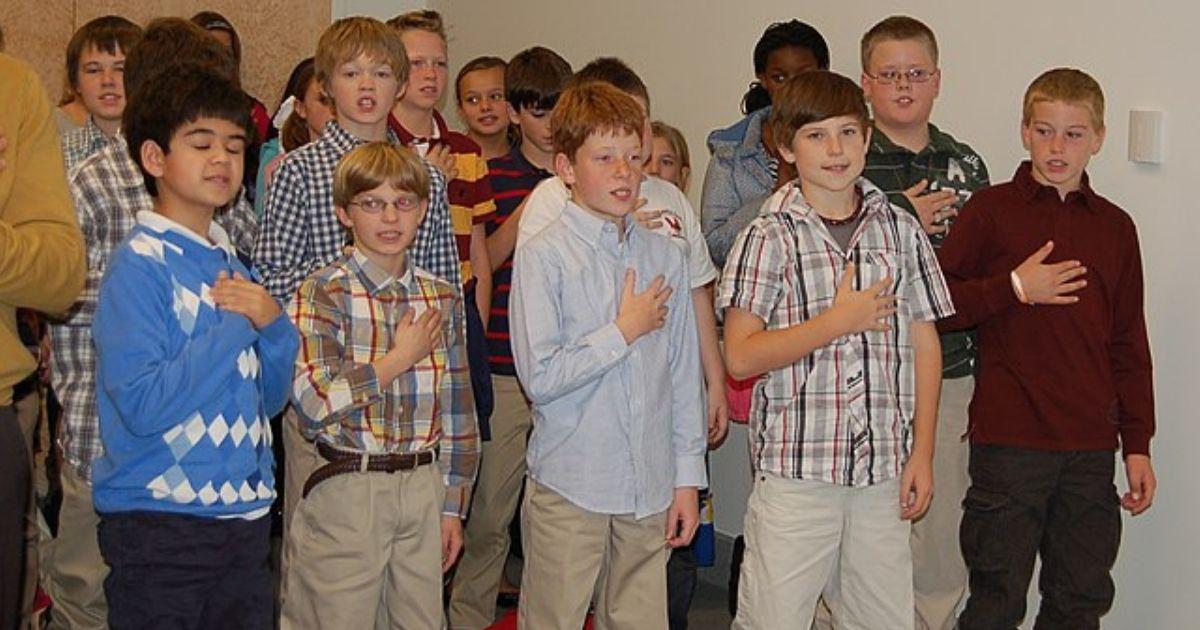
From an outside perspective, the pledge of allegiance seems "culty."Photo credit: U.S. National Archives

You know how you were raised in a household where things were done a certain way, and then at some point, you went to other people’s houses and saw that other people’s families lived completely differently and it sort of blew your mind? Different rules, different standards, different consequences, different habits—all of which were considered normal to them? Some of those differences may have made you thank the heavens for your parents, or they may have made you realize your own family had some issues you didn’t recognize.

The same thing happens when you are born and raised in a specific culture. Your sense of what’s normal is molded by it—so much so that you may never even think to question whether certain things are actually rather bizarre.

That’s why it’s nice to have some outside perspective sometimes.

A Reddit user asked “What is the most bizarre thing Americans do that feels unbelievable by British standards?” and the answers are eye-opening.


Pledging allegiance to the flag

The first response was “Having kids pledge allegiance to the flag in school. Seems culty.”

Most adult Americans were trained as young children to place our hands over our hearts, face the flag and recite the pledge every morning at school. Every single morning. Swearing our allegiance to our country and its flag, out loud, in unison.

“I went to an American school while I lived in Italy; I was one of the only English kids there. The pledge of allegiance was indeed every morning, and it felt as culty as you think. They called my parents when I wasn’t joining in ffs,” wrote one commenter.

“Never mind seeming culty, it just flat out is,” wrote another.

And another: “As an expat, I can confirm that having to pledge allegiance to the American flag was definitely one of the weirdest things that contributed to the culture shock.”

Let’s be real. If we saw children from any country deemed unsavory to American sensibilities (let’s say Russia, China, North Korea, for example) being required to stand in unison and recite a pledge of allegiance to their country’s flag every single morning, we’d consider it brainwashing.

There’s a reason that first comment got more than 5,500 upvotes.

The way we do healthcare

The comment “Going bankrupt because you needed your broken leg realigned. Being homeless as a result of needing to pay for cancer treatment” garnered 2,000 likes because the U.S. approach to healthcare is genuinely bizarre.

Everything Americans accept about healthcare is asinine: the for-profit health insurance industry, the fact that health insurance is tied to employment (but not all employment, because that would make too much sense, apparently), the fact that we pay way more for healthcare than other wealthy nations and yet have worse health outcomes, the fact that virtually no one understands how their health insurance works because it’s so complicated, the fact that medical bankruptcy is a thing, etc.

And on top of that, the fact that there is a baffling number of Americans who actually defend this system when all evidence points to the superiority of universal healthcare is absolutely mind-blowing.

How we don’t do guaranteed paid parental leave

“No paid maternity/paternity leave and new mothers having to go back to work within two weeks of giving birth. Insane,” wrote one commenter.

After Americans tried to say this wasn’t true because their company offers paid leave, the commenter clarified that the U.S. doesn’t require paid leave. It’s up to the discretion of companies, which is, indeed, insane.

“I’ve always thought this was barbaric but since having my baby it horrifies me even more,” someone wrote in response. “My baby is 12 months old next weekend and I’m still on leave. My mat leave is just finishing and I’m about to start annual leave which will see me through until January. I’ve been on around half pay for the year which has been tough financially but I wouldn’t give up this time for anything.

“At 2 weeks I could still hardly sit (episiotomy), my boobs were painfully full and leaking all the time, I was barely managing to get dressed, my baby was wanting to be held at all times day and night… I was hardly functioning.

“We don’t separate kittens and puppies from their mothers that early, how can it possibly be okay to separate babies from their mothers.”

School shootings and the active shooter drills that go along with them

Well, yeah. Not exactly a point of pride.

It’s not that other countries never ever have school shootings, but the U.S. is in a league of our own here.

“My cousins in America do school shooting practises every term,” wrote one commenter. “It’s awful that that’s a thing they need. Scary.”

“You can buy bulletproof school bags,” wrote another. “It’s nuts.”

To be fair, most Americans would agree that school shootings and active shooter drills are bizarre. We just can’t agree on what to do about it.

Our lack of electric kettles, apparently

One commenter wrote:

“On a less serious note, boiling water in a pan (or microwaving it!) for a cup of tea or coffee. I’ve seen it when watching regular people do videos, not just on tv or whatever. Where are all the kettles??(There are a lot about guns and stuff, so I thought I’d do one that’s less sad.)”

Others chimed in:

“I’m a Brit living in the US and my electric kettle is viewed by some of my American friends as a revelation. I buy them as gifts.”

“Both times I’ve been to America, I would go down to reception at the hotel and ask for a kettle. The receptionist would look at me dumbly and ask what a kettle was. And this wasn’t once or twice. This was multiple times.”

Some people explained some reasons for kettles being rare-but-not-unheard-of, ranging from the voltage being different in the U.S. to the fact that microwaving water is quick and easy. But there’s also this:

“British/American living in the US… No one I know really drinks tea with enough regularity to warrant a kettle, specially living in tiny apartments with limited kitchen space. Coffee makers are a lot more common because coffee is more popular than tea that I’ve seen.”

This is the truth. (And I do know a lot of people with electric kettles, but it apparently varies from region to region.)

We don’t walk when we can drive

Several commenters pointed to Americans’ resistance to walking anywhere that’s farther than a block or two, as well as our lack of sidewalks and walkways to even make it possible:

“No pavements/sidewalks in some places. I went to Dallas for work some years ago, and was dismayed to find that I couldn’t just ‘go for a walk’ from the hotel.”

“Yes! Nobody there walks ANYWHERE. I have a friend who is from Iowa but lived in London for a few years. When she went back she said she really misses walking. I asked what she meant, she said if she just went on a random walk she’d definitely get people stopping for her thinking she’s not okay, not okay in the head or just homeless.”

“I was reading a book the other day that described a woman walking two miles to then get a bus home as a ‘hike’. I mean, that’s just walking? Sure it was alongside a road not on a pavement but it’s still just walking!”

“Yep, that’s really weird. I went to an IT conference in Orlando back in the late 1990’s. The hotel was only about a kilometre from the conference centre, so obvs we walked as the weather was nice. Not only was it tricky due to the lack of any footpath, people thought we were mad. Also you can’t just cross the road where you want to.”

Sorry, Brits. Our land is big and our gas is cheap compared to yours. And also, you know we’re notorious for our unhealthy habits.

Sales tax tacked on at the end of a purchase

“Taxes put on at check out,” wrote one commenter.

Wait, what? This isn’t normal?

Apparently not.

“The taxes infuriate me,” wrote one commenter. “I was in Canada last week and they do the same thing. I kept thinking I was being overcharged until I remembered that advertised prices don’t include taxes, and that you’re expected to tip for pretty much everything.”

“I only found out about the tax thing recently and it f*cking blew my mind,” wrote another. “How tf do you know how much cash you’ll need? Americans must be really good at mental arithmetic if they have to add tax every time they add something to their basket.”

Spoiler: We’re not all that good at mental arithmetic. We just know we need about 10% more money than what a thing actually costs.

Agreed, though. It’s weird and annoying.

This isn’t an exhaustive list, by any means. Other “bizarre” American habits include circumcision (just the messenger—please don’t send me hate mail), televangelism, prescription drug commercials and spray cheese.

Definitely some food for thought as we consider what’s “normal” and what’s not. Different or even “bizarre” isn’t necessarily bad, but we could certainly do some national soul-searching with some of the things on this list.

(And hey, British friends—the way you say “aluminum” is weird. So there.)


This article originally appeared on 11.18.21

  • Man gets wave of support after tearful confession that a friend called him ‘too poor’ to get invited anywhere
    A man gets a wave of support after sharing how a friend excluded him for being “poor.”Photo credit: @father_vs_world/TikTok

    Recently, a man went on TikTok to tearfully recount being called “poor” by a close friend. He was overwhelmed by the amount of support he received from total strangers.

    On February 12, Andrey Borul explained in a video that he had fallen into medical debt after spending two weeks nearly dying in the hospital. Now, he’s “working almost twenty hours a day trying to recover.”

    Borul isn’t alone in this struggle. Studies estimate that approximately 100 million Americans have some form of medical or dental debt, with total outstanding debt around $220 billion.

    And yet, Borul’s family has tried their best to keep their spirits up and “make it work.” They’ve always managed to “bring a gift” to whatever parties they were invited to.

    “Too poor” to get invited

    So when, at one of these parties, a friend said that Borul and his wife don’t get invited anywhere because they’re “too poor,” he was “dumbfounded.”

    Things only seemed to get worse when, presumably at the same party, couples were talking about “buying houses.” Borul’s wife suggested making a group trip to the mountains so the kids could enjoy the snow together. Again, a friend immediately “shot down” the idea, saying, “You can’t afford that.”

    Tears welling up in his eyes, Borul admitted, “It’s true—we can’t.” He then shared how, the next morning, he drove up to the mountains himself to bring down some snow for his kids to play with.

    @father_vs_world

    Daughter been praying for snow and since Idaho had zero snow days i made a secret trip high into the mountains to bring snow for them to play in

    ♬ Snow Day – Tabitha Meeks & Ryan Corn

    “After our bills are paid, we have so little left over for entertainment,” he said. “I’ve been working nonstop to dig ourselves out of this financial hole…being poor sucks.”

    Borul ended his clip saying, “I feel so alone. We haven’t been invited for three months anywhere.”

    Thankfully, Borul was met with a wave of support from viewers 

    A few people shared that they had found themselves in equally disheartening situations.

    “Most of us in North America are in your shoes.”

    Many chimed in to remind him what real friendship looks like.

    @father_vs_world

    Replying to @Sandyyy.R. How can so called close “friends “ be so crule.. just thinking about it makes me cry 😭

    ♬ original sound – father_vs_world

    “Bro, you literally went to the mountain and brought your kids back snow…you’re working 20 hours a day for your family…you are THE MAN. Do not let those types of people make you feel any sort of way. Run from them. You’re the kind of guy I would be honored to call my friend.” 

    “You almost died, lost two weeks of income, and those people did not help you? They are not your friends.” 

    “This broke my heart and angered me because I’ve been in between blessings before and I remember when we planned a trip and our friends knew we were in between blessings. They ended up paying for the trip and once we got back on our feet, that’s when we paid them back (they wouldn’t take it). My point is friendship is about support (not necessarily financial), love, and grace. As hard as it’s going to be it may be time for you and your wife to leave them where they are at. Sending you love.”

    “You should not be wasting your time and energy on these people. You are richer than them in the most important way.”

    “If they were your friends, they would ask how to help you, not leave you out because you don’t have the money.” 

    And perhaps most encouraging of all, donations began pouring into Borul’s GoFundMe to help cover some of those exorbitant medical bills and give him some room to breathe. So far, a little over $30,000 has been raised, inching closer to the overall $35,000 goal.

    Understandably, Borul was overwhelmed by all the support 

    “I woke up with a total lightness in my chest,” he said. “Total strangers showed me more compassion than my own friends. I am so beyond grateful.”

    Hopefully, Borul can take solace in knowing that he does have a friend group, even if it wasn’t who he was expecting.

    If you’d like to donate to Borul’s GoFundMe page, click here

  • Generation Jones is showing off their Farrah Fawcett feather hairdos from the ’70s in all their voluminous glory
    Generation Jones shows off their Farrah Fawcett–inspired hair from the 1970s.Photo credit: Reddit/Asleep-Cow-6367 & Wikipedia

    Television in the 1970s was packed with unforgettable variety shows and iconic late-night talk shows that showcased some pretty incredible performances. One TV show that had a seismic impact on pop culture in the late 1970s was Charlie’s Angels, which debuted in 1976 and starred the gorgeous Farrah Fawcett.

    It was Fawcett’s legendary coif that set off a major 1970s hair trend. Baby Boomers and Generation Jonesers took cues from Fawcett, opting for feathered shags and voluminous hairstyles that defined the decade.

    On Reddit, users shared photos and discussed the glory of the hair trend back in the day.

    Generation Jones on their feathered hairdos

    Redditor Asleep-Cow-6367 shared a photo of her feathered ‘do, along with a few funny comments. “I wanted to look RAD! 😅,” she wrote. “I didn’t know WTH I was doing, but I had that comb in the back pocket of my H.A.S.H. jeans! Haha. Oh, that blow dryer and round brush.”

    Another Redditor commented on her ‘do: “Nice! You had your hair ‘trained’ as they used to say back when.” She replied, “Kinda. I didn’t like hairspray, so I had that mirror in my locker door, and that comb in my back pocket! Every class break, I am checking my look! LOL.”

    She inspired other Gen Jonesers to share their nostalgic thoughts and memories:

    “Some of us guys pretty much had it too….lol.”

    “I loved my Farrah feather.”

    “I had shorter hair so I had the Dorothy Hamill. I think 90% of the girls were having one or the other.”

    “God the time and hair spray spent on these hairdos!! I looked exactly the same. I’m 63 now.”

    “The wild thing about this hairstyle is it worked on guys and girls. I’m a 64 year old man and I had that exact hairstyle in 1978.”

    “I remember getting the Farrah Fawcett hair style in Junior High. I cried when I washed my hair because it was the first time I had any type of bangs and thought I was bald. Haha I wore that style for several years as a teenager. My 8th grade school picture had the FF hair cut and the ugly baby blue eye shadow. I was next level using the dark blue mascara too.”

    Farrah Fawcett hair history

    Hairstylist Allen Edwards is credited with creating Fawcett’s signature hairdo.

    “The layers around the face are shorter,” Edwards told Stylelist in an August 2009 interview, according to the Huffington Post. “What made it different was that it wasn’t full on top. It was flatter, and the ‘Farrah’ part was the edges, which went flipping back. She had a very strong, squarish jaw, and with her hair long cut [and] moving away from her face, it took your eye away from it.”

    Edwards also told Access Hollywood that he had always wanted to style Fawcett’s naturally curly hair, and that the two finally met through mutual friend Jane Brolin in the mid-1970s.

    “When she came to me they were overbleaching her, and it was dry and didn’t have the luster I gave to it,” he quipped.

  • Bridgerton’s Luke Thompson shared his favorite French phrase. We need something like it in English.
    France isn't the only country with a saying like "un ange passe."Photo credit: Canva

    Luke Thompson has achieved heartthrob status as Benedict Bridgerton, the free-spirited, second-born son of the noble family featured in the popular Bridgerton television series. The show’s fourth season focuses on Benedict’s Cinderella-esque love story with a servant named Sophie, played by Yerin Ha.

    In an interview promoting season four, Thompson and Ha read questions from Bridgerton fans. One person asked Thompson, who grew up in France and speaks fluent French, to share his favorite French phrase.

    @etalkctv

    We can’t think of a better French teacher! 🇫🇷 Luke Thompson revealed what his favourite French phrase is and taught Yerin the language of love in the process! Watch the FULL video of Yerin Ha and Luke Thompson texting fans at the link in our bio. 🔗 Part 1 of ‘Bridgerton’ season 4 is streaming NOW on @Netflix. #LukeThompson #YerinHa #Bridgerton #French #BenedictBridgerton @Yerin Ha

    ♬ original sound – etalk

    “My favorite French phrase is probably…Oh! ‘Un ange passe,’” he said.

    Ha asked what it meant, and Thompson helped her decipher it. Un = a/an. Ange = angel. Passe = pass(es). In English, “Un ange passe” means “An angel passes.”

    “What it means is, when you’re having a conversation, or like just in a group, it’s a nice way of expressing awkward silence,” Thompson explained. “But it’s just those moments where like, just, there’s a bit of a lull and no one says anything. And you say, ‘Un ange passe.’”

    “You say, ‘An angel passes,’” Ha said. “That’s really nice.”

    It is nice. And it appears to be a glaring omission from the English language, since people in the comments shared that they have similar phrases for awkward silences in their cultures:

    “OMG we say the same thing in Arabic!”

    “We say the same in Portuguese… ‘passou um anjo’ ☺️”

    “In Spanish we say that, at least in Chile ‘pasó un angel or ‘un angel pasó.’”

    “In Spanish we say the same thing!! México 🇲🇽”

    “In Philippines we have this too! Haha may dumaang anghel 😂”

    “In Malay we said: malaikat lalu.”

    “We have that phrase in Danish too. But it’s more an angel went through the room.”

    “The Dutch also have this, but a reverend walks by instead of the angel 🙈 Angel is much nicer.”

    “We say that too in Nigeria. ‘Ndị muozi na agafe.’”

    It seems that many cultures have handy phrases like this to make a conversational lull feel mystical or magical instead of uncomfortable and awkward. The wording may differ from place to place—apparently, in Russia and Kazakhstan they say, “A cop was born”—but why don’t we have anything even close to it in English?

    When silence falls over a group of English speakers, we just stand there and shift our gaze, feeling the heavy seconds tick by. Occasionally, someone might acknowledge the silence by saying, “Well, this is awkward…” but that only emphasizes the awkwardness.

    The irony here is that English speakers tend to be particularly uncomfortable with silence, at least compared to cultures in which silence is viewed more positively.

    In his research, linguist Haru Yamada found that Americans consider the length of silence in Japanese speakers’ conversations to be “unbearably long.” Unlike many other cultures, we have no sweet, playful saying to slice through the pregnant pause.

    Not all silence is uncomfortable, of course. It becomes awkward when we expect others to speak—or when we are expected to speak—and no one does.

    According to Rebecca Roache, associate professor of philosophy at the University of London, the awkward feeling of silence comes from fear of how it might be interpreted: “Specifically, we worry about one or both of two things: having others misinterpret our silence, and having others correctly interpret our silence.”

    In other words, we might worry that people think we’re boring if we don’t have something to say, which would be a misinterpretation of our silence. Then again, we might worry that people will think we’re nervous, which may be a totally correct interpretation of our silence—but just not the impression we want to give others.

    The beauty of having a standard phrase like “un ange passe” is that it allows everyone to acknowledge that lulls in conversation are a normal, universal phenomenon. It says, “This is so common, we even have a saying for it.” That alone helps lessen the awkwardness. The English language’s lack of such a phrase now feels like a big, gaping hole in our social lives.

    Where did the idea of saying “un ange passe” come from in the first place? According to the Lawless French website:

    “No one seems to know the origin of the expression, whether the angel’s passing is what causes the silence or if she is attracted by the tranquility, but either way, un ange passe is a nice way to break the tension and continue chatting.”

    Can we just start saying “an angel passes” now? Do we need to ask anyone’s permission for this? It appears to be pretty universal, so maybe we English speakers just missed the boat somewhere along the centuries. It feels well past time to remedy that.

  • Henry Cavill shared a delightful story about a boy’s teacher who refused to believe his uncle was Superman
    Henry Cavill February 10, 2013Photo credit: Sean Reynolds via Wikimedia Commons

    When Henry Cavill was cast as Superman in 2011, most people were thrilled. His nephew Thomas was thrilled too, and he wanted everyone to know about it.

    At school, during a “talk about your family” day, Thomas told his class: “My uncle is Superman.” His classmates were stunned. Nobody believed him. His teacher, less than impressed, told him plainly: “Thomas, we don’t lie in school.”

    Thomas did not back down. “My uncle is Superman,” he insisted.

    The teacher, now genuinely concerned, raised the issue with Thomas’s mother when she came to collect him that afternoon. She walked her through the whole incident, explaining that the school did not encourage children to make things up in front of their peers. Thomas’s mother listened patiently, then delivered the news as gently as she could.

    “I hate to tell you this,” she said, “but it’s all true.”

    Cavill told the story on The Tonight Show with Jay Leno in June 2013, and it got so much mileage that he retold it on Live with Kelly and Ryan in 2018. Both times, audiences loved it for the same reason: Thomas never wavered. He knew what he knew, and no amount of adult skepticism was going to change it.

    “My uncle is Superman” is not the kind of claim most teachers are prepared to receive. But from Thomas’s perspective, it was simply a fact about his life, one that happened to be harder to verify than most. As Cavill told the story, there was no drama, no grand reveal. Just a small boy, stubbornly telling the truth, and a mother who had to gently correct a teacher’s assumptions at school pickup.

    The clip from the Live with Kelly and Ryan appearance has amassed over nine million views, with fans delighting in the specifics. “I hope the teacher replied by saying ‘I’m going to need you to prove that,’” one commenter wrote. “If my uncle was Superman I would brag about it every single day,” said another.

    Thomas, for his part, appears to have handled the whole thing with exactly the composure you’d expect from someone whose uncle saves the world for a living.

    This article originally appeared last year.

  • His classmates wouldn’t sign his yearbook. He signed it himself. Then Paul Rudd got involved.
    Photo of a high school; (Inset) Paul Rudd Photo credit: Gage Skidmore via Wikimedia Commons

    When Brody Ridder came home from school on May 24, 2022, his mom took one look at his yearbook and felt her heart crack open. He’d asked all kinds of kids to sign it. Two had. Two teachers had. And then, on one of the pages, in his own handwriting: “Hope you make some more friends. — Brody Ridder.”

    He had signed his own yearbook. And then wished himself better luck next year.

    Cassandra Ridder posted a photo of the page to the school’s private Facebook parent group that night. She didn’t ask Brody first, but as she told the Washington Post, she knew he’d be fine with it. “Brody has always told me he wants to be part of the solution.” Her message to other parents was simple: talk to your kids about kindness. She had no idea what was about to happen.

    Other parents showed the post to their kids. Seventeen-year-old Joanna Cooper got a text from her mom with a screenshot and made a decision on the spot, as she told KDVR. “We’re going to sign his yearbook,” she said, “because no kid deserves to feel like that.” She started texting friends. Meanwhile, Simone Lightfoot, also an 11th grader, was doing the same thing. “When I was younger, I was bullied a lot like him,” she told the Washington Post. “We walked in and we were like, ‘Where’s Brody at? Is Brody Ridder in here?’ And they’re like, ‘Yeah, he’s in the back.’ And we’re like, ‘Brody! We’re here to sign your yearbook, bud.’”

    The older kids didn’t just sign their names. As Goalcast reported in its coverage, they asked Brody about his hobbies, which turned out to include chess and fencing, and gave him a pep talk. Many of them had been in similar situations at his age. Once the upperclassmen started filling pages, the kids in Brody’s own class started getting up from their seats to sign it too. “It was like a domino effect,” Cassandra told Fox News. “It was beautiful.” By the end of the day, Brody had collected more than 100 signatures, paragraphs of encouragement, and a handful of phone numbers.

    “It just made me feel better as a person,” Brody told KDVR. “I don’t know how to explain it. It just makes me feel better on the inside.”

    The story didn’t stay local for long. After Cassandra posted an update to her personal Facebook, it spread widely. Letters started arriving at the Ridders’ P.O. Box from people across the country and around the world, people of all ages who recognized something in Brody’s story. By July, at least 600 letters had arrived, with more still coming, including one dictated by a three-year-old to his mom.

    Among those who reached out was Paul Rudd. According to the Denver Post, Rudd’s sister saw Cassandra’s post and contacted her to say the actor would love to connect with Brody. Rudd FaceTimed him and sent a care package that included a signed Ant-Man helmet and a handwritten note telling Brody that things get better and that many people, Rudd included, thought he was “the coolest kid there is.”

    Cassandra and Brody have since partnered with The UGLI Foundation, an anti-bullying nonprofit, to keep the conversation going, according to the Denver Post. Cooper, the 11th grader who organized the original yearbook visit, said she planned to push for a schoolwide signing event the following year so no student would face an empty book again.

    Brody said he’s not sure all the kids who refused to sign will become his friends. But something shifted. “It made me feel like there’s hope for the school,” Cassandra said, “there’s hope for humanity, and there are a lot of good kids in this world.”

    This article originally appeared two years ago.

  • ‘I am 55 and I look exactly 55.’ Woman’s viral commentary on aging hits all the right notes.
    It's more than okay to look your age.Photo credit: @tingmystyle/Instagram

    “You look like you’re aging backwards!”

    “You can’t be 50—you don’t look a day over 35!”

    “How do you stay looking so young? What’s your secret?”

    While such comments may be well-intentioned, a woman’s viral video challenges the idea that they are actually compliments. Ting, who posts as @tingmystyle on Instagram, looks directly at the camera and says matter-of-factly, “I am 55 and I look exactly 55. Stop telling a woman, ‘You look younger,’ or ‘You look good for your age.’ It’s not a compliment.”

    Challenging youth-obsessed culture

    Ting says such comments only reinforce our youth-obsessed culture.

    “Everyone ages so differently,” she points out. “What are we even supposed to look like at this age? So tired of hearing that ‘She’s in her 50s but looks 20 years younger.’ Why is that the goal?”

    It’s a question worth asking—and definitely one worth pausing to answer. So often, people go along with what society dictates as the norm, and today that norm means trying to look younger than one’s age. But why? Traditionally, elders have been revered. When did we decide youth was superior?

    As Ting declares, “I don’t survive five decades to be obsessed with looking 30. How many people never made it to 55?”

    Aging is a privilege

    Aging is a privilege not everyone gets. Shouldn’t we feel happy to have lived as long as we have? Part of wanting to look younger may be that getting older reminds us of our mortality. But in reality, none of us knows our timeline, and if we see each day of life as a gift, the more days we’ve lived, the better.

    “Women don’t owe the world youth, beauty frozen in time,” Ting states. “Looking my age, or even older than my age, is not a failure. Youth is not a standard. It’s just a season. And the seasons change.”

    Four images of trees and leaves during the four seasons as a metaphor for the seasons of life
    Every season has its unique beauty. Photo credit: Canva

    Amen. When we hold youthful beauty up on a pedestal, we miss the beauty of every other season. And though women have borne the brunt of the expectation to remain young-looking, men are feeling the pressure to look younger as well. Just look at the Hollywood stars across the gender spectrum getting facelifts and eyelifts. There’s nothing wrong with wanting to look good. But that’s not the same as trying to look young.

    “We look our age not because we’ve let ourselves go, but because we’ve finally let ourselves be,” says Ting. “I am so proud to look my age.”

    Embracing aging with pride

    It feels like an act of defiance to let ourselves look our age, much less be proud of it. But with more than eight million views, middle-agers everywhere heard Ting’s message loud and clear.

    Here’s what people are saying in the comments:

    “Ooooh, youth is not a standard, it’s just a season. Loveeeee.”

    “‘How many people never made it to 55.’ My mum never made it. I would have loved to send this video to her.”

    “Turning 39 next year and I’m excited! Like wow thank you for another year of life! I almost died in 2022 from a stroke and every birthday I’m just so thankful for my life.”

    “Aging is a privilege. I’ve lost too many people who would have loved to be here, wrinkly & full of sun spots and grey hairs.”

    “Yes! I’m 58. Don’t call me ‘young lady.’ Don’t tell me ‘happy 30th,’ on my birthday. Do you imagine I was having this much fun when I was 30? I wasn’t.”

    “Yes! Yes! Yes! When I turned 50 someone said to me – and I quote – ‘That’s ok 50 is the new 30!’ And I immediately shot back – ‘God I hope not. At 30 I was knee deep in diapers, never got any sleep and cared way too much about what other people said.’ At 58 when someone tells me I don’t look my age all I say is yes I do and change the subject.”

    “I’m 55 too. My only goal is to have clear glowing skin. I’m not supposed to look like my kids and I’m okay with that.”

    “I like giving compliments like wow you have amazing skin. Or wow you have such gorgeous shiny hair. Your eyes are bright – etc. You’re so right about youth-based compliments.”

    Examining our own habits

    So many are taking Ting’s message to heart, and it’s something to consider the next time we feel compelled to tell someone they look young for their age. Is this really a goal we want to reinforce? Or is it a social norm that needs to be thoughtfully examined—if not outright done away with?

    Thank you, Ting, for putting it so plainly and for serving as an example for us all.

    You can follow Ting on Instagram here.

  • A non-American asked how lemonade stands work. The responses are an absolute field day.
    Kids in the United States love to have lemonade stands.Photo credit: Canva
    , ,

    A non-American asked how lemonade stands work. The responses are an absolute field day.

    “I personally believe it’s illegal to not buy lemonade from a lemonade stand, especially if the kids are young and having fun.”

    Having a lemonade stand is like a rite of passage for children in the United States. So much so that they’ve become a trope in many movies set in America.

    Lemonade stands evoke nostalgia and fond childhood memories for many Americans. According to Smithsonian Magazine, 40% of Baby Boomers reported having a lemonade stand during their childhood.

    So when a non-American on Reddit genuinely asked if lemonade stands are “a real thing” here in the States, they got a flood of emphatic responses.

    Adding that in their country “parents would be embarrassed if their kids did that,” they asked Americans to describe “the vibe” of lemonade stands.

    “Is it seen as a cute hobby or an actual way to learn about money?” they wrote.

    And while many Americans confirmed that lemonade stands are indeed breeding grounds for future entrepreneurs, they also explained why they symbolize so much more in American culture.

    American lemonade stands, explained

    Some American Redditors took a more straightforward approach, describing what lemonade stands are all about and how they support kids with a business mindset:

    “It’s not something kids do to actually support their families. It’s a for fun thing typically done when school is out for pocket money or for fun to learn about running a business.”

    “I’ll also add that many people like to support kids doing this. I rarely want a cup of lemonade, but I pretty regularly stop to buy some when I see a stand in the summer. People like supporting kids who are putting in effort and people find it cute. It’s similar to kids mowing lawns, shoveling snow, selling bottled water, watering gardens, etc. for cash.”

    “I don’t want the lemonade, but I want to reward the kids for initiative. I’ll usually pay for a few, drink one and then tell others to stop by.”

    “I ALWAYS stop when I see one. Anytime I do I always overpay. $1 lemonade? Here is $5+ (depends on what I have). I’ve done it… 4 times so far? Not often but enough to make me happy to do it.”

    “Yes and I personally believe it’s illegal to not buy lemonade from a lemonade stand, especially if the kids are young and having fun.”

    “Yeah it’s viewed here they the kid is a ‘go getter’. They’re motivated and trying to get ahead. It’s not common on super busy roads, but on smaller neighborhood roads.”

    Americans share their nostalgic lemonade stand memories

    Others offered up their personal stories of how setting up a lemonade stand back in the day impacted them:

    “I remember receiving a Sacagawea dollar as a kid selling lemonade!! Best customer ever!”

    “When I was of the age (early 1970s) we had a giant lemon tree in our yard, that we used to make the lemonade. Ours was definitely not ‘warm and horrible.’ Ice came from the trays for free, but my mother lent us the money to buy the sugar, and we paid her back from profits. I guess she was really into the authenticity of the business experience.”

    “My dad made me pay him back for the frozen lemonade cans (where you add water to create a quart or half gallon), but didn’t tell us until after so our price of $0.50 barely covered it. Killed my business initiative real quick Selling coffee at the bottom of my driveway that was across from a polling place was far more effective.”

    @sweetmamamadeline

    Even tho I don’t like lemonade… I am still always going to stop! 🤣 #lemonadestand #mom

    ♬ original sound – mama madeline | mom life

    The history of the lemonade stand

    According to Smithsonian Magazine, the first recorded lemonade stand in the U.S. appeared in New York City in the fall of 1839. The publication also noted that in 1880, The New York Times reported that “a customer can have a glass of ice-cold lemonade, made before his eyes, for five cents.”

    Back then, lemonade was hawked by adults. By the early 1900s, it had become a popular entrepreneurial venture for children. Kids initially sold lemonade for charitable purposes. After states passed laws in 1918 requiring school attendance for children, lemonade stands became a summer staple.

    In recent years, many states have cracked down on lemonade stands due to public health concerns. Some began requiring permits for kids to run them. However, many states have also bucked regulation—including Georgia and Texas—ensuring that lemonade stands continue to be part of many American childhoods.

  • 21 years ago, Halle Berry made history by turning a Razzie into one of her most iconic performances
    Halle Berry made history by turning a Razzie into one of her most iconic performances.Photo credit: Razzie Channel/YouTube & Canva

    In 2004, the film Catwoman (directed by a French visual effects supervisor known simply as Pitof) was unleashed on the world, and it did not go well. The movie received scathing reviews, landing at 8% on Rotten Tomatoes (with an audience score of 18%). This didn’t go unnoticed by the Golden Raspberry committee, which bestowed seven nominations on the film, including Worst Picture, Worst Screenplay, and Worst Actress for Halle Berry.

    Did this stop Berry from having a good time? Absolutely not. In 2005, she created one of the most iconic power moves Hollywood has ever seen.

    For those unaware, the Golden Raspberry Awards (better known as the Razzies) began in 1981 as a satirical antithesis to the Oscars. The idea was that if filmmakers received prizes for “good work,” they should also have to accept awards for the “best worst” movies.

    So when Berry “won,” she didn’t just take it in stride. She used it as a reminder that she’s one of the entertainment business’ most incredible performers.

    Posted on the Razzie YouTube page, we see two presenters announce her name: “Halle Berry for Catwoman.” The crowd claps and laughs as we see a clip of Berry in the film, sniffing catnip manically.

    “Ladies and gentlemen—Halle Berry.” The crowd erupts as Berry, clad in a beautiful black dress, comes roaring onto the stage holding both her Razzie and her Oscar, which she received in 2002 for her work in Monster’s Ball. She feigns shock and excitement as the crowd jumps to its feet for a standing ovation.

    Berry’s speech

    “Oh my gosh,” she yells into the mic while milking every cheer. She pretends to hyperventilate, perhaps even tearing up a bit. “Thank you, guys! Thank you so much! I never in my life thought I’d be up here winning a Razzie.” The crowd laughs uproariously. “I mean, it’s not like I ever aspired to be here, but thank you!”

    What she does next is on another level. She holds up her Oscar and screams, “And no, I don’t have to give this back—it’s got my name on it!” Now the audience knows she’s in charge. She composes herself and says, “Ya know? I’ve got so many people to thank, because you won’t win a Razzie without a lot of help from a lot of people. So please indulge me and let me go through this.”

    Spoofing an Academy Award acceptance speech, she begins her list of “gratitude.” “First of all, I want to thank Warner Bros. Thank you for putting me in a piece-of-s–t, God-awful movie! It was just what my career needed, ya know? I was at the top, and then Catwoman just plummeted me to the bottom. Love it!”

    She pauses, then says, “It’s hard being on top. It’s much better being on the bottom.” The list continues. “I want to thank my manager, Vincent Cirrincione,” she says, and ushers him onto the stage. Cirrincione humbly listens while she kids, “This guy loves me. He loves me so much that he tells me I’m the greatest actress who ever was. He loves me so much that he convinces me to do projects even when he knows they’re s–t!”

    He humbly nods and plays along. “My only advice to you, Vinnie, is next time I do a movie—if I get a chance to do another movie—maybe you should read the script? Just counting the zeroes behind the one really isn’t enough. You’ve really got to read the script. Love you, man. Love you!”

    Berry is far from done.

    “I want to thank my agent and lawyers, who obviously don’t give a s–t. They’re not here tonight, but love you guys! I want to thank the writers—all twenty of them—for thinking this was a good idea.” She adds, “You tried, hey.”

    She couldn’t do it alone

    Now it’s time for her fellow actors to receive some love.

    “I want to thank the cast. You know, it’s really important. In order to give a bad performance like I did, you need a lot of bad actors around. So I want to thank all of them for being bad right along with me! One of them is here—Alex Borstein. Come on out!”

    Borstein, who played Sally, the “sassy best friend,” mugs and chews the scenery onstage as she stumbles out with fake tears. The crowd cheers. After they calm down a bit, Berry gets more serious. “One of the best things about Catwoman is I got to make some really wonderful lifelong friendships, and this lady is one of them.”

    Borstein composes herself and gazes into Berry’s eyes. She continues, “And you know what? I want to thank you for every single day looking up at me and telling me I was doing a great job—that I was the best Catwoman you ever saw. I want to thank you for lying straight to my face every day. You know, in Hollywood they lie behind your back, but she lied straight to my face!”

    Again, the crowd goes wild as Berry refocuses her energy. “I also want to thank our director, Pitof—you know, that one-name French guy? Thank you very much.” She admits his accent made it hard to take direction. “I mean, I didn’t know what the hell he was saying, but I’m sure it showed in my performance. But it was truly a joy and a pleasure.”

    Her acting coach is now on deck: “I want to thank my acting coach, Ivana Chubbuck. She just wrote a book called The Power of the Actor. You all should rush to get it. It could change your life too.”

    Berry ends on a serious note, saying, “When I was a kid, my mother told me that if you could not be a good loser, then there’s no way you could be a good winner. If you weren’t able to take criticism, then you were not worthy of getting your praise.”

    She then shares a story of having begun in beauty pageants and learning to control her rage when she lost. “So as you can imagine, I wanted to slap the s–t out of the Razzie people that brought me here tonight. But I won’t do that. I’ll do what my mother taught me and I’ll stand here graciously. I’ll take the criticism—take it as a lesson learned—and hope to God I never see these people ever again. Thank you all!”

    The response

    The audience claps with joyous applause. So did the comment section. On the official YouTube page, there are over 4,000 comments, with one reading, “This lady is classy as hell! Anyone who accepts their Razzie in person has my respect, and the delivery was absolutely priceless!”

    Another comment references the time Adrien Brody gave a six-minute speech for his Best Actor win for the film The Brutalist. The YouTuber jokes, “This speech is longer than Adrien Brody’s 6-minute speech, and hers is undeniably not a second wasted.”

    A clip circulating on Instagram has nearly 18,000 likes and a heap of support for her talent and her sense of humor. One person jokes, “The fact that she brought her Oscar…”

Culture

Bridgerton’s Luke Thompson shared his favorite French phrase. We need something like it in English.

Life Hacks

Woman’s request for ‘life-changing sentences’ is a gold mine of wisdom

Nature

In 1958, a scientist began filling flasks with air. The samples showed the Earth was ‘breathing.’

Science

The little paper emoji on your phone has words on it and people are stunned at what it says