upworthy
Add Upworthy to your Google News feed.
Google News Button
Science

Zoo in Michigan proudly welcomes the arrival of two adorable baby bintlets

Great news! What's a bintlet?

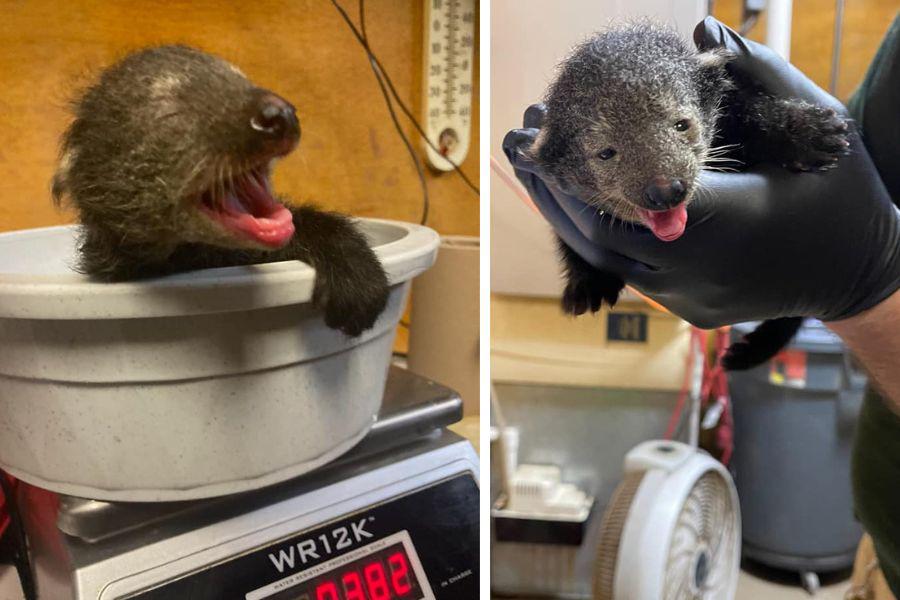
baby bintlets on scale, held in someone's arms

A dose of cuteness the world needs to see.

Michigan’s Potter Park Zoo was thrilled to announce the arrival of some new residents in 2022: bintlets.

You might be asking yourself, Um, just what is a bintlet? Well, bintlets are baby binturongs, fascinating creatures that hail from the rainforests of Southeast Asia where they love to hang out in the lush treetops. They're one of the few animals with a prehensile tail, meaning it can hold and manipulate objects.

Binturong: The bearcat that is neither bear nor cat.www.youtube.com

Though they are often called "bearcats" due to their hodgepodge appearance, binturongs are neither bear nor cat. They belong to the Viverridae family, a very unique species group containing all seemingly cat-like critters, though none are actually felines. According to Britannica, they have even been reported to be affectionate pets, much like the domestic house cat. But still—not cats. Very misleading.

Also: The binturong’s teeth technically classify it as a carnivore. However, it might as well be classified as a fig-etarian by the way it likes to swallow the small fruit whole. They’re basically a walking contradiction on four legs.

Perhaps the coolest thing about binturongs is that getting up close and personal with one might have you thinking you waltzed into a movie theater. They mark their territory by secreting a substance that famously smells just like buttery popcorn. Nature’s creativity is endless.

Threatened mostly by deforestation and illegal wildlife trade, binturongs have been listed as “vulnerable” on IUCN (International Union for Conservation of Nature) Red List. That makes the birth of Potter Park’s bintlets—the first bintlet birth at the zoo in more than two decades, WILX News reported—all the more special. Baby animal news is great. At-risk baby animal news is even better.

Potter Park posted to its Facebook page congratulating Thistle, the zoo’s female binturong, on her newborns. WILX added that where Thistle would remain with the bintlets for a few months time, the binturong father (named Barry—Barry the binturong, it’s just too perfect) would still be viewable at the zoo’s habitat.

Officials added that, sadly, only two of three bintlets survived. Despite 24 hours of care from veterinary and animal care staff, the third bintlet passed away from an illness. Still, in the video we see two healthy, squeaking babes right next to their happy mama.

"Love how the mom looks right at the camera like she is saying aren’t my babies the cutest babies ever," one person commented.

And now for the moment we’ve all been waiting for—close up photos revealing all the bintlet cuteness.
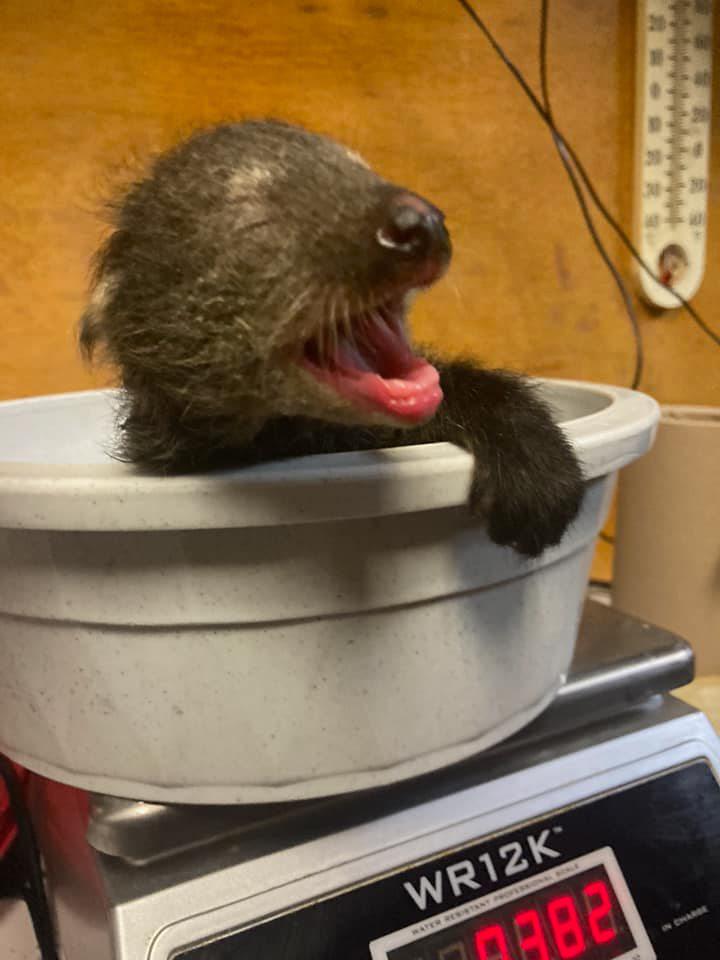
baby bintlet

100% adorable.

scontent-lax3-2.xx.fbcdn.net

A baby bintlet in a baby bathtub. To what do we owe this pleasure?

This one has its little eyes open.
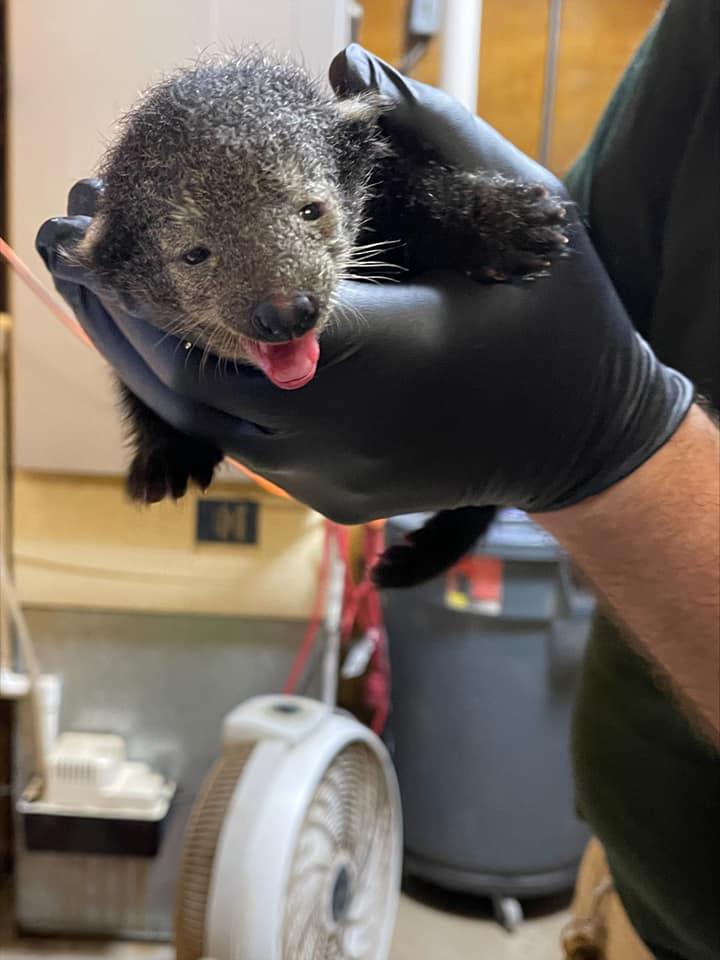
baby bintlet

Sooooo teeny!

scontent-lax3-1.xx.fbcdn.net

According to Smithsonian's National Zoo & Conservation Biology Institute, bintlets are born with their eyes closed and will cling to their mothers until independent. Sometimes for even longer. Relatable.

Special thanks to Potter Park Zoo and Thistle for delivering some happy news to get us through the week. We got a sweet story and fun animal education—it doesn’t get much better than that.

If you’d like to check in on all the animal shenanigans happening at Potter Park, you can follow the zoo on Instagram. With more than 350 residents of all sizes and species, there’s sure to be no shortage of wholesome critter content.


This article originally appeared three years ago.

Health

From trials to treatments: one family's journey with "Brittle Bone Disease"

For Alex and his family, osteogenesis imperfecta spans four generations — and Shriners Children’s has been there every step of the way with life-changing care.

Four generations, one diagnosis: A family’s lifelong journey with “Brittle Bone Disease”
True

Like his mom, grandma and great-grandma before him, Alex was born with a condition called osteogenesis imperfecta, otherwise known as “brittle bone disease.” For every family member before him, the condition meant a lifetime of broken bones, hospital visits, and constant worry — but that story is now changing. With the support from Shriners Children’s™, Alex is experiencing a level of freedom and quality of life that former generations had only hoped for.


A family affair

Alex’s family’s story began in 1934, when his great-grandmother June started fracturing her bones at the age of 10. June would be nearly a teenager before she received a diagnosis of osteogenesis imperfecta — and, with that, she became one of the first patients with the condition to be treated at Shriners Children’s.

June’s daughter, Wanda, was diagnosed with the same condition at Shriners Children’s shortly before she was born in 1955. Like her mother, Wanda spent a significant part of her childhood in the hospital, often watching her siblings line up outside the hospital window to wave and wish her luck between surgeries.

When Wanda’s daughter was born, Chandra spent years undergoing treatment at Shriners Children’s for osteogenesis imperfecta, like her mother and grandmother before her. Experiencing more than 200 fractures in her early years, she was unable to walk before age 22 — but no less determined to make life better for others with her condition. Chandra donated her bone marrow to be used in a study, and the results contributed to the OI protocols and treatment that are now the standard of care all over the world. Best of all, this study would go on to benefit her own son, Alex.

Care that feels like family

While her treatment journey was challenging, Chandra also cherished her experience at Shriners Children’s. “The staff was like family to me,” she said.

Shriners Children’s has been providing that same level of professional care for families across the country. Founded in 1922 — just two years before June was born — Shriners Children’s has been providing specialty care to children with a wide variety of complex conditions, such as orthopedics, burn injuries, cleft lip and palate, and others.

But Shriners Children’s doesn’t provide this care alone. All services are made possible by generous donors. Through their giving, patients are able to access specialty care as well as adaptive equipment, long-term rehab, surgeries, and more. In one year alone, Shriners Children’s performed more than 24,000 life-changing surgeries, as well as 446,000 procedures. On top of that, they delivered tens of thousands of prosthetic and orthotic devices for patients in need and welcomed an additional 62,000 patients on top of that.

Hope for a new generation

With Chandra’s bone marrow donation, along with the compassionate care he was able to receive through Shriners Children’s, Alex is now able to live a life his family only dreamt of. To treat his condition, Alex receives infusions that regulate calcium levels in his blood and slow bone breakdown.

“When Alex started walking between one and two years old, I was shocked,” Chandra said. “The fact that he was able to walk, even run, and knowing I had a part to do with that, makes my heart happy.”

Without consistent treatment, Alex’s family believes he might still be spending most of his time in the hospital, facing broken bones and countless fractures. Instead, the compassionate care he receives has given him a bright future — and has made Chandra eternally grateful.

“Shriners [Children’s] is amazing with him,” she said. “I love Shriners [Children’s] so much.”

Shriners Children’s helps children heal and thrive so they can chase their dreams. Learn more about how they’re making it possible and share this article to inspire others to join you. Shriners Children’s relies on generous donors to make a difference.

Donate today during the 3X Match Challenge to make 3X the life-changing impact for patients.

black lab, dog walker, dog walker near me, dog walker ap, neighbors, good news, pets, feel good news

black lab (left. Handwritten letter (right)

If you've lived your whole life with a dog, a home has to feel pretty empty without one. Your heart has to feel like there's something missing as well. When Jack McCrossan, originally from Scotland, moved to Bristol, England with his three friends, they were bummed out to learn that their landlord didn't allow dogs.

So when they saw a beautiful black Sheprador (a German Sheppard Lab mix) in their neighbor's window, they knew that had to become buddies with her. They wrote the dog's owner, Sarah Tolman, a letter asking to arrange a play date with the dog. "If you ever need someone to walk him/her, we will gladly do so," they wrote.


"If you ever get bored (we know you never will, but we can dream), we are more than happy to look after him/her. If you want to come over and bring him/her to brighten our day, you are more than welcome. If you want to walk past our balcony windows so we can see him/her, please do," the letter continued.

"We hope this doesn't come too strong, but our landlord won't allow pets, and we've all grown up with animals. The adult life is a struggle without one," they wrote. "Yours sincerely, The boys from number 23," the letter concluded.

Soon after, the boys in 23 received a response from the dog herself, Stevie Ticks, accepting the offer. However, it may have been written by her human, Sarah Tolman. In the letter, Stevie shares a bit about herself, saying she's two years and four months old, was adopted in Cyprus, and that she's "very friendly and full of beans." (The boys shouldn't worry about a gassy hound, in England, "full of beans" means lively.)

"I love meeting new people and it would be great if we can be friends. I must warn you that the price of my friendship is 5 x ball throws a day and belly scratches whenever I demand them," the letter continued. A few days later, the boys got to meet Stevie.

"Meeting Stevie was great!" McCrossan told Buzzfeed. "She was definitely as energetic as described. We got to take her for a walk and she wouldn't stop running!"

Tolman thought the boys' letter was a fantastic gesture in an era where, quote often, neighbors are strangers. "In a day and age where people don't really know or speak to their neighbors, it was really nice for them to break down that barrier," she said. After the story went viral, she saw it as an opportunity for people to share their love of dogs with the world. "My mother and I are amazed at all the love we've received from around the world these past few days," Tolman wrote as Stevie. "If you have a doggo in your life, share that love with those around you."

A lot has changed since this story first warmed hearts around the globe. The boys have since moved away, but as of September 2024, Stevie is around 8 years old and still living her best life. Recently, she even made it to the doggie wall of fame at her local coffee shop.

In the years since this story first went viral, pet-sharing and neighbor dog borrowing have actually become more common, especially in cities where landlords restrict pets. Several platforms (like BorrowMyDoggy) and community groups now exist to pair dog owners with trusted neighbors who want occasional playtime, walks, or dog-sitting without having to own a pet. It’s a small but growing trend that reflects how deeply animal companionship is needed—even for people who can’t adopt a dog full-time. In many apartment buildings, these kinds of informal arrangements help reduce loneliness, build community, and give non-owners the emotional benefits of living with pets.

Just goes to show the power of a dog's love…even if that dog isn't your own.

This article originally appeared six years ago.

maikon alves, agt, dance, robot dance, dance tutorials, tiktok dance, agt dance
Maikon Alves | Instagram

Some people have such amazing control of their bodies

If you're a dance enthusiast, or just anyone who appreciates great artistry, meet Maikon Alves, a dancer from Brazil turns heads on social media with moves so fluid and robotic that people around question if he's human.

In one particularly viral video, Alves dances to "Boom Boom Pow" by the Black Eyed Peas—to say his moves are impressive would be an understatement. Alves pops his chest to the beat while slowly stepping in place making it look like he's gliding from move to move. Some movements are crisp and sharp like a robot while others are so fluid it's nearly unbelievable that it could be coming from a human.


While the man's moves do look slightly out of this world, he is indeed a real person, or at least he appears to be in other videos on his page.

Comments ranged between being in awe of his abilities and questioning if he was human.

"Loved. I like how everything is in sync - from the music to the moves to face expressions. 👏👏👏 and your cool personal style," one person writes.

"Doesn’t even look real it’s that good..!! Love this," someone says.

"You will be the dance instructor for the children of our AI overlords someday," a commenter thinks.

"Nah, this is God-level pop-locking," someone compliments.

Even Nicole Scherzinger, actress, singer and former member of the pop group and dance ensemble, Pussycat Dolls gave Alves praise saying, "you are a legend!"

Alves' uncanny robot dance even made its way to season 19 of America's Got Talent. His audition routine included pretending to play the Violin and a fun moonwalk to robotic themed music.

Gotta hand it to folks like Alves, who remind us all what amazing feats the human body is capable of, and how dance can instantly spark joy. Whether you're the one performing the moves or not.

To catch even more of his nifty routines, follow Alves on Instagram.

This article originally appeared last year. It has been updated.

predators, forensics, crime, women, awareness
via Екатерина Шумских/Pexels, Vladimir Konoplev/Pexels and Teona Swift/Pexels

Three women walking down city streets.

A forensics student named Alexandria recently shared vital information on TikTok that all women should know. She detailed the specific signs male predators are looking for when they choose a victim.

Her video is based on a 2013 study entitled “Psychopathy and Victim Selection: The Use of Gait as a Cue to Vulnerability.” For the study, researchers interviewed violent criminals in prison and asked them the type of women they’d be most likely to victimize.


The study found that the criminals all agreed that how the woman walked was a deciding factor.

“What the selected women all had in common was the way that they walked and how they generally held themselves in public,” Alexandria says in the video she later deleted but has been shared broadly across the platform.

@_alf_90_

How to walk for your safety! #women #safety #tips #walking #kidnapping #murder #attacks #fyp

“The selected women all had a similar ‘awkwardness’ to the way that they walked and carried themselves,” she continued. “The first part of the woman had a gait that was a little bit too small for their body, which resulted in smaller steps, slower speed and their arms more typically to their sides, or crossed, as well as their heads being down and not really taking in their general surroundings, which indicated three different things to these potential attackers.”

The woman’s body language signaled to attackers that she was fearful and anxious and because her head was down, she'd be easier to surprise. Alex then described the second type of woman the criminals said they’d target.

“On the other hand, the other part of the women that were selected had a gait that seemed a bit too big for their body and their arms tended to flail to the sides and seemed just overly awkward,” Alexandria continued.

The woman with the bigger gait signaled to potential attackers that she may be clumsy and won’t put up a good fight. “Because their arms were out and flailing to the side, it left the lower body open to, again, come around and grab them,” she said.

women, walking, predators, crime, body language Women walking down a street.Image via Canva Photos.

The video was helpful because Alexandria also discussed the types of women the attackers wouldn’t pursue. Alex says these women “walked with a gait that tended to be more natural to their body.” She adds they moved at the same pace as those in the immediate area, with their shoulders back and chins up and asserting a general sense of confidence.

“Essentially, the women that were not selected gave off an energy that said, ‘Don’t mess with me. I will put up a good fight.’ And that’s why they weren’t selected,” Alex said. “I know that it sounds silly, but something as simple as the way you walk or the way that you carry yourself in public could determine the likelihood that you become a target of a predator.”

According to the Center for Violence Prevention and Self Defense Training, detecting vulnerability is the biggest factor in who predators choose to victimize. Confusion, isolation, appearing insecure, unaware, unassertive, or distracted all play a part in who predators target, but being aware of these factors can increase safety considerably. They also note that access plays a part in being targeted, stating that, "Attackers tend to target people positioned near entrances, exits, or secluded areas where they can quickly grab and escape without arousing suspicion."

woman, crime, predator, safety, awareness Woman aware of her surroundings in a parking garage. Image via Canva Photos.

Alexandria concluded her video by sharing an acronym that can help prevent women from being victimized while in public: STAAR.

S(tride): Walk with a natural stride to your body with steps that are not too far apart or short.

T(all): Stand tall. Keep your shoulders back and your chin up. Assert a natural confidence and dominance to those around you.

A(rms): Swing your arms naturally by your sides, avoiding keeping them too close to your body or flailing out of your natural range of motion.

A(wareness): Stay aware of your surroundings. Take notice if something feels or looks off.

R(elax): Stay cool, calm, and collected and don’t indicate to a potential attacker that you feel or see something is wrong.


This article originally appeared last year. It has been updated.

baking, 350 degrees, 350 degrees Fahrenheit, maillard reaction, baking chemistry

This is why recipes call for ovens to be set at 350 degrees Fahrenheit when baking.

The holidays are all about baking. From delicious Christmas cookies to pies to extravagant dinner feasts, the oven is used a ton during this time of year.

And if you've ever made a recipe that requires the oven, you've probably noticed it tells you to preheat it to 350 degrees Fahrenheit. But why?


It's a question that people on Reddit were curious about, too. One person posed the question: "How did 350 degrees become such a standard in all thing baking and roasting etc…?"

- YouTube www.youtube.com

From a scientific standpoint, 350 degrees Fahrenheit is recommended because of something called the Maillard reaction, which was discovered by French chemist Louis-Camille Maillard in 1912. Essentially, the Maillard reaction is a chemical reaction that takes place in food between 280 and 330 degrees Fahrenheit.

"The Maillard reaction is responsible for the formation of desirable sensory qualities such as flavor, aroma, color, and texture in cooked and thermally processed foods, in addition to the improvement of nutritional value and shelf life of foods," a 2025 study published in the journal Foods explains.

@thecaketoonist

#oventemperature #recipe #tipsforbakers #centigrade #farhenheit #lol #dessert #jokesforbakers #foodtok #BakingOfTikTok #BakeTok #BakersOfTiktok #tiktokbaker #AmateurBaker #HobbyBaker #BakingForFun #FunnyBaking #CakeLOL #funnyfood #funnywomen #CakeOfTikTok #FunnyBaker #thecaketoonist


So there is a lot of chemistry that takes place while food is cooking in an oven at 350 degrees Fahrenheit.

"The real specifics of the Maillard reaction occur when an amino acid (which forms the backbone of proteins) reacts with a reducing sugar (such as glucose and fructose) to produce a 'browning' type reaction," Nicholas Gillitt, chief science officer at the David H. Murdock Research Institute, told PBS. "The products of this reaction have all sorts of flavors and aromas depending on the individual compounds that end up reacting. And because eating food is a very sensory experience, these products usually enhance the palatability, taste and/or smell of the food enticing us to eat and enjoy."

Modern ovens can also be finicky. As one Redditor explained, "There is a magical reaction called the Maillard reaction that happens up to 330 degrees, its what makes roast food so delicious. Most ovens are a bit inconsistent, so to make sure the Maillard reaction happens as much as it can, the oven is set higher."

- YouTube www.youtube.com

Plus, caramelization, the sugar-breaking process that creates browning, begins at about 320 degrees Fahrenheit, according to the University of San Diego. This is why cookies become golden brown when done and have that oh-so-yummy taste.

Baking in an oven set to 350 degrees Fahrenheit not only helps prevent burning but also allows the necessary chemical reactions to fully develop. It's essentially the baking "sweet spot" temperature.

"Yeah the big deal is going higher to like 375 or 400 things will start burning or crisping too quickly," another Redditor added. "Which sounds good (and can be!) but the vast majority of things meant to be baked are big thick items that need to be cooked evenly. That's why they're to be baked in the first place. Maybe there's a more ideal 'perfect' temp to do it but 350 is pretty darn close to it and is a significant number."

joe walsh, joe walsh auction, the troubador, west hollywood california, joe walsh guitar, the eagles guitar,
via Tod Perry

Joe Walsh on stage at The Troubadour in West Hollywood, California

Life’s been good to Joe Walsh, 78, as he famously sang on his 1978 monster hit. However, there comes a time to let go of all the mementos, cool clothes, and musical instruments he’s accumulated over 50-plus years in the spotlight so that someone else can enjoy them. “People should have this stuff, either to hang on their wall or play. Because they're good for both things, just play it if you don't have any walls,” he joked at a December 8th event at The Troubadour in West Hollywood, announcing his upcoming Life’s Been Good auction.

On December 16th and 17th, Walsh will auction over 800 of his personal items at The Troubadour to benefit VetsAid, a charity he founded in 2017 to support those who have sacrificed for the country. Among the items are his 2013 McLaren MP4-12C Spider, iconic stage-worn wardrobe pieces, such as the famous brick suit he wore at The Eagles Rock ‘n' Roll Hall of Fame induction ceremony, and over 400 musical instruments.


- YouTube www.youtube.com

“I wanted people to have a chance to get a guitar or get something of mine that they may think is valuable. So, it's my way of giving back. And this will help veterans, as a portion of the proceeds from the auction will go to VetsAid," Walsh said before adding, with his trademark humor, "And now I will have more room in my warehouse so I can go get more stuff!”

Walsh told Upworthy that the hardest item to let go of is his 1966 Framus Strato Gold De Luxe 12-string electric guitar that he used heavily on his 1972 Barnstorm album. “It’s because of the sentimental value, and that was a very creative period of my life, and some great songs came out of it,” he told Upworthy. “I played it a couple times and said, ‘Man, I should keep this forever, and then it goes back into storage, and I don't see it till I happen upon it the next time.’ So, it's time for somebody else to have.”

joe walsh guitar, 12-string guitar, strato gold de luxe, vintage guitar, A 1966 Framus Strato Gold De Luxe 12-string electric guitar.via Julien's Auctions (used with permission)

One of the most unusual items on the auction block is Walsh’s ham radio. He was introduced to the World War II-era technology as a boy in New York, and it became a lifelong passion. “That saved me from a horrible, stagnant summer, and I learned Morse code by myself, took the exam, and got a license,” Walsh shared at The Troubadour. “This is the same model that I got, and I talked to 32 states in about four months. That's all I did, was talk on Morse code to people."

ham radio, joe walsh's radio, hammerlund radio, amatuer radio, short wave receiver A Hammarlund HQ-One Forty Five model 145C Ham radio shortwave receiver.via Julien's Auctions (used with permission)

Walsh’s passion for helping veterans is very personal to the Rock ‘n’ Roll Hall of Famer. His father, Lt. Robert Newton Fidler, was a flight instructor for the first US operational jet-powered aircraft, the Lockheed F-80 Shooting Star, and died in a mid-air collision over Okinawa in 1949 while on active duty. Walsh was just 20 months old at the time. Since its founding eight years ago, VetsAID has awarded over $4 million in grants to veteran organizations. On November 15, Walsh assembled a group of musicians, including Nathaniel Rateliff, Susan Tedeschi, Derek Trucks, Vince Gill, Ryan Bingham, and the Texas Gentlemen, for a VetsAid benefit concert in Wichita, Kansas, which is available to stream at VEEPS.

“There's a special place for me with the Gold Star families because I am one. I know what that sadness is,” Walsh told Upworthy. “We didn't have the Gold Star terminology when I was growing up. It was just, 'Oh, you lost your father? That's too bad.’ So I am resonant with Gold Star families and the sacrifices our vets and their families make. I wanted to find a way to support them and started VetsAid.”

In addition to The Troubadour, The Life's Been Good: Joe Walsh auction is set to take place on December 16th and 17th online at Julien's Auctions.

- YouTube www.youtube.com