Online, you’ll find hundreds of newfangled hacks to get food crispy and golden brown without the oil. But one new method taking over TikTok isn’t new at all. In fact, it’s centuries old.
Enter: salt frying. Recently, Roice Bethel (@roicebethel) went viral after sharing a clip of himself dropping chicharrones and popcorn kernels into a frying pan filled to the brim with salt and salt alone. Then voila, each of the foods puffed out, ready to eat…leaving some viewers dumbfounded.
“Am I being gaslit?” one person quipped.
History of salt frying
In truth, the technique of using salt (or sand) to cook certain foods has been around for millennia in countries like China, India, and Greece. And you’ll still find it among street food vendors today. In India, for instance, far far (or fryums), made from potato starch, tapioca, and/or wheat flour, are often made this way.
In China, chestnuts roasted in large woks filled with hot sand are a seasonal winter staple, prized for their subtly smoky flavor. And in Bangladesh, peanuts are traditionally toasted in pans of hot black sand, which helps them roast evenly without burning.
Similar techniques have also appeared in parts of the Middle East and Mediterranean, where cooks have long relied on heated salt beds to gently cook or warm foods. Historically, these methods were especially useful in places where cooking oil was scarce or expensive, making salt and sand practical alternatives. Not to mention that watching foods cooks this way is also a treat for the eyes.
In Turkey, sand has also been a tried-and-true way to make coffee, seen below.
How salt frying works
Really, salt or sand frying isn’t so much frying as it is dry roasting. Frying food in oil makes food crispy by rapidly dehydrating the outer layer. The intense heat triggers the Maillard reaction, which is responsible for browning and complex flavors, and causes surface starches to gelatinize and harden while the inside stays moist.
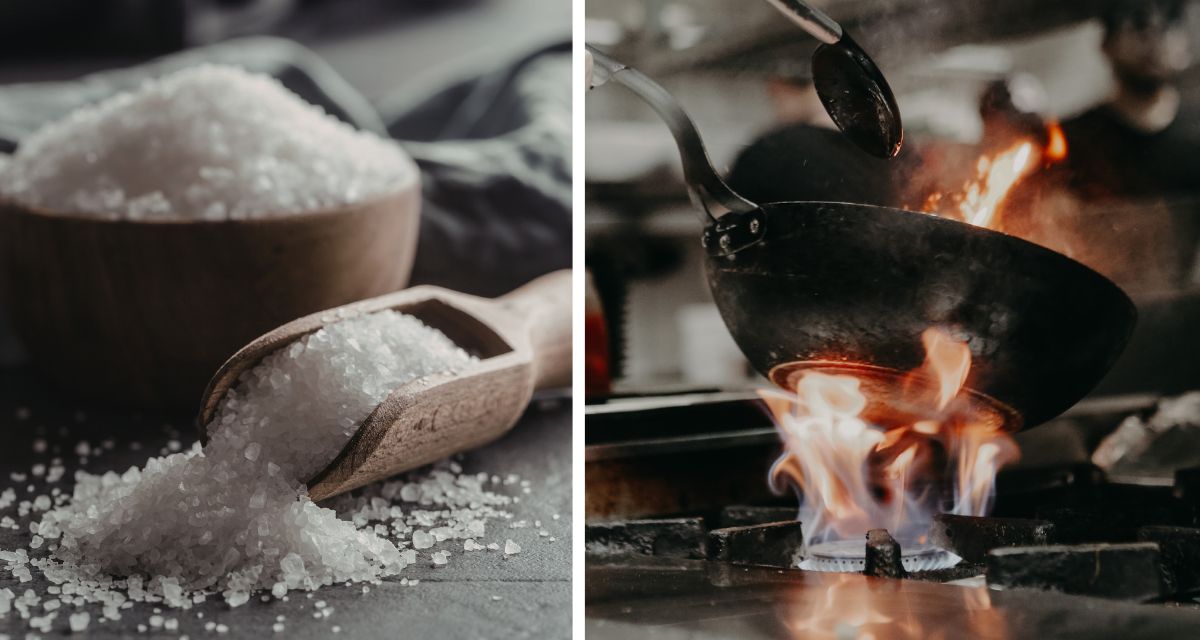
When heated, salt and sand act as equally excellent heat conductors. Both can store and distribute heat evenly, surrounding food on all sides and eliminating hot spots. This creates a consistent cooking environment that mimics the effect of deep frying, only without added fat.
As Kurush F. Dalal, an archaeologist and culinary anthropologist, told Food & Wine, “it’s an incredibly cost-effective and very controllable process,” especially since you can reuse the salt you fry with. Tell that to the southerners among us who save every drop of their bacon grease!
Salt frying tips
Now, if you’re excited to try this cooking style out yourself, there are a few caveats—the most important being that this really only works on dry ingredients. Salt will stick to any damp ingredients and completely ruin the taste of the dish.
Second, it is advised to use coarse salt, according to Food & Wine. And at least one person on Reddit suggests that no matter what salt or sand you use, “let it heat for 15 minutes to let the volatile compounds evaporate (like iodine).”
Lastly, you’ll need a large, deep fryer-friendly utensil, like a wok or cast-iron skillet, that can hold a lot of salt or sand.
So, while it may look like a viral magic trick, salt frying is really just ancient ingenuity making a well-deserved comeback. Some things are timeless for a reason.