New 3D posters lean into empathy and engagement—making it easier to help missing people
When technology meets compassion.

A little AI can go a long way.
When the Amber Alert came out in the 1990s, pictures of missing children on the backs of milk cartons became a thing of the past. But still, we see posters of missing people line telephone polls, grocery store windows and community bulletin boards. And what’s more, they continue to be easily ignored. Perhaps it’s time for another revamp.
Missing People, a London based charity, created digital billboards showing moving 3D portraits rather than static photos. Blinking eyes, head tilts, the works. You remember the double-take you made when you first discovered iPhone’s “live photos”? It feels a bit similar.
Not only that, but each bright pink “poster” has a clear, easily scannable QR code that can be used to spread the word about a missing individual on social media. With its immediacy and global reach, social media has had an ever-growing role in recovering missing persons. Having an easy way to share across social media platforms seems like an obvious improvement already.
This combination of technology and eye-catching visuals is all part of an initiative to get people more engaged in the missing persons search. After all, our fast-paced modern world makes it easy to turn a blind eye to what pops up in our periphery. How many times have you strolled past a traditional missing persons poster before forgetting it the minute you go to TikTok?
You’ll also notice that the words “help find” replace the word “missing.” This too is by design.
Anita Braga, behavioral science consultant at Influence at Work, which led the research for the project, explained that this subtle tweak can create a distinctly different outcome. “Very often people do want to act, but they feel like they don't have the means to, they feel a bit overwhelmed by the situation,” she said, according to The Independent. “Giving a clear call to action is a way to make them feel empowered and also feel empathy towards the person they're looking for.”

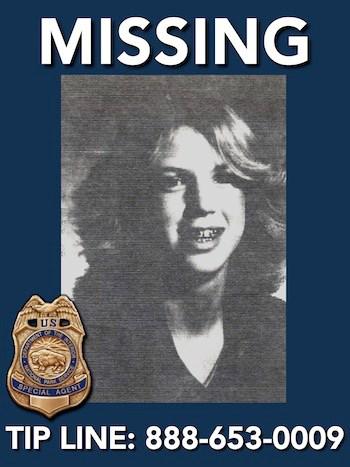
An example of a traditional missing persons poster.
www.nps.govIt makes sense. Usually a poster with the word “MISSING” in big bold letters feels … less than hopeful. In addition to dread, sadness and alarm, there tends to be this finality to the situation. This person is missing, if not worse. That’s that. Language is such a powerful tool. It’s pretty amazing that when used intentionally, language can turn passive sympathy into compassionate action.
These interactive posters are still too new to truly test their efficacy, but they are getting some buzz. The Independent also reported Steve Martin, chief executive of Influence at Work, saying, “Even if a couple of dozen extra people see that image, they connect with it, they feel some empathy towards it, that could make the difference and it could help a family who has had their whole life not just disrupted but destroyed because they don’t know where their loved one is.”
This project feels like innovation at its best. Technology often disconnects us from one other, but it also has the potential to bring us closer. Who knows what impact this revamp will have, but the very notion that minds are coming together to use AI in this way feels like a positive move forward.

- A resourceful nonverbal teen lost in the woods is rescued after ... ›
- A Young Boy Goes Missing And One Person Waits An Entire ... ›
- Social media highlights missing people of color and it's working ... ›
- 'Baby Holly' found alive and reunited with her family - Upworthy ›
- Soul Asylum's 'Runaway Train' saved 21 missing children - Upworthy ›
- QR code menus are on their way out - Upworthy ›
- Boomers and Gen X share the nostalgic posters they hung on their walls back in the day - Upworthy ›


Student smiling in a classroom, working on a laptop.
Students focused and ready to learn in the classroom.
Fish find shelter for spawning in the nooks and crannies of wood.
Many of these streams are now unreachable by road, which is why helicopters are used.
Tribal leaders gathered by the Little Naches River for a ceremony and prayer.

Communications expert shares the perfect way to gracefully shut down rude comments
Taking the high ground never felt so good.
A woman is insulted at her job.
It came out of nowhere. A coworker made a rude comment that caught you off guard. The hair on the back of your neck stands up, and you want to put them in their place, but you have to stay tactful because you're in a professional setting. Plus, you don't want to stoop to their level.
In situations like these, it helps to have a comeback ready so you can stand up for yourself while making making sure they don't disrespect you again.
Vince Xu, who goes by Lawyer Vince on TikTok, is a personal injury attorney based in Torrance, California, where he shares the communication tips he's learned with his followers. Xu says there are three questions you can ask someone who is being rude that will put them in their place and give you the high ground:
Question 1: "Sorry, can you say that again?"
"This will either make them have to awkwardly say the disrespectful remark one more time, or it'll actually help them clarify what they said and retract their statement," Xu shares.
Question 2: "Did you mean that to be hurtful?"
The next step is to determine if they will repeat the disrespectful comment. "This calls out their disrespect and allows you to learn whether they're trying to be disrespectful or if there's a misunderstanding," Xu continues.
Question 3: "Are you okay?"
"What this does, is actually put you on higher ground, and it's showing empathy for the other person," Xu adds. "It's showing that you care about them genuinely, and this is gonna diffuse any type of disrespect or negative energy coming from them."
The interesting thing about Xu's three-step strategy is that by gracefully handling the situation, it puts you in a better position than before the insult. The rude coworker is likely to feel diminished after owning up to what they said, and you get to show them confidence and strength, as well as empathy. This will go a lot further than insulting them back and making the situation even worse.
Xu's technique is similar to that of Amy Gallo, a Harvard University communications expert. She says that you should call out what they just said, but make sure it comes out of their mouth. "You might even ask the person to simply repeat what they said, which may prompt them to think through what they meant and how their words might sound to others," she writes in the Harvard Business Review.
More of Gallo's suggested comebacks:
“Did I hear you correctly? I think you said…”
“What was your intention when you said…?”
“What specifically did you mean by that? I'm not sure I understood.”
“Could you say more about what you mean by that?”
Ultimately, Xu and Gallo's advice is invaluable because it allows you to overcome a negative comment without stooping to the other person's level. Instead, it elevates you above them without having to resort to name-calling or admitting they got on your nerves. That's the mark of someone confident and composed, even when others are trying to take them down.