In “Back to the Future,” teenager Marty McFly goes back in time 30 years, from 1985 to 1955. But what if the film were made today and he went back from 2021 to 1991? I think the culture shock of a modern teenager going from a post-to-pre internet world would be much greater than the one that Marty experienced in the original film.
Would a kid from today be able to dial a payphone? Read a clock with actual hands? Look up directions on a Thomas Guide map?
A lot has changed since the dawn of the new millennium so a group of Redditors marked the changes in a post entitled: “What is something that was used heavily in the year 2000, but it’s almost never used today?”
GeoCities is definitely one of those things that was everywhere and then suddenly disappeared. At its peak, GeoCities hosted millions of websites, but its popularity declined after it was purchased by Yahoo and web hosting became cheaper.
2.
“If you had a big screen TV it was probably a ridiculously thick rear projection TV,” — ParoxysmAttack
Before plasma TVs came around, if you had a big screen it was also a seriously deep-screen TV.
3.
“Re-writable CDs. I used to burn so many mix cds after downloading from napster, bearshare, limewire, frostwire,” — Shittinwithmykitten
Napster created a music revolution overnight, but where were we going to save all of that new, stolen music? Rewriteable CDs were all the rage before the iPod came along and put ’em in the palm of your hand.
4.
“Payphones. (Yes I know payphones still exist. Also, I am now very aware payphones are free in Australia, thank you for informing me.)” — Adreeisadyno
Kids these days have never had to walk five blocks to make a phone call.
5.
“Dial-Up.
weeeeeeeee WOOOOOO_OOOOOO_ E E E E E E E EEEEEeeeeee eee eee URRRRRRRRRBEDULUDOLEDULUDOLEEPEEPEEP R R R R R R R R R R R R RUMMMMMMMMMMMM,” — Martini_Man_
Those of us who lived in the dial-up era will never, ever forget the whizzing, belching sound that we had to sit through to experience the World Wide Web.
“Indoor smoking. My young-ish kids marvel at the fact that people used to sit in restaurants and smoke,” — TurdFergDSF
People used to smoke on airplanes, in hospitals, at restaurants … pretty much everywhere.
8.
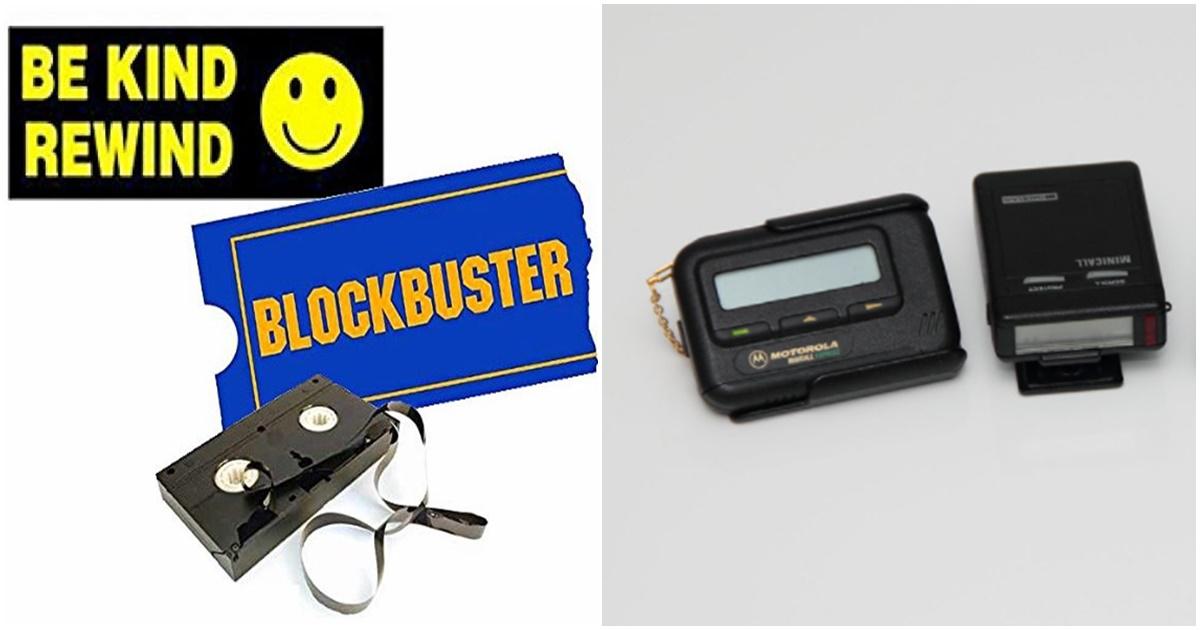
“Blockbuster card,” — larrythetarry
It wasn’t Friday night in the ’90s without a two-liter of Pepsi, a large pizza and a stack of VHS tapes from Blockbuster video.
9.
“VCRs,” — Murtamatt
Want to feel old? In 2016, Funai, which manufacturers the VCRs in China for Sanyo, announced it would produce its final VHS player, making it the last one ever produced.
10.
“AOL,” — PacMan8112
“Welcome!” “You’ve got mail!” AOL was the leading internet provider in the late ’90s but soon lost its relevance after merging with Time Warner, Inc. in 2000.
11.
“Calculators; teachers kept saying ‘you won’t have one with you all the time,’ look who’s stupid now?! Both of us…” — elika007
A calculator was a luxury item in the ’80s. In the ’90s, a Texas Instruments graphing calculator could cost you $90. Now, it’s all on your phone along with a million other apps.
12.
“A/S/L” — Smart_North_3374
Anyone who’s a proud member of Gen X knows the “age/sex/location” question. It’s the first thing you asked in an AOL chatroom when people used to try to hook up online. Of course, nobody answered it honestly, but that was half the fun.
13.
”JNCO jeans,” — ccherry124
In the 2000s everyone wore skinny jeans. But in the 1990s, people wore the baggiest jeans possible. The award for baggiest jeans goes to JNCO, the manufacturers of raver pants that fit two legs and a few kilos worth of MDMA.
14.
“Pagers,” — skaote
The pager was one of the most popular status symbols of the ’90s. Nothing said “cool” like having a pager that was constantly blowing up. (Does anyone under the age of 40 know what it means for a pager to “blow up”?)
15.
“‘Wanna Cyber?’” God . We were awful,” — icanbeafrick
Back in the AOL days, the closest you could come to getting it on while online was through cyber sex. There were no pictures or video so you just exchanged dirty messages until the other person logged off. The typical cyber session began with, “What are you wearing?”
16.
“Limp Bizkit,” — Timmah_1984
Unfortunately, they’re back.
17.
“Travel agencies. Now I can do everything on my phone,” — whatdoineedaname4
If you can belive it, before there was Priceline, there was a person sitting at a desk with a rotary phone who booked your seven-day trip to Europe.
In a small village in Pwani, a district on Tanzania’s coast, a massive dance party is coming to a close. For the past two hours, locals have paraded through the village streets, singing and beating ngombe drums; now, in a large clearing, a woman named Sheilla motions for everyone to sit facing a large projector screen. A film premiere is about to begin.
It’s an unusual way to kick off a film about gender bias, inequality, early marriage, and other barriers that prevent girls from accessing education in Tanzania. But in Pwani and beyond, local organizations supported by Malala Fund and funded by Pura are finding creative, culturally relevant ways like this one to capture people’s interest.
The film ends and Sheilla, the Communications and Partnership Lead for Media for Development and Advocacy (MEDEA), stands in front of the crowd once again, asking the audience to reflect: What did you think about the film? How did it relate to your own experience? What can we learn?
Sheilla explains that, once the community sees the film, “It brings out conversations within themselves, reflective conversations.” The resonance and immediate action create a ripple effect of change.
MEDEA Screening Audience in Tanzania. Captured by James Roh for Pura
Across Tanzania, gender-based violence often forces adolescent girls out of the classroom. This and other barriers — including child marriage, poverty, conflict, and discrimination — prevent girls from completing their education around the world.
Sheilla and her team are using film and radio programs to address the challenges girls face in their communities. MEDEA’s ultimate goal is to affirm education as a fundamental right for everyone, and to ensure that every member of a community understands how girls’ education contributes to a stronger whole and how to be an ally for their sisters, daughters, granddaughters, friends, nieces, and girlfriends.
Sheilla’s story is one of many that inspired Heart on Fire, a new fragrance from the Pura x Malala Fund Collection that blends the warm, earthy spices of Tanzania with a playful, joyful twist. Here’s how Pura is using scent as a tool to connect the world and inspire action.
A partnership focused on local impact, on a global mission
Pura, a fragrance company that recognizes education as both freedom and a human right, has partnered with Malala Fund since 2022. In order to defend every girl’s right to access and complete 12 years of education, Malala Fund partners with local organizations in countries where the educational barriers are the greatest. They invest in locally-led solutions because they know that those who are closest to the problems are best equipped to solve and build durable solutions, like MEDEA, which works with communities to challenge discrimination against girls and change beliefs about their education.
But local initiatives can thrive and scale more powerfully with global support, which is why Pura is using their own superpower, the power of scent, to connect people around the world with the women and girls in these local communities.
The Pura x Malala Fund Collection incorporates ingredients naturally found in Tanzania, Nigeria, Pakistan, and Brazil: countries where Malala Fund operates to address systemic education barriers. Eight percent of net revenue from the Pura x Malala Fund Collection will be donated to Malala Fund directly, but beyond financial support, the Collection is also a love letter to each unique community, blending notes like lemon, jasmine, cedarwood, and clove to transport people, ignite their senses, and help them draw inspiration and hope from the global movement for girls’ education. Through scent, people can connect to the courage, joy, and tenacity of girls and local leaders, all while uniting in a shared commitment to education: the belief that supporting girls’ rights in one community benefits all of us, everywhere.
You’ve already met Sheilla. Now see how Naiara and Mama Habiba are building unique solutions to ensure every girl can learn freely and dare to dream.
Naiara Leite is reimagining what’s possible in Brazil
Julia with Odara in Brazil. Captured by Luisa Dorr for Pura
In Brazil, where pear trees and coconut plantations cover the Northeastern Coast, girls like ten-year-old Julia experience a different kind of educational barrier than girls in Tanzania. Too often, racial discrimination contributes to high dropout rates among Black, quilombola and Indigenous girls in the country.
“In the logic of Brazilian society, Black people don’t need to study,” says Naiara Leite, Executive Coordinator of Odara, a women-led organization and Malala Fund partner. Bahia, the state where Odara is based, was once one of the largest slave-receiving territories in the Americas, and because of that history, deeply-ingrained, anti-Black prejudice is still widespread. “Our role and the image constructed around us is one of manual labor,” Naiara says.
But education can change that. In 2020, with assistance from a Malala Fund grant, Odara launched its first initiative for improving school completion rates among Black, quilombola, and Indigenous girls: “Ayomidê Odara”. The young girls mentored under the program, including Julia, are known as the Ayomidês. And like the Pura x Malala Fund Collection’s Brazil: Breath of Courage scent, the Ayomidês are fierce, determined, and bursting with energy.
Ayomidês with Odara in Brazil. Captured by Luisa Dorr for Pura
Ayomidês take part in weekly educational sessions where they explore subjects like education and ethnic-racial relations. The girls are encouraged to find their own voices by producing Instagram lives, social media videos, and by participating in public panels. Already, the Ayomidês are rewriting the narrative on what’s possible for Afro-Brazilian girls to achieve. One of the earliest Ayomidês, a young woman named Debora, is now a communications intern. Another former Ayomidê, Francine, works at UNICEF, helping train the next generation of adolescent leaders. And Julia has already set her sights on becoming a math teacher or a model.
“These are generations of Black women who did not have access to a school,” Naiara says. “These are generations of Black women robbed daily of their dreams. And we’re telling them that they could be the generation in their family to write a new story.”
Mama Habiba is reframing the conversation in Nigeria
Centre for Girls' Education, Nigeria. Captured by James Roh for Pura
In Mama Habiba’s home country of Nigeria, the scents of starfruit, ylang ylang and pineapple, all incorporated into the Pura x Malala Collection’s “Nigeria: Hope for Tomorrow,” can be found throughout the vibrant markets. Like these native scents, Mama Habiba says that the Nigerian girls are also bright and passionate, but too often they are forced to leave school long before their potential fully blooms.
“Some of these schools are very far, and there is an issue of quality, too,” Mama Habiba says. “Most parents find out when their children are in school, the girls are not learning. So why allow them to continue?”
When girls drop out of secondary school, marriage is often the alternative. In Nigeria, one in three girls is married before the age of 18. When this happens, girls are unable to fulfill their potential, and their families and communities lose out on the social, health and economic benefits.
Completing secondary school delays marriage, and according to UNESCO, educated girls become women who raise healthier children, lift their families out of poverty and contribute to more peaceful, resilient communities.
Centre for Girls’ Education, Nigeria. Captured by James Roh for Pura
To encourage young girls to stay in school, the Centre for Girls’ Education, a nonprofit in Nigeria founded by Mama Habiba and supported by Malala Fund and Pura, has pioneered an initiative that’s similar to the Ayomidê workshops in Brazil: safe spaces. Here, girls meet regularly to learn literacy, numeracy, and other issues like reproductive health. These safe spaces also provide an opportunity for the girls to role-play and learn to advocate for themselves, develop their self-image, and practice conversations with others about their values, education being one of them. In safe spaces, Mama Habiba says, girls start to understand “who she is, and that she is a girl who has value. She has the right to negotiate with her parents on what she really feels or wants.”
“When girls are educated, they can unlock so many opportunities,” Mama Habiba says. “It will help the economy of the country. It will boost so many opportunities for the country. If they are given the opportunity, I think the sky is not the limit. It is the starting point for every girl.”
From parades, film screenings to safe spaces and educational programs, girls and local leaders are working hard to strengthen the quality, safety and accessibility of education and overcome systemic challenges. They are encouraging courageous behavior and reminding us all that education is freedom.
Experience the Pura x Malala Fund Collection here, and connect with the stories of real girls leading change across the globe.
Gym class may be the easiest class for some kids in school, but for others, it’s the roughest. For the not-athletically-inclined, P.E. can feel like torture, both physically and psychologically. Oliver Foit was one of the kids for whom gym class was fine. But he recognized that wasn’t the case for all. He shared a…
Gym class may be the easiest class for some kids in school, but for others, it’s the roughest. For the not-athletically-inclined, P.E. can feel like torture, both physically and psychologically.
Oliver Foit was one of the kids for whom gym class was fine. But he recognized that wasn’t the case for all. He shared a story about a gym class experience when he was 14 that he said changed the way he treated people for the rest of his life.
“I remember I was in gym class and my teacher had chosen me to be one of the captains to pick teams for basketball,” he shared in an Instagram video. “And I remember I was getting ready to make my pick, and I was standing up in front of everyone. And before I did, I saw this girl that was sitting in the back of the class, and she usually got picked last. She was a little bit heavier set, wasn’t really super coordinated, wasn’t really into sports, which is fine. I called her name, and I remember she looked up and was like, ‘Me?’”
Foit said his friend, the other captain, leaned over to him and asked, “Why’d you pick her?” Foit responded, “Why not?”
The girl came up and stood right behind Foit. He told her to stand next to him since she was on his team.
“She stood next to me, and I remember my friend was getting ready to pick whoever he was going to pick. And I remember she whispered something in my ear that I’ll never forget. She leaned over and said, ‘Are you sure?’ And it kind of hit me. I looked over at her, and I said, ‘Absolutely.’”
It was a rogue decision. Competition means picking the best athletes first, right? Everyone knows that. But this wasn’t an NBA coach choosing players for a professional sports team—it was P.E. class.
From that moment on, Foit picked the kids who normally didn’t get picked to join his team. It paid off.
“That gym class was one of the most fun gym classes I’ve ever had in my life,” Foit said. “Because I remember it wasn’t about trying to prove something or having your friends competing or anything like that. It was seriously about just having fun and including people…it was so fun. And I didn’t shoot one time, I was just passing the ball the whole time, and it was so fun.”
That was his freshman year. Fast forward to graduation. After the ceremony, the girl from gym class four years earlier approached him and grabbed his arm.
“She looked at me, and she said, ‘Oliver, I still remember when you picked me first when we played basketball in ninth grade.’ And I was like, ‘Really? I remember that too.’ And she’s like, ‘That was the only time I was picked first for anything in school.’ And that hit me really hard.”
Years later, that act of kindness still meant something to her. Foit said he shared the story in the hope that it might inspire people to be kind and more aware of those around them.
“It takes so little to be kind to someone, but it makes such a big impact on them,” he said. “Include people. That’s what the world’s about. It’s about including people and being kind to them.”
The story did inspire people, both from the perspective of someone who experienced the impact of being kind and from those on the receiving end of that kindness. Here’s what people are saying in the comments:
“Being a good person is more rewarding and enriching than anyone could imagine. It is life changing for the person doing the deed as much as it is for the person it done for.”
“You are so awesome. I was that girl in high school. I wish I knew someone like you then.”
“In school, I was always picked last and bullied for just existing. After I broke out of that shell and gained confidence, I made it a point to make those still in their shells feel welcome & included. Thinking back, it’s amazing how sometimes it only takes one person to crack that shell.”
“I was a skinny, sickly version of that girl. I remember kids arguing over who had to take me for PE. More than once, I was part of a 2-for-1 deal after all the other kids were picked. I’m 60, and I haven’t forgotten. Bless you, Oliver. ❤️”
“As a girl who also was always picked last in school… thank you. I have no doubt that small gesture impacted and changed her in ways you’ll never know. ❤️”
But as much as anything: I’m really sorry to hear how bad gym class was for so many of y’all.
We hear so much about how education has gotten worse and staid but, really, sounds like it was bad in all sorts of ways already.
“From every ‘last picked in gym class’ kid, thank you. I guarantee you that she still thinks about this moment to this day. I know I would.”
“This made me cry. I was always picked last. That would’ve changed my life if I was her.”
“At my 30th reunion last summer, a woman walked up to me and hugged me tight. She said to her husband who I hadn’t yet met, that I was nice to her in high school. I was taken back for a moment bc she was this girl in the back of gym who was probably never chosen. I smiled and responded with ‘Of course. We were friends. You were so easy to love.’ We both cried. I hope your feed finds as many people as possible.”
Even Katie Couric responded: “Okay Oliver. I love you. You’re so right. Pick the person who might get picked last. Go talk to the person at the dance who is alone and looks uncomfortable. Ask the new kid to sit at your table for lunch. Simple, seemingly small acts of kindness make a huge difference. You are going to be a successful human. ❤️”
It was a simple but beautiful reminder of the power of a kind act. (And perhaps an indication that we should stop picking teams this way in gym class?)
People are allowed to dislike whatever they want, but sometimes that comes with questions. Tyreak, who runs the Instagram account Tyreak Told You, has a peculiar beef that often leaves people laughing and scratching their heads. The New Yorker spends some of his free time disliking the universe, but the planets within our solar system…
People are allowed to dislike whatever they want, but sometimes that comes with questions. Tyreak, who runs the Instagram account Tyreak Told You, has a peculiar beef that often leaves people laughing and scratching their heads. The New Yorker spends some of his free time disliking the universe, but the planets within our solar system take the brunt of his disdain.
It’s unclear why he doesn’t like the planets, but he makes it his mission to roast them. No planet’s feelings are spared when Tyreak gets fired up about whatever new information he has just learned about them. His research into space and the deadpan delivery of his annoyance with the planets have people learning while laughing.
Some planets in his crosshairs take a little more heat than others. Parents may want to preview any video before showing it to their child to take note of any profanity. In his amusing takedown of Jupiter, he uses colorful language while trying to figure out what happens to the planets Jupiter eats. Yes, scientists have discovered that the large planet may be expanding after consuming smaller planets. That news just didn’t sit right with the space critic.
“Can you believe that Jupiter just gave me another reason to not like it? Look at this,” Tyreak says. “Jupiter may have grown by swallowing baby planets reveals a new study. I told y’all Jupiter was morbidly obese. Jupiter just overeats. Jupiter never gets full. You can’t satisfy Jupiter. Jupiter just eats everything around it. That’s why it’s so big. That’s why it looks like that. These are stretch marks.”
He goes on to talk about the 95 moons orbiting Jupiter before asking whether the planet poops. A logical question after finding out it eats other planets. But don’t worry, other unsuspecting planets aren’t escaping his amusingly nonsensical ire for their existence.
In another video, he petitions to exile Mercury from the solar system because it’s dead.
“We shouldn’t have dead planets just rotting away in our solar system. Isn’t that like some type of health code violation?” Tyreak asks. “You have dead planets just chilling out in the solar system? Like, what does it smell like? Do you think Mercury smells worse than Saturn? Cause Saturn has a bunch of ammonia crystals, so that whole planet probably smells like pee.”
He calls Saturn a “giant UTI” before moving on to explain Mercury’s distance from the Sun, the reason it may be shrinking, and information about its core.
Commenters can’t get enough of his series about why he dislikes the planets and the universe as a whole.
One person writes, “I love this series. It’s giving Tyreak DeGrasse Tyson.”
Another person adds, “My dude got beef with the Galaxy.”
“So Mercury is a planet but Pluto isn’t?? Feels racist somehow,” someone jokes.
One person conjures a horrifying image of Jupiter, saying, “I bet you Jupiter’s mouth is that red super hurricane! It just sucks those planets in. Horrifying!”
Jupiter is a honey badger, and honey badgers don’t care, says this person: “Jupiter is out here behaving like a Honey Badger.”
Someone else is proving that Tyreak is educating viewers one annoyed planet video at a time: “I haven’t been this invested in science since Miss Frizzle and Bill NYE.”
“Please never stop doing these. They bring me so much joy and laughter, for real,” one person swears. Another says the videos belong on TV: “This is PBS Science documentary worthy commentary.”
A trend has emerged on social media that has older generations questioning what is happening. Someone will go to a college campus and ask students to name a celebrity icon. The celebrity is usually from a culturally classic movie, TV show, or a musician who crosses generational lines.
In every instance, very few students, if any, get it right. From Whitney Houston to John Ritter, Gen Z struggles to name the person they’re seeing.
A man who goes by the name Adivunsolicited on Instagram has a theory about why Gen Z doesn’t know pop culture from before they were born. He believes this is something unique to the younger generation. Many people from older generations recognize musicians and actors from their parents’ generation and earlier.
The man shows a viral clip of college students being shown a photo of Whitney Houston. None of the students guessed the correct celebrity. Guesses swung wildly from Alicia Keys to Prince, but none came close to naming the iconic singer.
“Imagine not knowing one of the vocal trinity, Whitney Houston,” the man says. “Ask a Millennial to name a band from the ’60s, you’ll probably hear The Beatles, Marvin Gaye or Aretha Franklin without hesitation. Ask us to name classic films, we might say The Godfather or Star Wars. Classic TV? Living Single, Friends, The Fresh Prince of Bel Air. Now ask a Gen Z, a lot of them draw a blank.”
Adivunsolicited says it’s not because they’re less intelligent. Instead, it has to do with exposure. Millennials and older generations were often forced to listen to or watch whatever was on television or the radio. Gen Z, on the other hand, has everything curated for them by personalized algorithms that learn their tastes.
“Millennials grew up with limited choices, and we’re the last generation to truly understand the way the world operated in analog before the switch to digital, Wi-Fi, and algorithms,” he explains. “You had the radio. You had cable TV with a few channels and maybe MTV, that’s it. Everyone consumed culture from the same handful of places. If a song from the ’70s played on the radio, you heard it. If a classic movie aired on television, you watched it. Cultural exposure was shared and centralized. Gen Z, they grew up in the algorithm era.”
This younger generation experiences culture differently. YouTube recommendations, TikTok, and Instagram feeds are all curated to their personal tastes.
“Hyper-personalization and hyper-isolation,” Adivunsolicited says. “If the algorithm doesn’t surface Prince or Madonna, it may never organically encounter them. If no one around them references Back to the Future, it doesn’t naturally enter their world. Millennials absorbed older culture almost by accident. Gen Z has to seek it out intentionally.”
The man, who is also a musician, takes a moment to call out Gen X. He points out that Gen X would be the ones to expose their children—Gen Z—to older pop culture. While much of how Millennials absorbed pop culture came from limited entertainment choices, parents also played a role in introducing it to them. Judging by the responses given when students were asked to guess celebrities, that parental guidance on pop culture seems to have been missing.
Commenters agree with the take. One person jokes, “They’re not woken up at 7 am on a Saturday morning to clean and listen to Anita Baker and it shows.”
Another writes, “This made me sooo sad to see the video of them not knowing the great Whitney Houston but this is a really good point that they don’t know what they don’t know because of what they’ve grown up with.”
Someone else points out a missed connection: “Because we were growing up interacting with our families of all ages not always by choice either, grandparent and parents were in the same rooms watching their shows and listening to their music and observing and learning about history and expanding our general knowledge.. this generation does not have to do this. They can go on to their own devices and have lost the communal element.”
“The parents aren’t passing things down,” another person laments. “This is our culture. They don’t have MTV or BET and aren’t just going to know. It’s up to parents to pass down culture.”
Comedian Kevin Nealon and the late, great Robin Williams first became friends in 1979 in Los Angeles. But according to Nealon, as kind and lovely as Williams was, it took a little bit of maneuvering on his part to make it happen. In fact, Nealon claims he had to outright lie to lock the friendship in.
He recently took to X and Threads to recount a heartwarming memory of pretending he knew anything about cars just to spend a little time with the brilliant comic.
X user @ISScottDavenport shared this Ellis Rosen cartoon. Photo credit: Scott DavenPort, X
“Robin Williams had done his set and left the comedy club. Soon after, he walks back in annoyed.
I said, what’s going on?
He said his car wouldn’t start.
I go, maybe I can help. I know absolutely nothing about cars. He doesn’t know that. I just wanted to make him think I was helping him.
So we go outside. He’s got a Range Rover.
We open the hood. He’s leaning in, swearing.
I’m looking around. Nodding. Like I’m a mechanic.
I have no idea what any of it is.
After a minute, I say, ‘Yeah… I don’t have my tools with me. You might need a mechanic.’
The simplicity and honesty in this one post have so many fans of both comedians truly engaged. Some share their own funny takes. “A technical comedian is an oxymoron,” jokes one X user. Another writes, “The classic mechanic technique: nod seriously and suggest a mechanic.”
Another commenter notes how wholesome Nealon’s story is: “‘I don’t have my tools with me’ is the perfect punch line for a guy who knows nothing about cars. You gave a legend a ride home and a great story to tell. That’s a win-win.”
This person shared their own story of seeing Williams when he dropped in as a surprise guest at the San Francisco Punch Line: “I saw him do a surprise, unannounced set at Punch Line SF, right after Brett Butler. He was a whirling dervish across the tiny stage, blessing us in the front seats with his frenetic sweat. It was amazing, and I’ll never forget it.”
One Threads user shared how much they love stories like these, writing, “I could listen to people recount stories about Robin Williams for hours and hours. That’d be such a great podcast (or something). Just actors sharing stories about their good friend, Robin.”
In past social media posts, Nealon has heaped praise and love on his old friend.
On Instagram, he shared a painting he made of Williams, relaying how their friendship began and blossomed over decades:
“My caricature painting of the brilliant Robin Williams. This was the Robin I first met in 1979 in a Los Angeles comedy club. (Before ‘Mork and Mindy.’) No one was quicker or funnier! I was absolutely floored by his wit, movement, improv skills, characters, and voices. Pure genius on the level of Jonathan Winters. As much as I laughed, I also found myself depressed because I knew I could never be that funny.
He was Amadeus Mozart, and I would be Antonio Salieri at best. But, I eventually realized that Robin couldn’t be everywhere at once (but almost), so I would probably, at least, get some work. It was always a thrill for me whenever Robin hosted SNL when I was a cast member. Absolutely brilliant! So missed!”
When you’re one of the best, it’s easy to get caught up in continuing to prove you’re the best. Displaying your dominance in a sport can be exhilarating as crowds cheer you on. But for one wrestler, fostering a love for the sport is more important. Tamara Humphries is a wrestler at the University of…
When you’re one of the best, it’s easy to get caught up in continuing to prove you’re the best. Displaying your dominance in a sport can be exhilarating as crowds cheer you on. But for one wrestler, fostering a love for the sport is more important.
Tamara Humphries is a wrestler at the University of Pittsburgh at Johnstown who goes by the name Firefly. In a recent video, the college wrestler is intently watching as a referee seemingly explains different starting positions to another wrestler. The newcomer looks visibly terrified as she struggles to figure out how to position her body before the match starts.
Instead of letting things play out and using her own knowledge to her advantage, Humphries intervened. She taps the referee on the shoulder and signals that he doesn’t need to help. That’s when a sweet display of sportsmanship is shown. The championship wrestler starts from the position the other wrestler seems to be most comfortable with. Humphries also uses much less force while wrestling the girl to the mat.
For some viewers, the more experienced wrestler took it easy on her competitor. Others saw the wrestling match differently and praised the wrestler for her acknowledgement of the girl’s fear while still giving her a match. Humphries isn’t a stranger to the fear she saw on the other wrestler’s face, which may have played into why her response was to be kind.
The Pittsburgh native didn’t start wrestling until 10th grade. At the time, her inner-city school didn’t have a girls’ wrestling team, so she had to wrestle with the boys. In an old video uploaded to YouTube, Humphries shares how she was terrified the night before her very first match.
“Listen, before my first match, I’m literally freaking out in my bed, terrified. I’m like, ‘Oh my gosh,’ cause when I was on the team, there was no sanctioned girls wrestling at this moment,” the wrestler reveals in the year-old clip. “So I’m like, okay…I have to wrestle a boy. I’m looking up on YouTube, freaking boy versus girl wrestling, and it’s a bunch of girls getting actually demolished by guys. I’m like ‘oh my gosh, I’m cooked.’”
Before joining the boys’ wrestling team, she was a cheerleader and ran track. Wrestling was a complete change that she had to take on alone. With girls’ and women’s wrestling starting to catch on, Humphries wants to do her part to make new wrestlers feel welcome.
In the text overlay of a recent video, she writes, “Shout out to this super brave girl. This sport is terrifying! Never be afraid to start something new. We all start somewhere.”
Viewers of the kind video heap praise on the young college athlete.
One person writes, “U definitely took it easy on her and that was a very noble thing to do. Ive seen other clips of yours and know just how savage you can be when you need to be. You were a great ambassador to the sport for her. Many others would have smelled blood in the water and worked her over.”
Another says, “This actually made me tear up. Wow. You are a GIRLS GIRL! You gave her a story, one day she’ll tell others, the reason she kept competing is because of this moment. It could’ve gone BAD, but you changed the trajectory. Well done.”
This commenter adds on to the praise, saying, “I luv this. You showed her grace. Maybe someone did that for you. But it’s possible she can move forward and become better instead of giving up because of this one defining moment. And for you to have that wisdom is why you’re going to move mountains.”
“Awesome sportsmanship, one of my teammates got clip farmed by a national qualifier this season and it was her first match ever,” another says.
A coach views the act as a moment to praise both athletes, writing, “You’re great. You know that. You don’t need to show the world all the time. That’s admirable! Can we take a second to praise her? She was clearly scared and nervous. You can see it in her face. But she still went out there and competed. That’s more than most can say. Congrats to both of you from a dusty, old coach.”
One commenter gushes, “Oh my god she’s trying so hard. This is the most touching thing I’ve seen in so long. You go girls!”
Humphries reminds people in her caption that women’s wrestling is still new, and praises anyone trying it out: “I love running into people who just started to show them the sport isn’t so bad, with women’s wrestling on the rise, it’s nothing new. Never be afraid to start something new!! You guys are killing it.”
Mom Michelle celebrates her 60th birthday on a surprise party bus and takes it to visit her mom Jackie, who has dementia and lives in assisted living. – Photo credit: TikTok/@daniix3dee (with permission)
There is only one way to celebrate turning 60—on a party bus. That’s what Danielle DeBernardi and her sister were thinking when they booked one for their mom, Michelle. After the family gathered to celebrate the milestone birthday at a friend’s home, Danielle and her sister had one more surprise waiting outside—a party bus full…
There is only one way to celebrate turning 60—on a party bus. That’s what Danielle DeBernardi and her sister were thinking when they booked one for their mom, Michelle.
After the family gathered to celebrate the milestone birthday at a friend’s home, Danielle and her sister had one more surprise waiting outside—a party bus full of family and friends.
In a series of touching videos, Danielle documented Michelle’s epic 60th birthday, which ended with a tear-jerking visit to a nursing home to see Jackie (a.k.a. Juju), the family matriarch battling dementia.
Mom asked if the party bus could go see My grandma in a nursing rehab facility. She has dementia and Alzheimer’s. She was dead asleep when we showed up at 10pm with 10ppl standing in her room ready to party 😂 #motherdaughter#birthdaygirl#queen#nursinghome#partybus
The party bus pulls up as Michelle and her husband wait outside, and when she sees it, Michelle looks shocked. “Is this us?” she asks her daughter, before quipping, “Is there a dancing man in there?”
When the doors open and she steps on, all 10 of her closest people inside yell, “Surprise!” Michelle appears overwhelmed with emotion and starts hugging each person on the bus.
They take Michelle to dinner, and then Michelle has a special request: to go visit Juju.
The ladies are living it up on the bus. They can be seen singing and dancing to songs like Pat Benatar’s “Hit Me With Your Best Shot” and Madonna’s “Like a Virgin.”
Once they arrive at the nursing home, it’s all about Juju. Michelle can be seen sitting on her mom’s bed. Then she hops in with her, feeding her Häagen-Dazs ice cream and laughing together.
“POV: you get your mom a party bus for her 60th birthday and you ask her where she wants to go, and she says she wants to go see her mom at the nursing facility so you pull up in a party bus with 10 people at 10:00 at night and all go inside to see juju,” Danielle captioned the video.
It’s a moment Danielle and the family will never forget.
“Having four generations together in that nursing home room for my mom’s 60th birthday meant more than words can fully express,” Danielle tells Upworthy.
She continues, “Seeing my mom, her mother, myself and my daughter all in one place was such a powerful reminder of love, family, and the moments that truly matter. It was simple, but incredibly meaningful—a memory I’ll carry in my heart forever.”
If you travel around the United States, you’ll find that Americans sound different everywhere you go. If you go from Boston to Birmingham, you’ll hear a big contrast in dialects and accents. Going from Seattle to San Diego, the differences would be much smaller, but they’d still be there. Some people don’t think they have…
If you travel around the United States, you’ll find that Americans sound different everywhere you go. If you go from Boston to Birmingham, you’ll hear a big contrast in dialects and accents. Going from Seattle to San Diego, the differences would be much smaller, but they’d still be there.
Some people don’t think they have an accent at all. It’s common for Americans outside the South and Northeast to believe they speak “normally,” unaware of the geographic “tells” in how they pronounce certain words. But as linguist Carson Woody demonstrates, sometimes just a single word can reveal where in the U.S. a person is from.
A woman shared a social media trend in which people say three words that supposedly indicate where they’re from. She said she didn’t think she had an accent, but she only got as far as saying “bagel.” That’s okay, Woody said, because that was all he needed to clock her hometown.
“Baby girl, you sound like the Pope,” Woody said. Sure enough, like Pope Leo XIV, she’s from Chicago.
Woody said he understood what she meant when she said she didn’t think she had an accent.
“A lot of people use the term ‘accent’ when referring to someone who has a distinct accent from them,” he said. “Like, ‘You have an accent, I don’t. Because you’re not from here and I am.’ You’re saying you don’t think you have an identifiable, regional accent. But linguistically, when we say, ‘an accent,’ what we’re talking about is just how you pronounce things. If you speak, you have an accent.”
He explained that the way she pronounced the “a” in “bagel” gave away her location. He also shared that none of the various pronunciations of words are right or wrong.
“Every accent, every dialect, every language, the way everybody speaks around the world are all equally valid and beautiful,” he said.
What’s the difference between an accent and a dialect?
As Woody said, an accent is the way words are pronounced. A dialect is broader, encompassing not only pronunciation but also grammar and vocabulary.
So just how many dialects are there in American English? More than you might think. It’s hard to pin down an exact number because it depends on how broad or specific you want to get. Linguists recognize somewhere between three and 24 (or more) distinct American English dialects in the U.S. Within those dialects, there are hyperlocal pronunciation variations as well.
For instance, there are some commonalities among Midwestern accents, but someone from Chicago will pronounce certain words differently than someone from northern Minnesota.
Woody even shared how a dialect can practically—and in some cases actually—become a totally different language:
Everybody has one
As Woody pointed out, everyone has an accent. People in the comments even shared some metaphors that help illustrate this point:
“Saying, ‘I don’t speak with an accent’ is like saying ‘I don’t type with a font.’”
“Someone told me once to think of accents like fonts, you can’t really write or type without a font lol, everyone has their own accent that shows your heritage, family, origins, or even sometimes your personality. Humans are pretty cool.”
“‘I don’t have an accent, everyone else does.’ ‘I don’t have a location, everyone else does.’ Same energy.”
“If you eat you have a diet, and if you speak you have an accent.”
“I had a professor years ago (ASL grammar) who could tell what part of the country someone was from or where they went to college by how they signed or finger spelled words. Even sign languages have accents!”
And if you’re wondering what the other two words were that supposedly help indicate where you’re from, they’re “milk” and “eggs.” Apparently, ordering breakfast gives a lot away. Isn’t language fun?
Michael Harris was on his final run on the ski slopes at Stevens Pass in the Cascade Mountains on February 26 when tragedy struck—he was caught in an avalanche. “Because I was on skis, I got caught between two slabs,” he told FOX 13 Seattle. Harris was buried in a snow hole and remained upright.…
Michael Harris was on his final run on the ski slopes at Stevens Pass in the Cascade Mountains on February 26 when tragedy struck—he was caught in an avalanche.
“Because I was on skis, I got caught between two slabs,” he told FOX 13 Seattle.
Harris was buried in a snow hole and remained upright. He tried to free himself by making a swimming motion, but he couldn’t budge. “The sensation was being encased in cement,” he said.
He was packed so tightly that he couldn’t even grab the phone from his jacket pocket. His wife, Penny, sensed something was wrong when she hadn’t heard from him. “I started freaking out,” she told WSAW-TV. “My texts got more intense, and then I started calling.”
Harris could feel his phone buzzing in his pocket, but there was nothing he could do. “My mind shifted very quickly to ‘does anyone know that I’m here and how am I going to survive?’” he said.
Penny checked the Find My feature on her phone to see whether her husband had moved on the mountain. But his location was static—not typical for a skier. Realizing that if he wasn’t moving, something was very wrong, she contacted the ski patrol and gave them his location. “They were able to take my location and get a snapshot of it and pinpoint pretty much where he was,” she said.
After being stuck in the snow for four hours, Harris was rescued. Ski patrol was shocked to find him still conscious. Harris’ body temperature had dropped into the 70s, and he was severely hypothermic. Throughout the harrowing experience, all he could think about was his family.
“The thing I was hoping is that I’d get to see her [his wife] and my four kids one more time,” he said. “They were the only thing I thought about.”
Harris was alive, but he sustained several serious injuries in the avalanche. His daughter, Lauren, posted an update on GoFundMe about his condition. “A full trauma was called,” she wrote. “After various labs and imaging, my dad only sustained a contusion of his lung, pneumonia, injuries to his kidneys, and a right tibial plateau fracture.”
The avalanche came at a terrible time for the family
Harris is expected to make a full recovery, but his injuries couldn’t have come at a worse time. He is currently between jobs, and his recovery will delay any return to work. So, his family set up a GoFundMe page to help them through this difficult time. It has already raised over $36,000 toward a goal of $40,000.
“I have started a GoFundMe to try and help alleviate some of the medical costs as well additional bills for my family as my dad is the sole provider, and we are unsure how long the road to recovery actually looks. Literally anything helps,” Lauren wrote.
When someone is caught in an avalanche and encased in freezing snow, time is of the essence. According to Safeback, about 75% of avalanche deaths occur due to suffocation, and after roughly ten minutes of being trapped in the snow, the risk of asphyxiation increases rapidly.
Amazingly, Harris survived four hours in freezing conditions without passing out. What a blessing that his quick-thinking wife was able to locate him before he lost his life in the snow.