My best friend lives in San Diego. One day a few years ago, her teenage son came home and told her he’d made a new friend at the skate park. He talked about how they had struck up a conversation, the guy had given him some pointers, and they’d chit-chatted about this and that. “He was really cool,” her son said. Then he showed her a selfie they’d taken together.
Yeah, his “new friend” was the skateboarding icon Tony Hawk. True story. Tales of Tony Hawk not being recognized as Tony Hawk—even for people who actually know who Tony Hawk is—have become the stuff of legends. The 56-year-old made a name for himself in the skateboarding world decades ago and is credited with bringing the sport into the mainstream. Even in 2020, he was listed among the Top 10 skateboarders of all time. He’s had his own video game, cameos in film and television shows, his own clothing line—everything, apparently, but a recognizable face.
The “people not recognizing Tony Hawk as Tony Hawk” thing is so common it’s become a meme of its own. Hawk himself jokes about it all the time, sharing hilarious interactions he has with people on his Twitter account.
Surfing in Hawaii, paddling out to the lineup. Guy paddling next to me: “anyone tell you that you look like Tony Hawk” Me (thinking he knows the meme): “yes, but you’re the first today” Him: “you should tell people you are and then sign his name, haha” His friend: “he’s real one”— Tony Hawk (@tonyhawk) February 28, 2021
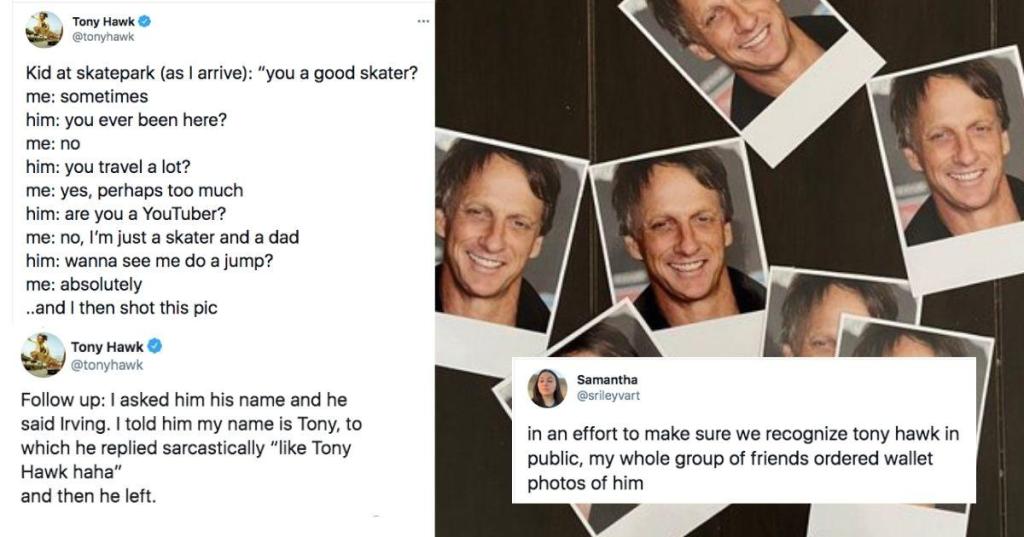
This one from a couple of years ago has re-gone viral:
Follow up: I asked him his name and he said Irving. I told him my name is Tony, to which he replied sarcastically “like Tony Hawk haha” and then he left.— Tony Hawk (@tonyhawk) October 31, 2019
Which is just one of many similar stories. Hawk told Business Insider that it happens often, but he only shares the interactions that are the funniest.
at a Covid testing site (wearing masks), handing over paperwork for me & two of my kids: woman looking over papers: "okay… Anthony, Keegan and Kadence… Hawk? Are you guys related to Tony Hawk?" me: yes her: "Are you pulling my leg?" me: no, we are all directly related to him— Tony Hawk (@tonyhawk) December 31, 2020
TSA agent (checking my ID): "Hawk, like that skateboarder Tony Hawk!" Me: exactly Her: "Cool, I wonder what he's up to these days" Me: this— Tony Hawk (@tonyhawk) March 21, 2017
Kid at skatepark: “Are you Tony Hawk?” me: I am him: “no you’re not” me: ok, I’m not him: “but are you, FOR REAL?” me: I am, for real him: I thought you’d look younger me: ME TOO— Tony Hawk (@tonyhawk) July 29, 2019
Now the meme itself results in some funny interactions with people.
Guy at grocery store: "you ever get mistaken for Tony Hawk… or are you Tony Hawk? Me: both!— Tony Hawk (@tonyhawk) July 14, 2018
To clarify: each person was joking, but unaware that they were redundant.— Tony Hawk (@tonyhawk) January 11, 2021
People’s funny reactions to the meme are becoming their own meme: “I will know Tony Hawk when I see him.”
I study a picture of Tony Hawk daily so I’m not one of those people he tweets about if I ever run into him— kate (@k8sday) March 10, 2021
in an effort to make sure we recognize tony hawk in public, my whole group of friends ordered wallet photos of him pic.twitter.com/D53W3JU5VL— Samantha (@samvriley_) March 5, 2021
Going to teach my kids: 1. Not to talk to strangers 2. Who Tony Hawk is 3. Tony Hawk is not a stranger, you can talk to him. Do not embarrass this family.— Shelby Hintze (@ShelbyHintze) March 10, 2021
Part of what makes the whole thing so delightful is that Tony Hawk himself is so delightful. He’s down-to-earth, friendly, doesn’t take himself too seriously, does a lot of connecting out in the community, and is just a genuinely likable guy.
Tony Hawk periodically trending for being wholesome, unproblematic and generally unrecognizable is one of my favorite things on Twitter.— Shawnté James, MD: The Olds™/Elder Millennial (@ShawnteJamesMD) March 10, 2021
And to top it all off, he’s still a heck of a skater. Though he retired from the pro circuit in 1999, he still skateboards for fun and charity. In fact, he recently landed a 720—two full 360-degree turns in the air off a ramp—which isn’t easy for even a young skater to pull off, and then auctioned the board to raise money to help build more public skateparks. (He did say it might be his last time pulling off that trick, but who knows. Good for him for pushing the age envelope.)
I can’t say for certain that this is the last one I’ll ever do, but I can’t imagine doing many more. So I’m offering this board to raise money for public skateparks: donate any amount to @thenineclub superchat 1/27 7pm PT (on YouTube), & you’ll actually be donating to @skatepark— Tony Hawk (@tonyhawk) January 27, 2021
Tony Hawk—skating legend, father of five, nice guy to all, supporter of community parks, and man that everyone adores but nobody recognizes—thanks for being such a ray of sunshine in our world. May we know you when we see you, or at least be entertaining enough to make your Twitter account if we don’t.
A single door can open up a world of endless possibilities. For homeowners, the front door of their house is a gateway to financial stability, job security, and better health. Yet for many, that door remains closed. Due to the rising costs of housing, 1 in 3 people around the world wake up without the security of safe, affordable housing.
Since 1976, Habitat for Humanity has made it their mission to unlock and open the door to opportunity for families everywhere, and their efforts have paid off in a big way. Through their work over the past 50 years, more than 65 million people have gained access to new or improved housing, and the movement continues to gain momentum. Since 2011 alone, Habitat for Humanity has expanded access to affordable housing by a hundredfold.
A world where everyone has access to a decent home is becoming a reality, but there’s still much to do. As they celebrate 50 years of building, Habitat for Humanity is inviting people of all backgrounds and talents to be part of what comes next through Let’s Open the Door, a global campaign that builds on this momentum and encourages people everywhere to help expand access to safe, affordable housing for those who need it most. Here’s how the foundation to a better world starts with housing, and how everyone can pitch in to make it happen.
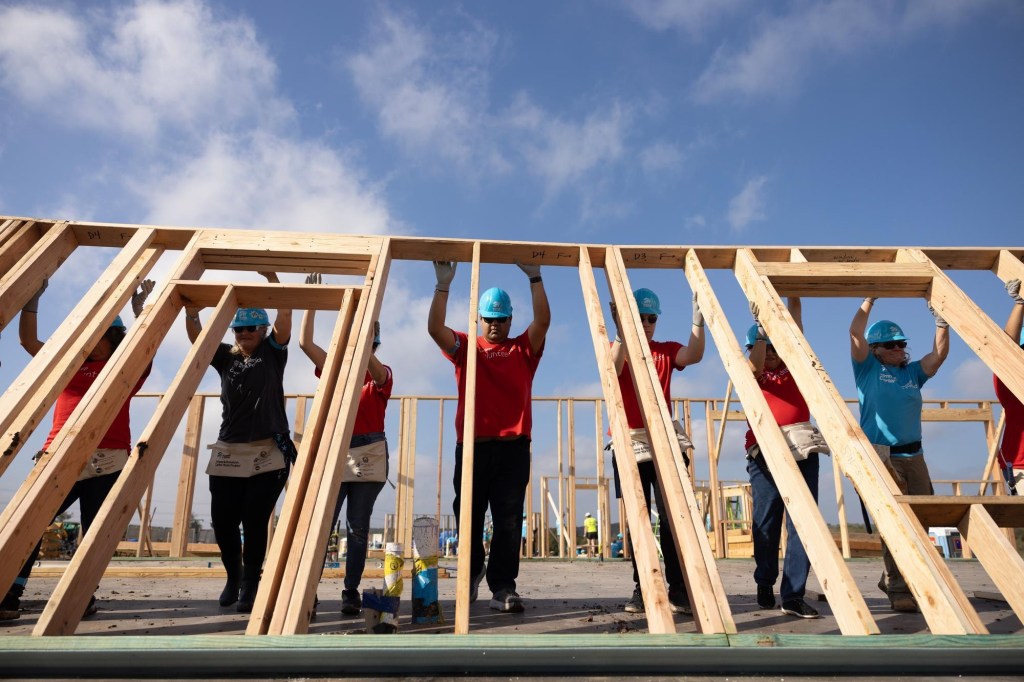
Volunteers raise a wall for the framework of a new home during the first day of building at Habitat for Humanity’s 2025 Carter Work Project.
Globally, almost 3 billion people, including 1 in 6 U.S. families, struggle with high costs and other challenges related to housing. A crisis in itself, this also creates larger problems that affect families and communities in unexpected ways. People who lack affordable, stable housing are also more likely to experience financial hardship in other areas of their lives, since a larger share of their income often goes toward rent, utilities, and frequent moves. They are also more likely to experience health problems due to chronic stress or environmental factors, such as mold. Housing insecurity also goes hand-in-hand with unstable employment, since people may need to move further from their jobs or switch jobs altogether to offset the cost of housing.
Affordable homeownership creates a stable foundation for families to thrive, reducing stress and increasing the likelihood for good health and stable employment. Habitat for Humanity builds and repairs homes with individual families, but it also strengthens entire communities as well. The MicroBuild® Initiative, for example, strengthens communities by increasing access to loans for low-income families seeking to build or repair their homes. Habitat ReStore locations provide affordable appliances and building materials to local communities, in addition to creating job and volunteer opportunities that support neighborhood growth.
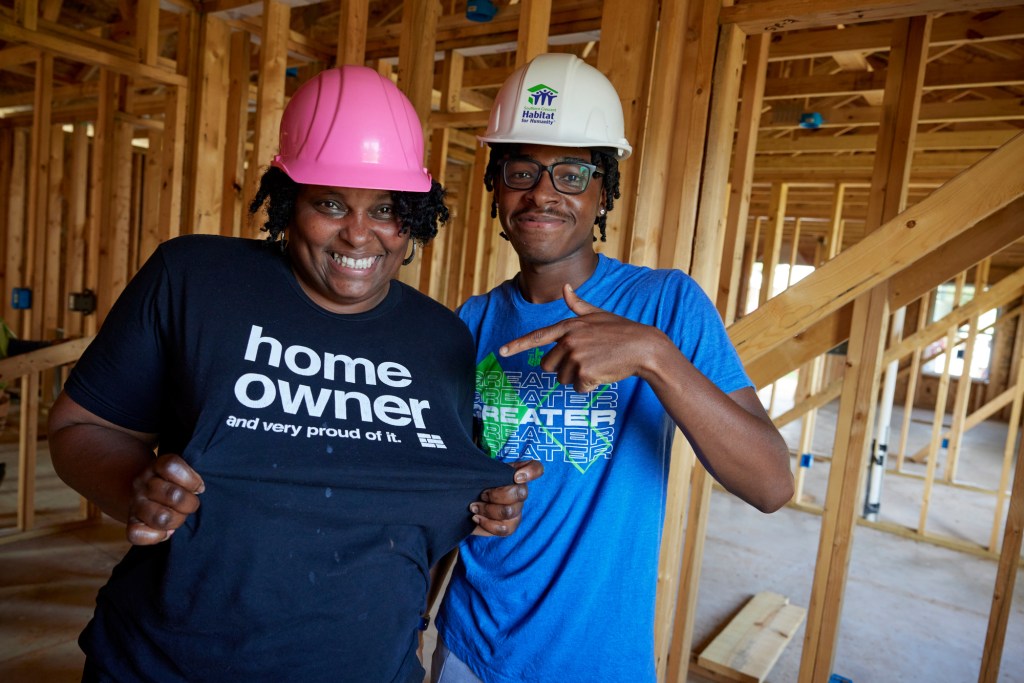
Marsha and her son pose for a photo while building their future home with Southern Crescent Habitat for Humanity in Georgia.
Everyone can play a part in the fight for housing equity and the pursuit of a better world. Over the past 50 years, Habitat for Humanity has become a leader in global housing thanks to an engaged network of volunteers—but you don’t need to be skilled with a hammer to make a meaningful impact. Building an equitable future means calling on a wide range of people and talents.
Here’s how you can get involved in the global housing movement:
Speaking up on social media about the growing housing crisis
Volunteering on a Habitat for Humanity build in your local community
Travel and build with Habitat in the U.S. or in one of 60+ countries where we work around the globe
Join the Let’s Open the Door movement and, when you donate, you can create your own personalized door
Every action, big and small, drives a global movement toward a better future. A safe home unlocks opportunity for families and communities alike, but it’s volunteers and other supporters, working together with a shared vision, who can open the door for everyone.
There’s no doubt that there are contrasts between the generations, as baby boomers, Gen X, millennials and Gen Z see and experience the world quite differently. While generation gaps have always existed, the tech age has widened those gaps in big ways, which sometimes creates challenges but often results in hilarity.
For instance, watching a Gen Zer try to figure out how to use a rotary phone is pure entertainment. The way emojis are used and interpreted varies vastly by age, making for some chuckle-worthy communication mishaps. Slang terms can be hard to keep up with the older you get, but they can also be manipulated by savvy elders to great comedic effect.
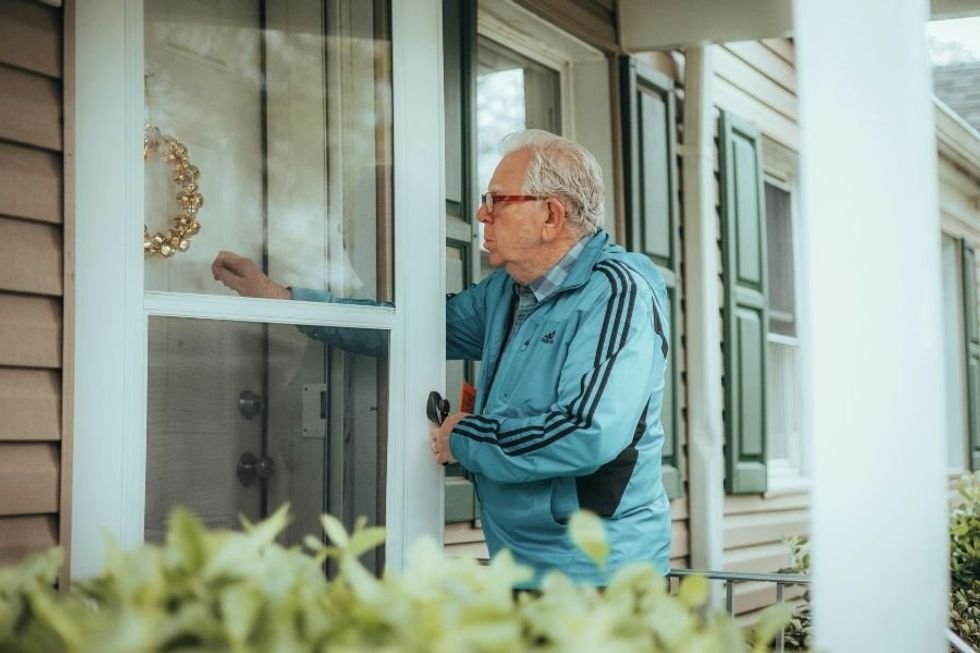
“You’ve basically got boomers who will turn up completely unannounced any time from about 7:00 in the morning and they will knock on your door just slightly louder than the police using a battering ram carrying out a house raid,” Lambert begins.
“And then you’ve got Gen X. They would have made the plans well in advance, and they would’ve also checked in a couple of days before just to make sure the plans are definitely still happening,” he coninues. “You see, Gen X is the forgotten generation and they’re so scarred by this title they would’ve assumed that you’d forgotten not only about the plans but about their very existence.”
“Millennials will have hoped that the plans would’ve been canceled. There’s no reason that a millennial will ever actually want to come to your house,” he continues. “They will arrive late, but they will text you to let you know they’re on their way, just as they’re about to get into the shower. And a millennial will never knock on your door. You’ll just get a text either saying ‘here’ or ‘outside,’ and that’s your cue to go and let them in.”
“Similarly, Gen Z will never actually knock,” he concludes. “But the chances are they won’t have to, as they would have been documenting the entire journey from their house to yours, maybe even on FaceTime using this angle [camera facing directly up at the chin] as they go along for some reason. Either that or they’ll just send a picture of your front door or a selfie of them outside it. And again, just like the millennial, that’s your cue to go and rescue them from the outside world.”
The comments were laughing at themselves
People feel alternately seen, attacked and validated by Lambert’s assessments, with the most common response being “accurate.”
“I‘m a millennial, my husband GenX. Scarily accurate! 😂“
“Described this millennial to a T.”
“This is surprisingly accurate 😂 I laughed slightly louder than the police using a battering ram…”
“Sooo accurate…guilty of the lateness and ‘here’ text 🙃”
“I must admit I’m a millennial. But knocking on the door feels so aggressive, uknow? 😅😇”
“Millennial texting to say almost there but just started getting dressed to go out. Why do we do this? It’s not intentional, at least not for me.”
“Honestly your observations are just brilliant! GenX-er here!”
“The Gen Z angle omg. 😂😂”
Naturally there are some people who don’t resonate with their generation’s description, but there are exceptions to every rule and some people will never fit a stereotype. However, judging by the wave of affirmative responses, Lambert has nailed the generational generalities across the board—and done so in a way that allows us all to laugh at ourselves.
Photo credit: via The White House/Wikimedia Commons and The Earthy Jay / Pexels – Kansas City Chiefs quarterback Patrick Mahomes and a woman with a nose ring.
Online culture has had an incredible effect on fashion trends. It used to take a trend about 20 years to complete a cycle: introduction, rise, peak, decline, and obsolescence. However, in recent years, this cycle has been sped up incredibly due to several factors. Trends can be quickly introduced and adopted due to social media, online shopping and quick turnaround through fast-fashion distribution. The speed of adaptation also means they can fizzle out just as fast.
This means a fashion trends we’d usually see stick around for years can come and go in months. It’s an expensive pill to swallow for anyone trying to keep up with the latest (Gen Z, we’re looking at you), but it’s a blessing for those of us who have a problem with some of today’s polarizing looks.
The bad news is you may not like broccoli cuts. The good news is that they will be gone and forgotten before you know it.
A great conversation recently broke out on Reddit, where commenters weighed in on all the fashion trends they couldn’t wait to go away.
It seems that some of the most controversial styles are the work of Gen Z. Whether it’s the nose ring that looks like it belongs on a bell cow or big pillowy eyelashes, Gen Z has championed some looks that will probably look a little silly in a few years.
Here are 15 fashion trends currently “in” that people are already over.
The trends people are already over
1. Suits with shorts
“Took my cousin to prom and saw at least 30 dudes wearing a suit with shorts.”
This one is extremely hard for millennials and Gen Xers to wrap their heads around, but it is oh-too-real. It seems to be a natural evolution of the “suit with sneakers” look.
2. Anti-aging tweens
“Children (I’ve mostly seen around ages 9-13) going to Sephora for anti-aging serums and makeup. You all can hardly go to the park by yourselves, yet you’re plastered in expensive creams and makeup like you’re 20+.”
“This one really bothers me. It’s pretty dark, honestly, and the parents who allow this are weird as hell.”
The New Yorker says tweens are imitating influencers and popular “get ready with me” videos on social media.
3. Limp Biz-kids
“I’m a high school teacher and a surprising number of the boys dress like it’s 2000 and they’ve got Limp Bizkit’s ‘Nookie’ on repeat. There’s one kid that looks like he’s from 1977. Puka shells, feathered hair, big, open collars. I like that kid.”
4. Botox
“Excessive Botox in young people. I’m so tired of everyone having a frozen face. It’s not pretty. It’s just weird.”
“I swear there was a coordinated effort by some industry to convince girls in their 20s that they need to start Botox now because it’s preventative. That’s the reason given when I ask these early 20s girls why they use it. “It prevents future wrinkles” like there was a peer-reviewed study showing it does or something.”
Patricia Wexler, MD, of Wexler Dermatology in Manhattan, told Vogue that getting preventative Botox injections at a young age can lead to more wrinkles. “If you do too much Botox on your forehead for many, many years, the muscles will get weaker and flatter,” Wexler says. This means that surrounding muscles do more work when you make facial expressions. “If one stops using their forehead muscles, they may start squinting using their nose and have wrinkles along the side of their nose,” she continued.
5. Teen boys with alpaca hair
“I used to work reception at a salon and it was always fricken hilarious when these kids would come in to get a perm. They’d come sulking in behind their mommies, sit for 2 hours with curlers and stinky perm solution in their hair looking like cats being forced to take a bath, then prance out thinking they were the shit with their new poodle cuts lol.”
“Some of them are definitely embracing their natural curls, which is awesome! But a good chunk of them, especially the preppy ones with rich parents, are getting straight up 80s style perms. It’s great.”
Patrick Mahomes helped popularize this one, though he cut his signature curls in early 2025 — which may say something about where the trend is headed. Jake Paul, unfortunately, is still on board.
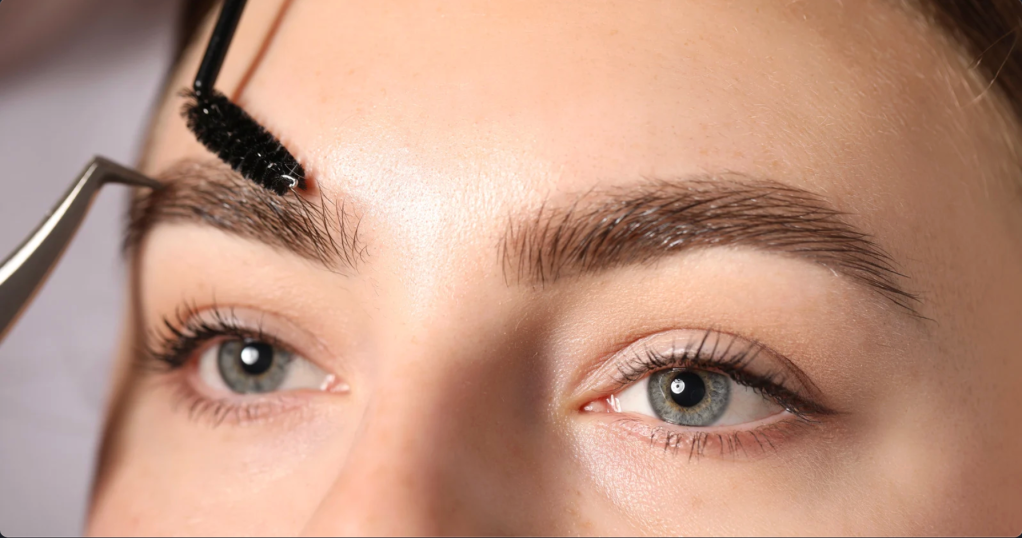
6. Laminated brows
“Eyebrows that are brushed upwards. That’s the only way I can think to describe it. I can’t see anything else when looking at someone who has that style brows. I just don’t know why people like it.”
“Almost every eyebrow trend ends up looking kinda silly. Let’s just all work with the eyebrows we have. Sure, clean it up a lil bit if you feel like it.”
In the 2000s, we had spiky hair. Now, we have spiky eyebrows. But don’t worry, it won’t last.
Woman gets work done on her eyebrows. Photo credit Canva
7. Over-the-top fake eyelashes
“The ridiculous false eyelashes. I get it. I’ve got no problem with the ones that at least have a semblance of being natural. But the uber thick ones that look more like fur are just…pointless. Someone I deal with at work wears them. And it’s so weird, because most of the time she dresses down in sweatshirts, jeans, sneakers, etc. And doesn’t pay much attention to her hair. But she’s got those stupid wooly caterpillar eyelashes in. They just call attention to how un put together the rest of her is. I know that everyone should just dress for themselves, but it’s just weird.”
8. Barrel jeans
“The barrel jeans have got to go. They’re the ugliest effing things I’ve ever seen. And people keep lying to these women about how they’re flattering and I’m like no! You look bowlegged!”
For years jeans got tighter and lower until they reached an inevitable breaking point. High-waisted jeans were a sign of the pendulum swinging back in the other direction, and now young peoples’ jeans look like inflated balloons.
9. ’80s moustaches
“Weird ’80s moustaches, I’ve seen good looking guys made to look like Ned Flanders. Ages them instantly, which I guess is the plan, but ages them past 20s to married with kids approaching teenage years.”
The number of young men with mullets and moustaches is absolutely staggering these days.
The ones that have been around way too long
10. Crocs
“I thought they were hideous when they first came out almost twenty years ago, and they’ve never gone away.”
“We always made fun of them and then suddenly everyone was wearing them. I don’t get it!”
How did Crocs go from the bargain bins to becoming one of the top footwear brands in the U.S.? The big reason is that comfort became more important during the pandemic than aesthetics. They were also quite a statement for people who wanted to rebel against traditional beauty standards. Add celebrity endorsements from Justin Bieber and Post Malone and Crocs came back in a big way.
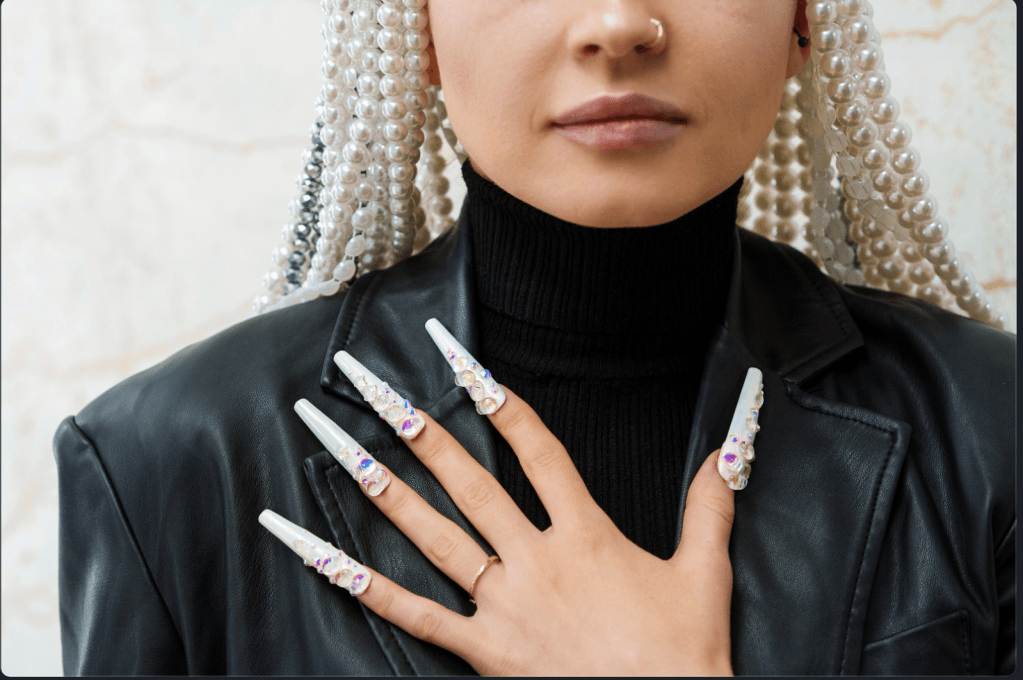
11. Long nails
“Super long acrylic nails, they seem really impractical.”
“Especially the pointed ones that all the Hollywood people wear like claws. You look trashy and high maintenance.”
“Patriot clothing and beards. Grunt style, nine line… all these fools dressing like they’re special forces, their entire identity tied to 1776. It’s embarrassing.”
If I never see a t-shirt of an American flag with an assault rifle superimposed on top, it will be too soon.
13. Hair parted in the middle
“Middle parts. You need an almost symmetrical face to be able to pull it off, which is pretty rare. Side parts all the way.”
“Middle parts look so harsh and unflattering on everyone. Side parts are a million times better.”
It was cool when Shawn Hunter and Jonathan Taylor Thomas did it. Let’s leave this one in the ’90s.
14. Nose rings
“That nose ring in the middle. Just doesn’t look good to me. You do you. But just think it doesn’t look good very often.”
“They always make me think of cattle.”
15. Political clothes
“Political attire as someone’s entire main wardrobe, no matter the side of the spectrum. You got more personality than that!”
“I have a bro-in-law who wears American flag t-shirts almost exclusively. He must have hundreds of them. And not the tasteful kind with like a little flag on the sleeve or chest. I’m talking about the most garish kind. The kind with a gigantic waving US flag along with a menacing bald eagle flying dramatically over snow-capped peaks. We like America too, Dan, but can you try to wear at least a polo to Grandma’s funeral?”
Fashion trends may come and go faster than ever, but some of these looks can’t go fast enough. And Reddit will always be sure to let everyone know it.
This article originally appeared two years ago. It has been updated.
Renee Buckingham was on a tram in Melbourne when an older man started calling a young woman “disgusting.”
The woman was with friends, wearing a dress. The man told her she should be embarrassed for dressing that way in public, in front of older people like him, he said. He kept going.
She couldn’t stay quiet
Buckingham, a Melbourne-based content creator, said she felt her heart rate climb as she watched. She doesn’t usually look for confrontation. For a moment she hesitated, worried the man might turn aggressive if she intervened.
“I said to him, ‘Don’t you dare speak to women like that,’” she explained in an Instagram post shared on January 19, 2026. She told him that if he felt uncomfortable looking at the woman’s outfit, that was his problem, not hers. She told him a woman’s clothing choices have nothing to do with her worth.
He didn’t have much to say after that.
Putting the shame on the shamer
Buckingham posted about the incident and it spread quickly, drawing thousands of responses from people who recognized the moment, the calculation that happens in real time when you witness something wrong in a public space and have to decide whether the cost of speaking up is worth it.
For the young woman on the tram, Buckingham had a direct message: “Never change who you are for any man.”
Her message resonated
The comments on her post filled with people who’d been in similar situations on both sides of it, the ones who’d been shamed, the ones who’d watched and said nothing and still thought about it, and the ones who’d spoken up and found it went differently than they feared. “Thank you for advocating for that young woman,” wrote one commenter. “We need to keep speaking up.”
Buckingham’s point, boiled down: the discomfort belongs to the person doing the shaming, not the person being shamed.
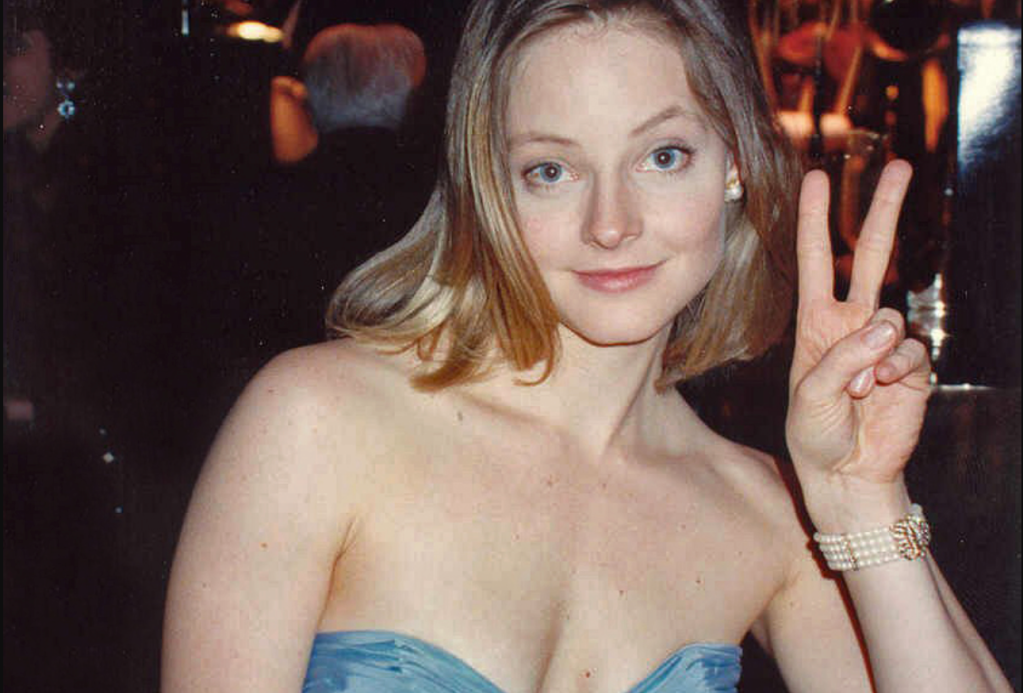
Jodie Foster has won two Oscars, been famous since she was 12, and has been working in the industry since she was barely 3. By her own account, all of that success had started to do something to her she didn’t like.
The cappuccino that changed everything
She described the moment of recognition in a January 2026 interview with Variety, timed to the release of her new film “A Private Life.” It came down to a cappuccino.
“I asked someone for a cappuccino?” she recalled, with what Variety described as barely restrained horror. “I did what? I thought I knew what I was talking about and ranted on for 45 minutes? I didn’t send that person a condolence letter when their mom died? I wasn’t at their wedding? I disappeared for four months and expected everybody to be my friend when I came back?”
Foster, now 63, said she feared she was becoming what she called “a creature of Hollywood,” a politer way of putting something less polite. Famous since her breakout in “Taxi Driver” at 12 and a two-time Best Actress winner before she was 30, for “The Accused” in 1988 and “The Silence of the Lambs” in 1991, she’d spent decades in an environment that tells you your needs come first. The cappuccino moment was when she realized she’d started to believe it.
The science behind her self-awareness
That discomfort is backed by research. Columbia University psychologist Adam Galinsky has studied the relationship between power and empathy, finding that people who feel powerful are demonstrably less able to read others’ emotional states accurately. In one experiment, participants who’d been primed to feel powerful made significantly more errors identifying emotions in facial expressions than those who hadn’t. Power, it turns out, reduces emotional sensitivity, not because powerful people are inherently worse, but because the environment trains them to stop paying attention.
Foster paid attention when she noticed it happening to her, and she stepped back. She told NPR in a separate interview that she wanted to make movies she loved and give everything to her performances without getting caught up in celebrity culture, and that meant keeping her personal life tightly guarded. “I wanted to give everything of myself on screen, and I wanted to survive intact by having a life and not handing that life over to the media,” she said.
Hollywood on her terms
She has since returned to work, including “A Private Life,” which premiered at Cannes and opened in January 2026. She told Variety she believes it may be the best work of her career, and the secret, she said, is that she’s never worked less hard in terms of energy output. “I just do what I think, and then I drink a coffee.”
Many of us feel invincible when we are young, believing we can control the aging process so that we’ll always stay forever young, as Bob Dylan once sang. But there’s a moment when everyone realizes aging is an inevitable process and that, eventually, we will have to deal with a slow decline in our physical and, quite possibly, mental capabilities.
This realization and understanding that we won’t be here forever can profoundly change one’s perspective on life. Even though aging is inevitable, studies show how we think about the process can significantly impact our longevity. People with a positive view of aging live an average of 7.5 years longer than those without.
When the reality of aging sets in
Things happen as we age that are impossible to describe to younger people. However, a group of Redditors did an excellent job of explaining the truths about aging that they were not “prepared” for in a recent thread that made a lot of people feel seen. A user named sofiagympixie asked the AskReddit forum, “What’s a truth about aging that no one prepared you for?” and it received thousands responses.
A big takeaway is that many people feel like they stop mentally aging at a certain point, usually in their late 20s. Still, the continued physical aging they experience makes them feel like they cannot relate to the person in the mirror.
Here are 17 of the most profound responses to the question: What’s a truth about aging that no one prepared you for?
1. There is an end
“You start to realize the older you get that the end is closer than the beginning and you still feel like you have so much more to do.”
“That moment where you start to get a sense that there is an end.“
2. It takes energy to keep everything afloat
“No one prepared me for how much energy and time it takes to maintain everything—like health, relationships, and just staying organized. It’s way more work than I expected!“
3. Mind/body detachment
“How your mind stays young while your body starts to slow down. You still feel like the same person you’ve always been, but suddenly you notice little things changing.“
“This was such a surprise to me. I really expected to feel psychologically older as I aged. But physically, oh my body has betrayed me… Eyes… hair (gray, but at least I still have it)… back… knees… hips… prostate.“
4. The past feels closer than it is
“When you get a flashback of a good memory and you realize that was over 10 years ago.“
“When I told my daughter about something I did 24 years ago, I had to pause for a moment.”
“I’m 61, and sometimes I feel like this world is not for me anymore. I feel almost like an imposter. For example, I can’t find clothes I like that fit correctly, TV is abhorrent, only old music sounds pleasant, shoes are uncomfortable, I don’t recognize most celebrities or famous people in the news or tabloids, and I don’t understand the need for most new and supposedly exciting products. I’m an educated person, I still work and have an active life. I’m not a recluse. But a little at a time, I feel the world is moving on without me. I finally understand why, in her final years, my mother only watched movies from the 1950s and reminisced about the past more than she talked about the present. Her world was long gone.“
When the people and world around you start to change
6. You lose friends
“If you choose not to have kids, you may end up losing your friends. I turn 40 this year, and my partner and I don’t see many folks these days. Parents like to hang out with other parents. And I don’t have a grudge, I totally see the value for playdates, etc. But it can be a little lonely.”
“To be fair, I have 2 kids and lost a lot of friends because we simply don’t have the time/energy to connect regularly enough to maintain a healthy friendship. It instead falls into an awkward acquaintance stage where enough time passes between communication, and you’re not sure if reaching out to connect comes across weird.”
“I feel this. Lost my mom 2 weeks before my 21st birthday. 40 now with 2 kids. I get angry/sad at a lot of milestones like my wedding and kids’ stuff ‘cause my mom was robbed of them, and I was robbed of her.”
8. Time wasted caring about other people’s opinions
“It’s so freeing when that old twinge of ‘why don’t they like me’ pops up, and then I remember that I can not be bothered by that anymore, and magically, I don’t care!”
“Just wasting time in general. No thanks. I want to do as many things as possible!”
9. Your friends die
“Your friends start to die. It’s something I never thought about.”
10. Time flies
“Man. I don’t even feel like the days are long anymore. I just keep blinking and the weeks go by.”
“Yup, wake up, eat breakfast, do a couple things. Wait, it’s lunch already? Eat lunch, do a couple more things, time to prep dinner. Eat dinner, clean up, fix a few things, it’s 9 pm. I guess it’s almost time to get ready for bed? This times 10,000 for me.”
11. The monotony sets in
“You will realize that you hate planning meals and making food every single day. It’s boring, and it’s too easy to fall into monotony. But you have to make lunch again and then plan for dinner again then make dinner again and what do you want to eat tomorrow so you plan for breakfast tomorrow and get up and make breakfast again and then plan for lunch again….”
12. You become invisible to much of society
“I wondered what felt off the last year. Gen Z is everywhere now, and I’m still asking myself when that happened.”
“When you’re a kid, you can’t wait to ‘grow up,’ and then you do, and you’re still you, just older. That voice inside your head doesn’t change, but what you see in the mirror does. Only now you’re just older and saddled with bills and stress and all of life’s ‘surprises.’ On top of this, everyone is winging it. Absolutely everyone. Because the idea of order and a civilized society is an illusion. We’re all playing by made up rules and making imaginary money and all the rest of it. A one-dollar bill costs just as much to print as a hundred-dollar bill.”
14. Priorities change
“Things that seemed so important when you were younger, really are not important.”
15. Younger people’s reverence
“I’m middle-aged, and a funny thing is how younger people get self-conscious or apologize when there is no need. For example, they will apologize for swearing around me or mentioning something like (gasp) drinking, or drugs, or sleeping around. I think it’s funny. Why would being on earth longer make me easier to scandalize? I’ve seen and done things that would shock them, lol, but to them I’m a very proper-looking classy older lady.”
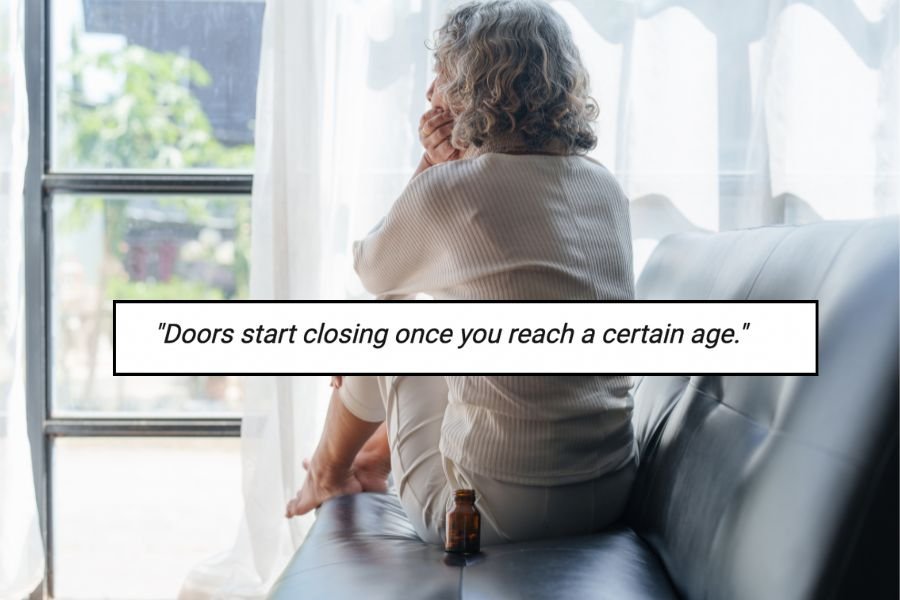
16. Ageism
“Doors start closing once you reach a certain age.”
“Ageism is real. I just turned 50 and am in a young person’s career (software development). I feel how hiring managers look at me when asked to turn my camera on, during an interview that was going very well and suddenly it’s ‘we’ll get back to you.’”
17. It all catches up
“Things like drinking, eating unhealthily, smoking, spending … they will catch up. When you’re young you think you’re different, or you think that when it does catch up you’ll be old so who cares, I won’t care when I’m old anyway. You will care, though. You’ll still be you. Those things won’t seem like an issue right up to the moment they are. And then it’s too late to take them back.”
The bottom line is that aging is a part of life, and while sometimes it is easy to get wrapped up in the negative, there is still plenty of positive to focus on. Because everyone gets old. Even Bob Dylan.
This article originally appeared two years ago. It has been updated.
Photo credit: via Andrea Piacquadio/Pexels and Ethan Brooke/Pexels – A woman is shocked to learn that her name means something totally different in Australia.
When people move abroad, it’s normal to experience serious culture shock. Culture shock is a feeling of being disoriented or confused by a different way of life and set of norms than you’re used to. You’d think moving from America to another English speaking country wouldn’t be so jarring, but you might actually be surprised at how different things can really be even when the bulk of the language and customs overlap nicely.
Devyn Hales, 22, from California, recently moved to Sydney, Australia, on a one-year working visa and quickly found out that she had a lot to learn about her new home.
The first thing that made her feel out of place? Believe it or not, her name. It wasn’t going to work Down Under. It all started when a group of men made fun of her on St. Patrick’s Day.
Why her name became a problem the moment she landed
After she introduced herself as Devyn, the men laughed at her. “They burst out laughing, and when I asked them why, they told me devon is processed lunch meat,” she told The Daily Mail. It’s similar to baloney, so I introduce myself as Dev now,” she said in a viral TikTok video with over 1.7 million views.
For those who have never been to Australia, Devon is a processed meat product usually cut into slices and served on sandwiches. It is usually made up of pork, basic spices, and a binder. Devon is affordable because people buy it in bulk and it’s often fed to children. Australians also enjoy eating it fried, like spam. It is also known by other names such as fritz, circle meat, Berlina and polony, depending on where one lives on the continent. It’s like in America, where people refer to cola as pop, soda, or Coke, depending on where they live in the country.
So, one can easily see why a young woman wouldn’t want to refer to herself as a processed meat product that can be likened to baloney or spam.
“Wow, love that for us,” another woman named Devyn wrote in the comments. “Tell me the name thing isn’t true,” a woman called Devon added.
For Devyn, it could have been worse, as her name was easily shortened to Dev. She could have been named Sheila, which is a slang term for women or girls that also carries slightly derogatory undertones.
Besides changing her name, Dev shared some other differences between living in Australia and her home country.
“So everyone wears slides. I feel like I’m the only one with ‘thongs’—flip-flops—that have the little thing in the middle of your big toe. Everyone wears slides,” she said. “Everyone wears shorts that go down to your knees and that’s a big thing here.”
Dev also noted that there are a lot of guys in Australia named Lachlan, Felix and Jack. (Oliver, Noah, and Henry have topped the charts in recent years, with Leo and William also consistently near the top.)
She was also thrown off by the sound of the plentiful magpies in Australia. According to Dev, they sound a lot like crying children with throat infections. “The birds threw me off,” she said before making an impression that many people in the comments thought was close to perfect.
“The birds is so spot on,” a user named Jess wrote. “The birds, I will truly never get used to it,” Marissa added.
One issue that many Americans face when moving to Australia is that it is more expensive than the United States. However, many Americans who move to Australia love the work-life balance. Brooke Laven, a brand strategist in the fitness industry who moved there from the U.S., says that Aussies have the “perfect work-life balance” and that they are “hard-working” but “know where to draw the line.”
Despite the initial cultural shocks, Devyn is embracing her new life in Australia with a positive outlook. In a follow-up video, she mentions she hasn’t even had many run-ins with Australia’s infamous and dangerous creatures like giant spiders and man-eating sharks. There are other perks to living there, as well.
“The coffee is a lot better in Australia, too,” she added with a smile, inspiring others to see the bright side of cultural differences.
This article originally appeared two years ago. It has been updated.
This article originally appeared 7 months ago. It has been updated.
Photo credit: Photo by lil artsy/Pexels – Older people are sharing memories of wild behaviors and norms that would be considered "boundary crossing" today
How many times have you looked back to things you thought were “normal” from your childhood and thought “Huh, that was actually kinda weird in hindsight”? Times change, and what’s considered “normal and acceptable” change with them. That’s not automatically good or bad, necessarily, but hopefully humanity is evolving such that we learn from our mistakes and recognize room for improvement.
Culture, social progress, and technology all play a role in how our behaviors evolve. We hope our behavior changes for the better, and sometimes it does, but some folks might disagree and think things were better back in simpler times.
In that vein, someone asked Gen Xers and Boomers on Reddit, “What are some things that would be considered rude or boundary crossing today but were perfectly normal and acceptable when you were growing up?” and the answers reveal how much has shifted in the past handful of decades.
If you’re over 40, enjoy this slightly disturbing trip down memory lane. If you’re under 40, yes, all of these things really happened on a regular basis.
Scolding other people’s kids (even strangers)
Raising a child was seen as more of a community effort than it is today, which resulted in perfect strangers doling out discipline.
“Scolding someone else’s child. I remember getting corrected by strangers.”
“Those were the lessons that stuck the most too for me. When a family friend or stranger corrected me I knew without doubt I done f’d up. I didn’t like the trend during the late 80’s into 90’s of everyone telling each other to mind their own business and not correct a child that wasn’t theirs ~ horrible logic that I feel totally contributed to where we are at today with nobody considering other peoples opinions on things.”
“OMG yes! in my neighborhood, whoever’s house you were at, if you acted up, their mom was expected to let you know, and even send you home! it’s just how things were.”
“Kids were basically community property.”
People are split on whether this development is ultimately good or bad.
Showing up or dropping by unannounced
Before cell phones, people didn’t always call or text before going to someone’s house. Company could just show up at any time. People had snacks on hand specifically for unexpected guests. It was a thing.
“Possibly stopping in at a friend’s house unannounced. That used to be fairly common when everyone didn’t have a phone in his or her pocket.”
“You never knew who, or how many, would show up at our house on a Friday night for a game of penny ante poker or Yahtzee in the 60’s and 70’s.”
“I do miss that. We always had extra snacks for guests available because we never knew when someone might just show up.”
“We always had a Pepperidge Farms Coconut cake in the freezer. My mother would take it out to thaw as soon as company showed up.”
“A corollary of this was that you were also expected to have your clothes on and be somewhat presentable while you were at home, since you never know who would be dropping by.”
“Hell, me and my friends would just walk into each other’s house like we lived there. None of the parents seemed to mind either. I often ended up eating meals at their homes and them at mine.”
People still show up out of nowhere in movies and TV shows, though. Probably because texting isn’t quite as cinematic!
Birthday spankings
Okay, yeah, this one is weird. It was a tradition to get a spanking for every year of your life on your birthday, and it wasn’t even just parents who did this. Teachers, your parents’ friends, etc.
“All my parents’ friends used to give me a spanking for each year on my birthday. Does anyone else remember this? Birthday spankings? So weird.”
“And a pinch to grow an inch.”
“My 4th grade teacher did this to all of us in front of the whole class. She ended it with a “pinch to grow on” and literally pinched our butts. This was around 2001 in Indianapolis. I don’t recall anyone ever having an issue with it at the time, but looking back it was definitely odd. She was a great teacher and I have nothing bad to say about her at all. It was just a different time.”
“Yessssss! I’m in MD and was in elementary school in the 80’s. If it was our birthday we would pick another kid to spank us in front of the whole grade, so if turning 9 you would get 9 smacks on your butt and all the kids would shout “ONE! TWO!…” I can’t imagine that happening now!”
“Oh god! In a school club we would all line up and the birthday girl to crawl between all our legs as we spanked her on birthdays. What a crazy tradition!”
“The spanking machine! Kids would line up in a row, legs open, and you would crawl through, while kids slapped your butt. Sometimes singing ‘today is spankin’ day!’”
Later, the birthday spankings evolved in birthday arm punches — again, one for every year. It’s really hard to imagine anyone getting away with this today.
Actual spankings. With a paddle. At school.
School principals, vice principals and sometimes teachers kept a paddle at their desk, which would be used to whack kids who misbehaved. Corporal punishment was the gold standard for behavior modification. Hacking, whacking, paddling—so many names for this woefully outdated practice.
“The big paddle that one of the teachers would possess that would be used on your hind quarters at their whim. No parent permission needed.”
“The (completely backward) school I attended in 7th grade in 1999-2000 still spanked kids. My math teacher spanked a kid in class at least once a week. This was the deep south and very different from other schools I went to, it was quite the culture shock.”
“I would get the paddle or else my desk kicked over while I was in it, my head would hit that floor HARD! I don’t know which was worse.”
“In 1987 my mom walked me into the school office and told everyone including the principle that under NO circumstances is anyone to paddle or spank me for discipline and if I misbehaved they were to simply call her about it. Their jaws dropped. That would not have happened anyways because I was a very well behaved and respectful child.”
“I definitely got the big paddle in the vice principal’s office.”
It’s impossible to explain to young people today how ubiquitous smoking used to be. Like, it was considered rude not to have ashtrays in your home. High schools had smoking areas. Restaurants, airplanes, waiting rooms—people smoked everywhere.
“I can recall the nurses at the triage in the hospital in my home town, smoking away while working. The 80s man, crazy time.”
“I was born in 82, there’s a picture of my mother holding me shortly after I was born, laying in a hospital bed, and on her bedside table is a pack of reds and an ashtray.”
“And on airplanes and trains. I remember riding the L in Chicago with people smoking on the cars.”
“Smoking in class at college.”
“Smoking in grocery stores and putting out butts on the floor.
Teachers with ash trays on their desks smoking during class.”
“My parents didn’t smoke, but they (1970s) kept a guest ashtray in the house in case a visitor wanted to light up. Complained endlessly about the smoke smell once the person was gone, but it would have been rude to tell them to take it outside or wait.”
The first question a restaurant hostess used to ask you was “Smoking or non-smoking?” if you can believe it.
Sexual harassment
A man exhibiting inappropriate behavior in the workplace. Photo credit: Canva
Not that this was ever normal or acceptable, but it was tolerated to a disturbing level.
“Until Anita Hill, I had never even heard the term Sexual Harassment. I literally had no idea it was a thing. You were female, you were employed, men could make insistent advances with zero repercussions. One of my co-workers finally slept with the boss just to try to get him to leave her alone. This was NORMAL. We expected it to happen and accepted that it would, we just had to deal with it.”
“I was told to lighten up because it was a compliment.”
” I got my first job in 1973 when I was 15. I worked in the restaurant business and waited tables all through college. It was pervasive and customers (men) would say many unwanted things as well. My first adult job was selling pharmaceuticals in 1984 and the first thing my regional manager told me during orientation was if a doctor did or said anything inappropriate handle it anyway you saw fit and then call and tell me about. He made it clear we didn’t have to put up with any BS and were free to slap anyone if we needed to. By the nineties sexual harassment wasn’t gone but was getting called out in a big way. Until there was a name for sexual harassment we knew we were uncomfortable but didn’t really have a way to express it in a meaningful and united manner.”
“My friends and I were grabbed constantly in middle school by boys in early 90s. It never occurred to us to tell anyone and I honestly don’t think they would have cared. We just shared our shame amongst ourselves.”
“Men would randomly grab and touch women all the time when I was growing up. Boomers were the worst about it, but I’m GenX and even we had it somewhat normalized. We’d gotten a clue that it wasn’t great, but we hadn’t yet realized it was actually sexual assault when someone would fondle your butt or breasts unbidden. Or when someone would grab you and kiss you. If you complained you were told to lighten up.”
Watching old films and TV shows can be a bit cringeworthy for this exact reason. Inappropriate comments and contact at work was often seen as a joke and “just good fun.”
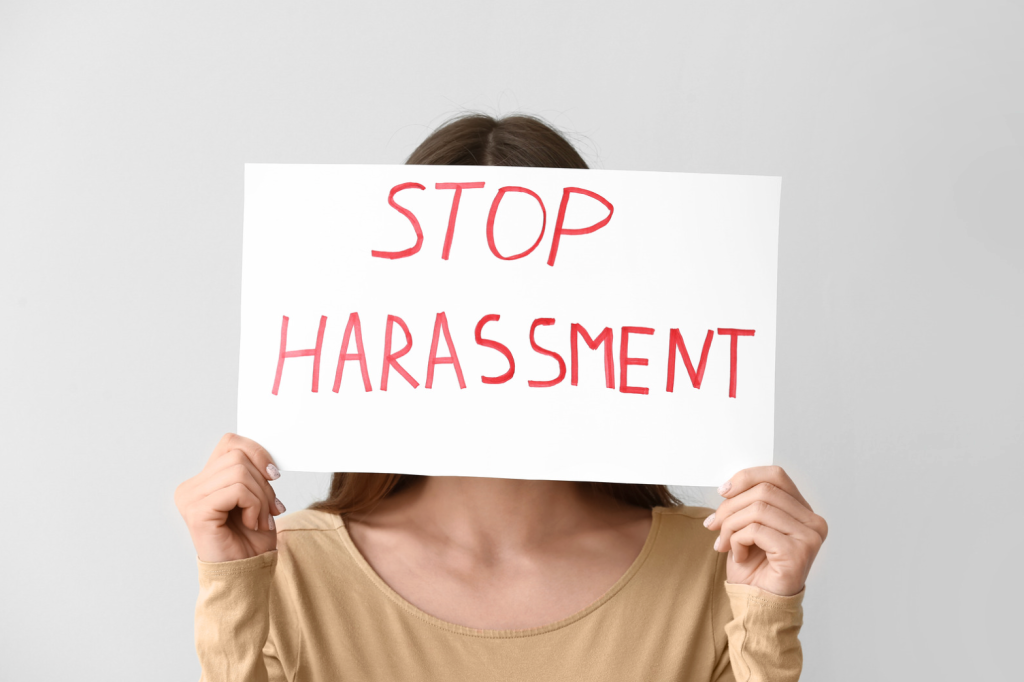
Woman holding up a sign saying “Stop harassment.” Photo credit: Canva
The drastic policing of what women wore under their clothes
Imagine having all the girls line up in gym class while the teacher runs his finger down each girl’s back to make sure she was wearing a bra. Imagine it being unheard of to not wear pantyhose and show bare skin on your legs while wearing a skirt. We still police what women and girls wear in some places, but it’s not as bad as it used to be.
“I’ve been told that women were expected to wear ‘foundation garments’ at work, and if they didn’t, then they might get reprimanded. I’m talking about longline bras and girdles.”
“In the 80s, one of my friends got sent to the office for not wearing a bra to high school.”
“Until 1999, I was required to wear pantyhose at work. Nuts! And they dictated ‘suntan’ color!”
“Not sure what I spent more $ on – pantyhose or clear nail polish to stop the runs.”
“I remember being a kid in the 90s my mom going from store to store looking for slips to put under my dresses, she had a whole section of her closet devoted to them. I hated them and didn’t understand their purpose. Still don’t. I’m so glad those are in the past.”
People shared other things as well, such as how common it was to touch total strangers or to cut through people’s yards to get to where you were going, and it’s a wild ride through shifting social norms. Some things are definitely best left in the past, but some lend themselves to a stronger sense of community and might be worth revisiting. It does make you wonder what things from today will show up on a list like this decades from now.
You can see more on the r/AskOldPeople thread here.
This article originally appeared two years ago. It has been updated.
When a woman stopped to pump gas in Folsom, California, she noticed a 62-year-old man standing on the nearby street corner holding a sign. He wasn’t asking for money. He was handing out resumes.
She offered him cash anyway. He declined and handed her a copy of his resume instead.
“My heart sunk,” she later wrote. She went home and posted his story, along with his resume, to a private Facebook group called Folsom Chat. Within 24 hours, as CBS Sacramento reported, George Silvey had a job.
Sacramento veteran’s determination pays off
Silvey was a Vietnam veteran who had spent six years standing on street corners trying to find work the old-fashioned way. He’d had careers in maintenance, heavy equipment operation, painting, and in-home healthcare. He wasn’t looking for charity. He was looking for someone to take a chance on him.
“I know that once I get my foot in the door, I can make a lot of money real fast,” he told reporters. “All I need is the opportunity.”
This veteran’s job search was over
The Facebook post did what six years of sidewalk networking hadn’t. Summer Gonzalez, co-owner of KiKi’s Chicken in Rancho Cordova, saw it and called. The next day Silvey was washing dishes and taking out trash. He showed up early.
“How many people are really asking to earn their money when you see them out on the street?” Gonzalez said. “And how can you say no to someone that actually wants to take the initiative to take care of himself?”
She didn’t say no. Neither did Silvey when his roommate’s phone started ringing off the hook with offers after the post went up. “It threw me for a loop because I didn’t expect this to happen so fast,” he said.
On his first day he put on his uniform shirt and got straight to work. Gonzalez watched and said simply: “He’s a great guy.”
The importance of community
Silvey called it a lucky day. But the luck was mostly the woman at the gas station who saw someone doing exactly what she would have wanted someone to do — refusing to beg, asking instead to be given a shot — and decided she was going to make sure he got one.
“Never give up, never give up hope,” Silvey said afterward. “It can happen and it will happen.”