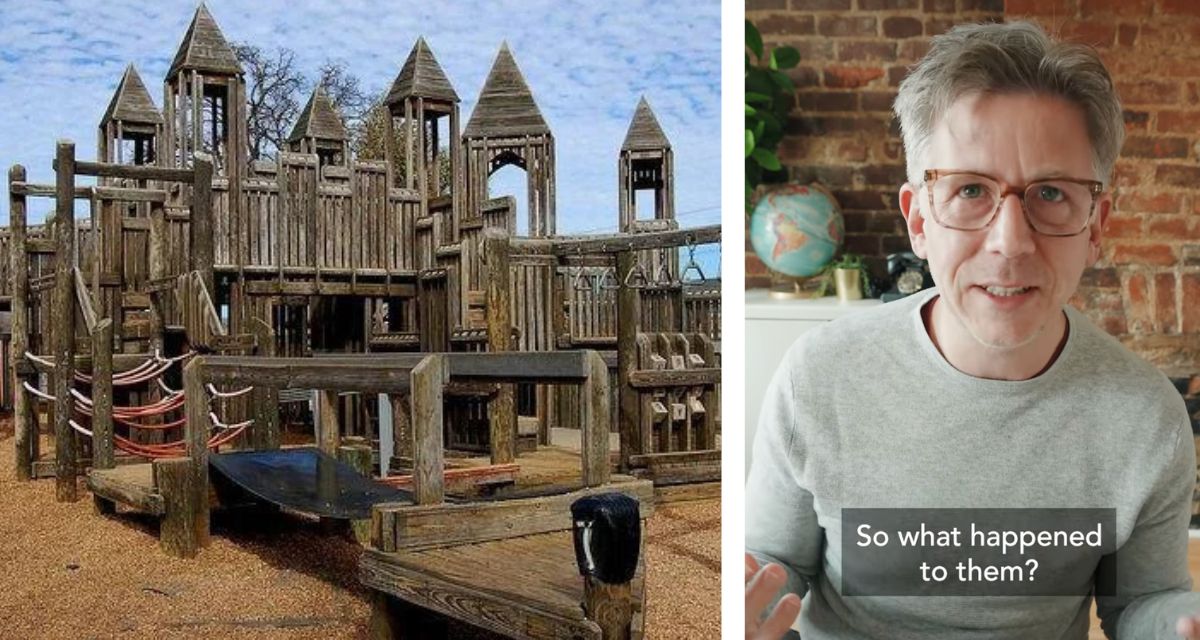
If you grew up in the ’80s or ’90s, you’re likely all too familiar with those all-wooden, castle-like playgrounds complete with drawbridges, child-sized tunnels, rope mazes, PVC pipe “walkie-talkies,” cool hideaway spaces, airport towers, and tire walls.
They were the perfect place to let your imagination run wild, whether you pretended to be knights, wizards, Vikings, or simply played freeze tag without ever touching the ground.
Nowadays, those castles are like a modern-day fairy tale: no longer made, rarely seen, and mostly remembered as relics of a bygone era. What happened?
History of wooden playgrounds
As a fun Instagram video by content creator Phil Edwards explains, part of what made wooden playgrounds special was that children had a major role in how they were created.
According to Edwards, Robert “Bob” Leathers, founder of Leathers and Associates, and his partner, Tom Rockwell, consulted children during the design process. Those playgrounds were then built by volunteer community members, such as parents, in a matter of days.
Personal memories
Interestingly, quite a few viewers shared personal memories of helping design their wooden playgrounds as children.
“My parents helped built the one for my elementary school…it was pure magic.”
“I participated as a child, and I clearly remember standing up as a kindergartener and saying, what if a slide came out of a dragon’s mouth. Years later, playing in the Orange CT playground, I realized the slide came out of a dragon’s mouth, rendered in wood. I almost didn’t believe my earlier memory. Could that wild idea from the mouth of a kindergartner have become a major feature of an actual playground?? What an amazing program. ❤️”
Castle Parks?
by u/Comfortable_Weight82 in grandrapids
“I remember being at planning meeting at the Waverly community house. I remember my dad building. I remember sanding wood. And I have so many memories of playing on this playground for hours a day while my mom taught dance…It was the greatest sense of community.”
“Our very small southern NJ town had one of these – Pine Cone Zone. I still remember the planning team coming to our school. We all submitted our ideas and designs. They also had a naming contest. People could donate money and their names would be engraved on the fence posts. Still remember spending the day at the rec fields while our parents built it. Was such a big deal for our little community ❤️”
Why they stopped making wooden playgrounds
Unfortunately, a study in the early 2000s found that the type of wood used in these structures contained arsenic, and that children who played on them had significantly higher levels of the toxin on their skin. The findings raised concerns about the structures’ overall safety, and major playground manufacturers eventually stopped using this type of wood in favor of other materials.
And while this didn’t seem to influence their decline, several folks recalled the wooden playgrounds as having merciless splinters.
“The splinters were ruthless,” quipped one commenter.
Still, there weren’t any documented cases of “anything going wrong from these playgrounds,” Edwards noted. That’s why they weren’t forcibly torn down, and why you might still find some of the 1,600 that were built scattered across the country.
While their reign has ended, wooden playgrounds leave behind a wonderful legacy. As Edwards put it, they were built “by parents who wanted to share their love with their children” and make something “amazing.” Imagine what could be possible if there were more opportunities for that kind of thing.