
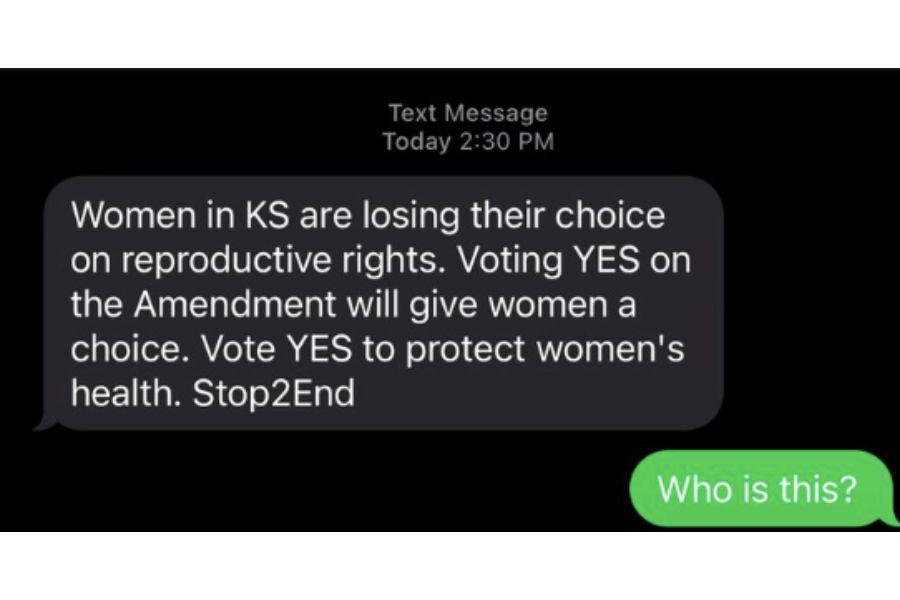
Getting to the truth in politics is challenging as it is and it’s hard enough just to get people to vote. The last thing we need is to have voters receive direct messages telling them that voting YES on an important ballot measure will do exactly the opposite of what it will do.
Yet that’s what has been happening in at least one state.
In its current election, Kansas voters are being asked to vote for or against an amendment to the state’s constitution that would impact abortion laws. The Value Them Both Amendment says that there’s no constitutional right to an abortion and would grant legislators the authority to regulate abortions. According to NPR, it’s the first ballot measure on reproductive rights in the U.S. since the Supreme Court’s decision that overturned Roe v. Wade.
The night before the election, people in Kansas started reporting text messages that sounded very much like they came from a pro-choice source. “Women in Kansas are losing their choice on reproductive rights,” the texts read. “Voting YES on the Amendment will give women a choice. Vote YES to protect women’s health.”
However, that’s exactly the opposite of what voting yes would do. Voting yes on the amendment would open the door to more restrictive abortion laws. Voting no means keeping current regulations.
The texts came from several different 888 numbers and did not disclose who they came from.
The texts are pretty clearly meant to confuse pro-choice voters into voting for the amendment, telling them that a yes vote would protect women’s reproductive rights when the opposite is true. It’s blatantly misleading, but according to the Kansas Governmental Ethics Commission, it’s not illegal.
Not only do text messages about constitutional ballot initiatives not require disclaimers informing receivers of who has paid for them, but there’s also nothing in the current statutes that addresses misleading wording. Lovely.
According to KMBC, the service Twilio disabled the user’s account from sending out any more text messages as distributing disinformation is against the platform’s terms of service. But the damage has already been done.
Naturally, people should read the ballot thoroughly before they vote and not just follow what some text tells them. However, ballots can be confusing. Language can be vague and/or biased, littered with legalese or contain muddled positives and negatives so voters aren’t always clear on what they are voting for or against.
The Kansas amendment measure is confusing as it is written. Check out the language used on the ballot, as shared by The Guardian:
Explanatory statement. The Value Them Both Amendment would affirm there is no Kansas constitutional right to abortion or to require the government funding of abortion, and would reserve to the people of Kansas, through their elected state legislators, the right to pass laws to regulate abortion, including, but not limited to, in circumstances of pregnancy resulting from rape or incest, or when necessary to save the life of the mother.
A vote for the Value Them Both Amendment would affirm there is no Kansas constitutional right to abortion or to require the government funding of abortion, and would reserve to the people of Kansas, through their elected state legislators, the right to pass laws to regulate abortion.
A vote against the Value Them Both Amendment would make no changes to the constitution of the state of Kansas, and could restrict the people, through their elected state legislators, from regulating abortion by leaving in place the recently recognized right to abortion.
Shall the following be adopted?
§ 22. Regulation of abortion. Because Kansans value both women and children, the constitution of the state of Kansas does not require government funding of abortion and does not create or secure a right to abortion. To the extent permitted by the constitution of the United States, the people, through their elected state representatives and state senators, may pass laws regarding abortion, including, but not limited to, laws that account for circumstances of pregnancy resulting from rape or incest, or circumstances of necessity to save the life of the mother.
That’s not a simple yes or no choice the way it’s worded. “Do you want the state to pass restrictive abortion laws? Yes or No?” would be simple. The way this is written, you have to unravel language that’s pretty clearly written to favor the amendment while also deciphering what it is you’re actually voting for or against.
The text messages telling pro-choice people to vote yes because it will protect choice are 100% wrong and almost assuredly designed to confuse voters even more than the ballot already does.
It’s a good reminder to ignore political messaging and to always read ballots carefully so that we know what we’re voting for. Some people will go to extreme dishonest lengths to score a political win, so we must stay diligent as we exercise our civic right, privilege and responsibility.
























.jpg)