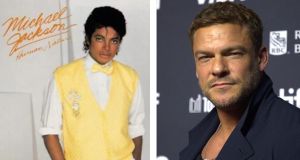
That was certainly the case during the April 11 episode, where host Ryan Gosling and Mikey Day transformed into human versions of “Beavis and Butt-Head.” Or, more accurately, two regular guys who happened to look like the iconic cartoon characters. Like, to an insane degree.
The scene centers around a talk show called “News Nation,” where journalist Hieid Garnder interviews a professor (Played by Kenan Thompson) about the ethical limitations of AI. Only what should be a very serious conversation is completely thwarted as Thompson can’t look away from an audience member (Gosling) donning a blue “Death Rock” T-shirt, prosthetic nose and platinum blonde pompadour.
“Professor, is there a problem?” the journalist asks.
“Um, yeah. There is a gentleman in your audience who looks strikingly similar to Beavis, from the cartoon ‘Beavis and Butt-Head’,” the professor responds. “Just a little distracting.”
That’s when Gardner turns around and, judging from her surprised stifled chuckle, sees the crazy realistic looking prosthetic Gosling is wearing for the first time.
Though Gosling’s character assured everyone he had no idea what “Beavis and Butthead” was, he politely agreed to move seats. Of course, he was immediately replaced by Day, just another innocent dude…who looked exactly like Butt-Head come to life. At this point Gardner lost it.
“Sir,” she says before busting out into a fit of laughter.
Eventually both Day and Godling end up sitting next to each other. And no one, save Thompson and the stone faced audience, can keep it together. And kudos to them, it couldn’t have been easy.
Watch below. And if you’re a “King of the Hill” fan, definitely watch til the end:
An Operation Smile volunteer reverses an oxygen mask so a child with a cleft condition can blow a bubble for the first time in Guadalajara, Mexico. (Operation Smile Photos)
For thousands of children born with cleft conditions, Operation Smile provides simple, playful tools—like bubbles—to strengthen the skills they need to speak and thrive.
While a bottle of bubbles might seem out of place in a hospital setting, you might be surprised to learn that, for thousands of children around the world born with cleft lip and palate, they can be a helpful tool in comprehensive cleft care. Lilia, who was born with cleft lip and palate in 2020, is one of the many patients who received this care.
As a toddler, Lilia underwent two surgeries to treat cleft lip and palate with Operation Smile’s surgical program in Puebla, Mexico. Because of Operation Smile’s comprehensive care, it wasn’t long before her personality transformed: Lilia went from a quiet and withdrawn toddler to an exuberant, curious explorer, babbling, expressing herself with a variety of sounds, and engaging with others like any child her age.
Lilia is now a healthy five-year-old, with the same cheerful attitude and boundless energy. Her progress is the result of care at every level, from surgery to speech therapy to ongoing support at home—but it’s also evidence that small, sustained interventions throughout it all can make a meaningful difference.
Lilia at age 1, before surgery, and at age 5, 4 years post-surgery
Cleft Conditions: A Global Problem
Since 1982, Operation Smile has provided cleft lip and cleft palate surgeries to more than 500,000 patients worldwide with the help of generous volunteers and donors. Cleft conditions are congenital conditions, meaning they are present at birth. With cleft lip and palate, the lip or the roof of the mouth do not form fully during fetal development. Cleft conditions put children at risk for malnutrition and poor weight gain, since their facial structure can make feeding challenging. But cleft conditions can have an enormous social impact as well: Common difficulties with speech can leave kids socially isolated and unable to meet the same developmental milestones as their peers.
Surgery is a vital step in treating cleft conditions, but it’s also just one part of a much larger solution. Organizations like Operation Smile emphasize the importance of multi-disciplinary teams that provide comprehensive, long-term care to patients across many years. This approach, which includes oral care, speech therapy, nutritional support, and psychosocial care, not only aids in physical recovery from surgery but also helps children develop the skills and confidence to eat easily, speak clearly, and engage in everyday life. This ensures that each patient receives the full range of support they need to thrive.
Marie, 11 months, with her mother at Operation Smile Madagascar before her cleft surgery (Operation Smile Photos)
A Playful (and Powerful) Solution
Throughout a patient’s care, simple tools like bubbles can play a meaningful role from start to finish.
Immediately before surgery, children are often in a new and unfamiliar environment far from home, some of them experiencing a hospital setting for the first time. When care providers or loved ones blow bubbles, it’s a simple yet effective technique: Not only are the children soothed and distracted, the bubbles also help create a sense of joy and playfulness that eases their anxiety.
Milagros Rojas, a volunteer speech therapist in Peru, using bubbles in a screening with a patient. (Operation Smile Photos)
In speech therapy, bubbles can take on an even more important role. Blowing bubbles requires controlled airflow, as well as the ability to form a rounded “O” shape with the lips, which are skills that children with cleft conditions may struggle to develop. Practicing these skills with bubbles allows children to gently strengthen their facial muscles, improve breath control, and support the motor skills needed for speech development. Beyond that, blowing bubbles can help kids connect with their parents or providers in a way that’s playful, comforting, and accessible even for very young patients.
Finally, bubbles often follow patients with cleft conditions home in the “smile bags” that each patient receives when the surgical procedure is finished. Smile bags, which help continue speech therapy outside of the hospital setting, can contain language enrichment booklets, a mirror, oxygen tubing, and bubbles. While regular practice with motor skills can help with physical recovery, small acts of play help as well, giving kids space to simply enjoy themselves and join in on what peers are able to do.
Bubbles at Home and Beyond
Today, because of Operation Smile’s dedication to comprehensive cleft care, Lilia is now able to make friends and speak clearly, all things that could have been difficult or impossible before. Instead of a childhood defined by limitation, Lilia—and others around the world—can look forward to a childhood filled with joy, learning, discovery, friends, and new possibilities.
CTA: Lilia’s life was changed for the better with the care she received through Operation Smile. Find out how you can make an impact in other children’s lives by visiting operationsmile.org today.
Sir Paul McCartney, 83, has lived a life that’s full of music, from listening to his father James play dancehall songs on the piano as a child, to joining a skiffle group with John Lennon as a teenager, to becoming the biggest band of all time with The Beatles. Then, he forged a solo career as a member of Wings and under his own name that has yielded more number-one hits than any other songwriter.
McCartney’s music has been a cornerstone of pop culture for over 60 years, but what are the songs that formed his musical taste? Paul recently revealed the ten songs that have “soundtracked my life” to the BBC’s Vernon Kay on his show Tracks Of My Years, which premieres on May 25 on BBC Sounds and iPlayer.
The full episode hasn’t been released, but the BBC revealed the 10 songs that Paul chose, in no particular order.
Paul McCartney reveals 10 songs that soundtracked his life:
10. John Lennon – “Imagine” 09. The Beach Boys – “God Only Knows” 08. Bob Dylan – “Tambourine Man" 07. Prince – “Kiss” 06. The Human League – “Don’t You Want Me” 05. The Kinks – “You Really Got Me” 04. Elvis -… pic.twitter.com/rUQyERDQnA
In 1971, a year after the breakup of The Beatles, John Lennon released what would become his signature song, a wistful (and slightly acerbic) plea for humanity to envision a world without religion, war, or possessions, and to live in harmony. “When we came to not writing together, I think it was difficult for both of us,” McCartney once said of Lennon. “But, y’know, he still did ‘Imagine.’ He still did one of his best things ever.”
McCartney has routinely played songs written primarily by Lennon in concert, including “A Day in the Life,” “Give Peace a Chance,” and “Help!”, but he won’t touch “Imagine.” “There’s no shame in doing [Lennon’s] songs,” McCartney said. “In fact, I considered doing a major tribute to John…But then people started saying, ‘Why don’t you do ‘Imagine?” And I thought, ‘F***ing hell, Diana Ross does ‘Imagine’.’ They all do ‘Imagine’. That’s when I backed off the whole thing.”
The Beach Boys – “God Only Knows”
“God Only Knows,” written by Brian Wilson of The Beach Boys and Tony Asher, appeared on the band’s 1966 masterpiece Pet Sounds and is often cited by McCartney as one of his favorites. “I just think it’s a great song—melody, harmonies, words, you know,” Paul said. “I love it, you know. …It’s my favorite Beach Boys song.”
“Brian Wilson sort of proved himself to be like a really amazing composer,” McCartney added. “And I was into chords and harmonies and stuff at that time, and we ended up [in] kind of like a rivalry. [The Beatles would] put a song out and Brian [would] hear it, and then he’d do one, which is nice. [It was] like me and John [Lennon]. You know, you’d kind of try and top each other all the time.”
Bob Dylan – “Tambourine Man”
Released in 1965 on Dylan’s Bringing It All Back Home, an album that merged his earlier folk sound with his growing interest in rock ‘n roll, “Tambourine Man” is one of his first songs to introduce psychedelic imagery. It’s often believed the song is about a drug dealer, but the tambourine man in the story may actually be Bruce Langhorne, a session guitarist, who brought a giant Turkish drum to a session.
McCartney recently ribbed Dylan for not playing the song in his live set. “I’ve been to see a couple of shows of Bob’s, and I couldn’t tell what the song was that he was doing,” McCartney said, according to Music Radar. “Now, that’s a bit much because, I mean, I know his stuff and, you know, I get it if he doesn’t want to do ‘Mr Tambourine Man,’ you know, maybe he’s fed up with that, but I would like to hear it. And I’ve paid.”
Prince – “Kiss”
The Purple One had a big hit in 1986 with this cheeky, minimalist funk track about how he doesn’t care if a woman is “rich” or “cool”; he just wants her “extra time” and her “kiss.” The song topped the charts, beating out number two, “Manic Monday” by The Bangles, which was also written by Prince.
In 2016, shortly after Prince’s death, McCartney snuck Prince’s “Let’s Go Crazy” into his set while performing in his hometown of Minneapolis, Minnesota.
The Human League – “Don’t You Want Me”
“You were working as a waitress in a cocktail bar….” the song begins, and you either quickly change the station or roll up the car windows and scream, “Don’t you want me, baby? Don’t you want me, Oooooooooooh.” Evidently, McCarney is a roll-up-the-windows-and-belt-it-out kinda guy. Who knew?
I didn't have any money on McCartney digging The Human League.
— Bill Brennan 🍀 🎸 🎥 📚 (@williamcbrennan) May 14, 2026
The Kinks – “You Really Got Me”
In 1964, The Kinks released a monster with their third single, “You Really Got Me,” which, with its revolutionary distorted guitar sound, helped spark the rock era and served as a blueprint for heavy metal and punk. The song was released at the peak of Beatlemania, and both bands shared several bills in their early years, but didn’t really hit it off. “Paul McCartney was one of the most competitive people I’ve ever met. Lennon wasn’t. He just thought everyone else was sh*t,” Kinks’ frontman, Ray Davies, recalled.
Elvis Presley – “All Shook Up”
It’s hard to understand how big an impact Elvis’s 1957 hit “All Shook Up” had on a teenage McCartney. He and his friend, Ian James, struck out trying to meet girls at a fairgrounds, and he remembers going back home, and the two listened to the song to cheer themselves up. “The blues had gone. The headache had gone. We were like new people,” McCartney said, according to American Songwriter. “I just love that song so much for being able to do that. There’s just good moments like that, very reminiscent of the kind of moments you had when you were just starting a band.”
Buddy Holly – “That’ll Be The Day”
“That’ll Be the Day” has a big role in the Beatles’ history. It was routinely played by The Quarrymen, their earlier skiffle incarnation, featuring McCartney, Lennon, and George Harrison. It was also the first song they recorded as a demo in 1958 with Lennon on lead vocals. The recording would later be featured on The Beatles’ 1995 release Anthology 1.
Chuck Berry – “Maybelline”
Berry greatly influenced the Beatles’ music, especially the way he turned his songs into stories. “From the first minute we heard the great guitar intro to ‘Sweet Little Sixteen,’ we became fans of the great Chuck Berry,” McCartney said, according to Far Out. “His stories were more like poems than lyrics – the likes of ‘Johnny B Goode’ or ‘Maybellene.’”
It’s no surprise the rock ‘n roll pioneer made it to McCartney’s top 10, although many wondered why a Little Richard song wasn’t in there, too. McCartney routinely sang Little Richard songs in the early Beatles years, including a rousing version of “Long Tall Sally.”
I am surprised not to see any Little Richard track.
“Be-bop-a-Lula” was the first record McCartney ever purchased, and it would stick with him forever. “Yeah, it was the first record I bought, you know, and in those days, I think this with the Beatles, you know, it made us realize how special it is for people to buy records because we didn’t have much money. And you think about your purchase … so precious, man. It was all your money that week would go on that record,” he recalled in an interview with Ronnie Wood of The Rolling Stones. “It was in the film The Girl Can’t Help It. We finally saw him sing it, you know, with the Blue Caps and stuff, so I just loved it. It’s just such a beautiful record, you know.”
McCartney has a new album out, May 29, The Boys of Dungeon Road, featuring “Home to Us,” a duet with Ringo Starr.
“Robin Hoodand Little John, walking through the forest/Laughing back and forth at what the other’n has to say/Reminiscing this and that and having such a good time/Oo-de-lally, oo-de-lally, golly, what a day…
“Never ever thinking there was danger in the water/They were drinking, they just guzzled it down/Never dreaming that a scheming sheriff and his posse/Was a-watching them and gathering around.”
There never was a greater set of foes than Robin Hood and that evil Sheriff, whose greed was even more legendary than Robin Hood’s archery skills.
The discovery was made on a farm in Rushcliffe, Nottinghamshire, 26.9 miles from Sherwood Forest. The forest is known worldwide for being the mythological home of Robin Hood and his band of Merry Men. A central road that traversed the forest was notorious in Medieval times for being an easy place for bandits to rob travelers going to and from London.
Today, the forest is a designated National Nature Reserve. It contains ancient oaks that date back thousands of years, making it an important conservation area.
“It was the first big dig after lockdown on a glorious day. We were searching two fields. Other detectorists kept finding hammered coins but I’d found nothing,” Harrison said according to the Daily Mail. “Then I suddenly got a signal. I dug up a clod of earth but couldn’t see anything. I kept breaking up the clod and, on the last break, a gold ring was shining at me. I broke out into a gold dance.”
Harrison sent the ring to the British Museum’s Portable Antiquities Scheme to have it authenticated.
After doing some research they found that it was once owned by Sir Matthew Jenison, who was the Sheriff of Nottingham between 1683 and 1684.
The first accounts of Robin Hood, then known as Robyn Hode, first appear as early as the 13th and 14th centuries, a few hundred years before Sir Matthew served as sheriff.
But there’s no doubt that the archer and leader of Merry Men would have been delighted to know that an everyday guy came into possession of the Sheriff of Nottingham’s ring.
Sir Matthew was knighted in 1683 and acted as a commissioner to examine decaying trees in Sherwood Forest. He was later elected to Parliament in 1701. However, a series of lawsuits over shady land dealings would eventually be his ruin and he’d die in prison in 1734.
The gold signet ring bears the coat of arms of the Jenison family, who were known for getting rich off a treasure trove of valuables left for safekeeping during the English Civil War.
The valuables were never claimed, so the Jenisons took them for themselves.
Was Robin Hood a real person?
The whole thing makes you question how much of the legend of Robin Hood is actually true. Experts debate whether Robin Hood stories are based on one person or accounts of multiple different people. Various versions of the mythology begin and end in different time periods, but all share some similarities: Namely, Robin Hood shooting a bow and arrow and being constantly at odds with the evil Sheriff of Nottingham.
In the end, Robin Hood was said to have been murdered by his aunt. As he bled to death, “Little John placed Robin’s bow in his hand and carried him to a window from where Robin managed to loose one arrow. Robin asked Little John to bury him where the arrow landed, which he duly did. … A mound in Kirklees Park, within bow-shot of the house, can still be seen and is said to be his last resting place,” according to Historic UK.
Another site, a cemetery in Yorkshire, features a tombstone that reads:
Here underneath this little stone Lies Robert, Earl of Huntingdon Ne’er [never] archer was as he so good And people called him Robin Hood Such outlaws as he and his men Will England never see again.
Believe it or not, that wasn’t the only ring
What makes the story even more remarkable is that a second ring found at the same site five minutes before Harrison’s discovery was sold at auction in 2023. The circa 1560 posy ring, inscribed with the words “I Meane Ryght,” was found by water company worker Andy Taylor and is also believed to have belonged to a member of the Jenison family.
What happened to the ring after it was found
As for Harrison, he decided that he would sell the ring to someone who appreciates its importance.
“There can’t be many people who’ve found anything like that. I’m only selling it because it’s been stuck in a drawer,” Harrison said. “I hope it will go to someone who will appreciate its historical value.” It was sold at auction by Hansons Auctions for £8,500 ($11,115).
You can witness the intense final moments of the auction here:
Let’s hope that the man who sold the ring does what Robin Hood would have done with a piece of jewelry that adorned the hand of a nobleman whose family came into money by taking other people’s loot. Surely, he’d take the proceeds from the auction and give them to the poor.
This article originally appeared four years ago. It has been updated.
Photo credit: @drjasonisfresh/TikTok, Representative Image from Canva – Dr. Jason Singh explains the pro and cons of showering at night and in the morning.
You would think the “right answer” would be largely up to personal preference, much like which way to face while showering and whether or not to snack in the shower…two previous hot button issues online. But according to Singh, there are definitive pros and cons to each option, which could settle the debate once and for all.
Here is what the doctor actually found
Singh says in the clip that overnight, “your body can accumulate germs such as bacteria and fungus” through “processes like sweating and shedding skin cells,” all of which help create odor. When you shower off this residue in the AM, it brings your “skin microbiome back to a more hygienic baseline.”
Makes a pretty compelling case for morning showers, doesn’t it? Just wait.
One, it helps release melatonin to help induce sleep. Plus, when your body adjusts from a warmer temperature to a cooler temperature, that also helps your body prepare for a good night’s rest.
The second benefit is that it washes away “the entire day’s grime.” Which, let’s be honest, can be very therapeutic sometimes. And lastly, showering at night is the ‘better way to help hydrate your skin,” making it a better option for those with sensitive or dry skin.
Singh’s bottom line: “Overall night-time showers have more benefits to it but morning showers have really one benefit and that’s better hygiene.”
Singh encouraged viewers to weigh in with their own opinions, and they didn’t hold back.
“You will never convince me to go to bed dirty,’ one person wrote. Another argued “The worst part about night time showers is long, wet hair. I hate going to bed with wet hair!”
There ended up being some pretty funny responses as well. One person joked that they opted for morning showers since it helps them “Get my head together. Generate a to-do list. Fight with pretend people.”
Another person noted that timing preferences can be dictated by their schedule, commenting, “night showers during the work week and morning showers on the weekends.”
Woman takes an outdoor shower during the day. Photo credit: Canva
Some people said two showers was the answer
Many argued that two showers a day was the actual best option. That way you don’t go to bed dirty, and you’re fresh for the morning.
To be a great fiction writer requires understanding basic story structures and being clever enough to disguise them so your audience doesn’t know they’re watching or reading something they’ve seen before. Academics suggest that there are only a finite number of plots and structures, but that number varies based on who’s doing the talking.
Writer Kurt Vonnegut, best known for his satirical works on American politics and culture, including “Slaughterhouse-Five,” “Cat’s Cradle” and “Sirens of Titan,” was obsessed with the shapes of stories and summed up his views in one powerful sentence: “The fundamental idea is that stories have shapes which can be drawn on graph paper and that the shape of a given society’s stories is at least as interesting as the shape of its pots or spearheads.”
What are the shapes of stories?
In the video below, Vonnegut explains the shapes of three different types of stories. The first one he starts with is “person gets into trouble.”
The first question is where the main character or protagonist starts their journey. Are they in a state of good or bad fortune, and how does that change from beginning to end? The arc of this story is simple, someone starts off in good fortune, they get into trouble, and then find their way out. “Somebody gets into trouble, then gets out of it again. People love that story. They never get tired of it,” Vonnegut says with a smirk.
The second is called “boy gets girl,” which is the basics of the story: someone finds something “wonderful,” their life is on an upward trajectory, then they trail downwards until they can get the girl or boy back. He finishes with the “most popular story” of Western civilization, and that is “Cinderella.”What’s interesting about the story is that it’s about a poor little girl whose mother has died, and her life is pure misery. But her story has a massive upswing when she meets her fairy godmother and can go to the ball. But once the clock strikes midnight, her life crashes down in a matter of seconds.
Vonnegut’s eerie prediction about AI
What’s interesting is that at the beginning of the video, Vonnegut notes that stories are relatively “simple” and that they should be able to be plugged into computers that could then regurgitate the same story over and over again. It almost feels like an eerie predictor of artificial intelligence. “There’s no reason why the simple shapes of a story can’t be fed into computers. They are beautiful shapes,” Vonnegut says. “Now this is an exercise in relativity, really. It’s the shape of the curves are what matters, and not their origins.”
After seeing Vonnegut map out the basic plotlines of stories, it’s hard not to see them every time you watch a movie or TV show. It is amazing that, because there are so few characters and plot arcs in modern storytelling, anyone can create anything that feels new.
This story originally appeared three years ago. It has since been updated.
Christine Kesteloo has become popular on TikTok with over one million followers because she shares what living on a cruise ship is really like. Kesteloo is the wife of the ship’s Staff Chief Engineer, so she gets to live on the boat for free. She only has to pay for alcohol and soda, which she gets for half off according to Business Insider.
So what is life actually like on board?
“I live on a cruise ship for half the year with my husband, and it’s often as glamorous as it sounds,” she told BusinessInsider. “After all, I don’t cook, clean, make my bed, do laundry or pay for food.“
Kesteloo’s life seems pretty stress-free. After all, she’s basically on a permanent vacation. However, even though she lives on a cruise ship as a “wife on board,” there are a few things she either can’t or shouldn’t do.
Here are the four things she cannot do
She shared these four things in a TikTok video with nearly 10 million views.
Kesteloo says she cannot sit at a slot machine and “play my heart out until I win.” She believes it would “look a little weird if I, as the wife of the staff chief engineer, won a big jackpot.”
2. Leaving the ship with the guests
When the ship arrives at a destination, she can’t get off with the guests. She must wait about an hour and exit the vessel with the crew. When returning to the ship, she also has to be on time. “No, they will not wait for us,” she says. And the same goes for her husband, if they “miss the ship, someone else will take over the role.”
3. Sitting in a crowded pool
Although Kesteloo has access to the pool, gym, and all the ship’s amenities, she’s cautious not to interfere with the guests’ good time. She’ll exit the pool if it’s busy because “it’s just the right thing to do.”
4. Traveling without international traveler insurance
She must have insurance in case of a misfortune on the ship. But as a citizen of the Netherlands, they already have coverage and just have to pay a few extra dollars a month.
The comments had one big question
Though folks generally welcomed Kesteloo’s advice, some of the most popular commenters on the video were from women regretting that they married men who aren’t chief engineers on cruise ships or those who want to know where to find a single one.
“OK, can you explain how to marry a cruise ship engineer?” one female commenter wrote.
“How. in. the. H E double hockey sticks do I become the wife of a cruise ship engineer???? I don’t have to work AND cruise for free!” another added.
“Does he have any single friends with same job??? Asking for me,” one more asked.
For even more tips on living this charmed life, follow Kesteloo on TikTok. Who knows, by now she might even have some advice for landing your own cruise ship engineer spouse.
This article originally appeared three years ago. It has been updated.
The case called attention to the fact that there are motifs and musical structures common in pop music that no one owns, and all are free to use. When it comes to chord progressions, the 12-bar blues and basic I, IV, V, I progressions you hear in country and folk have been used and reused since people first picked up the guitar.
In the wrong hands, the progressions can result in music that is boring and formulaic, but in the right hands, they can be a springboard for fresh ideas.
Guitarist playing their instrument. Photo credit: Canva
A comedy group proved the point perfectly
In 2009, Australian comedy group Axis Of Awesome did a funny sketch showing how one four-chord progression, famous for being the basis of Journey’s “Don’t Stop Believin’,” has been used countless times by musicians to great effect.
They played a medley of 38 major hits using the same progression to prove their point. For musicians, it’s known as the I–V–vi–IV progression, and when played in the key of C it would be C, G, Am, F.
Warning: Video contains strong language.
Here are all 38 songs in the medley
“Don’t Stop Believin’” by Journey
“You’re Beautiful” by James Blunt
“Forever Young” by Alphaville
“I’m Yours” by Jason Mraz
“Happy Ending” by Mika
“Amazing” by Alex Lloyd
“Wherever You Will Go” by The Calling
“Can You Feel The Love Tonight” by Elton John
“She Will Be Loved” by Maroon 5
“Pictures Of You” by The Last Goodnight
“With Or Without You” by U2
“Fall At Your Feet” by Crowded House
“Not Pretty Enough” by Kasey Chambers
“Let It Be” by The Beatles
“Under the Bridge” by Red Hot Chili Peppers
“The Horses” by Daryl Braithwaite
“No Woman No Cry” by Bob Marley
“Sex and Candy” by Marcy Playground
“Land Down Under” by Men at Work
“Waltzing Matilda” by Banjo Paterson
“Take On Me” by A-ha
“When I Come Around” by Green Day
“Save Tonight” by Eagle Eye Cherry
“Africa” by Toto
“If I Were A Boy” by Beyoncé
“Self Esteem” by The Offspring
“You’re Gonna Go Far Kid” by The Offspring
“U + Ur Hand” by Pink
“Poker Face” by Lady Gaga
“Barbie Girl” by Aqua
“You Found Me” by The Fray
“Don’t Trust Me” by 30h!3
“Kids” by MGMT
“Canvas Bags” by Tim Minchin
“Torn” by Natalie Imbruglia
“Superman” by Five for Fighting
“Birdplane” by Axis of Awesome
“Scar” by Missy Higgins
And the official video has even more songs
It’s quite an extensive (and, as they prove, accurate) list, but that’s not all. In the summer of 2011, Axis of Awesome released an official music video of “4 Chords” on their YouTube channel, which included even more songs such as Train’s “Hey, Soul Sister,” The Black Eyed Peas’ “Where is the Love?”, John Denver’s “Take Me Home, Country Roads,” and even Men at Work’s “Land Down Under” in addition to many, many, many more.
Check it out:
Axis of Awesome officially broke up in August 2018 after a year-long break in 2017. Though the trio is no longer performing together, the impact of “4 Chords” goes on and on…much like the use of that musical progression. And, while all these songs may use the same four chords, you’ve got to admit they’re all bangers, so we’re not mad at it.
This article originally appeared three years ago. It has been updated.
Mark Twain is often seen as the quintessential American novelist, having penned classics such as The Adventures of Tom Sawyer and Adventures of Huckleberry Finn. But he was also a popular travel writer who wrote six books about his adventures abroad. In 1867, he was sent by a newspaper to travel throughout Europe and the Holy Land via the Mediterranean Sea, resulting in the popular book The Innocents Abroad.
In 1880, Twain wrote an unofficial sequel to The Innocents Abroad called A Tramp Abroad, a fictionalized account of himself, his traveling companion “Harris,” and their attempt to walk through Europe. The book is both a travelogue from a time when it was rare for most Americans to travel to Europe and a satire of how clueless they can be when encountering new cultures.
Twain didn’t care much for European cuisine
One unforgettable passage in A Tramp Abroad has Twain critiquing European food and longing for his favorite comfort foods. He refers to European fare as unsatisfying, to say the least. “The number of dishes is sufficient, but then it is such a monotonous variety of UNSTRIKING dishes. It is an inane, dead-level of ‘fair-to-middling.’ There is nothing to ACCENT it,” Twain wrote.
In the book, he jokes that when he returns to the States, he will have a “modest” meal of his favorite foods prepared for him and will send his requests ahead of time so they are ready when he arrives. The menu contains 60 of his favorite American comfort foods.
Twain lists his favorite comfort foods
“It has now been many months, at the present writing, since I have had a nourishing meal, but I shall soon have one, a modest, private affair, all to myself,” Twain wrote. “I have selected a few dishes, and made out a little bill of fare, which will go home in the steamer that precedes me, and be hot when I arrive, as follows:
Early rose potatoes, roasted in the ashes, Southern style, served hot.
Sliced tomatoes, with sugar or vinegar. Stewed tomatoes.
Green corn, cut from the ear and served with butter and pepper.
Green corn, on the ear.
Hot corn-pone, with chitlings, Southern style.
Hot hoe-cake, Southern style.
Hot egg-bread, Southern style.
Hot light-bread, Southern style.
Buttermilk. Iced sweet milk.
Apple dumplings, with real cream.
Apple pie. Apple fritters.
Apple puffs, Southern style.
Peach cobbler, Southern style
Peach pie. American mince pie.
Pumpkin pie. Squash pie.
All sorts of American pastry.
Fresh American fruits of all sorts, including strawberries, which are not to be doled out as if they were jewelry, but in a more liberal way. Ice-water—not prepared in the ineffectual goblet, but in the sincere and capable refrigerator.”
Twain’s list of favorite foods is notable because he spent much of his life in different regions of the United States, including Hannibal, Missouri (his boyhood home), Hartford, Connecticut (his adult home), and Elmira, New York (his summer retreat).
His career as a writer also took him to places in the West, including San Francisco and Sacramento, California, as well as Carson City and Virginia City, Nevada. This led him to develop a taste for many regional cuisines, which he referenced specifically on his list. The oysters should be from San Francisco, and the black bass from Mississippi.
Some may recoil when they see a few items on his list, namely “’coon” (short for raccoon) and “’possum,” short for opossum. These days, most Americans would shudder at the idea of eating them for dinner, but in the 1800s, they were seen as delicacies. Both were commonly roasted or stewed and served with sweet potatoes.
Twain’s over-the-top menu is a fun look at the types of food that were popular in the late 1800s, and it’s also a charming example of how every region of the U.S. has its own specialty. Whether it’s fish in the Sierras or duck in Baltimore, Maryland, every place has its own flavor, and to a man who lived just about everywhere, they were all something to savor.
Let us not forget his arguably most well-known and beloved ’90s character, Rick O’Connell from the “Mummy” franchise. Between his quippy one-liners, Indiana Jones-like adventuring skills, and fabulous hair, what’s not to like? During a double feature of “The Mummy” and “The Mummy Returns” in London, moviegoers got the ultimate surprise when who should walk in but Brendan Fraser himself, completely decked out in Rick O’Connell attire. The brown leather jacket. The scarf. Everything.
“I am proud to stand before you tonight,” he told the audience. “This is a film that was made in Britain. You should know that! Even the second one, too. Be proud. Thank you for being here.”
He continued, “We didn’t know if it was a drama or a comedy or a straight-ahead action or romance, a horror picture, more action, all of the above. No idea until it tested in front of British audiences. Thank you for that.”
Fraser then asked the crowd if anyone hadn’t actually seen the movie yet, before shouting, “Outstanding!” when somebody raised their hand. He then quickly made a polite plug, encouraging people to go see “The Whale” before whisking himself away, saying, “I won’t take up any more of your time.”
Uh, yeah…I don’t think any time spent with Brendan Fraser is a waste. Do you?