Obituary for a ‘very sick man’ went viral because it’s so funny you’ll wish you knew him

You’d never want to date one of his daughters.

Array
Photo credit: via Legacy.com Array

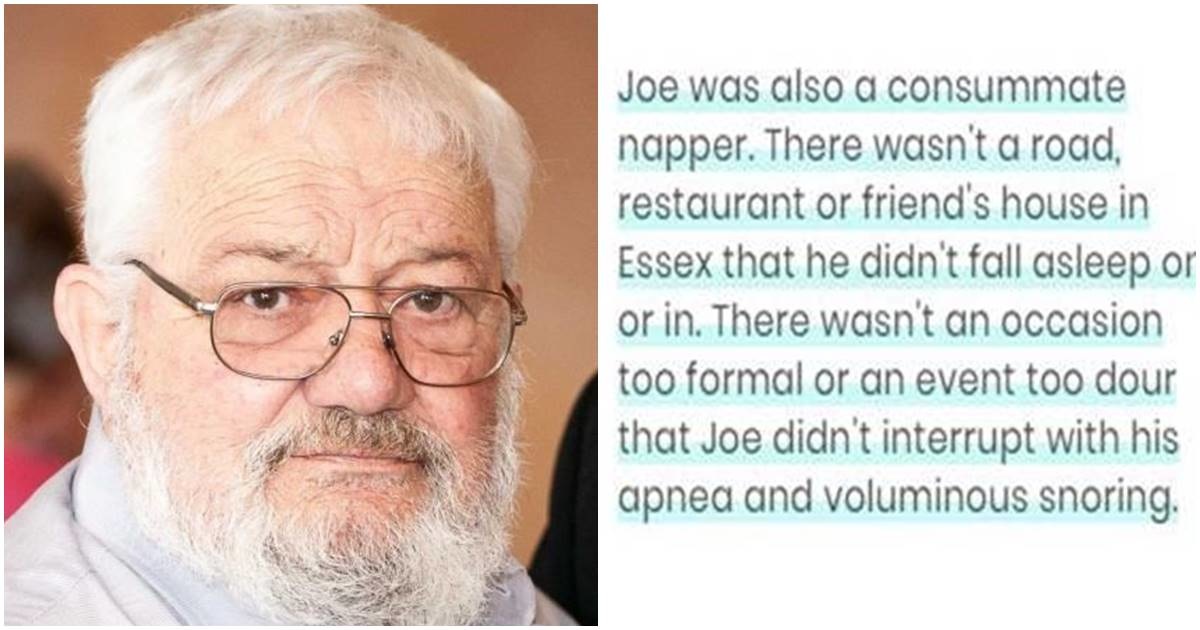
Joe Heller (1937 – 2019) of Essex, Connecticut appears to have lived a full life: he was in the Navy, worked at the Yale library, and raised three daughters. But he was also a hoarder, a hardcore napper, and loved pulling pranks that involved feces.

Well, as Abe Lincoln once said,”A man without vices is a man without virtues.”

His hilarious obituary, believed to be penned by one of his daughters, is going viral because it paints a loving picture of a man who clearly didn’t take life too seriously — a lesson we could all use from time to time.


The obituary opens with a helluva zinger.

Joe Heller made his last undignified and largely irreverent gesture on Sept. 8, 2019, signing off on a life, in his words, ‘generally well-lived and with few regrets.’ When the doctors confronted his daughters with the news last week that ‘your father is a very sick man,’ in unison they replied, ‘you have no idea.’

In his youth, Heller played the role of a prankster.

Being the eldest was a dubious task but he was up for the challenge and led and tortured his siblings through a childhood of obnoxious pranks, with his brother, Bob, generally serving as his wingman. Pat, Dick and Kathy were often on the receiving end of such lessons as “Ding Dong, Dogsh*t” and thwarting lunch thieves with laxative-laced chocolate cake and excrement meatloaf sandwiches. His mother was not immune to his pranks as he named his first dog, “Fart,” so she would have to scream his name to come home if he wandered off.



He met the “love of his life” at work and his daughter can’t believe he fooled her into marriage.

Joe was a self-taught chemist and worked at Cheeseborough-Ponds where he developed one of their first cosmetics’ lines. There he met the love of his life, Irene, who was hoodwinked into thinking he was a charming individual with decorum. Boy, was she ever wrong. Joe embarrassed her daily with his mouth and choice of clothing. To this day we do not understand how he convinced our mother, an exceedingly proper woman and a pillar in her church, to sew and create the colorful costumes and props which he used for his antics.

Heller had a knack for creatively intimidating his daughters’ boyfriends.

Growing up in Joe’s household was never dull. If the old adage of “You only pull the hair of those you love” holds true, his three daughters were well loved. Joe was a frequent customer of the girls’ beauty shops, allowing them to “do” his hair and apply make-up liberally. He lovingly assembled doll furniture and built them a play kitchen and forts in the back yard. During their formative years, Joe made sure that their moral fibers were enriched by both Archie Bunker and Benny Hill. When they began dating, Joe would greet their dates by first running their license plates and checking for bald tires. If their vehicle passed inspection, they were invited into the house where shotguns, harpoons and sheep “nutters” were left clearly on display.


He never met a dog he didn’t like.

After retiring from running Bombaci Fuel, he was perhaps, most well-known for his role as the Essex Town “Dawg Kecher.” He refused to put any of his “prisoners” down and would look for the perfect homes for them. One of them was a repeat offender who he named “A**hole” because no owner would ever keep him for very long because he was, in fact, an a**hole. My Dad would take his buddy on daily rides in his van and they’d roam around town with the breeze blowing through both of their fur. He never met a dog he didn’t like, the same could not be said for the wanna-be blue bloods, snoots and summer barnacles that roamed about town.


He had a small issue with hoarding.

Joe was a frequent shopper at the Essex Dump and he left his family with a house full of crap, 300 pounds of birdseed and dead houseplants that they have no idea what to do with. If there was ever a treasure that he snatched out from under you among the mounds of junk, please wait the appropriate amount of time to contact the family to claim your loot.

Heller was born with an innate napping ability.
Joe was also a consummate napper. There wasn’t a road, restaurant or friend’s house in Essex that he didn’t fall asleep on or in. There wasn’t an occasion too formal or an event too dour that Joe didn’t interrupt with his apnea and voluminous snoring.

According to the obituary, Heller will be laid to rest on Friday, September 13, at 10:00 am in Centerbrook Cemetery, but his family urges attendees to dress casually.

Joe despised formality and stuffiness and would really be ticked off if you showed up in a suit. Dress comfortably. The family encourages you to don the most inappropriate T-Shirt that you are comfortable being seen in public with as Joe often did. Everybody has a Joe story and we’d love to hear them all. Joe faced his death and his mortality, as he did with his life, face on, often telling us that when he dropped dead to dig a hole in the back yard and just roll him in.

You can read the entire obituary at Legacy.com.


This article originally appeared on 9.10.19

  • The surprisingly mysterious reason we use the $ symbol for the U.S. dollar
    Photo credit: CanvaWhy do we use $ to represent a dollar?
    ,

    The surprisingly mysterious reason we use the $ symbol for the U.S. dollar

    The U.S. dollar and its symbol have an international origin story.

    We see many symbols in our everyday lives that we likely don’t pay much attention to: the @ in our email addresses, for instance, or the % in our weather forecasts. But do we ever wonder where these symbols came from? Why they look like they do? Or how they came to mean what they mean?

    One of the most commonly used symbols that most of us are clueless about is the dollar sign ($). Why does it have an “S” if there’s no “s” in “dollar”? Is there supposed to be one line or two? And where did the $ symbol even originate?

    As educator and etymology enthusiast Rob Watts (better known as RobWords on YouTube) explains, the answers to those questions are surprisingly complicated.

    The first written use of the dollar sign as we know it appeared in a handwritten letter sent by a man in New Orleans in 1778. Some may be under the impression that the $ is an amalgamation of “U” and “S,” as in United States, but nope. Its origin isn’t actually from the United States at all.

    The international origins of the U.S. dollar start in Spain

    In fact, we have to take a whole international tour through hundreds of years of currency history to arrive at what we think is the origin of the $. As Watts shares, we don’t know with 100% certainty.

    The story begins with the Spanish real, the silver coin that served as the currency of Spain in the 14th century. A larger coin, worth eight times the value of the real, became known as a “piece of eight” in English. Those pieces of eight made their way to the Americas through colonialism in the 15th and 16th centuries.

    “The discovery of huge, gleaming reserves of silver in Central and South America meant that they could also be made there, too,” Watts shares. “At the local mints, they took on a new name as well, based on the fixed weights of  silver they were made from. They became known as the ‘peso,’ meaning ‘unit of weight.’”

    spanish dollar, piece of eight, peso, coin
    A Spanish piece of eight dating between 1651 and 1773. Photo credit: Portable Antiquities Scheme/Wikimedia Commons

    Because of their reliability and divisibility into smaller units, these pesos started being used not just in the Spanish-speaking colonies, but in British colonies in the Caribbean and North America as well.

    Hold the peso thought. We’ll come back to it momentarily.

    The word “dollar” can be traced back to the German Joachimsthaler coin

    In the meantime, another coin of similar value from the German town of Joachimsthal had gained traction in Europe.

    “In precisely the same way that a round slab of beef from Hamburg became known as a hamburger, this round slab of silver from Joachimsthal became known as a Joachimsthaler,” Watts explains. “And in exactly the same way that a hamburger is sometimes just called a ‘burger,’ a Joachimsthaler was sometimes just called a ‘thaler.’”

    Joachimsthaler, thaler, german dollar, coin
    A Joachimsthaler coin from 1525. Photo credit: TommyG/Wikimedia Commons

    “Thaler” became “daalder” in the Netherlands, “daler” in parts of Scandinavia, and “dollar” in the English-speaking world.

    But that dollar wasn’t the dollar we ended up with.

    “By 1700, the thaler had been adapted to have almost exactly the same silver content as another coin that was competing for usage in Europe: the ‘piece of eight’ or peso,” says Watts. “And so, to help differentiate between the two similarly valued coins, people started referring to the peso as ‘the Spanish dollar.’ This Spanish dollar was the de facto currency of the Americas right up until the American Revolution.”

    spanish dollar, piece of eight, peso, coin
    A Spanish dollar from Mexico circa 1771. Photo credit: Heritage Auctions/Wikimedia Commons

    The dollar sign actually comes from the peso symbol

    Prior to declaring independence from Britain, the U.S. used the British pound for accounting. But the Spanish dollar, or peso, was the coin most often used as currency, so post-Revolution, the U.S. adopted the dollar as its own. (The first official U.S. dollar coin was minted in 1792.)

    So, long story short, the Spanish dollar, or peso, was the basis for the U.S. dollar. Which finally leads us to where the $ came from.

    The symbol used for pesos way back when was “ps,” with the “s” written like a superscript. When written with a pen in one stroke, the “s” ended up with a line through it. And when someone wanted to indicate plural pesos, they would write the symbol twice. The second instance, written more quickly, ended up blending the “p” and “s” together to look more like a $.

    Essentially, the evolution looked like this:

    dollar, dollar sign, peso
    Theories of where the dollar sign came from. Photo credit: JesperZedlitz/Wikimedia Commons

    What about the double-lined dollar sign?

    How did the $ with two lines come about? As shown in the image above, the two lines often lead people to the “U” plus “S” theory. However, Watts points out that the first printed version of the dollar sign appeared in 1797. That dollar sign actually had two lines, with no indication that “U” and “S” were the reason. Both versions of the symbol were in use by the close of the 18th century.

    Watts goes into some of the other theories about where the double-lined dollar sign comes from. However, there doesn’t seem to be solid evidence to back any of them up.


    Isn’t that wild? Who knew that our currency had such a complicated origin story? Or that we don’t even really know for certain why we use $ for the almighty dollar?

    Thanks, Rob Watts, for making us all a little bit smarter. You can follow him on YouTube for more word fun.

  • Woman lives on a cruise ship for free, but says there are 4 things she’s not allowed to do
    A woman looks out over the ocean while standing on a cruise ship.

    Upworthy has covered a few stories about people who decided to live permanently on cruise ships because it’s cheaper than living on land or in a nursing home. These stories have connected with millions because they say a lot about the modern cost of living but are also aspirational.

    Christine Kesteloo has become popular on TikTok with over one million followers because she shares what living on a cruise ship is really like. Kesteloo is the wife of the ship’s Staff Chief Engineer, so she gets to live on the boat for free. She only has to pay for alcohol and soda, which she gets for half off according to Business Insider.

    So what is life actually like on board?

    “I live on a cruise ship for half the year with my husband, and it’s often as glamorous as it sounds,” she told Business Insider. “After all, I don’t cook, clean, make my bed, do laundry or pay for food.“

    Kesteloo’s life seems pretty stress-free. After all, she’s basically on a permanent vacation. However, even though she lives on a cruise ship as a “wife on board,” there are a few things she either can’t or shouldn’t do.

    Here are the four things she cannot do

    She shared these four things in a TikTok video with nearly 10 million views.

    1. Gambling

    Kesteloo says she cannot sit at a slot machine and “play my heart out until I win.” She believes it would “look a little weird if I, as the wife of the staff chief engineer, won a big jackpot.”

    2. Leaving the ship with the guests

    When the ship arrives at a destination, she can’t get off with the guests. She must wait about an hour and exit the vessel with the crew. When returning to the ship, she also has to be on time. “No, they will not wait for us,” she says. And the same goes for her husband, if they “miss the ship, someone else will take over the role.”

    3. Sitting in a crowded pool

    Although Kesteloo has access to the pool, gym, and all the ship’s amenities, she’s cautious not to interfere with the guests’ good time. She’ll exit the pool if it’s busy because “it’s just the right thing to do.”

    4. Traveling without international traveler insurance

    She must have insurance in case of a misfortune on the ship. But as a citizen of the Netherlands, they already have coverage and just have to pay a few extra dollars a month.

    The comments had one big question

    Though folks generally welcomed Kesteloo’s advice, some of the most popular commenters on the video were from women regretting that they married men who aren’t chief engineers on cruise ships or those who want to know where to find a single one.

    “OK, can you explain how to marry a cruise ship engineer?” one female commenter wrote.

    “How. in. the. H E double hockey sticks do I become the wife of a cruise ship engineer???? I don’t have to work AND cruise for free!” another added.

    “Does he have any single friends with same job??? Asking for me,” one more asked.

    For even more tips on living this charmed life, follow Kesteloo on TikTok. Who knows, by now she might even have some advice for landing your own cruise ship engineer spouse.

    This article originally appeared three years ago. It has been updated.

  • Comedy rock band use 38 songs to prove how ‘every pop song’ uses the same four chords
    Photo credit: random804/YouTube Axis of Awesome on stage.

    Singer-songwriter Ed Sheeran was found not liable on April 4, 2023 in a lawsuit where he was accused of stealing elements of the Marvin Gaye classic “Let’s Get It On” for his 2014 hit, “Thinking Out Loud.”

    Since then, a federal appeals court also upheld that ruling in November 2024, affirming that the two songs only share basic musical building blocks that copyright law does not protect. A separate, related lawsuit remains ongoing.

    The case called attention to the fact that there are motifs and musical structures common in pop music that no one owns, and all are free to use. When it comes to chord progressions, the 12-bar blues and basic I, IV, V, I progressions you hear in country and folk have been used and reused since people first picked up the guitar.

    In the wrong hands, the progressions can result in music that is boring and formulaic, but in the right hands, they can be a springboard for fresh ideas.

    guitar, music, chords, chord progression, songs, axis of awesome
    Guitarist playing their instrument. Photo credit: Canva

    A comedy group proved the point perfectly

    In 2009, Australian comedy group Axis Of Awesome did a funny sketch showing how one four-chord progression, famous for being the basis of Journey’s “Don’t Stop Believin’,” has been used countless times by musicians to great effect.

    They played a medley of 38 major hits using the same progression to prove their point. For musicians, it’s known as the I–V–vi–IV progression, and when played in the key of C it would be C, G, Am, F.

    Warning: Video contains strong language.

    Here are all 38 songs in the medley

    “Don’t Stop Believin’” by Journey

    “You’re Beautiful” by James Blunt

    “Forever Young” by Alphaville

    “I’m Yours” by Jason Mraz

    “Happy Ending” by Mika

    “Amazing” by Alex Lloyd

    “Wherever You Will Go” by The Calling

    “Can You Feel The Love Tonight” by Elton John

    “She Will Be Loved” by Maroon 5

    “Pictures Of You” by The Last Goodnight

    “With Or Without You” by U2

    “Fall At Your Feet” by Crowded House

    “Not Pretty Enough” by Kasey Chambers

    “Let It Be” by The Beatles

    “Under the Bridge” by Red Hot Chili Peppers

    “The Horses” by Daryl Braithwaite

    “No Woman No Cry” by Bob Marley

    “Sex and Candy” by Marcy Playground

    “Land Down Under” by Men at Work

    “Waltzing Matilda” by Banjo Paterson

    “Take On Me” by A-ha

    “When I Come Around” by Green Day

    “Save Tonight” by Eagle Eye Cherry

    “Africa” by Toto

    “If I Were A Boy” by Beyoncé

    “Self Esteem” by The Offspring

    “You’re Gonna Go Far Kid” by The Offspring

    “U + Ur Hand” by Pink

    “Poker Face” by Lady Gaga

    “Barbie Girl” by Aqua

    “You Found Me” by The Fray

    “Don’t Trust Me” by 30h!3

    “Kids” by MGMT

    “Canvas Bags” by Tim Minchin

    “Torn” by Natalie Imbruglia

    “Superman” by Five for Fighting

    “Birdplane” by Axis of Awesome

    “Scar” by Missy Higgins

    And the official video has even more songs

    It’s quite an extensive (and, as they prove, accurate) list, but that’s not all. In the summer of 2011, Axis of Awesome released an official music video of “4 Chords” on their YouTube channel, which included even more songs such as Train’s “Hey, Soul Sister,” The Black Eyed Peas’ “Where is the Love?”, John Denver’s “Take Me Home, Country Roads,” and even Men at Work’s “Land Down Under” in addition to many, many, many more.

    Check it out:

    Axis of Awesome officially broke up in August 2018 after a year-long break in 2017. Though the trio is no longer performing together, the impact of “4 Chords” goes on and on…much like the use of that musical progression. And, while all these songs may use the same four chords, you’ve got to admit they’re all bangers, so we’re not mad at it.

    This article originally appeared three years ago. It has been updated.

  • How does an election with no electioneering work? A peek inside the Bahá’í electoral process.
    Photo credit: Annie ReneauThe National Spiritual Assembly of the Bahá'ís of the United States, left, and the Bahá'í House of Worship in Wilmette, Illinois, right.
    ,

    How does an election with no electioneering work? A peek inside the Bahá’í electoral process.

    Around the world, the nine-member governing bodies of the Bahá’í Faith are democratically elected with no nominations, campaigns, or even mention of individual names.

    While doing research for her 2021 book, High Conflict, investigative journalist Amanda Ripley posed a question: “Are there examples of institutions that do conflict better, institutionally, sort of enshrined in what they do?”

    That question led Ripley to the Bahá’í Faith and the process it uses to elect its governing bodies. Ripley specializes in exploring “depolarization” and found the faith’s electoral process to be a solid example of how to avoid polarization while electing the most qualified people.

    Elections with zero electioneering? How?

    Imagine a democratic election process with no nominations, no campaigning, no parties or factions, and no electioneering of any kind. Not a whisper of “You should vote or shouldn’t vote for so-and-so.” Not even an “I’d like to humbly put myself forward for consideration.” That’s what Bahá’í elections are like.

    “It’s literally the opposite of elections today in the United States, in every way,” Ripley told the Society Builders podcast. “And yet, it’s happening all around the world, so it’s very encouraging.”

    As a Bahá’í myself, seeing Ripley explain the Bahá’í electoral process from an outside perspective is fascinating. I’m so used to it, having participated in dozens of elections, that I sometimes forget how unique it is. But when contrasted with nearly every other democratic voting system, I can see why it drew Ripley’s attention.

    Bahá’í elections at the local level

    At the local level of administration (town, city, or county), Bahá’ís elect nine-member bodies called Local Spiritual Assemblies. The elected members of a Spiritual Assembly have no individual authority, but function as a collective, consultative institution that tends to the affairs of the community.

    Here’s how these institutions are elected: Throughout the year, we spend time getting to know the members of our community, keeping in mind that we will elect some of these people to serve on the Local Spiritual Assembly each spring. No names are ever mentioned when discussing the Assembly election, though. We only discuss the combination of qualities necessary to serve, which include selfless devotion, a well-trained mind, unquestioned loyalty, recognized ability, and mature experience.

    At election time, after prayer and reflection, every adult member of the community votes by secret ballot for the nine people they believe are best qualified to serve on the Assembly.

    The way ballots are handled ensures that even the tellers who tally the votes don’t see who voted for whom. The nine people who receive the most votes overall are called to serve on the Local Spiritual Assembly.

    Serving on a Spiritual Assembly is viewed as a sacred, selfless duty, not as a personal victory or promotion. As Ripley shared, “If you get asked to serve, you gotta serve. And the ego is really subverted in that process.”

    How Bahá’ís conduct national elections

    The electoral process looks slightly different at the national level, where we use a delegate system. I participated as a delegate in helping elect the National Spiritual Assembly of the Bahá’ís of the United States this year, so I can share an insider’s view of what that process looked like.

    Last October, a total of 171 delegates were elected (again by secret ballot, with no electioneering) from electoral units around the U.S. Every adult Bahá’í has the opportunity and responsibility to participate in their local delegate election. And again, whoever receives the most votes serves.

    Baha'i temple, Baha'i house of worship, Wilmette, Illinois
    The Bahá’í National Convention was held at the Bahá’í House of Worship in Wilmette, Illinois. Photo credit: Annie Reneau

    In April, those 171 delegates gathered for the Bahá’í National Convention at the Bahá’í House of Worship in Wilmette, Illinois. The purpose of the convention was twofold: to elect the National Spiritual Assembly and to consult and share what we’ve been learning through our community activities over the past year.

    It may be hard to imagine, but the admonition against electioneering is taken to heart in elections at every level. The convention began on Thursday morning, and the election took place on Saturday. The delegates were together all day Thursday and Friday, and there was not a single conversation about who should or should not be elected to the National Spiritual Assembly.

    Instead, we consulted about what’s been happening in our communities, sharing triumphs and challenges, heartening stories and heartfelt concerns. We discussed the qualities necessary to serve on the Assembly, but never names. Not even the slightest indirect hint about any particular individual.

    Baha'i, delegates, election
    Bahá’í delegates from around the U.S. gathered in Wilmette, Illinois, to elect the National Spiritual Assembly. Photo credit: Nancy Wong

    What the actual voting looks like

    The morning of the election, the delegates gathered in the sanctuary of the House of Worship for prayer and meditation. Then we returned to the meeting hall downstairs to vote. Each of us silently filled out a paper ballot with the names of nine people we felt were most qualified to serve. Then we placed our ballots into plain white envelopes. Once all delegates had finished voting, we deposited the envelopes, one by one, into a box at the front of the room. The atmosphere was peaceful, calm, and reverent.

    Our votes are secret and private—no one will ever know who we voted for unless we choose to tell someone. (In 30 years of participating in elections, I’ve never had another Bahá’í tell me who they voted for.) As delegates, we represent our local areas at the convention, but we are elected to vote according to our own consciences. No one from our electoral unit talks to us about who they want us to vote for.

    The process is about as pure as an election process can be. And the result is a high-functioning administrative body that beautifully reflects our national community.

    Baha'i, National Spiritual Assembly, election
    The National Spiritual Assembly of the Bahá’ís of the United States elected in April 2026. Photo credit: Annie Reneau

    (Every five years, the world’s National Spiritual Assemblies from every country gather to elect the Universal House of Justice, the nine-member body that guides the international Bahá’í community. Again, no electioneering—just prayerful, conscientious voting by secret ballot.)

    Bahá’í consultation: A low-conflict approach to making decisions

    The other low-conflict element of Bahá’í administration that Ripley found in her research is the process of decision-making, simply referred to as “consultation.” As Ripley shared with the Aspen Institute, the ideal way to deal with conflict is to avoid it in the first place. Bahá’í consultation, she said, is designed “to keep the ego in check and keep high conflict less likely.”

    When the Assembly needs to discuss an issue or make a decision, all members are encouraged to voice their thoughts and opinions frankly and openly. But as soon as an idea is presented, it becomes the idea of the group to discuss. It is no longer associated with the individual who shared it. Discussion centers on the idea itself and the spiritual principles that need to be applied to the situation. Ripley says this method aligns with how humans naturally function, helping “reduce the odds of the kind of binary, us-versus-them dynamic that we know tends to lead to high conflict.”

    Of course, we are ever-evolving humans doing our best, not perfect beings. I have occasionally seen personal conflict arise over the years, and I’ve seen it handled well and not so well. But considering the inherent complexities of human dynamics, the Bahá’í system works remarkably well as designed and intended. Compared with how elections and institutions so often function, it’s truly a beautiful thing to witness and participate in.

  • After touring the globe, Mark Twain listed 60 American dishes he sorely missed
    Photo credit: The Guardian/Wikimedia Commons & Cary Bass-Deschênes/Wikimedia CommonsA raccoon, left, and Mark Twain, right.
    ,

    After touring the globe, Mark Twain listed 60 American dishes he sorely missed

    Baked apples ’n’ cream? Yum. “‘Possum”? Not so much.

    Mark Twain is often seen as the quintessential American novelist, having penned classics such as The Adventures of Tom Sawyer and Adventures of Huckleberry Finn. But he was also a popular travel writer who wrote six books about his adventures abroad. In 1867, he was sent by a newspaper to travel throughout Europe and the Holy Land via the Mediterranean Sea, resulting in the popular book The Innocents Abroad.

    In 1880, Twain wrote an unofficial sequel to The Innocents Abroad called A Tramp Abroad, a fictionalized account of himself, his traveling companion “Harris,” and their attempt to walk through Europe. The book is both a travelogue from a time when it was rare for most Americans to travel to Europe and a satire of how clueless they can be when encountering new cultures.

    Twain didn’t care much for European cuisine

    One unforgettable passage in A Tramp Abroad has Twain critiquing European food and longing for his favorite comfort foods. He refers to European fare as unsatisfying, to say the least. “The number of dishes is sufficient, but then it is such a monotonous variety of UNSTRIKING dishes. It is an inane, dead-level of ‘fair-to-middling.’ There is nothing to ACCENT it,” Twain wrote.

    mark twain, twain relaxing, mark twain book, mark twain suit,
    Mark Twain relaxing. Photo credit: The Guardian/Wikimedia Commons

    In the book, he jokes that when he returns to the States, he will have a “modest” meal of his favorite foods prepared for him and will send his requests ahead of time so they are ready when he arrives. The menu contains 60 of his favorite American comfort foods.

    Twain lists his favorite comfort foods

    “It has now been many months, at the present writing, since I have had a nourishing meal, but I shall soon have one, a modest, private affair, all to myself,” Twain wrote. “I have selected a few dishes, and made out a little bill of fare, which will go home in the steamer that precedes me, and be hot when I arrive, as follows:

    Radishes. Baked apples, with cream

    Fried oysters; stewed oysters. Frogs.

    American coffee, with real cream.

    American butter.

    Fried chicken, Southern style.

    Porter-house steak.

    Saratoga potatoes.

    Broiled chicken, American style.

    Hot biscuits, Southern style.

    Hot wheat-bread, Southern style.

    Hot buckwheat cakes.

    American toast. Clear maple syrup.

    Virginia bacon, broiled.

    Blue points, on the half shell.

    Cherry-stone clams.

    San Francisco mussels, steamed.

    Oyster soup. Clam Soup.

    Philadelphia Terapin soup.

    Oysters roasted in shell-Northern style.

    Soft-shell crabs. Connecticut shad.

    Baltimore perch.

    Brook trout, from Sierra Nevadas.

    Lake trout, from Tahoe.

    Sheep-head and croakers, from New Orleans.

    Black bass from the Mississippi.

    American roast beef.

    Roast turkey, Thanksgiving style.

    turkey, thanksgiving turkey, cooked turkey, stuffed turkey, roast turkey,
    A Thanksgiving turkey. Photo credit: Canva

    Cranberry sauce. Celery.

    Roast wild turkey. Woodcock.

    Canvas-back-duck, from Baltimore.

    Prairie hens, from Illinois.

    Missouri partridges, broiled.

    ‘Possum. Coon.

    Boston bacon and beans.

    Bacon and greens, Southern style.

    Hominy. Boiled onions. Turnips.

    Pumpkin. Squash. Asparagus.

    Butter beans. Sweet potatoes.

    Lettuce. Succotash. String beans.

    Mashed potatoes. Catsup.

    Boiled potatoes, in their skins.

    New potatoes, minus the skins.

    Early rose potatoes, roasted in the ashes, Southern style, served hot.

    Sliced tomatoes, with sugar or vinegar. Stewed tomatoes.

    Green corn, cut from the ear and served with butter and pepper.

    Green corn, on the ear.

    Hot corn-pone, with chitlings, Southern style.

    Hot hoe-cake, Southern style.

    Hot egg-bread, Southern style.

    Hot light-bread, Southern style.

    Buttermilk. Iced sweet milk.

    Apple dumplings, with real cream.

    Apple pie. Apple fritters.

    Apple puffs, Southern style.

    Peach cobbler, Southern style

    Peach pie. American mince pie.

    Pumpkin pie. Squash pie.

    All sorts of American pastry.

    Fresh American fruits of all sorts, including strawberries, which are not to be doled out as if they were jewelry, but in a more liberal way. Ice-water—not prepared in the ineffectual goblet, but in the sincere and capable refrigerator.”

    mark twain, twain relaxing, mark twain book, mark twain suit, mark twain pool
    Mark Twain playing pool. Photo credit: The World’s Work/Wikimedia Commons

    Twain’s list of favorite foods is notable because he spent much of his life in different regions of the United States, including Hannibal, Missouri (his boyhood home), Hartford, Connecticut (his adult home), and Elmira, New York (his summer retreat).

    His career as a writer also took him to places in the West, including San Francisco and Sacramento, California, as well as Carson City and Virginia City, Nevada. This led him to develop a taste for many regional cuisines, which he referenced specifically on his list. The oysters should be from San Francisco, and the black bass from Mississippi.

    Some may recoil when they see a few items on his list, namely “’coon” (short for raccoon) and “’possum,” short for opossum. These days, most Americans would shudder at the idea of eating them for dinner, but in the 1800s, they were seen as delicacies. Both were commonly roasted or stewed and served with sweet potatoes.

    Twain’s over-the-top menu is a fun look at the types of food that were popular in the late 1800s, and it’s also a charming example of how every region of the U.S. has its own specialty. Whether it’s fish in the Sierras or duck in Baltimore, Maryland, every place has its own flavor, and to a man who lived just about everywhere, they were all something to savor.

  • Brendan Fraser surprised everyone at a screening of ‘The Mummy’ by showing up in costume
    Brendan Fraser dressed as Rick O'Connell.

    Brendan Fraser might be making the greatest career comeback ever, having won the Academy Award for Best Actor for his dramatic, transformative role in “The Whale.” But the OG Fraser fans (the ones who watch “Doom Patrol” solely to hear his voice and proudly pronounce his last name as Fray-zure, for this is the proper pronunciation) have known of his remarkable talent since the ’90s, when he embodied the ultimate charming, dashing and slightly goofball Hollywood action lead.

    Let us not forget his arguably most well-known and beloved ’90s character, Rick O’Connell from the “Mummy” franchise. Between his quippy one-liners, Indiana Jones-like adventuring skills, and fabulous hair, what’s not to like? During a double feature of “The Mummy” and “The Mummy Returns” in London, moviegoers got the ultimate surprise when who should walk in but Brendan Fraser himself, completely decked out in Rick O’Connell attire. The brown leather jacket. The scarf. Everything.

    stephen colbert, brendan fraser, montclair film festival, red carpet,
    Stephen Colbert and Brendan Fraser at the Montclair Film Festival 2022. Photo credit: Montclair Film/Wikimedia Commons

    What Fraser said to the crowd that night

    “I am proud to stand before you tonight,” he told the audience. “This is a film that was made in Britain. You should know that! Even the second one, too. Be proud. Thank you for being here.”

    He continued, “We didn’t know if it was a drama or a comedy or a straight-ahead action or romance, a horror picture, more action, all of the above. No idea until it tested in front of British audiences. Thank you for that.”

    Fraser then asked the crowd if anyone hadn’t actually seen the movie yet, before shouting, “Outstanding!” when somebody raised their hand. He then quickly made a polite plug, encouraging people to go see “The Whale” before whisking himself away, saying, “I won’t take up any more of your time.”

    Uh, yeah…I don’t think any time spent with Brendan Fraser is a waste. Do you?

    Watch:

    Mummy 4 is officially happening

    The answer to whether we’ll see Fraser back as Rick O’Connell is now a resounding yes. The Mummy 4 was officially confirmed in early 2026, with Fraser and Rachel Weisz both set to reprise their roles, and a release date of October 15, 2027. Directors Matt Bettinelli-Olpin and Tyler Gillett are attached to direct.

    This article originally appeared three years ago. It has been updated.

  • The ‘Knight Rider’ car somehow got a speeding ticket even though museum owners swear it hasn’t moved in years
    Photo credit: Morn, NBC Universal, Wikimedia CommonsDavid Hasselhoff, left, and his car KITT from "Knight Rider."

    “Give me every ounce of turbo boost you’ve got,” Michael Knight often demanded of his black Pontiac Firebird Trans Am, KITT.

    If you didn’t grow up glued to television (like much of Gen X), this is a reference to the NBC hit show Knight Rider, starring David Hasselhoff as Knight. Its first incarnation ran from 1982 to 1986 and featured the crime-fighting Knight alongside his well-ahead-of-its-time talking car, KITT, short for Knight Industries Two Thousand. (In a later reboot of the series, KITT stood for Knight Industries Three Thousand.)

    So imagine everyone’s surprise when KITT was allegedly spotted by traffic cameras driving 36 miles per hour in a 25 mph zone in Brooklyn on April 22. Or was it KITT? A car was seen zipping through a New York City intersection with a California plate that read KNIGHT.

    Where is the real KITT?

    The only issue? The speeding ticket was sent to the Volo Museum in Illinois, which has a replica of the KITT car on display. A spokesperson for the museum took to Facebook to share the mix-up:

    “Well, this is a new one… we got this in the mail today. This is 100% legit. A traffic camera captured Knight Rider’s KITT speeding down the streets of New York City. The camera captured the novelty license plate (not a real plate…and also a California plate). Their official system ties the novelty plate to Volo Museum and we got a bill for $50! You can’t make this up! Our KITT hasn’t moved from our museum in years! Does anyone have Hasselhoff’s number? He owes us $50!!!!”

    WABC-TV reports that the “summons, complete with a picture from a traffic camera, was sent to the Volo Museum in Volo, Illinois, where a black 1982 Pontiac Firebird Trans Am replica of the TV show car is on display. It linked the KNIGHT license plate to the museum’s display vehicle. The museum has requested a hearing to dispute the ticket.”

    Turbo boost

    Of the more than 20 KITT cars built for the series, only five remain. According to Road & Track:

    “KITTs were made out of 1982, 1983, and 1984 Trans Ams, as well as base Firebird hardtops. Transmissions got swapped for Turbo 350 3-speeds, brake line locks were added, as well as some additional bracing, while the team used as much body filler as the panels would take.

    The second-to-last KITT ever built started out as an ’84 base hardtop before taking up the role of a disposable stunt car. Yet after the show, NBC chose this example to be retrofitted with their sound stage dashboard, T-tops, and all the things children would expect to see once they put it on display at their theme park.”

    “KITT’s been out traveling and breaking the law”

    So why was Volo Museum in Illinois on the hook for a California-plated car? Theories and jokes abound. One Facebook user commented under the museum’s post, “You THINK that KITT hasn’t moved in years, but you forget KITT can drive anywhere he wants without Michael Knight. KITT’s been out traveling and breaking the law.”

    And this case of mistaken identity isn’t unique. Another commenter added, “There’s a guy in southern Indiana who drives his KITT on a novelty plate while going through a toll bridge into Kentucky. Since I have a legitimate Indiana KNIGHT plate, they charge his tolls to my EZ-Pass.”

    KITT conspiracy theories

    On a Reddit thread titled, “Museum’s ‘Knight Rider’ replica car got a speeding ticket. It hasn’t gone anywhere in years,” commenters were quick with the nostalgic jokes. “I think there is an obvious answer. This car is a Brum, and every night it drives out into the big city on adventures,” one user wrote.

    This Redditor shared the story of someone reportedly trying to evade speeding tickets: “There’s a story about an engineer who tried to be clever and got the plate ‘NULL’ in the hopes of avoiding tickets (if you’re not aware, NULL is used in some databases as a way of saying ‘no data’). He ended up with every ticket that didn’t have a plate number attached to it.”

    Another user jokingly quoted KITT, writing, “I do not understand how you’ve managed to get us a speeding ticket without even being in motion, Michael.”

    Will the real KITT please stand up?

    As for the real KITTs? The remaining five cars used in the series have been spread among various museums and private owners. One famous car enthusiast, Jay Leno, got to take a ride in Joe Huth’s fabulous ride and even featured it on his show Jay Leno’s Garage.

    It’s possible that if KITT were asked for comment about this whole affair, he might repeat one of his more memorable lines: “Really, some people are simply too much.”

  • 9 fascinating Colonial-era words to brush up on for America’s 250th birthday
    Photo credit: CanvaSigning of the Declaration of Independence.
    ,

    9 fascinating Colonial-era words to brush up on for America’s 250th birthday

    The word “vulgar” had a different meaning than it does today.

    On July 4, the United States of America will celebrate its 250th birthday. Called the “semiquincentennial,” the day will commemorate 250 years since the Declaration of Independence was signed.

    Of course, English was spoken by colonial Americans, and they had a distinctive accent that was unique to the newly formed country.

    Surprisingly, they did not sound British. That’s because by the time of the Revolutionary War, two new generations had been born on American soil, according to JSTOR.

    British English and American English began to develop separately. An English tourist commented on the colonial American dialect in 1770:

    “The colonists are composed of adventurers, not only from every district of Great Britain and Ireland, but from almost every other European government…Is it not therefore reasonable to suppose that the English language must be greatly corrupted by such a strange admixture of various nations? The reverse is however true. The language of the immediate descendants of such promiscuous ancestry is perfectly uniform, and unadulterated; nor has it borrowed any provincial, or national accent from its British or foreign parentage.”

    9 interesting Colonial American words

    Many words from colonial America have faded from the modern-day lexicon. But a book from 1785 titled The Vulgar Tongue by author Francis Grose documented slang used during colonial times. The book was reprinted over the years, including an updated version titled 1811 Dictionary of the Vulgar Tongue.

    The word “vulgar” had a different meaning than it does today. “Vulgar” meant “common” or “ordinary,” according to Merriam-Webster.

    Here are nine fascinating colonial-era words to add to your lexicon:

    Adam’s ale

    This is another word for water. According to Merriam-Webster, its origins are “after the biblical Adam; from its being provided by nature and thus presumably being the only drink in the Garden of Eden.” The term’s first known use was in 1643.

    Altitudes

    This is another word for drunk. According to the 1811 Dictionary of the Vulgar Tongue, it means “the man is in his altitudes, i.e. he is drunk.”

    Arsy yarsey

    According to the 1811 Dictionary of the Vulgar Tongue, it means “to fall arsy varsey, i.e. head over heels.”

    Merriam-Webster defines it as “backside forward; head over heels; topsy-turvy.” It goes on to add that the word is “a non-reduplicative (yet still very cheeky) equivalent of arsy-varsy would be the expression ass over teakettle. However, arsy-varsy may be used as both adverb (modifying an action, as in the first example below) or an adjective (modifying a noun, as in the second) meaning ‘topsy-turvy’ or ‘disordered.’”

    Calibogus

    Surprisingly, this is the name of a colonial drink. According to the 1811 Dictionary of the Vulgar Tongue, it means “rum and spruce beer, American beverage.” It may also have been sweetened with molasses, according to Merriam-Webster.

    Carroty-pated

    This is another word for a redhead. According to the Collins Dictionary, “carroty” means “a reddish or yellowish-orange colour; having red hair.” The word “pated” means “having a (specified kind of) pate, or head.”

    Caudge-pawed

    This is another word for left-handed, according to the 1811 Dictionary of the Vulgar Tongue.

    Flam

    According to the 1811 Dictionary of the Vulgar Tongue, it means “a lie, or sham story: also a single stroke on a drum. To flam; to hum, to amuse, to deceive. Flim flams; idle stories.”

    While it was used in colonial times, its history dates further back. Merriam-Webster explains:

    “‘Flimflam’ first entered English as a noun meaning ‘deceptive nonsense’ in the second half of the 16th century. A sense meaning ‘deception’ or ‘fraud’ soon developed. The verb use didn’t show up until well into the next century. In addition to general deceiving or tricking, the verb ‘flimflam’ is often used specifically to refer to swindling someone out of money. The ultimate origin of ‘flimflam’ is uncertain, but the word is probably of Scandinavian origin and may be related to the Old Norse flim, meaning ‘mockery’.”

    Huzza

    This celebratory word was chanted during colonial times. According to the 1811 Dictionary of the Vulgar Tongue, it means “said to have been originally the cry of the huzzars or Hungarian light horse; but now the national shout of the English, both civil and military, in the sea phrase termed a cheer; to give three cheers being to huzza thrice.”

    American colonists also adopted the word. According to Dr. Tyler Putman at the Museum of the American Revolution, it also had a surprising pronunciation: hu-ZAY (like “hooray”), not hu-ZAH (like “hoorah”).

    Oyster

    This word had a second meaning besides the shellfish. According to the 1811 Dictionary of the Vulgar Tongue, it means “a gob of thick phlegm, spit by a consumptive man; in law Latin, UNUM [one] VIRIDUM [green] GOBBUM [lump or mass].”

Education

Linguist clearly demonstrates how ‘thinking is walking’ in English and it’s just so cool

Pop Culture

Comedy rock band use 38 songs to prove how ‘every pop song’ uses the same four chords

Making Sense of Science

‘Museum fatigue’: Why museums make you want to take a nap before you really get started

Politics

How does an election with no electioneering work? A peek inside the Bahá’í electoral process.