Most of us get the hiccups on occasion, and some people have waged battles with persistent bouts of them. While harmless, hiccups are annoying, especially when it feels like they’re never going to stop. There are all kinds of tips people have for getting rid of them, from drinking a glass of water upside down (which has never made sense) to holding your breath (which sometimes works) to having someone startle you (it’s hard to be startled when you know it’s coming).
Stanford University neuroscientist Andrew Huberman explains a science-supported technique to “reliably” stop hiccups in their tracks. It’s a variation on holding your breath, with a couple of simple but important tweaks. Watch:
“It’s a technique that takes advantage of hypercontracting the phrenic nerve over a short period of time,” he explains, “so that it then subsequently relaxes or alleviates the spasming of the phrenic nerve. And that simple method is to inhale three times in a row.”
On the first inhale, you breathe in deeply through your nose. Then, without exhaling any air, you inhale again through the nose (however brief). Then you inhale a third time, which might be just a micro- or millisecond of breath, and hold your breath for about 15 to 20 seconds before exhaling slowly.
People in the comments said they tried it and shared their experiences:
“Amazing how fast this worked. 10/10!”
“It really stopped, I had them for 10 minutes and it worked, thank you!”
“Just finished first chemo treatment. Hiccups have been terrible. This helped me so much. Thank you!”
“This man is saving lives. I had hiccups for hours tried this and it worked right away.”
“It worked!!! I have been hiccuping for the past 30 mins and it’s started to get frustrating for me, then I came across this short and now I’m fine. Thank you.”
HOW TO RELIABLY STOP HICCUPS: Hiccups = phrenic nerve-to-diaphragm spasm. To de-spasm that circuit, inhale maximally (via your nose) 3 times with no exhales in between. Then hold your breath for 15-30 seconds & then slowly exhale (via your mouth). Done.— Andrew D. Huberman, Ph.D. (@hubermanlab) February 23, 2023
“Hiccups are repeated spasms of your diaphragm paired with a ‘hic’ sound from your vocal cords closing. Your diaphragm is a thin, dome-shaped muscle that separates your chest from your belly. It moves downward when you breathe in and upward when you breathe out.
Two things happen when you hiccup:
Your diaphragm pulls down suddenly between breaths, making you quickly suck in air.
The glottis (space between your vocal cords) suddenly closes to stop more air from coming in.
These actions make the ‘hic’ sound of a hiccup.”
Hiccups usually go away on their own, but some people experience episodes that last much longer than expected. If they persist for more than two days, it’s time to see a doctor.
As for the physiological cause, something irritates the phrenic nerve or vagus nerve, causing your diaphragm to contract and spasm. A number of factors can cause the irritation that leads to hiccups, and the Cleveland Clinic categorizes them as transient (temporary), persistent, and intractable.
Transient hiccups
According to the Cleveland Clinic, there’s “often no clear cause for a random hiccup or two. But certain triggers might play a role, like:
Eating too much or too fast.
Eating spicy foods or foods that are very hot or cold.
The Cleveland Clinic says “various medical conditions can cause persistent hiccups, including:
Gastrointestinal diseases, like GERD or gastritis.
Conditions affecting your central nervous system, like stroke, Parkinson’s disease or multiple sclerosis.
Lung conditions, like pneumonia, pulmonary embolism or pleurisy.
Tumors or lesions, like mediastinal tumors, esophageal cancer, or pancreatic cancer.
Conditions that disrupt your metabolism and related nerve signaling, like uremia or hypocalcemia.
Certain infections, like flu, shingles, and herpes simplex.
Some medications can also cause persistent hiccups. Examples include:
Dopamine agonists.
Benzodiazepines (at low doses).
Some chemotherapy drugs.
Dexamethasone.
Azithromycin.
Persistent hiccups may also happen after certain surgeries or procedures, including those that require general anesthesia.”
Whatever is causing your hiccups, getting them to stop is surely the primary concern. Try Huberman’s three-inhale trick and see if it works as reliably as he suggests.
A single door can open up a world of endless possibilities. For homeowners, the front door of their house is a gateway to financial stability, job security, and better health. Yet for many, that door remains closed. Due to the rising costs of housing, 1 in 3 people around the world wake up without the security of safe, affordable housing.
Since 1976, Habitat for Humanity has made it their mission to unlock and open the door to opportunity for families everywhere, and their efforts have paid off in a big way. Through their work over the past 50 years, more than 65 million people have gained access to new or improved housing, and the movement continues to gain momentum. Since 2011 alone, Habitat for Humanity has expanded access to affordable housing by a hundredfold.
A world where everyone has access to a decent home is becoming a reality, but there’s still much to do. As they celebrate 50 years of building, Habitat for Humanity is inviting people of all backgrounds and talents to be part of what comes next through Let’s Open the Door, a global campaign that builds on this momentum and encourages people everywhere to help expand access to safe, affordable housing for those who need it most. Here’s how the foundation to a better world starts with housing, and how everyone can pitch in to make it happen.
Volunteers raise a wall for the framework of a new home during the first day of building at Habitat for Humanity’s 2025 Carter Work Project.
Globally, almost 3 billion people, including 1 in 6 U.S. families, struggle with high costs and other challenges related to housing. A crisis in itself, this also creates larger problems that affect families and communities in unexpected ways. People who lack affordable, stable housing are also more likely to experience financial hardship in other areas of their lives, since a larger share of their income often goes toward rent, utilities, and frequent moves. They are also more likely to experience health problems due to chronic stress or environmental factors, such as mold. Housing insecurity also goes hand-in-hand with unstable employment, since people may need to move further from their jobs or switch jobs altogether to offset the cost of housing.
Affordable homeownership creates a stable foundation for families to thrive, reducing stress and increasing the likelihood for good health and stable employment. Habitat for Humanity builds and repairs homes with individual families, but it also strengthens entire communities as well. The MicroBuild® Initiative, for example, strengthens communities by increasing access to loans for low-income families seeking to build or repair their homes. Habitat ReStore locations provide affordable appliances and building materials to local communities, in addition to creating job and volunteer opportunities that support neighborhood growth.
Marsha and her son pose for a photo while building their future home with Southern Crescent Habitat for Humanity in Georgia.
Everyone can play a part in the fight for housing equity and the pursuit of a better world. Over the past 50 years, Habitat for Humanity has become a leader in global housing thanks to an engaged network of volunteers—but you don’t need to be skilled with a hammer to make a meaningful impact. Building an equitable future means calling on a wide range of people and talents.
Here’s how you can get involved in the global housing movement:
Speaking up on social media about the growing housing crisis
Volunteering on a Habitat for Humanity build in your local community
Travel and build with Habitat in the U.S. or in one of 60+ countries where we work around the globe
Join the Let’s Open the Door movement and, when you donate, you can create your own personalized door
Every action, big and small, drives a global movement toward a better future. A safe home unlocks opportunity for families and communities alike, but it’s volunteers and other supporters, working together with a shared vision, who can open the door for everyone.
Many kids are seriously struggling in school. According to the National Center for Education Statistics, an estimated 49% of public school students started off the 2022-2023 school year behind in at least one subject. More recent data shows some improvement, with that figure dropping to 44% for the 2023-24 school year, though millions of students remain behind.
While there are several factors contributing to this issue, including the lasting effects of the COVID-19 pandemic, underfunded schools, and a growing teacher shortage, many educators feel that one majorly overlooked factor is parental involvement, or the lack of it, in their child’s education.
A former teacher’s blunt take on parental denial
One former teacher bluntly stated that it was parents’ “denial” that’s to blame. Odion, who now works as a flight attendant, made her case in response to another teacher’s TikTok asking parents why they’re unaware that their children are underperforming for their grade level.
In the original video, user @qbthedon laments that his 7th grade students still perform at a 4th grade level, and, despite his efforts, those kids still move onto the next grade even though they’re not ready. The worst part is that the parents don’t seem to be aware that their kids are extremely behind.
This lack of awareness and engagement dates back further than the pandemic years, says Odion, who taught Pre-K and Kindergarten in 2013.
Case in point: parent-teacher conference nights, where virtually no parent would show up. Odion then recalled one father who did attend with his daughter, called Tia for the story, but would not believe that Tia did not know the full alphabet.
“In kindergarten, you have to at least know, I think it was 80% of the 52 letters, as in uppercase and lowercase, and you have to be able to identify at random. So, I’m telling the dad that she barely knows 10 letters. And he’s in denial. ‘Nah, you know, she knows her letters,’” Odion says.
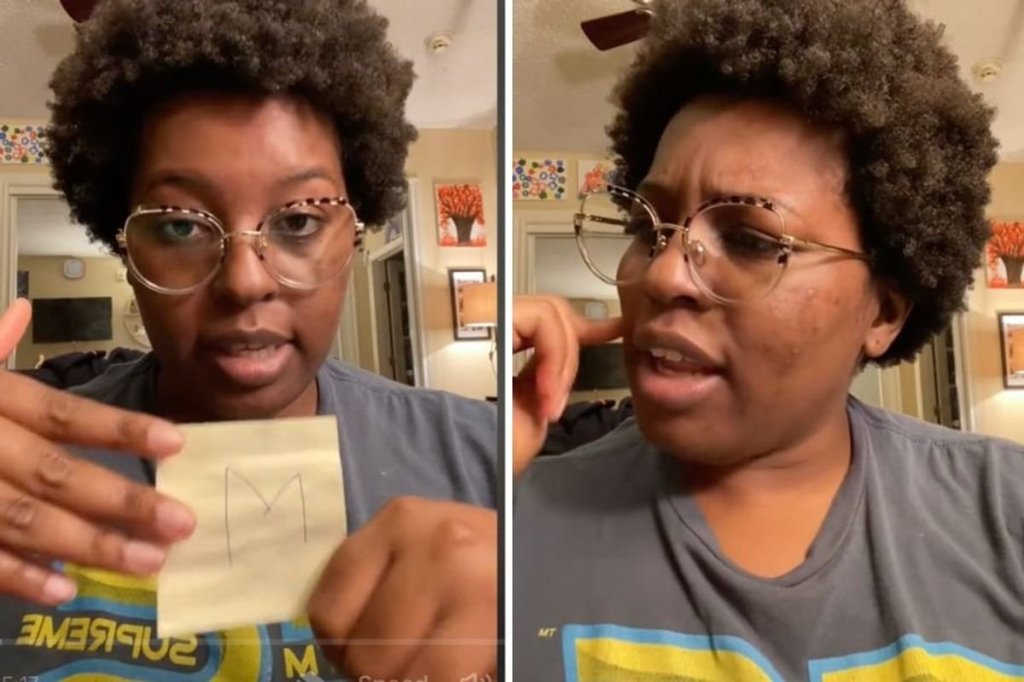
She then acts out that night, using a makeshift flashcard like she did to test Tia.
“I literally said, ‘What letter is this?’” Odion says while holding up the letter “M.” “She said something that’s not it. Put another one down. ‘What letter is this?’ She don’t know it.”
Still, the dad insisted that Tia knew her letters. Eventually, he blamed Tia’s older brother, who, despite only being a sixth grader himself, was “supposed to teach her.”
“It is not up to a child in elementary school, or middle school, or really any of your older kids, as someone who’s an older child… It is not up to the kids to teach younger kids,” Odion says in the clip.
Using another example, Odion states that a fifth grader in her class was reading at a kindergarten level and could only process basic sentences like “I see you” and “I like to see.”
In this instance, the students should be held back in order to fully learn the year’s curriculum. But Odion argues that parents fight against it “because they are more concerned about the optics of a child being held back than actually taking care of the child’s needs.”
Why holding kids back is not a simple solution
While the research shows that holding kids back a grade does improve their academic performance by granting them more time, there are still significant pros and cons to consider. In other words, being held back might not be the best solution for every struggling child. The biggest point Odion seems to be trying to make is that in addition to teachers and administrators, parents need to be more proactive in their child’s education.
“Parents, y’all can’t be backseat drivers about your child’s learning. You have to help reinforce it at home. You put a kid in front of that phone or iPad whenever they come home, it better be on YouTube, and it better be learning about letters and sight words. You can’t tell me you can’t read to the kid. It takes 10 minutes to read to the kid. No one is that busy,” she concludes.
This article originally appeared two years ago. It has been updated.
For all of our disagreements in modern American life, there are at least a few things most of us can agree on. One of those is the need for reform in public education. We don’t all agree on the solutions but many of the challenges are undeniable: retaining great teachers, reducing classroom size and updating the focus of student curriculums to reflect the ever-changing needs of a globalized workforce.
And while parents, politicians and activists debate those remedies, one voice is all-too-often ignored: that of teachers themselves. This is why a short video testimony from a teacher in the Atlanta suburb of Gwinnett County went viral. After all, it’s hard to deny the points made by someone who was just named teacher of the year and used the occasion to announce why he will be leaving the very school district that just honored him with that distinction.
In a video carried by Fox5 Atlanta, 2022 Gwinnett County Public Schools Teacher of the Year Lee Allen breaks down what he sees as the overriding problems in the county’s school system. While his comments are specific to that of Gwinnett County, it’s virtually impossible to not see the overlap across all of America and how the problems have only grown more challenging in the years since.
What Lee Allen said about leaving
“At the end of this year, I will be leaving Gwinnett County Schools, leaving behind the opportunity to submit for state teacher of the year, roughly $10,000 in salary, and most importantly, the students and colleagues I’ve built strong relationships with,” Allen, a math teacher at Lawrenceville’s Archer High School, says at the beginning of his remarks. “I’m leaving in hopes that I can regain the ability to do the job that I love.”
Normally, one might assume teacher pay is the overriding issue for educators like Allen. But he makes it clear that he is, in fact, leaving money on the table to avoid what he deems as unacceptable changes to the student body and how the district manages its teachers and the learning environment.
Four big problems that pushed a Teacher of the Year out the door
“First issue at hand is student apathy and disrespect for school rules and norms. … We have an alarming number of students that simply do not care about learning and refuse to even try.”
“We are also experiencing incredible disrespect and refusal to follow basic school rules. There is little to no accountability or expectation for grades or behavior placed on students or parents. Rather than being asked what the student can do to improve their understanding, teachers are expected to somehow do more with less student effort.”
“Cell phone use. Teachers simply cannot compete with the billions of dollars tech companies pour into addicting people to their devices. Phones allow constant communication, often being the spark that fuels fights, drug use and other inappropriate meetups throughout the day. We need a comprehensive district plan with support behind it in order to combat this epidemic and protect the learning environment.”
“Lastly, there is a huge disconnect between administrators and teachers. The classroom in 2022 is drastically different from just three years ago. Most administrators have not been in a classroom full-time in years or even decades. Many teachers do not feel understood, valued or trusted as professionals from administrators and the decisions that they make.”
While Allen points fingers at administrators and student behavior, he also says that the pressures put on both students and teachers alike by COVID-19 had a catastrophic impact on learning. “The pandemic has acted as a catalyst and turned a slow negative trend into an exponential crisis,” he says.
His suggestions for fixing the problem
But he also offers some solutions, stating, “I won’t list complaints without offering ideas for improvement.”
All administrators should spend at least one week in a high needs classroom, “without a suit, without people knowing your title and in the same room, all day, for an entire week.”
Prioritizing smaller class sizes.
Greater transparency from the district in terms of needs and expectations and goals.
“We all want the same thing and we cannot accomplish this without supporting one another,” he says near the end of his remarks.
With hundreds of thousands of views, it’s clear his remarks resonated with people well beyond his school district.
There’s almost nothing more important than how we educate our children. And while the national political debate centers on areas of far less importance generated to gin up controversy and campaign fundraising, it’s families and local leaders who will need to do the heavy lifting of reprioritizing the fundamental principles of learning and leadership if we want an American educational system that can compete on the global stage. After all, when literal award-winning educators like Allen are walking away, it’s clear something more needs to be done.
This article originally appeared five years ago. It has been updated.
Kindergarten through 12th grade teachers and college professors have heard every excuse in the book. Whether it’s a third grader claiming their “dog ate my homework” or a college freshman claiming their grandmother died to get out of a test, they’ve heard it all a billion times.
The top excuses teachers say they hear all the time
Yes, some students actually say they didn’t do their work because of a holiday predicated on drinking or getting stoned and others have the audacity to say, “Hey! I needed a vacation.” After spending week after week fielding excuses, there’s a good reason why most educators are skeptical when they hear one from their students.
But every once in a while, an excuse that seems way too improbable to be believed actually is true.
Reddit user u/minecraftplayer48 asked the teachers of Reddit to share the “best excuse for being late that turned out to be true” and the stories were all pretty great. But it wasn’t only teachers who chimed in; a lot of people shared stories from when they were students and had an excuse that was so crazy they didn’t think anyone would believe them.
17 excuses that sounded fake but were completely true
Here are 17 of the best excuses for being late that were actually true:
1. Revenge of the torque wrench
“My auto teacher let me practice removing and adding the tires on his vehicle. The next morning it was about 20 minutes into first period and no sign of him. He comes running into the classroom out of breath and his hair is all messed up. He points at me and says ‘YOU!!!! What is a torque wrench used for???’ I respond with “I don’t know.” He says ‘ I know you don’t know!!!” Turns out one of his tires came off while driving down the highway.” – ethnicjello
2. Mom wanted to sleep in
“She had to take her sister to school and drive her mom to rehab. She was always late to class because her mom just wanted to sleep in. Problem was if the mom was late or did not go she would have violated her probation and gone to prison. I never marked her late. If she missed anything important she could come in at lunch or after school to make it up.”– RM156
3. That was you?
“Student here, I headed into school early to get some studying done in the library before my night class. I was one exit away when I was caught in a 3 car accident. Most of the expressway afterwards was gridlock with only one lane left open. I did eventually make it into my lab class 15 minutes late, with a few scrapes and bruises. My professors reaction was simply ‘Oh that was you!”” – AlienCowAbduction
4. School bus blew up
“I was one of about 20 kids who were late to school. We showed up at the school office as a group and when questioned why we were late, we said ‘The school bus blew up.’ They questioned ‘So the engine blew up?’ The kids ‘No, the whole bus, in flames. It blew up.’
“There was much conference between the teachers, all of them thinking we embellished the story. Next thing you know, one of the admin staff has the news website open, very obvious image of an entire bus on fire with a bunch of kids in our school uniform standing in front of it. Our late slip for class read ‘School bus blew up.’” – AusPB90
5. B.U.I.
“Told me he got pulled over by the cops for wobbly driving on his bike and they thought he was drunk. Turned out he was just dodging all the slugs on the street.” – Fortisvol
6. Chicken of death
“A guy in my college class missed class one day. The next day he came in with his eye covered up and medical paperwork in hand. Apparently he got pecked in the eye by a chicken.” – BrrToe
7. Chicken 2: The chickening
“When I was student teaching, I was late because there was bunch chickens in the middle of the road. They wouldn’t move at all. This is in the middle of a city of 200,000 people. Freaking chickens.”
“I finally get to school and profusely apologize to my mentor teacher and I told her why I was late thinking it sounded ridiculous. She said, ‘yeah, those chickens are fucking assholes, they surrounded my car in the McDonalds parking lot last year. Don’t worry about it.” – Makenshine
8. Cracker Barrel conference
“Taught a group of seniors first period. It was towards the end of the year. I had a class of around 30 and only 5 were there when the bell rang. Halfway through class, the rest of them show up. They went out to Cracker Barrel for breakfast and brought me some back. All was forgiven.” – SwansonsLoveChild
9. Beary late
“Bear in the backyard. No access gate. Animal control had to tranq it from the roof and drag it through the house. Made the news. Got to retake the test I missed after sending her the news article.” – Vladtehwood
10. Present the flat
“We had an exam in my class and the teacher got a message from a student saying that he was going to be late because his car had a flat tire (the student was known to party), the teacher didn’t think it could be true, so as a joke the teacher asked him to bring the tire back. He brought the flat tire back in the middle of the exam. Needless to say, the professor didn’t expect that.” – Sapang
11. Moo
“A kid missed my first-period class one morning but was in school later that day. When I asked him why he hadn’t arrived in time for my course, he said his cow was birthing its calf that morning, so he’d picked being in the barn over English. Made sense to me. His essays weren’t going to win any ribbons at the county fair, but his calf could.” – Bobosbigsister
12. Abduction
“In high school a kid came late to history class. He was a joker so when someone asked him where he had been, he goes ‘I was kidnapped.’ Everyone laughed, until he goes ‘no really.’”
“Turns out 2 guys kidnapped him and tossed him into the back of the minivan he was using for his morning paper route. They drove him around while they robbed something. I can’t remember what happens after. I think they just drove the van somewhere and got away.” – notinmybackyardcanad
13. Honesty is the best excuse
“Not a teacher, but a kid walked into my class one day and literally just said ‘Sorry I’m late, I didn’t want to be here.’ He wasn’t wrong I suppose.” – Scally59
14. It actually was the dog
“A little off topic but in 8th grade, a friend of mine turned in their homework late because her dog literally ate her homework. She even brought a note from her parents.” – JoeyJoey2004
15. Is this a real excuse? Or is it fantasy?
“‘Sorry Bohemian Rhapsody came on just as I parked.’ — My art teacher when he was about 5:55 minutes late.” – Deeberber
16. I took a shortcut
“This happened to me as a pupil; a very quiet, unassuming kid in our class came in to German with about five minutes of the class left. We went to a Catholic school and the teachers were all quite strict and intimidating. Classes were usually silent, especially in junior school. When this boy came into class at the end of the lesson that day, the door flew inwards with such force that the teacher gave an audible gasp.”
“It had been raining heavily outside, his hair was plastered to his forehead. His blazer was dripping and sodden. He had mud caked into his trousers up to his knees, and he was breathing heavily. The teacher exclaimed, ‘Brendan! What happened?’ We all stared up at him in shocked silence. This quiet, unassuming little boy let out a big sigh and just said, ‘I took a shortcut.’ And went straight to his seat.”
“That line became iconic in our school for years afterward.” – lestat85
17. Pug lovers can attest
“Kid was late to school and had to miss a very important football game. The reason? His fat pug fell asleep on his phone. The pug’s fat rolls muffled his alarm.” – tip52
This article originally appeared two years ago. It has been updated.
A high school teacher’s TikTok sparked a serious conversation about screen time, low expectations, and the surprising role BookTok is playing in the literacy crisis.
Studies show that kids are spending a lot less time reading these days. In 2020, 42% of nine-year-old students said they read for fun almost daily, down from 53% in 2012. Fourteen percent of 13-year-olds read for fun daily, down from 27% in 2012. Among 17-year-olds, 19% reported reading for fun in the last year data was collected, down from 31% in 1984.
It’s safe to say that modern technology is a big reason why kids aren’t reading as much. A recent report found that teenagers spend an average of eight hours and thirty-nine minutes per day on screens, compared to five and a half hours for pre-teen children. So, it’s no wonder they don’t have any time left to crack open a book. In December 2024, Ms. C, a high school teacher on TikTok who goes by the name @stillateacher, brought the topic up with her class and learned they stopped reading for fun at the end of middle school.
Why are kids stopping?
“So, even those who are like avid readers of the Percy Jackson series in fourth and fifth grade fall off,” the teacher says. “Honestly, there are many reasons to stop reading recreationally, like increased pressure inside and outside of school, a desire to spend more time socializing, and, of course, the phones.”
But the teacher says there’s an obvious reason “right in front of our faces”: the adults. “Adults have lowered the bar for how much you should read as a teenager so far that the bar cannot be found,” she continued. “There are many educators who have the mindset that you shouldn’t teach whole books because kids just won’t read them.”
“I’ve taught at schools where teaching novels is actually discouraged,” she continued. “And I have conversations with teachers in other content areas who say that they themselves never read books, that they don’t think it’s important for students’ long-term success. All this said, it is not entirely surprising that high schoolers don’t wanna read.”
How does reading benefit kids?
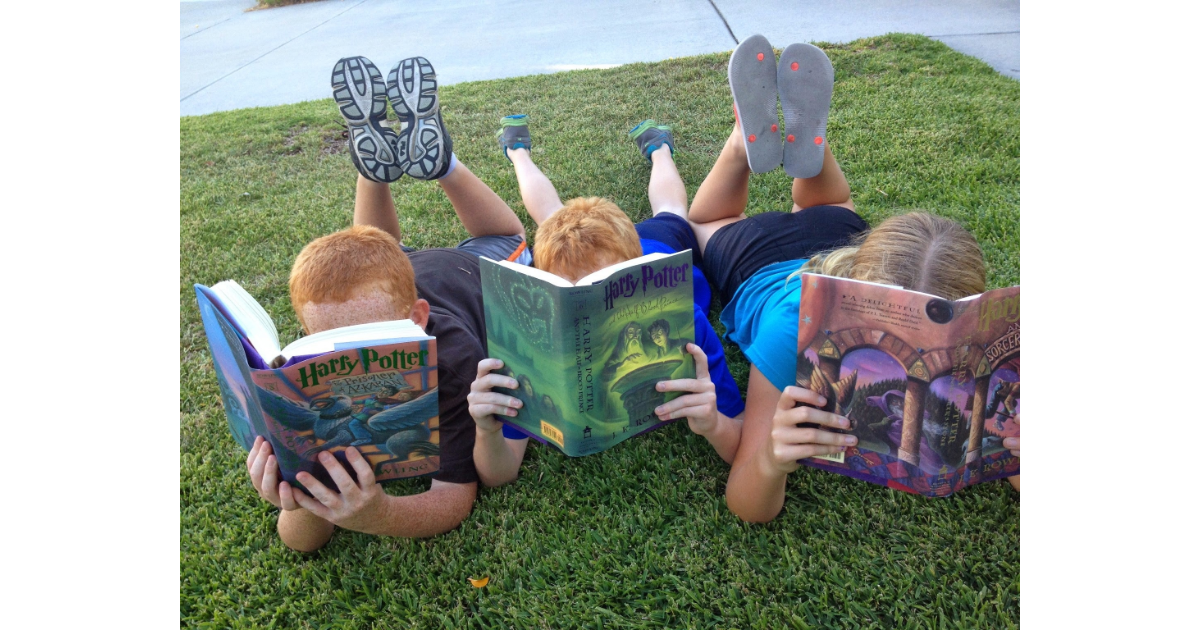
Kids laying down in the grass reading. Photo credit: Canva
The significant decrease in the number of children who read for fun means that many will miss out on the incredible benefits of regularly curling up for a good book. Studies show that children who read for pleasure enjoy improved cognitive performance, language development, and academic achievement. Reading is also linked to fewer mental health problems, less screen time, and more sleep. Findings suggest that kids get the optimal benefits of reading when they do it for around 12 hours a week.
“You forgot empathy,” one commenter added. “People who read are better at empathizing because they have been able to put themselves in the shoes of others and learn about different perspectives, people, cultures, experiences.”
And @stillateacher has seen these incredible benefits first-hand. “But I’m telling you, the handful of kids I teach who do read are built different. Kids who read have stronger critical thinking skills, more success across all academic areas, and, honestly, just a stronger sense of self. Because reading helps you figure out who you are as a person,” the teacher said.
The case for BookTok
The decline in young people’s reading is a serious problem that must be addressed. So, it’s terrific that the teacher used her platform on TikTok to bring it to the public’s attention. Interestingly enough, she says that TikTok is one of the few platforms encouraging kids to read.
“And honestly, thank goodness for BookTok because I think it is one of the only drivers of adolescent reading that still exists,” she concluded her post. “Isn’t that sad? Like, the schools aren’t doing it, TikTok’s doing it. We gotta start a movement here.”
This article originally appeared two years ago. It has been updated.
If you’ve ever been around a group of 20 or 30 kids or teens, try to imagine getting them all to pay attention and stay focused for longer than 5 minutes. There’s no doubt that wrangling a classroom of kids is a formidable feat at any age. Getting a group of learners to be engaged, attentive and reasonably courteous is the goal, but managing diverse personalities from various backgrounds and home environments and who have different standards and expectations of behavior isn’t easy.
Some teachers take the old-school “law and order” approach to classroom management. They lay out a list of rules everyone is supposed to follow, and those who don’t fall in line face consequences of some sort. But high school Language Arts teacher Monte Syrie takes a different tack, one that sees students as valued citizens of a community instead of young people to be controlled.
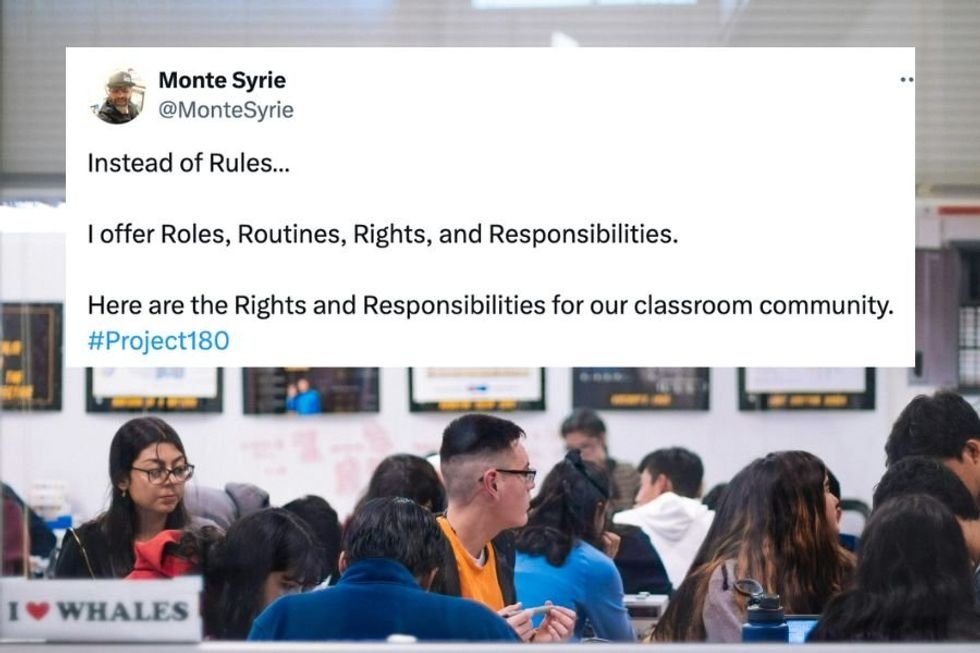
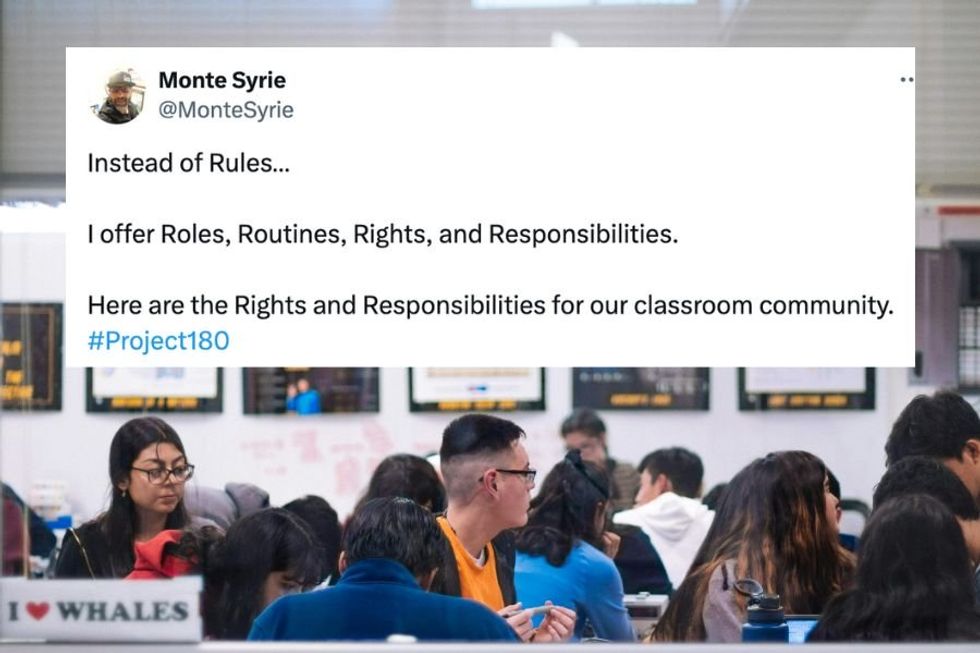
Instead of Rules…
I offer Roles, Routines, Rights, and Responsibilities.
Syrie, who has been teaching for nearly three decades, says he’s always striving to make the school year better than the last one. That means regularly reflecting and reevaluating how he communicates with his students, which is how he went from standard classroom rules to reframing them as “Policies and Procedures” to tossing out the concept of “rules” altogether.
Why he ditched the rulebook entirely
Now he offers 4 R’s, Roles, Routines, Rights and Responsibilities, as a framework for classroom management.
“I think teachers are framers. We frame the room. We frame the work. We frame the day. We frame the year. We frame the entire experience–whether we want to or not,” Syrie shares. “The kids look to us for the frame. What we do or don’t do decides the day. And, man oh man, is there pressure in that. But, there’s also possibility–powerful possibility.”
Syrie explains in his book about teaching that kids respond differently when teachers frame things differently, and being greeted with classroom rules on day one evokes a specific response in kids.
“We seem to believe if we don’t get rules in front of the kids immediately, we will never get the kids where we want them,” he writes. “I don’t believe in this anymore. I did, I suppose, at one point, but at this point, I believed there was a better way to ‘get kids.’”
Syrie decided to reframe his classroom policies as Roles that let kids see themselves through various lenses, Routines that tell them what to expect, Rights that give them individual autonomy and Responsibilities that help them contribute to a shared community.
What each of the four R’s means in practice
So what does that look like?
Roles in Syrie’s classroom include the roles of Yourself (the most important role, he says), Valued Community Member, Reader, Writer, Mistake Maker, and Reflector. He explains to the students what each of these roles entails and why it’s important for kids to take them on.
Routines include daily and weekly activities such as starting class with a community check-in called Smiles and Frowns and ending class with Journey Journaling. Each day of the week also has a specific focus, such as writing, reading or grammar.
Rights include things like, “I have the right to feel safe,” “I have the right to learn,” and “I have the right to ask as many questions as l want.” Syrie also gives students the right to eat and drink in class and the right to make mistakes without fear of penalty.
As for Responsibilities, students have a responsibility to get to class on time, know and honor the class routines, self-regulate use of electronic devices in the classroom, be a great listener, self-regulate leaving the room, take ownership of their learning, and be sensitive and respectful of others’ viewpoints, among other things. Students are expected to do their best to fulfill these responsibilities and to handle any breaches (such as being late to class) with courtesy and minimal disruption to the rest of the class. If they are struggling with any of these responsibilities, interventions include reminder(s), conversation(s), parent contact, and as a last and unlikely resort, office referral.
The beauty of Syrie’s four R’s is that they demonstrate a sense of trust in students right off the bat, helping them see themselves both as responsible individuals and as valued parts of a communal whole. When people feel trusted and valued and are empowered by a clear balance of rights and responsibilities, most tend to rise to the occasion, even when they’re in high school. That’s not to say that this framing eliminates all classroom management issues, but it’s a framework that encourages character development from within the students rather than exerting control from the top down. They’ll be able to take this framing through their whole educational career and beyond.
Why this idea goes beyond the classroom
A fellow educator wrote on X, “Love this in so many ways! In these times, this answers ‘how can we help learners understand the principles of a democracy?’” Imagine if we all reflected more on our roles, routines, rights and responsibilities as citizens rather than just memorizing the laws we are obliged to follow. Perhaps Mr. Syrie’s rethinking and reframing of the educational experience can help us all consider a new framing for our own lives as individuals and community members as well.
It’s nothing new for parents to lament their kid’s ever-growing list of school requirements. From piles of homework to getting graded for school supplies, the pressures seem to be not only racking up over time, but spreading to younger and younger grades. And it’s not just parents who have noticed the shift.
In a video that continues to spark vital conversation, longtime kindergarten teacher Ms. Kelli, of the TikTok account @the_wondermint, reflected on how different it is for students at even the most introductory level: Kindergarten.
The “trickle-down” effect of academic pressure
We all know how intense the pressure is for high schoolers looking to get into college. Two or three decades ago, SAT tutoring and prep courses were a luxury for wealthy families. Now they’re viewed as essential. But what’s taking parents, and teachers, off guard is how the elevated standards are trickling down to little kids who are barely out of diapers.
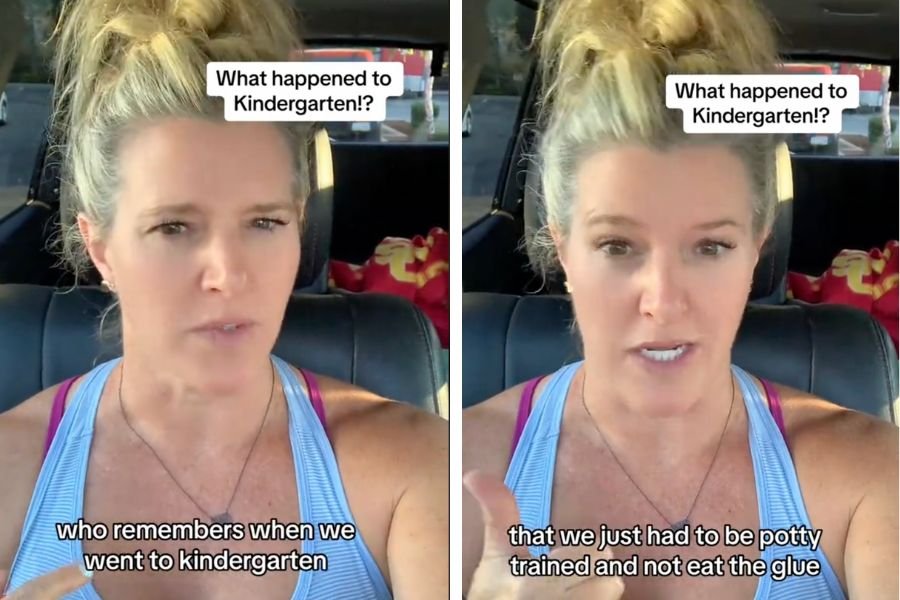
In her viral message, Kelli begins, “So I just gotta ask, as a 20-year kindergarten teacher myself, remember when we went to kindergarten that we just had to be potty trained and not eat the glue?” Comparing that to the long list of requirements nowadays, the educator says she feels sorry for families going through it.
“My heart breaks when I see all these videos of what do you need to do to prepare your child for kindergarten, and things your child must know before going to kindergarten, and these lists of things that parents need to be working on.”
One teacher agreed in a recent Reddit thread: “When I first taught Kindergarten in Wisconsin in 2009 the standard was to count to thirty. By 2012, the standard had changed to one hundred.”
Another parent chimed in: “Our kindergarten has them count to 100. Know 40 sight words by the end of kindergarten. Begin teaching reading and phonics … they learned to write their names within the first two weeks and are expected to do that and the date on every assignment. Each week they make a letter book for a different letter but they expected them to go into kindergarten knowing all their letters. They have a math packet every week for take home. … I mean I love it, he’s learning a lot but he does get quite a bit of work. Two packets due a week. So we do a page a night from each so it’s done by Thursday night.”
(Remember, these kids are about five years old. They can barely eat spaghetti without drenching themselves in pasta sauce, and we’re expecting them to sit down and do worksheets!)
Another added, “My son’s school routinely takes away recess. They do it if they don’t get enough school work finished during the day, or if the class misbehaves too much, or one single child can get it taken away. It’s also at the end of the day, so the kids are slaving away learning for six hours before maybe getting a break.”
It’s not just the parents who are noticing, either. A study out of the University of Virginia in 2016 found that kindergarten standards and curriculums at the time were far more similar to first grade curriculums from the previous decade. And the standards have only gotten higher since.
Redefining what “success” looks like for a five-year-old
Kelli says she’s had enough. She argues that, “Human development hasn’t changed. What a five or six-year-old child is physically, mentally and developmentally able to do hasn’t changed, in all these years.”
Still, the standards have changed. And kids are paying the price.
So she encourages fellow teachers and parents to not force the educational aspect.
“The learning will come. The development will come, the ABCs, the one, two, threes, writing, all of it, it will come … Curriculum, it will happen. The learning, it will happen,” she says.
Instead of placing more pressure, Kelli suggests a gentler, simpler approach.
“Let them play, let them socialize with each other. Let them learn to be away from their mommy and daddy and be sad for a little bit and be comforted. Let them find friendships that are gonna make them laugh so hard that their bellies ache and tell stories that go home. Let them create something that they never thought they could. Let them do an art project where they turn a box into a robot and they’re so excited to show their parents!”
Kelli’s video seemed to really resonate with parents and teachers alike, who have definitely felt like certain aspects of childhood have been sacrificed in the name of “productivity.” Especially when it comes to homework.
The comments couldn’t agree more
“Yes! My son struggled in Kindergarten last year and even had homework! I could not believe what all he had to know. Teacher said he had a hard time paying attention… yeah he is 5!” one mom shared.
“Finally someone said it,” added another. “The curriculum is insane for elementary school kiddos. They have absolutely lost their childhood.”
One person noted that “the kindergarten report card used to be things like skipping, walking on a balance beam, the hardest thing was counting to 100.”
As for whether or not a more academic-focused approach to kindergarten is, in fact, less beneficial to kids— a 2019 study in the American Educational Research Journal did find that it led to improvements, both academic and interpersonal, in the long run.
But that doesn’t necessarily mean we need to load them up with a ton of work for after school. Another study reported that elementary school students, on average, are assigned three times the recommended amount of homework.
This is why Kelli created a follow-up video sharing why she doesn’t assign homework to her own students.
Replying to @Drea_keevs Controversial but yet it shouldn’t be… 5 year olds should not be doing homework! Talk as a family, snuggle and read, enjoy their favorite sport activity, have a dance party! Their days are filled inside school, make the time outside of school good for their hearts and souls! tteachersontiktoktteachertoktteachersoftiktokiiteachkkkindergarteniilovekindergarteniiloveteachingfforyoupagetteacherforyoupageffypagetteacherfyppplaybasedlearningsseethewonderkeepitfreshhhandsonlearningrreggioemilialletthemexploreparentsontiktok #parentsoftiktok#parentingtips#homework#homeworkhelp
“We are covering what we’re covering in the five or six hours with these little babies, and if we can’t cover that in that time, we’re definitely not gonna get the best out of them at 5, 6 o’clock at night when they’re tired and they should be enjoying time with their family,” she said.
She does, however, advocate trying to instill a “love of reading,” if you can count that as homework. But even then, that assignment looks more like snuggling in bed, cozying up with a book, and having their parents read it to them.
Point being: of course school is meant to help set up students for success. But if it robs them of their precious, formative, and oh-so-temporary childhood, then is it really worth it?
This article originally appeared two years ago. It has been updated.
If you haven’t spent time in a middle school classroom lately, you may not fully grasp the intensity of it on every level, from the awkwardness to the body odor to the delightful hilarity that tweens bring to the table. When you connect with your students, it can be incredibly rewarding, and when you don’t…well, we all read “Lord of the Flies,” right?
Skilled teachers bring out the best in young people, and that can be done in many different ways. In fact, this new generation of students requires out-of-the-box thinking and new ideas to keep them engaged in the learning process.
Teacher Amy Allen makes middle school fun
For Amy Allen, it’s all about making her middle school classroom a fun, welcoming place to learn and by bonding with her students. For Allen, fun and welcoming comes before anything else.
“I love teaching middle schoolers because they are awkward, and I’m awkward, so we get along,” Allen tells Upworthy.
She plays games with students, gets rambunctious with them and creates opportunities for them to expend some of that intense pre-and-early-teen energy in healthy ways. For instance, she shared a video of a game of “grudgeball,” an active trivia game that makes reviewing for a quiz or test fun and competitive, and you can see how high-energy her classroom is:
“I think for teachers, we always want to create moments for our students that are beyond the standard reading, writing, memorizing, quiz, ‘traditional learning,’” Allen says. “Games are a great way to incorporate fun in the classroom.”
Allen clearly enjoyed the game as much as her students—”I love the chaos!” she says— and there’s absolutely nothing wrong with that. Fun keeps teachers sane, too.
Allen shares tons of classroom and teacher content on her TikTok page, where she’s accrued 15,000 followers and more than a million likes. Most of them admire her as a dedicated educator.
Most of them.
Then a troll showed up in the comments
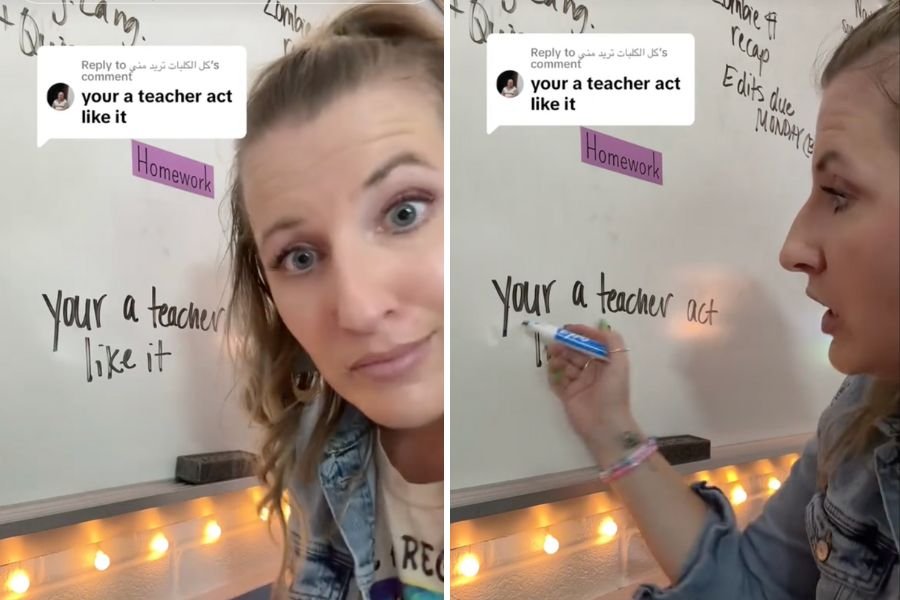
Recently, one person took issue with Allen’s silly and raucous classroom behavior and commented, “your a teacher act like it.” (Not my typo—that’s exactly what the person wrote, only with no period.)
Allen, never one to shy away from public criticism on her social media, addressed the comment in another video in the most perfect way possible—by acting exactly like a teacher.
Watch as she eviscerates the anonymous commenter’s poor spelling, grammar, and punctuation.
There are two solid ways to handle a rude comment without making things worse—you can ignore it or you can craft a response that makes the person look like a fool without being cruel or rude yourself. Allen’s grammar lesson response was A+ work, right down to the “Come see me if you have any further questions” caption.
Teacher-mode, activated.
Free lesson: Don’t mess with Ms. Allen
In fact, the person apparently went back and deleted their comment after the comeback video went viral, which makes it all the more hilarious. Allen’s video currently has more than 4 million views on TikTok and over 18 million views on YouTube.
“What’s funny is I left my correction on the board accidentally, and the next day, students asked me what that was all about,” Allen says. “When I explained it, they thought it was cool because ‘why would anyone go after Ms. Allen’? At that point, the video had maybe 10,000 views. I never imagined the video would go viral.”
Two days later, as the video was creeping toward a million views, she upped the stakes. “Some of my students are my ultimate hype people, and they were tracking it harder than I was,” she says.
“I made a ‘deal’ with my fifth period if it reached 1 million during their class, they could sit wherever they wanted the entire week.
“During lunch, I checked, and it reached 1 million. So when they came back from recess, I announced it, and it was like I was a rockstar. They screamed and cheered for me. It was an incredible moment for me.”
The comments showed lots of love
Allen’s followers, and many more people beyond that, loved her response:
“You’re an amazing teacher. (Did I do it right???)”
“Well, I appreciate you acting like a teacher… love it…”
“I love this clap-back! Look at you “acting” like a teacher!”
The irony, of course, is that Allen was acting like a teacher in her grudgeball video—an engaged teacher with engaged students who are actively participating in the learning process. Just because it doesn’t look like serious study doesn’t mean it’s not learning, and for some kids, this kind of activity might be far more effective at helping them remember things they’ve learned (in this case, vocabulary words) than less energetic ways of reviewing.
Allen has her thumb on the pulse of her students and goes out of her way to meet them where they are. Last year, for instance, she created a “mental health day” for her students. “I could tell they were getting burnt out from all the state tests, regular homework, and personal life extracurricular activities that many of my students participate in,” she says. “We went to my school library for ‘fireside reading,’ solved a murder mystery, built blanket forts, watched the World Cup, colored, and completed sudokus. Is it part of the curriculum? No. Is it worth spending one class period doing something mentally rewarding for students? Absolutely.”
Teaching middle school requires a lot of different skills, but perhaps the most important one is to connect with students, partly because it’s far easier to teach someone who actually wants to be in your classroom and partly because effective teaching is about so much more than just academics. A teacher might be the most caring, stable, trustworthy adult in some students’ lives. What looks like silly fun and games in a classroom can actually help students feel safe and welcomed and valued, knowing that a teacher cares enough to try to make learning as enjoyable as possible. Plus, shared laughter in a classroom helps build a community of engaged learners, which is exactly what a classroom should be.
Keep up the awesome work, Ms. Allen, both in the classroom and in the comment section.
Reading is hard. It wasn’t always, but now, it is. You know that feeling: you finally sit down with a book you’ve heard great things about—Song of Achilles, for example—and then it hits you. Your brain doesn’t work the same anymore. You’re no longer that wide-eyed child, eagerly tearing through books like they’re a bag of candy. Your brain has been trained to skim, scroll, and hop from one thing to the next.
So, each night ends the same way. You reach for your phone, scroll mindlessly for forty-five minutes, and fall asleep while wondering where your curiosity disappeared off to.
Don’t worry; this isn’t a moral failing. It’s inherently a wiring issue, a flaw in your current design. One that runs on, “What have I been training my brain to do all day?”
The good news is that the same science that explains that smooth-brain instinct to reach for your phone can also help you reach for something more nourishing, like books. In his YouTube video, “How to Read More Books,” user Ali Abdaal outlines ten rules to gently retrain your mind to read again. We’ve outlined them below.
Some context
Over the last twenty years, the number of adults who read for pleasure has dwindled. It’s fallen by 40%. It’s reported that today, only about 16% of Americans even pick up a book on any given day.
At the same time, we have never had more content at our fingertips. It’s ironic, isn’t it? We are constantly consuming words: emails, Instagram captions, text messages that are nothing more than veiled scams. Only now, words arrive in bite-sized formats and notifications instead of chapters.
Here’s a secret. Most people who “wish they read more” (a.k.a. all of us) do not lack interest. Nor willpower. Our brains have been trained to operate in overstimulation mode, always expecting novelty, speed, and interruptions. It’s a far cry from the stillness, focus, and flow that reading requires, certainly. These ten habits work because they help reduce the mental effort it takes to begin reading. They can feel almost like a gentle kind of magic, slowly making it easier and more comfortable to stay with a text just a little longer. Enjoy.
Rule 1: Put the book where your brain is tired
Place your book or e-reader on your nightstand tonight. Charge your phone in another room.
That’s it! That’s the whole rule.
Behavioral scientists call this micro-shift “choice architecture.” Developed by economists Richard Thaler and Cass Sunstein, this theory demonstrates that small, subtle changes to your physical environment can profoundly alter your behavior, with little to no impact on your freedom. It requires little conscious effort. You are making the easiest option also the most nourishing one.
By bedtime, your brain is running on automatic habit mode. It reaches for whatever’s closest, most familiar. Over time, that tiny swap makes reading feel like the natural way to end the day. Your brain begins to associate printed words with rest and comfort, not effort.
Your favorite reading app deserves prime digital real estate. Canva
Rule 2: Make your home screen a little library
The average person picks up their phone dozens, if not hundreds, of times per day.
Phew. Each glance at your screen, every flash of artificial LED light, represents a mental crossroads.
If the first thing your eyes land on is a social app, your fingers will go there before your conscious mind even checks in. However, if the first thing you see is your Kindle, your brain gets a different cue. Research refers to this instinct as “habit stacking” and “cue design.” The idea is to take something your brain already does (picking up your phone to scroll) and sneakily insert reading, gently redirecting the automatic cue. This way, each idle moment—waiting in line, commuting on public transit, a quiet moment in the morning—becomes a reading window.
So, your favorite reading app deserves prime digital real estate—the middle of your home page—while distracting apps are buried away in a folder, two or three swipes away.
Rule 3: Let audiobooks borrow your most boring moments
Commuting. Washing dishes. Dusting the annoying decorative trim at the bottom of the walls.
These moments are tedious, irksome. But they’re also perfect opportunities to treat your brains to the worlds of Tolkien, Woolf, and García Márquez. This represents habit stacking at its purest. The technique, pioneered by behavioral researcher BJ Fogg and popularized by James Clear’s Atomic Habits, exploits the brain’s existing neural pathways. Since the anchor habit (commuting, exercising) is already wired into daily routine, the desired behavior (listening to a book) simply rides in on the coattails of the existing habit.
Plus, it’s a great way to devour literature: if you spend even half an hour a day listening to audiobooks, you can easily finish 15–20 books per year.
Rule 4: Serve your brain a reading menu
School taught us to be faithful, monogamous readers. One book at a time. Cover to cover, start to finish. And no switching. Too bad adult brains don’t work that way.
The reality? Your energy shifts. Your focus changes. Some days, your mind craves ideas and changes. You want nothing more than to read about how basketball can help you succeed in life. Other times, you wish to get lost in the strange, bizarre universe depicted in Ottessa Moshfegh’s Lapvona.
The tactic: keep two to five books going at once; give your brain choices. Perhaps a novel, like 1Q84 by Haruki Murakami. A challenging work of nonfiction. A cozy audiobook, maybe one read by the actual author, like Ina Garten does in Be Ready When the Luck Happens: A Memoir. Plus, something short and fun for tired nights.
We’ve all been there. It’s the book of the year. You see it stacked up in piles like a shrine to reading in every bookstore window you pass. Everyone can’t stop raving about this book. But you can’t bring yourself to read past the first fifty pages.
Guilt creeps in. You don’t want to abandon this novel; you’ll seem like a quitter. The better option? Stop reading altogether.
Give yourself a break. Destroy the bias! Realign with your intrinsic motivation: the genuine desire to know what happens next.
Rule 6: Start with what feels easy
Hey, so I don’t know if you know this: not every book you read has to be Ulysses by James Joyce. Start with whatever books pique your interest, effortlessly. Genre fiction. Thrillers. Romance. Fantasy. Short stories. So-called “literary prestige” is what’s standing between you and your ultimate reading goals.
The problem is this: if you start your reading life at the steepest part of the mountain, books start to feel like work. Flow theory, developed by psychologist Mihaly Csikszentmihalyi, suggests that the “optimal experience” happens when skill level and challenge level are perfectly synced. If the book’s too difficult, and it seems like every page requires a dictionary, anxiety strikes. Too easy? Boredom.
Reading is such a personal, private experience. That’s a beautiful thing. It can also make progress feel invisible, even to you.
Tracking your reads with an account, like Goodreads, or in a notebook, changes that. Now, instead of “out of sight, out of mind,” you can see a list of titles. A little progress bar. A challenge you’re proud to celebrate. You’re gamifying the system, and wow, does it feel good.
Psychologists have long noted that our minds do not like open loops, unfinished mental threads that your brain keeps revisiting because they feel incomplete or unresolved. It’s called the Zeigarnik effect, and it’s why checking off a bullet point on your to-do list feels so satisfying.
Welcome to the gamification of reading: annual challenges, completion badges, public reviews, and community rankings leverage extrinsic rewards to supplement intrinsic motivation. Over time, your brain begins to associate reading with these tasty little rewards, and books start to feel smoother, lighter, and more enjoyable.
Rule 8: It’s okay to go a little faster
There is no moral virtue in reading slowly. Sure, it’s nice to sit with a sentence, to luxuriate in its prose as the language washes over you like a warm breeze.
But for audiobooks, a slightly faster pace can actually improve your sense of momentum. Your mind will wander less frequently because it has to pay attention to keep up. Many find that listening at 1.25x or 1.5x speed (approximately 225–275 words per minute) is the sweet spot. This is because the average audiobook reader takes their time. They enunciate, sometimes frustratingly so, at 150–160 words per minute—well below the typical adult’s listening comprehension.
But remember, there’s a delicate balance at play here. Do not jump to extremes. Play at the edges. Notice where you still feel present with the material. Let that be your guide.
Rule 9: Remove the “should I buy this?” option
Whenever someone recommends a book—in a conversation, on a podcast, in an article—and your brain goes, ‘Oh, that sounds good,” don’t think. Get your hands on it immediately. Buy it or download it on the spot.
Think about it, how many times have you been told about an excellent book…then did nothing about it? Life moved on, and the recommendation evaporated. Lost to the tabs, shuffled to the “saved for later” cart.
Decision fatigue, the progressive depletion of the brain’s capacity to make high-quality decisions after repeated choices, is real. By the end of the day, your brain is tired. Eliminating the decision about whether to buy a book removes friction at the exact moment you’re likely to balk. A fantastic book can lead to an entire new world: one good idea can shift a career, a relationship, and your connection to the universe.
Rule 10: You are a reader. Think of yourself as one
Stop calling yourself someone who “wants to read more” and start seeing yourself as a reader. You are a person for whom books are just a normal part of everyday life.
Reading works in this way. Once that story shifts, countless tiny decisions follow. If you believe you are a reader, reaching for a book in a spare moment feels natural. Suddenly, scrolling before bed feels off. A person who views themself as a reader will notice new ways to read: during a delay at the airport, a lunch break, or in the morning while drinking coffee; not because they’re forcing themselves to, but because that’s simply who they are.
Right now, your brain might be trained for short bursts of attention, quick hits of novelty, and constantly switching between tabs. It’s tired, and that makes starting a new chapter feel even more daunting.
But brains are pliable. They change in response to what we repeatedly do. Besides, this was never about hitting some impressive “books per year” quota. You’re taking back your time and filling it with an activity that’s actually nourishing.
A book on the nightstand replacing a phone. A reading app on the home screen. A lovely audiobook playing through your headphones as you vacuum your apartment or walk around the block. Together, these small actions steadily send a message to your mind: reading is safe, familiar, and rewarding. Over time, that message becomes a feeling.
And before you know it, you are not forcing yourself to read more.
You are simply living like someone who already does.