upworthy
Add Upworthy to your Google News feed.
Google News Button
Democracy

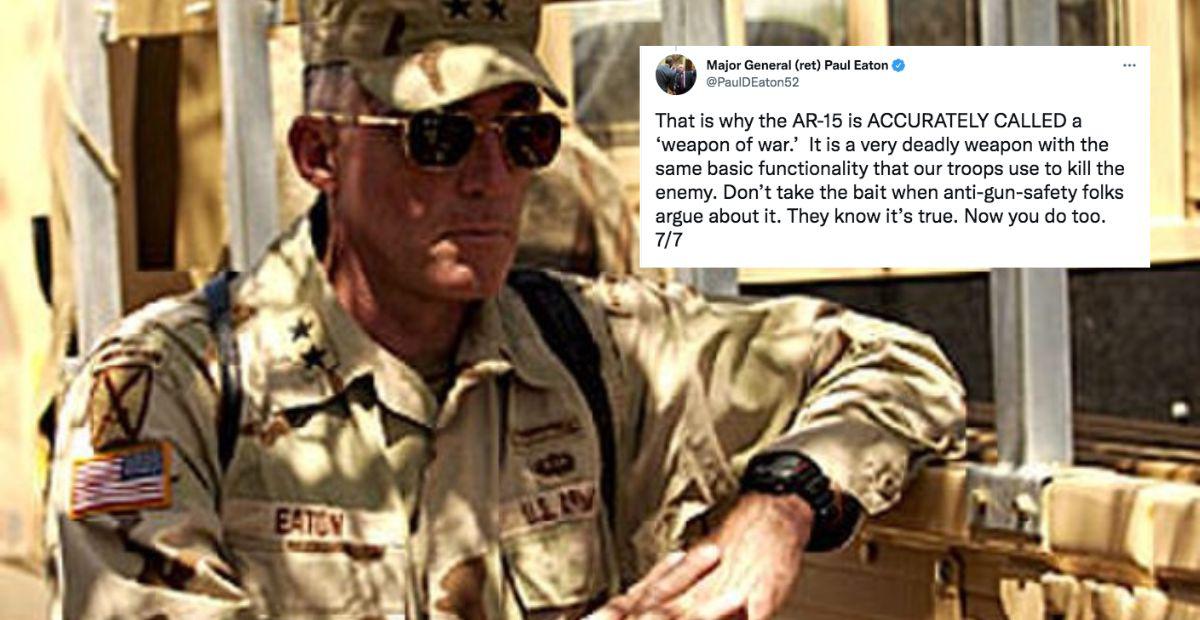
Ret. Major General explains the difference between an AR-15 and the military's weapons of war

Major General Paul Eaton was the commander in charge of training Iraqi troops during Operation Iraqi Freedom. He knows his weapons.

paul eaton, army, guns, gun violence

Retired Major General Paul Eaton shared his thoughts on whether the AR-15 is a "weapon of war."

A common criticism gun rights activists levy toward gun legislation advocates is that many people who push for stricter gun laws don’t know a lot about guns themselves. That’s not wholly accurate—there are plenty of gun enthusiasts who support reasonable gun laws—but it’s true that many people who are horrified by our nation’s gun culture are not well-versed on the specifications of our nation’s 393 million guns.

Not every American is an active part of American “gun culture." Some of us have never shot a firearm, for fun or otherwise. Some of us really are ignorant about guns themselves.


That can’t be said for anyone in the military, however. And it definitely can’t be said for a former Major General of the U.S. Army.


That’s why an explanation of the difference between an AR-15 and military-style firearms from retired Major General Paul Eaton has gone viral. Major General Eaton was the commander in charge of training Iraqi soldiers during Operation Iraqi Freedom, so he definitely knows what he’s talking about when it comes to weaponry.

He wrote:

“As the former Commanding General of the Infantry Center at Fort Benning and Chief of Infantry, I know a bit about weapons. Let me state unequivocally — For all intents and purposes, the AR-15 and rifles like it are weapons of war. A thread:

Those opposed to assault weapon bans continue to play games with AR-15 semantics, pretending there’s some meaningful differences between it and the M4 carbine that the military carries. There really aren’t.

The military began a transition from the M16 to the M4, an improved M16, some years ago. The AR-15 is essentially the civilian version of the M16. The M4 is really close to the M16, and the AR-15.

So what’s the difference between the military’s M4 and the original AR-15? Barrel length and the ability to shoot three round bursts. M4s can shoot in three round bursts. AR-15s can only shoot a single shot.

But even now, you can buy AR-15s in variable barrel lengths with Weaver or Picatinny rails for better sights and aiming assists like lasers. Like the military, but w/o the bayonet.

But our troops usually use single shot, not burst fire. You’re able to fire a much more accurate (deadly) shot, that way. Note: you can buy our Advanced Combat Optical Gunsight on Amazon. So troops usually select the same fire option available on AR-15.

That is why the AR-15 is ACCURATELY CALLED a ‘weapon of war.’ It is a very deadly weapon with the same basic functionality that our troops use to kill the enemy. Don’t take the bait when anti-gun-safety folks argue about it. They know it’s true. Now you do too."

Eaton is not the only former military leader who has spoken out in support of gun legislation. In 2019, a group of 13 influential retired military leaders wrote a letter to Congress, pushing it to pass the Bipartisan Background Check Act.

"Each of us has, at some point in our lives, made the choice to risk our lives for our fellow citizens and place ourselves in harm’s way," they wrote. "We were trained, we were coached, and we were prepared for the dangers that we chose to face. This is not the case for most Americans, yet they continue to face danger on the sidewalk, in their homes, at school, and at work. It is in the same spirit that led us to serve in the armed forces that we ask you, our elected leaders, to help protect the American people from gun violence here at home. We urge you to support this legislation."

Police leaders have also voiced strong support for gun legislation, which makes sense considering how much harder and more dangerous our free-for-all gun culture makes their jobs. The International Association of Chiefs of Police, the largest professional association of police leaders in the world, has a position paper that outlines the gun safety laws it supports, including firearm offender registration, waiting periods, closing the gun show loophole, banning semiautomatic assault weapons, armor-piercing ammunition, bulletproof body armor and more. The IACP states that these are “common sense policies that would assist in reducing gun violence, while upholding the second amendment.”

Yep, the largest police leader association supports banning semiautomatic assault weapons like the AR-15. Here’s what it has to say about that:

“First passed in 1994, the assault weapons ban required domestic gun manufacturers to stop production of semi-automatic assault weapons and ammunition magazines holding more than ten rounds except for military or police use. While the ban was in place, it was remarkably effective in reducing the number of crimes involving assault weapons. In the period of the ban, (1994-2004) the proportion of assault weapons traced to crimes fell by a dramatic 66 percent.”

If those who oppose gun legislation don’t want to listen to people who don’t know enough about guns to speak authoritatively on them, that's fine. Perhaps they should listen to these military and police leaders who not only know guns inside and out, but who also have the firsthand experience on both sides of the barrel to speak authoritatively on what can help minimize America’s gun violence.


This article originally appeared on 06.04.22

old letter, 1959, tony trapani, letter, secret letters, love letter, love stories, dads, fatherhood, father and son, parents, parenting
via SHVETS production/Pexels and Suzy Hazelwood/Pexels
Tony Trapani discovers a letter his wife hid from him since 1959.

Writing a letter is truly a lost art form, and many young people will never know the joy of it. You had to choose your words carefully and say everything you wanted to say. Once you sent it off, there was no way to be sure it was delivered. No way to know if it had been opened or read. You couldn't take it back or send it again. You just put it in the mailbox and hoped for the best. It was excruciating and magical all at the same time.

One story of a letter never delivered has captured the hearts of readers everywhere. A heart-warming local news story gone viral for the best reasons.


Tony Trapani and his wife were married for 50 years despite the heartache of being unable to have children. "She wanted children,” Trapani told Fox 17. "She couldn't have any. She tried and tried." Even though they endured the pain of infertility, Tony's love for his wife never wavered and he cherished every moment they spent together.

letter, secret letters, love letter, love stories, dads, fatherhood, father and son, parents, parenting Tony Trapani received the most important letter of his life, but he didn't see it for 50 years Photo by Álvaro Serrano on Unsplash

After his wife passed away when Tony was 81 years old, he undertook the heartbreaking task of sorting out all of her belongings. In particular was a mountain of papers stuffed into filing cabinets. Trapani diligently went through every single one.

That’s when he stumbled upon a carefully concealed letter in a filing cabinet hidden for over half a century.

The letter was addressed to Tony and dated March 1959, but this was the first time he had seen it. His wife must have opened it, read it and hid it from him. The letter came from Shirley Childress, a woman Tony had once been close with before his marriage. She reached out, reminiscing about their past and revealing a secret that would change Tony's world forever.

"Dear Tony, I bet you are surprised to hear from me after so many years. I was just thinking about you tonight like so many other nights. But I thought I would write you and find out how you are," the letter reads. "Tony, please don't be angry or surprised to hear this. I have a little boy. He is five-years- old now - grey eyes and beautiful black hair. What I am trying to say Tony is he is your son."


"Please, Tony if you can find it in your heart to forgive me, please come and see him," Shirley wrote in the letter. "Every day he asks me where is his daddy and believe me Tony I can't even answer him anymore. I would be forever grateful to you if you would just see him. ... I'll close now hoping and praying you will answer. P.S. His name is Samuel Duane."

Now, Tony faced the fact that he had a son that would be around 60 years old and he set out to find him.

For over a year, Trapani’s sister tried to track down the mysterious Samuel Duane Childress, until she finally contacted his wife, Donna.

Tony and Samuel met in January 2015 and he felt like a new dad. After meeting his father, Samuel said his mother told him she sent the letter, but Tony never responded. "Why my wife didn't tell me," said Trapani, "I don't know. She wanted children. She couldn't have any. She tried and tried."

It's easy to understand why it may have been hard for Trapani's late wife, Dolly, to pass along that sort of news. Though we'll never know what exactly must have been in her heart and mind when she hid the letter all those years ago.

"I always asked my mom, I said, 'Well what does he look like?'' Samuel said. "She said, 'Well, go look in the mirror."

The two met and caught up on a lifetime of memories with the understanding that they could never change the past. "Just to know him now is so important to me. It's going to fill that void," Samuel said.

But just to be sure, Tony took a paternity test to ensure they were father and son. Stunning everyone involved, the test came back negative. Tony was not the father.


letter, secret letters, love letter, love stories, dads, fatherhood, father and son, parents, parenting Tony and Samuel didn't waste time thinking about what might have been if he'd seen the letter earlier. Photo by Ire Photocreative on Unsplash

The news upset Tony and Samuel, but they still had a unique bond. They shared a relationship with Samuel’s mother and both have been on an incredibly wild ride after Tony found the mysterious letter.

“They're keeping that bond,” Donna said. “That paper doesn't mean anything to him. That bond has been made—and we're going to move on from here.”

Tony Trapani passed away in 2017, leaving him just two short years to connect with the man he once believed to be his son. If he'd seen the letter earlier, maybe they would have had more time. But that's all in the past, and by all accounts the men treasured the time they got together, and the relationship that they did have — not the one they wished for.

This article originally appeared earlier this year. It has been updated.

teacher, student, gifted student, high school class, instruction,

A teacher helping a student.

In the 1960s, psychologist Julian Stanley realized that if you took the best-testing seventh graders from around the country and gave them standard college entry exams, those kids would score, on average, about as well as the typical college-bound high school senior. However, the seventh graders who scored as well or better than high schoolers, Stanley found, had off-the-charts aptitude in quantitative, logical, and spatial reasoning. In other words, they were gifted.

In the 1970s, Stanley and his team launched a full-scale study, identifying many of America's gifted kids and tracking them throughout their lives.

The study, called the Study of Mathematically Precocious Youth never ended and is now more than 50 years in the making. It has followed countless kids from middle school into their careers as some of America's top politicians, scientists, CEOs, engineers, and military leaders. Needless to say, a lot has changed with how students are today compared to 50 years ago.


Stanley passed away in the mid-2000s, but psychologist David Lubinski helped bring the study to Vanderbilt University in the 1990s, where he now co-directs it with Camilla P. Benhow.

It's not a stretch to call this the biggest and most in-depth study on intellectual "precociousness." The results of the study thus far are both fascinating and genuinely surprising—a deeply insightful look into the minds and lives of brilliant children.

students, teachers, classroom, paying attention, school books, class in session A teacher in front of her class.Photo by National Cancer Institute on Unsplash


1. Some of what we used to think about gifted kids turned out to be wrong.

Ever heard the saying "early to ripe, early to rot"? It basically means doing "too much" to foster a kid's special talents and abilities at too young an age could actually cause harm in the long term. That's not even remotely true, at least not according to Lubinski.

That might be an outdated example. But Lubinksi says there are plenty of other misconceptions still alive today, like the idea that gifted kids are so smart that they'll "find a way" to excel even if those smarts aren't nurtured and developed.

Not so fast. "They're kids," he explains. "They need guidance. We all need guidance."


- YouTube www.youtube.com

2. Intelligence is not the same as passion.

Quick, what's the "smartest" career you can think of? Doctor? Scientist?

While you do have to be pretty brilliant to work in medicine or science, those are far from the only career paths gifted kids choose later in life. "Quantitatively, gifted people vary widely in their passions," Lubinski says. Many of the students in the study did end up pursuing medicine, but others went into fields like economics or engineering. Others still were more gifted in areas like logical or verbal reasoning, making them excellent lawyers and writers.

"There are all kinds of ways to express intellectual talent," Lubinski explains.

When it comes to doing what's best for a gifted student, it's just as important for parents and educators to know what the student is passionate about rather than pigeonholing them in traditionally "smart" fields and registering them in a bunch of STEM courses.


students, teachers, classroom, paying attention, school books, class in session Students taking a test.via Canva/Photos

3. Hard work definitely still matters.

Measuring a student's aptitude, their natural abilities, is only one part of the equation when it comes to determining how successful they'll be in life. Aptitude scores can identify a particularly strong natural skill set but tell us very little about how hard that person might work to excel in that field.

Effort, Lubinski says, is a critical factor in determining how far someone will go in life. "If you look at exceptional performers in politics, science, music, and literature, they're working many, many hours," he says. (And for the record, there are a lot more important things in life than just career achievement, like family, friends, and overall happiness.)

The idea that hard work still matters aligns with the 10,000-hour rule, popularized by journalist Malcolm Gladwell in his book Outliers: The Story of Success. The 10,000-hour rule suggests that some of the world's greatest innovators, including Bill Gates, The Beatles, and Robert Oppenheimer, excelled in their endeavors because they had 10,000 hours of practice.


students, teachers, classroom, paying attention, school books, class in session Students around a computer.via Canva/Photos

4. Regardless of aptitude, every kid deserves to be treated as though they were gifted.

The study's focus is specifically on kids within a specific range of intellectual ability, but Lubinski is careful to note that many of its findings can and should be applied to all students. For example, the children in the study who were allowed to take more challenging courses aligned with their skills and interests ultimately achieved more than those who were not afforded the same opportunity.

"You have to find out where your child's development is, how fast they learn, what are their strengths and relative weaknesses and tailor the curriculum accordingly," Lubinski says. "It's what you would want for all kids."

It may sound a bit like a pipe dream, but it's a great starting point for how we should be thinking about the future of education in America.

This article originally appeared eight years ago.

time, neil degrasse tyson, time flies, perception of time. clock, science,

A clock and Neil deGrasse Tyson.

When you’re a kid, time passes a lot more slowly than when you’re an adult. At the age of seven, summer seems to go on forever, and the wait from New Year’s Day to Christmas feels like a decade. As an adult, time seems to go faster and faster until one weekend you’re putting up your Christmas lights though you swear you just took ‘em down a month ago.

Why does time seem to speed up as we get older? Astrophysicist Neil deGrasse Tyson recently explained the phenomenon in a video posted to Instagram. He also offered tips on how to slow the passage of time as you age. DeGrasse Tyson is one of the most popular science communicators in the world and the host of 2014's Cosmos: A Spacetime Odyssey and 2020’s Cosmos: Possible Worlds.


Why does time appear to speed up as we get older?


“When you're young, everything is new. Your brain is constantly recording fresh memories, and the more memory your brain stores, the longer the experience feels. But then something changes. As you get older, routines take over. Your brain stops saving so much detail. It switches to autopilot because everything feels familiar and predictable,” deGrasse Tyson explains. “And when your brain stores fewer new memories, your perception of time compresses. That's why childhood feels long, and adulthood feels like a blur.”


Steve Taylor, PhD, author of many best-selling books including Time Expansion Experience, The Leap, and Spiritual ScienceThe Leap, and Spiritual Science, agrees with deGrasse Tyson.

“This is mainly because, as children, we have so many new experiences, and so process a massive amount of perceptual information,” Taylor writes at Psychology Today. “Children also have an unfiltered and intense perception of the world, which makes their surroundings appear more vivid. However, as we get older, we have progressively fewer new experiences. Equally importantly, our perception of the world becomes more automatic. We grow progressively desensitized to our surroundings. As a result, we gradually absorb less information, which means time passes more quickly. Time is less stretched with information.”

How do we make time slow down?

There’s something a little depressing about the idea that time speeds up as we age because we have fallen into predictable routines. The good news is that we can break this cycle by changing our habits and having new experiences. The more novel information we can process and the less routine our lives become, the slower time will move.

DeGrasse Tyson believes that with some change in our behaviors, we can get back to longer summers and Christmases that aren’t perpetually around the corner.

“You can actually slow time down again. Do something unfamiliar,” deGrasse Tysons says. "Travel somewhere new. Break a routine you've repeated for years. Learn a skill your brain hasn't mapped yet. Because the more new memories your brain forms, the slower time feels as it passes. So if life feels like it's accelerating, it's not your age. It's your brain, and you can reboot it.”

Joy

Pizza guy makes split-second decision that saves a woman's life, then gets best reward possible

His quick-thinking is a perfect example of successful bystander prevention.

joey grundl, pizza guy saves life, milwaukee heroes, heroes, rewards, domino's pizza, bystander prevention, sa, da, domestic abuse, positive news

Joey Grundl, Milwaukee pizza guy.

Editor's Note: This story discusses suicide. If you are having thoughts about taking your own life, or know of anyone who is in need of help, the 988 Suicide & Crisis Lifeline is a United States-based suicide prevention network of over 200+ crisis centers that provides 24/7 service via a toll-free hotline with the number 9-8-8. It is available to anyone in suicidal crisis or emotional distress.

Joey Grundl, who was working as a pizza delivery driver for a Domino's Pizza in Waldo, Wisconsin, was hailed as a hero for noticing a kidnapped woman's subtle cry for help. It's a timeless story that continues to resonate with people today. In 2018, the deliveryman was sent to a woman's house to deliver a pie when her ex-boyfriend, Dean Hoffmann, opened the door. Grundl looked over his shoulder and saw a middle-aged woman with a black eye standing behind Hoffmann. She appeared to be mouthing the words: "Call the police."


"I showed up, it was a normal delivery, and saw this middle-aged couple," Grundl, 24, told NBC News. "I gave him his pizza, and then I noticed behind him was his girlfriend," Grundl told WITI Milwaukee. "She pointed to a black eye that was quite visible. She mouthed the words, 'Call the police.'" When Grundl got back to his delivery car, he called the police. When the police arrived at the home, Hoffmann tried to block the door, but eventually let the police into the woman's home.

joey grundl, pizza guy saves life, milwaukee heroes, heroes, rewards, domino's pizza, bystander prevention, sa, da, domestic abuse, positive news Dean Hoffmann's mugshot. via WITI Milwaukee

After seeing the battered woman, Hoffmann was arrested, and she was taken to the hospital for her wounds. Earlier in the day, Hoffmann arrived at the house without her permission and tried to convince her to get back into a relationship with him. He then punched her in the face and hog-tied her with a vacuum power cord.

"If you love me, you will let me go," she pleaded, but he reportedly replied, "You know I can't do that." He also threatened to shoot both of them with a .22 caliber firearm he kept in his car. The woman later told authorities that she feared for her life.

- YouTube www.youtube.com

According to the National Coalition Against Domestic Violence, one in three women and one in four men will experience physical violence by an intimate partner in their lifetime. Stories like this highlight not only the dangers victims face behind closed doors but also the crucial role everyday people can play in recognizing when something is wrong.

A day later, Grundl was seen on TV telling his heroic story, wearing a hoodie from Taylor Swift's "Reputation Tour" and her fans quickly jumped into action, tagging Swift in photos of the hero. Grundl already had tickets to go to an upcoming Swift concert in Arlington, Wisconsin, but when Swift learned of the story, she arranged to meet Grundl backstage and they took a photo together.

"She … she knew who I was," Grundl jokingly tweeted after the concert. "I'm thoroughly convinced Taylor gave me a cold."

"This has been one of the most exciting weeks of my life," Grundl said. "I'm legitimately getting emotional and I almost never get like this. But as the likely most memorable week of my entire life comes to an end … I guess I can really say … I'm doing better than I ever was."

- YouTube www.youtube.com

Hoffmann was found guilty of kidnapping, suffocating, harming, and intimidating his girlfriend and was sentenced to 28 years in prison. It was his first criminal charge. During the trial, his victim told the jury that she was "deathly afraid" of Hoffmann. In 2023, after being transferred to Waupun Correctional Institute in Wisconsin, Hoffmann died by suicide after 9 days in solitary confinement. Hoffman has a history of bipolar disorder and suicidal ideation, and his death has raised questions over whether the facility was equipped to deal with severe mental health issues.

How anyone can help someone in danger: a quick bystander guide

joey grundl, pizza guy saves life, milwaukee heroes, heroes, rewards, domino's pizza, bystander prevention, sa, da, domestic abuse, positive news Nonverbal cues are often the only safe way a victim can communicate.Photo credit: Canva

1. Notice the quiet signals.

A bruise. A fearful glance. Someone trying to mouth “help.” Domestic-violence experts say these nonverbal cues are often the only safe way a victim can communicate that something’s wrong.This story originally appeared six years ago.

2. Put your safety (and theirs) first.

Advocates stress that directly confronting an abuser can escalate danger for everyone involved—especially the victim.

3. Call for help from a safe distance.

Get authorities involved while keeping yourself out of harm’s way. Bystander-intervention programs consistently rank this as the safest choice.

4. Remember the “Distract, Delegate, Direct” method.

This widely taught approach helps people intervene without putting themselves in danger:

  • Distract if it’s safe.
  • Delegate to police, security, or others.
  • Direct only in clearly safe, public, low-risk moments.

5. Know the modern silent distress signal.

The now-famous “Signal for Help” (palm up, thumb tucked, fingers folded) has already saved lives when victims used it to alert bystanders discreetly.

6. Trust the person, and trust your gut.

If someone gives even a tiny sign that they’re in trouble, believe them. Victims often minimize their danger out of fear, trauma, or control by the abuser. A single person taking them seriously can be life-saving.

7. Know that leaving is the most dangerous moment.

Experts say up to 75% of domestic-violence homicides occur when the victim is attempting to leave.This is why safe, indirect intervention is so important. Sudden confrontation can put them at even higher risk.

8. Share resources. They matter more than you think.

A hotline number. A shelter website. A text line. These small acts create opportunities for survivors to reach out when the moment is right.

Stories like Joey’s show that you don’t need a uniform or a badge to change the course of someone’s life. Sometimes heroism looks like being observant, trusting your instincts, and making a phone call.

This story originally appeared six years ago. It has been updated.